An unfunded mandate is a federal requirement imposed on states without providing corresponding funding, creating tension between federal authority and state autonomy; the debate centers on whether national problems require national solutions or should be handled by individual states, with practical implications for state budgets and policy-making authority.
Unfunded Mandates Explained | The West Wing Debate
Added:Deep Dive
The concept of Federalism, specifically how power and responsibilities are divided and contested between the US federal government and state governments.
Federalism
1.1K
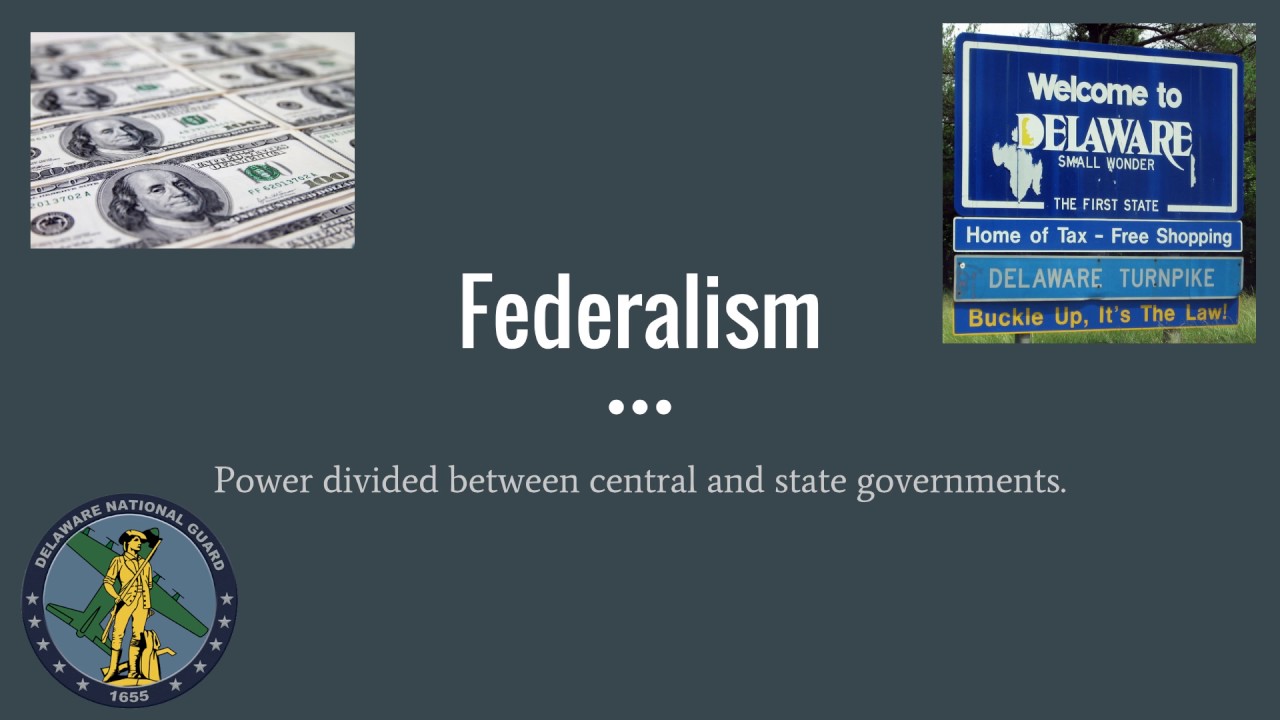
Federalism is the constitutional principle dividing power between central and state governments. The U.S. evolved from unitary (British colonial rule) to confederal (post-Revolution) to federal systems. Exclusive federal powers include currency issuance (Federal Reserve only), while states control taxation (sales, income) and local laws (seatbelt regulations). Cooperative federalism exists through institutions like the National Guard, co-funded by both levels. However, conflicts arise when federal and state policies diverge, as seen in same-sex marriage (Obergefell v. Hodges) and marijuana legalization debates. This ongoing tension between national uniformity and state autonomy defines American federalism.
Click to watch →

Facts Over Fury: Episode 2 Part 1: What is federalism?
106
Federalism involves a division of power, rights, and responsibilities between the federal government and state governments. The federal government handles matters like declaring war (which individual states cannot do) and regulating interstate trade. States have their own specific responsibilities, and there are areas where these powers overlap, such as taxation where citizens pay both federal and state income taxes.
Click to watch →

American Government 333000CH States’ Rights and the Division of Powers Page 7 of 9
144
Federalism is the U.S. system dividing power between the federal government (Washington DC) and state governments. The Constitution determines each level's powers: national powers include treaties, currency, and war; state powers include education and driving laws. Concurrent powers are shared (legislation, taxes, environmental regulations). The federal government has delegated powers: expressed (clearly stated like taxing), implied (necessary to carry out duties), and inherent (sovereign authority like immigration). The Tenth Amendment reserves powers not granted to the federal government to the states. Exclusive powers belong only to the federal government. The Supremacy Clause establishes the Constitution as supreme law. Federalism creates tension as both levels share power, potentially causing conflicts between national and state authority.
Click to watch →

What is Federalism?
387.1K
Federalism is a system of government where power is divided between a national (federal) government and state governments, with the U.S. Constitution establishing that some powers belong to the federal government (such as regulating interstate trade and declaring war), some powers belong to state governments (such as operating schools and maintaining state police), and some powers are shared (like taxation); this system emerged as a compromise during the American Revolution when former colonies sought independence from Britain but also needed a strong enough national government to unite the country without risking tyranny.
Click to watch →

US History Regents Review Live
61.1K
Federalism is the division of power between the federal government and the states. The federal government has delegated powers (such as declaring war, coining money, and regulating interstate commerce), while states retain reserved powers (such as issuing licenses and regulating intrastate commerce). Concurrent powers are shared by both levels of government, such as the ability to tax and borrow money. This system ensures that not all power is concentrated at the federal level.
Click to watch →
Deep Dive
The basics of Fiscal Federalism, including how federal grants (such as block and categorical grants) are used to influence state-level policies.
1.7 From Dual to Cooperative Federalism AP Gov
8.9K
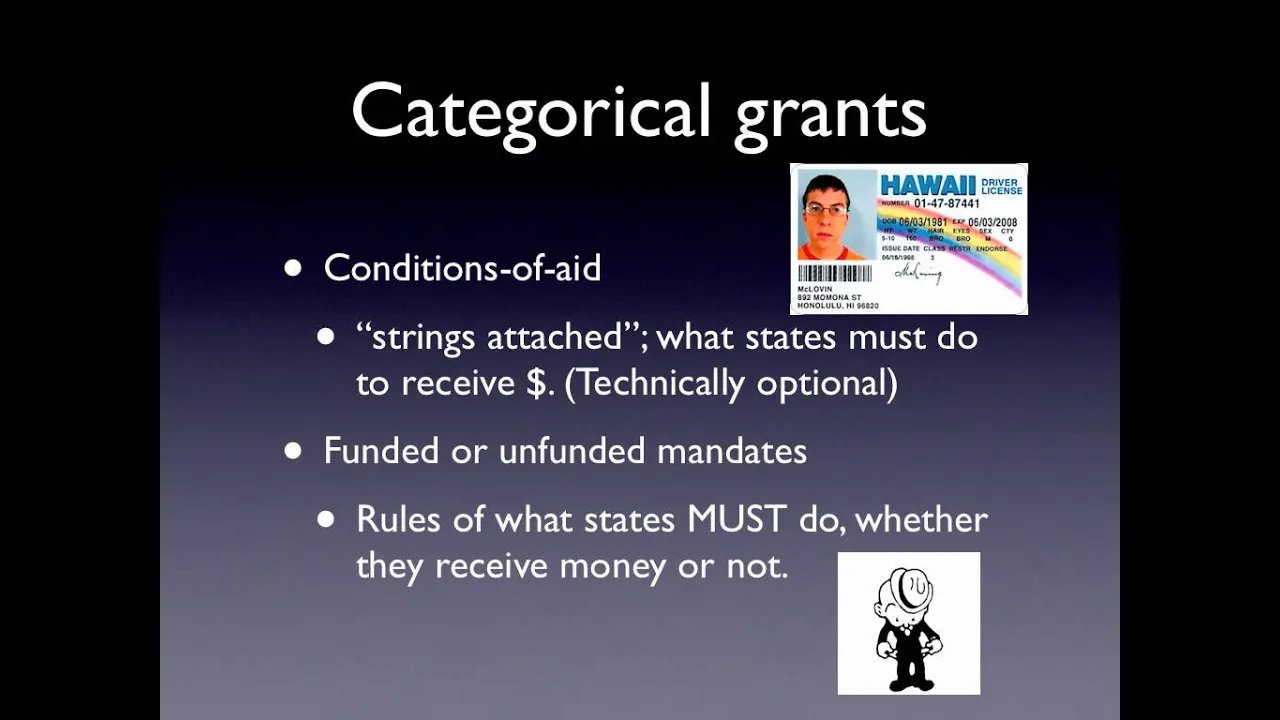
This section examines fiscal federalism—the financial mechanisms through which federal and state governments interact. Federal grants to states create opportunities for federal influence, as funding comes with conditions that shape state behavior. Categorical grants specify exact uses (e.g., building hospitals), giving federal control over implementation. Conditions of aid attach requirements to funding, compelling state compliance. The drinking age example demonstrates this power: federal highway funds were conditioned on raising the drinking age to 21, causing all states to comply despite preferring lower ages. This illustrates how fiscal federalism enables federal policy objectives through financial incentives rather than direct mandates.
Click to watch →

Unit 1b: Grants: Categorical, Block 1.40-1.42
292
Federal grants are financial awards from the federal government to states, with two main types: categorical grants (for specific purposes with strict federal guidelines, like Head Start preschool programs and WIC nutritional programs) and block grants (for general needs with more state discretion, favored by Republicans who prefer state latitude). The federal government uses grants as a tool of fiscal federalism to influence state policies, such as requiring states to raise drinking ages to 21 to receive highway grants.
Click to watch →
![AP Government UNIT 1 REVIEW [Everything You NEED to Know!]](https://i.ytimg.com/vi_webp/lxotd_zV1hc/maxresdefault.webp)
AP Government UNIT 1 REVIEW [Everything You NEED to Know!]
1.2M
Fiscal federalism describes how federalism operates primarily through financial mechanisms. Categorical grants provide federal funds to states for specific purposes with strict federal requirements, such as highway funding tied to drinking age laws. Block grants offer more flexibility, allowing states discretion in how funds are spent for broad purposes like crime prevention. Mandates require states to follow federal directives, sometimes with funding assistance (funded mandates) or without (unfunded mandates). The Unfunded Mandates Reform Act of 1995 restricted Congress's ability to impose unfunded mandates, reflecting ongoing tensions between federal and state authority.
Click to watch →
Fiscal federalism APGOV
2K
Fiscal federalism refers to how the federal government uses financial resources to influence state policies, primarily through grants in aid. The 16th Amendment enabled this by authorizing federal income tax, allowing the federal government to share money with states. Two main types of grants exist: block grants (general funding with minimal restrictions, giving states more control) and categorical grants (specific funding with strict requirements, giving the federal government more control). Additionally, the federal government issues unfunded mandates—programs requiring states to implement policies without providing funding—enforced through crossover sanctions that threaten funding reductions. The devolution movement, beginning in 1980, shifted policy toward increasing block grants and reducing categorical grants, returning more power to states.
Click to watch →

Govt 101 Lesson 2- Federalism
1K
Most federal politics plays out through budgetary concerns, with the central government controlling most budgetary power and giving money to states via grants. There are four major categories: (1) Project grants for specific purposes with competitive processes; (2) Formula grants based on specific formulas, usually population statistics; (3) Categorical grants with specific purposes and strings attached (e.g., highway funding requiring states to raise drinking age to 21); (4) Block grants providing general money for assistance like healthcare and Social Security.
Click to watch →
Deep Dive
The Tenth Amendment of the US Constitution, which reserves powers not explicitly delegated to the federal government to the states or the people.

The 27 Amendments
157
The Tenth Amendment to the United States Constitution reserves powers not delegated to the federal government to the states or to the people. This amendment establishes the principle of federalism, ensuring that the federal government only has the powers explicitly granted to it by the Constitution, while all other powers remain with the states or the citizens.
Click to watch →
The Constitution PT 2
258
The Tenth Amendment reserves powers not delegated to the federal government to the states or the people. This amendment reinforces the principle of federalism by ensuring that the federal government only has powers explicitly granted to it, with all other powers remaining with the states or individual citizens.
Click to watch →

Roy Moore
2.4K
The Tenth Amendment states that powers not delegated to the United States by the Constitution, nor prohibited by it to the states, are reserved to the states respectively or to the people. This constitutional provision establishes that any power not given to the federal government belongs to the states or the people.
Click to watch →

Anonymous Marine - State of Emergency, To all enemies, foreign and domestic
3K
The Tenth Amendment states that the powers not delegated to the United States by the Constitution or prohibited by it to the states are reserved to the states respectively or the people. This amendment establishes that powers not explicitly granted to the federal government remain with the states or the people.
Click to watch →

United States Marine (Anonymous) Declares A State of Emergency
731
The Tenth Amendment states: 'The powers not delegated to the United States by the Constitution, or prohibited by it to the states, are reserved to the states respectively or to the people.' This amendment establishes the principle of federalism by reserving powers not granted to the federal government to the states or the people.
Click to watch →
Deep Dive
The general definition of a government mandate as a regulatory requirement imposed by a higher level of authority.

California Today - Courts Rule Against Government in COVID Cases; Haberbush Comments
135
A mandate is defined as an order from someone higher in the government to someone beneath them in government. The video explains that the proliferation of mandates during the pandemic was problematic because these orders applied not just to government personnel but to 'we the people,' meaning ordinary citizens and businesses were subject to these government directives.
Click to watch →

KULIAH TANGGUNGGUGAT PEMERINTAH
226
According to Article 1, Paragraph 24 of Law No. 30 of 2015, mandate is the transfer of authority from a higher government body or official to a lower government body or official, with responsibility and liability remaining with the granting authority. For example, when the Vice President assists the President in carrying out governmental duties, the President remains the responsible party because the Vice President is acting under mandate. This principle ensures that ultimate accountability remains with the authority that granted the mandate.
Click to watch →

The Hindu Analysis | 30 July 2026 | UPSC, SSC, Banking & CDS | Editorial, Vocabulary |Shipra Miglani
216
Mandate means an official order or command, or a popular demand from the public. It can refer to a government's authority to act or a requirement that must be followed. For example, 'Under the government mandate' means following an official government order. The word 'mandatory' means required or compulsory.
Click to watch →

ESTUDIO BIBLICO 1 DE PEDRO 2 :13 -17
187
A mandate is a norm or rule issued by a superior authority to a subordinate. In general terms, it refers to commands or instructions that must be followed. The term can have different meanings depending on the context in which it is used.
Click to watch →
Government Grants and Mandates
3.9K
Mandates are requirements imposed by the national government on states to perform certain actions, without providing any money to help pay for them. An example given is the Americans with Disabilities Act, which required states to make all public buildings handicap accessible. States had to move money from other budget areas to pay for these requirements, making mandates particularly impactful on state budgets.
Click to watch →
Prerequisite Knowledge
- Concept 01The concept of Federalism, specifically how power and responsibilities are divided and contested between the US federal government and state governments.
- Concept 02The basics of Fiscal Federalism, including how federal grants (such as block and categorical grants) are used to influence state-level policies.
- Concept 03The Tenth Amendment of the US Constitution, which reserves powers not explicitly delegated to the federal government to the states or the people.
- Concept 04The general definition of a government mandate as a regulatory requirement imposed by a higher level of authority.
Subsequent Learning
- Step 01The Unfunded Mandates Reform Act (UMRA) of 1995 and its effectiveness in limiting the federal government's ability to impose costly requirements on states.
- Step 02Real-world case studies of unfunded mandates, such as the Americans with Disabilities Act (ADA) and the No Child Left Behind Act, and their financial impacts on local municipal budgets.
- Step 03The concept of 'Coercive Federalism,' where the federal government uses mandates, preemptions, and financial threats to compel state compliance.
- Step 04The ongoing political debate surrounding 'Devolution'—the movement to transfer power and administrative responsibilities back to the state and local levels.
Federal vs State Power
Federal vs State Power
0:00Playing Section
- 1
Debates over federal versus state control in education and healthcare.
- 2
Cites federal funding contributions to Florida's state budget as counterpoint.
- 3
Questions the return of federal funds to illustrate dependency.
Cooperative Federalism and the Case for National Standards
While critics argue that unfunded mandates infringe on state rights and strain local budgets, proponents of cooperative federalism argue they are essential for establishing vital national standards. Without federal mandates, such as the Clean Air Act or the Americans with Disabilities Act, states might engage in a regulatory 'race to the bottom'—lowering environmental, safety, or civil rights protections to attract businesses and cut costs. From this perspective, unfunded mandates correct coordination failures among states and ensure that all citizens benefit from baseline protections, public health measures, and civil liberties, regardless of the fiscal capacity or political willingness of their individual state governments.
Deep Dive
The Unfunded Mandates Reform Act (UMRA) of 1995 and its effectiveness in limiting the federal government's ability to impose costly requirements on states.

"Unfunded Mandates and Regulatory Overreach Part II"
223
The Unfunded Mandates Reform Act (UMRA) of 1995 was designed to increase transparency and accountability regarding federal mandates imposed on state and local governments, but witnesses testified that the law contains significant limitations, including exemptions for independent regulatory agencies and failures to account for indirect costs, which undermines its effectiveness in preventing unfunded mandates that burden small businesses and state budgets; proposed reforms include expanding UMRA's scope to cover independent agencies, requiring federal reimbursement for mandate costs, and implementing sunset provisions for existing regulations.
Click to watch →

Unfunded Mandates And Regulatory Overreach
1.1K
Since the founding of the Nation, the Federal Government has balanced its authority with States, counties, and cities, each operating within budgetary and statutory limitations. However, dedicated government staff increasingly move from serving people to mandating preferences onto agencies. In the modern regulatory environment, the probability that the Federal Government will overstep constitutional boundaries to impose preferences on State and local leaders has become increasingly likely, with little check and balance, allowing Federal regulators to dramatically affect budgets and staff structures of State and local governments. The Unfunded Mandates Reform Act of 1995 was enacted to minimize these burdens by defining mandates and creating congressional points of order, but multiple agencies and actions were excluded from UMRA, and its definition has come under criticism for being too narrow. Susan Dudley, former OIRA Administrator, testified that during her tenure, Executive Branch agencies issued 108 economically significant final regulations, only 17 classified as unfunded mandates, and none imposing mandates on State, local, or tribal governments. EPA's national ambient air quality standards were not classified as unfunded mandates because costs didn't meet the UMRA definition and the Clean Air Act prohibits EPA from considering cost when setting primary standards. Similarly, an HHS rule eliminating Medicaid reimbursement wasn't covered because it didn't require states to replace federal funding. The Government Accountability Office evaluated UMRA on its tenth anniversary and found that the Act does not adequately capture regulatory actions that might impose financial burdens on others. In 2004, GAO reviewed all final major and economically significant rules from 2001-2002 and found only nine triggered UMRA requirements, with the most frequent reasons being: the $100 million financial threshold wasn't met; the rule didn't go through the proposed rule stage; participation was considered voluntary; or the rule was issued by an independent regulatory agency.
Click to watch →
Unfunded Mandates, Regulatory Burdens and the Role of Office of Information and Regulatory Affairs
640
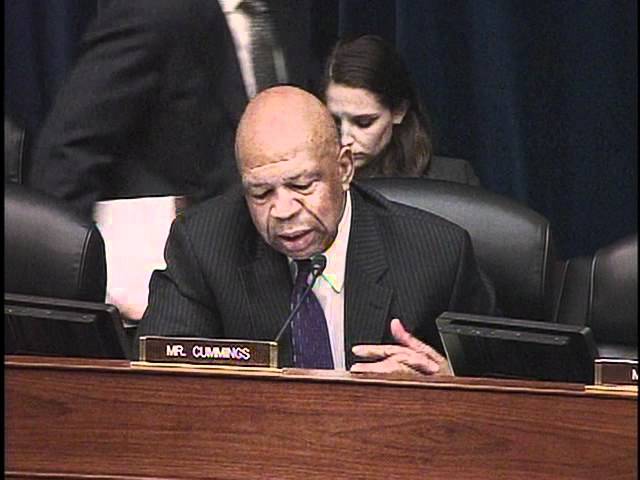
The House Oversight and Government Reform Committee exists to secure two fundamental principles: that Americans have the right to know Washington's money is well spent, and that Americans deserve efficient, effective government. The committee's duty is to hold government accountable to taxpayers. The Unfunded Mandates Reform Act of 1995 (UMRA) was designed to set federal mandates on state, local, and tribal governments and the private sector by shedding light on expected economic impacts. However, in the past 10 years, only four rules have been classified as unfunded mandates on state, local, and tribal governments, and only 13 of 66 major rules issued in 2010 were classified as unfunded mandates. Charts showed a rising trend of major regulations from the federal government, indicating UMRA is failing to live up to its promise of reducing unfunded mandates. The cost estimates under UMRA only capture direct costs or expenditures, not the total effects on the economy as required under Executive Order 12866. Thresholds are based on inflation adjustments, but this adjustment is not applied to Executive Order 12866. The cost estimates also do not account for the need to prepare for unfunded mandates by local governments or private businesses. A report by George Washington University Regulatory Study Centers found that the number of staff employed on regulatory matters within the federal government is on schedule to grow to about 10,000 new regulatory employees per year in 2011 and 2012, with full-time regulatory employees expected to reach an all-time high of 291,676 in 2012. In 2011, OIRA estimated that the annual benefits of major federal regulations issued between 2000 and 2010 are between $136 billion and $651 billion, while estimated annual costs are between $44 billion and $62 billion. Economic benefits of regulations are up to 10 times the costs. This conclusion is not limited to the Obama administration; in 2008, the Bush administration estimated that annual benefits of regulations issued between 1997 and 2007 ranged from $122 billion to $656 billion, while estimated annual costs ranged from $65.46 billion to $54 billion. According to both administrations, the benefits of these regulations greatly outweigh the costs. State and local governments are often direct beneficiaries of federal regulation, which protects the American public from health, welfare, and safety threats while saving local governments from significant expenses they would otherwise bear. OIRA has intervened to block proposed regulations of greenhouse gas pollution under the Clean Air Act Amendment. The consequences of failing to prevent global warming could be severe. According to Munich Re, the only plausible explanation for the rise of weather-related catastrophes is climate change. Recent extreme weather events, including unprecedented tornadoes that killed hundreds of Americans in Missouri, Alabama, and Virginia, demonstrate the devastation of climate change can reach biblical proportions. The vehicle efficiency standards enacted in the Clean Air Act will save consumers $3,000 per vehicle by improving the average vehicle's efficiency by 30 percent. In aggregate, OIRA estimates this regulation will produce $12.4 billion in benefits for consumers for only $3.7 billion in costs, representing a four-to-one ratio of benefits to costs. A central goal of UMRA is to minimize burdens on state, local, and tribal governments and the private sector, ensuring burdens are imposed only after informed and careful consideration. Title II of UMRA imposes reporting and consultation requirements for rules resulting in annual expenditure of $100 million or more on state, local, and tribal governments or the private sector. These requirements involve careful assessment of costs and benefits as well as accounting of various potential effects on the economy. UMRA from 1995 has a clear relationship to President Reagan's Executive Order 12291 from the early 1980s, which required agencies to analyze the effects of rules in advance and try to reduce burdens and costs. More recently, President Obama issued Executive Order 13563, which reaffirms the requirements of Executive Order 12866 and contains provisions bearing directly on UMRA goals. Executive Order 13563 specifically directs regulations to be based on the open exchange of information and perspectives among state, local, and tribal officials and the public as a whole. The executive order requires that before issuing a notice of proposed rulemaking, agencies must seek the views of those likely to be affected. It also requires agencies to select the least burdensome approaches to minimize cumulative costs, simplify and harmonize overlapping regulations, and identify flexible approaches that maintain freedom of choice for the American public. Executive Order 13563 requires a regulatory look back through the creation of plans by which agencies and departments will eliminate excessive costs and burdens, revise rules that are too complicated and confusing, and streamline rules that have too much red tape. This applies directly to state, local, and tribal governments as well as the private sector. The most important lesson learned from applying UMRA, Executive Order 12866, and Executive Order 13563 is the crucial importance of public participation to good regulatory outcomes. A common assumption among administrative law professors is that by the time a rule goes out for public comment, it's already 'baked' and public comments are not important. However, this cliche is false; to get rules right, it's very important to engage with the public. The best way to select who gives public comment is to let people who have interests and concerns voice those interests and concerns rather than having bureaucrats select people. OIRA is open to those who think a proposed rule or final rule is a problem at any stage of the process. When a rule comes in with a low-cost estimate and people in the private sector or state and local government say the estimate is inaccurate, OIRA has an internal process involving the Council of Economic Advisers, the National Economic Council, and economists within the government who try to make an assessment. There is also external peer review in the sense that the regulatory impact analysis goes out for public review. The ultimate decision is made by the agency working with OIRA, which has the authority not to approve a regulatory impact analysis. State and local governments are particularly strapped economically, so if there's a rule that burdens them economically, the choice of the least burdensome alternative may not be to impose the burden at all. OIRA looks at the benefits as well as the costs of regulations. Under the president's executive order, benefits are highlighted as prominently as costs. For example, in agreeing to new fuel efficiency standards, EPA projects that over the lifetime of a 2016 model, the average consumer will save $3,000 and the United States will save 1.8 billion barrels of imported oil. OIRA also looks at the risks of cost shifting, where costs are shifted from one sector to
Click to watch →

Corker Raises Budget Point of Order Against Reid Health Care Bill
709
The Congressional Budget Act of 1974 prohibits Congress from passing legislation containing unfunded intergovernmental mandates that exceed statutory limits without providing corresponding funding, and the 1995 Unfunded Mandates Reform Act was bipartisan legislation designed to prevent the federal government from imposing costs on states and cities without providing financial resources to cover those costs.
Click to watch →

Unfunded Mandates: Examining Federally Imposed Burdens on State and Local Government
159
The Unfunded Mandates Reform Act (UMRA) of 1995 was designed to require federal agencies to estimate and report the costs of their mandates on state and local governments, but it has significant weaknesses including exemptions for independent agencies like the FCC and SEC, exclusion of grant aid changes from mandate definitions, and lack of enforcement mechanisms; Congresswoman Virginia Foxx advocates for the Unfunded Mandates Information and Transparency Act (UMITA) to address these limitations and improve regulatory transparency.
Click to watch →
Deep Dive
Real-world case studies of unfunded mandates, such as the Americans with Disabilities Act (ADA) and the No Child Left Behind Act, and their financial impacts on local municipal budgets.
Unfunded Mandates And Regulatory Overreach
1.1K
Despite being designed as an unfunded mandate, No Child Left Behind did not fully qualify under UMRA because it was written in a manner that exempted bills imposing significant costs on localities. The design, testing, and implementation costs of No Child Left Behind increased local educational costs significantly, by hundreds of millions of dollars in many places including Fairfax County, Virginia.
Click to watch →
Libertarian Running for Governor of New York | Larry Sharpe | POLITICS | Rubin Report
104.1K
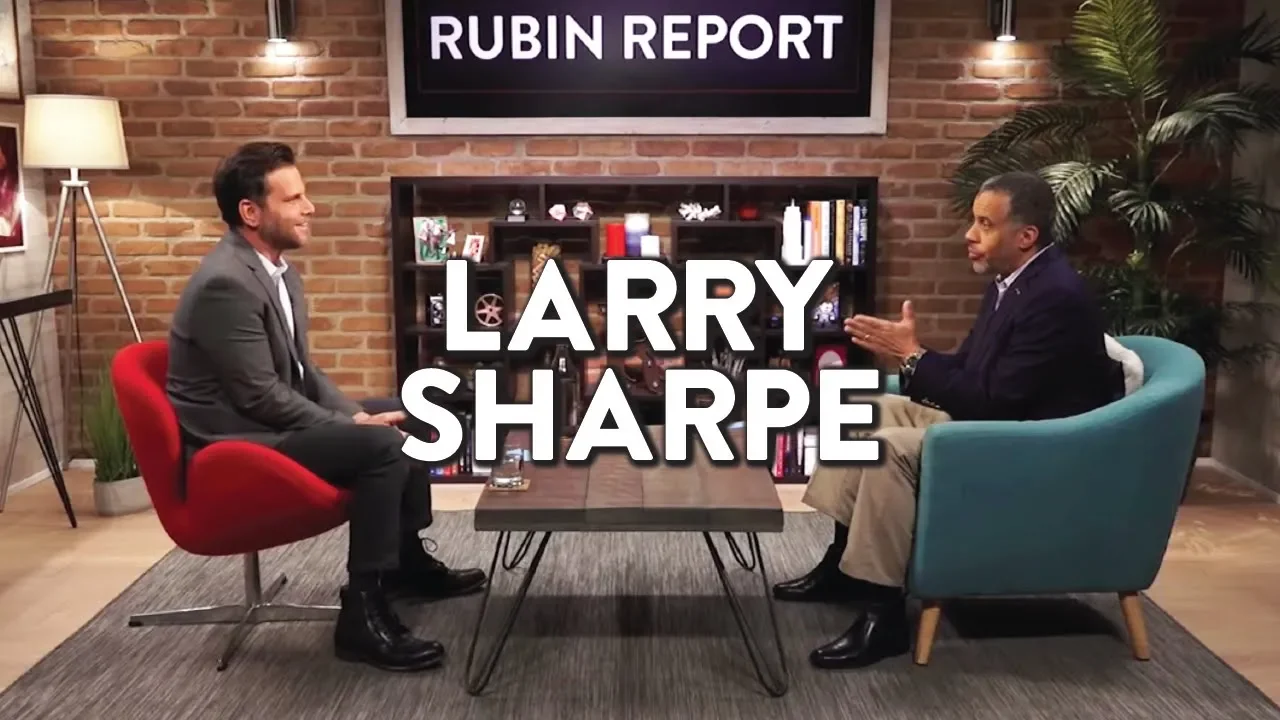
Unfunded mandates occur when state or federal governments require local governments to implement programs without adequate funding. In New York, counties face mandates exceeding 100% of their budgets, forcing property tax increases or creative revenue solutions. This system undermines local governance, creates incentives for corruption, and leads to arbitrary emergency tax increases. The speaker describes how property tax loopholes allow officials to bypass voter approval entirely, demonstrating how structural flaws in government finance enable abuse of power.
Click to watch →

Sediko Rakolote_ Analysis of the Integrated Development Planning in SA Local Municipalities
116
When municipalities perform functions that are not their competency (such as libraries, which are exclusive competencies of national and provincial government), it results in an unfunded mandate. This eats into financial resources that should be directed to programs within municipal competencies. For example, municipalities providing library services need to maintain buildings, pay staff salaries, and purchase books, but no national fiscal allocation goes to local government for library services. This compromises the delivery of basic services that municipalities are mandated to provide.
Click to watch →
Nebraska Legislature - 07-30-24 - Government Military and Veterans Affairs Committee Hearing
199
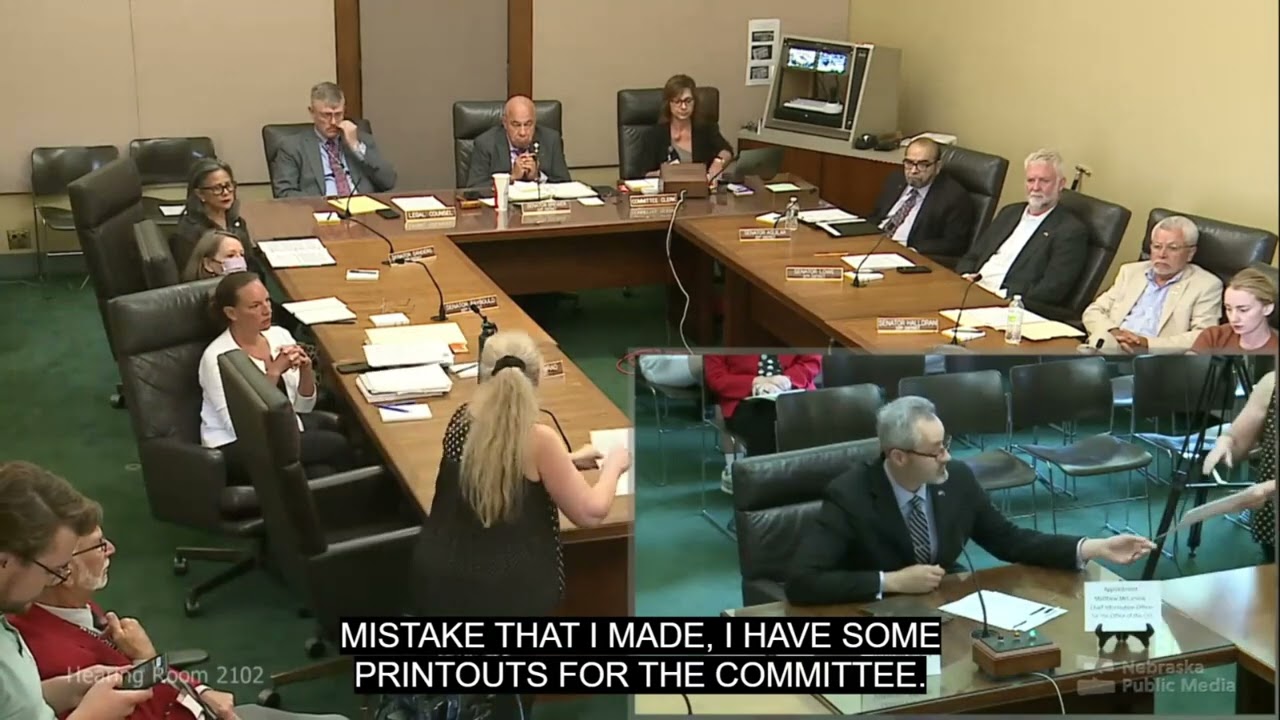
Local governments face substantial burdens from unfunded mandates across multiple domains: (1) Economic development programs using both state and local sales taxes without adequate reimbursement; (2) Publication requirements exceeding 90 in state law, creating cumulative administrative costs; (3) Service delivery mandates requiring infrastructure investments (computers, furniture, facilities) without state funding; (4) Curriculum and training requirements requiring teacher hours and material purchases. Local governments advocate for: (1) Constitutional amendments establishing permanent protections; (2) Mandatory fiscal impact analysis before bills reach the floor; (3) Genuine partnership approaches rather than cost-shifting; (4) Recognition that local governments cannot absorb unlimited mandates without proportional state funding.
Click to watch →

Truth in Accounting's Sheila Weinberg on IL finances post COVID-19
118
Government financial transparency is essential for accountability, as hidden unfunded liabilities can lead to fiscal crises; for example, Chicago's taxpayers bear a combined burden of $122,000 in unfunded debt across multiple government layers (city, schools, county, transit, parks, housing authority, and state), while California's $275 billion in hidden debt demonstrates how governments can appear financially healthy while accumulating unsustainable obligations that become crises during emergencies.
Click to watch →
Deep Dive
The concept of 'Coercive Federalism,' where the federal government uses mandates, preemptions, and financial threats to compel state compliance.

Gov. Greg Abbott hides behind Trump for his bigoted threats to defund Texas cities
388
Federal agencies can issue mandates that require states to comply with specific requirements in order to receive federal funding. In this case, the United States Secretary of Transportation issued a mandate threatening to withhold highway funds from any state that does not enforce the specified requirements. This demonstrates the mechanism by which federal governments can influence state-level policies through financial incentives and penalties.
Click to watch →
AP Gov Chapter 3: Federalism Explained | Key Concepts & Court Cases
17K
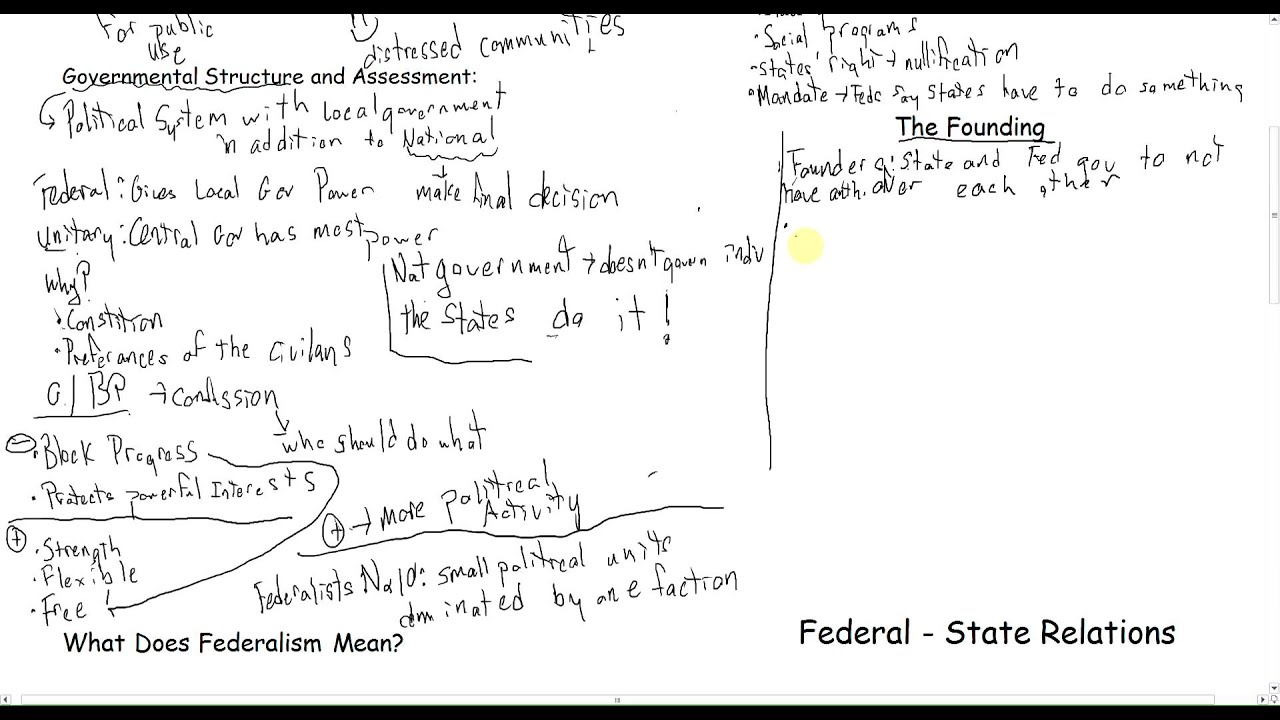
Federal mandates are requirements imposed by the federal government on states, often without direct funding. For example, the federal government mandates a drinking age of 21, but states receive additional funding if they comply. This creates a system where states must follow federal directives to access resources, even when those directives may conflict with state preferences.
Click to watch →
Stephen Miller BLASTS "Afraid" Republicans Who Refuse to Back the BBB
101.6K
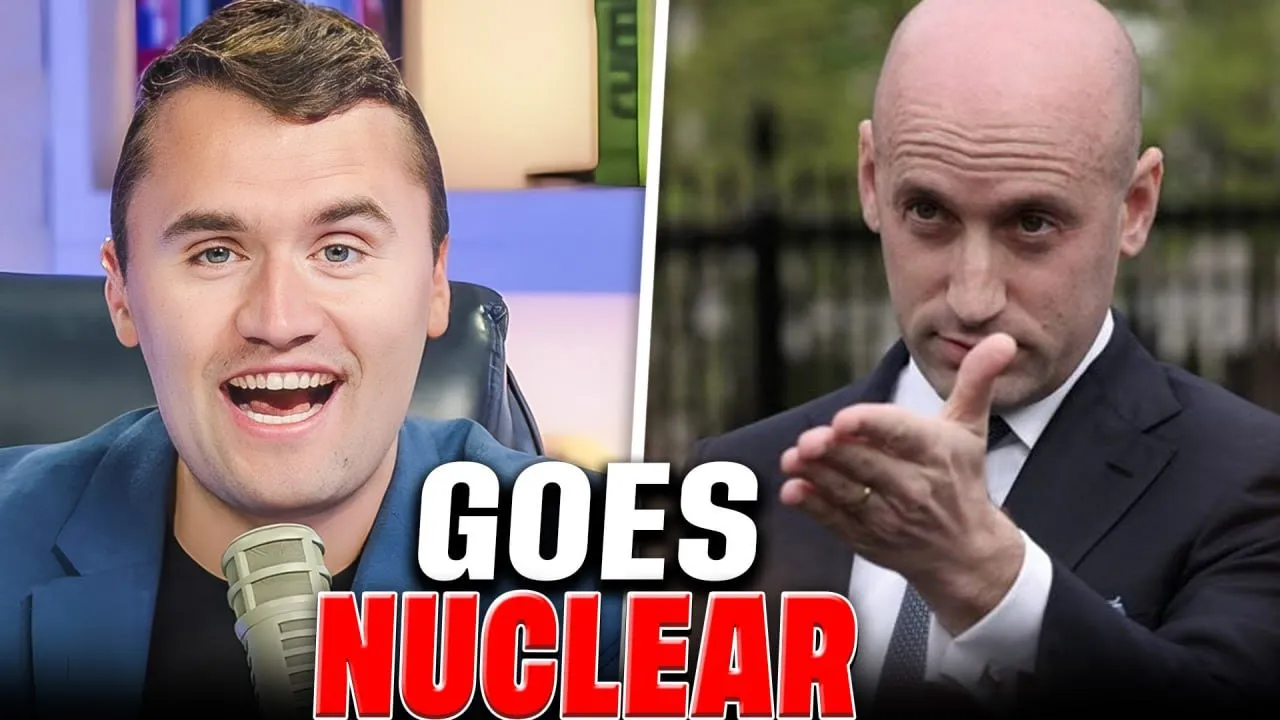
California's economic dominance enables it to set de facto national standards through regulatory capture. Key examples: (1) Fuel emission standards apply nationwide because car companies must do business in California; (2) Energy infrastructure cannot bypass California due to regulatory requirements; (3) AI companies headquartered in California could effectively nationalize AI policy through state mandates; (4) The bill includes provisions preventing California from establishing AI standards that would become national requirements. This represents a conservative policy win addressing federalism concerns about state overreach into national policy domains.
Click to watch →
Supreme Court Signals that HUGE TROUBLE is Coming
387.1K
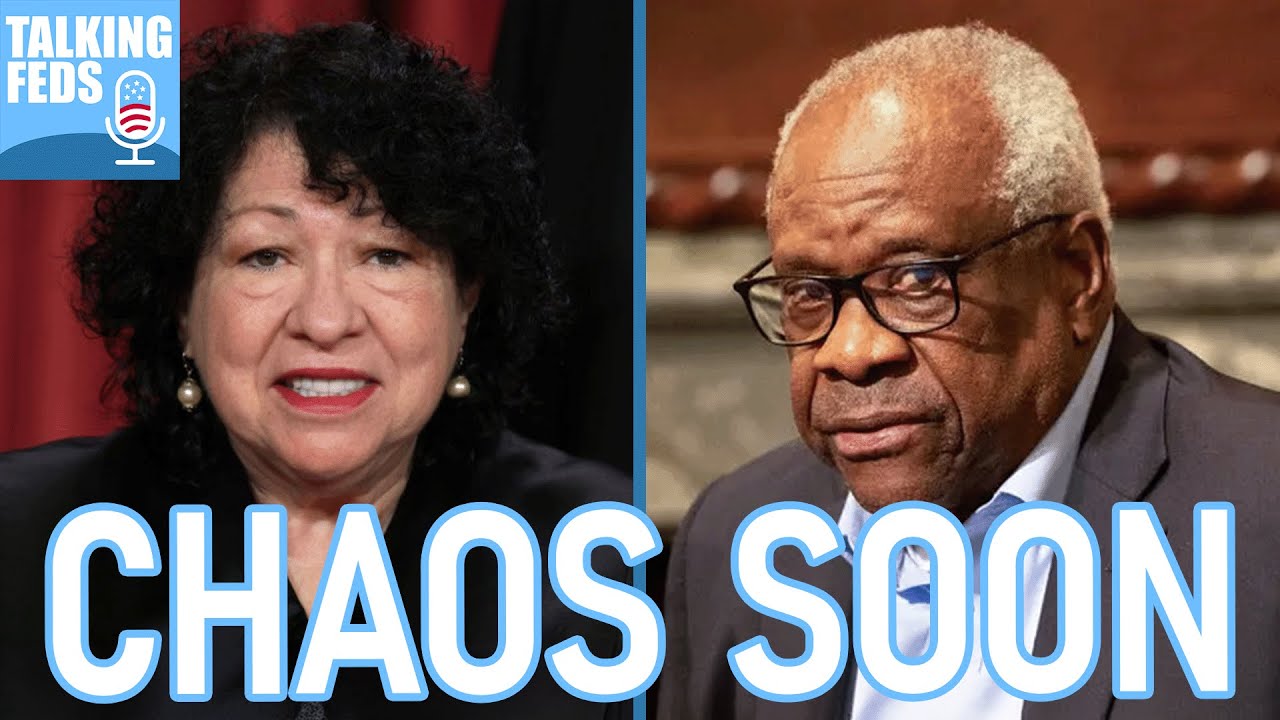
Federal preemption occurs when federal law takes precedence over conflicting state laws. In this case, the federal government argued that Idaho's abortion restrictions were preempted by federal law because Idaho receives federal Medicare funds and must comply with federal requirements under EMTALA. When state law conflicts with federal law, federal law generally prevails, meaning states cannot enforce laws that contradict federal mandates.
Click to watch →

Se equivocan quienes insisten en que la SCJN o un gobierno estatal pueda anular la reforma: Valadés
166.7K
State judicial elections are not invasions of state competencies because they derive directly from the national Constitution. When the Constitution establishes that state judges shall be popularly elected, this is a constitutional mandate that states must follow, not an infringement on state autonomy. Challenging such constitutional provisions represents both a legal error and a social mistake that fuels unnecessary conflict.
Click to watch →
Deep Dive
The ongoing political debate surrounding 'Devolution'—the movement to transfer power and administrative responsibilities back to the state and local levels.

County Council. Thursday, 11th December 2025 at 10:00am
131
Council members debate local government reorganization and devolution, expressing concerns about the proposed Local Government Reorganization (LGR) model being unworkable. Key concerns include: elected mayors being attached to the devolution agenda; unlimited precepts for elected mayors without caps on council tax increases; and the government using precepts to increase council tax while claiming they did not do so. Members express concern that devolution is being used as a mechanism for tax-raising rather than genuine power transfer to local councils. There is agreement on the need for real devolution that brings powers back to existing local councils rather than creating new tax-raising authorities.
Click to watch →

The Camilla Tominey Show Highlights | Sunday 28th June
7.4K
This extended segment covers the Labour Party leadership transition from Keir Starmer to Andy Burnham, featuring a debate between GB News presenter Camilla Tominey and Steve Reid, Secretary of State for Housing, Communities, and Local Government. Reid explains his support for Burnham after 20 years of working together on devolution, arguing that power is too centralized in Westminster causing economic inequalities. The discussion covers the Vagrancy Act repeal, homelessness policy, housing statistics showing 25% increase in social house building, and the nature of parliamentary democracy where MPs choose their party leader and prime minister. Reid emphasizes that over two-thirds of the public don't want a general election and want the government to deliver change. The segment also covers international news including Ben Stokes' cricket retirement, Venezuela earthquake disaster, France skydiving plane crash, London grooming gang audit, Prince Harry's security concerns, and England's World Cup qualification.
Click to watch →

Administrative Law- Introduction and general overview
452
Decentralization is the transfer of powers, authority, and responsibility from the central government to lower levels of government, such as local government. Devolution is the transfer of legislative powers from higher levels to lower levels, from central government to lower government levels. An example is England, where Scotland and Wales have their own parliaments.
Click to watch →

BBC News and Weather (December 1994)
107
British Prime Minister John Major strongly opposed Labour's plans for Scottish and Welsh parliaments, calling them dangerous. The debate centered on whether to centralize power throughout the United Kingdom or decentralize it within a united framework. Major argued that the UK had always believed in centralized power over the past 100-150 years, while Labour proposed decentralization. This political debate illustrates the ongoing tension between regional autonomy and national unity in British constitutional politics.
Click to watch →

Britain's Newsroom | Monday 29th June
19K
The UK government announced significant changes to the asylum system, including training members of the public to decide asylum appeals instead of immigration judges to speed up the process. The Home Secretary proposed a new refugee sponsorship scheme allowing community groups to sponsor refugees from various countries, with people supporting them for a year before permanent residency. Critics argue this could encourage more small boat arrivals by providing an alternative route. The system currently has over 85,000 asylum cases, an all-time high, with the government proposing to move from a two-tier tribunal system to a single opportunity for appeal. Meanwhile, Andy Burnham proposed devolution including tax-raising powers for local councils, arguing that while this means more taxes for citizens, it would create accountability - councils would have to explain to voters why they are raising taxes, whereas currently they can spend money and then come back to Westminster begging for more without facing direct electoral consequences. The proposal includes 'Number 10 North' - breaking off parts of Westminster and moving them to Manchester, representing the greatest transfer of power from Westminster in modern times.
Click to watch →
Federal vs State Power
Federal vs State Power
0:00- 1
Debates over federal versus state control in education and healthcare.
- 2
Cites federal funding contributions to Florida's state budget as counterpoint.
- 3
Questions the return of federal funds to illustrate dependency.
Cooperative Federalism and the Case for National Standards
While critics argue that unfunded mandates infringe on state rights and strain local budgets, proponents of cooperative federalism argue they are essential for establishing vital national standards. Without federal mandates, such as the Clean Air Act or the Americans with Disabilities Act, states might engage in a regulatory 'race to the bottom'—lowering environmental, safety, or civil rights protections to attract businesses and cut costs. From this perspective, unfunded mandates correct coordination failures among states and ensure that all citizens benefit from baseline protections, public health measures, and civil liberties, regardless of the fiscal capacity or political willingness of their individual state governments.
The concept of Federalism, specifically how power and responsibilities are divided and contested between the US federal government and state governments.
The basics of Fiscal Federalism, including how federal grants (such as block and categorical grants) are used to influence state-level policies.
The Tenth Amendment of the US Constitution, which reserves powers not explicitly delegated to the federal government to the states or the people.
The general definition of a government mandate as a regulatory requirement imposed by a higher level of authority.
The Unfunded Mandates Reform Act (UMRA) of 1995 and its effectiveness in limiting the federal government's ability to impose costly requirements on states.
Real-world case studies of unfunded mandates, such as the Americans with Disabilities Act (ADA) and the No Child Left Behind Act, and their financial impacts on local municipal budgets.
The concept of 'Coercive Federalism,' where the federal government uses mandates, preemptions, and financial threats to compel state compliance.
The ongoing political debate surrounding 'Devolution'—the movement to transfer power and administrative responsibilities back to the state and local levels.
198.7K views1Klikes1:45@RyanBurgePhDOriginal Release: 2012-07-20
governor Ritchie good evening good evening perhaps the biggest philosophical difference between you and the president is over the role of the federal government itself and whether national problems really have national solutions can you explain your view well first let me say good evening and thank you it's a privilege to be here my view of this is simple we don't need a federal Department of Education telling us our children have to learn Esperanto they have to learn Eskimo poetry Eskimo poets the state to decide let the communities decide on health care on education on lower taxes not higher taxes now he's gonna throw a big word at you unfunded mandate he's going to say if Washington let's the states do it it's an unfunded mandate but what he doesn't like is the federal government losing power but I call it the ingenuity of the American people president Bartlet you have 60 seconds for a question and then answer well first of all let's clear up a couple of things unfunded mandate is two words not one big word there are times when we're 50 states and there are times when we're one country and have national needs and the way I know this is that Florida didn't fight Germany in World War two or established civil rights you think states should do the governing wall-to-wall that's a perfectly valid opinion but your state of Florida got twelve point six billion dollars in federal money last year from Nebraskans and Virginians and New Yorkers and Alaskans with their Eskimo poetry twelve point six out of a state budget of fifty billion I'm supposed to be using this time for a question so here it is can we have it back please
Up Next
50:30
AP Gov Chapter 3: Federalism Explained | Key Concepts & Court Cases
@csm10495
17K views•2012-09-20

24:30
BRICS Pay and de-dollarization: A New Financial Order Emerges? | 55 chars
@DannyHaiphongYT
164.6K views•2024-10-22

7:33
Government Surveillance Methods: 10 Ways You May Be Watched
@BeAmazed
1.6M views•2017-04-09
10:19
Explaining the Saudi-Iranian Proxy Conflict in the Middle East
@Vox
18.2M views•2017-07-17
Related Study Plans & Knowledge Roadmaps
Structured learning paths in Political Science
political-science
Economic Statecraft: Sanctions & Chokepoints
01Foundations of Geoeconomics and Economic Statecraft
02The Mechanics of Weaponized Interdependence
03International Sanctions: Types, Implementation, and Efficacy
+ 2 more learning modules
12h5 modules
Explore Roadmap
political-science
Central Bank Independence: Politics & Policy
01Foundations of Central Banking and Monetary Policy
02The Time Inconsistency Problem & Inflation Bias
03The Delegation Model and Designing Independence
+ 2 more learning modules
12h5 modules
Explore Roadmap
political-science
Consociationalism: Power-Sharing & Stability
01Democratic Dilemmas in Divided Societies
02Introduction to Consociational Democracy
03The Four Pillars of Consociational Design
+ 2 more learning modules
12h5 modules
Explore Roadmap
political-science
Rebel Governance: Legitimacy, Economy & State
01Foundations of Rebel Governance and Statehood
02Establishing Political Legitimacy and the Rebel Social Contract
03Wartime Economies and Rebel Resource Management
+ 2 more learning modules
14h5 modules
Explore Roadmap