





















Drug clearance is defined as the volume of plasma cleared of drug per unit time (measured in mL/min), serving as a proportionality factor in the equation Rate of Elimination = Clearance × Plasma Concentration; clearance occurs through organs with access to the external environment including kidneys (renal clearance via glomerular filtration), liver (bile excretion), and lungs (pulmonary excretion), with total clearance being the sum of clearance at each organ, and clinically, renal clearance is estimated using Glomerular Filtration Rate (GFR) derived from plasma creatinine concentration to guide drug dosing decisions.
Drug Clearance and Rate of Elimination | Pharmacokinetics Lecture 12
Added:Basic concepts of pharmacokinetics, specifically the definition of drug concentration in plasma and Volume of Distribution (Vd).
Elementary physiological mechanisms of drug elimination, primarily renal excretion (glomerular filtration) and hepatic metabolism.
Mathematical understanding of rates of change and basic kinetics, such as the distinction between first-order and zero-order processes.
Familiarity with concentration-time profiles and how drugs are absorbed and distributed within the body.
Calculation of drug half-life (t1/2) and its mathematical relationship with clearance and volume of distribution.
Determination of steady-state plasma concentrations (Css) and designing continuous intravenous infusion regimens.
Calculating clinical dosing adjustments, specifically maintenance doses and loading doses in patients with renal or hepatic impairment.
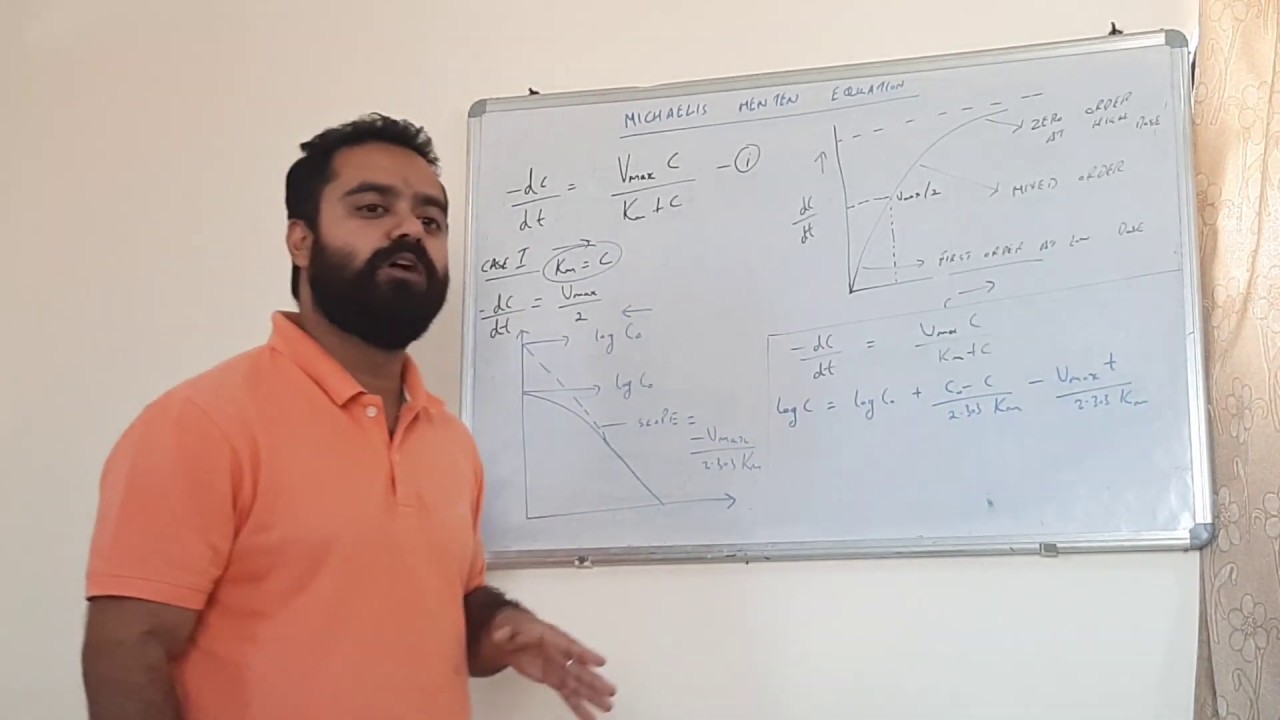
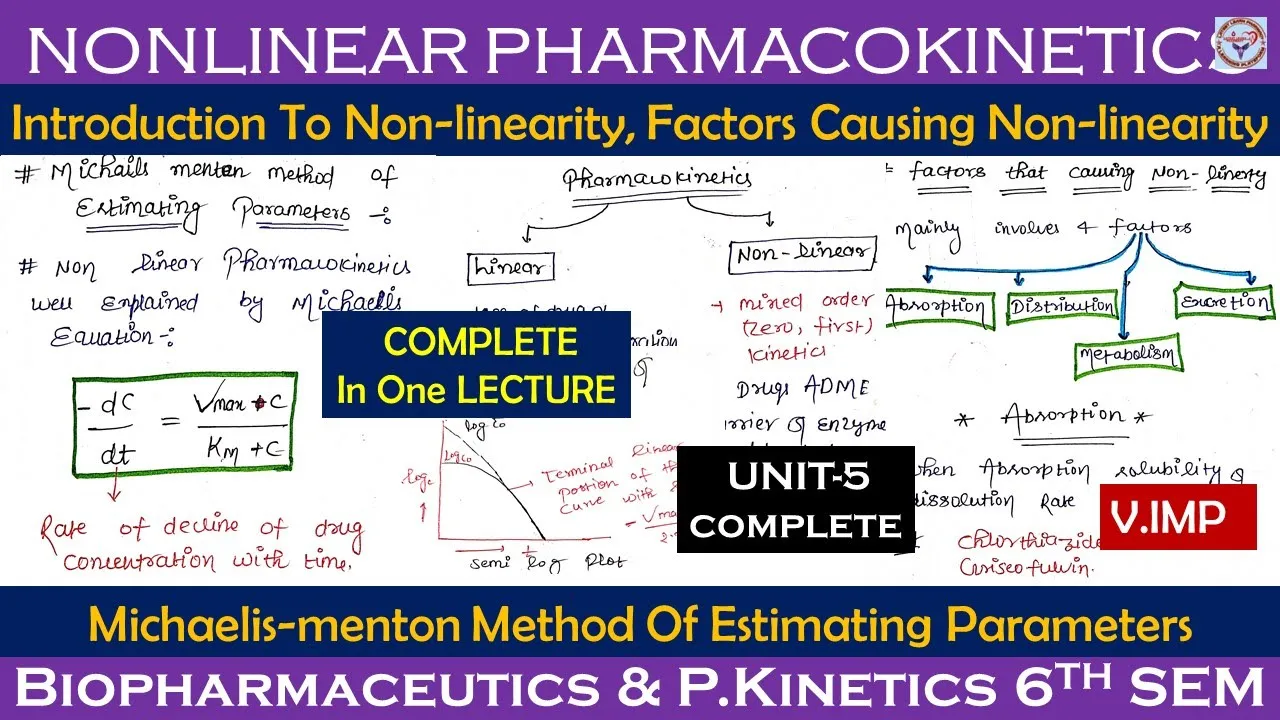
Exploring non-linear pharmacokinetics, where clearance is dose-dependent due to enzyme saturation (Michaelis-Menten kinetics).
216K views2.2Klikes10:35Original Release: 2012-11-17
So now we finally get to talk about drug clearance.
Let's start off with the definition.
What is it?
Clearance is the volume of plasma that is cleared of drug per unit time.
It is a volume per unit time.
So, let's discuss the 3 most important points to remember and front load this lecture and then develop each one of those points.
So, the first point is the definition.
What is the definition of clearance?
Well we just said it's a volume per unit time and I want you to remember just that.
The units of clearance. It is a volume. It is milliliters per minute.
Note, that this says nothing about the amount of drug.
Clearance does not tell us how much drug, it is telling us the volume of plasma that is cleared of drug per unit time.
If I wanted to figure out the amount of drug that is being cleared, then I'm talking about the rate of drug elimination.
So, clearance is used to determine the rate of drug elimination and the way that it does so is that clearance is the proportionality factor that is used to determine the rate of elimination.
This is the definition used in many textbooks.
So, what do I mean?
Well, if I wanted to figure out the rate of elimination, what I need to do is take that clearance and multiply it by the plasma drug concentration.
Let's talk about this for 1 moment.
So, the rate of elimination of a drug. What the units are here or what I'm referring to is the amount of drug being eliminated per unit time.
So, the amount of drug we can think of as the mass of the drug, the amount of milligrams of drug being eliminated per unit time and that's going to equal the clearance which we said is a volume per unit time multiplied by a concentration.
So what are the units of concentration?
You should be screaming at me concentration is equal to mass over volume.
And so, notice volume cancels out and we get the units for the rate of elimination and that is mass over time or the amount of drug being eliminated over time.
That is how clearance is used. It is a proportionality factor.
The third point I want you to remember is how do we clear drugs.
Well any organ that has access to the outside world. Our kidneys can excrete drugs into the urine, our liver can excrete drugs into our bile, our lungs can excrete drugs into the air.
Those are all organs in which clearance occurs and to figure out the total clearance, I have to add up the clearance at each one of those individual organs.
Now the most important one is the renal clearance.
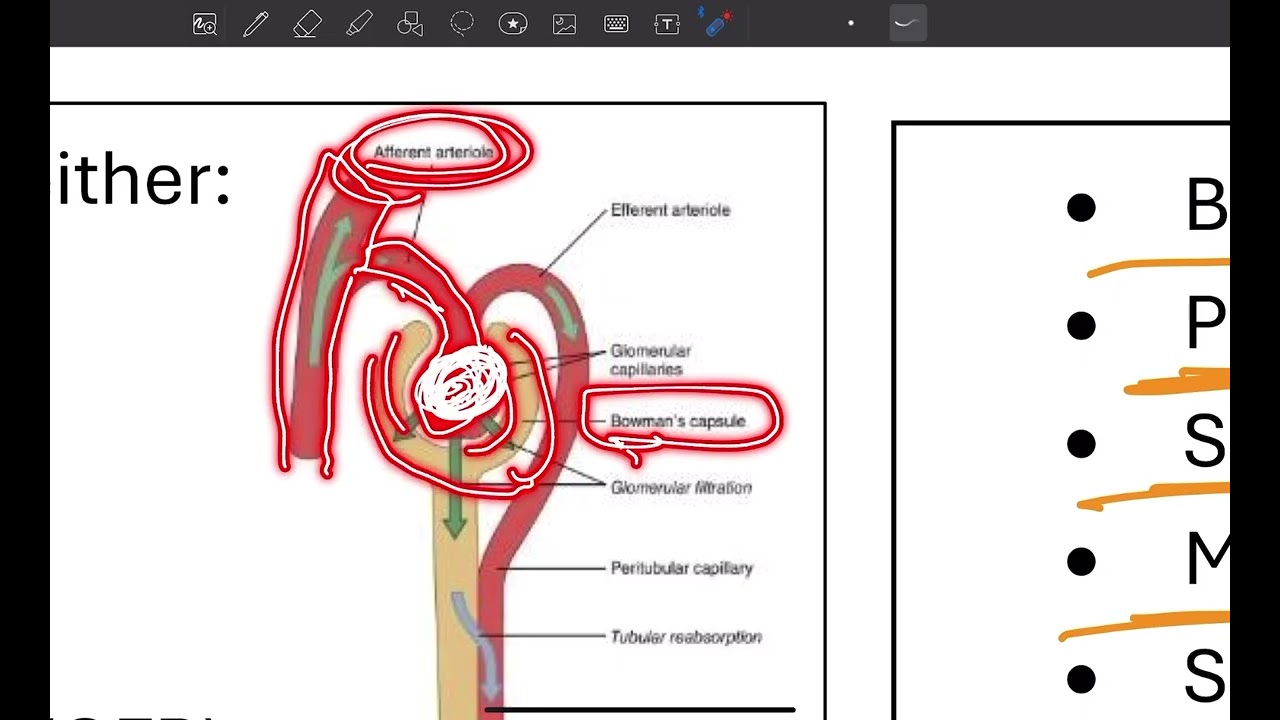
And so, if we think about what's going on at the kidney, we have our glomerulus which is filtering our blood of drug and we excrete it.
So that is how we estimate clearance clinically. We use the glomerular filtration rate. The GFR, and the GFR is used to make clinical decisions regarding drug dosages and drug choice and this is a good thing because we can easily estimate the GFR and if we have less renal clearance, we might want to give less drug to avoid the build up of metabolites or we might want to give a drug that might be cleared via the liver.
So, important points to remember.
Let's discuss the first point, the definition.
So clearance is a volume per unit time and what I've done here is I've created a little video to represent what's going on at the kidney.
So, this is the filtering apparatus of the kidney. I just made a little filter.
And this is the collection system of the kidney. We can think of this as the functional unit of the kidney or the nephron.
So, the rate at which this picture is being filled up of fluid. Let's say this is a 1 liter pitcher and it fills up in a minute, that would tell me my clearance.
So, the clearance is the rate at which we are clearing the blood or the plasma of drug.
Now, it's important to remember that in order to figure out how much drug I am clearing, I would need to multiply this rate of clearance by the concentration in here and that would tell me the mass over time.
Now, to point 2. Clearance is the proportionality factor used to determine the rate of elimination.
So, here I have this equation that the rate of elimination is equal to the clearance times the concentration.
And so, the way the constraints under which I can use this equation is when I'm dealing with first order kinetics.
And this is something that we describe in the past and I'll briefly touch on it now.
But if you're confused, refer to the prior video on that topic.
So, on this graph, I have the rate of elimination on the Y axis and the plasma drug concentration on the X axis.
And as we discussed in the past, as the plasma drug concentration increases, the rate of drug elimination goes up and when this happens, we call this first order kinetics or first order elimination.
And so, notice that there is a proportional relationship here on this part of the graph and if I wanted to figure out that proportional relationship, I need the proportionality factor or the clearance but after I've saturated all of my enzymes, I reach a certain point where as I increase the plasma drug concentration, the rate of elimination does not go up anymore.
That is zero order kinetics.
and the way that I remember that is the slope of the graph here is approximately equal to zero.
So, clearance really is a constant and it is a constant under the constraint of first order kinetics.
First order kinetics.
And what I mean here is when I have not saturated all of my enzymes. So, this is for most drugs at most dosages.
Clearance is not constant when you hit this zero order kinetics.
Just a little tidbit that you should know.
Another point I want to make here is this is 1 equation you should know for clearance.
There's also another equation and that equation is that the clearance is equal to the volume of distribution multiplied by something called the first order elimination rate constant.
Now, we have a video on each one of these terms and I'd suggest that you go back and look at them if you are confused but this equation isn't too bad because if we look at the units for each one of these, the units for volume of distribution is just volume and the units for first order elimination rate constant is inverse time.
So that's one over time.
And if we multiply these two by each other, we get the units of volume over time which would be clearance.
Now, I want to be clear here. No pun intended that we don't really use this equation to solve for clearance.
This equation is really used for us to get a sense of that first order elimination constant which is equal to the clearance divided by the volume of distribution.
This here makes sense to us because as our clearance is increasing more volume per unit time, the rate of elimination will also go up.
Also, as the volume of distribution decreases and that means that you know if the drug is staying in the plasma, that drug now has a better chanceof being filtered by the kidney.
So, lower volume of distribution also increases that first order elimination rate constant.
These two terms here are constants for a given drug, so this is not something we really calculate using this equation but it gives us a sense of the first order elimination rate constant.
Now, let's move on to our third point that the total clearance is the sum of clearance at each organ.
And I mentioned to you that really organs that have access to the outside world are organs in which clearance occurs.
So, in terms of the kidney, the renal clearance - this is excreting drugs into the urine.
This is occurring for most drugs.
At the liver, we are excreting drugs into the bile which then goes into the feces and we defecate that out and at the level of the lungs, we have our pulmonary clearance and the pulmonary clearance is important for really for inhaled anesthetics.
These are drugs. These are volatile substances that we breathe in, they get access to our brain and then once we remove the you know gas, we can breathe out the drugs.
And so, what's nice here is that the total clearance is the sum of each one of these.
So, if a patient has a decrease in their renal clearance, let's say they have chronic kidney disease or they just get older, we can do a couple of things.
We can choose a drug that might be hepatically cleared or we can decrease the dosage or increase the spacing between dosages so that we don't have a build up of drug from a lack of elimination or excretion.
And like I was saying, clinically speaking, this is the most important term.
and the way that we estimate our renal clearance is by looking at our glumerulofiltration rate.
So, we use the GFR to estimate changes in the renal clearance of drugs and the way that we determine the GFR is by looking at something called the plasma creatinine concentration and so, what we're going to do in the next video is talk about these two terms in a little bit more detail.
Subtitles by the Amara.org community
Up Next

38:27
Structure Activity Relationship (SAR) Explained | Medicinal Chemistry
@RFQ-09-18
11.1K views•2022-07-28

48:47
Graphic Medicine: Comics for Collaborative Healthcare Communication
@nationalpatientadvocate
189 views•2023-12-04

10:28
Neuroanatomy: Central and Peripheral Nervous System Divisions Explained
@AKLECTURES
136.2K views•2014-09-20
3:05
Stages of Labor and Vaginal Birth | Childbirth Animation
@nucleusmedicalmedia
52.1M views•2017-08-18
Related Study Plans & Knowledge Roadmaps
Structured learning paths in Medicine
medicine
Abnormal LFTs: Diagnostic Workup & Pathology
01Liver Anatomy and Basic Physiology
02Introduction to Liver Function Tests (LFTs)
03Hepatocellular vs. Cholestatic Patterns
+ 3 more learning modules
12h6 modules
Explore Roadmap
medicine
Analyzing Blood Smears: RBC, WBC & Platelets
01Introduction to Blood Components & Smear Preparation
02Normal Morphology of Blood Cells
03Erythrocyte Pathologies & Morphological Variants
+ 2 more learning modules
12h5 modules
Explore Roadmap
medicine
Mechanical Ventilation: Waveforms & Alarms
01Anatomy and Physiology of Breathing
02Introduction to Mechanical Ventilation & Core Modes
03Ventilator Settings and Waveform Interpretation
+ 2 more learning modules
12h5 modules
Explore Roadmap
medicine
Neuro Exam: Localization & Stroke Syndromes
01Foundations of Neuroanatomy and Vascular Supply
02The Neurological Examination: Step-by-Step
03Principles of Neurological Localization
+ 3 more learning modules
18h6 modules
Explore Roadmap