




















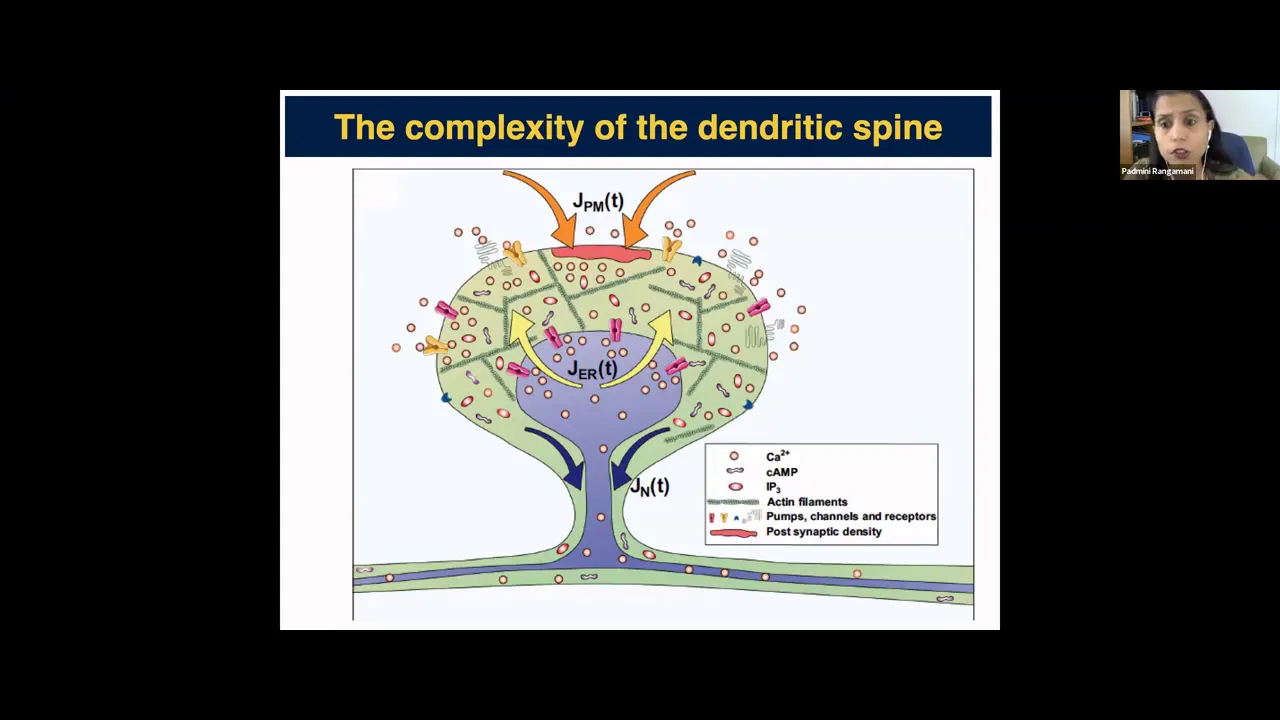


Signals propagate through dendrites following an exponential decay pattern described by the cable equation, where voltage decreases exponentially with distance according to V(x) = V₀ × e^(-x/λ), with the length constant λ determining how far signals travel before decaying significantly; λ depends on dendritic radius as λ ∝ √r, meaning larger dendrites can transmit signals further passively, but this scaling is too slow for long-distance communication across the brain, which is why neurons use active action potentials instead of passive propagation.
Dendrites: Cable Theory and Signal Propagation | MIT 9.40
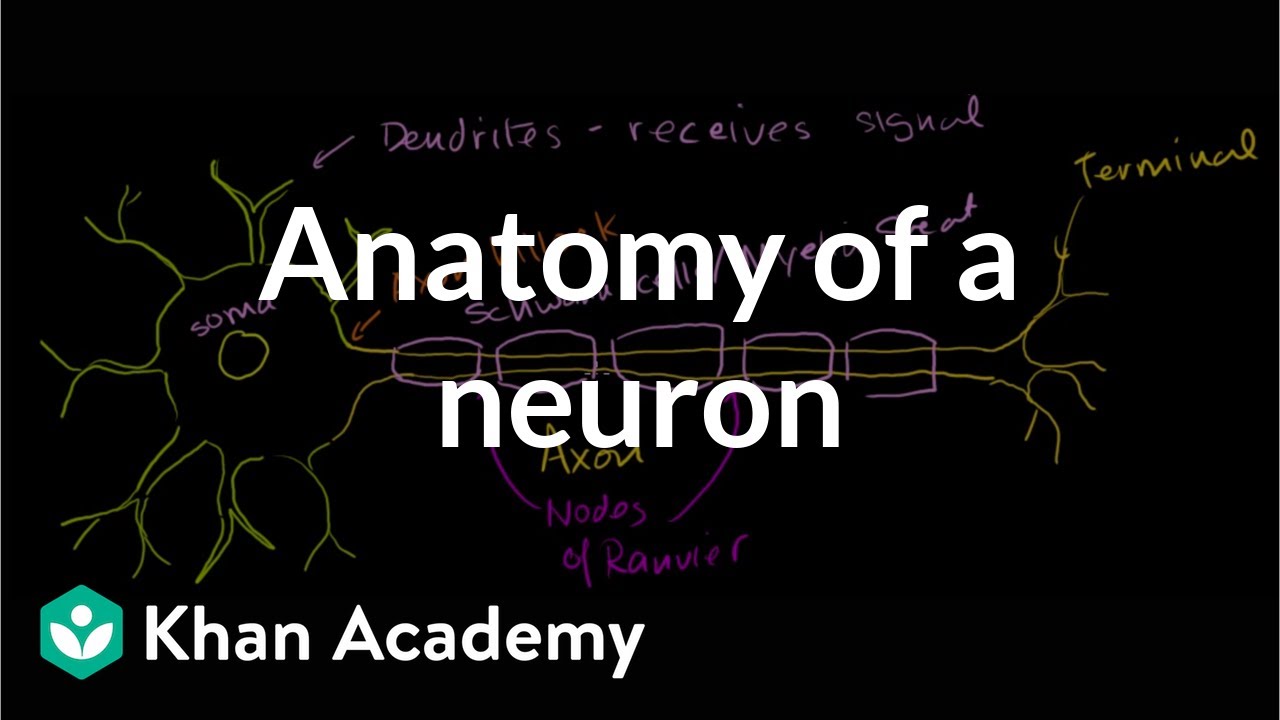
Added:Basic neuroanatomy, specifically the structure of a neuron, including the soma, dendrites, axon, and synapses.
Fundamental electrical circuit concepts, such as Ohm's Law, resistance, capacitance, and RC (resistor-capacitor) circuits.
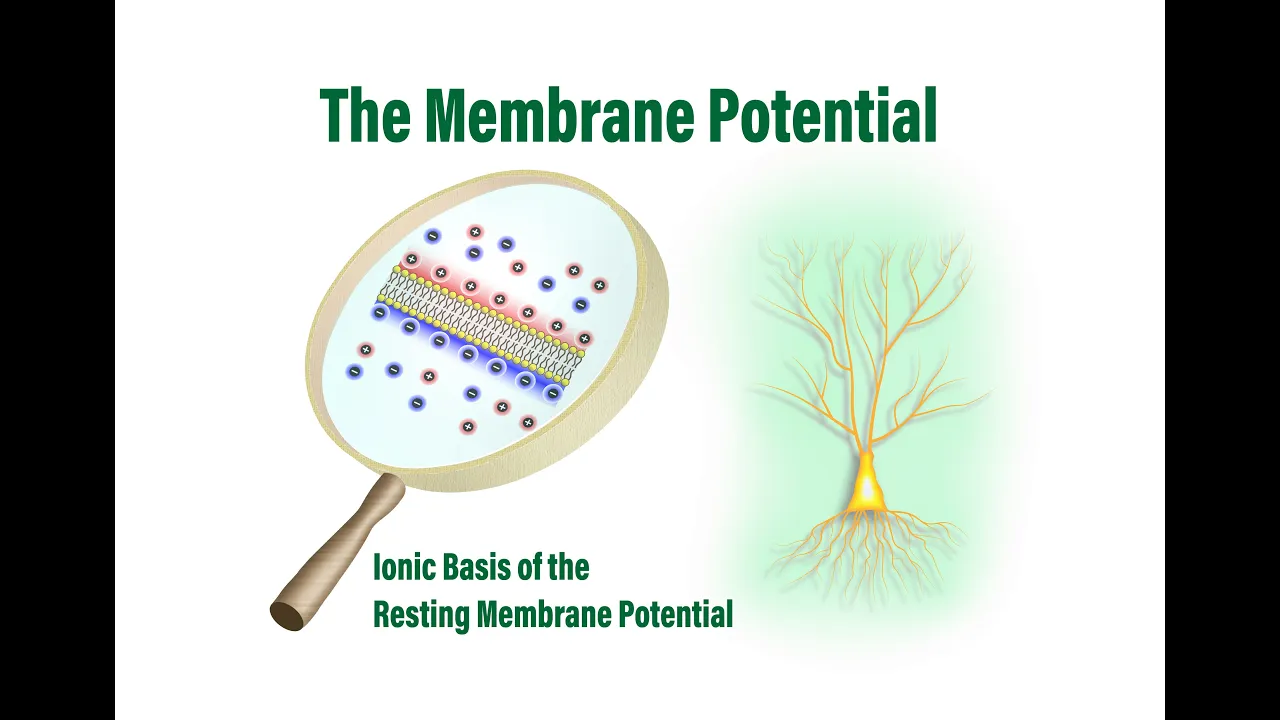
The biophysical basis of membrane potentials, including resting membrane potential, ion concentration gradients, and channel conductance.
Basic calculus and ordinary differential equations (ODEs), which are essential for understanding the mathematical derivation of the cable equation.
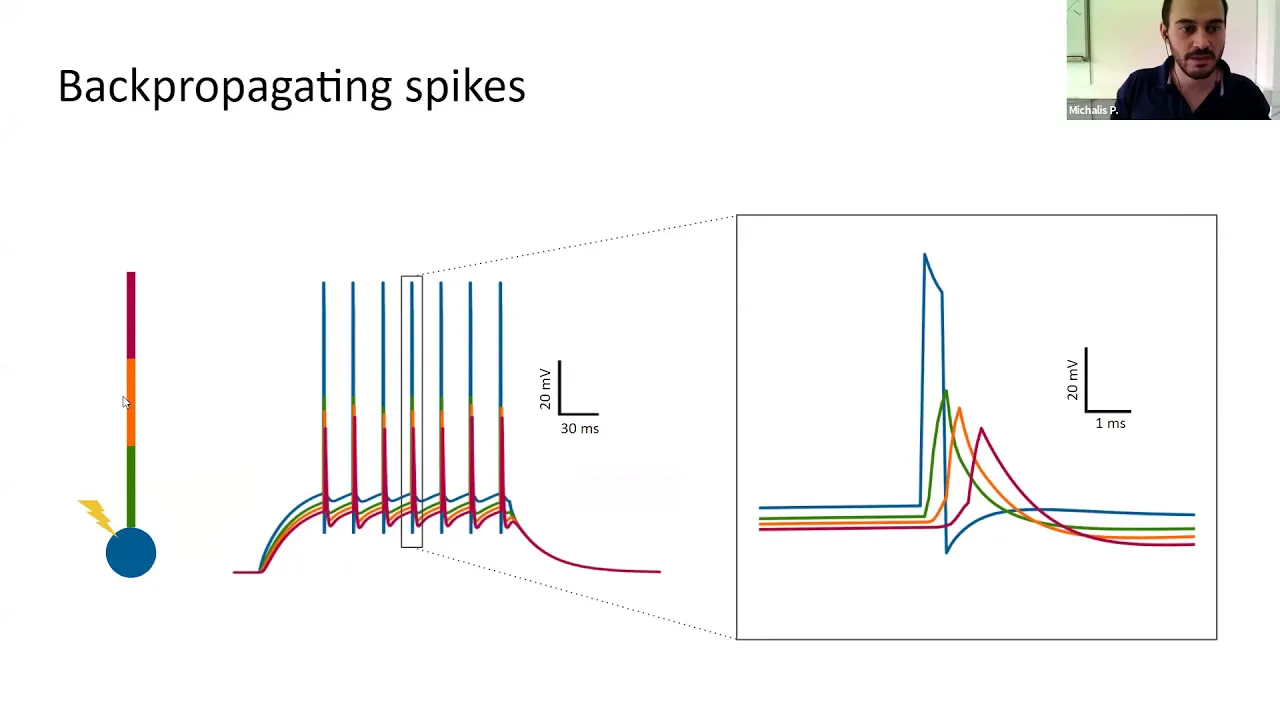
Active dendritic processing, including voltage-gated ion channels in dendrites, backpropagating action potentials, and dendritic spikes.
Synaptic integration principles, focusing on how spatial and temporal summation of EPSPs and IPSPs occur within the dendritic tree.
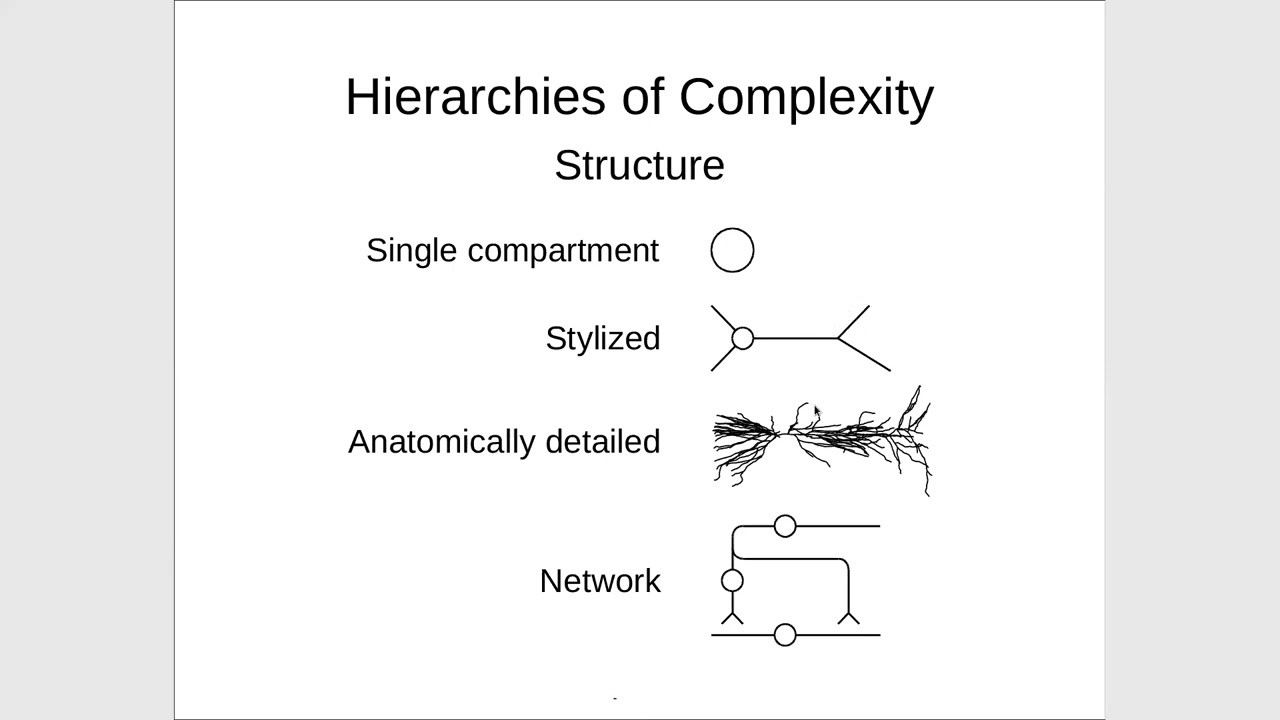
Multi-compartmental modeling in computational neuroscience, using software like NEURON to simulate complex, branching dendritic structures.
The role of dendritic morphology and spine dynamics in synaptic plasticity, learning, and memory mechanisms (such as LTP and LTD).
11.4K views179likes1:06:30Original Release: 2020-06-29
okay so today we're going to start topic we're going to be talking about the propagation of signals in in dendrites and axons so so the the model that we've considered so far is just a soma right we we basically had a kind of a spherical shell of insulator that we've been that we've been modeling then has different kinds of ion channels in it that allow the cell to do things like generate an action potential so the the reason that we've been doing that is because in most vertebrates the soma is the site in the neuron at which the decision to make an action potential is made so all kinds of inputs come in and then the soma integrates those inputs accumulates charge reaches some spiking threshold and then generates an action potential and so that's where the decision is about whether a neuron is going to spike or not now in real neurons relatively few of the inputs actually come on to the soma most of the synaptic inputs most of the inputs arrive on to the dendrites which are these branching cylinders of cell membrane and most of the synapses actually form onto the dendrite you know at some distance from the soma there are synapses that form onto the soma but the vast majority of synapses form onto these onto these dendrites and sometimes those synapses can be as far away as one to two millimeters for very large neurons in cortex so there's a population of neurons in deep layer five you some of you may have heard about that have dendrites that reach all the way up into layer one and and those cells can be those dendrites can be as long as a couple of millimeters okay so we we really have to think about what this means how signals get from out here in the dendrite down to the soma and that's what we're going to what we're going to talk about today so the most important thing that we're going to do is to simplify this by the way this is a anybody know what kind of cell this is good it's a Purkinje cell and it was one of the this is one of the cells that rimoni qahal drew back in the late 1800s okay so the first most important thing we're going to do is to simplify this very complex dendritic arborization and we're going to basically think of it as a single cylinder okay now mathematically there are reasons why this is not actually unreasonable there are you can write down if you analyze the structure of dendritic trees there's something about the way the ratio of the of the diameters of the different dendrites as they converge to form thicker branches as you get closer and close to closer to the soma that mathematically makes this not a bad approximation for for an extended dendritic Arbor like this so we're going to think about the problem of having a synapse out here on this cylindrical approximation to a dendrite and we're going to imagine that we're measuring the voltage down here at the soma or at different positions along the dendrite and we're going to ask how does a synaptic input out here on this cylinder affect the membrane potential in that in the dendrite and down here at the soma okay all right and the the the basic conceptual picture that you should have is that is that those signals propagate some distance down the soma but gradually leak out all right and there's a very simple kind of intuitive picture which is that the dendrite is kind of you can think of you can think of this as a leaky pipe or a leaky hose so imagine you took a piece of garden hose okay and you poked holes in the side of it or you know at so that they're kind of close together and when you when you hook this up to the water faucet you turn the water on that some of that water flows down the hose but some of it also leaks out the through the holes that you drilled okay you can see that eventually the waters all going to leak out through the sides and it's not going to go all the way down to the other end to get to your hydrangeas or whatever it is that you're watering okay and so you can see that that signal isn't going to get very far if the if the holes if the holes you drilled are big enough okay and the general kind of analogy here is that current is like the flow of the water current electrical current here is like water current flowing down the pipe and voltage is like pressure right so the higher the pressure here the higher the current flow you'll get and we're going to develop an electrical circuit model for for a dendrite like this that's going to look kind of like a set of resistors going down the axis of the dendrite and a set of resistors that go across the membrane and you can see that each little piece of membrane here a little piece of the dendrite is going to look like a resistor a resistor divider where you have a resistor along the axis along the axial direction and a resistance across the membrane and as you make a longer and longer piece of dendrite that voltage you're going to get additional voltage dividers each voltage divider sort of divides the voltage by some constant factor okay and as you stack those things up the voltage drops by some constant factor per unit length of the dendrite and so you can see anybody want to just take a guess of what kind of functional form that that would give you if you divide the voltage by some constant factor each unit length of the dendrite exponential that's right okay and that's where this exponential fall-off comes from okay all right so so today we're going to do the following things and we're going to basically draw a circuit diagram and an electrical equivalent circuit of a piece of dendrite and I would like you to be able to make that drawing if you're asked to we're going to be able to plot the voltage in a piece of dendrite as a function of distance for the case of a dendrite that has leaky walls and for the case of a dendrite that has non leaky walls all right and we're going to describe the concept of a length constant which I'll tell you right now is just the one over the distance at which the voltage falls by 1 over E as a function of you know as a function of length so it's some length over which the voltage falls by some amount 1 over E I we're gonna go over how that length constant depends on the radius of the dendrite it's a it's a function of the size and also we're going to describe the concept of an electric tonic length and then finally we're going to go to some sort of extreme simplifications even beyond taking that very complex dendrite simplifying it as a cylinder we're going to go to an even simpler case where we can just treat the cell as a soma connected to a resistor connected by a resistor to a separate compartment okay and that's sort of the most extreme simplification of a dendrite but in fact it's an extremely powerful one from which you can get a lot of intuition about how signals are integrated in dendrites okay alright so we're going to analyze a piece of dendrite using a technique called finite element analysis we're going to imagine we're going to approximate our piece of dendrite as a cylinder of constant radius a and an axial dimension that we're going to label X we're going to break up this cylinder into little slices so imagine we just took a little knife and we cut little slices of this dendrite and we're and they're going to be very small slices and we're going to model each one of those slices with a separate little circuit and then we're going to connect them together and we're going to let the length of that slice be Delta X and then eventually we're going to let Delta X go to 0 get some differential equations that describe that relationship between the voltage and the current in this piece of dendrite okay so let's start with a model for the inside of this cylinder so remember in a Cell we had the inside of the cell modeled by a wire okay in a dendrite we have we can't just use a wire and the reason is that current is going to flow along the inside of the dendrite it's going to flow and it's going to experience voltage drops right so we have to actually model the the resistance of the inside of the dendrite and we're going to we're going to model it with the resistance between each one of those slices with a resistor value little R okay we're going to model the outside of the axon or the dendrite as a wire and the reason we're gonna put resistors inside and just a wire outside is because the resistance remember the axon or dendrite is very small in the brain dendrites might be about two microns across so the current is constrained to a very small space when currents then flow outside they're flowing in a much larger volume and so the effective resistance is much smaller and we're going to essentially ignore that resistance and treat the outside as just a wire okay all right now we have to we have to model the the membrane okay anybody want to take a guess how we're going to model the membrane what's that I heard two correct answers what did you say Jasmin capacitor and excellent oops I wasn't quite there let's let's put that up okay good so we're gonna have a capacitance we're going to imagine that this membrane might have a an ion selective ion channel with some conductance G sub L and a equilibrium or a reversal potential ISA bail okay now coming back to these terms here we're going to model we're going to write down the voltage in each one of our little slices of the dendrite okay so let's do that the let's just pick one of them as be the voltage at position X and time T the the voltage in the next slice over is going to be V at X plus Delta X of T okay and the voltage in this slice over here is V of X minus Delta X and T okay so now we can also write down the current that goes axially through that piece of that slice of our dendrite we're going to call that I of I of X and T and we can write down also the current in every other time in every other slice of the dendrite I have X minus Delta X in T okay alright and we're going to model this this piece of membrane in each one of those slices as well okay all right any questions about that that's the basic set up that's the basic finite element model of a dendrite okay no questions all right now where we also have to model the current through the membrane that's going to be I sub m m for membrane and it's going to be a current per unit length of the dendrite we're going to imagine that there's current flowing from the inside to the outside through the membrane and there's going to be some current per unit length of the dendrite right and we can also imagine that we have current being injected let's say through a synapse or through an electrode that we can also model as coming in at any position X and this is again current per unit length times Delta X does that make sense okay all right so the first thing we're going to do is we're going to write down the relation between V at each in each node and the current going through that node okay so let's do that we're going to use Ohm's law so the voltage difference between here and here is just going to be the current times that resistance does that make sense we're just kind of use Ohm's law very simple okay so V of X and T minus V of X plus Delta X comma T is just equal to little R times that current and now we're going to rewrite this let's divide both sides of this equation by Delta X all right so you see 1 over Delta X V of X minus V of X plus Delta X is equal to little R over Delta X times the current okay and can anyone tell me what that thing is as Delta X goes to 0 good it's the derivative of it's the spatial derivative of the voltage ok that's just the definition of derivative when Delta X goes to 0 so let's write that out it's notice that it's the negative of the derivative because the derivative would have V of X plus Delta X minus V of X so it's a negative of the derivative so negative DV DX is equal to some resistance times the current and notice that this capital R sub a is called the axial resistance per unit length it's this resistance per unit length of the dendrite now notice that that that if you pass current down that dendrite the voltage drop is going to keep increasing the resistance is going to keep increasing the longer that piece of dendrite right so you can think about resistance in a piece of dendrite more appropriately as resistance per unit length okay okay so there's Ohm's law - DV DX equals axial resistance per unit length times the current any questions okay and notice that according to this current flow to the right eye is defined as positive eyes defined as current to the right here produces a negative gradient in the voltage so the voltage is high on this side and low on that side so the slope is negative okay okay so now let's take this and let's analyze this for some simple cases where we have no membrane currents so we're gonna just ignore those and we're just going to include these axial resistances and we're going to analyze what this equation tells us about the voltage inside of the dendrite that makes sense okay so let's do that so if we take that equation we can write down the current at let's say these two different nodes I of X minus Delta X in I of X and we can just because there are no membrane currents you can see that those two currents have to be equal to each other right Kirchhoff's current law says that the current into this node has to equal the current out of that node so if there are no membrane currents there's nothing leaking out here then those two currents have to equal each other and we can call that I knot okay so now DV DX is minus axial resistance times I naught and what does that tell us about how the voltage changes in a piece of dendrite if there's no membrane current if there's no leakage no leaky membrane there's no leakage in the membrane what is that if dv/dx is a constant or does it tell us yeah but it decreases how what functional form good it changes linearly right okay so if there are no membrane conductances then the membrane potential changes linearly alright so you can see that the voltage as a function of position sorry I forgot to label that voltage just changes linearly from some initial voltage to some final voltage over some length L okay we're considering a case of a piece of dendrite of length L yes yep so I just rewrote this equation sorry I just rewrote this equation moving the minus sign to that time yep okay all right good now you can see that that the Delta V that the voltage difference from the left side to the right side is just the total resistance times the current just Ohm's law again right and the total resistance is the axial resistance per unit length times the length all right really simple voltage changes linearly if you don't have any membrane conductances and you can just write down the relation between the voltage difference on the two sides and the current okay all right so in general let's think a little bit more about this this problem of banal - what you need to write down the solution to this equation okay it's a very simple equation if you integrate this over X you can see that the voltage as a function of position is some initial voltage - a resistance times the current times X right and that again just looks like this that's where that solution came from it's just integrating this over X and you can see that in order to write down the solution to this equation we need a couple of things we need to either know the the voltages at the beginning and end or we need to know the current we need to know some combination of those three things right so let's write down the voltage here let's call it V naught let's write down the voltage there V sub L and plug those in and you can see that there's V naught there's V sub L you can see that if you know any two of those quantities V naught V sub L or I naught you can calculate the third so if you know V naught and V L you can calculate the current if you know V naught and the current you can calculate V sub L okay that is the concept of boundary conditions okay you can you can write down the voltages or the currents at some positions on the dendrite and figure out the the total solution to the voltage in a position right does that make sense if you don't know some of those quantities you can't you can't write down the the solution to the equation okay it's just the simple idea that when you integrate a differential equation you need to have an initial condition in order to actually solve the equation okay any questions about that okay so let's think about a couple of different kinds of boundary conditions that you might encounter so this boundary condition right here so let's say that we inject a fixed amount of current I knot into a piece of dendrite and we take that piece of dendrite and we inject current on one end and we cut the other end so that it's open okay what does that produce at the other end does so we have a wire that describes the inside of the dendrite we have a that describes the outside of the dendrite and if you cut the end of the dendrite off so that there it's leaky so it's an open end what does that look like electrically like what's the word for like those two wires are touching each other what's that called it's a short right you if you cut the end of a dendrite off you've created a short circuit the inside is connected to the outside okay so that's called an open end boundary condition okay and what what can you say about the voltage at this end the outside is so what can you say about the voltage inside the dendrite at that end it's zero good so we have injected current we have V naught the voltage at this end and we know if we have an open end that the voltage here is zero now we can write down we know that the initial voltage is V naught the voltage at at position L is zero and now you can you know that the current here is equal to the current there and you can write down the equation and solve V naught okay so V naught is just the resistance the total resistance of the dendrite times the injected current okay and that are in is known as input impedance it's just the resistance of the dendrite its it tells you how much voltage change you will get if you inject a given amount of current okay all right any questions about that let's consider another case rather than having an open end let's leave end of the dendrite closed so that it's sealed closed okay so we're gonna consider a piece of dendrite that that one end we're injecting current in and the other end is closed okay so what do you think that's going to look like it's called a closed end what does that look like here it's an open circuit those two wires are not connected to each other there's no resistance between them let's say we define the voltage here is V naught what can you say well what you can say about the current there is that the current is zero right because it's an open circuit there's no current flowing and so the current flowing through this at this end is zero that makes sense so what can you say about the current everywhere it's zero and what can you say about the voltage everywhere is V naught okay exactly so the voltage everywhere becomes V naught and the input impedance anybody want to guess what the input impedance is how much what's the ratio of the voltage at this end and the current at this end it's in its infinite that's right okay okay so we're just trying to build some intuition about how voltage look tune of distance for one special case which is a piece of dendrite of some finite length for which you have no membrane currents okay and you can see that the voltage profile you get is linear and the slope of it depends on the boundary conditions depends on whether the piece of dendrite has a sealed end whether it's open right okay alright so now we're going to come back to the case where we have membrane currents okay and we're going to derive the general solution to the to the voltage in a piece of dendrite for the case where we have membrane capacitance and membrane currents okay all right and expect you to be able to reproduce this but I but we're going to derive what's called the cable equation which is the general mathematical description the most general mathematical description for the voltage in a cylindrical tube of which you know that's what dendrites look like and so we're gonna write down that differential equation and I want you to just see what it looks like and where it comes from but I don't expect you to be able to derive it okay all right so let's come back to this simple model that we started we're going to put our model for the membrane back in okay remember that's a capacitor and conductance in parallel we're going to we can write down the membrane current and we're going to have an injected current per unit length so as current law tells us the sum of all of those currents into each node has to be zero right so let's just write down let's just write down an equation that sums together all of those and sets them to zero so the membrane current leaking out minus the injected current coming in they have signs because one is defined as positive going into the into the dendrite and the other one is defined as positive going out so those two the membrane current plus the current going out this way minus the current coming in that way is zero okay all right so we're going to do the same trick we did last time we're going to divide by Delta X so again membrane current per unit length times the length of this finite element we're gonna divide by Delta X so this thing right here I membrane minus i electrode I guess equals minus one over Delta X I of X minus I of X minus Delta X okay so what is this we've seen something like that before it's just a derivative we're it first derivative of i with respect to position okay so now what you see is that the membrane current minus the injected current is just the first derivative of I okay so hang hang in there we're going to substitute that with something that depends on voltage all right so how do we do that we're going to take oath law there's Ohm's law let's take the derivative of that with respect to position so now we get the second derivative of a voltage with respect to position is just equal to minus RA times the first derivative of current and you can see we can just take this and substitute it there okay so here's what we get that the second derivative of voltage with respect to position is just equal to the membrane or injected currents coming into the dendrite at any position okay so the curvature of the voltage how curved it is just depends on what's coming in through the membrane alright remember in the case where we had no membrane current and no injected current the curvature was zero d two v DX squared is zero which if the curvature is zero then you have a straight line right okay now we're going to plug in the right equation for our membrane current what is that that we know it's just a sum of two terms what is it it's the sum of remember this is this this is going to be the same as our soma model what was that we had two terms what were they the current through the membrane in the model in the hodgkin-huxley model is what's that good it's a capacitive current and a membrane ionic current okay so let's just plug that in which is going to substitute into here the current through a capacitor and the current through this conductance okay that's just C DV DT G times V minus VL okay the capacitive part and a resistive part okay now the capacitance is a little funny its capacitance per unit length times the length of the element plus and the tensest conductance per unit length times the length of our finite element okay capacitance per unit length and ionic conductance per unit length and we're gonna plug that into there we're first going to notice that this leak is just an offset so we can just ignore it and just set it to zero we can always add it back later if we want we divide both sides by the membrane conductance per unit length to get this equation okay and that's called the cable equation it's got a term with the second derivative of a voltage with respect to position and it's got a term that's the first derivative of voltage with respect to time okay that's because of the capacitor okay and then it's got a term that just depends on which all right now that's the most general equation it describes how the voltage changes in a dendrite if you inject a pulse of current how that current will propagate down the dendrite or down an axon okay we're going to take a simplifying case okay next we're going to study the case just of the steady-state solution to this okay but I want you two to see this and to see how it was derived ok just using finite element finite element analysis deriving Ohm's law in a in a one dimensional continuous medium and by plugging in the equation for the membrane that includes the capacitive and resistive parts you can derive this full equation for all the voltage changes in a piece of dendrite okay now there are a couple of interesting constants here that are important lambda and tau so lambda has units of length notice that all the denominators here have units of voltage so this is voltage per distance squared so I have the right units you have to multiply by something that's distance squared okay this is voltage per unit time so you have to multiply by something that has units of time okay so that is the length constant right there and that is a time constant and the length constant is defined as 1 over membrane conductance that's the conductance of the membrane through the membrane and this is the axial resistance down the dendrite okay so this is conductance per unit length and this is resistance per unit length and we multiply those things together you get two per unit length stone in the denominator so when you put those in the numerator you get length squared and then you take the square root and that gives you units of length the time constant is just the capacitance per unit length divided by the conductor length and that is the membrane time constant and that's exactly the same as the membrane time constant that we had for our cell okay it's a property of the membrane not the geometry alright so any about that it was it's a lot I just wanted you to to see it okay yes this one or yes here know that that equation is still correct okay it's it's voltage is the derivative with respect to position as a function of the axial current okay remember going back up to here notice that when we derived this equation right here we didn't we didn't even have to include these membrane they don't change anything it's just Ohm's law it's the voltage here minus the voltage there has to equal the current flowing through that resistor doesn't matter what other currents what whether current is flowing in other directions here does that make sense the current through that resistor is just given by the voltage difference on either side of it that's Ohm's law okay so now we're going to take a simple example we're gonna solve that equation for the case of steady state okay how are we going to take the steady state how are we gonna find the steady state version of this equation any idea good we just set DV DT to zero and we're left with this equals that okay so we're gonna take a piece of our cable and we're going to imagine that we take a piece of dendrite that's infinitely long in either direction okay and somewhere here in the middle of it we're gonna inject we're gonna put an electrode and we're going to inject current at one position okay so it's injecting current at position zero how many of you have heard of a delta function direct delta function okay so we're going to define the the current as a function of position as just a current times a direct Delta function of X that just says that all the current is going in at position zero and not no current is going in anywhere else okay all right so the direct Delta function is just it's a peaky thing that is very narrow and very tall such that when you integrate over it you get a 1 okay okay so we're going to go to the steady-state solution and now let's write down that so there's the steady-state cable equation and we're going to inject current at a single point so that's what it looks like does anyone know the solution to this notice what this says is we have a function is equal to the second derivative of that function anybody know there's only one function that that that does this it's an exponential that's right so the solution to this equation is an exponential position alright is V not some voltage in the middle eetu the minus x over lambda why do I have an absolute value what is the voltage going to look like if I inject current right here you're gonna have current flowing where's the current gonna go find jet current into the middle of a piece of dendrite is it all gonna go this way no what's it gonna do it's gonna go both ways okay and the current the voltage is going to be high here and it's gonna fall as you go in both directions okay that's why we have an absolute value here so the voltage it's going to start at some V naught that depends on how much current we're injecting and it's gonna drop exponentially on both sides and notice what what's right here the lambda tells us the 1 over e points how far away the one over e point of the voltages what that means is that the voltage is going to fall to 1 over e of V not at a distance lambda from the site at which the current is injected okay that make sense that is the steady state space constant it has units of length it's how far away do you have to go so that the voltage Falls to 1 over Falls to 1 over 2.7 of the initial voltage okay any questions okay it's pretty simple we took an unusually complicated route to get there but that's the nice thing about that is you've seen the most general solution to how a cable a dendrite will behave when you inject current into it okay all right so now we can calculate the current as a function of position any idea how to do that what if you know voltage what do you use to calculate current which law Ohm's law anybody remember what owns law looks like here yep and we have to do something else the remember the current is is what Ohm's law in a continuous medium the current is just going to be what of the voltage the blank of the voltage the derivative of the voltage so we're just gonna take this and take the derivative that's it okay DV DX is just equal to minus R times I so the current is proportional to the derivative of this what's the derivative of an exponential just another exponential okay so there we go the current and then there's some to bring the lambda down when you take the derivative so the current is now just minus one over the axial resistance per unit length times minus V naught over lambda lambda comes down when you take the derivative times e to the minus X over lambda okay notice the current is to the right on this side so the current is positive it's flowing to the left on that side so the current is negative okay so to do this properly you'd have this is the solution on the right side you'd have to write another version of this for the current on the left side but I haven't put that in there okay and again the current starts out at I not and drops exponentially and it falls to one over e at a distance lambda okay why is that because the current is leaking out through the holes in our garden hose right so as you go further down less and less of the current is still going down the dendrite right I don't expect you to be able to derive this but again just know where it comes from comes from Ohm's law okay okay so I want to show you one really cool thing about the space constant okay it has a really important dependence on the size of the dendrite okay and we're going to learn something really interesting about why the brain has action potentials all right so let's take a closer look at the space constant and how you calculate it and how it depends on the size this diameter or this radius of the dendrite okay so we're gonna take a little cylinder of dendrite of radius a and length little L okay G sub M is the membrane conductance per unit length let's just derive what that would look like okay the total membrane conductance of this little cylinder of of dendrite little cylinder of cell membrane is just the surface area of that fill endure times the conductance per unit area remember this is the same idea that we talked about when we were talking about the area of our soma okay we have a conductance per unit area that just depends on the number of ion channels and how open they are on that piece of membrane okay so the total conductance is just going to be the conductance per unit area times the area and the area of that cylinder is 2pi a it gives us the circumference times the length 2pi al okay okay and the conductance per unit length is just that total conductance divided by the length so it's 2 pi a times G sub L the conductance per unit area all right so that's that's membrane conductance per unit length the axial resistance per unit length along this piece this little cylinder of dendrite we can calculate in a similar way the total axial resistance along that dendrite is can be calculated using this equation that we developed on the very first day the resistance of a wire in the brain the resistance of a chunk of extracellular or intracellular solution right the resistance is just the resistivity times the length divided by the area right the hunger for a given medium of some resistivity the longer you have to run your current through the bigger the resistance is going to be and the bigger the area the lower the resistance is going to be okay so that total resistance is it has units of ohm millimeter so it's the resistivity times L divided by a in intracellular space that's around 2,000 ohm millimeters the cross-sectional area is just pi times a squared okay and so now we can calculate the axial resistance per unit length that's the total resistance divided by L so that's just resistivity divided by a which is resistivity divided by pi radius squared just the cross-sectional area and that has units of ohms per millimeter so now we can calculate the steady state space constant conductance per unit length and axial resistance per unit length the space constant is just the one over the product of those two square root we're just going to notice that that's siemens per millimeter ohms per millimeter inverse ohms so those cancel and you're left with millimeter squared square root which is just millimeters so again that has the right units units of length but now let's plug these two things into this equation for the space constant and calculate how it depends on a okay so let's do that actually the first thing I wanted to do is just show you what a typical lambda is for a piece of dendrite okay so let's do that conductance per area is around five times ten to the minus seven typically so that conductance per unit length of a dendrites six nano Siemens per millimeter you don't have to remember that we're just calculating the length constant axial resistance is plugging in the numbers for a piece of dendrite that's about two microns in radius the axial resistance per unit length is about sixty mega ohms per millimeter and so when you plug those two things to calculate lambda you find that lambda for a typical piece of dendrite is about a millimeter okay so that's a number that would hope that you would remember okay that's a typical space constant so if you inject a signal into a piece of dendrite it's gone it it's mostly gone or about a two-thirds gone in a millimeter okay and that's how that's how you can have dendrites that are up in the range of close to a millimeter and they still are able to conduct a signal from synaptic inputs out onto the dendrite down to the soma okay so millimeter is a typical length scale for how far signals propagate okay so now let's plug in those the expressions that we derive for conductance per unit length and axial resistance per unit length of a into this equation for the space constant and what you find is that the space constant is a divided by two times the resistivity times the membrane conductance per unit area or area to the one half so it goes as the square root the space constant the length goes as the square root of the radius now notice that the space constant gets bigger as you increase the size of the dendrite right as you make a dendrite bigger what happens is the resistance down the middle gets smaller right and so the current can go further down the dendrite before it leaks out that makes sense but the resistance is dropping as the square of the area but the surface area is only increasing linearly okay and so that resistance down the middle is dropping as the square that the the the conductance out the side is growing more slowly and so the signal can propagate further the bigger the dendrite is okay so that's why it's very closely related to why the squid giant axon is big because the current has more access to propagate down the axon the bigger the cylinder is okay but there are limits to this so you know that in in our brains neuron need to be able to send signals from one side of our head to the other side of our which is about how big how far is that not in Homer but in seeing a little cartoon a little okay never mind how big across is the brain how many millimeters about yeah order of magnitude let's call it a hundred right so a piece of dendrite two microns across has a length constant of a millimeter how what diameter dendrite would we need if we needed to send a signal across the brain passively through a piece of a piece of a cylindrical piece of dendrite like this so lambda scales with radius 2 microns diameter radius gives you 1 millimeter and now you want to go to you want to go a hundred times further how what by what factor larger does that radius have to be 10000 good and so how big does our 2 micron radius piece of dendrite have to be to send a signal a hundred millimeters 10000 times 2 microns what is that anybody two centimetres so if you want to make a a piece of dendrite that sends a signal from one side of your brain to the other 100 millimeters away the two centimeters across actually that's the radius needs to be four centimeters across doesn't work does it so you can make things you can make signals propagate further by making dendrites bigger but it only goes as the square root it's like diffusion right it's all it it increases very slowly so in order to get a signal from one side of your brain to the other with the same kind of membrane your dendrite would have to be four centimeters in depth in diet okay so that's why the brain doesn't use passive propagation of signals to get from one place to the other it uses action potentials that actively propagate down axons okay pretty cool right okay all right so I want to just introduce you to the concept of electrotonic length all right and the idea is very simple if we have a piece of dendrite that has some physical length L you can see that that length L might be very good at conducting signals to the soma if what if what what aspects of the of that dendrite would make it very good at conducting signals to the soma so it's big or what else it's got a fixed physical length L so let's think of something else less leaky right okay so depending on the properties of that dendrite that piece of dendrite a physical length L might be very good at sending signals to the soma or it might be very bad right if it's really thin really leaky right so we have to compare the physical length to the space constant okay so in this case there's very little decay the signal is able to propagate from the site of the synapse to the soma in this case a slightly smaller piece of dendrite might have a shorter lambda and so there would be more decay by the time you get to the soma and in this case the lambda is really short and so the signal really decays away before you get to the soma okay so people often refer to a quantity as the referred to as the electrotonic length which is simply the ratio of the physical length to the base constant okay so you can see that in this case the physical length is about the same as lambda and so the electrotonic length is 1 in this case the physical length is twice as long as lambda and so the electrotonic length of that piece of dendrite is - in this case it's four and you can see that the amount of signal it gets from this end to that end will go like what well will depend how on the electrotonic line it will depend something like e to the minus L okay so a piece of dendrite that has a low electro tonic length means that the synapse out here at the other end of it is effectively very close to the soma its various mitting that signal okay if the electrotonic length is large it's telling you that that some input out here at the end of it is very far away the signal can't propagate to the soma okay and the amount of signal that gets to the soma goes as e to the minus l e to the minus like so if i told you that a signal is at the end of a piece of dendrite that has electrotonic length - how much of that signal arrives at the soma the answer is e to the minus two okay about ten percent whatever that is okay okay so i want to tell you a little bit more about the way people model complex dendrites in sort of in real life so most of the time we're not integrating or solving the cable equal the cable equation is really most powerful in terms of giving intuition about how cables respond so you can write down exact solutions to things like pulses of current input at some position how the voltage propagates down the dendrite that the functional form of the voltage is a function of distance but when you actually want to sort of model a neuron you're not usually integrating the cable equation and so people do different approximations to a very complex dendritic structure like this and one common way that that's done is called multi appartment model so basically what you can do is you can model the soma with this capacitor resistor combination and then you can model the connection to another part of the dendrite through a resistor to another sort of finite element slice but we're gonna let the slices go to zero length we're just gonna model them as like chunks of dendrite that are gonna be modeled by a compartment like this okay and then that can branch to connect to other parts of the dendrite and that can branch to connect to other parts of the model that model other pieces so you can basically take something like this and make it arbitrarily complicated and arbitrarily close to a representation of the physical structure of a real dendrite okay and so there are labs that do this that take a picture of a neuron like this and break it up into little chunks and model each one of those little chunks and model the the branching structure of the real dendrite and you can put in real ionic conductances of different types out here in this model and you get a gazillion differential equations and you can those differential equations and actually compute sort of predict the behavior of a complex piece of dendrite like this okay now that's not my favorite way of doing modeling any any idea why that would be why that why there could be a better way of modeling a complex dendrite I mean what's the one of the problems here is that in a sense your model gets to be as complicated as the real thing okay so it would be it's a great way to simulate some behavior but it's not a great way of getting an intuition about how something works right so people take simplified versions of this okay and they can take this very complex model and simplify it even more by doing something like this so you take a soma and a dendrite you can basically just break off the dendrite into a separate piece and connected to the soma through a resistor okay now we can simplify this even more by just turning it into another little module a little compartment that that's kind of like the soma it just has a capacitor and a membrane resistance and whatever ion channels in it you want and it's a and riddick compartment that's connected to the somatic compartment through a resistor and if you write that down it just looks like this okay so you have a somatic compartment that has a somatic membrane capacitance somatic membrane conductance is a somatic voltage you have a dendritic compartment that has all the same things dendritic membrane capacitance conductances and voltage and they're just connected through a coupling resistor okay it turns out that that very simple model can explain a lot of complicated things about neurons okay so there are some really beautiful studies showing that this kind of model can really explain very diverse kinds of electrophysiological B neurons so you can take for example a a simple model of a layer 2 3 pyramidal cell that has a simple compact dendrite and you can write down a model like this where you have different conductors the dendrite you have hodgkin-huxley conductances in the soma you connect them through this resistor and now basically what you can do is you can model that spiking behavior and what you find is that if you have the same conductances in the dendrite and in the soma but you simply increase the air the total area of this compartment just increase the total capacitance and conductance --is that you can see that and that would model a layer five neuron that has one of these very large dendrites you can see that the spiking behavior of that neuron just totally changes and that's exactly what the spiking behavior of layer five neurons looks like okay and so you could imagine building a very complicated a thousand compartment model to simulate this but you wouldn't really understand much more about why it behaves that way whereas you a simple two compartment model and analyze it and really understand what are the properties of a neuron that give this kind of behavior as opposed to some other kind of behavior right it's very similar to the approach that that David Cory took in modeling the effect of the t tubules on muscle fiber spiking in the case of sodium failures to the sodium channel to inactivate okay that was also a two compartment model okay so you can get a lot of intuition about the properties of neurons simple extensions of an additional compartment onto the soma and next time on Thursday we're going to we're going to extend a model like this to include a model of us okay okay so let me just remind you of what we learned about today so you should be able to draw a circuit diagram of a dendrite just that kind of finite element picture with maybe three or four elements on it be able to plot the voltage in a dendrite as a function of distance in steady state for leaky and non leaky dendrites and understand the concept of a length constant know how the length constant depends on dendritic radius you should understand the idea of an electric tonic lengthen able to say how much a signal will decay for dendrite of a given electrotonic length and be able to draw the circuit diagram of a two compartment model and we're going to spend more time on that on Thursday okay you
Up Next

91:41
Membrane Excitability and Synaptic Plasticity | Lecture 2 (ICTP-ICTS QSB 2021)
@ICTStalks
203 views•2021-12-28

21:55
Deciphering Neural Circuits Controlling Anorexia in Mice | Richard Palmiter
@AllenInstitute
2.3K views•2011-10-10

50:09
Neurobiology 3: Synaptic Regulation & Neural Circuits | MIT 7.013
@mitocw
20.4K views•2014-01-15

13:03
How Exercise Benefits Your Brain: Science Explained
@TED
11.4M views•2018-03-21
Related Study Plans & Knowledge Roadmaps
Structured learning paths in Neuroscience
neuroscience
Appetite Regulation: Brain Circuits & Hormones
01Foundations of Endocrinology and Brain Anatomy
02Introduction to Energy Homeostasis
03Peripheral Signals: Leptin, Ghrelin, and Insulin
+ 2 more learning modules
14h5 modules
Explore Roadmap
neuroscience
Neuroeconomics: Value, Risk & Brain Mechanisms
01Foundations of Neuroscience and Brain Anatomy
02Introduction to Neuroeconomics and Subjective Value
03Dopaminergic Prediction Errors & Reinforcement Learning
+ 3 more learning modules
18h6 modules
Explore Roadmap
neuroscience
Spatial Navigation: Cells, Grids & Brain Maps
01Foundations of Brain Anatomy and Memory
02Place Cells and Head-Direction Cells
03Grid Cells: The Brain's Coordinate System
+ 2 more learning modules
12h5 modules
Explore Roadmap
neuroscience
BCIs: Neural Decoding & Prosthetic Control
01Neuroscience Foundations: How the Brain Signals Intent
02Signal Acquisition: Recording the Brain's Activity
03Neural Decoding: Translating Brain Waves into Data
+ 2 more learning modules
25h5 modules
Explore Roadmap