


















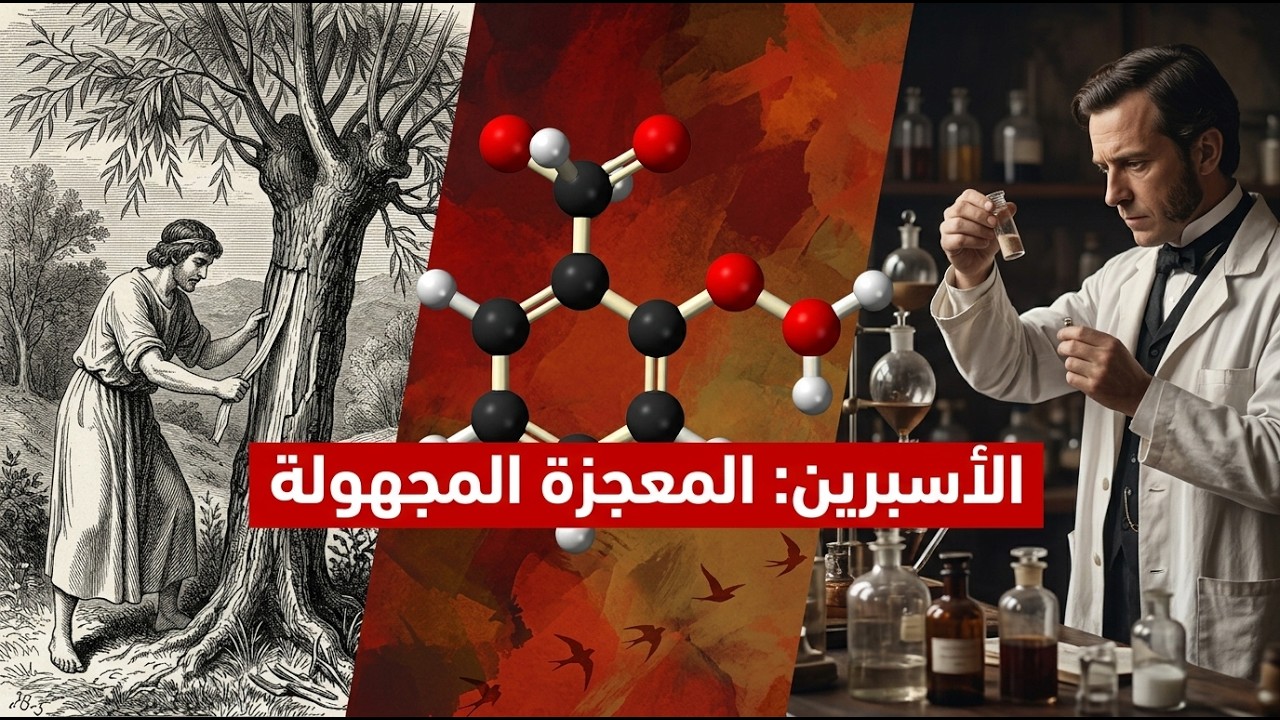





Aspirin's development represents a pivotal moment in medical history, transforming from ancient willow bark remedies used by Egyptians and Greeks over 3,000 years ago to the first synthetic over-the-counter drug in 1915; this evolution involved key scientific breakthroughs including the isolation of salicin (1826), the synthesis of salicylic acid (1838), and the acetylation process that created acetylsalicylic acid (late 19th century), ultimately leading to the discovery of its mechanism of action through prostaglandin inhibition by Sir John Vane in 1970, which also revealed its anti-platelet effects for preventing heart disease.
The Medical History of Aspirin: From Willow Bark to Modern Medicine
Added:Basic understanding of ethnobotany and how ancient cultures historically utilized plant-derived remedies.
Fundamental concepts of human anatomy and physiology, particularly the inflammatory response, pain signaling, and fever.
Introductory chemistry principles, specifically the difference between organic compounds found in nature and synthetic chemicals.
The basic definition of pharmacology, including terms like active ingredients, dosage, and efficacy.
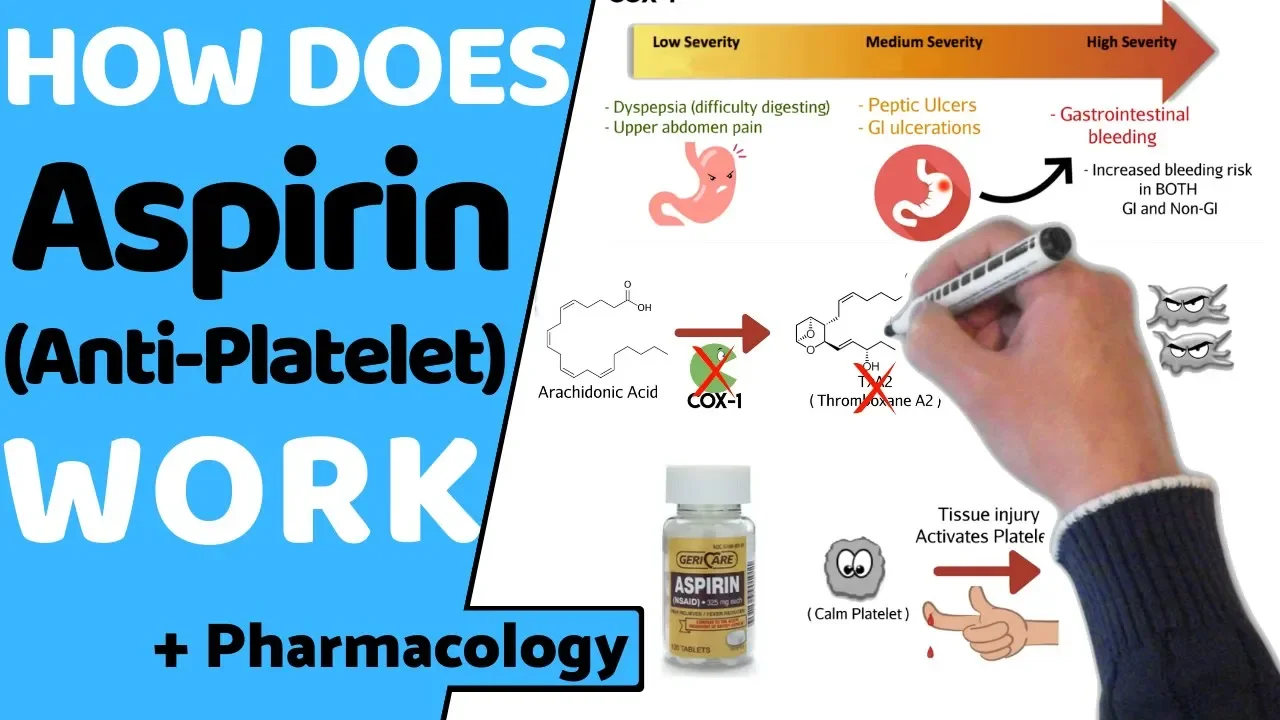
The molecular mechanism of action of aspirin, specifically how it inhibits cyclooxygenase (COX-1 and COX-2) enzymes to reduce prostaglandin synthesis.
A comparative study of nonsteroidal anti-inflammatory drugs (NSAIDs), including ibuprofen, naproxen, and acetaminophen, and their differing therapeutic profiles.
The cardiovascular applications of low-dose aspirin therapy, focusing on its role as an antiplatelet agent in preventing heart attacks and strokes.
The clinical side effects and safety considerations of aspirin, including gastrointestinal irritation, bleeding risks, and its association with Reye's syndrome in children.
The modern drug discovery and regulation pipeline, mapping how ancient herbal remedies are transformed into standardized, FDA-approved pharmaceuticals.
505K views16.3Klikes11:51Original Release: 2019-01-10
♪ Aspirin might seem like the most generic, boring pill ever.
I mean, the patent for it expired literally a hundred years ago.
And we have all kinds of better over-the-counter painkillers these days.
But behind those tiny, cheap, plain-looking pills is a story that changed medicine forever.
Because aspirin isn’t just an old pill.
It was the one of the first pills — or at least, one of the first medicines we learned how to make ourselves.
And we're still discovering new uses for it today.
So, the active ingredient in aspirin is a compound called acetylsalicylic acid.
But more than 3,000 years before we learned how to make it, doctors were using its original natural source, willow bark, as a medicine.
Ancient Egyptians used willow and myrtle to treat fever and pain, some of the same symptoms we use modern-day aspirin for.
And old school medical superstars like Hippocrates, Celsus, and Galen had come across the soothing effects of willow bark for treating inflammation.
But it wasn’t until the 1700s that a British reverend named Edward Stone made a crucial observation.
During a particularly nasty outbreak of ague, a fever thought to be caused by malaria, Stone noticed that willow bark tasted an awful lot like Peruvian bark, the more common ague treatment of the time.
Peruvian bark was good at relieving ague symptoms, but really expensive, and he thought willow might work as a cheaper alternative.
So he spent the next few years collecting, drying and powdering willow into a form that could be used to treat ague, eventually settling on a dosage of two scruples — which is a real unit of measure!
It was about 2.5 grams of bark.
His concoction wasn’t as powerful as Peruvian bark, which was a source of quinine a compound that actually kills the malaria parasite.
But he did publish the first report of willow’s effects in a scientific journal, Philosophical Transactions.
35 years later, in 1826, a French researcher isolated the active ingredient in willow bark: a yellowish crystal that was named salicin a couple of years later.
Around the same time, a much larger shift was happening among scientists.
For a long time, a lot of chemists thought substances from living beings had some kind of vital force that made them different than non-living things an idea known as vitalism.
A drop of human sweat would just be different than anything we could make in the lab.
How? It just is!
But in 1828, a German chemist named Friedrich Wohler showed otherwise when he synthesized urea, a substance found in both sweat and urine — hence the name.
This was the first time that someone made an organic compound from inorganic materials in the lab.
Wohler didn’t set out to disprove vitalism — he was originally trying to make a totally different compound.
But when he accidentally made urea instead, scientists began to think maybe living things weren’t so chemically different from non-living things.
This event swung the doors wide open for experimentation into organic chemistry — the study of compounds usually found in living things.
So for drugs like aspirin, the next few years were one big progress party.
In 1838, an Italian scientist named Raffaele Piria synthesized a stronger form of the active ingredient in willow bark for the first time: salicylic acid.
This might not seem like that big of a deal, especially compared to the neat and tidy synthesis in modern labs, but it marked an enormous shift in our approach to drug development.
Researchers weren’t just purifying what they found in nature anymore they were actively working to change the chemical structure of compounds to develop more effective treatments.
It’s one of the biggest differences between old school and modern medicine.
Salicylic acid might sound familiar if you’ve used topical acne treatments, but it wasn’t quite modern-day aspirin yet.
By 1876, a Scottish doctor had published a positive review of salicylic acid’s effects on rheumatism in The Lancet, in a paper titled “Rheumatic Fever Treated by Salicylic Acid” It was no controlled, double blinded study by any means, but the word was getting out that this stuff might turn into something big.
Except, there was a problem.
Because that was only the first half of the paper’s title.
The second half was “Symptoms of Poisoning Produced by the Acid”.
People weren’t actually being poisoned, but it’s not hard to see why it looked like they were: salicylic acid worked for fever, pain, and inflammation, but it also often caused gastritis, where the stomach lining becomes inflamed.
Maybe a little bit ironic, considering the medicine usually reduced inflammation, but it turns out the stomach lining doesn’t really like being eroded, and that’s what the salicylic acid was doing.
As you can probably imagine, this is not pleasant.
It tends to lead to, like, nausea and vomiting.
Meanwhile, something else was changing in the medical world.
Researchers were starting to realize that a lot of the chemical byproducts of dye manufacturing could be used in medicine.
This is actually how some of the first pharmaceutical companies were born — they started out as dye manufacturers.
The Bayer group in Germany was one of those dye companies that started branching out into medicine.
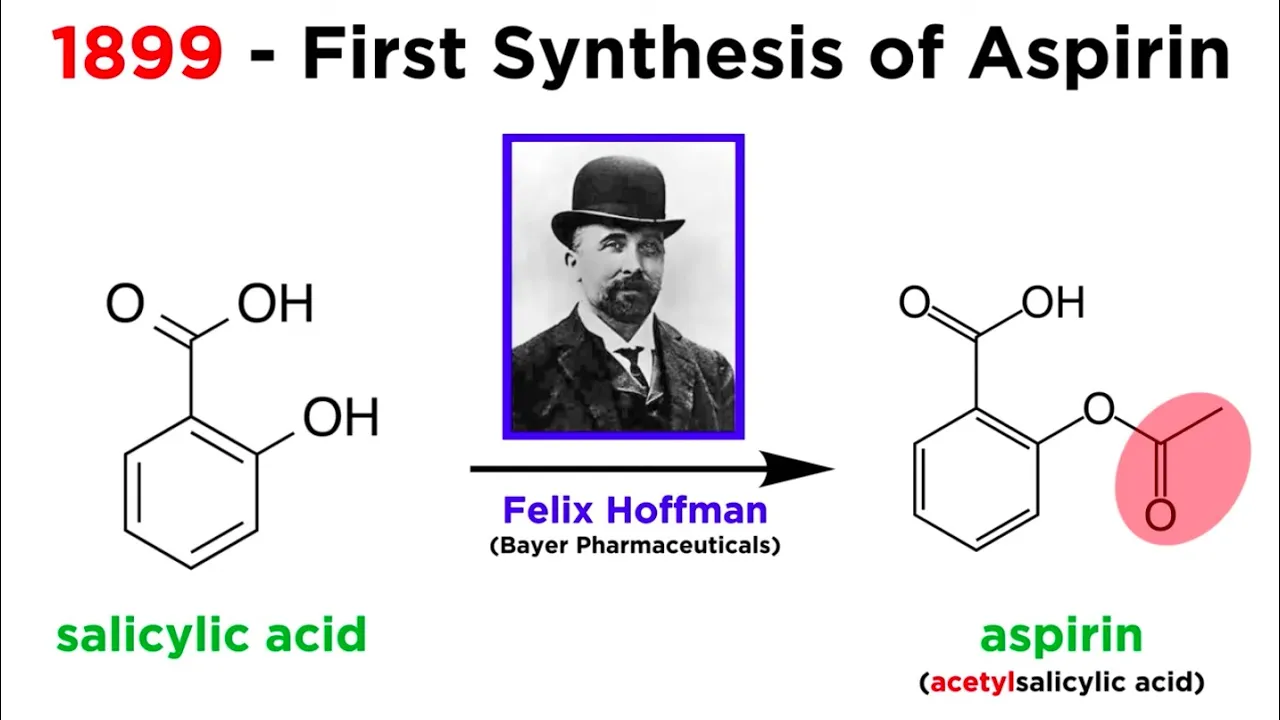
And around the end of the nineteenth century, a couple of scientists at the Bayer group in Germany came up with a protocol to modify salicylic acid and make it less toxic.
This is where the history of aspirin starts to get a little controversial, because at least three different scientists all claimed credit for the discovery.
But either way, the process they came up with involved a reaction known as acetylation.
It replaced one of salicylic acid’s hydroxyl group — that’s an oxygen and hydrogen bonded to a carbon — with an acetyl group, which is two carbons, one double-bonded to an oxygen and the other bonded to three hydrogens.
The result was acetylsalicylic acid, the modern active ingredient in aspirin.
The compound had technically been synthesized by a French chemist about 50 years earlier, but his version was impure and unstable.
The reaction used by the chemists at Bayer didn’t have those problems, and they ended up with a drug that reduced a lot of that gastrointestinal irritation, at least compared to regular salicylic acid.
Gastritis was still a side effect, but it didn’t happen as often or as badly.
And as far as industry was concerned, companies now had a reliable way to make a highly useful pill.
It quickly became the world’s best selling drug, in part because people were already used to taking salicylic compounds.
This was just a safer and less toxic version.
More positive medical reports kept coming in, so aspirin continued to grow in popularity.
And in 1915, it became available without a prescription which made it the first synthetic, over the counter drug.
This was about two years after Bayer stopped producing over-the-counter heroin, by the way, so for a while you could stroll into any pharmacy and buy heroin but needed to get a prescription for aspirin.
The times, they have changed.
After aspirin became available over-the-counter, not much happened for a while.
There were some legal changes when Bayer lost their trademark, which was part of Germany’s deal with the Allied powers after World War I.
But on the scientific side of things, there wasn’t much progress for a few decades.
Keep in mind that all this time, we really had no idea how aspirin worked.
We knew what it did, but not how.
It took until around 1970 for British pharmacologist Sir John Vane and his research team to figure that out.
Their experiments involved inducing severe allergic reactions in rabbit and guinea pig lungs, then studying both the chemicals produced during the allergic reaction and the effects of aspirin on those compounds.
The team found that the allergic reactions caused cells to produce more prostaglandins, a type of hormone.
And aspirin seemed to inhibit that production.
They were able to tie prostaglandins to fever, inflammation, and headaches, so this went a long way toward explaining how aspirin worked.
A few years later, other scientists came across prostaglandins again.
In 1976, researchers discovered cyclooxygenase, or the COX enzyme, which makes a few different biomarkers, including prostaglandins.
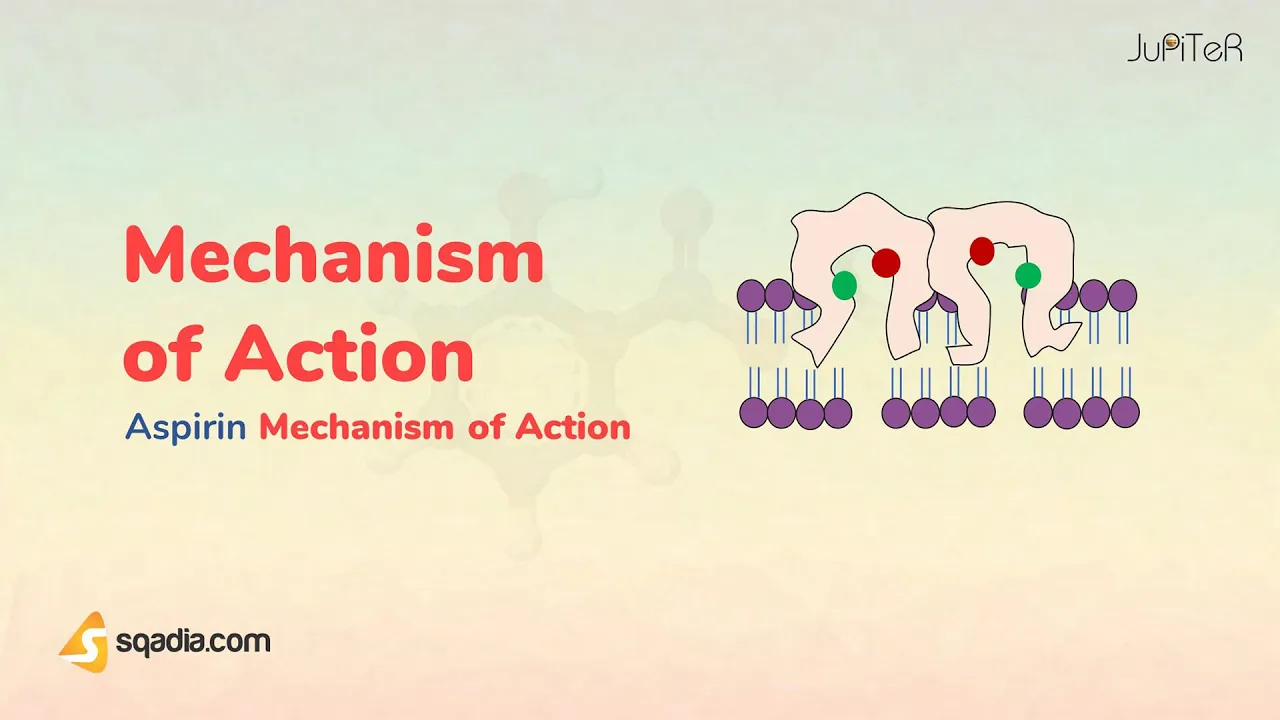
And once you introduce it to aspirin, the drug irreversibly binds to it.
More COX binding, less prostaglandin, so less pain.
The problem, though, is that there are multiple kinds of these enzymes, and they all do slightly different things.
While COX-2 produces prostaglandins during inflammation, a COX-1 enzyme has the added duty of making prostaglandins to protect the lining of your stomach.
And aspirin affects both COX-1 and COX- 2, which is why it can act as a pain reliever, but also messes with the whole stomach lining thing.
So doctors needed to find drugs that could do the heavy lifting of aspirin, but without causing upset stomach.
That’s where other NSAIDs, or non-steroidal anti-inflammatories, came in.
As you might have guessed, their name comes from the fact that they reduce inflammation without being steroids.
Pharmaceutical companies were after any drugs that would selectively inhibit COX-2 without touching COX-1.
Acetaminophen seemed like a good alternative.
We’d known about its pain-relief effects for about a hundred years.
But it’s not a proper NSAID.
It reduces pain like one, but doesn’t do anything for inflammation.
Today, we have other actual NSAIDs, like ibuprofen, which can still irritate your stomach but seem to do it less than aspirin.
Aspirin, though, is still extremely popular.
That’s because, in addition to its pain and fever reduction powers, it has benefits in preventing heart disease.
It was a surgeon named Lawrence Craven — primarily an oral surgeon, oddly enough, not a cardiologist — who stumbled upon this idea in the early 1950s.
Craven performed a lot of surgeries on tonsils and the adenoid glands, a pretty routine procedure by his standards.
He’d usually do the surgery in the morning and send the patient home in the afternoon, often prescribing aspirin chewing gum for the pain.
But he noticed that as the use of aspirin gum increased, so did more oral bleeding.
Craven was convinced that aspirin was preventing prothrombin, one of the factors in blood clotting.
He even went as far as taking 12 aspirin a day to give himself a nosebleed and show the blood thinning effects of the drug.
Over the next few years, he prescribed aspirin to all of his patients who were at risk for a heart attack - mostly older, overweight men.
His rationale was that rapid blood clotting could cause in heart attacks in the arteries around the heart that experienced plaque buildup, or atherosclerosis.
Craven thought aspirin would reduce coagulation, allowing blood to pass through the arteries smoothly, and reduce heart attacks.
But really, all he had was anecdotal evidence and observations.
Over the next few decades, multiple doctors and scientists would learn more about aspirin’s use as a blood thinner with much more rigorous science.
And then, in the 1960s, researchers made a game-changing discovery: aspirin had anti-platelet effects.
Platelets are tiny cells in the blood that help clots form, and aspirin acts as a blood thinner by keeping them from clumping together.
That’s why they won’t let you donate platelets if you’ve taken aspirin in the last two days.
So Craven’s speculation was actually pretty close.
Platelets bunch up around those atherosclerotic sites in blood vessels, causing heart attacks.
Today, doctors will recommend low dose, daily aspirin for certain patients — it can reduce the chances of heart attacks in people who’ve already had a heart attack or stroke.
And more recent research has shown that low doses of aspirin might help prevent other diseases, too — especially colorectal cancer.
None of this means you, generic person, should start popping an extra pill with breakfast, unless your doctor tells you to.
The risk of side effects isn’t generally worth it, and we’re still learning more about which doses work and for whom.
But one thing’s for sure: that old, boring, little pill has come a long way since the early days of grinding up willow bark.
Thanks for watching this episode of SciShow, which was brought to you by our patrons on Patreon!
If you want to help us keep making episodes like this, just check out patreon.com/scishow.
And if you’re as fascinated as I am by the stories behind the science we have today, we have a whole, new History of Science series over at youtube.com/crashcourse.
♪
Up Next

65:29
The Power of Plants: Exploring Phytochemical Properties
@MelodysMondayMusings
1.4K views•2021-08-03

12:54
Triumph of Orthodoxy Icon: Byzantine Art & History Explained
@BenCallan
2.1K views•2024-08-06

6:14
How Hydrothermal Vents Could Explain the Origin of Life
@SciShow
201.4K views•2020-04-09

1:42
Game of Thrones Opening Credits: A Cinematic Analysis
@gameofthrones
46.3M views•2011-04-18
Related Study Plans & Knowledge Roadmaps
Structured learning paths in General & Interdisciplinary Studies
general-studies
Elevator Engineering: History, Physics & Cities
01From Hoists to Safety Brakes: The Dawn of Vertical Lift
02Hydraulic vs. Traction: The Engineering Physics of Elevators
03Modern Speed, Safety, and Algorithms
+ 2 more learning modules
12h5 modules
Explore Roadmap
general-studies
Rubber: Material Science, History & Geopolitics
01Origins of Natural Rubber & Mesoamerican History
02The Chemistry of Natural Rubber & Vulcanization
03The Geopolitics of the Rubber Boom & Colonization
+ 2 more learning modules
12h5 modules
Explore Roadmap
general-studies
Containerization: Evolution, Logistics & Trade
01Ancient Trade & Bulk Cargo: Amphorae to Barrels
02The Industrial Revolution & Cardboard Packaging
03The Containerization Revolution: Malcom McLean
+ 2 more learning modules
12h5 modules
Explore Roadmap
general-studies
Textile Tech: Evolution, Labor & Global Impact
01Pre-Industrial Textiles: Handloom & Cottage Industry
02Mechanization: The Spinning Jenny to the Power Loom
03The Factory System & Global Labor Transformation
+ 2 more learning modules
10h5 modules
Explore Roadmap