A cloud chamber can be constructed using stacked Peltier coolers (thermoelectric modules) instead of traditional dry ice cooling, creating a super-saturated environment where ionizing radiation produces visible particle tracks; this alternative method eliminates the need for dry ice while maintaining the fundamental principle of creating a cold zone that causes water vapor to condense along charged particle paths.
DIY Cloud Chamber with Peltier Cooler (No Dry Ice) | Particle Detection Demo
Added:Deep Dive
Fundamental concepts of ionizing radiation, specifically the nature and characteristics of alpha particles, beta particles, and cosmic muons.
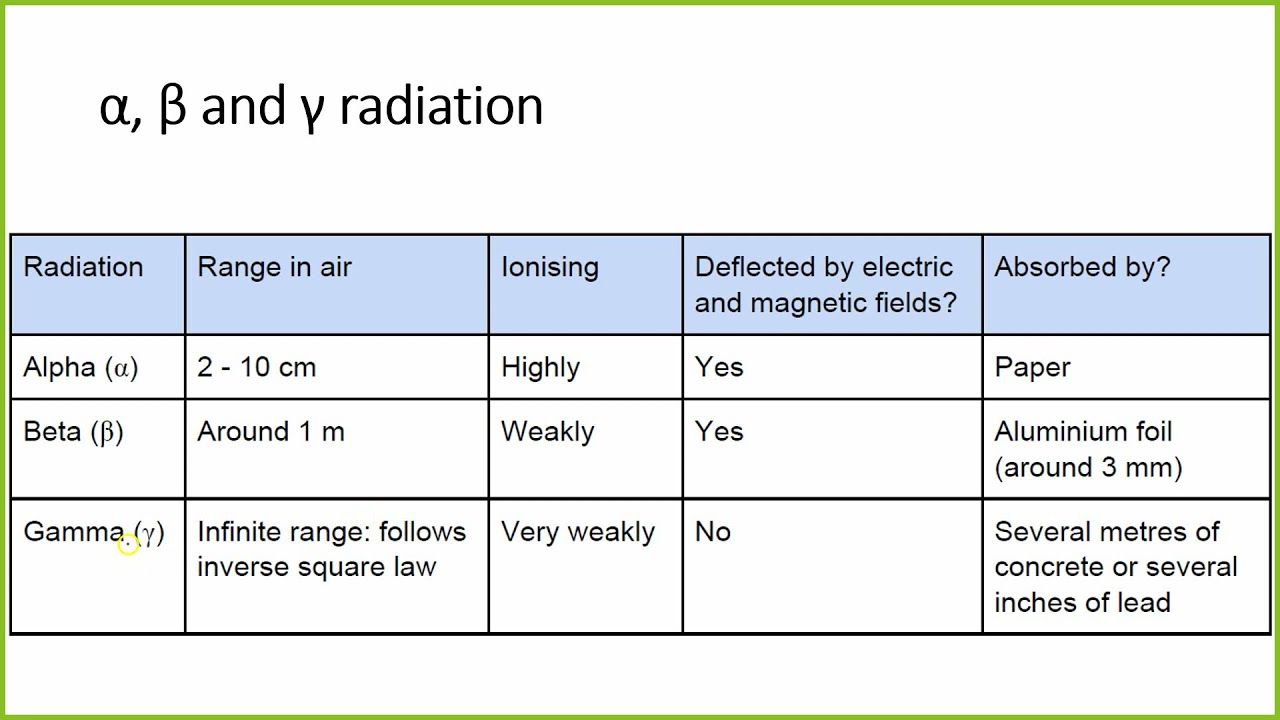
radioactivity lesson
476
Ionizing radiation includes alpha, beta, and gamma particles that ionize atoms by knocking electrons off their shells. Alpha particles are helium nuclei (heavy, 2 protons + 2 neutrons) with high ionization ability. Beta particles are electrons (light, negative charge) with weak ionization. Gamma rays are electromagnetic waves (no mass, no charge) with very weak ionization. These particles can be identified by nuclear changes: alpha decay decreases atomic number by 2, beta decay increases atomic number by 1, and gamma decay causes no change in atomic or mass numbers.
Click to watch →

Vật Lý Lý Sinh _P.18
2K
Ionizing radiation is radiation with sufficient kinetic energy to release electrons from atoms or molecules, creating ions. It originates from nuclear reactions and natural/artificial sources like solar radiation and particle accelerators. Radiation is classified into two categories: particles with definite mass and charge (alpha, beta, protons, neutrons) and electromagnetic radiation (gamma, X-rays). Alpha particles are helium nuclei (2 protons, 2 neutrons) with +2 charge, traveling at 10^8 m/s and stopped by paper. Beta particles are high-energy electrons with -1 charge, traveling faster and requiring metal shielding. Gamma rays are high-energy photons with no mass or charge, traveling at light speed and requiring dense shielding like lead.
Click to watch →

Radioactivité: particule alpha, bêta et rayonnement gamma
799
Radioactivity occurs when unstable atomic nuclei transform into other atoms, releasing particles and radiation. Alpha particles are helium nuclei (2 protons, 2 neutrons) with +2 charge, traveling at ~20,000 km/s, and highly ionizing. Beta particles are electrons created when unstable nuclei lose protons, with -1 charge, very low mass (5×10^-4 amu), and speeds from 12,000-290,000 km/s. Alpha particles are stopped by skin or paper, while beta particles require a few centimeters of metal to block.
Click to watch →

Ionising Radiation Part 2
148
Ionising radiation consists of three main types emitted from unstable atomic nuclei: alpha particles (helium nuclei with 2 protons and 2 neutrons, mass 4, charge +2, slow-moving, low penetrating power, stopped by paper or skin), beta particles (fast-moving electrons with charge -1 and negligible mass, moderately ionizing, travel about 1 meter in air, stopped by thin aluminum foil), and gamma rays (high-frequency electromagnetic waves with no mass or charge, traveling at light speed, highly penetrating, stopped by several centimeters of lead or meters of concrete).
Click to watch →
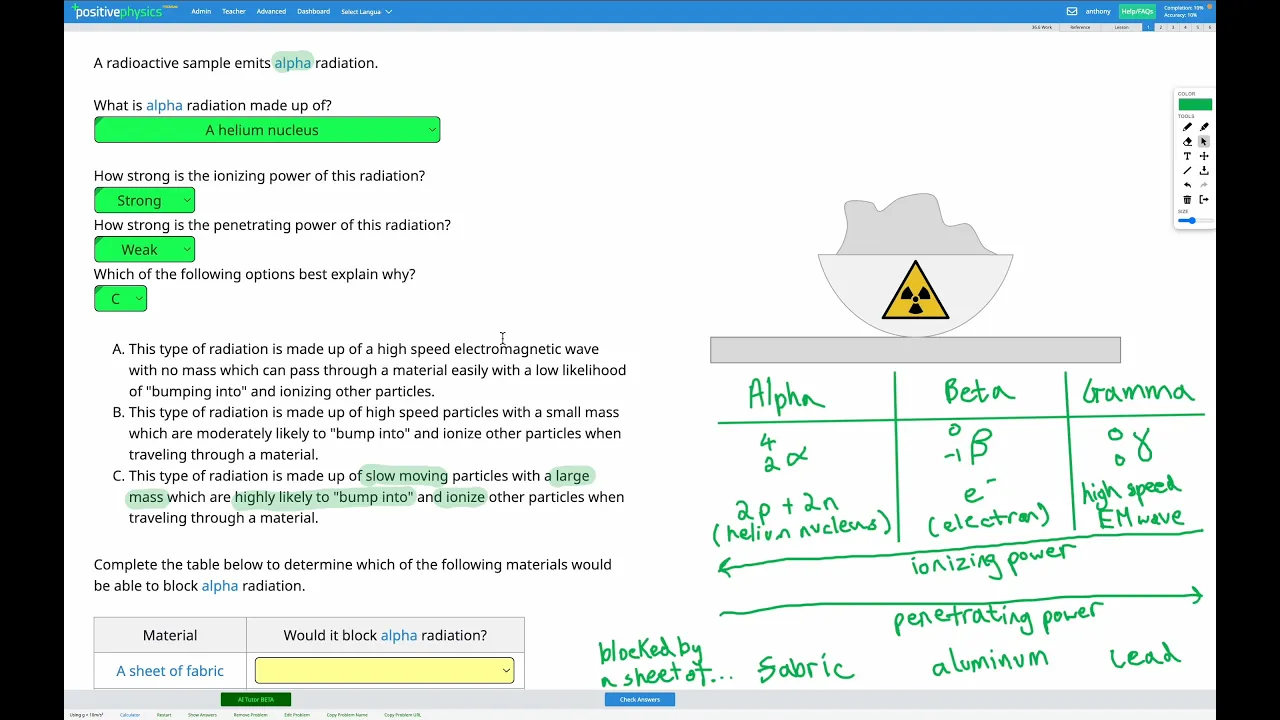
Chemistry - Nuclear Chemistry - Types of Ionizing Radiation - www.positivechemistry.org
251
This comprehensive overview covers the three main types of ionizing radiation. Alpha particles consist of two protons and two neutrons (a helium nucleus) with significant mass, making them highly ionizing but poorly penetrating. Beta particles are lightweight electrons with moderate ionizing and penetrating abilities. Gamma radiation is massless electromagnetic waves with weak ionizing power but strong penetrating capability. These fundamental differences in composition directly determine how each type interacts with matter and materials.
Click to watch →
Deep Dive
The thermodynamics of phase transitions, particularly the mechanism of vapor supersaturation and how condensation nucleation occurs around charged ions.

Wilson cloud chamber
29K
The value of supersaturation necessary to produce drops on ions depends on both the quality of the vapor and the value of the charge. Water vapors mostly condense on negative ions, while ethyl alcohol vapors condense on positive ions.
Click to watch →

Физическая химия, Траньков С. В. 18.10.2021г.
1.3K
The nucleation rate is proportional to exp(-16πσ³V_m²/(3RTΔμ²)), showing exponential dependence on the critical nucleus barrier. Higher supersaturation (larger Δμ) reduces the barrier and increases the rate. Supersaturation S is defined as the ratio of actual to equilibrium concentration, with ΔG* ∝ 1/(ln S)². In charged systems, additional work against Coulombic forces adds a positive term to free energy, potentially making ΔG positive even when the volume term is negative. This explains why charged colloids can remain metastable indefinitely. Experimental observations show induction periods in supersaturated solutions (like BaSO₄), where solutions remain clear before rapid crystallization begins. The induction time decreases with increasing supersaturation.
Click to watch →

PGQu - IQ/UFRJ, Prof. Dr. Denis Gebauer (Leibniz Universität Hannover), 28/09/2022
171
The thermodynamics of nucleation can be described using chemical potential differences. The affinity (Δμ/n) depends on the logarithm of the supersaturation ratio, defined as the ion activity product divided by the solubility product. When supersaturation exceeds 1 (activity product > solubility product), nucleation becomes thermodynamically favorable. However, even when supersaturated, nucleation may not occur spontaneously for very small nuclei due to kinetic barriers.
Click to watch →
![[5.2] Radioactive detectors - Cloud chamber](https://i.ytimg.com/vi_webp/y3Q9xYGm0Y4/maxresdefault.webp)
[5.2] Radioactive detectors - Cloud chamber
31.2K
When radioactive radiation passes through the supersaturated vapor in a cloud chamber, it causes ionization of the vapor molecules. These formed ions act as condensation nuclei, around which the surrounding super cold and supersaturated vapor condenses to form visible tracks.
Click to watch →
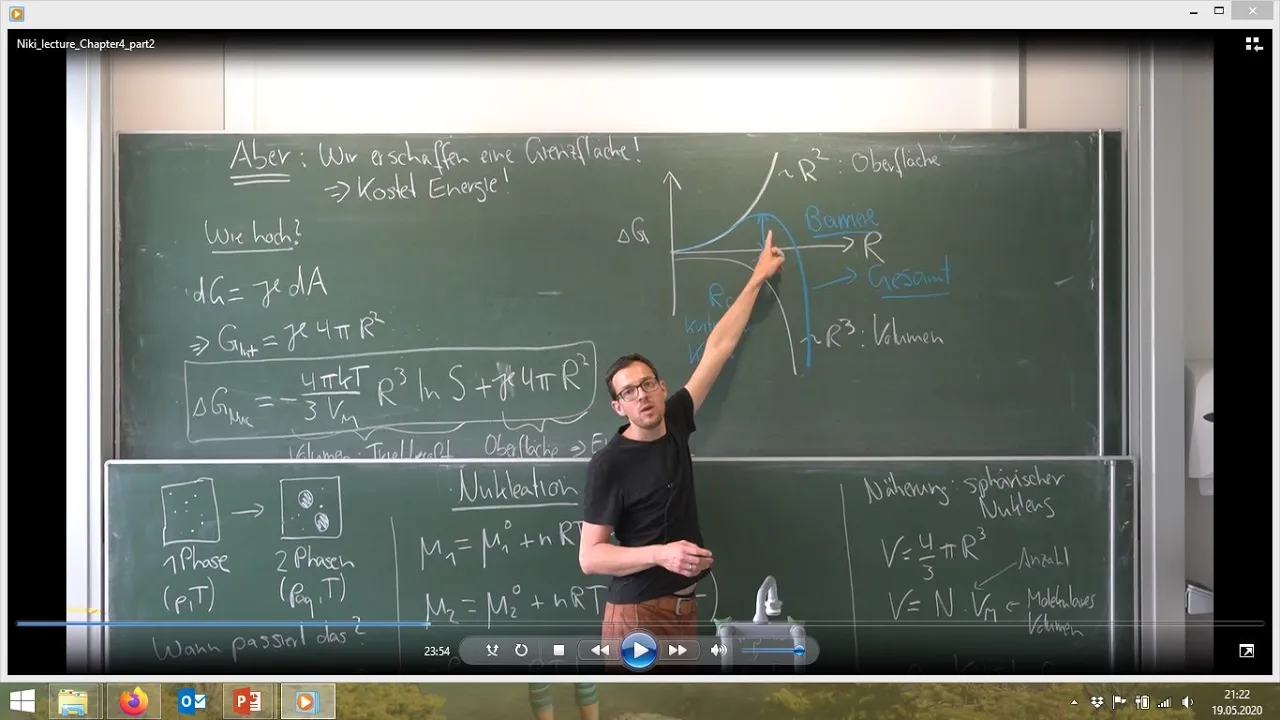
Grenzflächen in der Verfahrenstechnik 08 - Nukleation und Wachstum II: Homogene Nukleation
1.8K
Phase diagrams distinguish metastable (requiring activation energy) from unstable (spontaneous) regions. Phase transitions from single-phase to two-phase systems require work against an energy barrier. The chemical potential must decrease (ΔG < 0) for spontaneous transitions. For ideal gases, μ = μ° + RT ln(P/P°), establishing that supersaturation (P/P_eq > 1) provides the thermodynamic driving force. Without supersaturation, phase transitions cannot proceed spontaneously, explaining why metastable states persist until external perturbations trigger transitions.
Click to watch →
Deep Dive
The operating principles of thermoelectric cooling (the Peltier effect) and the physics of heat dissipation using heat sinks.

Effet Peltier : Comment ça marche ? - SILISElectronique -
76.5K
The Peltier effect, discovered by French physicist Jean Charles Peltier in 1834, is a thermoelectric phenomenon where an electric current passing through a junction between two different conductors (typically p-type and n-type semiconductors) produces either heating or cooling depending on the current direction; when current flows from p to n junctions, heat is absorbed (cooling), while current flowing from n to p junctions releases heat (heating), enabling applications like portable coolers and microprocessor cooling systems.
Click to watch →

TikTok Tech Tips are TERRIBLE
1.3M
A Peltier module (thermoelectric cooling element) works on the principle of the Peltier effect, where applying an electrical voltage across two different materials creates a temperature difference. One side becomes hot while the other becomes cold. The heat absorbed from the cold side is transferred to the hot side, which must be actively cooled by a fan or heat sink. In this case, the Peltier module was generating electricity from the temperature difference between the CPU and ambient air, powering the fan.
Click to watch →

Peltier Thermoelectric Cooler
222.2K
A Peltier thermoelectric cooler is a solid-state device that transfers heat from one side to the other when an electric current passes through it, creating a temperature difference where one side becomes cold and the other becomes hot; this principle allows for targeted cooling applications such as mini refrigerators or personal cooling units, though they require significant power (typically 60-120W) and proper heat dissipation to function effectively.
Click to watch →

Peltier Air Conditioner - How to make Peltier AC at Home
595.1K
Peltier modules (thermoelectric coolers) work on the principle of the Peltier effect, where applying an electric current causes heat to be absorbed at one junction and released at another, allowing for directional heat transfer without moving parts; when two Peltier modules are connected in parallel with a copper heat sink and cooling fan, they can effectively cool a small enclosed space by transferring heat from the cold side to the hot side, making them suitable for portable mini air conditioning units.
Click to watch →

BUILD YOUR OWN REFRIGERATOR! - SOLID STATE TEC
1.4M
Peltier devices (thermoelectric coolers) are solid-state refrigeration units discovered by Seebeck and rediscovered by Peltier. They consist of two different conductive materials (like bismuth-tin and copper) joined together. When current flows, electrons at junctions must overcome energy barriers between dissimilar metals. Electrons absorb heat at one junction (cooling it) and release heat at another junction (heating it). The process is reversible—reversing current direction reverses heat flow. These devices are lightweight, have no moving parts, operate silently, and can be powered simply by battery. However, they have lower efficiency compared to phase-change systems.
Click to watch →
Deep Dive
Basic electrical concepts, including DC power supply operation, voltage, current, and safe handling of electronic components.

How to use a DC Power Supply | Basic Electronics
117.5K
A DC power supply provides controlled direct current voltage and current to small electronic circuits, operating on the principle that power equals voltage multiplied by current (P = V × I); it features voltage and current adjustment knobs with coarse and fine settings, and includes a current limiter as a safety feature that prevents excessive current flow to protect connected components, with proper use requiring understanding of Ohm's Law (V = IR) and correct polarity connections using the positive and negative terminals rather than ground.
Click to watch →

Herramientas Basicas Ep.1 - Fuente de voltaje DC Variable
160
A basic DC power supply operates in two modes: Constant Voltage (CV) and Constant Current (CC), with the CV mode maintaining stable voltage output while the CC mode limits current to protect connected loads; the power supply features adjustable voltage and current controls, an integrated wattmeter that calculates power consumption by multiplying voltage and current, and built-in protection systems that activate during overload conditions to prevent damage to both the supply and connected equipment.
Click to watch →

DC Power Supply | How to use it | full Description | GW Instek
162
A DC power supply converts AC to DC power for electronic testing and circuit powering, featuring adjustable voltage and current settings with safety features like short circuit protection; when using it, always set current limits below 1A to protect electronic components, and use a multimeter to verify output voltage by connecting probes to the correct terminals with the selector switch set to voltage mode.
Click to watch →
![[ARDUINO] 전자회로 기초](https://i.ytimg.com/vi_webp/VtBB5u85KCw/maxresdefault.webp)
[ARDUINO] 전자회로 기초
283.1K
This section covers the three fundamental electrical concepts essential for understanding electronics. Voltage (전압) represents potential energy stored in a system, similar to pressure, measured in volts. Current (전류) is the actual flow of electrical energy through conductors, converting to light, heat, or mechanical motion. Resistance (저항) opposes current flow, with conductors having low resistance and insulators having high resistance. The critical relationship is that current cannot exist without voltage, and the danger of electric shock comes from current, not voltage alone. A 1.5V battery is safe, but 220V can cause shock because it drives sufficient current through the body.
Click to watch →

DC Power Supply එකෙන් දුරකතනවල ලෙඩ අල්ලන ක්රමේ | How To Use DC Power Supply In Mobile Repairing
29.8K
DC Power Supply is an essential electronic device that converts AC power to DC power for powering electronic equipment. The video introduces the basic concept of DC power supply and explains its role in providing stable electrical power to various devices. Voltage represents the electrical potential difference that drives current through a circuit, while current measures the flow of electrical charge. Understanding these fundamental electrical parameters is essential for proper power supply operation and device protection. The presenter emphasizes that DC power supply is critical for devices requiring direct current rather than alternating current.
Click to watch →
Prerequisite Knowledge
- Concept 01Fundamental concepts of ionizing radiation, specifically the nature and characteristics of alpha particles, beta particles, and cosmic muons.
- Concept 02The thermodynamics of phase transitions, particularly the mechanism of vapor supersaturation and how condensation nucleation occurs around charged ions.
- Concept 03The operating principles of thermoelectric cooling (the Peltier effect) and the physics of heat dissipation using heat sinks.
- Concept 04Basic electrical concepts, including DC power supply operation, voltage, current, and safe handling of electronic components.
Subsequent Learning
- Step 01Particle track morphology analysis: How to visually differentiate between alpha particles, beta particles, and cosmic rays based on track thickness, straightness, and deflection.
- Step 02The integration of magnetic fields (Lorentz force) with the cloud chamber to determine the charge-to-mass ratio and polarity of incoming particles.
- Step 03The historical evolution and engineering of advanced particle detectors, transitioning from cloud chambers to bubble chambers and modern gaseous ionization detectors.
- Step 04Quantitative radiation shielding experiments using various materials (aluminum, plastic, lead) to measure particle attenuation within the chamber.
Peltier Setup
Cloud Basics
Cooling Design
Stacked Units
Final Assembly
Peltier Setup
0:01Playing Section
- 1
Desk contains a Peltier-based cloud chamber device.
- 2
Two stacked Peltier units cool the chamber bottom.
- 3
A PC fan assists in cooling the assembly.
Performance Limitations and Technical Hurdles of Peltier-Cooled Cloud Chambers
While Peltier-cooled cloud chambers eliminate the hassle of sourcing dry ice, they present significant technical hurdles and performance trade-offs. Thermoelectric coolers (TECs) struggle to reach and maintain the deep sub-zero temperatures (ideally below -30°C) necessary for a robust, highly active supersaturated vapor layer. To achieve sufficient cooling, DIY builders must stack multiple Peltier stages, which requires complex thermal management, high-current power supplies, and bulky water-cooling systems to dissipate massive waste heat. If heat dissipation is insufficient, the hot side of the Peltier elements will overheat, ruining the temperature gradient or destroying the components. Consequently, Peltier cloud chambers often feature an extremely thin and finicky sensitive layer, resulting in faint, inconsistent particle tracks compared to the deep, reliable cold of traditional dry ice. For classroom demonstrations, critics argue the high setup complexity and low track visibility can make Peltier systems less effective than dry ice chambers or modern solid-state PIN diode detectors.
Deep Dive
Particle track morphology analysis: How to visually differentiate between alpha particles, beta particles, and cosmic rays based on track thickness, straightness, and deflection.

Cold Nuclear Transmutation & Ball Lightning 27 - Monday Afternoon
276
This section provides detailed analysis of track morphology using electron microscopy and atomic force microscopy. Periodic tracks show precise repetition of patterns, with particles appearing to stamp or roll along surfaces. Track periods range from 20-200 micrometers, yielding particle diameters of 7-70 micrometers when assuming rolling without slipping. Some tracks show evidence of particle fragmentation, with single particles splitting into multiple parallel paths. The forces required to move these particles along surfaces are much larger than gravitational forces, indicating non-gravitational mechanisms are at work.
Click to watch →

2009 - University of Missouri LENR Seminar - Dr. Pamela Mosier-Boss
515
Due to limited particle range in water (10 microns reduces alpha energy by 2 MeV), CR-39 detectors must be positioned near cathodes. Initial nickel screen experiments revealed impressions mistaken for particle tracks, later attributed to X-ray/gamma ray damage. Magnetic field application distinguished directional particle tracks from isotropic background damage. Nuclear tracks exhibit diagnostic features: dark surface appearance with bright central spot (conical tip acting as lens) versus shallow, featureless background damage. Track morphology varies—circular, elliptical, or torpedo-shaped depending on incidence angle. Triple tracks indicate reactions producing three particles of equal mass and energy. Control experiments validated nuclear origin: no tracks without electrolysis, no tracks without palladium chloride, no tracks with copper chloride, and reduced tracks with light water (four orders of magnitude fewer than heavy water).
Click to watch →

LION - Tracks... Does this confirm the Kieth Fredericks Tachyon structure?
850
Track structures can be assembled from multiple image series to create complete visual representations with scale references. The formation mechanism involves dual counting processes where particles pass through material, creating cone shapes and entry points. Particles may spin or tear through the material during passage, producing characteristic holes and conical structures. Three-dimensional visualization using anaglyph imaging reveals bowtie-like structures and provides spatial context. Track analysis shows fairly regular sizes within specific ranges, with measurable distances between footprints. Raw image files enable detailed examination of track morphology, supporting systematic analysis of formation processes and underlying mechanisms.
Click to watch →

2009 - University of Missouri LENR Seminar - Dr. Pamela Mosier Boss
2K
Track analysis distinguishes nuclear signals through diagnostic features: nuclear tracks appear dark on surface with bright central spots (cone tip acting as lens), while chemical damage shows shallow bright tracks. Track modeling using Track Test Program (N. Nisic) simulates track formation based on energy, angle (30-90°), etch rate, and time. For 1.3 MeV alphas at 35° with 1.25 μm/h etch rate over 6 hours, modeled dimensions (D1=5.59 μm, major axis=9.32 μm, minor axis=7.68 μm) closely match measurements. Particle angle affects track shape: oblique incidence produces elliptical/torpedo shapes; perpendicular incidence creates circular tracks. Mylar filters demonstrate energy reduction: 18 μm reduces 5.5 MeV alphas to 1.92 MeV, 24 μm to 1.09 MeV. Only perpendicular-incidence particles retain enough energy to create detectable tracks after filtering, explaining why CR-39 detectors must be positioned close to cathodes in electrolysis experiments.
Click to watch →

Feynman: Take the world from another point of view (2/4)
485.6K
In bubble chamber photographs, straight tracks indicate unbroken particles. When particles collide with nuclei, they produce branching tracks resembling a Y-shape. More complex disintegrations create multiple branches. Since particles travel nearly at light speed, short tracks correspond to extremely brief timescales (fractions of a billionth of a second).
Click to watch →
Deep Dive
The integration of magnetic fields (Lorentz force) with the cloud chamber to determine the charge-to-mass ratio and polarity of incoming particles.

Lec 03 Determination of Charge Mass Ratioof Electron, 11th Chemistry
51.9K
Fleming's Left-Hand Rule determines force direction on current-carrying conductors in magnetic fields, while Fleming's Right-Hand Rule determines induced current direction. Conventional current flows positive to negative, while electron flow is opposite. J.J. Thomson discovered the electron in 1897 using a cathode ray tube, a vacuum tube with cathode and anode electrodes. When high voltage is applied, cathode rays (streams of electrons) are emitted from the cathode and travel toward the anode, striking a fluorescent screen to produce light. Cathode rays are deflected by both electric and magnetic fields. In an electric field, they deflect toward the positive plate because they carry negative charge. In a magnetic field, they deflect according to Fleming's Left-Hand Rule. The amount of deflection depends on the charge-to-mass ratio. Thomson determined the charge-to-mass ratio of the electron to be 1.76 × 10^11 C/kg, much larger than any known atom, indicating electrons are very light particles with significant charge. Thomson found that cathode rays have the same properties regardless of the gas or cathode material used, indicating electrons are universal subatomic particles present in all matter.
Click to watch →

Buniyaad: NCERT ONE SHOT: Structure of Atom CBSE || CUET || JEE || NEET || JEE MAINS || IIT
704.3K
J.J. Thomson determined the charge-to-mass ratio (e/m) of electrons by applying perpendicular electric and magnetic fields to cathode rays. He balanced the fields so electrons traveled in a straight line. By varying field strengths and measuring deflection, Thomson calculated e/m for electrons. The deflection depends on charge magnitude (greater charge = greater deflection) and particle mass (lighter particles deflect more easily). This experiment established electrons as fundamental particles with specific charge and mass properties.
Click to watch →

🔴 චුම්භක ක්ෂේත්ර ආරෝපණ මත බල 2026 REVISION | PHYSICS | ANURADHA PERERA
28.6K
The charge-to-mass ratio (e/m) of a particle can be determined by measuring the radius of its circular path in a known magnetic field. Using the formula r = mv/BQ and the velocity from the electric field acceleration, the charge-to-mass ratio can be calculated. This was how J.J. Thomson discovered the electron.
Click to watch →

Física 3 - Aula 14 - Campo Magnético (Parte 2)
20.3K
When a charged particle moves perpendicular to a uniform magnetic field, it undergoes uniform circular motion. The magnetic force provides the centripetal force: F = mv²/r = |q|vB. The radius of the circular path is r = mv / (|q|B). By measuring the radius of curvature in a known magnetic field, the charge-to-mass ratio can be determined.
Click to watch →

مراجعة الفصل الثاني الشهريات والانتساب والتمهيدي
59.4K
The Lorentz force is the combined force experienced by a charged particle in the presence of both electric and magnetic fields. It is the vector sum of the electric force (F_E = qE) and the magnetic force (F_B = qvB sin(θ)). The Lorentz force is given by the formula F_Lorentz = F_E + F_B = q(E + v × B), where E is the electric field, v is the velocity, and B is the magnetic field. This force is fundamental to understanding the motion of charged particles in electromagnetic fields.
Click to watch →
Deep Dive
The historical evolution and engineering of advanced particle detectors, transitioning from cloud chambers to bubble chambers and modern gaseous ionization detectors.

UKRN webinar: OpenMAPP UK - Meta-Analysis and reinterpretation in particle physics
282
Particle detection technology evolved from simple cloud chambers (discovered by CTR Wilson in Scotland) to sophisticated bubble chambers and finally to modern silicon-based detectors. Modern detectors like ATLAS at CERN are massive structures (20m high, 40m long) with multiple layers designed to measure different properties of particles passing through, allowing physicists to reconstruct collision events like examining broken watch components to understand the original mechanism.
Click to watch →
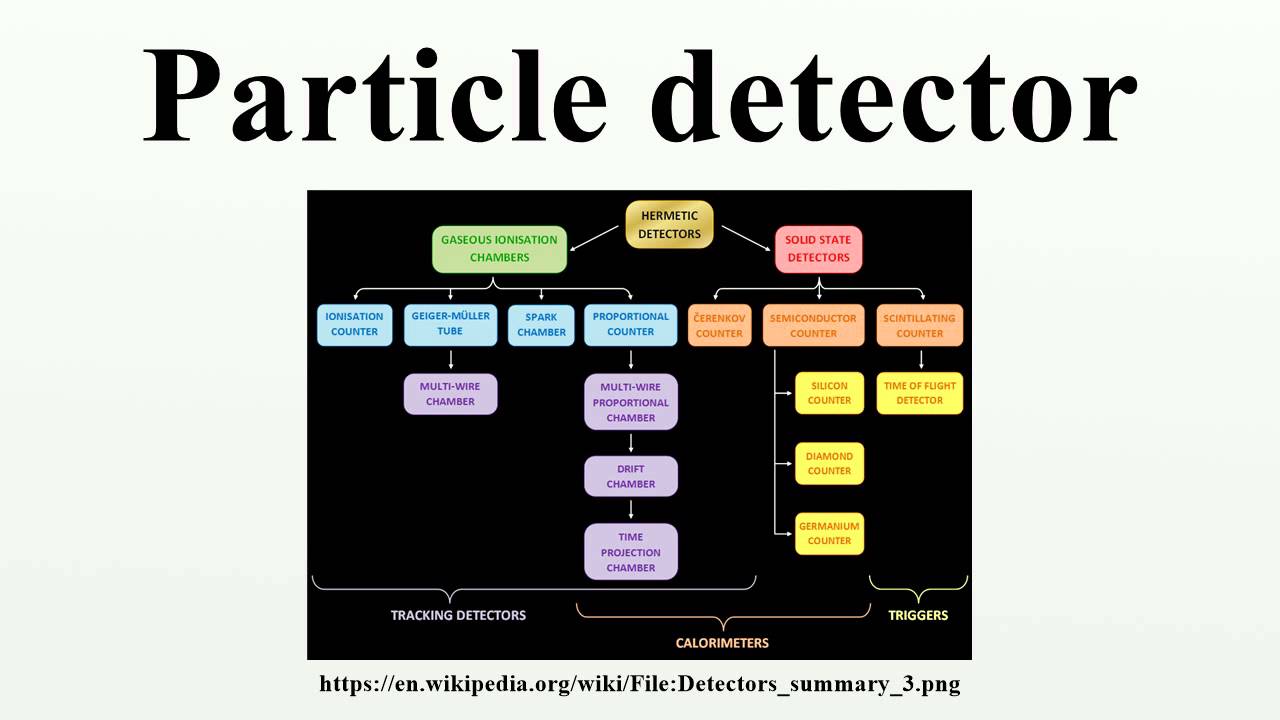
Particle detector
113
Particle detectors (radiation detectors) detect, track, and identify high-energy particles from nuclear decay, cosmic radiation, or particle accelerators. Modern detectors serve dual roles as calorimeters measuring radiation energy and can determine particle attributes like momentum, spin, and charge. The terminology distinguishes 'counters' (which count particles without resolving energy/ionization) from general detectors. Historical development progressed from ionization and scintillation detectors to advanced principles like Cherenkov light and transition radiation. Early examples include bubble chambers, Wilson cloud chambers, and photographic plates. Modern layered detector systems combine multiple technologies in hierarchical structures, exemplified by collider experiments like CMS, ALICE, and LHCb at CERN, along with non-collider applications such as Super Kamiokande and AMANDA for neutrino and dark matter research.
Click to watch →

Wie die verborgene Realität der Materie, enttarnt wird.
9.9K
Particle detectors visualize subatomic particles by detecting traces they leave in materials. Cloud chambers, developed over a century ago, use gas that condenses when ionized by charged particles, creating visible droplet tracks. Magnetic fields cause charged particles to curve, revealing their charge and momentum. In the 1930s, cloud chambers led to discoveries of the positron, muon, and tau. Bubble chambers, developed in the 1950s, use liquid that forms steam bubbles along particle paths. Multi-wire proportional chambers (1968) revolutionized detection by recording millions of tracks per second, enabling discoveries of the charm quark, gluon, and W/Z bosons. Time projection chambers with liquid argon provide 3D high-resolution imaging. Cherenkov radiation detects particles moving faster than light in a medium. Modern detectors at CERN integrate multiple technologies within strong magnetic fields, using computers to reconstruct collision events.
Click to watch →

8.02x - Lect 13 - Moving charges in B-fields, Cyclotrons, Mass Spectrometers, LHC
277.9K
Detecting invisible particles required innovative approaches. Cloud chambers use supersaturated alcohol vapor that condenses along ionized particle tracks; higher-energy particles travel farther before losing sufficient energy. Tracks curve in magnetic fields, with radius decreasing as particles lose energy. Anderson discovered the positron in 1932 by observing tracks curving in the wrong direction, validating Dirac's antimatter prediction. Bubble chambers replaced cloud chambers with superheated liquid hydrogen, producing denser tracks due to higher density. Between 1958-1968, 30 new particles were discovered using these techniques. MIT researchers including Sam Ting, Steven Weinberg, Jerry Friedman, Henry Kendall, and Clifford Shull made Nobel Prize-winning contributions to this field, revolutionizing our understanding of nuclear physics.
Click to watch →

#CERN70 #Live Exploring farther: machines for new knowledge
7.3K
Experimental particle physics is only about 100 years old. Early detectors included cloud chambers (showing particle tracks as droplet trails), photographic nuclear emulsions (capturing tracks on film), and bubble chambers (creating bubbles in superheated liquid). These detectors required researchers to sit in dark rooms for hours counting particles. Modern electronic detectors have replaced these methods, enabling much higher data rates.
Click to watch →
Deep Dive
Quantitative radiation shielding experiments using various materials (aluminum, plastic, lead) to measure particle attenuation within the chamber.
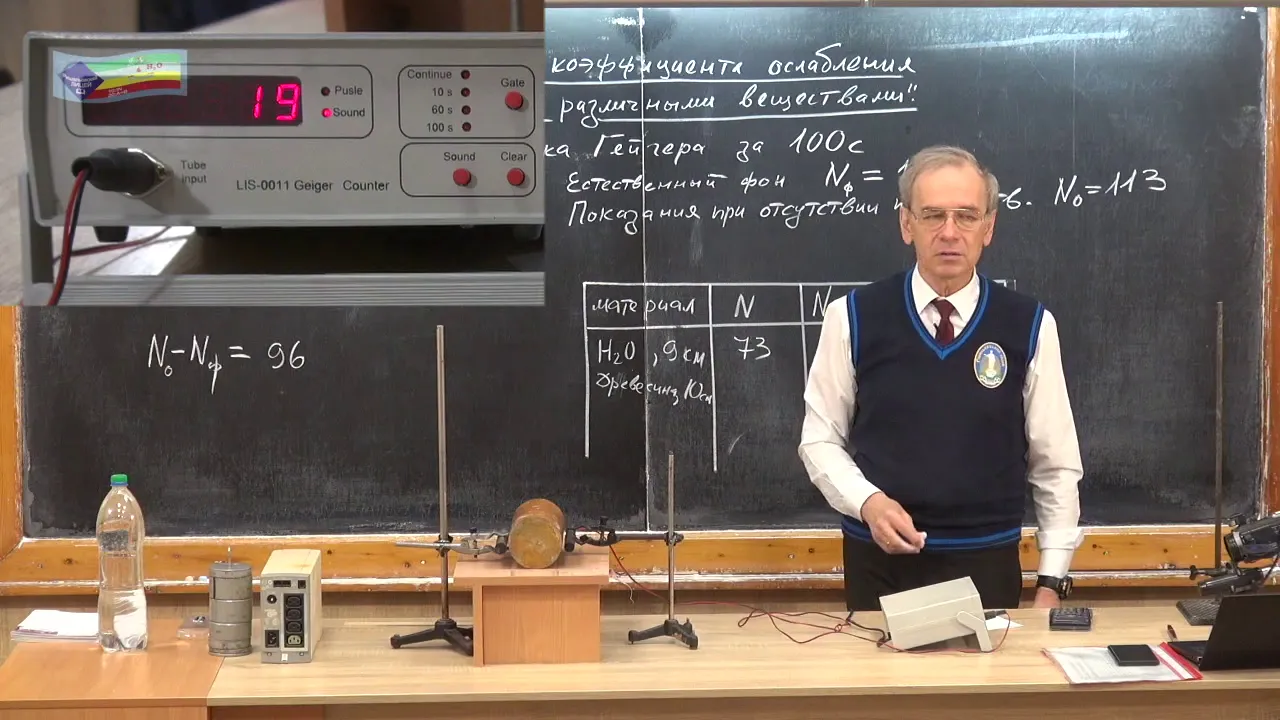
Урок 228 (осн). ЛР Определение коэффициента ослабления гамма-излучения различными материалами
32.3K
This segment continues the radiation attenuation measurements with aluminum and lead shielding. An aluminum block (8 cm thick) is tested, yielding 45 counts after background subtraction. Finally, a lead-containing device (approximately 9 cm thick) is tested, yielding 19 counts after background subtraction. These results demonstrate that lead provides the strongest attenuation among the tested materials, significantly reducing gamma radiation intensity. The experiment shows a clear trend: denser materials provide better gamma radiation shielding.
Click to watch →

Уран и Рентген в камере Вильсона! Uranium and X-ray in the Wilson chamber!
56.6K
Radiation intensity can be reduced using shielding materials. A lead plate with a small central aperture placed before the diaphragm allows radiation to pass through as a thin beam. This significantly reduces the intensity of radiation reaching the Wilson chamber. Further reduction can be achieved by placing multiple aluminum plates (three in this case) before the aperture. The combination of lead and aluminum shielding effectively controls radiation exposure while still allowing visualization of particle tracks in the Wilson chamber.
Click to watch →

Experiment 7: The Good, the Bad, and the Nuclear!
1.2K
This section examines how different materials block radiation. Students test strontium-90 fallout with plastic (3505 counts), aluminum (2468 counts), thicker aluminum (794 counts), even thicker aluminum (226 counts), and lead (only 48 counts). The instructor demonstrates replacing shields in real-time, showing counts drop significantly with denser materials. Lead's density of 11.3 g/cm³ makes it far more effective than aluminum's 2.7 g/cm³ or plastic's 0.92 g/cm³. The demonstration shows how radiation intensity varies dramatically based on material properties, with lead almost stopping all radiation while plastic shows minimal effect.
Click to watch →

Новый вид оружия для Путина
58.1K
Mean free path is the average distance particles travel between collisions. For air molecules at normal pressure, this is ~70 nanometers; for electrons in metals, 10-50 nanometers. Radiation penetration varies by type: alpha particles stop in paper, beta particles in aluminum, gamma rays require lead. Neutrinos' enormous mean free path allows them to pass through Earth undetected. Increasing neutrino energy and target density reduces mean free path, enabling detection and potential weaponization.
Click to watch →

Taller 1: Radioquímica
1.2K
Radiochemistry is the chemistry of ionizing radiations, studying atoms that emit radiation to achieve stability. Two main types of ionizing radiation exist: beta particles (electrons from atomic nuclei) and gamma rays (high-energy electromagnetic radiation). The experiment demonstrates how different materials attenuate radiation using Strontium-90 (beta source) and Cesium-137 (gamma source). Materials tested include paper, plastic, and lead sheets. The procedure involves measuring baseline radiation intensity, then placing materials between the source and detector to observe attenuation effects. Results show paper has minimal attenuation, plastic shows moderate effects (more pronounced for beta), and lead provides near-complete attenuation with just two sheets.
Click to watch →
Peltier Setup
Cloud Basics
Cooling Design
Stacked Units
Final Assembly
Peltier Setup
0:01- 1
Desk contains a Peltier-based cloud chamber device.
- 2
Two stacked Peltier units cool the chamber bottom.
- 3
A PC fan assists in cooling the assembly.
Performance Limitations and Technical Hurdles of Peltier-Cooled Cloud Chambers
While Peltier-cooled cloud chambers eliminate the hassle of sourcing dry ice, they present significant technical hurdles and performance trade-offs. Thermoelectric coolers (TECs) struggle to reach and maintain the deep sub-zero temperatures (ideally below -30°C) necessary for a robust, highly active supersaturated vapor layer. To achieve sufficient cooling, DIY builders must stack multiple Peltier stages, which requires complex thermal management, high-current power supplies, and bulky water-cooling systems to dissipate massive waste heat. If heat dissipation is insufficient, the hot side of the Peltier elements will overheat, ruining the temperature gradient or destroying the components. Consequently, Peltier cloud chambers often feature an extremely thin and finicky sensitive layer, resulting in faint, inconsistent particle tracks compared to the deep, reliable cold of traditional dry ice. For classroom demonstrations, critics argue the high setup complexity and low track visibility can make Peltier systems less effective than dry ice chambers or modern solid-state PIN diode detectors.
Fundamental concepts of ionizing radiation, specifically the nature and characteristics of alpha particles, beta particles, and cosmic muons.
The thermodynamics of phase transitions, particularly the mechanism of vapor supersaturation and how condensation nucleation occurs around charged ions.
The operating principles of thermoelectric cooling (the Peltier effect) and the physics of heat dissipation using heat sinks.
Basic electrical concepts, including DC power supply operation, voltage, current, and safe handling of electronic components.
Particle track morphology analysis: How to visually differentiate between alpha particles, beta particles, and cosmic rays based on track thickness, straightness, and deflection.
The integration of magnetic fields (Lorentz force) with the cloud chamber to determine the charge-to-mass ratio and polarity of incoming particles.
The historical evolution and engineering of advanced particle detectors, transitioning from cloud chambers to bubble chambers and modern gaseous ionization detectors.
Quantitative radiation shielding experiments using various materials (aluminum, plastic, lead) to measure particle attenuation within the chamber.
6.2K views6likes2:21@NothinglabsOriginal Release: 2010-02-03
uh so amongst bun other crap in my desk here I've got uh my Peltier based Cloud chamber uh Cloud chamers typically require dry ice or some other kind of super cold substance to uh get them down to the point where you get the a super saturated uh environment at the bottom where you actually see the trails in uh but I'm using uh two of these guys and they're stacked you can't quite see them but they're stacked on top of each other uh between this Tupper container uh and uh there's just like a PC cooling uh uh setup here nice big fan on it for that
Up Next

1:36
Teaching Radioactivity: Diffusion Cloud Chamber Experiment
@InstituteofPhysics
25K views•2019-07-24

12:53
21cm Hyperfine Transition in Neutral Hydrogen: Radio Astronomy Basics
@AaronRobertParsons
12.4K views•2011-10-13

32:32
NMR Spin Physics I: Zeeman Effect, Resonance Condition & Larmor Frequency
@nptel-indianinstituteofsci8064
2.3K views•2024-01-17

27:14
Entropy and the Second Law of Thermodynamics Explained
@veritasium
27.5M views•2023-07-01
Related Study Plans & Knowledge Roadmaps
Structured learning paths in Physics
physics
Nuclear Physics (Decay, Fission & Reactors)
01Atomic Structure and the Binding Force
02Radioactive Decay and Half-Life
03Nuclear Fission Mechanics and Chain Reactions
+ 2 more learning modules
12h5 modules
Explore Roadmap
physics
Soft Matter (Polymers, Colloids & Rheology)
01Foundations of Soft Matter & Thermal Forces
02Polymer Physics and Macromolecules
03Colloids, Surfactants, and Self-Assembly
+ 2 more learning modules
38h5 modules
Explore Roadmap
physics
Analytical Mechanics: Lagrangian & Hamiltonian
01Mathematical Foundations: Calculus of Variations
02From Newtonian Mechanics to Constraint Dynamics
03The Principle of Least Action & Lagrangian Mechanics
+ 3 more learning modules
28h6 modules
Explore Roadmap
physics
General Relativity (Spacetime & Cosmology)
01Foundations of Relativity: Special Relativity
02The Geometry of Spacetime: Equivalence Principle & Curvature
03Einstein's Field Equations: The Mathematics of Gravity
+ 2 more learning modules
55h5 modules
Explore Roadmap