

![Data Collection and Goals Scoring with SLP Toolkit [Tool Tips]](https://i.ytimg.com/vi_webp/nNW4K69QS_I/maxresdefault.webp)

















Effective speech therapy for speech sound disorders requires using dynamic tactile temporal cueing to maintain an 80% accuracy rate at all times, starting with the most challenging three-element clusters rather than easier targets, and measuring progress through standardized single-word speech tests every two months to ensure generalizable gains through cascading improvement rather than practice effects.
Data-Driven Progress Monitoring for Speech Sound Disorders
Added:Fundamental understanding of Speech Sound Disorders (SSDs), including the distinction between articulation and phonological impairments.
Basic knowledge of clinical data collection methods in speech-language pathology, such as calculating percentage-of-accuracy metrics.
Familiarity with standard speech therapy intervention frameworks and target selection strategies (e.g., developmental vs. complexity approaches).
Understanding the concept of clinical baselines and how they serve as a reference point for measuring therapeutic change.
Design and implementation of generalization probes to assess if speech sound improvements transfer to untrained words and conversational contexts.
Application of Single-Case Experimental Designs (SCED) to empirically evaluate the efficacy of specific speech interventions.
Utilization of digital data-tracking tools and visual dashboarding to present progress trends clearly to families and stakeholders.
Developing clinical decision-making protocols for when to modify, progress, or discharge a client based on quantitative plateau or mastery trends.
326 views10likes33:04Original Release: 2025-01-19
If you work with children with speech sound disorders, this is a can't miss session for you.
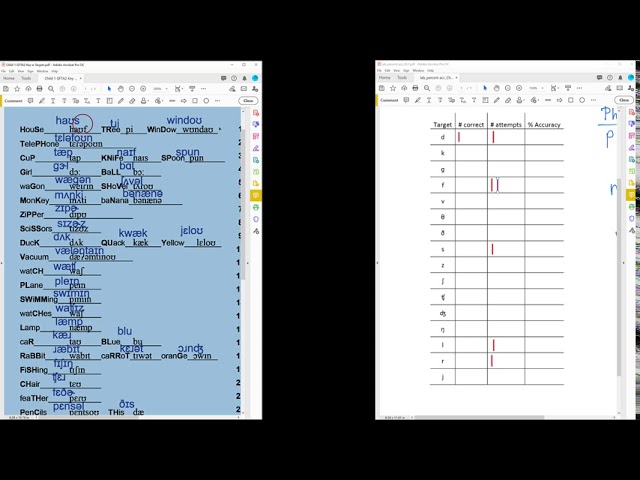
I'm talking about how I keep data.
So the way I keep data is not your mama's data, what you learned in graduate school.
It's quite different.
And I'm going to explain why I do things differently.
And if this doesn't work for you, that's fine.
If you're a bean counter and you're like, I need to keep data every second of the day.
And I need to keep data on every different cue I do.
And this is very important to me.
You do you.
I'm going to show you what works for me for my clients.
So here, I'm going to start.
Let's start off in step one of how I do therapy.
Here you can see my revised treatment target library.
I just revised it this month.
It's coming out to my CIS members for the month of January.
I'm sending this out.
This has been revised through 2025.
In these targets, you're going to see clusters, clusters, and more clusters.
So in the beginning level cluster I have here on top, these are children with very severe speech impairment.
These are children with childhood apraxia speech that are vowelizing.
That is when I work at the sentence level.
with a simple S- blend.
Then as we move down, I have two complex clusters, a three element in an affricate cluster with an R- blend in it.
And then we come down here and we go into a complex sentence.
And then we go into a paragraph.
And then I have a generalization cluster.
in which the child is producing the R in five very different manners in one tongue twister of a sentence.
So those are for children who are at the end of the road.
Now, when you look at these clusters, what I do is my starting point is where can the child do the cluster accurately at an 80 percent accuracy rate when I give them every single cue I have in my toolbox.
- I'm giving them all the cues.
I'm giving them all the scaffolds.
This is the Eiffel Tower.
Every scaffold possible to go as high as I can go.
Because the higher you aim, the higher the gains.
That's the rule.
If you go for a three element, S- blend such as 'stretch' it to them, you are going to get much higher gains than if you go for a two element S blend such as 'slide' it to them.
So I want to go for those three element S blends.
I want to use that R. If the child's not able to do the R, I will go for an SKW because our research showed the three element S- blends are much more powerful than the two element blends that contain R. Three trumps two.
It's just like poker.
Now, when I look at these blends, I'm going to start at our highest point.
Now, I say this, but I've changed my ways a bit, and at the beginning of the school year, I like to kind of fade in the demands.
So I have a set sentence level sentence trip with a three element and an African blend that I start on the first week of school.
Then very quickly by the second month, I'll move to a paragraph or a complex sentence.
But that's just kind of something new I've developed in fading in the demands so the child is not overwhelmed.
So that is a new step and I found it to be a valuable step to just kind of take that month to really focus on rapport and relationship building.
And don't worry, they're going to get that paragraph, which was going to give you much greater gains than a complex sentence or a sentence.
There will be time.
We have eight more months in the school year.
We're going to be there at the highest level.
So that is where I like to start.
in the first mother's school.
Then I like to very quickly, like the second mother's school, move to a paragraph, or at least a complex sentence.
Now, how do I do my data?
My data is based on an 80 percent accuracy rate at all times.
So what does that mean?
I'm looking for four out of five accurate at a moment to moment basis.
For instance, if I'm doing a literacy activity with 'Brown Bear, Brown Bear,' and the child's the zookeeper and the child's putting All of the animals in the zoo, we're looking at like nine different animals there, right?
And each time before they get to put the animal in the zoo, they're going to read their paragraph.
In the beginning, it's novel.
It's So fun.
They're gonna get that sticker from my SIS membership that is going to have the brown bear.
They're gonna get a nice little brown bear to hold in their hand too, to throw in the zoo and they get to stick it on, get to come back and check the checklist.
Being a zookeeper is a lot of fun.
Then they get like to the last animal.
I believe it's the peacock.
And they're just like not that into it.
They've done this eight times before.
At that point is I'm going to bring the prompts up because the motivation went down.
I want to make sure that the child is still 80 percent accurate, despite lower attention, lower motivation.
The whole name of the game is on a moment to moment basis, I am providing the level of.
cueing and scaffolding that ensures that this child is 80 percent accurate.
That's where the term dynamic tactile temporal cueing comes into play.
It's not, okay, in this session, I'm going to provide a direct imitation prompt.
In this session, I'm going to provide a gesture prompt.
In this session, I'm going to provide a tactile cue.
No, it's in every moment the cueing is going to change based on the child's performance.
So it's very much this back and forth dance that requires you to be present, that's when the magic's going to happen, and to sensitively respond to the child.
Always, we're at an 80 percent accuracy rate.
If it's too easy for the child, I need to pull back on the cues.
If it's too hard for the child and the child is below 80%, I need to up the cues.
Because if the child is going below 80%, we're likely going to be practicing poor motor patterns.
Just as practice makes perfect, practice makes imperfect.
So I need to up those cues to make sure we're minimally at an 80 percent rate.
Also, the child's going to be frustrated.
We don't want that.
Here we are, we're saying our paragraph, we're going through the animals every time before they get to pick that animal, pick that sticker, and do that movement activity and go on their way and read the book.
Then we're going to come back and check the checklist.
Every moment, change the level of cueing.
So if the child's distracted by something, they're interested in a toy on the shelf, okay, the cueing is gonna go up a level.
Okay, if the child is all in, oh my goodness, this child is all in, they need no cues at all right now.
They're paying total attention.
They're self monitoring.
Pull back.
No cues.
That is how you're going to be effective in dynamic tactile temporal cueing, is that you use every cue available to you.
And I know a lot of you that have been doing this 30 years, you have a Sears Craftsman toolbox that's the size of your garage.
You have a lot of cues that you can pull out and a lot of cues you can put away.
That's what we're going to do.
I'm working on the highest level.
that the child can possibly do.
I'm providing all of my cues to provide an 80 percent accuracy and I'm pulling away the cues -especially the verbal- whenever I can.
The verbal cue is the one that you want to be first to pull away because when you pull away that cue the child is doing their own pushups.
The child is doing the motor planning, the motor programming, the motor execution.
As long as you're providing that verbal imitation prompt, you are doing the motor planning, the motor programming, and even the execution, and the child is passively along for the ride.
That's why it's really important to use multimodal cues so you can stop talking and the child can be the teacher.
That is the level of cuing I'm providing on day one, is a maximum level of cuing.
Now, at the end of the school year, I might be providing a maximum level of cuing.
And I'm doing that because the child might be sick that day.
The child might be not interested in the activity.
The child might be talking silly and being really, really goofy and not regulated.
It's not like, okay, I'm coming in, this is my game plan, this is how I behave, you're not like a robot.
I have something that's programmed in me and this is the level I'm going to perform at.
It's like a dance.
That's what makes us special as human beings, is that we're able to sensitively respond to the child on a moment to moment basis, and in doing so, that's how we're going to optimize gains, paying attention to the whole child.
What happens is every two months for data, I give a single word speech test.
Now, you might say, why are you giving a single word speech test?
That's, that's not real speech, but actually it is.
At the preschool level, the research indicates that single word speech tests are very much right in line with how they speak in conversational speech.
When you show a preschooler a picture, you say, what's that?
The child just answers the question, and that's because the metacognitive skills in which the child is looking at the picture, paying attention to their speech, saying things how you should say that, that really develops at five to six years of age.
So when you're working with preschoolers, you're gonna, they're gonna answer those questions just like they normally would talk.
They're gonna answer semantically.
What is that?
That's a sheep.
They're not going to say, that's a sheep, I make that shh sound.
They're not going to do that because they haven't developed those metacognitive skills yet.
So in a way, the single word test is more reliable than a spontaneous speech sample.
Because in a spontaneous speech sample, you may not hear these sounds that you're targeting.
The child may not produce the 'ch' or the 'j' that the child has difficulty with in that spontaneous speech sample.
They may not produce the l sound that they have challenge with.
You're missing out on these sounds just because the words weren't there for them to use it in the spontaneous speech sample.
However, we know we have that phonetic balance in the single word speech test.
So what I'm doing is every two months, which is basically progress report time, if you work in the schools, you have four progress report periods.
So every two months, you test the child with a single word speech test.
Now don't worry about test retest reliability.
When it comes to language testing, you need oftentimes a good six month break because you're going to have practice effects and you could have an inflated score.
But that's not the case in single word speech tests.
You can use the same test, and I encourage you to use the same test because there's so much variance between the tests.
I've done other research that has shown that you get very different results on the CAP 2 than the GIFTA 3 when it comes to three year olds.
You always want to use the same test.
You want to compare apples to apples, not apples to oranges.
So, I give the same test every progress reporting period.
Now, why is that?
I don't want to know about practice effects.
I don't want to know that this paragraph that we're saying together, you can say more clearly due to practicing it over and over again.
I care about generalizable communication gains.
I care about your overall speech intelligibility.
Has that improved?
And, It has improved oftentimes, not in the targets we are training, because I'm working on three element clusters.
Three element clusters develop at six, seven, even eight years of age, right?
So they develop way down the road.
But I'm working on these most challenging sounds with scaffolds, because then I'm going to get bigger gains.
What happens is the child develops the speech sounds, and they develop it in a very developmental manner.
So if I have a child that's deleting final consonants, that's deleting syllables, the first thing that's going to develop when I'm working on STR blends and DR blends is the final consonant deletion, the syllable deletion.
That's going to develop first.
I don't focus on that in therapy.
I'm going over it.
And by going over it, I get generalization in which it spontaneously develops through a cascading impact.
So, when I give that CAAP-2 test, I say, okay, I'm going to We no longer have final consonant deletion.
The child is now producing the final consonants in 80 percent or more of the words tested.
In the beginning of the school year, they deleted final consonants in 80 percent of the words tested.
Okay, previously, the child was unable to produce P, B, T, D, N, these early stop sounds. Now they are.
That's how the speech is going to develop.
Now, I've mentioned before children with autism break the rules, but I mean, generally speaking, children with speech sound disorders, they're going to produce that sound of stop consonants next.
So am I focusing on the stop consonants in my treatment target?
No, I'm going over that.
But because I'm going over that, the child is running up those stairs and making progress, not crawling up the stairs.
They would be crawling up the stairs if I was focusing on final consonant deletion, if I was focusing on the easiest target.
When I focus on the easiest target, All I get is the easiest target.
There isn't a geyser impact.
It's a waterfall impact.
So I sing this song, and if you, you saw me on speechpathology.com You heard my bear hunt song.
I sing it to the bear hunt.
We're going on a target hunt.
I say, we can't go at it.
That won't generalize.
Can't go under it, that won't help, must go over it, cascading impact.
So when you're doing your treatment target in speech therapy, you bring your scaffolds in, you bring that toolbox in, you empty it out, and you go over the target.
That is the secret.
I'm going over the target.
And the child, the first time I test them in the fall, they're not deleting syllables, they're not deleting the final consonants, and they're getting those early stop sounds on.
Then I test them in the spring.
I give them the test two months later.
Why two months later?
Because the research indicates you need eight weeks on average to get generalization in speech and language gains from therapy.
A lot of people are like, every session, you got to take data.
Well, what are you taking data on?
It takes eight weeks.
So that data is really just practice effects.
I'd rather you focus your time on being present and sensitively responding to the child on a moment to moment basis.
Let's go to the next step.
Then I'm in the third marking period with the child.
What develops next?
the fricatives.
Now the child's beginning to say the F and the V and the shuh and the zuh and these fricative sounds.
Maybe the affricates are starting to come in.
The affricates are, are the early clusters in which you're saying half of each of the sounds and you're blending them together.
it's not a true consonant cluster the afficates ch and j might come in next after that.
And then I'm getting to the end of the school year.
And in the end of the school year, I'm starting to get those clusters, especially the early ones.
Words like snake, and swing, where it might be an S blend, but it's an S N or S W blend, these earlier S blends.
I might get a word like bridge or treasure in which the, the /dz/ in that word and the /tS/ in that word really help with the R.
I might get that R in grasshopper in which the /g/ helps with the R.
The blends are coming in at the end of the school year.
So.
When I'm working on three element clusters in therapy, the child is not producing three element clusters in conversational speech.
The child is not producing three element clusters on tests, even though tests really don't have three element clusters.
What I am doing is I'm helping this child run up these stairs and make optimal gains in a minimal amount of time.
That's really important to do when neuroplasticity is at its greatest level.
And before habituation of errors.
I work on these R and L blends, these later development clusters at an earlier age so it doesn't habituate.
So the R does not become W and it's a W and it's been a W for a million times.
Now the child's in kindergarten and it's in stone.
It's going to be very difficult to change because of all of the repeated practice, because practice makes perfect, but practice also makes imperfect, especially when you do it a million times.
That is how I keep data.
My data is on a moment to moment basis, at all times, ensuring the child's at an 80 percent accuracy rate.
I am always dancing with the child.
I'm always changing the level of cueing that I'm doing.
That's going to change the child's accuracy.
Every single time the child sets the treatment target in a session.
That means I have to be totally present.
That's why it's been so important to me to have the SIS activities.
They're ready to go.
I've got my toys.
I've got my book.
I've got my movement activities set up.
All I need to do is Is be present and interact with the child and focus on the interaction with the child.
That is when the magic happens.
I know I seem like a broken record, but that's just the way it is.
There's things where it's like, this is a Maxim and this is a Maxim because it just true.
It's coming to you from 23 years of experience.
I'm telling you the magic moments happen when you're a 100 percent present and you're sensitively responding to the child every minute of therapy, you can only do that if you've got it all there if you have the incredible treatment target that's really powerful.
If you have the engaging activity already set up, if you have the multimodal, multi sensory learning experience, if you have a huge toolbox of cues that you can build scaffolds from and you can remove those scaffolds and add those scaffolds at a moment's notice.
There's so much to be said about the quality of the interaction, and there's too much of a focus on the quantity.
That's not going to get you there.
So when I'm writing the goals, what do those goals look like?
And what those goals look like is in the first semester.
of that goal, it's going to say that the child is going to produce three element s-blends with a maximum level of cueing.
These are words like stretch.
These are words like spray.
These are words like scrape it to you.
Then after that, we go to the second marking period.
They're going to be producing those three element S splines, with a moderate level of cueing.
That's when I stop talking.
That's when I'm gesturing for the most part, and I'm jumping in, of course, when the child needs a little help with the hungry dog taste for that R sound so that they're not saying W for R. What happens in the third semester?
Then we're looking at a minimal level of queuing.
So at that point I might just jump in and win those hungry dog teeth 'cause the child just has a little problem with those Rs and go and join with them when we're saying stir.
And then I. And then I drop back and let the child move on their own.
And then we have independent.
What am I looking at independently by the end of the school year?
I'll say independently, I might say this is a goal.
The child will be able to produce the The S, the F, the S H, so I would say the fricatives that I'm focusing on with the child and the affricates, 'ch' and 'juh' on standardized speech testing at an 80 percent accuracy rate.
What I'm looking for is generalized speech gains, that the child's able to do this at independently.
This was not my goal.
My goal was not that the child produce F, the child produce S, the child produce SH, the child produce 'juh'.
No, my goal was that the child produce clusters containing these sounds.
The three element and even two element clusters were my targets.
That's how they spontaneously happened.
They happened spontaneously through a cascading, waterfall impact because in speech therapy, you can't go at the level of your goal.
That's not going to generalize.
You need to go over the level of your goal.
It's kind of like the LSVT loud training.
I'm trained in that.
And you're working with someone with Parkinson's and what you do is you yell in therapy.
Now, when the client leaves the therapy room in the therapy session, they're going to take it down.
Because you're yelling in therapy.
You're working over their goal, they're going to drop it down naturally, because we always do what's easy, and they're going to be louder in their normal register.
Because you work at a higher level in therapy, there's a cascading impact that comes down in a lower level.
Another thing they do in the LSVT method is they have a move method for people with Parkinson's This is very similar.
Take very small shuffling steps.
Instead of taking shuffling steps, they have them take really large steps that are like three feet big steps in therapy.
Why is that?
You need to work over your goal.
So when they go into their natural environments, they take it down a notch, and when they take it down a notch, they have a more normal sized step instead of a shuffle.
In therapy, I always explain to parents, we're doing the marathon in therapy so that when they're with you, they can easily do a 5k or a 10k in normal, conversational speech.
In therapy, they are really going to be challenged or we're lifting the hundred pound dumbbell in therapy, which means that naturally they can easily do 25, 10 or 15 pounds.
So we're going to go over our treatment target in speech therapy.
And that's what these targets are.
So if you look at my SIS membership, I newly developed these targets.
They're different from 2024.
2024 targets were different from 2023.
Every year I tweak them and I make them better.
I can make them better because not only am I a researcher, I'm looking at my numbers, I'm also a clinician.
I'm one foot in research, one foot in therapy.
And I can see these little tweaks.
Like, okay, they're a little bit scared of that dog.
Let's make it a really cute dog.
And instead of it being an angry dog, let's make it a hungry dog.
There's all these little tweaks that I get from my clients and from my SIS members on an ongoing basis.
And that's how we get better.
We just move the needle, we move the needle and we evolve and we evolve and we evolve.
The practice is always evolving and getting better.
I put Most of my attention on the target and that's because the treatment target is sort of like the food that you consume if you want to be healthy 80 percent of your outcomes is going to be what are you eating so that this is the what are you ingesting?
It's the treatment target And as I've said a million times before the higher you aim and treatment target the higher the gains.
Once again when it comes to data if I was to write what was my data for this session?
You I would say, what was I mostly doing?
Paragraph level, three element S blends, maximum level of cues.
It was mostly at a maximum level of cues.
That was primarily how we spent the session, even though there were times where I gave no, no cues at all.
I gave times when there's minimal cues.
I gave times when they're moderate cues throughout.
Most of the session, I was giving a maximum level of queuing.
So that is what I'm going to write down for my data, 80 percent accuracy rate.
So I'm always keeping an 80 percent accuracy rate.
And when it comes to the data, it's very qualitative in that nature in which I can write: Three element S flint, paragraph level, and then I might write minimal level of cues.
So that means I was just jumping in for those Rs to make sure that they weren't rounded as a W. I would jump in on those.
It was a little, a little bit of face when I do that little, Face to them when I jump in to prevent them from saying w for r. 80 percent accuracy rate.
So that is what my data looks like.
The data I really care about is the number of errors the child has on the clinical assessment of articulation of phonology 2.
I'd give the CAP 2 because that is a very easy test to give, and many of the clients I work with are three years of age.
They're young preschoolers.
Usually I give the test and it takes about 10 minutes and I'm able to use half a session and we're able to do our therapy and also get our test results.
In September, I do baseline testing the first week of speech.
Here we are in January.
In January, and only three months in, I would say that on average, when you look at my entire caseload, because I'm testing them all right now, we are looking at an average 50 percent less speech errors.
This is an average numbers.
So some children, of course, maybe they only had 15 errors in the beginning of the school year, but these children now have seven.
And there's other children that had like 50 errors in the school year, and now they have like 25.
So in my diverse caseload of children, children with severe impairments, children with mild, children with moderate impairments, across the board, we're seeing a 50 percent reduction on average in my caseload of children with speech sound disorders, articulation impairment.
I shared with you what I'm doing.
What makes me happy is these are generalizable gains.
This is not practice effects.
This is not because Miss Kelly constantly looks at me with hungry dog teeth.
No, this is me opening a book and saying ' what's that?'.
And these are children who are three years of age who are just saying whatever that is and not thinking about how they're talking.
They're just saying what it is.
That's generalizable speech gains.
At the end of the day, what I encourage you to do are a couple of things.
Number one, challenge creates change.
Go for the most complex treatment target that you can with your toolbox and scaffolds.
The higher you aim, the higher your success.
the gains.
Number two, always stay at an 80 percent minimal accuracy rate.
practice makes perfect, practice also makes imperfect.
If you go under that 80 percent rate, you're likely to have poor motor patterns that are going to be cemented, right, and difficult to change through practice.
You are also likely to get frustration.
Going below 80%, we gotta up the cues.
Also, don't go over 80%.
That's too easy.
You're not challenging them enough.
Pull back your cues so that we're a nice 80 percent accuracy rate at all times.
That's where dynamic comes in.
So it's going to change the level of cueing you provide and what type of cues you provide on a moment to moment basis.
Number three, I want you to think about using speech sound disorders single word tests, especially at the preschool level.
You're getting a phonetically balanced sample in which you're sure that you're, testing out all of the sounds.
I encourage you to do that every quarter, at least every eight weeks, to make sure that you're moving in the right direction.
That's my advice when it comes to keeping data for speech sound disorders.
If you are interested this month in the SIS membership, you might decide to just sign up for one month and then stop after one month.
I have totally revised not only speech targets, but also language targets that are revised for 2025.
They are, of course, better than ever.
I encourage you to join now to get the revised speech targets that are going to come on Friday at 5 30.
I don't want you to miss them.
They're really, really good.
And just roll up your sleeves and make the world a better place.
One child at a time.
You will always be first.
Up Next
46:27
Understanding Articulation Disorders: A Guide for Parents & Students
@SpeechLanguageBeyond
5.3K views•2019-12-31

12:54
Triumph of Orthodoxy Icon: Byzantine Art & History Explained
@BenCallan
2.1K views•2024-08-06

9:49
FastAPI vs Flask vs Django: Choosing the Right Python Web Framework
@TechWithTim
302.5K views•2024-05-26

1:42
Game of Thrones Opening Credits: A Cinematic Analysis
@gameofthrones
46.3M views•2011-04-18
Related Study Plans & Knowledge Roadmaps
Structured learning paths in General & Interdisciplinary Studies
general-studies
Elevator Engineering: History, Physics & Cities
01From Hoists to Safety Brakes: The Dawn of Vertical Lift
02Hydraulic vs. Traction: The Engineering Physics of Elevators
03Modern Speed, Safety, and Algorithms
+ 2 more learning modules
12h5 modules
Explore Roadmap
general-studies
Rubber: Material Science, History & Geopolitics
01Origins of Natural Rubber & Mesoamerican History
02The Chemistry of Natural Rubber & Vulcanization
03The Geopolitics of the Rubber Boom & Colonization
+ 2 more learning modules
12h5 modules
Explore Roadmap
general-studies
Containerization: Evolution, Logistics & Trade
01Ancient Trade & Bulk Cargo: Amphorae to Barrels
02The Industrial Revolution & Cardboard Packaging
03The Containerization Revolution: Malcom McLean
+ 2 more learning modules
12h5 modules
Explore Roadmap
general-studies
Textile Tech: Evolution, Labor & Global Impact
01Pre-Industrial Textiles: Handloom & Cottage Industry
02Mechanization: The Spinning Jenny to the Power Loom
03The Factory System & Global Labor Transformation
+ 2 more learning modules
10h5 modules
Explore Roadmap