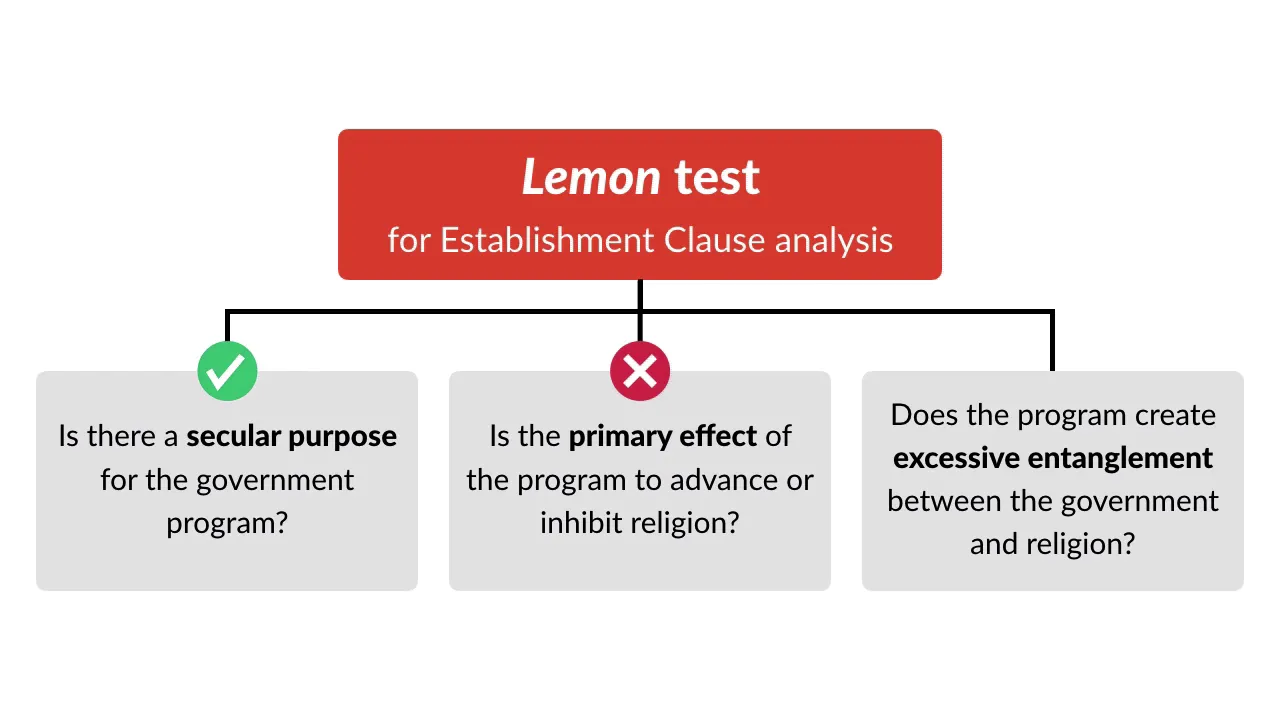
In Lemon v. Kurtzman (1971), the U.S. Supreme Court established the three-part test for evaluating Establishment Clause violations: (1) the statute must have a secular legislative purpose, (2) its principal or primary effect must neither advance nor inhibit religion, and (3) it must not foster excessive entanglement between government and religion; the Court ruled that Rhode Island's and Pennsylvania's laws providing salary supplements and reimbursements to private (mostly Catholic) schools violated the Establishment Clause because while they had secular purposes and primary effects, they created excessive entanglement between government and religious institutions.
Lemon v. Kurtzman Case Brief: Establishment Clause | Quimbee
Added:Deep Dive
The First Amendment of the U.S. Constitution, specifically the distinction between the Establishment Clause and the Free Exercise Clause.

FULL VIRAL CLIP - America is a Christian Nation!
122.9K
The First Amendment contains two distinct clauses: the Establishment Clause and the Free Exercise Clause. The Establishment Clause prohibits Congress from establishing an official state religion or government-controlled religion. The Free Exercise Clause protects citizens' right to practice their religion freely. These clauses were designed to prevent any single religious group (such as Presbyterian, Anglican, or Quaker) from taking over the federal government.
Click to watch →
05. Il Congresso non Farà Alcuna Legge - La Catena Profetica di Dio
1.2K
The First Amendment of the U.S. Constitution states: 'Congress shall make no law respecting an establishment of religion, or prohibiting the free exercise thereof.' This establishes the separation between Church and State. The amendment guarantees both religious freedom and civil rights, including freedom of speech, freedom of the press, the right to assemble peacefully, and the right to petition the government for redress of grievances. The Establishment Clause means Congress cannot establish any religious observance or practice. The Free Exercise Clause means Congress cannot prohibit people from freely practicing their religion. These clauses were based on biblical examples: Daniel 3 (establishing religious observance leads to persecution) and Daniel 6 (prohibiting free religious exercise leads to persecution).
Click to watch →

Stephen Bohr-05 Le Congrès ne passera aucune loi
6.7K
The First Amendment states: 'Congress shall make no law respecting an establishment of religion, or prohibiting the free exercise thereof.' While 'separation of church and state' does not appear in the Constitution, the concept is embodied in this amendment. The Establishment Clause prohibits Congress from establishing any religion, while the Free Exercise Clause prohibits prohibiting the free exercise of religion. Biblical examples illustrate these clauses: Daniel 3 shows government establishing religious observance (golden image) resulting in persecution, while Daniel 6 shows government prohibiting free exercise (Daniel's prayer) also resulting in persecution. The amendment establishes clear distinction between religious and civil authority.
Click to watch →

Scholar Exchange: First Amendment: Free Exercise & Establishment (High School and College Level)
738
The First Amendment contains two religion clauses: the Establishment Clause ('Congress shall make no law respecting an establishment of religion') and the Free Exercise Clause ('or prohibiting the free exercise thereof'). These clauses form the foundation of religious freedom protections in the U.S. Constitution. The Establishment Clause prevents government establishment of religion, while the Free Exercise Clause protects the right to practice religion freely. Understanding these two clauses is essential for comprehending American religious liberty.
Click to watch →

Boebert FAILS Civics: 'The Church Should Control The Government' | The Kyle Kulinski Show
53.6K
The First Amendment to the United States Constitution contains two critical clauses: the Establishment Clause and the Free Exercise Clause. The Establishment Clause states that 'Congress shall make no law respecting an establishment of religion,' which means the government cannot establish or enforce a state religion. The Free Exercise Clause states that the government cannot prohibit the free exercise of religion, meaning individuals have the right to practice their religion privately and publicly according to their own volition.
Click to watch →
Deep Dive
The concept of the 'separation of church and state' and its historical origins in American constitutional law.
What Does Separation of Church and State Mean? | 5 Minute Video
1.4M
The phrase 'separation of church and state' does not appear in the U.S. Constitution; it originates from Thomas Jefferson's 1802 letter to the Danbury Baptist Association, where he wrote about building a 'wall of separation between Church & State.' The actual constitutional provision is the First Amendment, which prohibits Congress from establishing a national religion or prohibiting the free exercise thereof. The modern strict separation view emerged in 1947 through the Supreme Court case Everson v. Board of Education, where justices interpreted the First Amendment to prohibit any governmental aid to religion, using Jefferson's phrase as support despite its absence from the Constitution. This interpretation led to removing religious expressions from public life, with subsequent cases like Engle v. Vitale (1962) banning school prayer. The Founding Fathers, including Jefferson, viewed religion as central to America's moral foundation, as evidenced by the Declaration of Independence and Constitution acknowledging God's role in government.
Click to watch →

SUNDAY LAWS? Religious Freedom Is ENDING — Deadline THIS MONDAY
4.9K
The concept of separation of church and state did not start with Thomas Jefferson in 1947. It began with Roger Williams, founder of Rhode Island and a Puritan pastor, in 1636. Williams fled Massachusetts Bay Colony due to persecution and founded Rhode Island, preaching that God created a garden like Eden with God's people inside the wall and the state outside. By 1644, he wrote a book using this metaphor. This concept was passed down to Baptists around the 1770s, who presented it to James Madison and other founding fathers, who drafted it into the US Constitution.
Click to watch →

교회와 국가(혹은 정치)는 '안보와 도덕'에서 분리될 수 없다! 교회는 강하고 선한 정부를 위해 기도하고 설교하고 행동해야 한다! (김홍기 목사, Ph.D., D.Min.)
3.5K
The concept of separating church and state emerged from historical persecution. In 1603-1683, Puritans and Separatists faced persecution in England under King James I, who enforced the Church of England as the state religion. Those who refused to attend state church services faced fines and imprisonment. Seeking religious freedom, they fled to the New World, establishing colonies where they could worship according to their conscience. This historical experience led to the idea that church and state should be separated to protect religious liberty. Thomas Jefferson later articulated this as a 'wall of separation between church and state,' which became foundational to American constitutional law.
Click to watch →

GOP Leaders CRUMBLE under KILLER CROSS EXAM at Hearing
695.5K
The concept of separation of church and state in the United States was coined by Thomas Jefferson. This principle is rooted in the First Amendment of the Constitution, which includes both the Establishment Clause and the Free Exercise Clause. These constitutional provisions create a legal framework that prevents government establishment of religion while protecting individual religious freedom. The founding fathers intentionally designed this separation to prevent religious persecution and ensure religious pluralism in American society.
Click to watch →

Boebert Gets Separation of Church & State Wrong
5.4K
The separation of church and state exists constitutionally through the Establishment Clause in the First Amendment, which prohibits government establishment of religion. Although the exact phrase 'separation of church and state' does not appear in the Constitution, Thomas Jefferson coined this term in 1802 to describe the First Amendment's intent. Within his presidency and the following decade, Jefferson worked with the Supreme Court and legislature to establish this separation, making it foundational within the first 15 years of the US government's existence.
Click to watch →
Deep Dive
The Incorporation Doctrine, which explains how the Fourteenth Amendment applies the Bill of Rights (including the Establishment Clause) to state governments.
Civil Rights and Civil Liberties (AP US Government and Politics)
54.9K
The incorporation doctrine is the Supreme Court's method of applying most provisions of the Bill of Rights to state governments through the Fourteenth Amendment. This doctrine uses selective incorporation, meaning the Supreme Court decides which rights are incorporated and applied to states and which are not. The Fourteenth Amendment states that no state shall make or enforce any law abridging citizens' privileges or immunities, nor deprive any person of life, liberty, or property without due process of law, nor deny equal protection of the laws. This allows federal constitutional protections to constrain state governments.
Click to watch →

Scholar Exchange: AP Landmark Supreme Court Cases
7K
The incorporation doctrine applies the Bill of Rights to state governments through the Fourteenth Amendment's Due Process Clause. Originally, the Bill of Rights only bound Congress, not states. After the Civil War, the Fourteenth Amendment was adopted to ensure states could not deny basic rights to citizens. The Court has applied most Bill of Rights protections against states through the Due Process Clause, which prohibits states from depriving any person of life, liberty, or property without due process of law.
Click to watch →

Video Criminal Law Week 1, Class 1
50.1K
The incorporation doctrine applies constitutional amendments to the states through the 14th Amendment's Due Process Clause. Originally, constitutional amendments only restricted the federal government. The 14th Amendment's Due Process Clause has been interpreted to make most Bill of Rights protections applicable to the states. For example, the First Amendment's free speech protections, Fourth Amendment's search and seizure rules, Fifth Amendment's Miranda rights, Sixth Amendment's right to counsel, and Seventh Amendment's right to confront witnesses have all been incorporated and apply to state governments. This means that when states try to infringe on these rights, they face constitutional limits similar to those imposed on the federal government.
Click to watch →
Richard Church "How the 14th Amendment Changed Everything"
1.4K
The Incorporation Doctrine is the legal principle that the protections of the Bill of Rights apply to state governments through the 14th Amendment's Due Process Clause. This doctrine was developed by the Supreme Court to extend constitutional protections that were originally applicable only to the federal government to state governments. The doctrine has been applied selectively, with the Court incorporating some rights while leaving others unincorporated, creating a complex and evolving body of constitutional law.
Click to watch →

AP Gov Review Video #49: The Incorporation Doctrine
20.9K
The Incorporation Doctrine is a constitutional principle that applies the protections of the Bill of Rights to state governments through the 14th Amendment's Due Process Clause, ensuring that fundamental rights such as protection from unreasonable searches (Mapp v. Ohio), right to counsel (Gideon v. Wainwright), right to remain silent (Miranda v. Arizona), and equal protection (Brown v. Board of Education) are guaranteed against both federal and state actions.
Click to watch →
Deep Dive
Basic understanding of the U.S. Supreme Court's role in constitutional interpretation and judicial review.

U.S Supreme Court Explained | What is the role of the U.S. Supreme Court? Judicial Branch Explained
54.8K
The U.S. Supreme Court, established during the 1787 Constitutional Convention as the nation's highest judicial court, serves as the final arbiter of constitutional interpretation and federal law; its nine justices are nominated by the president and confirmed by the Senate, serving lifetime terms during 'good behavior' to ensure judicial independence; the Court hears approximately 100-120 cases annually from thousands of petitions, using the 'rule of four' to select cases with significant constitutional implications, then deliberates privately before announcing decisions that shape American law and society, though implementation relies on executive and legislative cooperation rather than direct enforcement power.
Click to watch →

US Constitution | The US Judicial System
183
The US Supreme Court serves as the highest judicial authority in the United States, exercising both appellate jurisdiction (reviewing decisions from lower courts) and original jurisdiction (hearing certain cases directly). The Court plays a crucial role in constitutional interpretation, particularly through judicial review, which allows it to declare laws or executive actions unconstitutional. Supreme Court justices are appointed by the President and confirmed by the Senate, serving lifetime terms to ensure judicial independence. The Court's decisions significantly impact individual rights, fundamental freedoms, and the balance of power among the three branches of government, making it a cornerstone of American constitutional democracy.
Click to watch →
Judicial Branch! (အခန်း - 1 | အပိုင်း - 6 )
24.7K
The US Supreme Court has the authority of judicial review, which allows it to declare laws unconstitutional if they are repugnant to the Constitution; this power was established in the landmark case Marbury v. Madison, where Chief Justice William Marshall declared a Maryland law unconstitutional, establishing that laws contrary to the Constitution are void and not valid.
Click to watch →

АНГЛИЙСКИЙ НА СЛУХ ПО КНИГАМ /History of America/ урок 7/ #английскийдлявсех #АнглийскийПоКнигам
4.2K
The Supreme Court is the most important court in the country and has nine judges. Their job is to decide what the laws mean through judicial interpretation. They can declare that Congress has made a law which is wrong or that the president has done something wrong, as well as the government in Washington. This power of judicial review allows the Supreme Court to check the other branches of government and ensure laws comply with the Constitution.
Click to watch →

Street Smarts: The Supreme Court | PragerU Kids
54.1K
The Supreme Court is the highest court in the United States federal judiciary system, established by Article Three of the Constitution; it consists of nine justices (one Chief Justice and eight associate justices) who serve lifetime terms to protect them from political pressure, and its primary power is judicial review—the ability to declare laws unconstitutional—ensuring the Court remains impartial and serves as the final arbiter of constitutional interpretation.
Click to watch →
Prerequisite Knowledge
- Concept 01The First Amendment of the U.S. Constitution, specifically the distinction between the Establishment Clause and the Free Exercise Clause.
- Concept 02The concept of the 'separation of church and state' and its historical origins in American constitutional law.
- Concept 03The Incorporation Doctrine, which explains how the Fourteenth Amendment applies the Bill of Rights (including the Establishment Clause) to state governments.
- Concept 04Basic understanding of the U.S. Supreme Court's role in constitutional interpretation and judicial review.
Subsequent Learning
- Step 01Analysis of the three prongs of the 'Lemon Test' and how they are applied to evaluate state actions.
- Step 02Alternative legal standards proposed by the Court, such as Justice O'Connor's 'Endorsement Test' and the 'Coercion Test'.
- Step 03Subsequent landmark cases involving public funding of religious schools, such as Zelman v. Simmons-Harris (school vouchers).
- Step 04Recent developments in jurisprudence, including the Supreme Court's shifting away from the Lemon Test in cases like Kennedy v. Bremerton School District (2022).
Lemon v. Kurtzman
Lemon v. Kurtzman
0:00Playing Section
- 1
Supreme Court interpreted establishment clause in Lemon v. Kurtzman.
- 2
Rhode Island and Pennsylvania gave state aid to Catholic schools.
- 3
Legal challenge focused on alleged violation of church-state separation.
The 'Historical Practices and Tradition' Standard and the Abandonment of Lemon
For decades, the Lemon test faced severe criticism from jurists and legal scholars who argued it was subjective, difficult to apply consistently, and exhibited hostility toward religion. Critics, including several Supreme Court justices, contended that the test's 'excessive entanglement' prong forced the government to purge religious elements from public life, contrary to historical American traditions. Over time, alternative frameworks were proposed, such as Justice Sandra Day O'Connor's 'Endorsement Test' and Justice Anthony Kennedy's 'Coercion Test.' This jurisprudential shift culminated in the 2022 Supreme Court decision in Kennedy v. Bremerton School District, which officially abandoned the Lemon test. The Court replaced it with a framework anchored in 'historical practices and understandings,' arguing that the Establishment Clause should be interpreted through the lens of history and tradition rather than the tri-partite Lemon formula. This counterpoint advocates for a more permissive view of non-coercive religious expression in the public square.
Deep Dive
Analysis of the three prongs of the 'Lemon Test' and how they are applied to evaluate state actions.
What is a balancing test? - Ask an Attorney
316
The Lemon test is a balancing test with three prongs: (1) secular legislative purpose, (2) principal effect must neither advance nor inhibit religion, and (3) no excessive government entanglement with religion. These prongs involve matters of degree that require balancing individual interests in free exercise or speech against the state's interest in abiding by the Establishment Clause.
Click to watch →

Chapter 4 Video Lecture - Civil Liberties
221
The Lemon test has been applied to various government actions: providing bus transportation to both public and private school students is acceptable; providing nondenominational textbooks (math, English, social studies) is acceptable; providing aid for buildings at colleges and universities is acceptable; but supplementing teacher salaries, paying tuition, or providing rebates for elementary or secondary schools is generally unacceptable.
Click to watch →

Religious Display Committee - 6/6/2019
155
The Lemon test has three prongs that must all be satisfied for a religious display to be constitutional: (1) The display must have a legitimate secular purpose, (2) It must not have the primary effect of either advancing or inhibiting religion, and (3) It must not result in excessive entanglement of government and religion. These prongs ensure that the government is not endorsing or promoting any particular religion while still allowing for cultural and historical symbols.
Click to watch →

CONSTITUTIONAL LAW 2 (SECTION 5 FREEDOM OF RELIGION) PART 3
6.6K
The Lemon Test is a three-part framework used to determine whether a government act violates the non-establishment clause: (1) The government act must have a secular purpose; (2) It must not promote or favor any set of religious beliefs or religion generally; (3) It must not result in excessive entanglement between government and religion. This test was developed in the landmark case Lemon v. Kurtzman and provides a structured approach for courts to evaluate whether seemingly neutral government actions have the effect of advancing or inhibiting religion.
Click to watch →
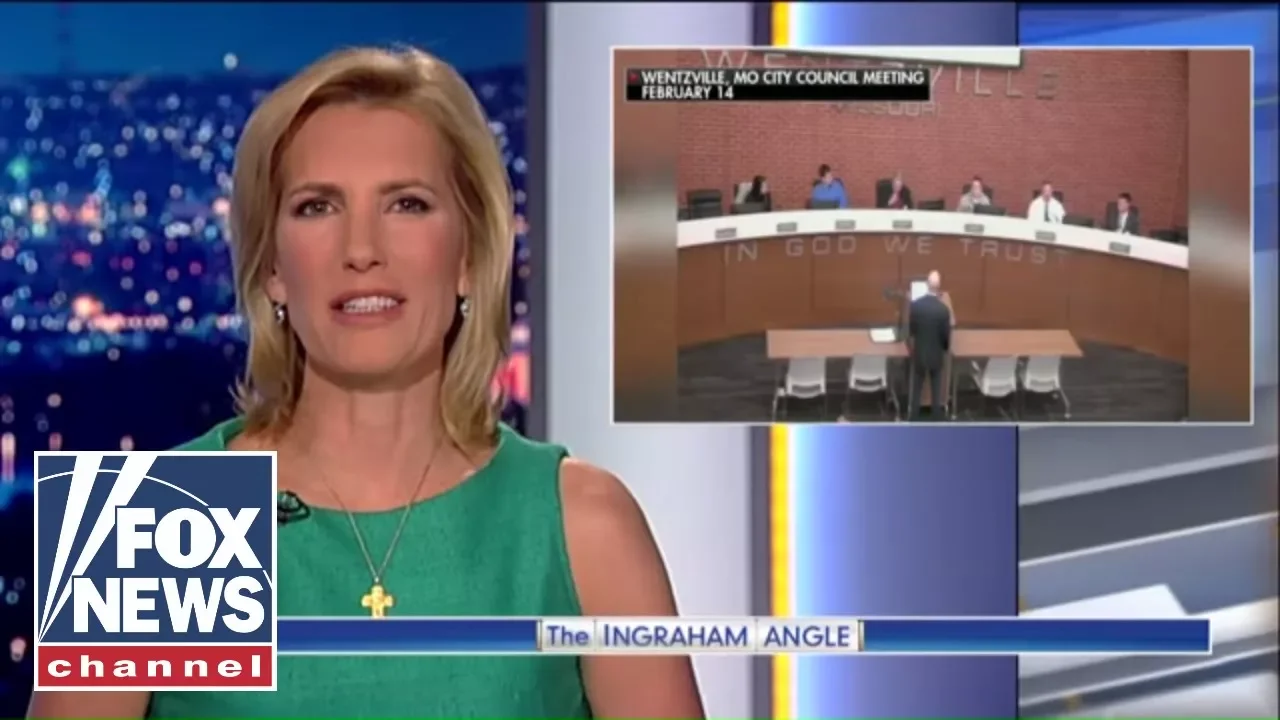
Atheist activist speaks out against 'In God We Trust' motto
44K
The Lemon Test is a three-part legal standard used by courts to determine whether a government action violates the Establishment Clause. The three prongs are: (1) The government action must have a primary secular purpose; (2) The action must not have the primary effect of advancing or inhibiting religion; (3) The action must not result in excessive government entanglement with religion. All three prongs must be satisfied for the action to be constitutional.
Click to watch →
Deep Dive
Alternative legal standards proposed by the Court, such as Justice O'Connor's 'Endorsement Test' and the 'Coercion Test'.

Establishment Clause in Specific Contexts: Module 4 of 5
1.7K
Some justices have proposed alternative tests to the Lemon framework. The coercion test, advocated by Justice Kennedy, holds that a law does not violate the Establishment Clause unless it provides direct aid to religion that would tend to establish a state church or coerce people to support or participate in religion against their will. The endorsement test, articulated by Justice O'Connor in Lynch v. Donnelly, states that a law only violates the Establishment Clause if a reasonable observer would perceive the government as endorsing or disapproving of religion. Justice O'Connor argued the Establishment Clause prevents Congress from sending messages that make non-adherents feel like outsiders while making adherents feel favored members of the political community.
Click to watch →

The Religion Clauses, RFRA & RLUIPA: Overview & Update - Sheldon Nahmod
915
Justice O'Connor's endorsement test asks whether a reasonable observer familiar with community customs would view government conduct as endorsing religion, aiming to prevent outsider status feelings. Justice Kennedy's coercion test (from Lee v. Weisman, 1992) examines psychological coercion even when attendance is not strictly compulsory. In Town of Greece, the Court distinguished adults from children, noting less coercion concern with adult attendees. These tests represent varying levels of government restrictiveness, with the endorsement test being less restrictive than Lemon and the coercion test applying specific psychological factors.
Click to watch →

2024年度後期・九大法・憲法Ⅱ(人権論)第21回「精神的自由⑤/信教の自由と政教分離3、表現の自由1」(2024.12.23.)
852
The Endorsement Test is an alternative judicial standard for evaluating separation of religion and state cases, originally developed by the U.S. Supreme Court. This test focuses on whether government actions convey a message of endorsement or disapproval of religion, rather than examining the purpose and effect of the action. The test asks whether a reasonable observer would perceive the government's action as endorsing a particular religion or religion in general. Some scholars have argued that the Japanese Supreme Court's application of the Purpose-Effect Test in cases like the Ehime Prefecture's Yasukuni Shrine Offering Case is functionally equivalent to the Endorsement Test. The argument is that when the Court finds that government actions create a special relationship with a particular religious organization that is not extended to others, this effectively conveys a message of endorsement. This interpretation suggests that the Court may be using the Purpose-Effect Test as a vehicle for applying the Endorsement Test's underlying concern about government endorsement of religion.
Click to watch →
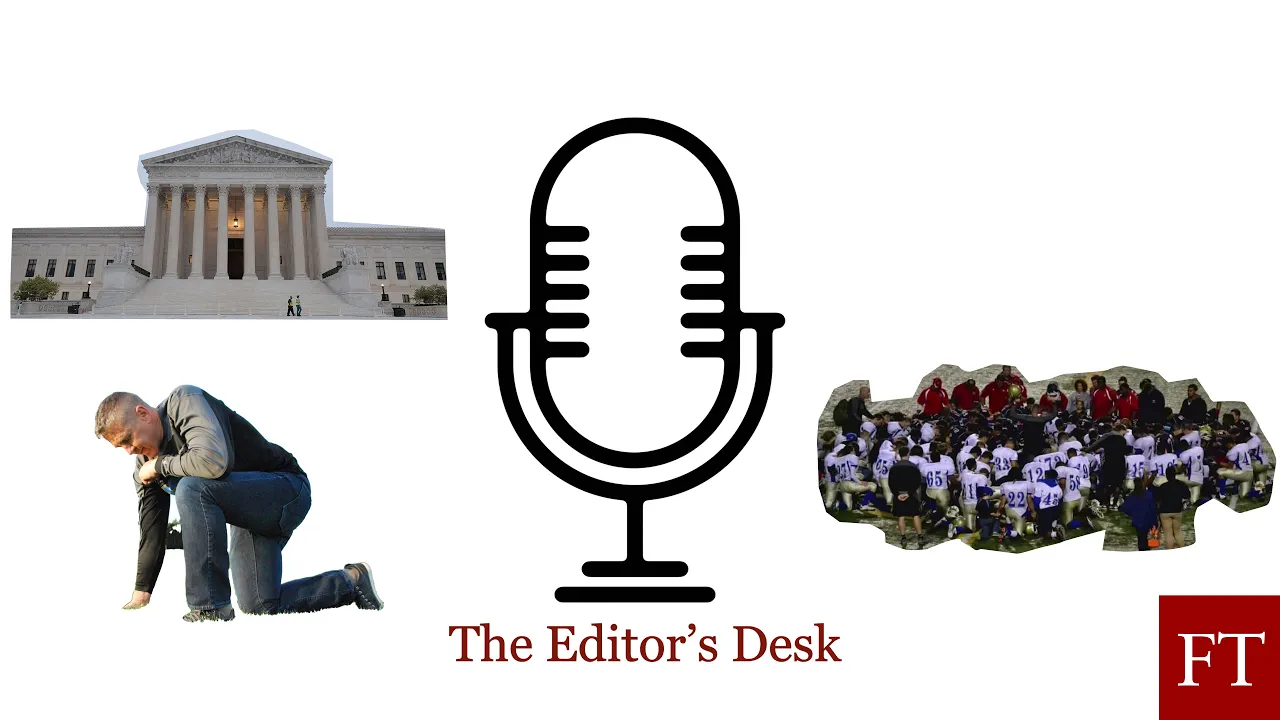
Kennedy v. Bremerton and the Establishment of Religion (Prof. Phillip Munoz - Notre Dame)
269
The Endorsement Test, proposed by Justice Sandra Day O'Connor in the 1980s, replaces the Lemon Test as a framework for evaluating Establishment Clause cases. This test holds that government cannot endorse religion, meaning the government should not appear to take sides in religious matters or favor one faith over others. The test focuses on whether a reasonable observer would perceive the government's action as endorsing religion, rather than examining the government's subjective intent or the effects of the action.
Click to watch →
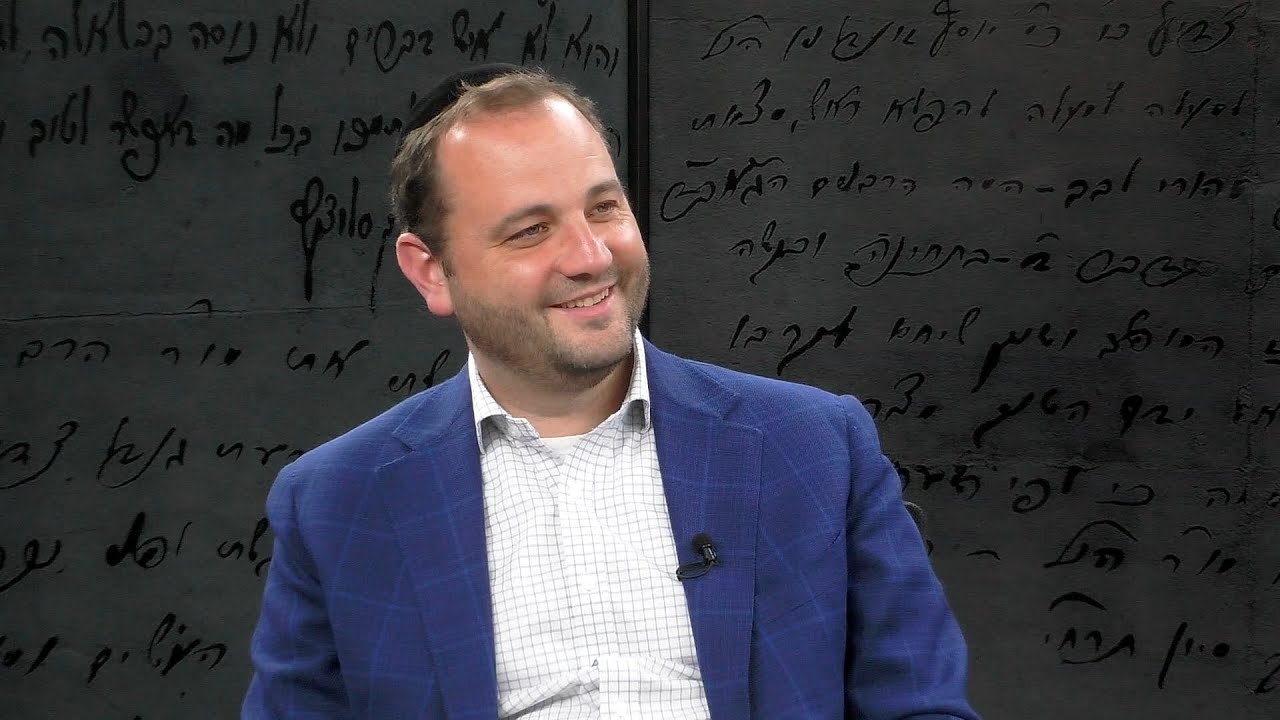
Jewish Voices in Constitutional Law with Michael Avi Helfand
458
In the 1980s, Justice Sandra Day O'Connor developed the endorsement test, shifting from strict secularism to a pluralist model. Rather than requiring government to be secular, this approach asked whether a reasonable observer would feel that government endorsed one religion over others. The goal was preventing the crowding out of minority religions rather than keeping all religion out of public life. However, drawing lines around endorsement proved extremely difficult, as illustrated by cases involving religious displays on government property.
Click to watch →
Deep Dive
Subsequent landmark cases involving public funding of religious schools, such as Zelman v. Simmons-Harris (school vouchers).
Oxford Handbook of Religion and American Education (2018)
464
The 2002 Supreme Court decision in Zelman v. Simmons-Harris marked a watershed moment in public funding of religious education. The Court definitively stated that aid flowing to private religious education is permissible so long as it goes through a 'neutral program with private individual choice.' This effectively ended the legal debate about public funding of religious education, with only direct public funding of tuition remaining as a threshold issue.
Click to watch →
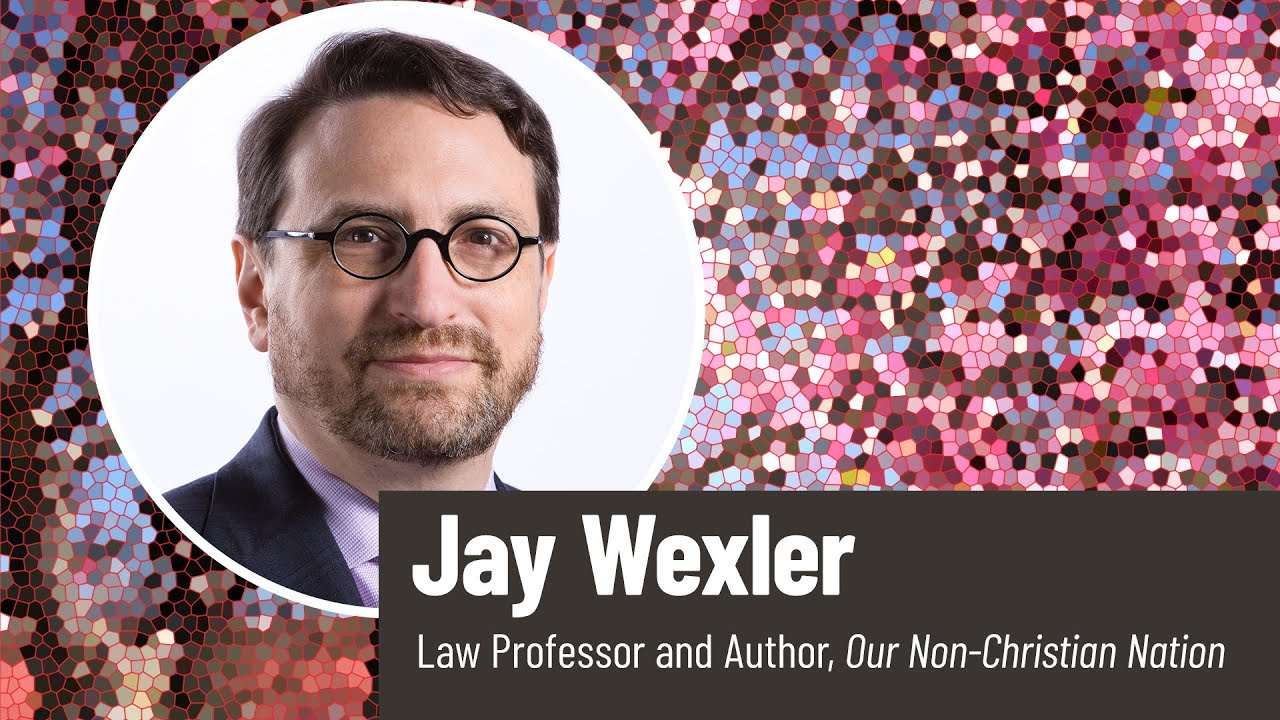
How Atheists, Satanists, Pagans and Others are Demanding Their Rightful Place in Public Life
768
The Supreme Court has issued decisions allowing religion to have much more ability to participate in public life, particularly regarding government funding. In the 2002 case Zelman v. Simmons-Harris, the Court held that school voucher programs are constitutional even when they fund religious schools, even if almost all money goes to religious schools. The 2015 Espinoza case further required that if government funds private schools through voucher programs, it must include religious schools as recipients.
Click to watch →
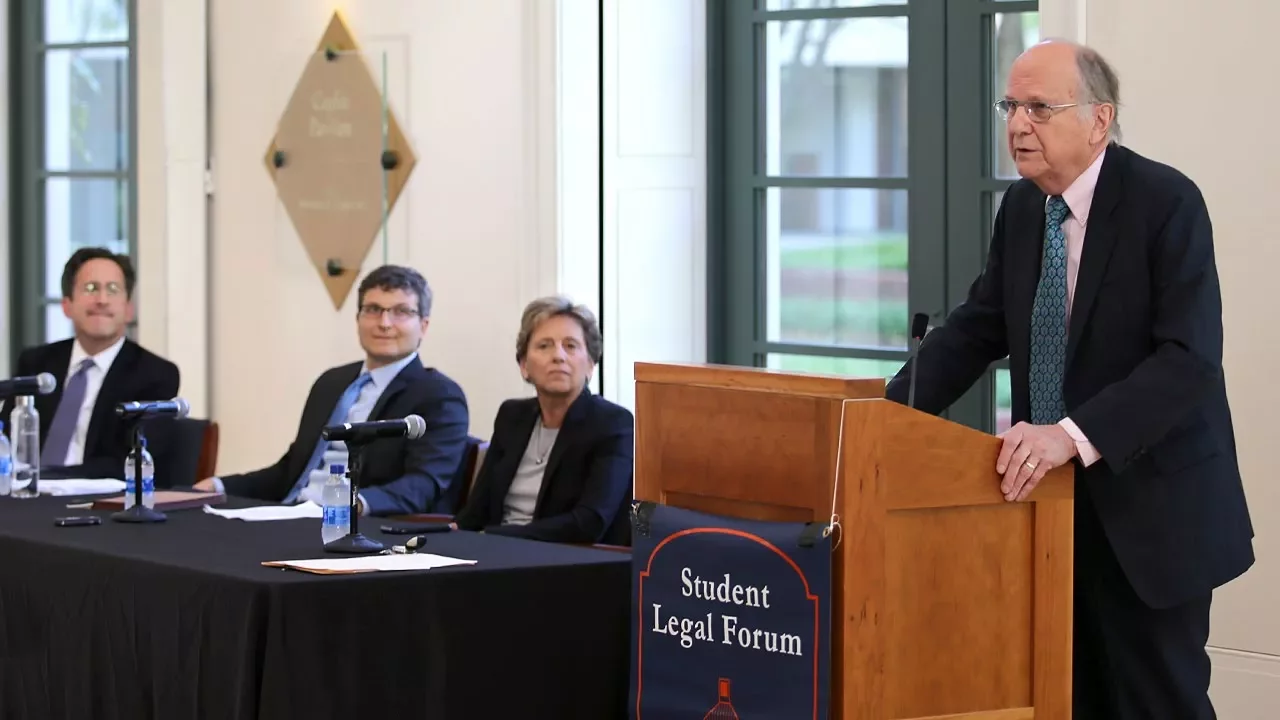
2017 Supreme Court Roundup
954
The Establishment Clause prohibits government from giving money to churches, but the rule has been nuanced regarding religious schools. Early precedents held that giving money to religious schools was an establishment of religion. More recent precedents have been more liberal: in Zelman v. Simmons-Harris, the Court held that government voucher programs that allow students to use funds at religious schools are permissible because the benefit goes to students, not churches. In Mitchell v. Helms, the Court held that government may give secular instructional materials directly to religious schools if distributed based on non-religious criteria and per capita. The Court in Trinity Lutheran assumed this question was easy under the facts, as the money was being given to a school not a church and was being used for a secular non-religious reason.
Click to watch →
Zelman v. Simmons-Harris Case Brief Summary | Law Case Explained
9.8K
In Zelman v. Simmons-Harris (2002), the U.S. Supreme Court ruled 5-4 that government can constitutionally fund educational programs based on financial need even when most recipients choose religious schools, provided there are legitimate non-religious alternatives available and the funding is distributed without religious preference; the Court applied the Lemon test, finding the Cleveland voucher program met all three criteria: secular purpose (helping low-income students access quality education), no primary effect advancing religion (aid distributed by financial need without religious reference), and no excessive entanglement (parents, not government, chose school attendance).
Click to watch →

The Big Sky Promise: FULL DOCUMENTARY
374
The Zelman v. Simmons-Harris case (2002) ruled that allowing families to choose religious schools in a religiously neutral school choice program was constitutional as long as parents make the choice. The Trinity Lutheran v. Comer case (2017) ruled that Missouri cannot deny money to a religious preschool for playground resurfacing, establishing a principle of equal access to public benefits. These cases established that government cannot single out and exclude religious options in financial aid programs.
Click to watch →
Deep Dive
Recent developments in jurisprudence, including the Supreme Court's shifting away from the Lemon Test in cases like Kennedy v. Bremerton School District (2022).

Predators (pastors) are replacing school counselors across the country
17K
In Kennedy v. Bremerton School District (2022), the Supreme Court ruled that the Lemon Test is no longer applicable in any way, shape, or form. This decision has significant implications because most Establishment Clause cases since the 1960s were decided using the Lemon Test. The speaker explains that this means cases like Stone v. Graham, which were decided using the Lemon Test, are now potentially at risk of being overruled. This opens the door for new approaches to Establishment Clause analysis.
Click to watch →
America is NOT a Godless Country - Lawyer Explains
33.9K
In 2022, the Supreme Court abandoned the Lemon Test and its offshoots in Kennedy v. Bremerton School District, adopting the history and tradition test instead. This test asks one simple question: Is a law consistent with the country's long-standing historical traditions and the understanding of the Constitution at the time it was written? If not, the law is probably unconstitutional. The purpose is to remove ambiguities inherent in previous tests, especially in core natural rights areas like religious freedom, creating a more stable and consistent approach to Establishment Clause interpretation.
Click to watch →

What the heck is up with the current Supreme Court?
133.3K
The Lemon test was a legal standard used by the Supreme Court to evaluate whether government actions violated the Establishment Clause of the First Amendment. The test required that government actions have a secular legislative purpose, not advance or inhibit religion, and not foster excessive government entanglement with religion. Kennedy v. Bremerton School District overturned this test, which had been falling out of favor in the decade prior. This shift represents a significant change in how the Court approaches separation of church and state issues.
Click to watch →

Lecture by J Nariman on Secularism and The Indian Constitution at The Ahmadi Foundation
6.9K
In Kennedy v. Bremerton School District (2022), the US Supreme Court replaced the Lemon test with a new framework called the 'hands-off test.' The Court held that a football coach who knelt in prayer before games did not breach the First Amendment. The new approach allows some mixing of religion and state but requires that the line where they mix doesn't go beyond a certain point, representing a significant shift from previous jurisprudence.
Click to watch →
Thank GOD 4 TRUMP: SCOTUS Ruling Bigger Than ROE v WADE | Media Ignore Pro-Christian Accomplishments
33K
The Supreme Court's 2022 ruling in Kennedy v. Bremerton School District overturned the Lemon v. Kurtzman test, which had been used to secularize the U.S. government and discriminate against religious expression in public spaces. This decision reversed previous court rulings that had forbidden prayer and religious symbols in schools, sports, and other public places, representing a significant pro-Christian legal development.
Click to watch →
Lemon v. Kurtzman
Lemon v. Kurtzman
0:00- 1
Supreme Court interpreted establishment clause in Lemon v. Kurtzman.
- 2
Rhode Island and Pennsylvania gave state aid to Catholic schools.
- 3
Legal challenge focused on alleged violation of church-state separation.
The 'Historical Practices and Tradition' Standard and the Abandonment of Lemon
For decades, the Lemon test faced severe criticism from jurists and legal scholars who argued it was subjective, difficult to apply consistently, and exhibited hostility toward religion. Critics, including several Supreme Court justices, contended that the test's 'excessive entanglement' prong forced the government to purge religious elements from public life, contrary to historical American traditions. Over time, alternative frameworks were proposed, such as Justice Sandra Day O'Connor's 'Endorsement Test' and Justice Anthony Kennedy's 'Coercion Test.' This jurisprudential shift culminated in the 2022 Supreme Court decision in Kennedy v. Bremerton School District, which officially abandoned the Lemon test. The Court replaced it with a framework anchored in 'historical practices and understandings,' arguing that the Establishment Clause should be interpreted through the lens of history and tradition rather than the tri-partite Lemon formula. This counterpoint advocates for a more permissive view of non-coercive religious expression in the public square.
The First Amendment of the U.S. Constitution, specifically the distinction between the Establishment Clause and the Free Exercise Clause.
The concept of the 'separation of church and state' and its historical origins in American constitutional law.
The Incorporation Doctrine, which explains how the Fourteenth Amendment applies the Bill of Rights (including the Establishment Clause) to state governments.
Basic understanding of the U.S. Supreme Court's role in constitutional interpretation and judicial review.
Analysis of the three prongs of the 'Lemon Test' and how they are applied to evaluate state actions.
Alternative legal standards proposed by the Court, such as Justice O'Connor's 'Endorsement Test' and the 'Coercion Test'.
Subsequent landmark cases involving public funding of religious schools, such as Zelman v. Simmons-Harris (school vouchers).
Recent developments in jurisprudence, including the Supreme Court's shifting away from the Lemon Test in cases like Kennedy v. Bremerton School District (2022).
18.3K views84likes1:59@QuimbeeDotComOriginal Release: 2020-11-13
thomas jefferson famously said that the first amendment created quote a wall of separation between church and state unquote is that how the modern supreme court has interpreted the first amendment the united states supreme court extensively interpreted the establishment clause in lemmon versus kurtzman rhode island enacted legislation providing a salary supplement to teachers in the state's private elementary and secondary schools 95 percent of which were catholic schools the legislation required teachers receiving the supplement to teach only secular courses also taught in the public schools with the same materials used in the public schools pennsylvania enacted legislation directly reimbursing private mostly catholic schools for teacher salaries and instructional materials reimbursement was restricted to secular courses also taught in the public schools in both cases there wasn't a dispute that parochial schools are an essential part of the catholic church's religious mission alton lemon a state taxpayer and parent of a child in public school in pennsylvania and others filed a federal lawsuit seeking an injunction against the pennsylvania statute on the ground that it violated the establishment clause a three-judge panel of the district court dismissed the lawsuit joan dicenzo and other state taxpayers and parents of children in rhode island public schools filed a similar federal lawsuit seeking an injunction against the rhode island statute a three-judge panel of the district ruled in the plaintiff's favor lemon and his fellow plaintiffs appealed to the united states supreme court in the pennsylvania case in the rhode island case the defendants state officials and parents of children in catholic schools also appealed to the supreme court [Music] you
Up Next
3:28
Engel v. Vitale (1962) AP Gov Required Supreme Court Case
@heimlershistory
449.2K views•2021-10-05

4:27
US Secondary Sanctions Impact on EU Businesses and Blocking Legislation
@Bureauvandijk
1.6K views•2019-03-20
1:52
Employment Division v. Smith Case Brief | Free Exercise Clause
@QuimbeeDotCom
15.4K views•2021-01-08

24:42
Police Interrogation Tactics: False Confessions & Legal Reform
@LastWeekTonight
7M views•2022-04-18
Related Study Plans & Knowledge Roadmaps
Structured learning paths in Law
law
Self-Defense Law: Imminence & Castle Doctrine
01Foundations of Self-Defense Law
02Imminent Threat & Reasonable Belief
03The Principle of Proportionality
+ 3 more learning modules
12h6 modules
Explore Roadmap
law
Defamation Law: First Amendment & Actual Malice
01Introduction to civil torts and the First Amendment
02Elements of Defamation: Libel and Slander
03Public Figures vs. Private Individuals
+ 2 more learning modules
8h5 modules
Explore Roadmap
law
Hearsay Rule: Trial Evidence & Exceptions
01Introduction to Trial Evidence & Courtroom Basics
02Demystifying Hearsay: The Core Definition
03Non-Hearsay: Exclusions Under FRE 801(d)
+ 3 more learning modules
14h6 modules
Explore Roadmap
law
Medical Malpractice: Law, Liability & Care
01Foundations of Tort Law and Civil Liability
02The Four Elements of Medical Malpractice
03Defining and Proving the Standard of Care
+ 2 more learning modules
12h5 modules
Explore Roadmap