














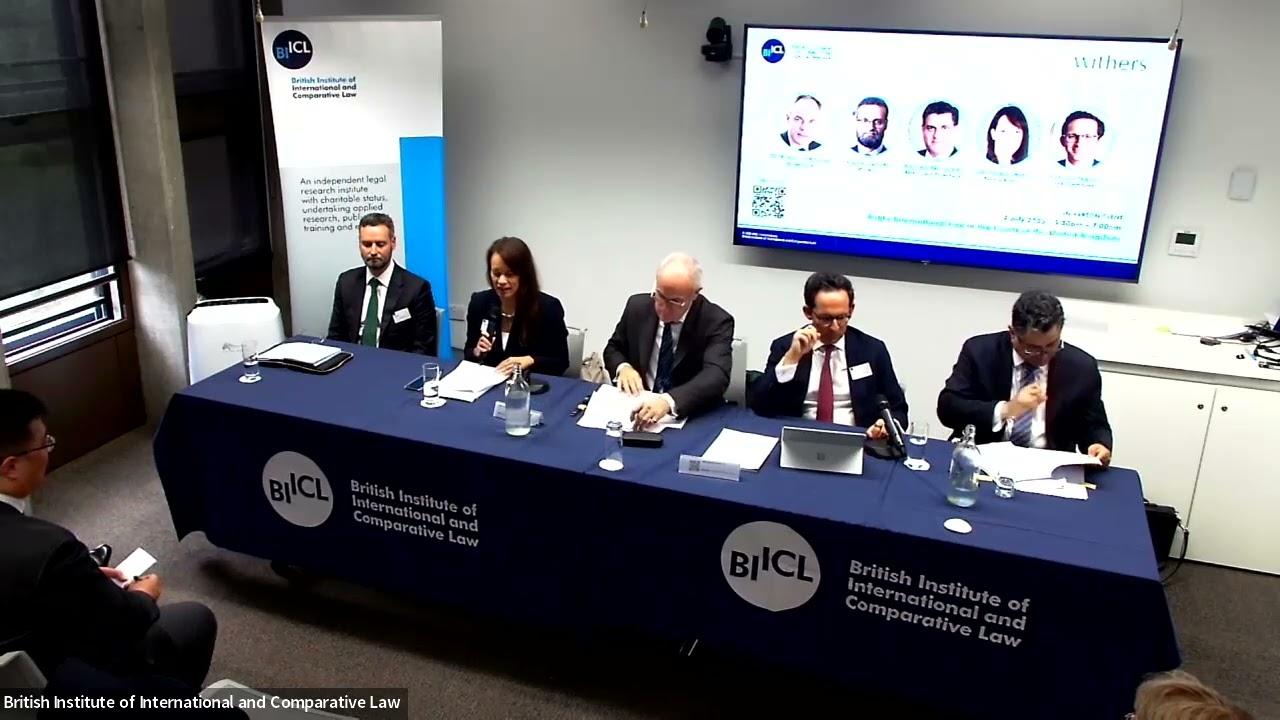





Second-generation international tribunals, which emerged over the past 40 years, contradict the conventional wisdom that international adjudication is marginal due to lack of mandatory jurisdiction and enforceable decisions; these tribunals—including international commercial arbitration, investment arbitration, WTO dispute settlement, and state immunity litigation—actually exercise effectively mandatory jurisdiction and produce enforceable awards because states must participate to protect their interests in international commerce and investment, thereby creating a more successful model than first-generation international courts like the ICJ or ITLOS.
International Adjudication's New Generation | Gary Born Lecture
Added:The fundamental differences between public international law (governing relations between states) and private international law (governing cross-border private disputes).
The basic mechanism of international arbitration, including the concepts of party autonomy, consent to arbitrate, and the binding nature of arbitral awards.
The role and structure of traditional permanent international courts, such as the International Court of Justice (ICJ), and how they derive their jurisdiction.
An understanding of foundational international treaties that facilitate arbitration, such as the 1958 New York Convention.
The mechanics of Investor-State Dispute Settlement (ISDS) and the contemporary regional and global debates surrounding its reform.
The process and legal challenges of enforcing international arbitral awards against sovereign states, including the doctrine of sovereign immunity.
Advanced study of specialized international tribunals, such as the World Trade Organization (WTO) dispute settlement mechanism and the International Tribunal for the Law of the Sea (ITLOS).
Critical analysis of the 'legitimacy crisis' in international arbitration, focusing on transparency, arbitrator impartiality, and the push for a multilateral investment court.
1.3K views10likes2:14:39Original Release: 2014-11-25
for for for test one two e for for spe e spe for for spe that's that only for one okay you want to no I Rel ch that's what I usually do Fusion no um I'll ask I'll ask worry I mean know e spe only right would e it's not my idea EX s [Music] ch than e for get e e good evening ladies and gentlemen and welcome to the 2014 laiv lecture organized jointly by the law firm laiv and partners and by the international law Department Of The gradate Institute and since I see many partners from La in the audience can I just briefly uh take a second to thank them all uh we at the graded Institute are very pleased at this joint venture and I think that both parties can take pride in what we have accomplished together in the past few years and also the impressive uh lineup of eminent colleagues that have been able to put together in this lecture Series this evening speaker G bone fits perfectly well into this tradition of Excellence of the L leave lectures and my colleagues Michael schne from La will present him shortly but if you can bear with me just a little bit longer I would just like to say a few words by way of Welcome to stress the novelty not so much of the LA lectures which uh are at their eigh Edition but of the venue this is the first time that we organize the uh L lecture in the Ian P Auditorium and the graded Institute it's a great location and we are very fortunate to have it and we're happy to share it with you at this occasion sadly p is not with us for the first time in all these years I trust he would have liked this immensely and our thoughts go out to him tonight now the organization of such events would not be possible if people didn't put a lot of time and energy in it and I know I'm not doing justice to all the people who were involved in this but may I just extend my my gratitude to Emma Cranfield from the grit Institute and Anna nales from L leave for having helped organizing uh this event thank you very much both of [Laughter] [Applause] you now all introductions these days need to be pathetically anecdotal and let this one be no exception as I would not wish to feel inadequate for the occasion the first anecdote um is that as a student at law school I prepared my exam for the international civil litigation in US courts taught by the late professor abin Chase on Gary born's case book I think that was the second edition this text exerted a great influence on developing my interest in some aspects of the international law of jurisdiction and jurisdictional immunities and I trust it played an important role in steering my career and research interest uh in the direction they both took in those years second I spent with Gary Bourne a couple of days in the same room in Dron in 1993 to be there together with a handful of other colleagues in the field of jurisdictional immunity jurisdiction and N territoriality I think that was it and we were there the invitation of KL messon um and uh the initiative it was a closed door seminar which led to the publication of the book extraterritoriality in theory and practice there too I received a fundamental stimulus to carry all my research and finish my third book so I'm therefore grateful to you all this whether the profession should be grateful to you for this is quite another mention but not one to be discussed um B that as in May I wish to extend to Gary bone also on behalf of the international law Department Of The gradate Institute our heartfelt thanks for having accepted this invitation and without any further Ado I'll hand this over to Michael Schneider from the thank you very much [Applause] ladies and gentlemen good evening those of you who watch arbitration TV are well familiar uh with Gary Bourn uh one of his uh best known appearances was recently at the hake at the permanent Court of arbitration and when you visit uh the site of the PCA you see the hearing In This Very extraordinary case uh in about the ab uh enclave and you will see Gary born at work and a link to the Institute is that the chairman of that tribunal was Professor piar du who until recently was a professor here so uh you tonight you need not go to the computer uh you see you will see Gary Bourne uh in presence and the ab case is just one of the many activities which he has and the LA lecture as Professor banki pointed out organized jointly by The Institute and the laiv firm has as its objective uh the to throw light on the relationship the interface uh between public and private law between commercial and public uh transactions between academics and practitioners and we are quite uh we are very appreciative of the very good cooperation uh which our firm has with the Institute and we're particularly grateful uh for this very constructive cooperation with profet banki thank you uh very much now these objectives of the L lecture are uniquely met by Gary Bourne and he's extraordinarily qualified precisely at uh these different uh elements that come together in the objective of these lectures he's qualified as a US lawyer but he practices in London and in Berlin but his cases as you know are all over the world uh he practices as Council in international arbitration uh in particular in His function as the chair of the arbitration group of Wilmer Cutler Pickering and Hal and door and a great variety of cases and a great variety of nature of cases in Interstate arbitration like for instance the case between Eritrea and Yemen about Territorial and Maritime borders in investor State disputes uh but even something extraordinary in uh arbitrations between State and noos because he was involved in the uh Rainbow Warrior case uh a very unusual uh event uh in commercial disputes in many eras and I just quote the Energy natural resources software joint venture there's also a case about Swiss watches uh and telecommun Telecommunications Mata Sher and I can testify to the remarkable efficiency and persuasiveness of Gary Bourne as Council since we had had the privilege of jointly representing a European Telecom company uh jointly uh with him he also act acts as arbitrator in a similarly wide range of disputes and uh on repeated occasions he was now uh uh listened to these titles advocate of the Year starred performer the world's best litigator and the work he had in these different functions including a an important branch of proon work I think that also must be pointed out and is part of uh the personality of Gary in fact in n in 2010 he was named as the leader of the pro bono team of the work the practice area as I've just described it of Gary Bourn is only part of the activities he sat on the executive Council of the American Society for international law and held similar positions on uh in many other learned bodies and he is a prolific writer we've heard already uh from uh Professor ban uh about one of his books and let me close by uh a reference to with three quotations about his probably his most outstanding book the book on International commercial arbitration which now is in his in its second edition and which has grown to three volumes now the quotations the first one is a professor of Harvard Professor Goldsmith this is an unparalleled book on the law practice and theory of international commercial arbitration it explains every aspect of international arbitration with both impressive doctrinal detail and exceptional theoretical accurity and will be indispensable for both practitioner and academics uh to uh strike the after Harvard professor professor huan Co from Yale stunningly comprehensive accessible and bristling with insights the definite text on International arbitration and as the last quotation from Campbell mcclin from New Zealand H Bor proceeds in the way in which the greatest legal Scholars have always done and then mclan adds in Brackets and which the modern legal Academy often neglects at its Peril I think that doesn't go for the Institute by by drawing together the Apparently disparate responses of arbitrators and National courts on the central issues of arbitration into a sustained treaties which expounds the common principles of law this achievement is all the more remarkable since it has been written by a lawyer and arbitrator with a distinguished and full-time practice the result is that the book will become the first place to go for practitioners arbitrators and Scholars in their Research into issues of General application in international arbitration law in delivering to us this Monumental work of legal scholarship Gary Bourne has himself contributed in no small measure to such a process he has equipped us with the fruits of his experience and research in a text which laws claim like no others to become the terminous AO theer Aqua on the law of international commercial arbitration in the 21st century voila Gary born thank you that was very very sweet so after those various introductions I think I'd rather just go home um I don't think I can improve on where I currently stand um I'd like to thank firstly though both um The Graduate Institute and the leave um Michael Matias and all your partners for this extremely kind invitation and The Graduate Institute of course um has not just a tremendous brand um uh but also a tremendous reputation and being invited to to speak here tonight is is truly a privilege and and I thank you for that I'd also equally like to to thank L leave um it is um a tremendous practice a tremendous Law Firm um and it's a real honor as well for me to to be asked to to come tonight and thank you all of course for um as the English would say having me um it's a real pleasure to to be able to spend some time with you I promise not three volumes of of time um but some time this evening and hopefully on a topic that all of us um myself and and all of you will will Find provocative if at the end of my talk perhaps not in the middle since I have a PowerPoint that's designed to deter questions um along the way um but perhaps at the end if there are questions please please don't hesitate to to ask them I think that's the format of the leave lectures and um something the professor the late professor would um both have um Wanted and no doubt insisted upon um today's talk um as you can see is titled a new generation of international adjudication and in picking this talk I aimed at um addressing this intersection that that Michael referred to between public public and and private international law and to some extent reflecting my own background practice and and Theory um and I wanted to explore um the developments in international adjudication International dispute resolution over the last century and I'll be focusing in particular on a new generation of dispute resolution International dispute resolution which looks more at the the last 40 years than the preceding 60 years and so in some sense depending on how old you are it may not be so new um it may be rather old but at least for me the last 40 years is looking increasingly new and um um that will be the focus of my talk and in particular on the various forms of international dispute resolution sometimes characterized as public sometimes characterized as private that have emerged during those 40 years I think it is um particularly appropriate though that I'm giving this talk here in Geneva because as we all know Geneva has been at the Forefront for um the last century and indeed the last 40 years um in many of the developments in international dispute resolution the going back some ways in history Geneva was um the seat of the famous Alabama arbitration and for those of you haven't who haven't gone down to the hotel DeVille you must do so and see the room um where those hearings were conducted it is a rather different room to this room um and I have to say as I when I always tries to put oneself in the physical setting where one will talk on an important occasion such as this and for some odd reason I'd placed myself in that room um you can imagine that um moving from 18th century Splendor to I think 22nd century Starship Enterprise is a little bit of a a little bit of a a change but um hopefully hopefully one where the technology will enable me to reach more people rather than than fewer people um Geneva wasn't important though just as the seat of the Alabama arbitration which in some ways ushered in um the modern um era of international dispute resolution dispute resolution involving disputes between states um but also subsequently in the in the 1920s the the draft Geneva protocol on Pacific settlement of international disputes and the subsequent General act um um had their seat so to speak here in Geneva and and um more ambitiously than the Alabama arbitration aimed at creating a frame framework for resolving international disputes not through force not through sheer power not through coercion but instead through an application a reasoned application of law legal principles um in a predictable and objective and neutral way to facts facts determined by adjudicators presented by the parties and and resolved by by those adjudicators and because my talk is about exactly that about the generation of international adjudication that followed the Alabama arbitration and those acts Geneva is an especially appropriate place for me to address you it's also especially appropriate for me to address you on those topics at the L leave lecture in the honor of of the late professor because his career his life as much as anybody in the world's epitomized exactly that epit ized the aspirations and the creativity of international adjudication his career spanned both private international law he addressed issues of course in in Swiss courts mostly international issues but issues in what in some sense are domestic courts as well as in international commercial arbitration as well as International Investment arbitration as as we all know he was Council in the first exit case um and then on the tribunal in the first exit analment proceeding and in public international law matters as well and so a talk such as mine that aims to look at and to draw together um the lessons from International adjudication over the last 40 years I think couldn't find a better home than in Geneva at the L leave lecture and for that I thank you again um for the opportunity to present this um I'm going to start um and this is a road map for for where we're going I'm going to start by describing the proliferation over the last 40 years or so of what are referred to as International tribunals and as we'll see that refers to International courts arbitral tribunals and other bodies all of which adjudicate disputes in the fashion that I've described with that background um and and a couple observations about the importance of that background I'm going to look at what I call the conventional wisdom about International adjudication about that proliferation of international tribunals and as we'll see it's indeed an extensive and and robust commentary extensive and robust set of views from Scholars all over the world about this proliferation in international tribunals um and in particular I want to look at how much of that debate much of the conventional wisdom has started from shared premises shared premises about the limitations of of international courts and International tribunals in particular their lack of mandatory jurisdiction what's seen as their lack of mandatory jurisdiction and their incapability their incapacity of rendering enforceable decisions in contrast to National courts and I also want to look um as we talk about the conventional wisdom at the very different conclusions that different schools of thought draw from that shared starting point that shared premise despite starting from the same place we'll see how International Scholars reach diametrically opposed position s about both the success of international adjudication over the past 40 years or so the efficacy of of that form of of international law in a sense and also very different prescriptions for how International adjudication ought to proceed in the future with that starting point with that um um beginning from the conventional wisdom about International adjudication I want to move on and examine the conventional wisdom and do so by focusing on and this is a sense in a sense simplistic because nothing's ever quite so easily categorize but focusing on what what I've tried to categorize into two generations of of international adjudication one generation going back to 1899 or if on one wants to be entirely comprehensive perhaps back to the Alabama arbitration and continuing through the the late 1950s early early 1960s and the second generation the one that really excites me um uh starting in the 1960s and continuing through right now and after I do that after I sketch and that will in many ways be the the main part of my talk um I'm going to look at the implications of the second generation tribunals for international adjudication in particular for the conventional wisdom um that that I will have described for you um with regard to International adjudication um but starting first with with this proliferation of of international courts and tribunals um I think most international law Scholars of of whatever ilk um agree that there has been an extraordinary growth in the the number and variety um and characteristics of um International tribunals um this quote um from one commentator on on the current slide I think captures that that sense um perhaps a little rhetorically but I still think fundamentally correctly um Professor Romano has explained to us that when Scholars look back to the end of the the 20th century they'll refer to the expansion and transformation of the international Judiciary as the single most important development of the the postwar age I think only a lawyer could have have written that but at least in so far as law is concerned um that may very well um that may very well be right um and and we'll try to um prove that by looking at um the evidence of the proliferation of of national courts um I could choose lots of um ways to present this but because my time is limited I'll go to what someone else has done this is the the project on International courts and tribunals a joint venture by the NYU Law School and University College London um and picked the project on International courts and tribunals has done and I'll jump ahead for just one second a very systematic and I'll jump back because that's a little hard to digest I'm a very systematic exploration of all the international courts and tribunals that there are um and has come up with a non-exclusive um listing of of 90 or so um judicial bodies arbitral institutions and other what I'd call quasi adjudicatory um bodies um this includes courts proper that means standing courts with standing panels of Judges like the permanent Court of international Justice the pcij the international court of justice the icj the international Tribunal for the law of the sea itlos um the European court of justice the international criminal court and and and um those you can see up in the upper left corner there I won't expect you to read it and you won't be tested um there are though in the rest of that diagram not quite countless but the dozens and dozens of international tribunals um tribunals sitting under the opes of the permanent Court of arbitration in the ha NAFTA tribunals the North American Free Trade Agreement IID the international cent center for the settlement of investment dispute arbitral tribunals unal other commercial arbitral tribunals claim settlement tribunals such as the Iran us claim climes tribunal the United Nations compensation commission and more and you can see those again um on on this slide um and and it includes in addition to those that I've mentioned the WTO the World Trade organizations's various dispute resolution mechanisms and it makes sense to include all of these various types of of tribunals decision makers in the same perspective because they all do in many ways the same thing they are all adjudicative bodies who as I started out my lecture by saying take facts find facts and apply the law to those facts almost always in a reasoned way allowing the parties an opportunity to be heard they don't exercise raw economic political military or other power they have to reason they have to ad at and they all share that common characteristic and you can test that um conclusion that observation by looking at how disputes that could be submitted to almost any one of these bodies can be submitted to many of the other bodies just as well a dispute that you could submit to an international commercial arbital tribunal can in many cases many cases is also submitted to to a bilateral investment treaty a bit arbitral tribunal it can also be the subject of national Court proceedings and it can be the subject depending on who the parties are of an icj proceeding um or other proceedings in an international Court properly described and so what I want to do is look at how all of these various um International tribunals a very different characteristics have functioned over the last 100 years and I want to do it as I said initially um by looking at the conventional wisdom about this entire range of international tribunals now there is a very extensive and and um vigorous debate on this topic you have professors as varied as Professor Goldsmith who who we heard about about previously um together with um Eric Posner John Yu um and others who are quite skeptical about these developments in international adjudication and international law and you can see one example we're going to look at some more of that that skepticism um on on the current slide um there's another though um extremely um vigorous body of proponents if you will of of international adjudication they're reflected not only by by some of us in this room but anarie Slaughter um Larry Hur at Duke Andrew gutzman at at Berkeley Ken Abbot and others who who although sharing some of the same premises about International adjudication um reach a very different view um about um both the efficacy of of international adjudication and also prescriptions about how in the future International adjudication um should be structured what forms it should take but before we before we go to the differences um let's talk about the similarities the shared premise um and the shared premise interestingly that that both the what I can call the Skeptics on the one hand and the proponents on the other hand of of international adjudication I'm agree upon um is is essentially twofold um it it starts with the observation that all these um all these International tribunals are are quite different from from National courts of the sort you and I you and I um are I don't think I'm doing that but if I am I stopped um um it starts with the observation that um International tribunals are are quite different from normal domestic courts and that the two main differences there there are number but the two main differences are that unlike National courts International tribunals lack mandatory jurisdiction they only have the jurisdiction that states choose to give them and states don't have to give them any jurisdiction and often times they don't and then secondarily um that although International courts International tribunals can make decisions when parties um give them jurisdiction to decide something their decisions are not enforcable um they're not like National Court judgments which you can take down to the bayf or the sheriff or what have you and have coercively enforced I mean one example of this from the skeptical school you can see on the current on the current slide um Professor Posner who describes that however impressive all this proliferation of international courts and tribunals may look um however impressive the project on International courts and tribunals may look on a slide it lacks the essential feature of adjudication within States in particular there's the absence of mandatory jurisdiction and then from a very different perspective as as we're going to see in a moment I'm exactly the same starting point um International tribunals lack a direct coercion mechanism to compel appearance you can't make Iran or the United States show up in the icj and coupled with this lack of mandatory jurisdiction which is to be contrasted with domestic courts International courts and international tribunals lack the authority lack the power to issue enforceable decisions and again you can see this time from the skeptical school again Professor Posner International courts may be able to issue judgments but they have no means to enforce them States May voluntarily comply with judgments and sometimes they do but they need not um and that puts it frankly very bluntly but um to some extent um um accurately um when one considers at least some forms of international tribunals um and again from the the proponents of international adjudication the same starting point um no coercion mechanisms to compel compliance with judgments um and Professor gutzman here and this is this sort of I think sums up the the conventional wisdom in a way um Professor Guzman explains how um um if a state doesn't comply with um an international decision against it its assets will not be seized nobody will be arrested and the state will not even lose its ability to file complaints in his View and to some extent this is this is shared by both the Skeptics and the proponents what international decisions do what the decisions of these International courts and tribunals do is provide information that's the the language that's the substance of of both the Skeptics and the proponents about the the um efficacy of international adjudication and and they particularly on the side of the proponents providing information is not an unimportant Thing by providing information to States um decision makers International adjudicators courts serve what to the proponents is a highly important function when there is neutral adjudication that looks in detail at a particular dispute identifies what the applicable legal principles are determines what the relevant Factor facts are and reaches a conclusion about the Pary respective rights and liabilities even if that's not enforcable that's very important because it provides the basis for subsequent actions by the state and in particular what I would call the exercise of the three Rs reciprocity reputational concerns and retaliation in particular when an international tribunal determines the that state a violated obligations to State b or to someone else then those determinations provide a basis which if State a acts inconsistently with that judgment result in damage to its reputation permit the exercise of reciprocal acts by state b or the world being what it is the exercise of retaliation and and and this is where the Skeptics and the um the Skeptics and the um proponents part company the three Rs are actually highly important that public international law Decisions by the icj or by itlos or whoever actually have substantial importance in world affairs have substantial effects on the conduct of states and that those um those mechanisms although indirect are nonetheless important the Skeptics on the other hand take a very different view of the world the three Rs for them are things that you should have forgotten about in kindergarten um you might have learned them there but they really are not of much importance going forward States will at the end of the day do what they do um they'll be guided solely by rather narrow conceptions of State interest and um somewhat ethereal somewhat attenuated Notions of reciprocity and retaliation really don't have much influence on their conduct um and so there's a there's a fundamentally different view um about the importance of international adjudication you can see um the Skeptics view here um on the in the top bullet point um International adjudication not withstanding all of these these um tribunals that I've described for you um is ultimately marginal to world affairs um Professor Romano would be heartbroken um and equally this observation is important prescriptively for what ought to happen in the future according to the Skeptics International courts should therefore be weak they should have voluntary jurisdiction limited jurisdiction weak remedies um it's entirely appropriate that their decisions are not enforcable um because if all they're doing is providing information they ought to do it rather like um the information desk at an airport um if somebody wants to go and get some advice that's a good thing but if States choose not to do that nobody should try to get them to do anything else on the other hand um the the proponents of of international adjudication um take a very different view despite starting from the same place the same shared premises um professors Slaughter and and heler and and and others um emphasize the proliferation of these tribunals suggests that states must know what they're doing um suggests that states are actually sending more and more disputes to all these tribunals and if states are doing that presumably in their self-interest it must be working um and generally take an extremely optimistic and positive view about International adjudication um prescriptively in the in the second bullet point in the slide they suggest that um International tribunals should really be more like National courts and when you dig into I don't have time really to do it but when you dig into their prescriptions more like domestic appellate courts meaning standing bodies of Fairly substantial numbers of PE people a dozen 15 judges um mandatory jurisdiction um and the like um aspiring towards um given where they come from probably the US Supreme Court or perhaps the European court of justice but that is their prescription in some diametric opposition to the prescription that we've seen from from professors um um Posner and and you um now what I want to do and this is really the main object of my talk is to look at this conventional wisdom look at how people have thought about look at how these professors have thought about International adjudication and consider whether it's right or it's wrong and not surprisingly I'm not going to come here and tell you it's right um I'm going to come and tell you that it's wrong otherwise my talk wouldn't be very interesting um H it may not be interesting anyway but um at least by saying they're wrong I can be provocative and um and essentially my thesis is that their description of international adjudication focuses on only part of the world and indeed an older part of the world not a newer part of the world and that when you look at the entire spectrum of international adjudication including the entire spectrum that we saw on the the slide a few moments ago one reaches a much more complicated and a much more interesting um set of of conclusions one sees that there are indeed what I've called a first generation of international tribunals um who um behave who have characteristics that are consistent with the conventional wisdom they issue decisions which are unenforceable they have broad potentially broad aspirationally broad jurisdiction but it's not mandatory they only have the jurisdiction that states um give to them in particular cases and as we'll see States haven't given them a whole lot of that sort of broad jurisdiction and in terms of their more specific characteristics we'll see how those first generation tribunals are characterized by some of the attributes that we saw of of domestic appellate courts standing judicial panels one size fits all procedural rules often these these first generation tribunals have mult indeed always I think have have multilateral Origins and we'll look at that um in a in a moment and in general this was as I previously said a generation that emerged between 1899 and the 19 1960s there are some some more recent additions but but in Broad somewhat simplistic terms chronologically the first generation um started at the beginning of the the 19th century and and continued through the the 1960s um beginning of the 20th century excuse me um and in contrast to that I want to look then at at what I've called the second generation of of international tribunals who behave very differently have very different character eristics as compared to the to the first generation these as we're going to see um these tribunals can issue and do issue enforcable decisions and they have limited indeed quite limited but effectively mandatory jurisdiction for reasons we're going to see and in terms of their characteristics they aren't constructed like domestic Appel at courts rather they're as you can see on the slide select by the parties on a case-by casee basis one Tribunal for one case modeled in many ways on International commercial arbitration tribunals going back centuries in in history and for the most part these um second generation tribunals don't arise out of multilateral instruments but instead have more pragmatic Origins usually in bilateral um or commercial and investment settings um and what I want to do um is is run through fairly quickly um because my time is limited the the first generation tribunals and then turn to the second generation tribunals with whom I'll spend a little bit more time each one of these um descriptions is with apologies to those of you who've who've done monographs on on various of these necessarily summary and I will leave out multiple important details but for present purposes I think it's enough to focus on on the big picture now not on this slide is the permanent Court of arbitration um created by first the 1899 and then the 1907 um he conference on um international law um ultimately creating the ha convention on the Pacific settlement of of international disputes um the aspiration at the time of the he conferences was um very high extraordinarily ambitious what was aimed at was the creation of an international Court a permanent International court that would resolve all disputes territorial disputes all legal disputes territorial disputes commercial disputes um um any type of dispute arising in the interactions between states between those parties that that acceded to to the convention ultimately those aspirations which had their origins in in the the peace movements of the the late 19th century foundered on real world politics and what instead of a standing court with mandatory jurisdiction over a large range of disputes between sovereign states instead of getting that what was agreed was the PCA the permanent Court of arbit ation which critics and trust me I I I think the PCA today is wonderful but what critics have said was neither permanent nor a court nor having anything to do with arbitration it wasn't permanent because um it had a rotating list of names of people who could be chosen as arbitrators um it wasn't a court because it wasn't a court it didn't have jurisdiction to decide anything it was a vestigal form um or a primitive form of of arbitral institution with compared to today's arbitral institutions very limited Authority and a very skeletal set of procedural rules and it wasn't really quite yet arbitration because um member states to the he convention didn't commit themselves to um arbitrate anything this um PCA would only um be effective um once states in the future agreed to arbitrate particular disputes and if they did that then the PCA would have a function as an arbitral authority as it happened States didn't in fact agree for a very long time to have the PCA do very much in the Years between 1900 and and 1970 there were 25 PCA arbitrations for an annual case load of about 0.3 um per year um article 18 of of the he conventions um required states to um um didn't require States actually to do anything it said that by agreeing to arbitrate which states had to do in the future States would Express their engagement to submit loyally to an award um a kind of backhanded way of saying that the award would be binding importantly there was nothing in the the he conventions that did anything more to make an award enforcable as opposed to binding and in a number of instances the few pcaa arbitral awards that were rendered were in fact ignored um the PCA in some ways though is a template for the first and the second um generations of of adjudication that I want to look at because that initial history the the aspirations for broad um mandatory jurisdiction to resolve all disputes between states foundering upon the reality of State politics um I think sets the stage for the the first generation of international adjudication and then importantly what happened to the PCA in the 1990s and and this Century thus far um sets the stage for the Second Generation Um this slide takes us to the next step in the first generation the step which we're familiar with from from The Graduate institute's um lectures on international law the permanent Court of international Justice the main judicial organ of the League of Nations um the statute of the PCI um um contemplated the establishment of a permanent Court to resolve as had been intended under the heg convention disputes between states the aspiration was as with the he conventions um for broad mandatory jurisdiction um that aspiration foundered again the statute of the PCI in article 36 didn't provide for for mandatory jurisdiction um it instead provided for jurisdiction over those disputes that states would submit to the PCI as well as the possibility for a kind of optional Clause jurisdiction um which in fact a number of states at the time about 65% of all the the the signatories to the to the statute of the pcij accepted um um but but um and we'll see that's somewhat in contrast to the icj but still um in particular in practice uh limited success on the jurisdictional front in terms of mandatory jurisdiction um with respect to the decisions by PCI by the PCI itself the article 60 of the statute provided that that those judgments would be final and without appeal but there was no enforcement mechanism um consistent with if you will the conventional wisdom there was a standing court 15 members um along the lines of the prescription of of our proponents of of international adjudication um importantly though um the experience with the PCI was was not a resounding success um as you can see um in the 20 years or so between 1922 and and 1939 before um the court fell into disuse um for obvious reasons it decided 38 cases those are contentious cases it also decided another 28 advisory opinions for a grand total depending on how you want to count of either two or or 3.5 cases a year um we all know as well that the PCI was succeeded by the international court of justice the icj which in many ways um replicated the template that that we've just seen um with respect to to mandatory jurisdiction articles 35 and and 36 set that out um again no automatic Grant under the icj statute of of jurisdiction as had been the aspiration both in the 1940s and previously in the he conventions but instead disputes that states agreed to submit to the icj again an optional Clause article 36 sub paragraph 2 which provided that states could agree to accept the Court's Jurisdiction against other states that did the same um initially as with the PCI that was that had some popularity 60 states in the 1950s had had optional Clause um acceptances under article 36 that number though by by today has has fallen to to to 30% and similarly the usage of the Court between 1945 and and the present I should update this but haven't um was um about two cases a year slightly less than with the the PCI um with respect to the decisions that were rendered by the court um um inconsistent experience at Best in a substantial number substantial perhaps over states that in an important number of cases um States refused to compl with the icj's judgments um States from from all over the world North America included um um in the icj statute the UN Charter didn't do anything to prevent that although as with pcia judge with pcij judgments um icj judgments were final and without appeal there was no real enforcement mechanism there's a mechanism by which you can go to the security Council but that's never been been done at least never clearly done for again reasons that are that are obvious um another first generation tribunal this Falls a little bit outside of um um the chronological order um but the international Tribunal for the law of the Sea Under the United Nations convention on the law of the sea um intended to be the main judicial body if you will under un close um in terms of the enforceability of of um International tribunal judgments they're final but there's no General enforcement mechanism there's also no mandatory jurisdiction states have to decide under article 287 whether they want to accept ito's jurisdiction and in fact only 27 States out of 161 Contracting states have have done that structure of the Court quite similar to the PCI and icj a standing court of a large number of of members and with respect to um um case experience again a very limited um case load with some questions about compliance okay that is the first generation the second gen and one could round out I don't have time one could round out the first generation by talking about uh Regional tribunals One could talk about um how Regional tribunals for example the African court of justice and and human rights or the Central American court of justice and the like um um bear very similar characteristics in multiple respects to that story and the one exceptional exception is the European court of justice which we could talk about separately that we may have questions about that but which I think is best regarded in fact um as an example of a quazi national um institution as opposed to um an institution that provides a good model um for for what we are talking about here um what I want to do though is turn to the second generation tribunals the tribunals that don't support and instead contradict um the conventional wisdom and in particular I want to look at at five different um types of tribunals um and just very quickly by way of of introduction litigation against foreign States in National courts especially since the 1970s International commercial arbitration involving foreign States again the focus is on foreign States investor State arbitration whether under bits bilateral investment treaties or the exid convention or other multilateral investment instruments claim settlement tribunals and then then the WTO and the the the essential um takeaway from from these the conclusion that I that I will suggest to you is that um these second generation tribunals exhibit characteristics that contradict the the conventional wisdom and that um far from rendering unenforcable decisions all of these tribunals can render enforceable decisions decisions that are recognized to be enforcable and that when it comes to it can be enforced and that equally if less clearly um equally if less clearly these tribunals exercise effectively mandatory jurisdiction they do so in a complicated way um but they do so in a way that is inconsistent with the conventional wisdom um let's though look through um each of these um and this may be in some ways a surprising place to start if we're talking about International tribunals because this is an example of of national courts but it's National courts doing things in an international way and also doing things um consistent with changing conceptions of international law and doing things if not uniformly um then at least consistently um we're Familiar of course with the the doctrine of of absolute immunity which prevailed during um a good chunk of the the 20th century and then um gave way um gradually but but progressively to the restrictive theory of of State immunity of sovereign immunity um reaching in the 1970s um um I think it's its current form perhaps not exactly its current form but with a series of of enactments um in in North America then then here in Europe and and successively in in Asia Japan Singapore elsewhere um followed by the UN um convention on jurisdictional immunities of states and their property no um exact uniformity as I say but the basic um the basic principles behind this legislation and that convention were that litigation based on on foreign States commercial activities as well as a limited number of other supposedly non-sovereign activities disputes involving real estate non-commercial torts um expropriation in some cases um waiver um could all be heard in National courts um the historic rule either that states were absolutely immune on the one hand or that the liability of States was a matter for political negotiation with um a private party's home state espousing the claim in a diplomatic negotiation that involved a mix of blandishments and and naked threats um to produce results that were often disconnected from the merits of of the party's claim um was history and that what instead was happening was that all of those disputes previously resolved through the exercise of political power um in diplomatic negotiations we're moved out of that Arena and into the courthouse we're moved under State immunity legislation into National courts that has produced a very substantial body of dispute resolution involving foreign States sometimes those exact same issues that could be submitted um to International commercial arbitral tribunals to bilateral investment treaties to the icj or to elsewhere um that body of cases is um it's a little difficult to count because of the vagaries of national court dockets and and the like but is at least 250 cases filed a year um IT addresses very significant issues um including if one reads today's Financial Times issues having to do with the Argentinian Bond defaults where National courts hold a sovereign state in contempt under national law these are not examples of tribunals that lack mandatory jurisdiction on the one hand or that are incapable of issuing enforcable judgments on the other hand national state immunity legislation prescribes mandatory jurisdiction a state is free not to show up at International litigations of that character but if it does so it does so at its Peril and suffers in much the same way as a private party the risk of a default judgment execution can follow it's difficult it's difficult to execute against a foreign state but in principle the possibility of coercively executing against commercial property is a viable option and one that gets pursued in the real world um if not every day at least oh dear help so um produces um important judgments uh I didn't know that perfect so um and and and very important issues in very significant cases get resolved by those types of and permit me a little poetic license International tribunals tribunals be at National courts applying widely recognized principles of international law my second example of the new generation of international adjudication is our old friend International commercial arbitration um foreign States engaging today for the last 40 years in Commerce and investment not always but very frequently conclude commercial arbitration agreements with their foreign counterparties um arbitration clauses as we all know are routinely included in those sorts of State contracts and they and I won't spend much time on this because I know it's familiar to you they routinely provide for institutional arbitration sometimes ad hoc arbitration tribunals of one or three members chosen by the parties or by an institution chosen by the parties for individual cases importantly these arbitration Agreements are given effect through an international framework most importantly the New York convention to which 150 or so states are now party guaranteeing the global enforceability of international arbitration agreements and the global portability of international arbitral Awards including arbitration agreements with foreign States and including Awards against foreign States one of the reasons I began with the foreign State immunity um um slide and and sequence is that that foreign State immunity framework gives effect to the arbitral awards and to the arbitration agreements that are concluded by Foreign States making it possible both to enforce those Awards as a practical matter and those arbitr agreements again a state doesn't have to show up at an arbitration but if it doesn't do so it does that at its risk it will be treated in much the same way as a private party meaning a default award capable of enforcement will be rendered against it in terms of case loads and thinking back to our first generation for a moment there are and again it's difficult to account but at least 300 or so International commercial arbitrations file each year against foreign States or foreign State entities the ICC statistics which break this out better than many estimate that some 10% of all ICC arbitrations fall into that category other institutions may have slightly different proportions and percentages but what's clear is that there's a very substantial number of international commercial arbitrations heard and decided each year involving foreign States or their companies and again those decisions frequently involve highly important issues not just to the states and and to to their the commercial counterparties of the states or the state counterparties to to the States but to the public at large they consider issues of of public international law they consider issues of of corruption they consider issues of national regulatory policy and national public policy picking up on things that Professor L taught to us to us all um and the awards that that are rendered by those tribunals considering those issues enjoy a high degree of both formal and practical enforceability foreign states can run but often they can't effectively hide um and at the end of the day voluntary compliance um at least in some fashion um occurs frequently um my next category of of um second generation tribunals is International Investment arbitration and again it follows much the same um pattern as as commercial arbitration in part because it was it was modeled on it in investment contracts between foreign investors and host States arbitration clauses are are common the exxid convention um from the 1960s um gave as the New York convention did for commercial arbitration agreements a legal framework and mechanism for enforcement for those arbitration clauses and in investment contracts um and indeed in article 54 imposed obligations just as articles four and five of the New York convention did for commercial arbitral Awards imposed obligations on all of the 150 so or so Contracting states to recognize and enforce those exxid Awards um in addition to the exxid convention though as we also are well familiar bilateral investment treaties some by current count 3,000 um bits um have been entered into um by by today the number grows um um with each passing passing year um providing um in the the memorable if inaccurate words of one one scholar for arbitration without privity even if the foreign investor has not included an arbitration clause in its investment contract it by virtue of a bilateral investment treaty has a right a unilateral right to commence an arbitration against the host State raising claims under um the international law protections of the bilateral investment treaty um those um bilateral investment treaties are joined by multilateral instruments um NAFTA the North American Free Trade Agreement the energy Charter treaty um the azian comprehensive agreement on investment all also provide mechanisms for the um arbitration of investment disputes all of that has produced um some 40 investment arbitrations being commenced each year those investment arbitrations as we know again from I could quite literally say today's Financial Times um involve very significant issues as well as very significant amounts does $50 billion ring a bell um and the the legal issues um that are um considered by the these tribunals are in many ways some of the the most important um International legal issues of the day questions about um the authority of states to to regulate um aspects of of the environment of health health their economy and the like are considered by um um investment arbitral tribunals every day and now um it it's also important indeed very important to to recognize that there is substantial debate about um this this particular development and I'm going to come back to that towards towards the end of my my my remarks um debate about the the wisdom um the legitimacy of of investment arbitration criticism of precisely some of of these aspects and um as we come back at the very conclusion of of my lecture I'd like to to look at a couple of of of those considerations before we do that and just very quickly other second generation tribunals the Iran us claims tribunal um heard some 4,000 cases um over its 20year history still still in in in work if not hard work um producing awards that that through the security Arrangements um that were concluded by Iran and the United States um had a perfect record of of enforcement at least thus far um the United Nations um compensation commission um again um processed um perhaps as opposed to hearing processed some 2.6 million claims for dramatic amounts of of money um and rendered awards for for almost equally dramatic amounts of money all of which were satisfied um and finally again just very briefly the dispute settlement understanding of the World Trade Organization the the WTO um most importantly seen in context with the Gat um which preceded it um in contrast to the Gat um the WTO um DSU procedures became essentially mandatory if you're a party to the WTO you have to be a party to the DS DSU um and it provides for um mandatory dispute resolution and effectively enforceable decisions albeit indirectly through through a mechanism of of authorized um countermeasures there have been 400 some some cases filed 25 cases a year again um High very high rates of of compliance ultimately and as with the other forms of second generation adjudication that I've looked at a body that decides very important um issues of of public international law of international um trade law um so with that um and I apologize for its Whirlwind character um that Whirlwind um um overview of um the real um world of of international adjudication the second generation of international adjudication I'd like to go back and look at both the the premises of of the Skeptics and and the proponents of of this form of this body of of international law um States May voluntarily comply with judgments and sometimes do but they need not the assets of the non-compliance state will not be seized um and um International tribunals um can't exercise mandatory jurisdiction um they can't do anything to prevent States from ignoring them um the reality um of course um is very different the reality is that in very important aspects of international adjudication um States um do have to appear um states have to appear in state immunity proceedings proceedings in National courts under um State immunity legislation they have to appear in international commercial arbitrations they have to appear in investment arbitrations they have to appear in the WTO and if they don't they are exposed to default judgments um which can be executed against their assets and if they do and they lose they're exposed to those same risks now one can say well states don't have to conclude International commercial arbitration or investment arbitration agreements but the reality there too is that they actually do in order meaningfully to engage in international Commerce International Investment Most states not all perhaps but Most states do have to conclude International arbitration agreements of one sort or the other and they have to submit themselves to the rigors of the World Trade Organization and out of self-interest they conclude the other forms of um um dispute resolution even between parties like Iran and the United States um subjecting them to enforce ible um judgments and therefore um the conventional wisdom correct as applied to the first generation of international tribunals isn't correct with regard to the second generation of international tribunals um and I'd like um with that observation to see what it means in terms of um two c questions um the first question is to go back and look at the the skepticism of the Skeptics the views of the Skeptics about International adjudication generally and then I'd like to look at some of the prescriptions um that both um proponents and Skeptics have have offered um and and consider whether given what we've heard about second generation tribunals those prescriptions um are appropriate um with respect to success um um my thesis is will be um that indeed second generation tribunals have been um very successful um they have been one of the most important um applications successful applications of of international law in the last 40 years um like many children they are a generation ation they require care and and nurturing um especially when they're under threat um but thus far they have exhibited striking successes that we all ought to to honor and and to cherish and secondly their structure and their design um contradicts the prescriptions that both Skeptics who urge purely dependent tribunals with weak or no remedial Authority and no real jurisdiction or purely independent tribunals like National appellate courts um and that instead what second generation tribunals teach us is that one needs a more a more complex a richer a more nuanced vision of how to construct a successful International tribuno um but first and and here basically is the the assessment that we saw previously from the Skeptics International adjudication is marginal um and the way that you should really design one of these tribunals is to make sure it can't do anything um and I think and this sums up to some extent what I've said over the last 45 minutes or so um it's just not right to say that International adjudication is is marginal um it may be true if you look first at at Point uh Point 2 here um depending on how you count and you can you can certainly um use different different metrics but um I think it's pretty tough to get past um five cases a year for First Generation tribunals Um and it's pretty tough to find very impressive levels of compliance um um with Decisions by those tribunals it's true and it's important that their explications of international law um are important um and and have played important roles in the development of international law um but I think it's equally important to recognize the the important limitations um um that those tribunals face and if Professor Posner was only talking about um if the only part of the world he had to pay attention to was first generation tribunals there might be a substantial amount of force to his his observations but as we've seen that's only part and indeed my thesis is a small part of the world the world of international adjudication because when you look at foreign State litigation with 250 cases a year commercial arbitration with 300 and that's me being conservative I think it's probably more like 500 investment arbitrations of 40 WTO of 25 and and the rest um you get a very substantial number and it's not just um um a question of of numbers um numbers are important they they suggest how frequently something's being done um but it's also the nature of the disputes that are being resolved by these tribunals These tribunals are considering as we saw some of the most important international law issues before the world Community today expropriatory conduct unfair Trade Practices all sorts of government regulation corruption and the like are some of the best examples of international law being applied and obeyed that we have today um the size of the disputes is is in some cases um staggering and then perhaps most importantly um the availability of international commercial arbitration on the one hand and investment arbitration on the other to provide a neutral efficient effective means of dispute resolution is Central to international trade and investment today it is the foundation on which World Trade depends um it is the oil which makes the wheels of Commerce turn and without it we would live in a very different world and in addition therefore to just the numbers the impact and fundamental importance of the second generation tribunals is something I think that cannot be underestimated that compares exceptionally favorably with the impact of first generation tribunals and that disproves Professor posner's observations about the marginality or irrelevance of international adjudication interestingly for the statistic Buffs among you I did some studies of treaty practice over the last um 20 years or so to see how frequently states were including first generation and second generation um dispute resolution Provisions in their treaties now my sample here was picked randomly I took treaties that were filed with the UN Secretariat in the years that you can see and what I found is you get basically one treaty a year one treaty in each of those years actually I fudged because there were only three that chose um the icj or itlos um in contrast more than 50 treaties in each of those years chose one of the forms of second generation dispute resolution that that I've that I've um described um interestingly um there were a substantial number of treaties about 30 a year um that did include references to the icj those treaties didn't provide for dispute resolution by the icj though what those treaties did was choose the icj president as the appointing authority for an international arbitration um often in a bit context but not always um it is a in my view striking example of how first generation institutions aren't given disputes but are in fact given roles to support Second Generation tribunals and I promised you at the outset of my discussion to return to the permanent Court of arbitration which as you will recall experience3 cases per year um for much of its history um it's enjoyed a real Resurgence in the last 15 or 20 years it's got a case load now this is this refers to six cases a year but if you look at at the last 5 years it's even it's even um it's much more robust um it has done so um by serving as the administering Authority in bilateral investment treaty and Commercial cases as opposed to first generation cases another example of a first generation tribunal being or institution being converted into one that is capable of issuing through its tribunals enforce ible Awards um not surprisingly um um I think that those conclusions also bear on the design of prescriptions for the design of future International tribunals um there are as we saw prescriptions that what you really should do is have independent tribunals um independent International tribunals um that really should act more like courts and by that it's meant more like um standing appellate courts in National court systems um 12 or 15 um um permanent appointees who hear any and all cases that come before them um applying a um one siiz fits all set of procedural rules on the other hand there are as we've seen prescriptions for dependent tribunals um and what I what I would like to suggest and this really is going to bring me to the to the end of my comments um what I'd like to suggest is that neither um of those two prescriptions um is is is satisfactory and that instead um looking to perhaps not religiously following but at least looking to um the success of Second Generation tribunals Um is important as one thinks about how to design future tribunas and in particular I think it's important to look at how the second generation tribunals that I've discussed combine a blend of both dependent and independent characteristics now the dependent and independent vocabulary I apologize for it's it's the conventional wisdom or at least the conventional vocabulary and the basic idea is a dependent tribunal is one that's completely subject to the party's will and and um almost entirely weak almost agents for for the parties with no independent um capacity whereas the independent um template if you will is as I've said previously modeled on domestic courts now it's interesting because I think when you look at the successful examples of second generation adjudication that I've described they combine in very interesting ways both dependency and independency on the one hand they have they have limited jurisdiction right I mean they they are they they arise out of a specific contract or a specific um investment contract um they arise out of um the generally reasonably narrowly drafted terms of a bilateral IE just between two states investment IE just Investments treaty with specified protections the WTO I don't have time to talk about it but has very carefully drafted limitations on on the AU authority of WTO tribunals which contrasts with the aspirations for very broad jurisdiction um at at the icj at Los and and otherwise um and and in some sense that is that is classic dependency on the other hand as we've seen um there are strong systemic needs for States actually to agree to those sorts of of jurisdiction um tribunals are selected in these cases almost always on a case-by Case basis with the parties substantially involved with very limited appellate review I in contrast to to standing courts um again classic dependency um fact finding and and adjudicatory procedures that are tailored um to to individual disputes um which which again are in contrast to your your model of a a domestic court and yet in cont all those evidences of dependency you have perhaps the most striking example of of Independence these these tribunals um Can effectively issue default um decisions default awards that are enforcable against States whether they like it or not um and I would suggest um in in closing that as one thinks about future um International tribunals um these characteristics successfully applied in a wide range of of um Fields um at least be consideration and and probably a lot more than just consideration as one designs future International tribunals and as a final closing I do I do think it's um I think it's important to recognize what I alluded to to previously which are the the criticisms of of one element of second generation International adjudication and that in particular is is investment arbitration um uh critics um argue that um for a variety of reasons bit tribunals exed tribunals have too much um Authority um that the basic construct of um investment arbitration is tilted against host States um and against Public public interests in a sense that criticism wouldn't be happening if investment arbitration wasn't contrary to the views of the Skeptics extremely important it wouldn't be worth spending a lot of energy and rhetoric criticizing something that was marginal or or irrelevant um at the same time time um there are legitimate criticisms of any dispute resolution process disputes are are horrible the world would be much better without disputes and dispute resolution particularly for clients is usually fairly awful too and it's not exactly a question of of finding the the best result but in most circumstances finding the procedure that's that's least bad um and at the same time um serious effort are underway have been taken and remain underway to address the concerns of of critics of investor State arbitration um that said those concerns the criticism should be viewed must be viewed um in the context of I would suggest the overall success of um International adjudication particularly second generation International adjudication um as an example of international law effectively and in action um that critics of that form of dispute resolution at bottom criticize international law itself and international adjudication itself and that as I said previously um any child um the child of the second generation needs care care and nurture and support during troubled times and with that um Call to parentship um and guardianship um I'd like to thank you again for your attention and welcome any questions you might have [Applause] it's a really bad sign if nobody asks any questions I think down here in the front thank you very much for your very provocative lecture and very interesting one I'm Marcelo Coen I'm professor of international law here at this institute my first reaction would be that uh you made a comparison that it is difficult to be accepted because you compare things that are difficult difficulty comparable uh take the case of the icj as you well know uh only States may appear before the icj how many states do you have uh around 200 if you have the case of uh foreign investments how many foreign investors do you have all around the world and then if you take into consideration this basic element then all these comparisons between how many cases per year do you have in in one generation and in the second generation uh how many treaties including compromissory Clauses accepting the jurisdiction of the icj and how many cases how many treaties do you have in which uh uh arbitration or second generation tribunals are accepted I think it is very difficult to compare these uh two situations on the other hand uh I have some doubts about uh calling Eric posner's comments conventional wisdom uh because if you have a look indeed if you have a look at uh uh the icj practice uh you may find that uh judgments by the icj uh has been have been applied uh if you uh have a look at States having accepted the compulsory jurisdiction of the icj you will notice that they finally end up coming to the icj uh if uh there is a case against them and so on and so forth um this is my comment my question is uh if you since you have compared what you call first generation and second generation of tribunals uh what about coherence of case law if you compare first generation and second generation what is the outcome of this comparison with regard to coherence of CAS those are those are excellent comments and questions I certainly didn't mean to um suggest that one can do um um an Apple for Apple statistical comparison and I tried to some extent to make fun of my own statistical comparisons that said I do think it's important to look at the relative usage over time whether a particular type of generation or institution is stagnating on the one hand or increasing in usage on the other um I think it's important to look at treaty practice where states are free to include different forms of dispute resolution in their treaties and um you're right there are 150 or 180 states that you could look at but the treaties filed with the UN Secretariat reflect what they consider to be the most effective choices um more importantly um and I did try to emphasize this I think it is the character of the disputes and the importance of the issues decided to fundamentally important aspects of contemporary life trade Commerce regulation um boundary disputes to some extent um and that that is um I think um the clearest proof If you will of the importance of second generation tribunals viav first generation tribunals I also think um although compulsory jurisdiction is sometimes accepted and icj judgments are sometimes obeyed with the counter examples and in particular um the decline from 65% Acceptance in the PCI to 60% in 1950 and 30% today um is an important statistic and the examples of non-compliance with icj judgments um are important warning um for for um the older Generation Um with respect to the coherence of of international law um that's obviously an issue that is of um relevance um whether one accepts my first generation Second Generation Um analysis on the one hand um um and even if one looks just at first generation tribunals um that debate arises with respect to the icj and and it Los and and the ICC for understandable reasons and um I see um those questions of coherence how is it do you take the potentially disperate decisions of different tribunals different bit tribunals different commercial arbitration tribunals different International courts um as more of a challenge than than a problem um it's a question of issues of um precedent and um of the development of international law in its traditional form through multiple voices speaking and out of that consensus or disagreement emerging and people acting on the basis of that um I think the important um and and I do think it's a critically important aspect um is that at the end of the day international law is founded on consent these tribunals are issuing decisions based on consent and those decisions play important roles in creating international law um I would suggest more important roles than first generation tribunals in the back thank you Jorge werman from Tila here in Geneva K thank you very much for your presentation I learned a lot from it especially on the step from first generation to Second Generation I'm 41 so I tend to underestimate the importance of that step and give it from granted that the efficiency of the second generation is there but my my question is where would you place investment arbitration would you place it closer to commercial arbitration or closer to WTO litigation I mean when one reads NAFTA chapter 11 you see that New York convention has been incorporated as a means for enforcement whereas when you see WTO you have the type of measures is regul regulatory measures so non-commercial measures can be challenged on the WTO law as well as investment arbitration but I would like to have your opinion on if you have to put a degree would you put it closer to commercial arbitration or closer to WTO thank you and so I think it's a very interesting question and um I think you rightly point out that um investment arbitration and different sorts of investment arbitration exhibit um characteristics of both um a WTO like regime and and a New York convention like regime if to just to take the easy case first if you will if you take a classic bit arbitration that doesn't feed you into exid you end up under pretty purely a New York convention regime and therefore it's a lot like maybe entirely like International commercial arbitration if you take a classic IID regime that um where investment contract feeds you straight into exxid then I think you you make an interesting point I didn't have time to discuss it but one of the interesting aspects of um many second generation tribunals is that while they combine elements of what's referred to as dependency as the first instance I.E the parties pick a tribunal and negotiate the procedures and and the like for a particular case they often in some fashion have a more independent second tier and I hesitate to call it review it's not really review but second tier um scrutiny of some sort it's most obvious in the WTO regime with the app pellet body it's also obvious although different in exxid with analment panels um it exists although much differently in the New York convention um context where you have um recognition and enforcement albe it subject to very very strict limitations um I think I personally would place in the pure IID regime um um the the dispute resolution a bit closer to the commercial arbitration World although um clearly there's a a parallel of sorts between the appell body and the the an nment panels there are important differences I know at least some of you are thinking um but there are similarities also in the middle there thank you thank you Mr bour for the presentation I had a question more relating to your uh personal and professional backgr ground I would assume that the shift from first to second generation part that I'm sorry we'll do part of that now my question would be um the shift to the second generation tribunals must have meant something also for the legal profession that surrounded the tribunals shifting from F two or three cases a year before these very high court such as the icj to the everyday practice of international law must have meant something so I want I would like you to develop a little bit on what it meant for the profession to recognize itself as such it's interesting because that comment I think in some ways goes back to to my answer to the to the first question um I think it was Abe Shay that talked about an invisible College of of international lawyers um Scholars practitioners because he like Professor laiv was was both um and and his vision one can accept it or not was that international law was developed and and given Force through this invisible College of lawyers in government out of government in Academia out of Academia in council's shoes in professor's robes in arbitrator seats no pun intended um and that out of um out of that college um with a focus on on scholarship um international law would would be developed and that there was vigorous and healthy interchange between people in in different roles academic um practitioner government otherwise um and I think um that is a characteristic that one sees in particular in the second generation um um tribunals um but to some extent it shares it shares some characteristics with the first generation um um I'm sitting on cases and inv M tribunals and and many others are with with icj members um um Council in investment arbitrations are councils in commercial arbitrations and in the icj um and in other forums um and they are also arbitrators um and they also go into and come out of government um and they also teach um one of the characteristics of our world international adjudication is that there's um a almost unique maybe unique attention to to scholarship in part because I think of Professor Shay I mean I differed with him on on many things um but agreed with him on this because of his his vision of a college of of lawyers International lawyers and going back to my answer to to the first question it is that college Discerning common principles working out common principles in different settings with the people in different capacities I think that provides the coherence of the law is it perfect no it's not perfect nothing is especially in dispute resolution but does it work um look at my statistics look at the importance of um the decisions that those tribunals um make and the importance of what they do to the reason we can all afford these beautiful premises um international trade and commerce in the front thank you Mr Bourne I wanted to pick up on the point you raised at the end of your presentation about the parentship or the Parenthood between the generations of tribunals as you say up there the success of the second generation tribunals count councils for considering their design for future tribunals but as you also said the same success has gen generated certain criticism in some circles called even a backlash um against these International tribunals so looking ahead to the Next Generation to what extent do you see that generation being a victim of its predecessor's own successes and what can they do to guard against that risk um I think that's a very good question um I hadn't indeed it's more preent than than I was prepared to go I was still focused on the second generation and I guess that betrays my age um um we should indeed think about the the third generation I think that the seeds of the Third Generation Um are found in the second generation just as its Origins were in in the first and I think one of the the the seeds for the answer is um the the process of continual re-examination recalling Professor Shay's college that that um is premised on continuing examination but also continuing revision and responsiveness there has been that in investor State arbitration and frankly commercial arbitration one of the interesting things about the rules of of all leading commercial arbitration institutions is they get revised somewhat to the Chagrin of at least older practitioners um every few years um transparency concerns get considered and debated and nobody's entirely happy with the resolution but concerns are addressed model bits get revised sometimes to the Chagrin of States sometimes to the more often perhaps to the Chagrin of investors um attempting to respond to to criticisms and I think that's a character istic of um the commercial arbitration process out of which my thesis was these various forms of dispute resolution have emerged and I think coming back to your question it's essential to remain responsive to that interestingly one of the challenges I think that um one faces is that this is um an ongoing process of reinvention and Rejuvenation uh that occurs not just at the institutional level um not just at the treaty level but also at the level of of States um and their arbitration legislation and um um equally of of lawyers of practitioners of each one of us you always need in arbitration not just to take the procedural order you used last time or the last three times but think about it for this case and one of the challenges Alles I think that many jurisdictions face is is um the innovativeness of of jurisdictions one thinks of Singapore but one could think of others who are continually um if not on a monthly it sometimes feels like that on a yearly basis improving their legal framework for international dispute resolution um that is a challenge to other jurisdictions but I think it's also partly an answer to your question um one has to pay attention to to criticisms um one can't cater to all criticisms but but clearly there are improvements that can be made in any system and um the one of the the the Geniuses of of international commercial arbitration and investment arbitration is its ability to respond to those one more question I'm told so somebody has to well I guess not uh here in the on this side over here um thank you very much for your talk um my question actually relates to the coherence part of international law and develop international law can you speak to the prct predictability of PR proliferation of so many disput atment for and where you know where we're going with how we develop international law is there even a SP space and international law for custom international law are we seeing more uses becoming custom international law rather than opin yours so can you speak to that please yes I mean it goes back to some extent to to some of the answers that that that I gave before um and when you look at um and in a sense this isn't a question of first generation versus second generation when you when you go back to the to the slide that that I started out with um from the from NYU and and University College London um it you know it bespeaks incoherence um um if you just look at it it's hard to imagine um how um how one could have a coherent system of international law emerging from this yet you know a major chunk of that is first generation indeed a majority of that slide is first generation tribunals of various sorts and therefore the proliferation of tribunals necessarily poses a threat whether their judgments are enforcable or not whether their jurisdiction is mandatory or not to international law and um my I'm not sure if on short notice I can improve on what I said previously being that the combination of an invisible College of of international lawyers on the one hand and developing Notions of of precedent um which many in this audience or at least some in this audience have addressed um is important to Bringing order out of the necessary disorder that comes from this now one could of course imagine more Creative Solutions one could create an um a Supra tribunal that would have a kind of app pellet Authority um with regard to all of these different tribunals I think the implicit lesson of what I've said or or my my Takeaway on first and second generation tribunals is that that is a very very difficult thing to imagine that um states have been most successful in creating tribunals with narrow focuses for particular problems and particular disputes um they've been willing to Grant most authority to those sorts of tribunals and the idea of imposing um some sort of supra decision maker on this or on second generation tribunals is very problematic there are suggestions of course in particular areas um for mechanisms um and and who knows some of these in particular areas investment arbitration for example um May um may lead to to more tangible results but um I think for the moment um suggest the the outline that I've provided with respect to precedent and the inv invisible College of lawyers is the more pragmatic and likely Way Forward well thank you very much I'm afraid it's about time to wind up but not before thanking you this highly visible College of international laws for having joined us this evening um and um you are all cordially invited to a cocktail upstairs but I'd like you to join me thanking once again Gary B for having delivered the 2014 La lecture thank you very much you
Up Next

30:58
WTO Dispute Settlement Mechanism Explained | International Trade Law
@Vidyamitra
15.3K views•2015-10-16

4:27
US Secondary Sanctions Impact on EU Businesses and Blocking Legislation
@Bureauvandijk
1.6K views•2019-03-20

5:27
Forensic Phonetics: Speaker Identification in Legal Cases
@nptel-nociitm9240
539 views•2025-03-19

24:42
Police Interrogation Tactics: False Confessions & Legal Reform
@LastWeekTonight
7M views•2022-04-18
Related Study Plans & Knowledge Roadmaps
Structured learning paths in Law
law
Self-Defense Law: Imminence & Castle Doctrine
01Foundations of Self-Defense Law
02Imminent Threat & Reasonable Belief
03The Principle of Proportionality
+ 3 more learning modules
12h6 modules
Explore Roadmap
law
Defamation Law: First Amendment & Actual Malice
01Introduction to civil torts and the First Amendment
02Elements of Defamation: Libel and Slander
03Public Figures vs. Private Individuals
+ 2 more learning modules
8h5 modules
Explore Roadmap
law
Hearsay Rule: Trial Evidence & Exceptions
01Introduction to Trial Evidence & Courtroom Basics
02Demystifying Hearsay: The Core Definition
03Non-Hearsay: Exclusions Under FRE 801(d)
+ 3 more learning modules
14h6 modules
Explore Roadmap
law
Medical Malpractice: Law, Liability & Care
01Foundations of Tort Law and Civil Liability
02The Four Elements of Medical Malpractice
03Defining and Proving the Standard of Care
+ 2 more learning modules
12h5 modules
Explore Roadmap