When a technician intentionally damages a customer's property, the warranty is voided due to physical damage, but the company the technician works for remains liable for all resulting damages under the legal principle of respondent superior (vicarious liability), which holds employers responsible for their employees' intentional torts.
Samsung TV Warranty Voided by Contractor: Legal Analysis
Added:Deep Dive
Basic principles of Contract Law, specifically how warranties act as legally binding agreements between manufacturers and consumers.

What Is A Warranty In Contract Law? - Law School Prep Hub
110
A warranty in contract law is a legally binding promise made by one party to another, assuring that certain facts or conditions related to the contract are true and reliable; warranties are considered minor terms where breach allows for damages but not contract termination, and they come in two main types—express warranties (explicitly stated verbally or in writing about product quality or performance) and implied warranties (automatically arising by law, such as warranties of merchantability and fitness for a specific purpose)—with remedies for breach including damages, repair, or replacement depending on contract terms.
Click to watch →

كفالة السيارات.. هل هي "فخ" أم ضمان حقيقي؟ د. نور الحديد توضح حقوقك القانونية - بصراحة
329
Vehicle warranties are legally binding contracts that create obligations for dealers. When included in sales contracts, warranties become contractual obligations that dealers must fulfill. The law interprets ambiguous warranty terms in favor of consumers. Warranties cover manufacturer defects and missing parts but do not cover accidents or owner-caused damage. Dealers must notify consumers in writing when their relationship with manufacturers ends. Even after such relationships terminate, dealers remain legally obligated to honor existing warranties.
Click to watch →
![Contract Law: Implied Warranty of Merchantability & Fitness for a Particular Purpose [LEAP Preview]](https://i.ytimg.com/vi/8Rr314OZv4Y/maxresdefault.jpg)
Contract Law: Implied Warranty of Merchantability & Fitness for a Particular Purpose [LEAP Preview]
15.6K
In contract law, warranties are analyzed through a two-part framework: whether a warranty was created and whether it can be disclaimed. Express warranties are formed by affirmations of fact, product descriptions, or samples that become the basis of the bargain, and are nearly impossible to disclaim. Implied warranties, specifically merchantability and fitness for a particular purpose, automatically apply to sales of goods; the warranty of merchantability only applies when the seller is a merchant (someone who regularly deals in that type of good) and guarantees goods are fit for ordinary use, while the warranty of fitness for a particular purpose applies to any seller when they know the buyer's specific needs, and both implied warranties can be disclaimed either orally or in writing.
Click to watch →

THE BIG BANG THEORY (2008) Season 2 Episodes 16-19 Reaction! | First Time Watch
6.6K
A warranty functions as a legal contract between a manufacturer and consumer, where the manufacturer promises to stand by their equipment and the consumer agrees not to violate the terms. The character explains that opening the box voids the warranty, which represents a 'sacred covenant' that both parties have entered into. This illustrates how warranties create legal obligations and protections for consumers, with specific conditions that must be followed to maintain coverage.
Click to watch →

"Comprei um carro que veio com sete mil reais em multa" #ArquivoPatrulha
246K
Brazilian consumer law distinguishes between legal warranty (garantia legal) and contractual warranty (garantia contratual). The legal warranty is mandatory and cannot be cancelled by the manufacturer, while the contractual warranty is additional and provided by the manufacturer. The legal warranty provides minimum protection that all consumers are entitled to, regardless of what the manufacturer's contractual warranty states.
Click to watch →
Deep Dive
The legal distinction between an employee and an independent contractor, and how this affects liability.

Talk 2 Me Tuesday- July 23, 2019 Broadcast feat. Attorney Andrew Kachnik
136
The key legal distinction between employees and independent contractors is the employer's ability to control work details. Employers can dictate exactly how employees perform tasks, while independent contractors are simply given tasks to complete. This distinction matters because employers are vicariously liable for employee torts but generally not liable for independent contractor acts. However, employers cannot delegate safety-critical duties to independent contractors (e.g., bomb disposal). An independent contractor may be an employee of another company, which affects who holds liability. Understanding this distinction is crucial for determining legal responsibility in workplace injuries and damages.
Click to watch →

LIVE: Witnesses Testify In Johnny Depp Defamation Trial Against Amber Heard | NBC News
418.7K
An independent contractor is a person who is engaged to produce a specific result but is not subject to the control of the employer as to the way to bring about that result. This is distinct from an employee who is subject to the employer's control over how work is performed. The legal distinction matters because employers are generally not liable for the tortious actions of independent contractors, whereas they may be liable for employees' actions within the scope of employment. This principle is fundamental to determining liability in cases involving third-party actions.
Click to watch →

Johnny Depp's legal reply to AH appeal. Crushing details!
1.6K
The distinction between employees and independent contractors determines vicarious liability. Employees have contracts of service with extensive protections including discrimination laws, holiday pay, and maternity rights. Independent contractors work on a project-by-project basis for multiple employers without ongoing relationships. Employers are generally not liable for independent contractors because they lack the power to control their actions. This framework protects employers from liability for workers who maintain professional autonomy and are not subject to detailed employer control.
Click to watch →
Johnny Depp v. Amber Heard defamation trial continues
228.9K
An independent contractor produces a specific result without employer control over methods. A client hires lawyers for results but does not control how results are accomplished. Lawyers exercise independent professional judgment and are not at the whim of clients. This distinction matters for liability—employers are not liable for independent contractors' actions.
Click to watch →
The 12 Enemies of Small Business Success and How to Defeat Them - Cliff Ennico - 2/27/24
140
The biggest legal mistake is confusing employees with independent contractors. An employee is someone you direct and control, regardless of hours worked. An independent contractor determines their own schedule and can say no to requests. The key distinction is control: if you can tell someone to stop what they're doing and do something else immediately, they're an employee. This distinction affects liability, taxes, and legal protections.
Click to watch →
Deep Dive
Fundamental concepts of Tort Law, particularly negligence and liability for property damage caused during service delivery.

Intro to Law: Basic Concepts and Definitions
202.3K
This section examines tort law fundamentals and liability categories. A tort is defined as a wrong to another person. Three liability types exist: fault liability (requiring proof of defendant's wrongdoing, e.g., janitor failing to post warning signs), strict liability (automatic responsibility regardless of fault, illustrated by Rylands v. Fletcher reservoir case), and vicarious liability (employer responsibility for employee actions). The negligence formula requires four elements: duty of care owed to another, breach of standard of care, causation linking breach to harm, and remoteness ensuring harm was foreseeable. Contributory negligence may reduce recovery if the plaintiff failed to act prudently. Additional torts include assault (threat of violence), battery (actual harmful contact), nervous shock (emotional distress from reckless conduct), false imprisonment (unlawful restraint), malicious prosecution (unfounded prosecution), and defamation (reputation damage).
Click to watch →
AIBE 20 Law of Tort including Motor Vehicle Act and Consumer Protection Law | Practice Class |
6.3K
Tort law is a civil wrong for which compensation is awarded to victims. The primary objective is to provide damages to injured parties rather than punish wrongdoers. Negligence requires three elements: duty, breach of duty, and damage. Strict liability applies to dangerous things, while absolute liability (established in MC Mehta v. Union of India) allows no exceptions. Vicarious liability holds masters liable for servants' acts. Assault creates apprehension of harm without physical contact, while battery requires actual physical contact without consent. False imprisonment involves unlawful restraint. The Donoghue v. Stevenson case established the modern doctrine of negligence.
Click to watch →

Introduction to Tort Year 1
81.9K
Tort law is a branch of civil law that provides remedies for civil wrongs through financial compensation (damages), requiring proof of three elements: duty of care owed by the defendant to the claimant, breach of that duty, and damage caused by the breach that is not too remote; unlike criminal law which punishes wrongdoing, civil law settles disputes between individuals, businesses, or government entities, with the burden of proof resting on the claimant to prove liability on the balance of probabilities rather than beyond reasonable doubt, and civil cases are decided by judges rather than juries.
Click to watch →

ติวสอบก.พ. พ.ร.บ.ความรับผิดทางละเมิด แค่รู้ 3 สิ่งนี้พร้อมสอบวิชากฎหมาย By พี่เม Guruacademy #สอบกพ
3.5K
Tort Liability distinguishes between intentional acts (จงใจ, มุ่งเป้าหวังผล) and negligence. Intentional acts involve knowingly causing damage. Negligence (ประมาทธรรมดา) results in agency liability. Gross negligence (ประมาทเล่ออย่างร้ายแรง) occurs when officials know damage will occur but fail to prevent it, resulting in personal liability. The key distinction is whether officials knew damage would occur and took no precautions.
Click to watch →

Recent and Landmark Judgment | #LU_llm_entrance_2026 #Lucknow_University_LLM_Entrance_2026
375
This section covers tort law principles including S.P. v White (1703) on maximum for maximum injurious and damno, Tuberville v Savage (1669) on words negating assault, and Bat v (1845) on partial obstruction not amounting to false imprisonment. The section also covers Caparo Industries v Dickman (1990) on the modern three-part test for duty of care, Blyth v Birmingham Waterworks (1856) on the classic definition of negligence, and Wagon Mound Case (1961) on reasonable foreseeability for remoteness of damage. These cases establish the legal framework for tort liability, negligence, and remedies.
Click to watch →
Deep Dive
The concept of express versus implied warranties under consumer protection standards.
Implied vs Expressed Warranties
6.6K
In consumer transactions, implied warranties are automatically provided by law (under UCC regulations) requiring products to be suitable for their intended purpose, while expressed warranties are additional guarantees explicitly stated by sellers that go beyond basic suitability, such as lifetime durability promises; consumers retain implied warranty rights unless they specifically purchase items 'as is' with proper disclosure.
Click to watch →
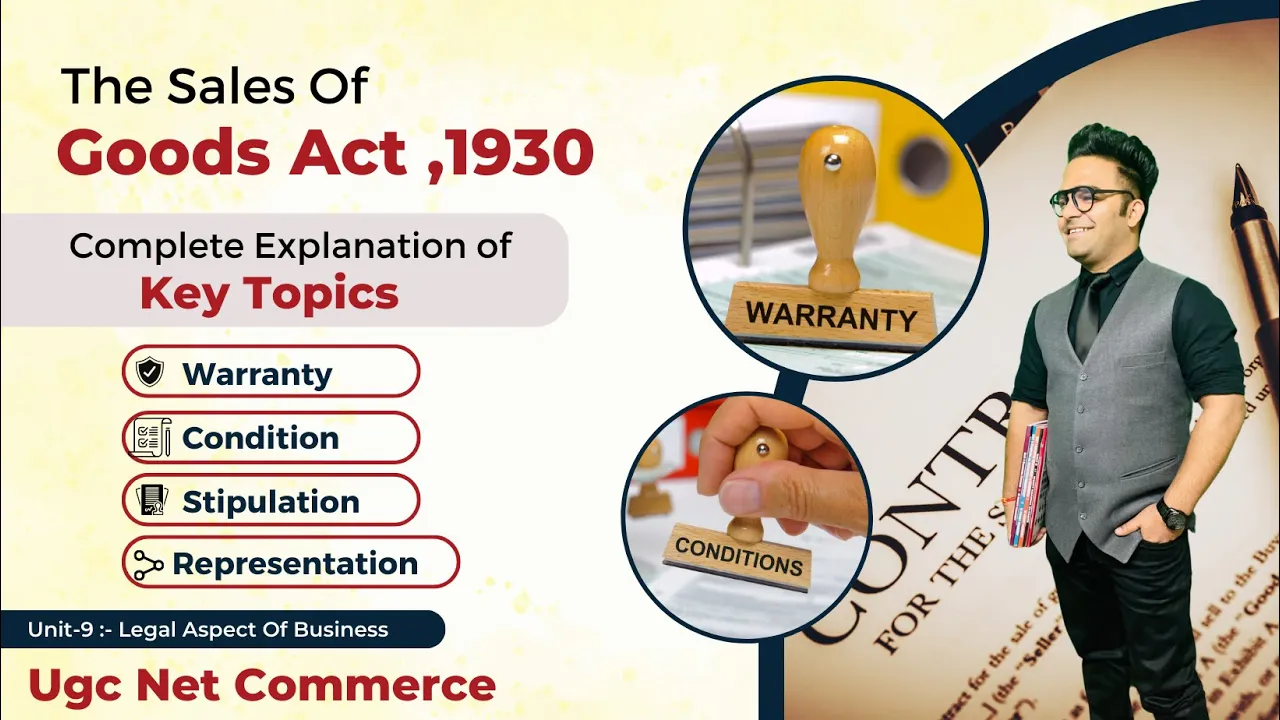
Sales Of Goods Act 1930 Key Topics- Warranty, Condition, Stipulation & Representation
5.6K
Express warranties are terms explicitly provided for in the contract of sale, while implied warranties are incorporated by law even if not explicitly stated. The instructor explains three main implied warranties: (1) Warranty as to quiet possession - the buyer receives quiet possession of the goods, (2) Warranty against encumbrances - the goods are free from any charges or encumbrances, and (3) Warranty to disclose the dangerous nature of the goods - the seller must disclose any dangerous nature of the goods that could harm the buyer.
Click to watch →
Ardentia PART 1 Review Day 6 (PM) | RFBT with Atty. Malaya
209
Express warranties are those explicitly stated by the parties in the contract. Implied warranties are those that are not stated but are implied by law. The key distinction is that express warranties are in the present tense (stated), while implied warranties are in the past tense (implied). The two most common implied warranties are warranty against hidden defects, warranty as to fitness, and warranty as to merchantability.
Click to watch →

Torts, bar review Day 2, Hour 3, Products liability continued.
1.3K
Express warranties (UCC §2-313) include affirmations of fact, promises, models, samples, or descriptions, including product names that imply certain functions. No reliance is required; intent to reach the plaintiff suffices. Implied warranties include merchantability (fit for ordinary use, adequate packaging, instructions, warnings) and fitness for particular purpose (when seller represents product is fit for specific use). Horizontal privity determines who can sue beyond the purchaser: UCC §2-318 options include (A) purchasers, family, household guests for personal injury; (B) anyone expected to be affected for personal injury; (C) anyone for personal injury and property damage. California allows any foreseeable plaintiff.
Click to watch →
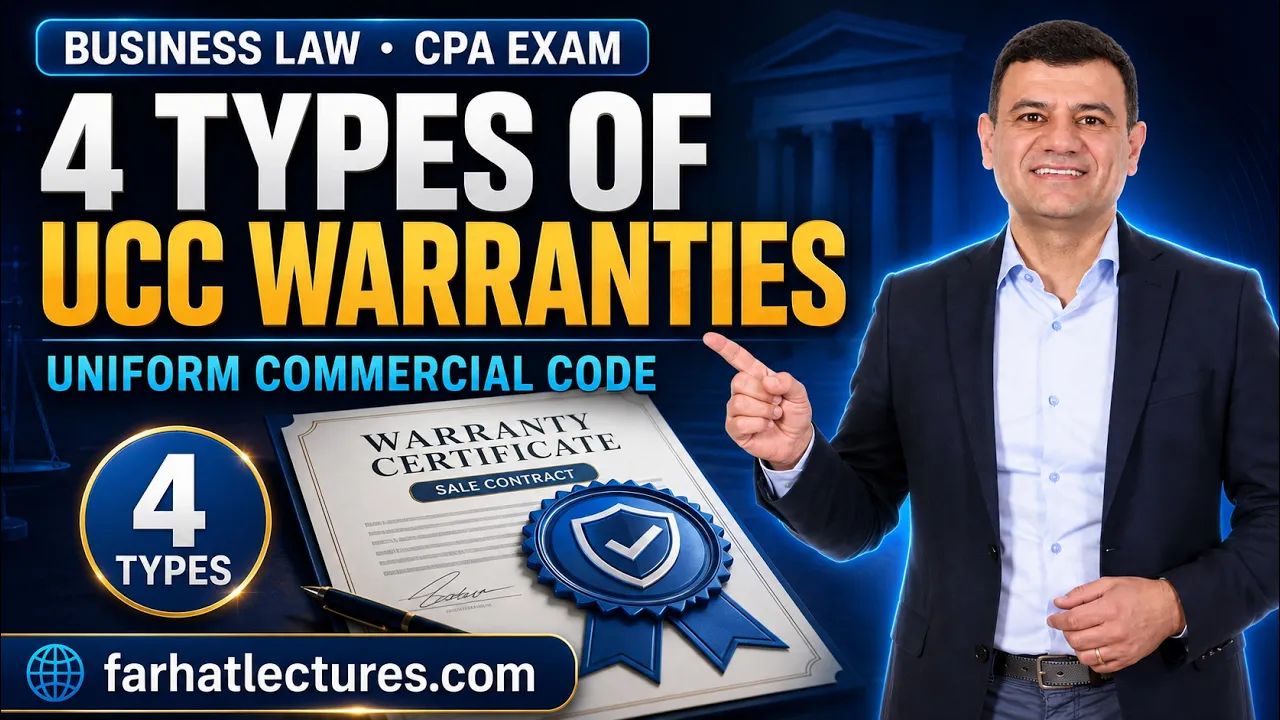
4 Types of Warranties Under the Uniform Commercial Code UCC | Business Law | CPA Exam
443
Express warranties arise from seller's factual statements, descriptions, samples, or models and cannot be disclaimed. The implied warranty of title automatically guarantees good title, no hidden liens, and no intellectual property infringement. This warranty applies to merchants and can only be nullified through specific language, not general disclaimers like 'as is.'
Click to watch →
Prerequisite Knowledge
- Concept 01Basic principles of Contract Law, specifically how warranties act as legally binding agreements between manufacturers and consumers.
- Concept 02The legal distinction between an employee and an independent contractor, and how this affects liability.
- Concept 03Fundamental concepts of Tort Law, particularly negligence and liability for property damage caused during service delivery.
- Concept 04The concept of express versus implied warranties under consumer protection standards.
Subsequent Learning
- Step 01In-depth study of the Magnuson-Moss Warranty Act and its regulations regarding consumer product warranties.
- Step 02The doctrine of Vicarious Liability (Respondeat Superior) and how courts determine if a corporation is responsible for a contractor's actions.
- Step 03Methods of consumer dispute resolution, including small claims court procedures, mandatory arbitration clauses, and consumer class actions.
- Step 04Corporate risk management strategies, specifically how companies structure indemnification clauses in third-party service agreements.
Intro Reset
Core Allegation
Warranty Contract
Damage Intent
Criminal Act
Vicarious Liability
Samsung Liable
Intro Reset
0:00Playing Section
- 1
Signal to disregard existing assumptions.
- 2
Shift focus to the real discussion topic.
Independent Contractor Defense and Limited Warranty Scope
From a corporate defense and contract law perspective, Samsung’s denial of the warranty claim may be legally defensible. Standard manufacturer warranties are strictly limited to defects in materials and workmanship arising from normal use, and explicitly exclude physical damage caused by external factors, including third-party handling. Furthermore, under the doctrine of independent contractor liability, a hiring company is generally not held vicariously liable for the negligent actions of an independent service provider. If the technician is legally classified as an independent contractor rather than an employee, the liability for the physical damage rests solely with the contractor's company, not Samsung. Consequently, Samsung's legal position would be that the warranty is not the appropriate legal vehicle for recourse; instead, the consumer’s proper remedy lies in a negligence or property damage claim directly against the third-party service firm that caused the physical damage.
Deep Dive
In-depth study of the Magnuson-Moss Warranty Act and its regulations regarding consumer product warranties.

FTC Brings Right-to-Repair to Barbecue Grills
45.7K
The Magnuson-Moss Warranty Act prohibits companies from conditioning warranties on using manufacturer-specified parts unless provided free. The FTC has issued a policy statement pledging to ramp up investigations into illegal repair restrictions. The act protects consumers, independent repair shops, and aftermarket parts manufacturers. Companies must prove to the FTC to receive exceptions for requiring specific parts. The FTC has authority under the FTC Act to take action against companies engaging in unfair or deceptive practices.
Click to watch →

Tesla's cybertruck warranty is what happens when consumer protection is a joke
353.1K
The Magnuson Moss Warranty Act is a 1970s consumer protection law that prevents manufacturers from voiding warranties simply because consumers repair their own devices. Manufacturers must demonstrate how the consumer destroyed the product to void the warranty. For example, if a consumer replaces a MacBook battery, Apple cannot void the warranty, but if they damage the motherboard during the process, they can void it. The FTC has issued penalties to companies like Harley-Davidson and Weber grills for violating this act, though enforcement remains inconsistent.
Click to watch →
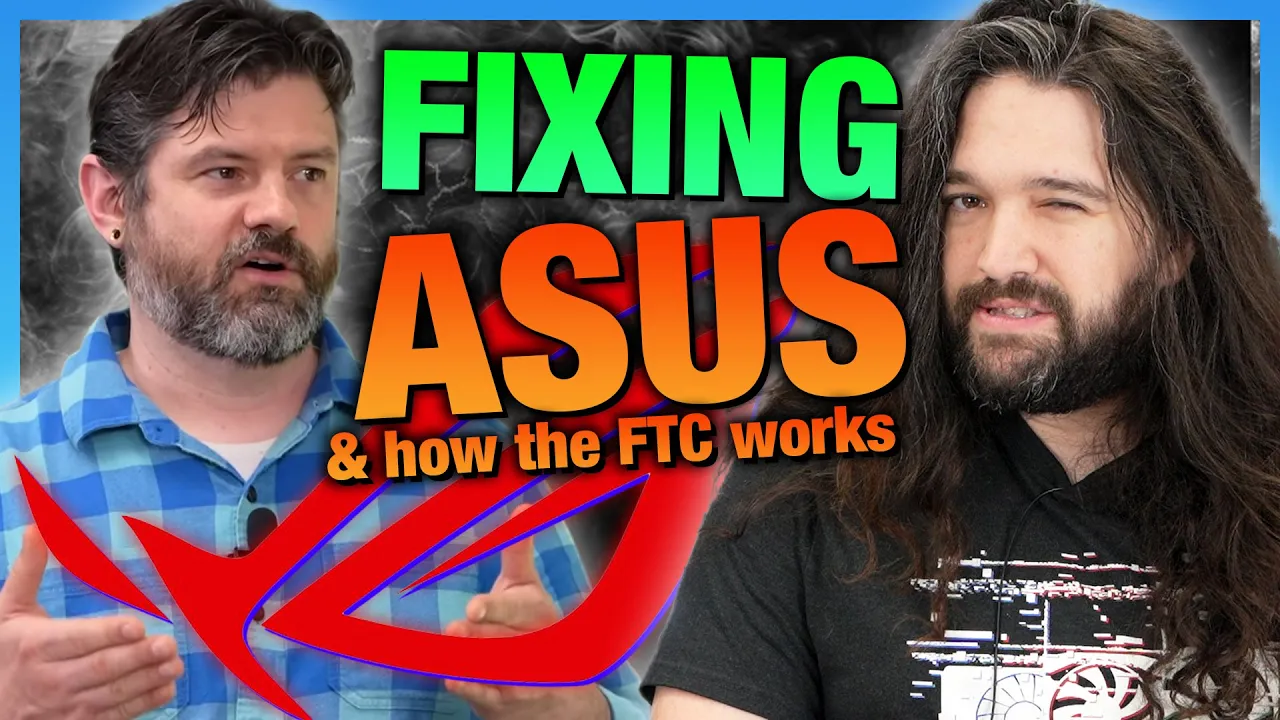
ASUS Already On Government's Radar for Warranty Issues
497.2K
Consumers have legal protections against unfair warranty practices under the Magnuson-Moss Warranty Act and FTC regulations, which prohibit companies from voiding warranties based on vague policies like 'tampering' or requiring exclusive use of manufacturer repair services; when companies systematically deny valid warranty claims to hundreds of customers, consumers can collectively report these violations to the FTC to prompt regulatory action and policy changes.
Click to watch →

Hoover vacuum warranty policy is a degrading scam
262.6K
The Magnuson-Moss Warranty Act prohibits companies from voiding warranties without meeting the burden of proof and requires clear, non-misleading warranty disclosures; companies that implement excessive bureaucratic barriers to warranty claims, such as requiring customers to destroy their own products or repeatedly request identical information, may be violating consumer protection laws and can face enforcement action from the FTC.
Click to watch →

Feds Target Those ‘Warranty Void if Removed’ Stickers
195.5K
The Federal Trade Commission is investigating PC manufacturers like ASRock, Gigabyte, and Zotac for using 'warranty void if removed' stickers, which violate the Magnuson-Moss Warranty Act; this federal law prohibits warrantors from conditioning written warranties on consumers' use of specific repair services or threatening warranty voidance for merely opening product cases, as such stickers create misleading impressions about warranty coverage and consumer repair rights.
Click to watch →
Deep Dive
The doctrine of Vicarious Liability (Respondeat Superior) and how courts determine if a corporation is responsible for a contractor's actions.
Motion for Summary Judgment--AZZ
175
Parent companies cannot be held vicariously liable for subsidiary actions without evidence of control or agency relationship, as this would defeat the purpose of separate corporate organization. Similarly, piercing the corporate veil requires plaintiffs to demonstrate both that the corporate fiction was used to perpetuate fraud and that the corporation is the alter ego of another entity. Identification of a corporation in a report alone does not constitute evidence of these elements. Courts require specific evidence showing fraudulent intent and unity between entities before allowing veil piercing.
Click to watch →

PERTANGGUNGJAWABAN PIDANA KORPORASI (VIDEO 3/4)
3.1K
Vicarious liability provides a mechanism for holding corporations criminally responsible for the actions of their agents. When corporate employees or officials commit prohibited acts within the scope of their employment and for the corporation's benefit, the corporation can be held liable. Three essential criteria must be satisfied: (1) an employment relationship exists between the agent and the corporation, (2) the prohibited act was performed within the scope of employment, and (3) the prohibited act provided some benefit to the corporation. This doctrine allows prosecutors to hold corporations accountable for systemic failures without requiring direct evidence of corporate authorization, though it raises questions about whether corporations should bear responsibility for individual employee misconduct.
Click to watch →
30 Latin Legal Terms Everyone Needs to Know
87.8K
Respondeat superior (Latin for 'let the master answer') is the doctrine holding employers liable for torts committed by employees within the scope of employment. This principle ensures that victims can seek compensation from the deeper pockets of employers rather than individual employees who may lack resources. The employer is vicariously liable for employee misconduct occurring during work-related activities, regardless of whether the employer authorized the specific conduct.
Click to watch →
Closely Held Business Organizations Review Module 1: Agency Law and Respondeat Superior
4.3K
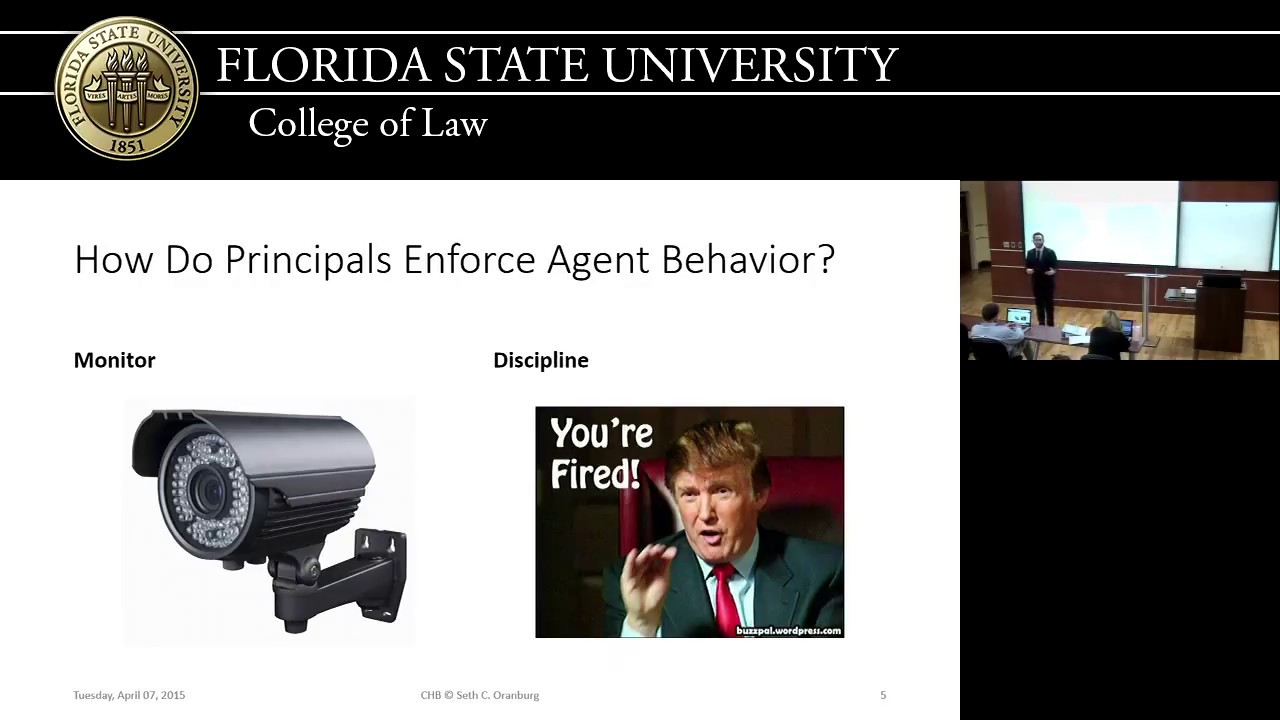
Respondeat superior (let the master answer) holds principals liable for torts committed by employees within the scope of employment. This principle allocates liability to principals because they are better positioned to monitor agents, can screen employees effectively, and typically have deeper pockets than individual employees. The doctrine provides relief for tort victims by creating an additional source of capital for compensation. Employee classification affects liability: employees receive W-2 forms with tax withholding and employment benefits, while independent contractors receive 1099 forms without withholding and lack similar protections. Misclassification can result in tax liabilities and loss of employee protections. Three questions determine if conduct falls within scope of employment: (1) Is the conduct of the general kind the employee was hired to perform? (2) Is the conduct substantially within the time and space of employment? (3) Does the conduct reasonably appear to further the employer's business?
Click to watch →

Tim Turner Freedom Seminar (2009) Part 4
9.1K
The presumptions of courts and agencies are that you are a debtor and slave to the corporation. If you rebut a presumption in writing and it is not rebutted, your presumption stands as law. This is the principle of truth in law. Respondeat superior means that if a subordinate commits an act against your rights, the superior is responsible. If a police officer trespasses against your rights, the mayor or police chief is responsible. This doctrine allows you to target higher authorities. The speaker had a case where a Game and Fish officer violated a fisherman's rights, and by targeting the department head, the officer lost his job and faced financial penalties. Even in society today, you cannot violate people's rights without liability. The books can be balanced when you know how to apply the right pressure.
Click to watch →
Deep Dive
Methods of consumer dispute resolution, including small claims court procedures, mandatory arbitration clauses, and consumer class actions.

Bài giảng Luật Bảo vệ quyền lợi người tiêu dùng _ Phần 5
1.4K
There are five methods for resolving disputes between consumers and business organizations: (1) Negotiation - direct communication between parties to reach agreement; (2) Mediation - involving a third party (such as consumer protection organizations) to facilitate resolution; (3) Arbitration - a binding decision by a neutral third party; (4) Court litigation - formal legal proceedings; (5) Administrative resolution - seeking intervention from government consumer protection agencies. Individual consumers can choose among negotiation, court, and administrative methods, but disputes affecting state interests, public interests, or many consumers must use arbitration or court proceedings.
Click to watch →

Asking lawyers what they think should be illegal...
6.1M
Many contracts with utilities, cell phone companies, and cable companies include mandatory arbitration clauses that require any lawsuits to be resolved through private arbitration rather than court proceedings. These clauses typically limit individual claims to small amounts (such as $20 or $75) and prevent class action lawsuits, which would allow groups of consumers to collectively pursue larger damages.
Click to watch →

Borçlar Hukuku Sözleşmelerde Şekil, Genel İşlem Koşulları
4.7K
Consumer disputes are subject to mandatory preliminary procedures: disputes up to a certain amount must first go to the Consumer Arbitration Board, and disputes above that amount must go to the Consumer Court. Arbitration board decisions can be executed without waiting for finalization, unlike previous procedures.
Click to watch →
Unit 1 - Resolving Conflict - Ombudsman & Small Claims Court
5.5K
Consumers have two main approaches to resolve conflicts with retailers: non-legislative (informal) and legislative (legal) methods. Non-legislative methods include directly complaining to the retailer or seeking assistance from agencies like the National Consumer Agency (NCA) or trade associations, which may offer mediation services. Legislative methods become necessary when informal resolutions fail and include taking cases to Small Claims Court or employing a solicitor. Small Claims Court offers an efficient, low-cost option for disputes under €2,000, with a €25 filing fee, focusing on issues like faulty goods, poor workmanship, and property damage.
Click to watch →

Day 1 – Day 1 of the Forbidden AI™ 5-Day Challenge!
674
Small claims court is generally preferable to arbitration for consumers because it is faster and less costly. Creditors who file thousands of lawsuits daily typically have arbitration clauses in their terms, but they rarely enforce them because they would have to pay arbitration fees (potentially $3,000-$5,000) while avoiding small claims court fees. Arbitration only becomes an issue if the consumer specifically requests it.
Click to watch →
Deep Dive
Corporate risk management strategies, specifically how companies structure indemnification clauses in third-party service agreements.
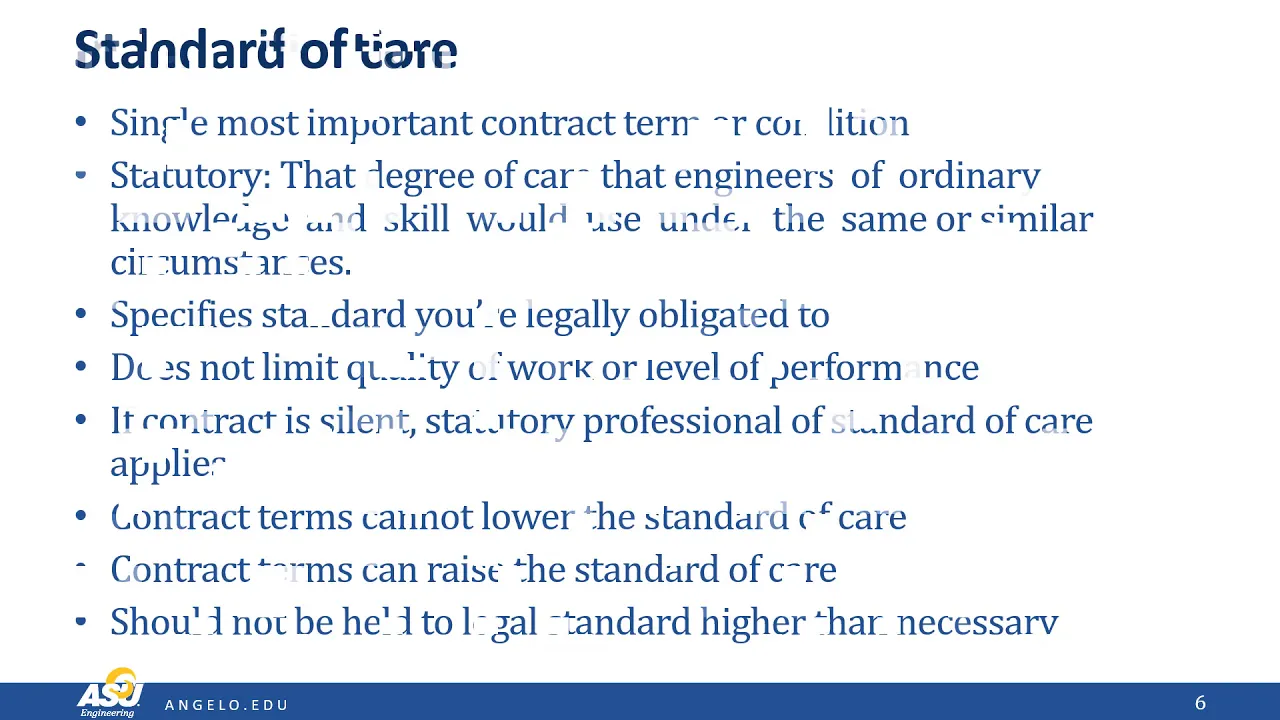
Contract Terms and Conditions
449
Indemnification transfers liability from one party to another, but effective risk management requires aligning risk ownership with the ability to manage that risk. Good indemnification occurs when the party taking on liability controls the associated risks—for example, contractors indemnifying property owners for site injuries because contractors control access and safety protocols. Poor indemnification transfers liability to parties without risk control capabilities. When evaluating indemnification clauses, always ask: Who is transferring liability? Who has control over the risks? Only then can you determine if the clause serves legitimate risk management purposes or merely shifts responsibility unfairly.
Click to watch →
What Is an Indemnification Clause? + 3 Types of Indemnification Clauses
3.3K
An indemnification clause is a contractual provision that shifts financial responsibility for certain events from one party to another; there are three main types: general indemnification clauses provide broad protection where one party pays for any losses or damages not their fault, specific indemnification clauses limit liability to particular occurrences like rejected architectural plans, and third-party indemnification clauses hold parties responsible for losses caused by third parties such as subcontractors, which business owners typically try to avoid due to lack of control over those third parties.
Click to watch →

Six Secrets to Negotiating Managed Services Agreements
1.7K
Indemnification provisions determine who pays when third parties are injured by service provision. Examples include employee injury claims (consultant equipment causing customer employees to trip) and data breaches where consultants mishandle protected health information. Data breach scenarios can result in tens of thousands of dollars in notification costs, preparation expenses, credit monitoring, and credit repair. Software licensing responsibilities must be clearly defined—providers should specify who purchases licenses, reviews compliance, and pays publishers. These provisions become important when things go wrong, even though they are rarely reviewed when everything is going smoothly. Providers should ensure they understand their liability exposure and have appropriate insurance coverage.
Click to watch →
Webinar on 'How to Draft a Contract and 3 Ways to Earn Money Through That' | Lawctopus Law School
7.4K
Indemnification clauses shift risk between parties by requiring compensation for losses from breaches, warranties, or willful misconduct. Unlike guarantees (which involve three parties), indemnification operates directly between contracting parties. These clauses secure representations made during negotiations—for example, when acquiring a business, the seller represents having all necessary licenses; if later discovered missing, indemnification allows recovery of damages. The wording significantly affects risk exposure: 'all liabilities' exposes parties to unlimited claims, while 'proven liabilities in court' provides meaningful limitation. Large companies often obtain insurance aligned with their indemnification exposure. Understanding these distinctions protects clients from unforeseen liabilities.
Click to watch →

Practical Law Canada | Insights from Sharmila Irvine, Commercial Transactions Practice Lead
284
Indemnification clauses are critical components in commercial contracts that allocate risk between parties, requiring careful consideration of key elements including the distinction between indemnification and hold harmless provisions, obligations to indemnify versus defend, recoverable and covered damages, liability baskets, maximum liability caps, insurance adjustments, and materiality qualifiers. These provisions are commonly used across various contract types including sale of goods, supply arrangements, confidentiality agreements, intellectual property licenses, franchising, consulting agreements, and equipment leases, and can be structured as long-form mutual or unilateral indemnity, or short-form provisions tailored to the specific roles of the parties involved.
Click to watch →
Intro Reset
Core Allegation
Warranty Contract
Damage Intent
Criminal Act
Vicarious Liability
Samsung Liable
Intro Reset
0:00- 1
Signal to disregard existing assumptions.
- 2
Shift focus to the real discussion topic.
Independent Contractor Defense and Limited Warranty Scope
From a corporate defense and contract law perspective, Samsung’s denial of the warranty claim may be legally defensible. Standard manufacturer warranties are strictly limited to defects in materials and workmanship arising from normal use, and explicitly exclude physical damage caused by external factors, including third-party handling. Furthermore, under the doctrine of independent contractor liability, a hiring company is generally not held vicariously liable for the negligent actions of an independent service provider. If the technician is legally classified as an independent contractor rather than an employee, the liability for the physical damage rests solely with the contractor's company, not Samsung. Consequently, Samsung's legal position would be that the warranty is not the appropriate legal vehicle for recourse; instead, the consumer’s proper remedy lies in a negligence or property damage claim directly against the third-party service firm that caused the physical damage.
Basic principles of Contract Law, specifically how warranties act as legally binding agreements between manufacturers and consumers.
The legal distinction between an employee and an independent contractor, and how this affects liability.
Fundamental concepts of Tort Law, particularly negligence and liability for property damage caused during service delivery.
The concept of express versus implied warranties under consumer protection standards.
In-depth study of the Magnuson-Moss Warranty Act and its regulations regarding consumer product warranties.
The doctrine of Vicarious Liability (Respondeat Superior) and how courts determine if a corporation is responsible for a contractor's actions.
Methods of consumer dispute resolution, including small claims court procedures, mandatory arbitration clauses, and consumer class actions.
Corporate risk management strategies, specifically how companies structure indemnification clauses in third-party service agreements.
4.6M views223.6Klikes0:59@UgoLordOriginal Release: 2024-06-15
lawyer's reaction I just want to reset everything you know the power anything else just that SP right I don't know this video owner alleged that this Tech intentionally damaged the television in order to Avid the warranty now these warranties are a contract and So contractually speaking absolutely this warranty is now voided because now it has physical damage Dage but the reason why it has physical damage ladies and gentlemen is because this Tech intentionally damaged it that is a crime known as destruction of property and due to another legal concept known as respondent Superior also known as vicarious liability the company that the tech works for would be in fact liable and in this case it's alleged that that is Samsung so ladies and gentlemen this warranty is void but it would still make Samsung liable for all the damages that happen next
Up Next

22:00
Medical Injustice: Diane Stewart Case and SB 850
@insiderexclusive
325 views•2012-06-11

12:54
Triumph of Orthodoxy Icon: Byzantine Art & History Explained
@BenCallan
2.1K views•2024-08-06

9:49
FastAPI vs Flask vs Django: Choosing the Right Python Web Framework
@TechWithTim
302.5K views•2024-05-26

1:42
Game of Thrones Opening Credits: A Cinematic Analysis
@gameofthrones
46.3M views•2011-04-18
Related Study Plans & Knowledge Roadmaps
Structured learning paths in General & Interdisciplinary Studies
general-studies
Elevator Engineering: History, Physics & Cities
01From Hoists to Safety Brakes: The Dawn of Vertical Lift
02Hydraulic vs. Traction: The Engineering Physics of Elevators
03Modern Speed, Safety, and Algorithms
+ 2 more learning modules
12h5 modules
Explore Roadmap
general-studies
Rubber: Material Science, History & Geopolitics
01Origins of Natural Rubber & Mesoamerican History
02The Chemistry of Natural Rubber & Vulcanization
03The Geopolitics of the Rubber Boom & Colonization
+ 2 more learning modules
12h5 modules
Explore Roadmap
general-studies
Containerization: Evolution, Logistics & Trade
01Ancient Trade & Bulk Cargo: Amphorae to Barrels
02The Industrial Revolution & Cardboard Packaging
03The Containerization Revolution: Malcom McLean
+ 2 more learning modules
12h5 modules
Explore Roadmap
general-studies
Textile Tech: Evolution, Labor & Global Impact
01Pre-Industrial Textiles: Handloom & Cottage Industry
02Mechanization: The Spinning Jenny to the Power Loom
03The Factory System & Global Labor Transformation
+ 2 more learning modules
10h5 modules
Explore Roadmap