













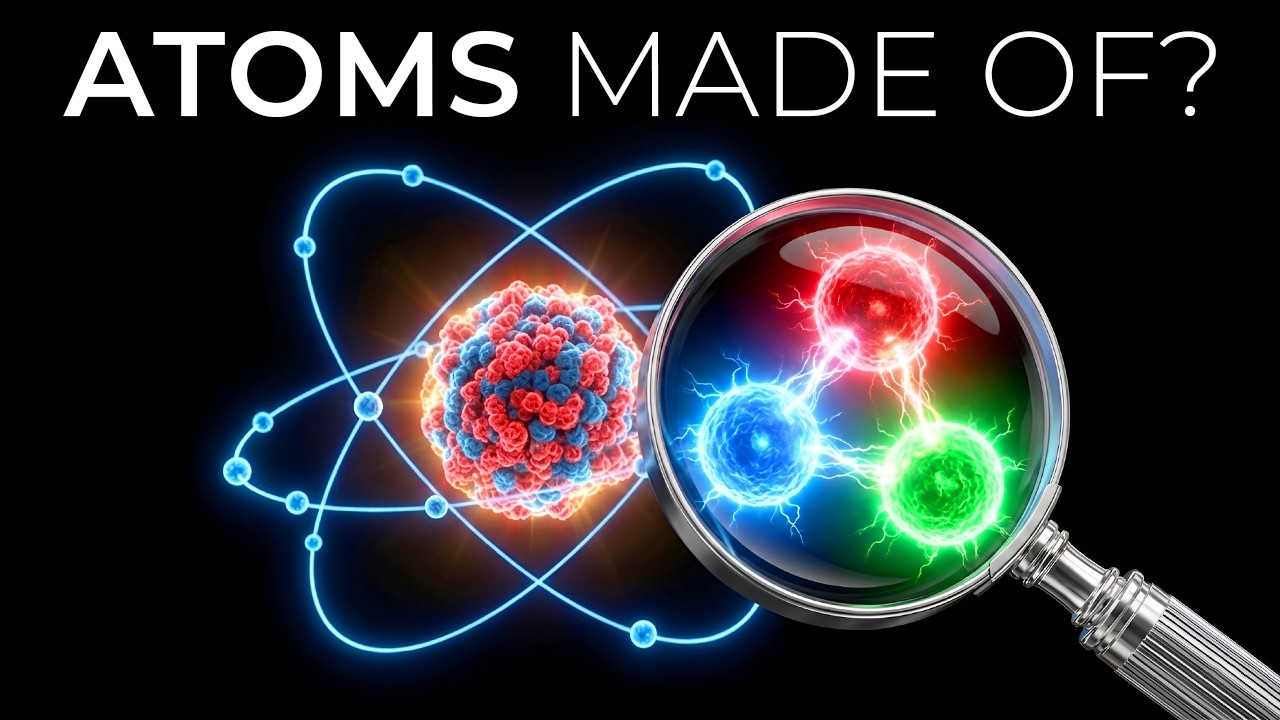









Atoms are incredibly small, with a carbon atom measuring approximately 140 picometers (1/7,000,000th of a millimeter); to illustrate this scale, a human hair (about 1/10 mm thick) contains roughly 700,000 carbon atoms in a single line, and its cross-section holds approximately 390 billion atoms—the smallest area visible to the naked eye. A single grain of sand contains about 6 quintillion atoms, while the human body contains approximately 7 octillion atoms, which if lined up would stretch 300 trillion kilometers or about 32 light-years.
The True Scale of Atoms: A Visual Guide to Their Size
Added:Basic atomic structure, including the concept that all matter is made of atoms consisting of protons, neutrons, and electrons.
Familiarity with metric units of length, particularly microscopic scales such as micrometers and nanometers.
The mathematical concept of orders of magnitude and how scientific notation is used to represent extremely small numbers.
An understanding of proportional scaling and how visual analogies are used to compare objects of vastly different sizes.
The distribution of mass within an atom, specifically the extreme density of the nucleus compared to the vast, empty electron cloud.
The principles of quantum mechanics that define why electrons behave as probability clouds rather than particles in neat, planetary orbits.
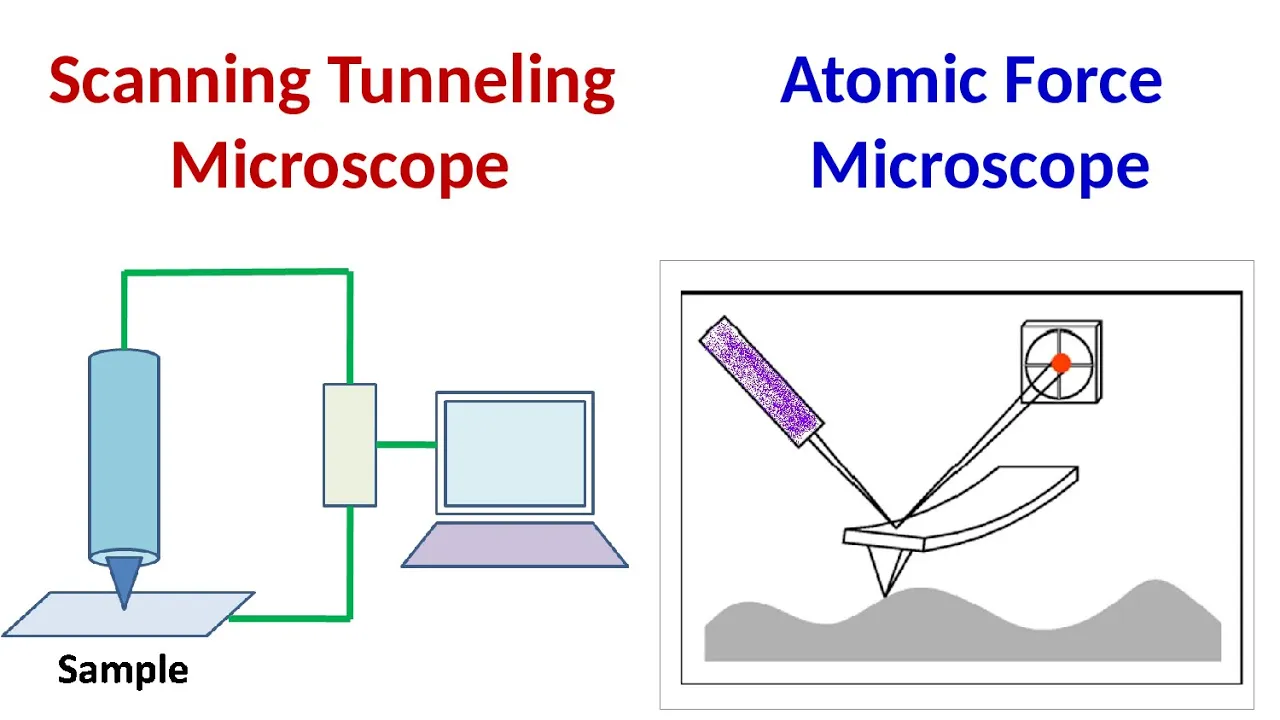
The technology behind atomic imaging, such as Scanning Tunneling Microscopy (STM) and Atomic Force Microscopy (AFM), which allow us to 'see' atoms.
The real-world applications of nanotechnology and molecular engineering, where manipulating matter at the atomic scale creates new materials.
1.4M views28.9Klikes10:28Original Release: 2019-04-15
Atoms: The building blocks of everything around you. That atoms are extremely small probably isn’t something I have to tell you - But how small exactly are they? That’s where things get a bit more interesting, because that’s actually quite difficult to answer visually. Now of course I could tell you that a carbon atom has a diameter of only 1.4E-7 mm, but that would hardly help you to visualize the scale of atoms – such a value is simply too abstract. Similarly I could say that 1m² of Diamond would contain about 1.75*10^29 atoms, but that too wouldn’t necessarily bring us any closer to a clear picture of how small atoms really are.
To illustrate the scale of atoms properly we have to bring it in a context that is still somewhat visualizable. And that’s exactly what we will be attempting to do today. Because the tiny dimensions we’re talking about make this not at all easy, we will explore three different approaches at once, so that at by the end hopefully everyone has a better understanding of how small atoms really are. Before we begin lets quickly establish how big a millimetre is, for our American audience because inches are way too big for the task at hand. If we take a look at this ruler than this is an inch, and this is a millimetre.
So a millimetre is almost exactly 1/25th of an inch, or based on this ruler: 2/3rds of 1/16th. So when I say something like 1/5th of a millimetre than that’s 1/5th of this blue area. Great, let’s begin. One of the smallest things visible to the naked eye is a human hair. This makes it the perfect starting point. On the one hand it’s so small that the numbers don’t instantly explode into absurdity but on the other hand everybody should have a clear understanding of its dimensions.
Now of course hairs vary in thickness (little black curly hair) but your average head hair is about 1/10 of a millimetre thick. Atoms also don’t have a uniform scale. Their Size varies depending on the element, the chemical environment and even how they are arranged.
Our model of the atom simply is just that, a model. As much as we like Atoms to be perfectly defined marbles, in reality it’s not that simple. However, to make this video we have to use some figure: For a carbon atom, the third most common atom in our body, 140 picometers is, I think, a fair value: That’s roughly 1/7.000.000th of a millimetre. That means a human hair is on average as thick as a strand of 700 000 carbon atoms, which showcases quite well how small atoms must be. But 700.000 too isn’t necessarily a conceivable number especially on the inside of a human hair. So what if we scaled up each of these atoms, but only to the point that each atom itself has the diameter of a human hair and would therefore barely be visible to the naked eye. If we did that the hair would be an astonishing 70meters or 230 ft thick - almost as tall as the Big Ben in London.
But these 700.000 Atoms of course only form a one dimensional string 1/7.000.000th of a millimetre thick. To fully appreciate how numerous and therefore small atoms are we have to explore all three dimensions. So let’s continue with an area. What if we covered the cross section of a hair with a layer of carbon atoms? That’s calculated easy enough. If we plug the radius of 350.000 atoms in the formula for the area of a circle we get an area of 390.000.000.000 (390 billion) atoms. Roughly that many carbon atoms fit on the cross section of a hair. Why is this number important? As mentioned earlier, objects 0.1mm wide (so the width of a human hair) are just distinguishable by good eyes. That means the cross section of a human hair is the smallest point you can still make out with your own eyes and thus an area of 390 billion carbon atoms is the smallest area of atoms visible to the naked eye, at least theoretically. Because while a monolayer of carbon atoms does absorb around 2-3% of white light making it ever so slightly opaque, such a small dot would probably still be too transparent to be distinguishable without a few more layers of atoms below it. Still, If you put the end of a cut hair between your fingers and press your fingers together so that only the very tip peeks out, on this tiny point would fit roughly 390 billion carbon atoms - an inconceivably large number.
To put this number into perspective lets go back to our scale up from earlier. But this time picture it as a giant 70m or 230ft thick paint brush made from human hair tightly backed together with no room in between. Humans have around 100.000 hairs on their head, so for a paintbrush that size would need to sheer the heads of around 4.000.000 people.
If each of these hairs would represent one atom then that’s how many carbon atoms would fit on the tip of one of your hairs. And this is just a single layer of atoms.
There is still one dimension left to explore and that’s where the numbers really become mind bogglingly large. But for that task we should probably switch to an object that is a little easier to see in detail, which brings us to our second approach.
This time lets use a grain of Sand. The average grain of sand has is about half a millimetre big, so about 5-times the diameter of a hair. Technically speaking sand isn’t made up of a particular material as it is only defined by size of its particles. It is finer than gravel but coarser than silt. Typically however Sand of course composed of Silicon dioxide so quartz. Our grain of sand would weigh about 200 micrograms.
Using the molar mass of silicon dioxide we can calculate that there are around 10^22 molecules in a gram of sand. Since each molecule of silicon dioxide contains 3 atoms this amounts to 6*10^18 or 6 quintillion atoms in our grain of sand.
Using our trick from earlier and scaling up each of these atoms to the size of a grain of sand our grain would be roughly 1100m or 3600ft tall, 3 times as tall as the Empire State Building. Or to put it differently: If you’d cover an area of 750 km² - roughly the size of New York City – with a layer of sand up to your belly button, you would have about as many grains of sand in that layer as there are atoms in a single grain. Granted that’s not nearly as many atoms as there are grains of sand on the entire planet, as some trivia sites claim but it’s still an absurdly large number that gives you a good understanding of how small atoms really are.
The final approach we want to explore is arguably the most abstract one, but it’s also the most fun one. How many atoms are in your body? Given that a single grain of sand already contains quintillions of atoms it doesn’t really make sense to try to visualize the number in a conventional way. Instead let’s try something a little different. What if we made a human sausage? What if we put a human (obviously a very bad one, like a murderer or a lawyer) through a meat grinder and then rolled him out thinner and thinner and thinner. How long could that sausage get?
How long could a single human theoretically get?
The first step would be to roll him out so thinly that we end up with a string of individual cells. How long would such a human cell thread be?
How many cells there are in a human body can of course only be estimated and even that is harder than it seems. For a start, the cells in our body differ vastly in size. Red Blood cells for instance a teeny tiny, only 1/150th of a millimetre wide. Sperm cells, the smallest cells in our body are even smaller. On the other side of the spectrum we have fat cells for instance, with a volume roughly 20.000 times larger. The largest cells the female egg cells are so large they are even visible to the naked eye. On top of that, the different cells also vary significantly in density.
All this makes an accurate estimation of the amount of cells in our body quite challenging.
By dividing the body into its individual organs and parts and those again into their cell-types scientists in 2013 for the first time made an attempt at a more accurate estimation.
Their result: The body of an average human not including the countless bacteria and microbes that live within us contains roughly 37 trillion (3.72*10^13) cells.
If we assume that an average cell has a diameter of 1/50th of a millimetre, then a string of all those cells would have a length of 740.000 km – 460.000 mi and would reach 18 times around the world. Now let’s break each of these cells down into its individual atoms – How long would the human body then be.
Earlier we learned that you could fit 390 billion carbon atoms on the tip of a hair.
So in simplified terms, you could say that each hair consists - similar to a steel cable - of 390 billion strands of atoms. If you’d put them one behind the other, the strands of a 13cm 5inch hair would already be enough to cover the distance from Earth to Mars.
But we obviously can’t stop here. An average human weights about 75 kg – 165 lbs. If we subtract 5 kilos of microbes and food or whatever’s left of it we end up with 70 kg or 155 lbs. of meat, fat, blood, and bones.
Since life on earth is carbon-based and 65% of our body is made up of water, it shouldn’t come as a surprise that hydrogen oxygen and carbon are the three most common elements in our body: In fact, they make up 99% of all the atoms we are made of, so let’s just leave out the other 1% Just under 2/3 of that is hydrogen, ¼ oxygen and 1/10th carbon. Using the atomic mass of these elements we can estimate that 70kg of human consist of roughly 7 octillion atoms. That’s a 7 with 27 zeros. How large is that number? Let’s put it that way. if wed cover the entire planet, land and water combined with a mat of made of human hairs sticking up from the ground. We would still need to duplicate the planet 140.000 times to get to 7 octillion hairs. That many atoms are in your body.
Would you line them up in a row, the resulting string of atoms would be 300 trillion kilometres long. That’s roughly 10 parsecs or 32 light years. That would make a single human long enough to stretch from earth to the sun and back 1.000.000 times or from the sun the nearest star Proxima-Centauri and back 4 times. This is only possible because the atoms that we and all the other ordinary matter in our universe are made of are so incredibly small.
And hopefully after these 10 minutes of theoretical shenanigans you now have a little better understanding of how small exactly.
Up Next

6:36
Leptons: A Beginner's Guide to Particle Physics Fundamentals
@thecodelucky
131 views•2025-10-17

12:53
21cm Hyperfine Transition in Neutral Hydrogen: Radio Astronomy Basics
@AaronRobertParsons
12.4K views•2011-10-13

32:32
NMR Spin Physics I: Zeeman Effect, Resonance Condition & Larmor Frequency
@nptel-indianinstituteofsci8064
2.3K views•2024-01-17

27:14
Entropy and the Second Law of Thermodynamics Explained
@veritasium
27.5M views•2023-07-01
Related Study Plans & Knowledge Roadmaps
Structured learning paths in Physics
physics
Nuclear Physics (Decay, Fission & Reactors)
01Atomic Structure and the Binding Force
02Radioactive Decay and Half-Life
03Nuclear Fission Mechanics and Chain Reactions
+ 2 more learning modules
12h5 modules
Explore Roadmap
physics
Soft Matter (Polymers, Colloids & Rheology)
01Foundations of Soft Matter & Thermal Forces
02Polymer Physics and Macromolecules
03Colloids, Surfactants, and Self-Assembly
+ 2 more learning modules
38h5 modules
Explore Roadmap
physics
Analytical Mechanics: Lagrangian & Hamiltonian
01Mathematical Foundations: Calculus of Variations
02From Newtonian Mechanics to Constraint Dynamics
03The Principle of Least Action & Lagrangian Mechanics
+ 3 more learning modules
28h6 modules
Explore Roadmap
physics
General Relativity (Spacetime & Cosmology)
01Foundations of Relativity: Special Relativity
02The Geometry of Spacetime: Equivalence Principle & Curvature
03Einstein's Field Equations: The Mathematics of Gravity
+ 2 more learning modules
55h5 modules
Explore Roadmap