















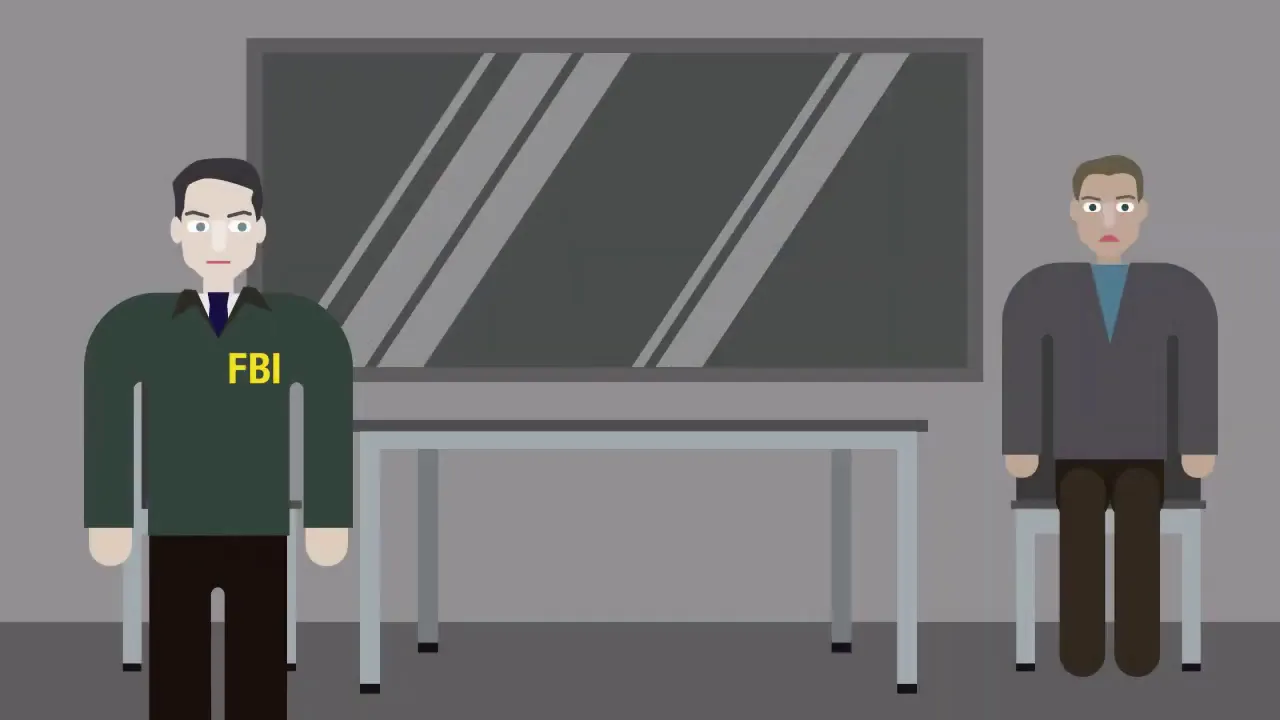




The landmark Supreme Court decision Miranda v. Arizona (1966) established that criminal suspects must be informed of their Fifth Amendment protection against self-incrimination and Sixth Amendment right to counsel before any interrogation, resulting in the familiar Miranda warning that ensures fair treatment in police custody by preventing coercive interrogation practices and protecting individual liberty against government overreach.
Miranda v. Arizona: The Right to Remain Silent Explained
Added:The Fifth Amendment to the U.S. Constitution, specifically the clause protecting individuals against self-incrimination.
The Sixth Amendment guarantee of the right to counsel and its application to criminal defendants.
The role of the U.S. Supreme Court in interpreting the Constitution and establishing binding legal precedents.
The basic stages of the criminal justice process, particularly the transition from a police investigation to an official arrest.
The legal definition of 'custodial interrogation' and how subsequent case law has defined when Miranda warnings are strictly required.
Established exceptions to the Miranda rule, such as the 'public safety exception' introduced in New York v. Quarles.
The standard for a 'knowing, intelligent, and voluntary' waiver of Miranda rights by a suspect.
The landmark case Dickerson v. United States (2000), which solidified Miranda warnings as a constitutionally based rule that Congress cannot supersede.
The 'fruit of the poisonous tree' doctrine and how it applies to physical evidence discovered as a result of unwarned confessions.
155.1K views750likes25:09Original Release: 2018-09-13
Every time you hear this phrase… You have the right to remain silent.
What you're really hearing is a simple way of saying this, from the Fifth Amendment: "No person…shall be compelled in any criminal case to be a witness against himself."
This is just one right from the Miranda warnings, rights read to suspects when they're under arrest and facing interrogation.
You have the right to remain silent.
It's like watching the Bill of Rights go to work.
The Miranda warnings are a staple of popular culture.
Miranda is really one of our iconic Supreme Court decisions.
When it was handed down, it was the most controversial criminal procedure decision ever.
That's because the right that says you can't be forced to confess or testify against yourself is a fundamental protection of our liberty, but it also seems like it might interfere with convicting criminals.
Are we giving criminals an advantage?
Or did the framers want to make it difficult for the government to take away someone's liberty?
The line between liberty and security has always been a place for some of the loudest debates in America.
And right there in the middle is the Miranda case, the Fifth Amendment, and the right to remain silent.
In March 1963, an 18-year-old woman was coming home from her job at a movie theater in Phoenix, Arizona, when she was pulled into a stranger's car, kidnapped and raped, then driven home.
She couldn't identify her attacker, but after piecing together parts of her story, 10 days later, the police showed up at the front door of Ernesto Miranda.
Ernesto Miranda is a criminal suspect.
They just take him down to the station and question him.
He was interrogated there for two hours.
We don't know exactly all of the details of that interrogation.
What we do know is that two hours later, the police came out with a confession.
And as confessions go, Miranda's was about as complete as they come.
He wrote it out.
It told how he picked her up. How he forced her into the car, that he drove her out to this rural, isolated area... and raped her and drove her back home.
Okay, this is a really big moment in the case.
Because in the prosecution of criminal trials, there's nothing more important to the police than a confession.
Confessions are hugely important.
It's probably the single most valuable piece of evidence.
There's nothing as powerful as a person who's accused actually saying, "Yes, you're right. I did do this thing."
It will probably be the basis for a conviction in the case, or the defendant probably won't even stand trial 'cause he'll know it's going to come and they will know it will sink him, so he's going to plead guilty.
If there's a confession, that's pretty much all the evidence the state needs.
It's a powerful tool for law enforcement and that's why the Fifth Amendment protects us from being forced to incriminate ourselves.
Self-incrimination is saying something that establishes or indicates your guilt.
This right not to betray yourself goes back a long, long way.
Historically, the privilege against self-incrimination started at the Star Chamber with John Lilburn.
John Lilburn stood up to the Star Chamber in 1637.
The Star Chamber was an English court that met in secret and sentenced religious opponents of the King to torture.
What happened in the Star Chamber was that they would call in people and ask them questions.
Did you commit this crime?
Well, you had no good choices.
If you said yes, they'd torture you.
If you said no, they'd say you were lying and torture you.
If you refused to answer, they'd torture you until you said yes or no.
John Lilburn refused to incriminate himself.
And what became a rallying cry in England became a fundamental right in the U.S. Constitution.
The framers were very aware that the criminal justice system could be the source of all sorts of abuse.
It's a setting in which the government is authorized to really take complete control over an individual's life, and giving the government that kind of authority is both necessary to have an ordered civilized society, but extremely dangerous.
And so the idea is to figure out how you create a system that gives the government the power it needs to have to punish wrongdoers without giving the government the power to be abusive.
So the Bill of Rights is loaded with protections throughout the 4th, 5th, 6th and 8th Amendments that limit what our government can do to people as they go through the criminal justice system: rules, or due process, about things like search and seizure; juries to give citizens (not the government) the last word before we take away someone's liberty; a right to a lawyer; no cruel and unusual punishment.
The fundamental principle of our criminal justice system is that you are innocent until you are proven guilty.
So the burden of proving an individual guilty of a crime rests with the government.
We have an adversarial system of justice.
Two sides, the prosecutor and the defense.
The prosecution (the government) has to make its case, and the defense can put up a good fight... or do absolutely nothing.
The entire burden to prove guilt beyond a reasonable doubt is on the government.
Because the defendant is presumed innocent and is not required to do anything actually in a criminal trial.
So they don't have to argue to the jury, they don't have to call witnesses, they don't even have to cross-examine the government witnesses.
And the defendant certainly doesn't have to testify.
Because you have a privilege against self-incrimination that means that you have the right to remain silent.
And a confession is the farthest thing from silence.
But here's where it gets really tricky.
Ernesto Miranda, like most people, confessed while he was in an interrogation room.
And at the time Miranda confessed, it wasn't clear what rights a suspect had in the interrogation room, which had a reputation for being a pretty scary place.
There's a sad history in the United States of not just lights being shown in defendants' eyes, not just long questioning of the sort that really can make you feel under pressure... but of actual violence.
The police developed the third degree, an abusive form of interrogation where they would do some pretty awful things to people to try to get them to confess and beat them, sometimes mercilessly.
It's hard to imagine today, but when the United States was formed, most areas policed themselves.
The idea that a police officer, the guy walking up and down the beat with the stick, who really is going to sort of maintain order... you know, it's a new idea in the United States.
The police departments don't start in the United States for the most part until the middle of the 19th century in any real way.
Not only were departments kind of new, but local police didn't care much about the U.S. Constitution.
Look at this: "Congress shall make no law."
Back then, the courts said the Bill of Rights only applied to the federal government, not the states, which to this day are responsible for most laws regarding crime.
Now, it wasn't legal to torture anyone, but check this out.
In 1931, a presidential committee called the Wickersham Commission said beatings had become a regular part of police interrogations.
They had boxes and boxes of documents, many of them from police themselves, saying, "Yeah, we've seen our colleagues do this," or even, "I've done this."
And that caused a tremendous national outrage.
The question is what else should the Constitution have to say about what was going on in the interrogation room?
Look at this.
Dragnet was one of the most popular television series of the 1950s - just a few years before Miranda was arrested.
Now, they're about to make the arrest.
Wait for it… and…um, nothing.
There was no rule that said the police had to inform someone under arrest of their rights before interrogating them.
So they didn't.
The ideal place for an interview in most cases is going to be the police station interview room.
It has many advantages.
Not only is it private but you are in psychological control of the environment.
This is from a police training DVD on interrogation.
The Reid Technique is a video update of training manuals that haven't changed much since they first came out in the 1940s.
To the police, a trip to the interrogation room should come only when they think they can make a case against a citizen.
You're dealing with a very special kind of contact between the police and a citizen.
The aim of an interrogator is to get what will amount to a confession of the crime.
There's a presumption of innocence before the trial... and that starts all over again when the trial begins.
But in between, the police gather evidence they hope will lead to an arrest of someone they think is guilty.
Interrogation is a process that is specifically designed to develop an admission of guilt.
What the training manuals advised is that what the police should do is to bring a suspect into the station, tell the suspect, "We've got the goods on you."
"We can prove that you did it."
"We have your fingerprints."
"We have eyewitnesses."
"We've got everything."
Sometimes they do, but they are authorized to, and they're told to lie.
Interrogation rooms can be the ultimate home court advantage.
And if you don't know your rights, chances are you're in deep trouble... whether you did anything or not.
And there's no lawyer there to advise you, to tell you you should shut your mouth.
The best advice that a criminal suspect can receive, even one who's innocent, is "Shut up, talk to your lawyer, have your lawyer talk to the police."
Silence is a vacuum that humans don't like.
At the time Miranda gave up his right to be silent and confessed, it was hard to tell if the police had crossed a line in the interrogation room, and the courts had to get inside the mind of each suspect to determine if the confession was given voluntarily.
So the question was, was this confession given voluntarily or was the will of the defendant overborne by the police?
Did they somehow force this out of him?
But how can you tell?
There's Ernesto Miranda, who was never told he was under arrest.
The police told him he was identified in a lineup when he really wasn't.
He probably didn't know he had a right to remain silent... and he didn't have a lawyer until he got to trial, which was too late because the one piece of evidence the prosecution had in court was the confession he wrote in the interrogation room.
So was Miranda's confession given voluntarily in a situation where the police just had some leverage?
Or was the situation so lopsided, the confession was compelled and a violation of his Fifth Amendment rights?
At the trial, Miranda's lawyer argued that Miranda had the right to have an attorney present in the interrogation room and that he should have been told he had the right to remain silent.
But that wasn't the law, so the trial judge overruled him, and allowed Miranda's confession to be admitted as evidence.
Ernesto Miranda was convicted of rape and abduction and sentenced to 20-30 years in prison.
His appeal, based on his confession, went all the way to the Supreme Court.
I'm of the opinion that the decisions of the courts have in no way adversely affected the prosecution of crime.
Chief Justice Earl Warren had been a prosecutor and attorney general AND governor of California before he was appointed to the Supreme Court by President Dwight Eisenhower in 1953.
Earl Warren had actually pretty good law and order credentials.
People have a lot of different views of the Warren Court.
But one way to think about it is as a court that was very concerned about fair process.
The perception was growing that too many convictions weren't being obtained justly.
So in the 1960s, under the leadership of Earl Warren, the Supreme Court began to say to the states: "We're not gonna take this hands-off attitude anymore."
"We're not sufficiently confident that the procedures state courts are following and state police departments are following are actually fair enough."
The Supreme Court handed down some controversial but important decisions that forced the states to comply with the Bill of Rights.
In March 1963, the Court ruled in Gideon v. Wainwright that everyone has the right to a lawyer at trial... whether they can afford one or not.
I think people now would be surprised to know that there was a long period of time in the nation's history where somebody could be made to go to trial without a lawyer.
The key word is "trial."
The Sixth Amendment gives everyone the right to counsel "in all criminal prosecutions," which everyone assumed meant "in court."
But in a case called Escobedo (that's how it was pronounced in court) Escobedo v. Illinois, the Supreme Court recognized that suspects needed lawyers even before their case came to trial.
But how long before?
If you don't have the right to counsel during police interrogation, then your right to counsel at trial is meaningless.
You've given the entire thing up, you've given it away.
There's nothing for counsel to do at trial because you've confessed.
In Escobedo, it had been established you had a right to counsel when you had become the focus of the investigation, whatever that meant.
That had created a lot of confusion.
The right to counsel is a Sixth Amendment right.
The right against self-incrimination doesn't come from the Sixth Amendment, it comes from the Fifth.
Nothing in the Fifth Amendment mentions having a lawyer at any of these things.
Before Miranda, everyone thought the Fifth Amendment really only applied at a trial or at one of these... I respectfully decline to answer on the grounds that my answer might tend to incriminate me.
In fact, invoking the right against self-incrimination came to be known as "Taking the Fifth."
The lawyers present at a trial or these hearings understood they had to respect those rights.
But no one thought this right applied to the interrogation room, when lawyers weren't around, but where most confessions took place.
And the Supreme Court hadn't cleared up another area of confusion.
The only way to tell if a confession is voluntary was to try to get in the mind of each suspect... case, by case, by case.
The exact same question kept coming before them in these confession cases.
Is it voluntary? Is it not voluntary?
It is voluntary? Is it not voluntary?
Part of the Supreme Court's job is to make sure the law is clear and all the courts know how to interpret it.
The Miranda case and three others like it were bundled together and argued before the Supreme Court for over two days.
One side fighting to protect civil liberties in police custody, the other fighting to give police all the freedom they needed to solve crimes.
The Miranda decision split the Court, 5-4.
I think it's fair to say that on June 13, 1966, when the justices read their opinions, they were very passionate about what they were doing on both sides.
Chief Justice Warren read his opinion for the majority, in favor of Miranda's right against self-incrimination.
He says the police have an unfair psychological advantage in the interrogation room.
They have all the power and can operate in secret.
It is not physical intimidation, but it is equally destructive of human dignity.
It's a very magisterial opinion.
It's about respect for human dignity.
The Chief Justice insists that once a suspect has been taken into custody or cut off from the outside world, he must be informed of his right against self-incrimination.
The Court was telling every police precinct in the nation they would have to start warning suspects of their rights before the interrogation began.
The Court was creating something that was new.
The Court had never said anything like this before.
These are what we know as the Miranda warnings.
And one of Chief Justice Warren's warnings included a right to an attorney because that right "is indispensable to the protection of the Fifth Amendment privilege."
The Court says, in effect, wait a minute.
Instead of applying the Sixth Amendment right, we're going to recognize that the Fifth Amendment privilege applies.
And the Fifth Amendment privilege against self-incrimination includes the right to have a lawyer to protect the privilege.
The neat move that Warren comes up with is to use a Sixth Amendment animal as a means of dealing with a Fifth Amendment problem.
The consequences of the defendant invoking his rights under Miranda isn't necessarily that a lawyer will rush in and the interrogation will proceed.
It's more likely that the interrogation will stop.
By telling the suspect he has a tool to stop the interrogation until a lawyer arrives, the majority in the Miranda decision is trying to level the playing field in the interrogation room and protect the Fifth Amendment right against self-incrimination.
The dissents were furious.
Justice John Harlan said: "One is entitled to feel astonished that the Constitution can produce this result."
And Justice Byron White's dissent said what a lot of people in the country thought.
He argued that the Miranda decision was going to make it harder for the police to do their job and make the country a more dangerous place to live.
He said: "The Court's rule will return a killer, a rapist or other criminal to the streets… to repeat his crime whenever it pleases him."
The remarkable thing about Miranda's history is that when it was handed down, it was the most controversial criminal procedure decision ever.
Congress railed against it. Richard Nixon ran against it.
This is Richard Nixon's nomination speech at the 1968 convention.
Let us always respect, as I do, our courts and those who serve on them.
But let us also recognize that some of our courts in their decisions have gone too far in weakening the peace forces as against the criminal forces in this country.
But as the next President and Congress worried on behalf of the police, something unexpected happened.
Police all over the country embraced Miranda.
Every jurisdiction within six months or a year had a Miranda card, a laminated card.
They took the language directly out of the opinion. Word for word.
Number 1. Do you understand that you have a right to remain silent?
Putting a legal formula in the stationhouse cop's mouth is a powerful message.
Not just to the suspect but to all of us.
And over time, the police get used to that... and frankly, over time, they realize that this isn't a bad thing from their perspective.
For one, relying less on confessions pushed the police to gather evidence more professionally.
It standardized the admissibility of confessions... because courts didn't have to go case by case to determine if a confession was voluntary.
If the Miranda rights were read and then waived by a suspect who confessed, the confession was admitted.
And Dragnet, on the air but in color after Miranda, worked the warnings into its new scripts whenever an arrest was made.
And while it's been a source of debate ever since, Miranda is still the law today.
The Court has granted a public safety exception and ruled that it's not enough simply to remain silent, you actually have to invoke the right.
There's even been debate over whether or not to give terror suspects Miranda warnings.
In 2000, James Hundley - this is him, right here - James Hundley successfully argued Dickerson v. United States.
In that decision, Chief Justice William Rehnquist wrote for the 7-2 majority that "Miranda is embedded in the national culture."
He said Miranda's probably the best known criminal decision of the past 50 years at least.
It's been shown that law enforcement has worked with it for many years and learned to work with it effectively.
It did have a big effect on people who were less likely to stand up for themselves against the government.
It did make them aware that they had constitutional rights that the government was bound to respect.
Justice Hugo Black appeared on television not long after the Miranda decision.
He was asked whether the Court had made police work more difficult.
Justice Black said the Court didn't do it… The Constitution makers did it.
They were the ones that put in "no man should be compelled to convict himself."
Mr. Justice, do you think that those decisions have made it more difficult for the police to combat crime?
Certainly. Why shouldn't it?
What were they written for? Why did they write the Bill of Rights?
They practically all relate to the way cases shall be tried.
And, in fact, they all make it more difficult to convict people of crime.
Not impossible. Just difficult.
Because the framers wanted it to be difficult to deprive people of their liberty.
We'll end the film on this.
Ernesto Miranda was eventually convicted without a confession, and after he got out of prison, he was stabbed to death in a bar fight.
Ironically, in what might be the best proof that these rights are for everyone, the man suspected of killing Ernesto Miranda was read his Miranda rights.
You have the right to remain silent…
Up Next
5:12
Miranda v. Arizona: The Origin of Your Rights | US Law Explained
@iammrbeat
349.7K views•2017-04-07

4:27
US Secondary Sanctions Impact on EU Businesses and Blocking Legislation
@Bureauvandijk
1.6K views•2019-03-20

25:58
New York Times v. Sullivan: Press Freedom & the First Amendment
@annenbergclassroom
10.1K views•2023-09-11

24:42
Police Interrogation Tactics: False Confessions & Legal Reform
@LastWeekTonight
7M views•2022-04-18
Related Study Plans & Knowledge Roadmaps
Structured learning paths in Law
law
Self-Defense Law: Imminence & Castle Doctrine
01Foundations of Self-Defense Law
02Imminent Threat & Reasonable Belief
03The Principle of Proportionality
+ 3 more learning modules
12h6 modules
Explore Roadmap
law
Defamation Law: First Amendment & Actual Malice
01Introduction to civil torts and the First Amendment
02Elements of Defamation: Libel and Slander
03Public Figures vs. Private Individuals
+ 2 more learning modules
8h5 modules
Explore Roadmap
law
Hearsay Rule: Trial Evidence & Exceptions
01Introduction to Trial Evidence & Courtroom Basics
02Demystifying Hearsay: The Core Definition
03Non-Hearsay: Exclusions Under FRE 801(d)
+ 3 more learning modules
14h6 modules
Explore Roadmap
law
Medical Malpractice: Law, Liability & Care
01Foundations of Tort Law and Civil Liability
02The Four Elements of Medical Malpractice
03Defining and Proving the Standard of Care
+ 2 more learning modules
12h5 modules
Explore Roadmap