














![Mặt trăng có thể là nơi trú ẩn của con người trong tương lai [Replay] | Top thú vị |](https://i.ytimg.com/vi/Y2OObdbgq7U/maxresdefault.jpg)



Asteroid Bennu, a rubble pile of rock, metal, ice, and organics, originated approximately 4.5 billion years ago from the rubble of a violent collision in the early solar system; it formed from chondrules—molten rock droplets created in the protoplanetary disc around our young Sun—and has traveled through space for billions of years, eventually settling into a near-Earth orbit where NASA's OSIRIS-REx mission will retrieve a sample to study the raw ingredients of our solar system's formation.
Asteroid Bennu: A Journey Through Solar System History | NASA
Added:The fundamental theories of solar system formation, specifically the nebular hypothesis and accretion processes.
The classification of asteroids, particularly the difference between carbonaceous (C-type) asteroids and stony or metallic types.
The geological and atmospheric factors on Earth (like erosion and weathering) that prevent terrestrial rocks from preserving pristine, early solar system history.
Basic principles of spaceflight, including launch trajectories, gravitational assists, and the concept of sample-return missions.
Advanced laboratory techniques used to analyze extraterrestrial samples, such as mass spectrometry, electron microscopy, and isotopic analysis.
The theories of prebiotic chemistry, exploring how organic compounds and water delivered by ancient asteroid impacts may have jumpstarted life on Earth.
Planetary defense mechanisms and risk assessment of Near-Earth Objects (NEOs), including tracking asteroid trajectories and methods of orbital deflection.
Comparative planetary science analysis between OSIRIS-REx's findings on Bennu and other asteroid exploration missions, such as JAXA's Hayabusa2 mission to asteroid Ryugu.
752.3K views3.6Klikes6:00Original Release: 2014-11-18
[ music ] The Milky Way - home to billions of stars, rising and setting over billions of worlds, including our own.
In this vast expanse, how did our Sun, the Earth, and the planets come to be?
In recent decades, our understanding of the solar system's evolution has greatly improved, but deep questions remain.
To answer those questions, astronomers are preparing to visit someplace very small.
Asteroid Bennu. A lump of rock and organic material, the early building blocks of the solar system, of Earth, of us.
Bennu is a time capsule, and its journey takes us way, way back...four and a half billion years.
The raw ingredients of Bennu, and our solar system, originated in a stellar nursery: a vast cloud of hydrogen, helium, and dust.
Our own Sun doesn't yet exist.
Nearby are hot stars like this one, quickly burning up its fuel... and destroying itself in a colossal explosion called a supernova.
The explosion destabilizes our cloud, causing it to collapse.
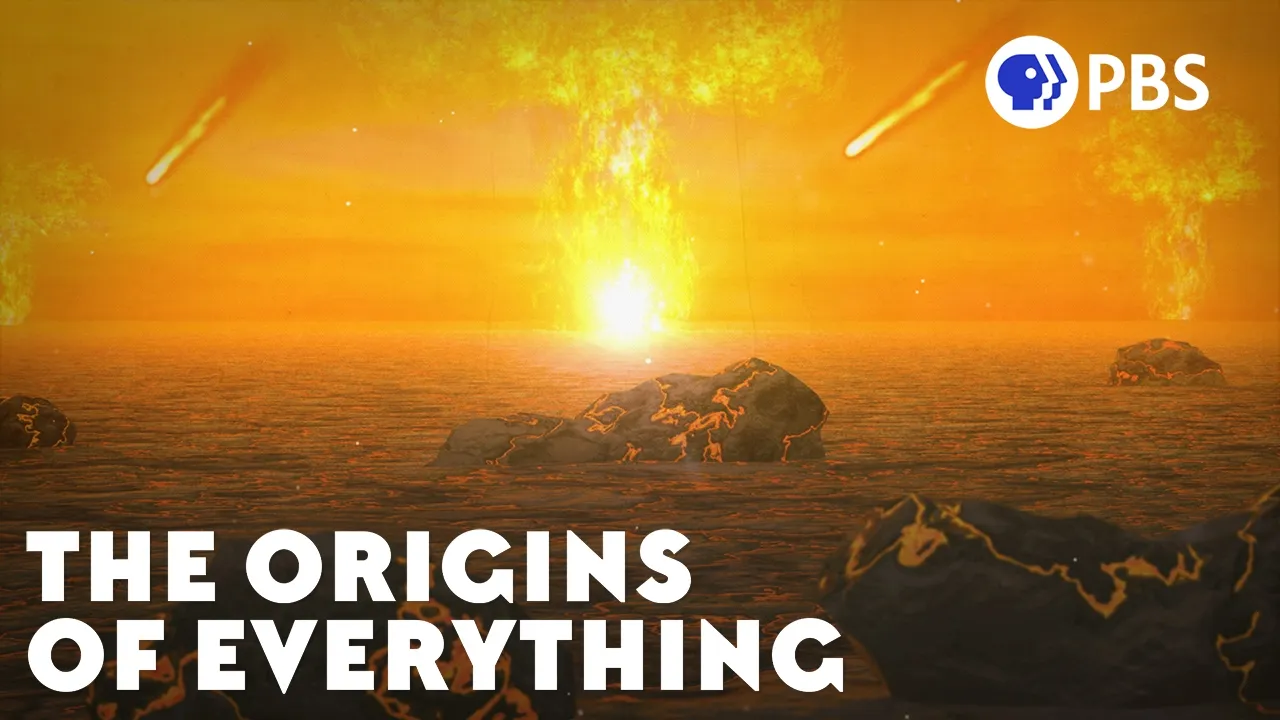
In the geologic blink of an eye, a hundred thousand years, gravity and angular momentum flatten the cloud into a swirling disc.
In the center, where molecules crash together tightest, a proto-star revs up to incredible pressures and temperatures.
Deep within the disc, clumps of dust not much larger than a grain of wheat are flash heated into droplets of molten rock, called chondrules.
The source of this heat remains a mystery.
Chondrules are destined to become the building blocks of the solar system.
Coaxed by gravity and turbulence, the chondrules clump.
They grow into the first asteroids, into mountains, into planets.
The asteroids are rubble piles of rock, metal, ice and organics.
This large asteroid is the parent body of Bennu, a proto-planet whose size we can only guess.
Closer to the proto-star, a planet begins to form.
And then...dawn in the solar system.
The proto-star undergoes fusion and ignites, revealing our Sun.
But the solar system is far from finished.
Jupiter most likely forms near its outer edge, but just 500 million years after the Sun ignites, some believe that it slowly moves inward.
Its massive gravity ripples the asteroid belt, disrupting countless asteroids and comets, flinging them toward the Sun.
They rain down on the inner planets, hammering and re-melting large portions of their crust.
Did these impacts also deliver organics and water, key ingredients for life?
Back in the asteroid belt, Bennu's parent body is lucky, it survives this period of heavy bombardment.
The solar system cools and calms. Jupiter and its many moons assume the orbits that we see today.
Billions of years of quiet follow...[ impact ] more or less.
Then a billion years ago, one theory suggests a collision shatters the proto-planet.
[ loud explosion ] Some of the debris loosely coalesces into a new, smaller body: Bennu.
But Bennu will not stay in place. Dull, non-reflective, it slowly migrates toward the Sun.
Solar heating turns its warm side into a low-intensity thruster.
Through millions of years, Bennu's orbit gradually tightens, until it interacts with Saturn's gravity, altering its trajectory and hurling it into the inner solar system.
Close encounters with Earth and Venus follow.
Their gravitational tugs may have repeatedly stretched and reformed Bennu... turning it inside out and pulling off loose material.
As a result, it has no satellites of its own...until now.
Today, NASA is sending a spacecraft called OSIRIS-REx to explore Bennu and retrieve a sample.
Why? Bennu has survived its long journey and settled into a near-Earth orbit, bringing its secrets within our reach.
Now it is ready to teach us more about the solar system's history, its formation, its evolution, and our own place among the stars.
[ music fades ] [ satellite beeping ]
Up Next

3:50
Chelyabinsk Meteor Plume: NPP Satellite & OMPS Data Analysis
@NASAGoddard
574.1K views•2013-08-14
61:17
First Billion Years of the Universe with the Square Kilometre Array
@iaaudc
121 views•2022-05-26

6:25
Kepler's Laws of Planetary Motion Explained (Educational Astronomy Video)
@Peekaboo_Kidz
404.9K views•2023-02-17
6:10
Gamma-Ray Bursts: Cosmic Snipers Explained | Astronomy
@kurzgesagt
15M views•2016-07-31
Related Study Plans & Knowledge Roadmaps
Structured learning paths in Astronomy
astronomy
Reionization: Pop III Stars, IGM & 21cm Line
01Foundations of Cosmology & the Early Universe
02Population III Stars & Cosmic Dawn
03Physical Mechanisms of Reionization
+ 2 more learning modules
17h5 modules
Explore Roadmap
astronomy
Planetary Rings: Dynamics, Roche & Resonances
01Foundations of Gravity and Orbital Mechanics
02Tidal Forces and the Roche Limit
03Structure, Composition, and Collisions
+ 2 more learning modules
10h5 modules
Explore Roadmap
astronomy
Asteroseismology: Stellar Waves, Ages & Cores
01Foundations of Stellar Astrophysics & Wave Mechanics
02Stellar Oscillation Modes: P-modes and G-modes
03Mathematical Framework of Asteroseismology
+ 2 more learning modules
35h5 modules
Explore Roadmap
astronomy
Adaptive Optics: Physics, Engineering & Control
01Foundations of Wave Optics and Wavefronts
02Atmospheric Turbulence & Optical Distortion
03Wavefront Sensing Technologies
+ 3 more learning modules
35h6 modules
Explore Roadmap