
















Cell-free systems provide an open and controllable platform for protein expression by extracting cellular transcription and translation machinery from E. coli cells, allowing researchers to produce proteins in vitro using linear DNA templates without cloning; the preparation involves a three-day process including growing bacterial cultures, harvesting and washing cells, lysing them through sonication, performing a runoff reaction to remove genomic DNA, and optionally conducting dialysis or buffer exchange, with key considerations including strain selection (such as BL21 or BL21(DE3)), energy solution choice (intensive vs. simplified), and protecting linear DNA templates from nucleases using GamS protein or Chi sequences.
Making Cell-Free Systems: E. coli Lysate Protocol Guide
Added:The Central Dogma of Molecular Biology: A solid understanding of prokaryotic transcription and translation mechanisms, including the roles of ribosomes, tRNAs, and RNA polymerase.
Bacterial Physiology and Growth Kinetics: Familiarity with E. coli growth phases (specifically the exponential/log phase) and how culture density correlates with cellular translation machinery abundance.
Basic Biochemistry and Buffer Chemistry: Knowledge of pH regulation, osmotic pressure, and the specific roles of divalent cations (like Mg2+) and monovalent cations (like K+) in stabilizing nucleic acids and ribozymes.
Principles of Cell Lysis: Understanding different physical and chemical methods used to disrupt bacterial cell walls and membranes (e.g., sonication, French press, or high-pressure homogenization) while preserving active proteins.
Optimization of Cell-Free Reactions: Learning how to systematically titrate magnesium, potassium, and energy source concentrations to maximize protein yield for specific target genes.
Energy Regeneration Systems in CFPS: Exploring different metabolic pathways used to regenerate ATP and GTP in vitro, such as the phosphoenolpyruvate (PEP), creatine phosphate, or glucose-based systems.
Advanced Applications of Cell-Free Systems: Investigating high-throughput screening of synthetic gene circuits, expression of membrane or toxic proteins, and the incorporation of non-canonical amino acids (ncAAs).
Scale-Up and Bioreactor Design: Studying the transition from static batch reactions to continuous-flow or continuous-exchange cell-free (CECF) systems to prolong reaction lifetimes and increase yield.
781 views8likes20:56Original Release: 2020-09-04
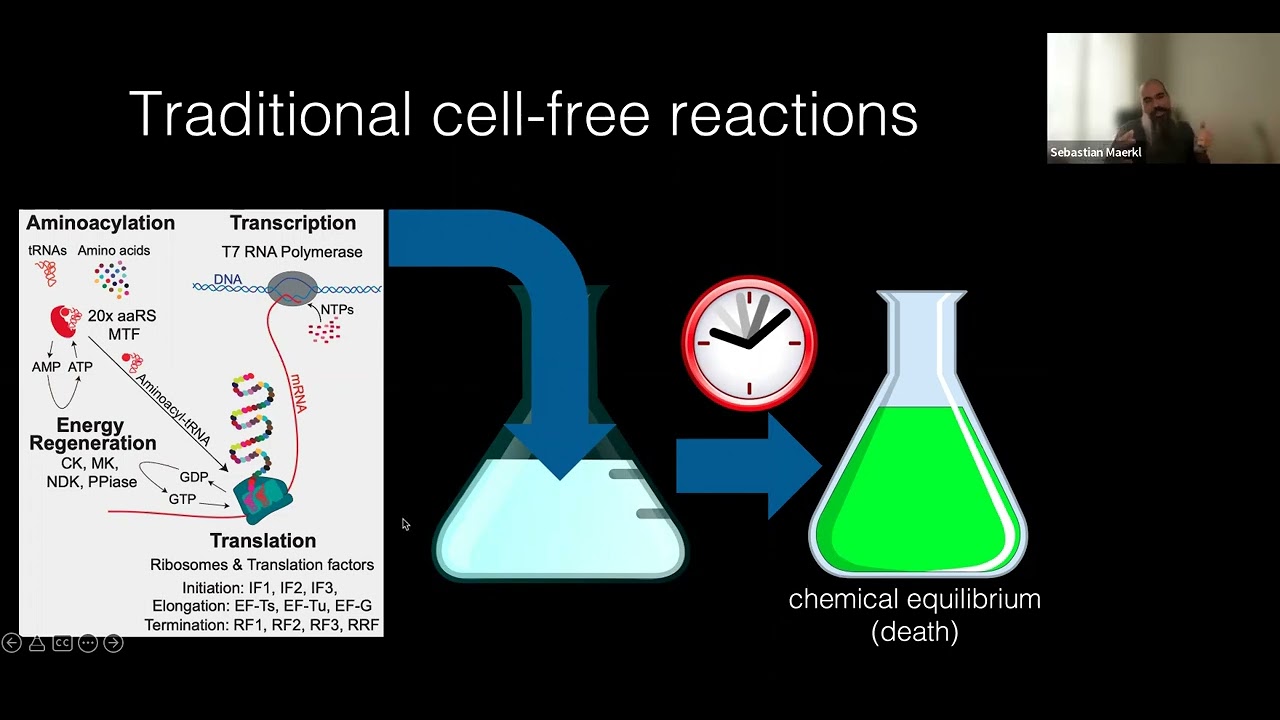
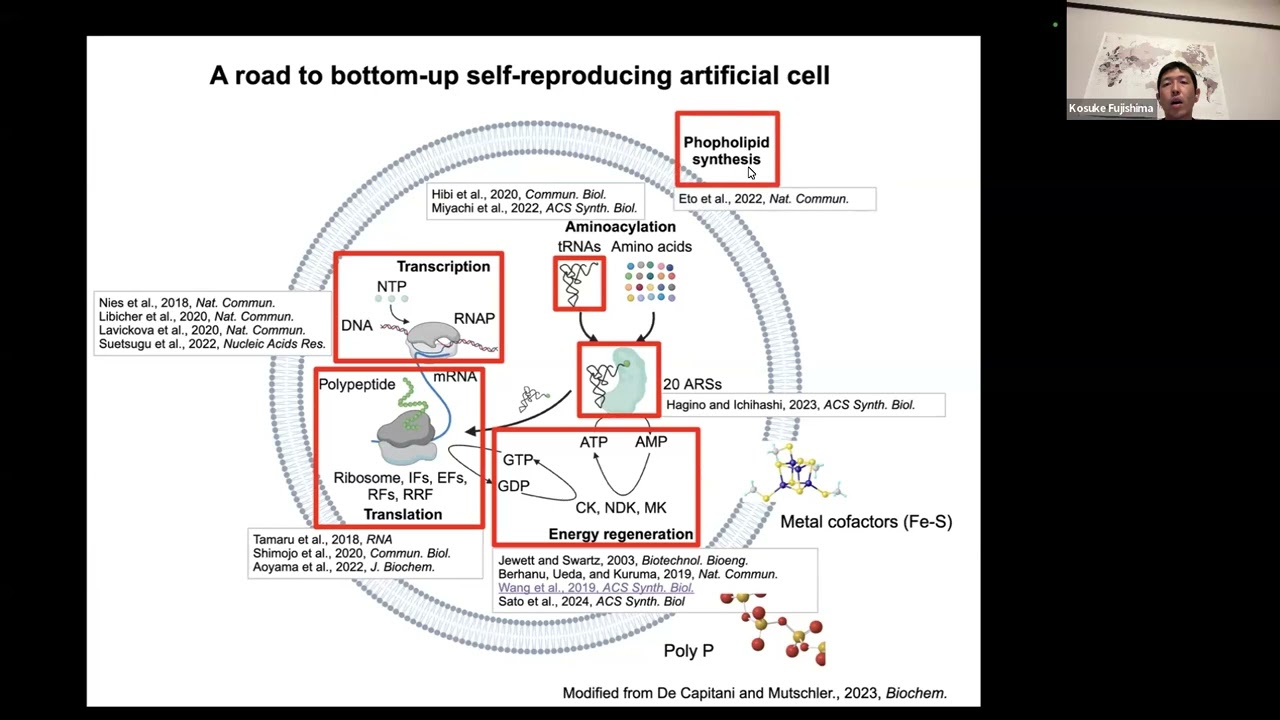
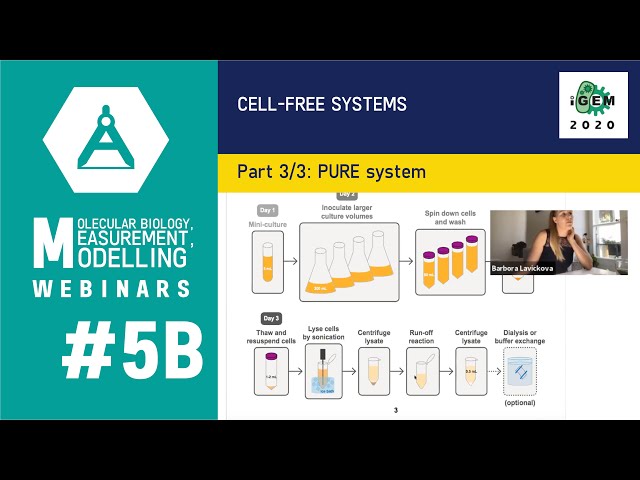
so i'll go through my experience um making e coli licenses and just sort of point out the main things that i think you should take into account when you're also trying to make these systems so i'll just reiterate again the benefits of using cell free systems so if you're working in vivo it's nice because you automatically have the transcription translation machinery readily available however you don't know if there might be some interactions between the sort of synthetic gene circuit you've introduced in the cellular environment you also have to deal with the fact that the cell is growing and dividing as well so that might interfere with your synthetic gene circuits and then the most critical disadvantage i think is that you have to spend a lot of time cloning all the different gene constructs you have into the cells so you can spend a lot of time doing that but instead you could use cell-free systems so you basically take out all of the protein components from the cell so you have this transcription translation machinery you combine it with an energy solution and then you can produce the proteins in vitro and it's a nice open and controllable system and you can use linear dna templates so you don't need to clone so many things um so i'll try and give you guys an overview of everything that is included in these e coli lysate systems so it's composed of the lysate which is the protein components from the cell and then you have your energy solution with the ntp salts cofactors amino acids and some form of atp regeneration and then you also have the dna templates and i would encourage that you use linear but as its igem you also get your plates with different plasmids so you if you have something that you want to test you can also use plasmids it works also well and yeah the resources i have on this page are just the publications that i used to create my protocol and they're very helpful also i think for everyone starting to work with e-coli lysate systems so this is sort of my um map of doing making lysate um so i'll just go through the general steps um the first day you start with uh your mini culture so it's just a 5ml culture with a certain bacteria strain in my case i was using e coli and then you take some part of this culture after growing it overnight and you inoculate larger culture volumes so i was typically doing four times 200 ml but you can always scale this depending on what you need and what you want and then after you grow these to a certain amount you then harvest them spin the cells down and then you wash them a few times and then once you've washed to remove all the media you can then freeze dry your cell pellet and then technically you can continue on to the third day without like freezing in minus 80 but i think actually the freeze drying of your pellet helps it to then life easier so normally i break it into three days and i think maybe if you're starting out new it's also easy to separate because the first time you do all the washing it's kind of tedious so you might be tired and then on the third day you resuspend your cells in a smaller volume normally it's a one-to-one ratio of the grams to milliliters of your wash buffer solution you then lyse the cells um i was using mostly sonication and there's a lot of nice there's a nice protocol by quan and scientific reports that highlights exactly the parameters for sonication so if you have access to that i think it it's very nice way to do it you then center future lysate and then you remove the supernatant you can do a runoff reaction at 37 degrees celsius in order to eat up all of the genomic dna present in your lysine then you centrifuge again and then if you need to you can do dialysis or buffer exchange so there's a few things that i think are maybe important to keep in mind and the first day is um mostly what cell strain do you want to pick and what type of medium do you want to use so the cell strain um depending on what you want to do um maybe the easiest is the using bl 21 strain because there's a lot of examples of this in literature so you have a lot of protocols to sort of troubleshoot with and also if you use vl21de3 then you also have the possibility to induce the expression of t7 rna polymerase so um that's nice if you want to work with that rna polymerase rather than the e coli hollow enzyme and then depending what types of proteins you want to express maybe you need a different strain that doesn't have a certain protein because you want to express it and um yeah the medium is important because if you want to make a simplified energy solution which i'll talk about a bit more later then um you have to use a medium with phosphates inside so that you can use a more simple energy solution so just to go in more detail about this energy solution um so the main protocol which a lot of people are using is the one from zach's son in job in 2013 and he uses a more intensive energy solution which costs um more money and has more components but it works very fast and also very well um otherwise you can you can i refer you to this paper by kai at all in 2015 who made a more simplified energy solution with 12 components and it costs a lot less money the main difference is that um in the sun paper they use ntps and uh 3pga as the energy source so the kinetics are different and you can see that with this first energy solution um the reaction happens much quicker um and if you use the simplified one then you basically start from nmps and then on based on how you grow the cells you have the machinery that produces the ntps for you so it takes a bit longer because you're producing at first the ntp's and then you start the reaction starts going afterwards but the main thing to see is that if you do lv and you try to use the simplified energy solution it definitely doesn't work so you have to take that into account if you want to use that energy solution um on the second day um there's maybe a couple things to consider mostly um what what sort of optical density do you want to grow the cells to um before you harvest them and um which wash buffer should you use and um in the case of optical density i've seen a lot of different things that are in the literature when i first started making it i thought it was really important to do it in to harvest the cells in the exponential growth phase um however then i started realizing that people do all sorts of stuff and in my um experience it hasn't made too much of a difference like in terms of what i was doing but perhaps you should just take a note of it because it could affect your experiments depending what you're doing and then depending on if you do dialysis or buffer exchange you maybe need to use a different wash buffer and then on the third day there's a number of things that are nice to keep in mind so maybe when you first start with the lysis you maybe need to know what method you will use as i said before the sonication is nice because um quan um described very well the parameters um to use for sonication but i know that you can also use french press i personally had some problems with feed beading but depending if you have like a bead beading machine that has different settings i think it's okay or you can do chemical methods or there's a lot of opportunity depending what you have available to you and um the thing that i always like to see is that when you ask like before you lice the cells it will be like very opaque thick solution and then afterwards it should be more transparent and then when you centrifuge this cell lysate solution down you should get three clear layers um two layers in this in the pellet and then clear transparent supernatant above which is what you take to do the runoff reaction and um i think some people say this is optional as well the runoff but i always do it and it seems to be useful and um then you centrifuge again and then depending if you need to or not you can do dialysis or buffer exchange um which can be important depending on the cell strain that you have and then um yeah you can use just the standard dialysis tubing but sometimes you can sometimes it's better if you have larger volumes for that depending on the size of the tubing so i also tried these slidilizer mini dialysis units which are very good for small volumes if you're trying different parameters out and then you could also instead of doing dialysis to do just a buffer exchange with the centrifuge filters which also works so just as an example for this because originally when i did when i was making lysate i just was doing bl 21 uh strain i was making from bl-21 strains and without doing dialysis or buffer exchange it was absolutely fine um but then for my experiments i wanted a lysate without a black inhibitor present so i tried to make lysate from two different strains and i found in this case for one of the cases it was very important to do the dialysis actually because um yeah as you see with just the runoff reaction or without the runoff reaction and no dialysis the expression is either very strange or not at all um only when i do sort of the real dialysis even is better than also just the buffer exchange but then if you look at one of the strains that i the mc4100 um it's completely different so only without the runoff it doesn't work so in that this case i find the runoff to be also useful and then um when you go on to test your lysate um you can do it with either plasmid or linear dna with plasmid since it's circular it's already protected naturally against the nucleuses that will be in your lysate but if you want to use linear templates then you do also need to add something extra to protect it from the nucleuses so you can either add this gams protein which protects the linear dna templates or you can add a dna with which contains a chi what's called a chi protection sequence and that also protects your linear dna template so the chi sequence is easy because you just anneal two dna oligos together and it's very fast to do however if you want to do the game s way it's also not that difficult you can either add the purified gams protein otherwise you can also mix lysates together so in in um this case we mixed the um a lysate we made from top ten cells and in these top ten cells we induced the expression of gammas so we could mix the lysate that has gamma s in it with a bl21 lysate and actually it works quite well um sort of regardless of the ratio um it works well and yes so in conclusion um i hope that you maybe are convinced that cell free will be useful to you and you can save a lot of time and avoid cloning to test linear dna constructs and i think uh since everyone in igem is working in teams it's actually not very difficult to make the live state and work together and there's a lot of resources so i think it's it's maybe annoying the first time but i think together with the team it's not that difficult and um also another thing to consider is if you really do want for some reason things to work in sales in the end it's actually okay because you can also just use this as a prototyping system and then um it should translate as well to working in vivo afterwards you uh and good luck on your project zoe do you want to answer some of the questions before you oh oh yeah i don't know so there was one question i will start with the later one which strains are common for such a process so you talked about it but maybe you can summarize just quickly yeah i think the most common is these bl 21 strings um i don't know if i've seen a female ones but i think i think often was also a19 use but i think it moved a lot more to the field okay yeah yeah because i guess like both of the protocols that i'm citing they are using bl21 so but yeah depending what you want to do like sometimes if you're going from a certain paper and you want to try and replicate what they did then it's also important to take into account the strain they used i guess yeah and then there was a question about what is more efficient if if cell free or in vivo protein synthesis for example in protein yield regarding protein yield i guess the lysate is still i mean i'm not exactly 100 percent sure how much better fury you've gotten now but i guess it's still more efficient the lifesaver yeah so uh yeah but i think it was in viva comparison with like itself expression so in that case i i would say it's more about if you are doing something there are like different advantages to using cell-free than protein meal but otherwise protein yield is much better in cells so if you are just trying to purify protein or something that you can easily do in e coli then it's better do you agree yeah yeah i agree i think it's only useful if you're doing something that is like toxic to the cells or yeah or you have to like really control the system or something it also depends on the size of of the batch where you're running your reaction um and and you can you can produce it produce much more protein at the at a larger scale in in bigger batches and they do that industrially um but i think it's just it's usually for more technical constraints that you would decide to pick cell free uh and and especially if the the the protein is is from the host or from the organism or not uh you'd always get a better uh better yield in in vivo i guess um but it it's it's more i don't think you should pick one or the other because you want to get a higher yield i think it's more about the constraints that you have on your system and and for example you can have different constraints you can have biochemical constraints like we were talking about toxicity but you could also have time constraints and once you've spent um many many hours preparing your lyset um they can you can keep it you can freeze it and then you can reuse it and then you can work really fast like you have your little aliquots and and and you can just reuse them over and over again to to just like uh like like prototype prototype your work so i think it's got some advantage uh compared to uh vivo okay there was a additional questions for this uh so for cost effectiveness i should choose in vivo so i guess this is what we were talking it's very complex not so straightforward answer so it really depends what you're doing yeah also i guess like for items i don't see a huge need to like really scale up reactions to like a huge extent so in the case of igem i think it's very useful because i don't think anyone needs to make like grams of protein or something like this so i think yeah exactly for the competition for example if you manage to express the protein i think you know the judges would be really happy to just see that and then if you can just prove that you don't need to you know we we you're not expected to produce something as as some industry would do or um yeah i mean it's good to think about but in that sense it's like since it's only the beginning with igem like it's only the beginning of a project so it's very nice because you could potentially try much more things using cell free than you could if you spent like all your time cloning basically yeah okay so are we fine can we move on yeah let's move on to barbara's talk
Up Next
20:21
Cell-Free Systems Explained: The PURE System for Protein Synthesis
@iGEMFoundation
601 views•2020-09-04
14:12
Quantitative Real-Time PCR (qPCR): Principle, Method & Data Analysis
@animatedbiologywitharpan
129.2K views•2023-09-06
23:33
Microbial Degradation of Plastics: Biodegradation Pathways & Sustainability
@majeedhammad
2.9K views•2021-04-11
16:04
CRISPR and Genetic Engineering: How Gene Editing Works and Why It Matters
@kurzgesagt
30.5M views•2016-08-10
Related Study Plans & Knowledge Roadmaps
Structured learning paths in Biotechnology
biotechnology
AAV Production: Transfection, Prep & qPCR
01Introduction to Gene Therapy and AAV Biology
02Mammalian Cell Culture: Suspension HEK293 Cells
03Upstream Bioprocessing: Triple-Transfection Optimization
+ 2 more learning modules
18h5 modules
Explore Roadmap
biotechnology
Building Gut-on-a-Chip: PDMS, Cells & TEER
01Foundations of Microfluidics and Gut Anatomy
02Cleanroom Fabrication & PDMS Soft Lithography
03Epithelial Cell Culture and On-Chip Seeding
+ 2 more learning modules
26h5 modules
Explore Roadmap
biotechnology
Optimizing CFPS: E. coli Extract & Yield
01Fundamentals of Molecular Biology and Translation
02Introduction to Cell-Free Protein Synthesis (CFPS)
03Preparing E. coli Crude Lysate (The Extract)
+ 2 more learning modules
19h5 modules
Explore Roadmap
biotechnology
Haematococcus PBR: Design, Stress & Astaxanthin
01Biology and Life Cycle of Haematococcus pluvialis
02Bench-Scale Photobioreactor (PBR) Design and Engineering
03Culture Media Formulation and Inoculation
+ 2 more learning modules
15h5 modules
Explore Roadmap