













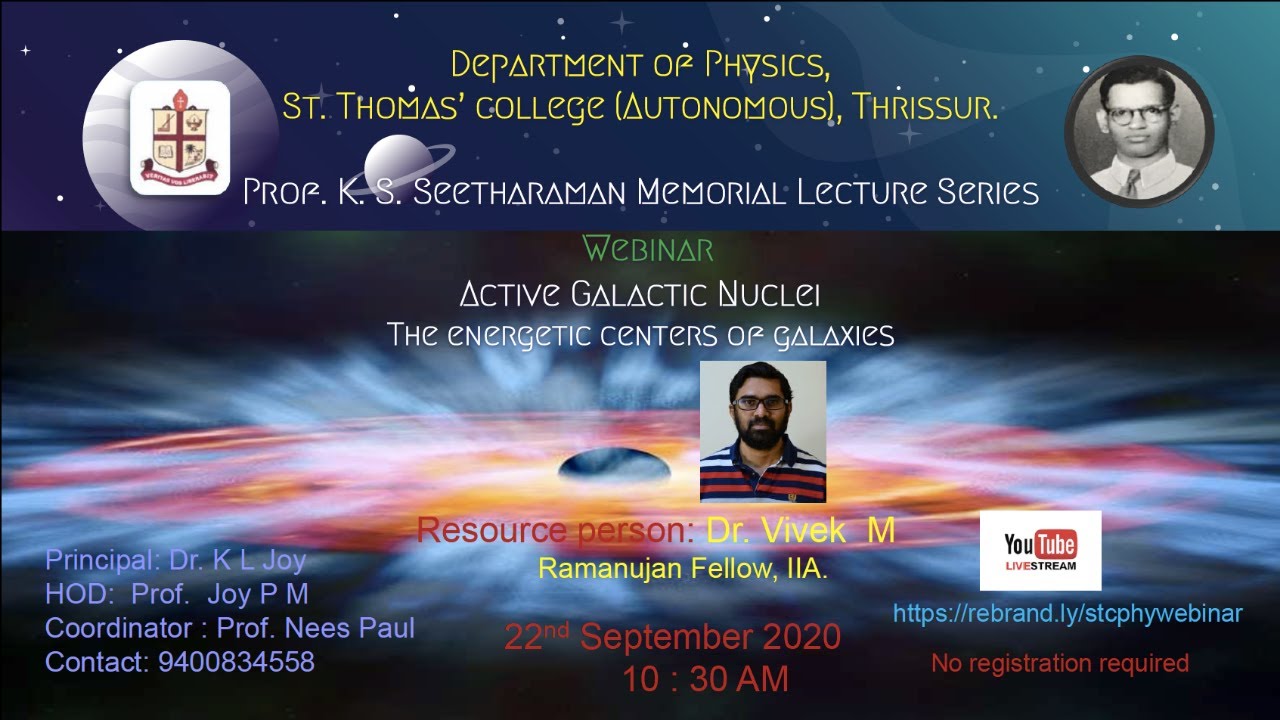















Active galactic nuclei (AGN) are extremely luminous galactic centers powered by supermassive black holes (10^6-10^10 solar masses) accreting matter, producing energy output ranging from 10^9 to 10^15 times the Sun's luminosity; their defining characteristics include strong broadband continuum emission from radio to gamma rays, broad and narrow emission lines from fast-moving and slower clouds around the black hole, dramatic variability across all wavelengths (from minutes to years), and relativistic jets, with the unified model explaining different AGN types (Seyferts, quasars, blazars) as variations in viewing angle relative to the central engine and surrounding dusty torus.
Active Galactic Nuclei Explained: Supermassive Black Holes & Quasars
Added:The basic physics of black holes, including gravity, the event horizon, and the difference between stellar-mass and supermassive black holes.
The structure of galaxies, specifically the components of spiral and elliptical galaxies and the concept of a galactic nucleus.
The conservation of angular momentum, which explains why infalling matter forms a rotating accretion disk rather than falling directly into the black hole.
The electromagnetic spectrum, as understanding AGN requires recognizing how they emit energy across radio, infrared, optical, X-ray, and gamma-ray wavelengths.
The Unified Model of Active Galactic Nuclei, which explains how our viewing angle relative to the dusty torus determines whether we classify an AGN as a quasar, blazar, or Seyfert galaxy.
AGN Feedback and Galaxy Co-evolution, studying how the energy emitted by supermassive black holes regulates star formation and influences the growth of their host galaxies (such as the M-sigma relation).
High-energy astrophysics and relativistic jet dynamics, exploring how magnetic fields and frame-dragging (the Kerr metric) accelerate particles to near-light speed.
Modern observational techniques in radio interferometry and space-based X-ray astronomy, including the operations of the Event Horizon Telescope and the Chandra X-ray Observatory.
235 views0likes1:18:03Original Release: 2022-07-26
okay good morning all of you uh it's a pleasure to welcome you all today this morning and it's a pleasure to welcome princess gulab devangan from ayuka our friend and colleague from ayuka his he works largely in the high energy part of electromagnetic spectrum x-rays where he works on a variety of compact objects but especially on active galactic nuclei and he's been closely involved with a very large number of astrocyte projects which has yielded a number of very interesting results on active galactic nuclear often referred to as hen in short so it's a pleasure to welcome mr evangel so good luck thank you thank you very much professor psychia and good morning to all so today uh i'll be talking on active galactic nuclei so the first questions is usually what are these active galactic nuclei and in order to understand that we also need to think of normal galaxies because there are different types of galaxies some of them are active some of them are normal galaxies and there are also different types of normal galaxies but to for our purpose if you let's say if you take a uh an image using a telescope and let's say you use a very short exposure let's say and you're observing a normal galaxy what you will see initially you may not see anything because the exposure may be very short but if you keep on increasing the exposure then you'll start seeing a diffuse emission okay of course the central region will be brighter but overall you will start seeing diffuse emission but if if the galaxy contains an active nucleus or if the galaxy is an agent so in the short exposure what you see is just a point like or a star-like object okay and when you start increasing the exposure time this point like object will become brighter and brighter and you will gradually you will start seeing the host galaxy also for example in the left hand side i have put a picture of an active galaxy njc4593 here you see a very bright nucleus and of course the spiral spiral arms in the right side i have there's a picture of a normal galaxy ngc 3277 and here you see a lot of diffusivism the central region is brighter but the this is not an active nucleus only because the central region is more bright that's why you see this uh support higher luminosity but this is not a really uh an unresolved point source unlike in the case of asian so by the way the left synthetic picture of ngc 4593 was taken with the associate near ultra violet uh the associated ultraviolet imaging telescope in the near ultraviolet band so agents uh have a very bright nucleus and that is uh some kind of an energy source other than the stars and this sometimes dominates the new the nuclear emission sometimes dominates the light from the host galaxy sometimes but but not always so this is one sign of an agent but there are other signatures of active electric nuclei so so though essentially they are nuclei of galaxies that are active and that holds an energy source other than the stars okay and this activity is uh revealed in observations in a variety of ways for example uh we have of course the lar high luminosity from a point like source but in addition you one can have a jets relativistic jets emanating from the central nucleus and seeing something like this so they are of course service not they cannot be attributed to stars and uh this origin of the jets are non-stellar in uh in nature and they this is again a signature of our of an active galactic nucleus in addition there are other observations for example if you take the spectrum of the nucleus then you will see emission lines in the optical in the ultraviolet bands and sometimes you see very broad emission lines which is not observed from normal galaxies and that's another signature of a aging sometimes some of the agents may be obscured the central region of agents may be obscured by dust lens for example in this case of ngc 1365 you see you do not see a very bright like nucleus but the there is a central dust and passing through the center and you it doesn't it looks like a normal galaxy but if you see if you observe the same galaxy in x-rays then you see a very bright uh nucleus here because x-rays can penetrate uh the obscuring material here particularly somewhat harder x-rays so you see very bright nucleus and that's another signature of the presence of an active nucleus or active galactic nuclei so there are uh a number of different types of agents but we can classify them in three main types we are not going to detail in the classification scheme because that will take one lakh couple of lectures itself so the main type of aegeans are the the seaford galaxies and they are so called because uh the carl seaford discovered this type of a agn so this type of region have this bright nucleus and the luminosity of the nucleus itself or the active galactic nucleus itself is comparable to the luminosity of the entire galaxy okay then we have radio galaxies and they are radio allowed objects essentially they have much more radial luminosity compared to what we observe from normal galaxies like like our own and you already i think you already have lectures on radio galaxies and i'm not going to go into detail in the radio galaxy but just to say that they are much more powerful in the radio band and they show jets emanating from the nucleus and many of them have the jet and low structures okay then the other major type of agents are these quasars are qsos nowadays they are simply called squishas they can be radio quite are radio loud okay so but uh the if you just look at the nuclear uh luminosity the luminosity from the active nucleus itself that is actually much more compared to what we observed from c 4 type asian so the luminosity of asian in this case is about 100 times the luminosity of the entire galaxy containing something like 10 to 11 stars or so so so these objects are really really powerful and that of the the powerful emission is just arising from the nucleus and that is why they are called active galactic nuclei so going into little more detail about the seafort galaxies so if you look at the optical spectrum of seaford galaxies so here it looks like what i have shown in this slide so first of all if you look at the continuum emission so this is a very strong continuum continuum of emission is not not zero it's a strong continuum then you would immediately notice that there are very broad emission lines like this this is due to the h alpha emission 86563 angstrom similar lines are there again due to hydrogen this is s beta lines so the h alpha s beta s gamma h delta all are the uh all of them are actually broad lines and they are the bomber lines okay and there are other kinds of uh broad emission lines uh particularly in the ultraviolet for example carbon four magnesium two which are not shown here but apart from the broad emission lines you also see very narrow emission lines for example here you see this oxygen the emission lines the narrow emission lines from oxygen three at a wavelength of 5007 angstrom similarly there are other neuroemission lines due to oxygen two three seven two seven in the h alpha band though almost blending with the h alpha broad inverse line there are like this nitrogen two six five eight three emission there is also this oxygen one line at 6300 so so the characteristic of of these regions in is what is observed in the optical spectra is they have very strong continuum they have broad emission lines and they also have narrow emission lines now one can convert the width of these emission lines using doppler shifts uh because the wavelength is shifting compared to the central wavelength and it turns out that the width of this broad image lines can range from let's say a few thousand kilometer per seconds to tens of thousands kilometer per second so so the material which is emitting these broad emission lines must be moving with several thousand kilometer per second then only we can observe this kind of broad emission lines but on the other hand the the narrow emission lines uh the if you convert the width of this narrow emission lines they are only about 500 kilometer per second so there are at least two kinds of line emitting material in these objects one is moving very fast of the order of let's say five to ten thousand kilometer per second the other kind of clouds which are emitting they have roughly about 400 500 kilometer per second speeds okay this is the lower panel is essentially the expanded view of the spectrum here here you will see some uh uh all these lines etc but there is a salt that there is a sharp rice below for the fourth of the gangster this is called smaller blue bump small blue bump and that means there is also big blue bump which we will discuss later but this is a small blue bump or the sharp rise the short part of this four thousand angstrom is due to these two things this is bulma continuum and the to emission so bomber continuum whenever the um the electrons join from uh the continuum from uh continuum of the hydrogen atom to n equal to two level then that gives rise to the some kind of continuum emission and that plus this iron two images and iron two again has a few large very large number of transitions the combination of these two things actually creates uh this kind of uh rice heart world rise below 4000 extra so let's look at the typical other signatures uh we what we observed and that helps us in classifying these objects that active galactic nuclei is active galaxies i had mentioned they they have active electric nuclei are essentially point like they are unresolved uh with this telescopes what we use this means that their sizes is actually much smaller than about uh one one parsec or even one uh light curve so the the huge amount of luminosity is just arising from a very very compact region here are these the picture the images of the central regions of some of these active galaxies uh taken with the hubble space telescope you see very very bright nucleus in everywhere but in edison there are some uh structures so these nuclei are surrounded by uh by a variety of forms for example sometimes you see the dustlin dust lens sometimes you see some kind of a ring here there are variety of some of the structures so we don't do not clearly understand these or the origins of this structures surrounding this brilliant nuclei but probably they may be carrying some some clues how the central engine is actually powered are fade which frequency ranges are these images taken these are optical images yes the the nucleus the unresolved nucleus has very large luminosity that can range from 24 42 to 24 48 per second and if you compare this luminosity with the luminosity of our sun then they these nuclei have a luminosity of 10 to the power 9 to 10 to the power 15 times the luminosity of the sun to make sense of these numbers let's compare with the luminosity of of normal galaxy or a field galaxy like let's say milky way if you uh look at milky way has of course something like 10 11 stars and let's say let's roughly assume that all stars are emitting like our sun then milky way has a luminosity of something like 24 44 per second so the age and luminosities range from let's say 100 after the the luminosity of an entire galaxy to about 10 000 times the the luminosity of the typical galaxy that's the range of the new luminosity from the active galactic nucleus itself of course so when we measure this luminosity there are certain complicating factors for example there can be large extinction so we may not be measuring the real luminosity but lower than actual luminosity then the relativistic beaming if there is a relativistic beaming that can also affect uh the measurement of luminosity in that case we will measure more than actual luminosity because the radiation is beamed towards us another very important this luminosity is integrated over the visible spectrum is it yes those this is mainly measured in the in the visible visible path okay but if you integrate over that because uh i will discuss later the the luminosity from asian is dominated due to one particular component which we call the big blue bomb and that emits in the optical ultraviolet okay so particularly in agents which are unobscured so mostly i mean if you integrate it will be somewhat larger maybe factor of 5 or 10 but usually this this will be the order of order in the optical band another very important uh characteristic of the aegin is this broadband container may mission again to make sense we will need to compare with the broadband continuum emission from broadband emission from a normal galaxy let's look at the normal galaxies the solid lines showed here so is essentially the spectral energy distribution of a normal galaxy like our own and here in this plot the x-axis is the frequency log of frequency and y-axis is log of the flux new as new here so so the luminosity or the emission from a normal galaxy is confined uh roughly in a frequency range which which is in which varies by a factor of 10 also what is the reason because normal galaxies are have essentially the emission from normal galaxies is from from stars and it starts of course there will be low mass stars and high mass stars and roughly the temperature of the lowest small stars will be two thousand maybe three thousand kelvin or something like that while the the hottest stars will have something like thirty thousand or forty thousand um kelvin so the temperature of these stars is varying by a factor of 10 also okay so this what this means and is that these stars are emitting like black bodies so if you sum the blackbody emission from the low mass stars and the high master stars are the cool stars to the hot stars there the emission the ranges from let's say from near infrared to ultraviolet okay that's where the emission will usually ranges on the other hand if you look at the spectral energy distribution of an agent at a nearby agent for example this ngc 3783 so first of all the emission is not confined to a narrow range in the frequencies you see in fact in the in the ultraviolet the emission from the normal galaxy is going down but in the ultraviolet actually the emission from agent is going um actually increasing and it does not diminish it does not decrease at high frequencies in the soft and hard x-rays it continues there is a strong emission in the in the ultraviolet in the soft and the hard x-rays at least down to even the to gamma-ray energies okay if you come to the the infrared and radio side again in the infrared again the luminosity of these agents is increasing compared to uh normal galaxies so there is something called the ir pump or the infrared bump and um when you go to the radio part and this there are radio quiet agents and radio loud agents this particular one is radio quiet the radio luminosity is actually low but in radio allowed agents the radio emission is also also high so if you look at this this is somewhat more detailed uh uh uh spectral energy distribution from asians so in the radio part the radio luminosity is also high in the from radio loud agents while from radio white agents it is much smaller so if you look at the spectral energy distribution of agents there are three main components one of them in the optical ultraviolet band is called the big blue bump and we will discuss um the origin of this big blue bump and in the longer wavelength side there is another bump which is called infrared infrared bump and of course there is a radio emission at a high frequency site in the soft and hard x-rays there is another component which is strong uh and which looks like a more like a power law component and which cuts off at a high energy about 100k via so so these the main these are the main components and when we are talking about let's say radio quiet agents then these are the three main components and we will discuss the origin of this at least the primary continuum here okay the primary emission from asian is considered to be this uh big blue bump emission then the emission components in the x-ray band the infrared bump is essentially uh thought to be the reprocessed emission of this ultraviolet as well as extremism by something called taurus which we will see later okay so let's look at the the okay the another other characteristics of agents so i i mentioned that this agent so very strong emission lines and if you compare the optical spectrum of let's say a normal galaxy and uh agent for example ngc 4151 4953 in normal galaxies first of all the container is extremely weak very weak you see this noisy like thing that's because the container itself is a weak and then there are some absorption features of course they arise from from these stars on the other hand the aegeans have very strong continuum and broad as well as narrow emission lines so based on their appearance of this whether there are broad emission lines or narrow emission lines only the agents have been classified in different types for example type one asian or the seafood one agents have both broad and narrow emission lines while the type two agents only have narrow emission lines the type 2 agents do not have the broad emission lines which we see in typhoon agents and some of the radio i mean the radio loud agents uh some of them also show this broad emission lines so in that in that case we call broadline radio galaxies and uh a number of them do not show these broad emission lines in that case we so we call them as a neural line radio galaxies in addition there are other types of agents for example uh no there is a class of asian called blazers and one type of blazer is this object called black object here you you see extremely strong continuum uh continuation and you almost do not see any kind of uh you miss under absorption lines there are there are some we there may be some weak emission features absorption features but these spectra are almost featureless so so these this the featureless spectrum is thought to be dominated due to the jet emission emission from the jet and where the jet is pointing towards us in such a situation relativistic beaming dominates and and even though there may be the emission lines uh whether something may be broad or narrow emission lines because but the continuum or the jet emission in this particular case is so strong that it dominates everything and the observed spectrum becomes featureless okay so this is the here i saw the the mean quasar spectrum this essentially the spectrum formed by taking a mean of spectra from large number of quasars and again these objects the kujas also saw broad emission lines something similar to what we see in seafart one type type agent okay so these are the the basic differences are the different types of agents classified based on their uh optical emission line properties can you please again explain like how to identify the blazer blader uh so if you take an optical step from the blazer spectra particularly the see again bladers have two types one is uh black type so be a leg type again the blazers do not show strong emission lines the emission the continuum is extremely strong but uh the emission through the emission lines uh are not present or even if they are present they will be extremely weak okay that's how we are identifying lines sorry there is no emission line there are no strong emission lines there may be extremely weak features but uh you can say that the the the emission lines are emission or absorption features are absent in bl the optical spectra of black types uh the blazers also uh have a different type called fsrqs flat spectrum radio quasas in that case also the continuum is extremely strong but those objects do have broad emission lines so so again in these two types of agents the we people think that the emission is dominated by the the emission from the jet which is essentially continuum emission so but you said that one of them like one of the important ways to recognize is through their emission line so how do we know it's a it's an acting galactic nuclei if there are no strong emission levels continuum so in that case you look at the continuum emission and compare uh compare with uh the spectrum of a normal galaxy normal galaxies will have very weak continuum and the absorption lines but uh black type agents will have very uh very strong very strong continuum and the black type objects are are actually identified from their radio emission from their emission from the jet which is dominated in the radio radio band and even in gamma ray wind for example so so so you one uses different information how does the optical the spectrum looks like whether it is a purely kind of a more like a continuum uh then of course uh you said okay this is likely to be pleasure then you look at the emission another x-ray gamma ray band and then you obviously confirm okay what the what could be the nature of this uh objects okay so i can also yeah what is the source of the continuum emission now just to be clear yeah so you see the the blazers have relativistic dates and in fact most radio allowed agents almost all radio allowed agents have a very strong jet emission uh and relate the jets are expected are thought to be relativistic that means the the particles in the jet are actually moving with the relativistic speeds and if if the jet is pointing to let's say away from us then because the the jet is moving with relativistic speed the emission from the jet is actually beamed along the direction of the motion so if the jet is pointing away from us in that case most of the emission is directed away from us so then we have we are not looking the very strong jet emission but we are looking the central engine and we have that's why we have the emission lines narrow emission lines broad emission lines but now imagine if the jet is pointing towards us that means the emission from the jet is beamed towards us and that emission we are observing is the featureless continuum and the source of this emission or the origin of this featureless spectrum is due to the jet image okay so it's the synchrotron uh um radiation it yeah in the in the optical band it will be synchro of the radio infrared optical ultraviolet this will be synchrotron animation even in the soft x-rays but when you go to heart x-rays or gamma rays the emission can uh can be synchrotron self compton or external compton etc yeah but in optical you can assume this is a synchrotron emission okay thank you yet another very important characteristic of asian is the very variability of their light output if you look at let's say the x-ray mission and uh and observe the agents as a function of time and then you measure the x-ray intensity as a function of time so this is one example from iras one three two two five this is a seafood type of an agn and look at how the x-ray intensity is varying it's increasing suddenly and going down in in decision times this time is in days but we have seen this variability by a factor of two even in uh thousands of seconds and here you see the variation is by more than by about the yeah more than by a factor of a hundred more factor of almost 200 300 so this is the is some of the agents so huge really really huge uh variability you if you look at the uh optical or the ultraviolet continuum emission for example this is the continuum emission measured at different wavelength 1350 angstrom 1840 2670 and 70 angstrom from this seaford galaxy called ngc 5548 again this continuum this intensity in the continuum is plotted as a function of time and you see again this strong variability of the ultraviolet continuum emission now if you look at the ultraviolet line emission and for the variability from optical animation will be similar this is the carbon four um intensity lyman alpha line intensity magnesium two line intensity again you see this strong variability of the line emission as well and now if you look at the radio emission uh as a function of time this is again from the black type object which is which happens to be a blazer the the the emission is very strongly variable the blazers are highly highly variable agents so the aliens generally vary in at almost all web web bands this is this is very important characteristic okay just to summarize the the various properties different types of properties of agents of course whatever we discuss not all agents will have all the properties but some agent will have some of the properties so first of all the agents have large luminosity luminosity can range from 10 to power 9 to 10 per 14 times the luminosity of sun the the emission arises from extremely compact region the sizes are much less than one per second castle they have a very broadband continuum from radio to to to gamma rays they have very strong emission lines in the optical and ultraviolet they they emit strongly in the x-ray band and many of the agents are also very strong at gamma-ray wavelengths they so strong variations over the entire almost over the entire electromagnetic band with a range of time skills the variability time scale can range from minutes to days and months of course and the radio loud agents of course have the jets and lobes and i'm not going to discuss little because i you already have a talk and these jets and loops can um um their sizes can be very large from kilo past up to kilo per sec mega pascal skills etc okay so let's now try to infer what is uh what is the origin of the power source how uh how does the huge power or the huge luminosity is uh arising from these asians so this of course we have to infer from what we have in our hand in terms of from our observations so one of the the thing is that the the agents are highly variable and we can use the uh variability time scale to infer uh the size of the emission region because we cannot resolve the nucleus with our telescope so we cannot actually measure the the size of the meeting region but there is a handle one can use the variability time scale and put limit on the size of these sources so the first of all the assume that the state of the emission region is changed by a physical process because the luminosity is increasing that means some uh there is a change in the uh there is a state change or the change in the the physical process so in such a case there are two time skills which are important one is the time scale for the radiation process this tau process uh let's say if you're talking about synchrotron radiation for example when the the particles are accelerated um that will and this radio missile rising or radius in the the synchronization in the optical it will be banterizing what would be the the kind of time scale and uh and then let's say the another time scale is the crossing time scale let's say we have some kind of uh spherical reason just to assume and this let's say imagine that something happens at the center so that due to the change in the state physical state of the object the radiation increases due to some radiation process and so there is a disturbance at the center let's say and because if a tiny region only the center is emitting we will not observe huge variability so that variability has to be caused by the almost the entire emitting region so that means the disturbance which started at the center has to travel to the within the spherical region to up to the outer region and that's the la of the the crossing time scale and this crossing time is generally much longer compared to the time scale for the radiation process and if the whatever is the speed of this speed with which this disturbance travels from the let's say from the center to the outer region that of course cannot exceed the speed of light so that states change spreads with a speed v let's say which is less than the speed of light then one can say the size of the emitting region which the let's say this is l then that will be the v the speed of uh the spirit change that v and the crossing time delta t so that this quantity v into delta t will of course be less than c into delta t delta t is crossing time again okay but our observed time scale will be the sum of these two time scales the tau process and delta t and as i mentioned the tau process is much smaller than delta t in any case one can say that the size of the emitting region is less or equal than the the speed of light times the the observed time scale okay and when you use this um uh information then uh then we can infer the size for example in the optical ultraviolet particularly they do quiet agents we observe the variability time scale is typically one to ten days okay and that translates into a size scale of uh point zero zero one to 0.01 per sec you see it is much smaller than one parsec or one light curve one light year on the other hand if you look at the variability time scale uh in the x-ray band the the x-ray emission varies on much faster time scale the time scale is about one hour for many aegean and this time scale of one hour translates to into a size scale of very very small 10 to the power minus 5 per second so and if you compare this kind of size scale with let's say with this hostile radius uh of a of a black hole then what you see is that the our the size scale is comparable to this fossil radius of a supermassive black coal let's say about 10 power 8 solar mass black hole the the size scale will be like 10 to the power minus 5 percent so this may suggest that uh the variability particularly in the x-ray band is uh um occurring in the vicinity of a supermassive black hole and and this is what now it is thought so yeah so why is there such a huge difference in time scaling both x-ray and optical yeah so so you can you can imagine that the x-rays are arising from the innermost regions where the size is smaller then the optical emission are arising from a larger region may be surrounding the x-ray region so so that is why if the size of the imaging region is larger than the variability time scale uh will be large inner region means that a vicinity of those black holes right visibility of the black hole yeah so we will we will look into some of those uh scales with some schematic pictures etc okay so after of course a lot of studies we have some kind of a physical picture of asian now and basic very basic uh ideas or arguments are as follows first of all agents have high luminosity as i mentioned agent's luminosity can range from 10 for 42 to 24 48 hours per second and if you think any object cannot emit arbitrarily large luminosity so what is the reason because okay of course they these are the large luminosity means a huge number of protons are being emitted these photons will interact with the surrounding material particularly with the with the electrons through through thompson and compound scattering so so this high luminosity will result in radiation pressure force on the electrons and the electrons and protons are coupled so this the radiation pressure force will throw out the material uh if the luminosity exceeds some value which the material will also be bound due to the gravitational attractive force but if the luminosity is high the luminosity will exert radiation pressure force and that will try to throw out the material and when you are equal when you equate the radius outward radiation pressure force and inward gravitational force then then you get a luminosity you derive a luminosity something called the eddington luminosity and this headington luminosity is of course a function of the the black hole uh black hole mass so so it is roughly about 1.4 times 10 to the power 38 arcs per second for one solar mass so one solar mass object okay and now in agents we are observing something like 10 44 10 to the power 45 per second so if you if you substitute this let's say uh 24 46 uh per second so then you automatically get the huge huge mass into power eight solar mass or so if it is a 10 to power uh let's say 48 uh per second then you get 10 power 10 solar mass and if you have let's say 10 to power 44 so then you get a million solar mass so just by with a very simple observation and simple very simple physics one can uh infer that the agents must be hosting a super massive black hole with a range with black hole mass uh from 10 to power 6 to 10 to power 10 solar mass or so okay even smaller sometimes ten to four five are tend to go out to ten to the power ten solar mass of liquid just from the eating the limit argument one can say that uh there is a huge mass okay on the other hand we have the variability time scale which are very short and we just saw the x-ray variability time scale translates to very very compact size we'll have something like 10 to power minus 5 per second so which is of the order of swastile radius for 10 to power 8 solar mass so we are from large luminosity we are inferring a huge mass 10 milli more than a million solar mass and from x-ray variability we are inferring that the size should be of the let's say of the order of the source cell radius for the uh million or billion solar mass so what this means is what this implies is that there is a supermassive black hole at the center of course the if it is a black hole the size is very small as we uh essentially will be given by this watch cell radius also so if a black hole is sitting then of course it will accrete material and as a result of this accretion process there will be energy released and this is what is thought to be powering the huge luminosity or huge output of a huge power output of active galactic nuclei so the supermassive black holes sitting at the centers of galaxies if they are equating a material then they are producing huge luminosity uh what we are observing in different bands so to to summarize the the picture we have is the aegeans have a central supermassive black hole which may or may not be rotating the mass of the black hole is about and about five to ten to about 10 years full of solar mass and they are powered by accretion so the equated power is being converted into luminosity with an uh efficiency eta so in this efficiency you can think it is roughly about 10 or so in fact much higher than the efficiency for nuclear reactions and that is why the nuclear reactions are not supposed to be the source of power that we are observing here but uh the accretion power the accretion is powering the aegean which which has which is more efficient than the nuclear reactions the size scale of size of these the things you can think imagine in terms of the swastile radius the luminosity is comparable i mean you can think of in in terms of anything luminosity given with this expression so these are the simple things to remember when we uh discuss more about the aegean physics okay so i described you a number of properties in the optical spectrum even we will see the x-ray spectrum we have seen the spectral energy distribution so how do you fit all everything into one paradigm so there is a so called the asian unification scheme at with let's say asian paradigm where all these observations in very different bands from radio to gamma rays can be fit into one picture in one paradigm in a way so in this paradigm the at the center of the an active galaxy there is a supermassive black hole which is accreting and because this accretion forms an accretion disk okay and that we will see that so this accretion disk emits in the optical ultraviolet band here and that's what we call the big blue bump emission okay then uh whatever then in the inner region so there is something called there is a hot corona and since heart corona is essentially very compact region consisting of very energetic electrons and the temperature of this hot corona is thought to be about a few hundred uh 200 kev something like 10 power 8 kelvin or so so so that then the optical ev photons from the crystal disk are interacting with the energetic electrons and that process is called compromisation because they are the inverse constant scattering dominates and this composition process is thought to generate the x-ray emission what we observed the the optical uv emission from the accession disk the x-rays due to the compromise all of them are actually uh interacting with the surrounding uh medium and there are lots of this different kind of entities here first of all very close to the uh i mean in the in the very close to the disk there are this line emitting clouds these are called broad line emitting broadline clouds and these are these are the clouds which are giving rise to these broad emission lines here further away from broadland region they are they're much further away in fact the broadland region size is something like 0.01 pass it but if you go to 100 per second more than that then there are other types of clouds which are called the narrow line the narrow line region clouds and they are giving rise to the narrow emission lines so the clouds which are closer to the black hole are moving faster that is why they are giving broad emission lines where the speeds are something like five to ten thousand kilometer per second while the narrow line region clouds are much further away they are moving only with speeds of uh 200 kilometer per second and in some agents we do not observe this broad emission line and that is due to the structure called industry taurus so this dusty taurus the role of dusty taurus is to essentially absorb this radius and optical ultraviolet radiation and x-ray radiation if our line of sight passes through this dusty torus so if our line of sight is passing through this dusty torus we do not have a view of the inner central engine including the broadline region and therefore you do not see broad emission lines what you see is this narrow emission line region and therefore only the narrow emission lines only but on the other hand if your line of sight uh does not pass through this torus but in that case we have a direct view of the the central region so we observe very strong x-ray emission very strong optical uv emission and uh this uh the broad emission lines from the broad line region as well as uh narrow mission lines from narrow line region so you see the full of full strength of are they all the characteristic of these agents when whenever line of sight is appropriate or whenever view to the central region is appropriate and the spectrum is much more complex the dusty torus is actually absorbing the radiation of the ultraviolet tree the optical ultra uh wallet radiation as well as extra radiation and it reprocesses essentially it thermal it gets heated and it it is a thick material so it emits like more like black body but because the temperature is much lower it is emitting in the infrared and this part is called the infrared bump is essentially due to this uh dusty torus and i have uh mentioned the x-ray emission from the innermost regions but we will look into in little more detail about the inner inner regions here so though so how does the inner innermost regions look like we of course do not know we cannot resolve and take a picture of the innermost regions but from the studies of let's say the time variability the spectroscopy exactly so from those studies so what we think that the innermost regions of agents may be may look like this first of all there is a supermassive black hole and surrounding the supermassive black hole there is this uh accretion disk here uh occurs in this the temperature of the equation this in the innermost regions is high high so that it emits in the extreme ultraviolet or so but when you move away from the secretion disc the temperature decreases and the intermediate regions as uh emit the optical radiation outer regions will emit infrared finally cutting down cutting the emission at one micron or one micron or so then um there is some kind of a corona and we do not exactly know the what is the geometry of this uh the disk and the corona relative geometry of the disc and corona but it is possible that this corona is the base of the relativistic jet relativistic jet is emitting our radio uh emission as well as other revolution at other weapons sometimes but this base of the jet probably is the hot corona where these where this heart which contains these highly energetic electrons then the optical ev photons from the disc will interact with this energetic electrons and that gives rise to x-rays and we will see how that can happen but this is one possible configuration but there are other possible configuration for example this one we maybe we may be having a maybe in particular in radio quiet agents uh because radio quite agents we do not observe strong jet emission so there may not be a strong jet here but in such cases the corona hot corona may be roughly spherical region uh surrounding this black hole and in the on top of this innermost egg crystalline uh accuracy and disc even in this case the photons from the equation disc will interact with the hot corona and give rise to xa radiation so these are some some of the possible geometries and a lot of research is still going on to understand um the innermost regions in the immediate vicinity of the supermassive black hole okay so let's try to let's uh discuss again the spectrometer the very different components in the broadband spectra applications the most important component is the the big blue pump which is thought to be the direct result of accretion onto the supermassive black hole so so hd material is being accreted onto supermassive black holes the material can cannot directly come radially and disappear below the even horizon of the telescope because the matter being accreted has certain angular momentum and the conservation of angular momentum forms this accretion disk where the the matter is mostly uh spiraling mostly uh spiraling around the supremacy black hole and gradually gracefully it is spiraling into black hole so therefore the the it is gradually falling onto the under the black hole otherwise this is it is moving roughly in capillary keplerian orbits so um such a disc is thin geometrically thin and optically thick so what that means is that if you take uh if you divide the accretion disk in a large number of annually then each annually will have certain temperature the temperature in the innermost region of the disc will be is highest and when you move outward the temperature decreases is radius to the power minus three fourth so if if you consider the various annually then initially you can the emission from each generally you can approximate a black body black body like at the temperature of that annulus and therefore the there will be a large number of black body uh emission from all this annually and finally you sum the black bodies from different annually and you get the total emission spectrum of from the seclusion disk which is which of course will be much broader compared to the individual black body emission and uh by this the emission from the christian disc will cut off at high frequencies because the the because of the emission from the inner region which is has the maximum temperature beyond that uh this does not exist so therefore the spectrum [Music] cuts off so one can actually measure this observe this spec from decreasing this spectrum and model according to this prescription and then one can find the temperature profile and study uh accretion disk okay so as of as a the result of a christian onto the supermassive black hole we have this optical ultraviolet continuum emission which is shown here and the question disc models actually tell us this what exactly is the shape of the spectrum for example in the optical uv region the continuum is more like a power law within a spectral index of one third or so then it uh of course cuts up but the eclipsing disc alone cannot explain the other components for example the high energy radiation in the particularly the soft and hard x-rays because the acrylic disc has some temperature distribution and that due to that it cuts off uh in the extreme ultraviolet or so so we need and the other other radiation processes to to account for the x-ray emission uh the soft and hard x-ray emission so this is another way of showing that how so the the here you see okay here you see the acres in this component which is shown here continuum and then on top of this large number of emission lines or from broadline region neural line region etc and then there is a x-ray power lap component in in between this uh let's say um far ultraviolet to extremely soft x-rays uh essentially the xuv band or extreme ultra lx many times we don't have access to this band because this band is affected with the galactic extinction and we don't uh observe here so so but of course the discrimination has to be connected with this x-ray continuum here and this is the real observed spectrum uh in the optical ultraviolet and here you see 13.6 electron volt and even the accuracy disc is not able to model the the spectrum uh satisfactorily but of course there are much more complicated physics including exchange in host galaxy contamination etc but it is roughly like the big blue bump uh the accretion discus spectrum what we observe and then of course there is an x-ray power like strong x-ray power continuum emission okay so how does observationally how does the x-ray spectrum looks like how much time i have i think uh gulab you could continue for about 10 minutes or so 10 to 12 minutes okay okay thank you so observationally the agent the x-ray spectrum of agent some looks like something like this in the x-axis there is the energy in kv now we do no longer measure in wavelength and frequencies because here we are observing individual photons so when we are measuring the energy of individual photons in kv is a convenient unit then in the y-axis we have photon flux photons per centimeter square per second per kv here in x-rays we measure individual photons so so that is why we measure we here we plot in terms of photon flux rather than the energy flux and these are log log scale so any uh linear line will have a power line spectrum so and these are the observed data for example um the one in the raid is the observation x-ray spectrum of this aegean call pg 1416 minus 1 to 129 so this is roughly like a linear line but there are certain departures first of all at the high energy is about 100 kv or so the the spectrum cuts off it does not continue to continue as a linear line or like a power like here in at lower energies there is some kind of excess emission which we call as the soft excess emission okay otherwise the the x-ray spectrum is essentially dominated by a power law which we can write something like this the ne is our photon flux and plotted in the y axis and the power law is e to the power minus gamma and in the we got this gamma is now called photon index rather than the the spectral index because we are we are measuring the photon spectrum here so e to the power minus gamma and gamma is the photon index and a of course is some normalizing factor so this question yeah yeah could you could you explain spectral index um and how is it useful etcetera so so when you are measuring the flux in uh energy units like ergs per per unit frequency that is called f new the flux density and majority in energy units then you and if you plot that as a function of frequency then you write that as a spectrum if new proportional to newton's power minus alpha so that is the the energy there is the spectral index energy spectral index uh you can you can call so radio astronomers for example will use that kind of uh convention while the optical astronomers use f lambda flux density again but this time earth's plus centimeter square per second per angstrom plotted as a function of angstrom and they will they will write like f lambda is proportional to lambda to the power of let's say minus p or something like that so in that case this p of the um again that is called a spectral index but for wavelength space let's say and the the energy spectral index when the frequency when you're using frequency units alpha and gamma all these are related quantities but they are used differently but the shape of the whether it is photon index or the spectral index the safe of the spectrum uh is related to the physical process and that's why measuring whether it is a power like or black body like or some different stuff is is a crucial the first thing is to measure the shape of the spectrum then we think about the physical processes occurring okay okay thank you so how do you produce this power law which is dominating the other atm which is ngc 4151 this is again a power law at least above a few kav it is like a power line and it's also cut off again a few hundred kb at low at low energy the spectrum is cutting up and that's that's due to absorption the soft textures are getting absorbed and that is why this uh emission is cut off if there were no absorption this spectrum will also continue something like this okay that's the only only difference here so the the question is uh what is the process which is giving rise to a broadband x-ray power law from few kv to all the way to few hundred uh kilo electron volt which and then cut up so what is the origin of this power law which cuts up at about 100 kv and that process is known as the compromision in a in a hot corona and in to understand this one one can assume this two phase model one uh one phase is the secretion disk and accuracy in this temperature is something like 10 electron volt of course it will depend on the black hole mass but assume this is a 10 electron volt or so so it is emitting in the ultraviolet and optical bands then we have another phase is the hot phase which is the hot corona and a temperature of about 100 kilo electron volt it is it is usually optically thin so so essentially this has energetic electrons and this has optical uv photons and then optically b photons are interacting with this energetic electron so naturally there is going to be inverse compound scattering and and repeated inverse compound scattering so that repeated compensating is essentially resulting in the in the power law broadband x-ray power in the following way let's say uh this disk is emitting roughly like a black body emission okay and this black body spectrum is interacting with this hot corona so in one spectring step let's say what is what is happening um a fraction tau which is tau where is the optical depth of this uh corona that flex you take the fraction which is tau is less than one you take that fraction which this black body reduces to by this factor then this is up scatter due to inverse component scattering so this black body reduce black body actually moves at higher energy in one scattering step an image in multiple scattering steps and every time the strength is reduced and then pushed to higher energy reduced and pushed to high energy until the energy of these photons reaches close to the temperature of these electrons in the hot corona and then you sum all these black body components then it looks like a power law which cuts off at few hundred kb and this is a very basic physics which is giving us a power broadband x-ray power law which cuts off at uh [Music] at the temperature of the hot corona rkt you can say and if you want to know more about this these are the papers you can actually read okay and there are observations proof this is observation from a nasa mission called new star and the japanese visit the sujaku this is and you see this is uh the this data is that actually the ratio of data to model and model is a simple power law and you are comparing this data so uh this is ratio and beyond let's say 20 kv or so this uh emission is actually uh reducing the and this reduction emission about every few 20 kv or so is actually the source or signature of the cutoff in the spectrum but if you introduce a cutoff then you can model the data reasonably well and that's how you measure the temperature on temperature of the corona okay um if you look at the the the x-ray spectrum energy distribution of course again this is in lag lag plot the photon flux in lag unit and energy for energy in log units so in so a constant here in fact it is new e f e e f e was plotted as a function of energy so here a constant line uh will result in a power law with a photon index of two so the entire emission is dominated by a power law with a photon index of two okay and but then there are departures of course there are there is an excess emission soft excess emission there are huge large huge large number of this uh absorption features uh here this is a this is again a schematic picture not even a model but in schematic picture there are some absorption lines are shown then uh there is this iron ke alpha line which can be broad or narrow there is a hump-like thing and then at higher energies there is a cut-off so the x-ray spectroscopic the aim of the x-ray spectroscopy essentially to understand these these components and connect to the asian central region and probe what is what kind of things are going on in the immediate vicinity of the supermassive black hole so i'm not going to in very detailed but just to explain few things i mean why there are so many uh absorption features let's say so this is a real spectrum nearly 900 kilo second roughly about 11 days 10 or 11 days of continuous observation with the chandra observatory by nasa and you see huge number of this exhaustion it looks like noise but they are actually real real features there is a numerous absorption features and this kind of features is due to um there's some kind of an absorbing cloud which is absorbing and giving rise to this numerous absorption lines the radiation from this hot corona central region is passing through some kind of a cloud and this is giving rise to huge number of absorption so why there's so many absorption line in the optical spectra you saw you you actually saw okay there are sulphurs gamma etc but lines are well identified they're not not blended like this the reason is that in the x-ray band for example you think of the iron k band which starts at 6.4 kv to 9.1 kv or so so in that band just look at the iron iron has 26 electron so the neutral iron will give rise to an emission lines at 6.4 kv and hydrogen like iron that means all electrons except one has been removed is the hydrogen like iron will give rise to an absorption feature at a 9.1 kv now imagine neutral iron 26 electrons hydrogen like iron uh one electron in between there will be lots and lots of ionization stages so each ion will have its own energy level diagram so each each ion will produce number of absorption lines and the large number of ions will produce huge number of this discrete features that's only from iron now you think of all these elements which have their k cell energies k cell bands in this energy band soft x-ray band 0.2 to 10 kv so this is a large number of elements and a huge number of ionization studies and the energy level very different energy level the levels of each of these ions will cause huge number of transitions and that's why we get huge number of this absorption absorption lines okay i think i will skip this uh so i'll only in the next couple of minutes i will only mention one more thing this is the the iron line so in asian spectra we observed the iron key alpha line which sometimes is very broad if you recall i had mentioned that the width of optical emission lines is about five thousand to ten thousand kilometer per second or so the velocity width and here in the x-ray band we see the line it's up to something like 50 000 kilometer per second or even higher so the iron key alpha line emitting material in the x-ray band is actually moving much faster and naturally it has to be closer to the supermassive black hole so therefore this line can be used to probe the the inner regions very close to the supermassive black hole and to to look into the very basic physics of this so let's consider this picture so this uh the x-ray radiation the power lab broadband x-ray power radiation is arising from this heart corona due to repeated inverse competency scattering the power law is also illuminating the accretion disk now these x-ray photons which are energy photons are interacting with the the material in the accretion disk and this material this occasion this temperature is about 10 electron volt or so so maybe the some of the the hydrogen helium or maybe pass may be possibly ionized but otherwise the the discuss a lot of atoms as well heavy heavy atoms so the x-rays photons will interact over with the with this um atoms and partially ionized material here and then they will uh okay so for example you consider one iron atom so the photon sexy photons with energy more than 7.1 k kilo electron volt will knock out the electrons in the innermost k cell and then produce one well vacancy here when such a stage is of course um unstable state there is therefore an l cell electron will jump to k cell and giving rise to this characteristic k alpha line emission similarly the other elements which will also produce uh similar lines see here the simple simple picture is there is a power lock continuum like this which is illuminating the equation disk and then the occlusion disk is giving rise to this kind of spectrum which we call the reflection spectrum among the the features the iron kelp line is the strongest due to uh the large cosmic evidence as well as a high fluorescence uh yield and this line is modified due to the special and general relativistic effects near the uh the supermassive black hole so imagine this is your acquisition disk and at the center there is a supermassive black hole and now imagine there are two rings in the accusation disk and you are observing line emission from these two rings and because the accretion disk is rotating just using newtonian physics the line emission uh if you observe it will look like uh this due to the blue shift and red shift and now if you apply uh special relativity because the the speeds near this uh black hole can be relativistic 0.1 times c or something like that so then then you have to apply special relativity so there are two effects one is relativistic beaming for the for example consider this part of the disk which is moving towards us so that emission from the disk which is moving towards us instead of going through all the four pi direction because of the linguistic speed it is beamed towards us so therefore the uh the high frequency part is actually the extent increases because of the release music beaming while the part of the disk which is moving away from us there the emission is diminished because the radiation is beamed away from us and then due to the transverse doppler shift the entire profile is shifted to a red board dude essentially this time does uh uh time dallas and effect so then because there is a supermassive black hole there is a effect of general relativity and one has to apply generally duty particularly the gravitational less red shift the light bending etc and this entire thing will rate shift the line as a function of energy and the line will be the photons at the red wing will be even more shifted towards low energy and if you sum the line emission it looks like something like this this asymmetric line profile uh double hump there is a double picked one peak is here another peak is maybe here and this is the characteristics line profile which was observed by the japanese satellite called advanced satellite for cosmology and astrophysics and this was a model fitted and this was an interesting result but because one can now uh use this broad iron kelvin line to probe the innermost regions surrounding the the black hole so i think i will skip these things this is another observation of broad iron line and you see in the rest frame of course this line will arise at 6.4 kb or so because of this effects of relativistic speeds and strong gravity the line photons are actually being shifted from about 6.4 kv to all the way to 4 and even 3 kv and such an emission such a strong red wing is observed due to that due to the emission from very close to the black hole within few rg because this this is how one can by measuring the the inner edge of the disc uh using this red wing one can measure the inner radius and from the inner radius one can measure the black hole spin because if that if the black hole is not rotating then the occasion this can accent only up to six six time gravitational radius while if the black hole is maximally rotating the christian disc can go down to about one rg and if it is going very close to the black hole that means the effect of special and generality will be much more stronger and the line will be shifted uh to even lower energy and that is what is uh happening here and there are a lot of things additional things uh additional studies are going on at the moment to prove the on the the innermost reasons so thank you i will stop uh here i could not complete some of the things which i wanted to mention but here i list some of the books uh which you can look at if you want to understand or if you are interested to study the central engines of active galactic nuclei thank you very much and thanks thanks very much for a great talk and so you all can unmute and ask your questions or raise your hand whatever you like or even put it in the chat box if you have audio problems uh you said that uh black holes accurate materials like the general black accurate materials and also you said that the radiation pressure will cause metals to throw away so my question is whether the engine will help in star formation or will prevent it yeah this this is a this is a very good ques good question so when the agn is accreting then some of the material is being thrown out of course in the form of winds out flows and jets which are interacting with the host galaxy material and and there are studies there are a lot of people actually studies this feedback asian feedback and the effect of this interaction of the winds outflows deaths with the host galaxy and what people find that these um things arising from the asian can here uh cause star formation enhanced our permission and some conditions they can they can also suppress uh star formation so this this is another a very interesting area and a lot of people are working on this asian feedback and how does it affect the host galaxy in fact one of the major thing is so called the m sigma relation where the m is the black hole mass and sigma is the solar velocity of the essentially the the motion of stars so these two things are actually absorbed to be strongly correlated and this is and that's why people think that the central black hole will be affecting the host galaxy and they are probing why this lesson is there through the asian feedback and various things okay okay thank you sir yeah maybe one more question sanuta and then we will take a break you will yes i want you to know like since like asian so they must have very large like very large diameter discs so can star formation apparel like yeah so this is another very interesting question and uh not fully understood problem but there are people who have studied a stop formation in the outer accretion disk i am not really an expert on the staff formation but there are studies and some people think that the stars may be forming in the in the outer regions of the disk maybe professor psychia can find out he's a he is he's an expert in the asian physics of uh as well so you want me to add to that sorry gulab uh this is on star formation right yes so so the question was whether the the accuracy there can be a star formation in the akrison disk uh itself so so i i know some people are working and they start formation in the disk and they think that the stars may be farming in the outer regions of existing disks yeah that's right actually outer regions it could be but in your regions it'll be difficult actually yeah yeah yeah will the temperature and densities be appropriate for that uh and the because the outer region of the accretion disk is still reasonably close to the rest of it right actually it goes and merges sort of with the torus and all that right which is particular gas okay it depends on how far you extend it that's where the reservoir is yeah yeah i mean one of the big problem in the how do you ex check the angular momentum of the material which is being acquitted so that the material moves inward and it is possible that the subformation may be resulting in loss of angular momentum in the in the outer regression disk of course there has to be other processes in the inner region but uh these are a bit complex yeah they're actually viscous forces turbulence all that would also play a role in dissipating angular momentum some of the material going outward some of it falling inwards yes so inner regions of course there are other processes but in the outer region yes i mean all those magnetic processes will require ionize or possibly analyze material but in the outer region if it is more like a molecular gas and all that so that process the same process may not be effective there that's right okay thanks very much thank you thank you very much
Up Next
58:47
Quasars and Black Holes: Cosmic Lighthouses | Astronomy Lecture
@GreshamCollege
298.9K views•2013-11-13
61:17
First Billion Years of the Universe with the Square Kilometre Array
@iaaudc
121 views•2022-05-26

6:25
Kepler's Laws of Planetary Motion Explained (Educational Astronomy Video)
@Peekaboo_Kidz
404.9K views•2023-02-17

6:10
Gamma-Ray Bursts: Cosmic Snipers Explained | Astronomy
@kurzgesagt
15M views•2016-07-31
Related Study Plans & Knowledge Roadmaps
Structured learning paths in Astronomy
astronomy
Reionization: Pop III Stars, IGM & 21cm Line
01Foundations of Cosmology & the Early Universe
02Population III Stars & Cosmic Dawn
03Physical Mechanisms of Reionization
+ 2 more learning modules
17h5 modules
Explore Roadmap
astronomy
Planetary Rings: Dynamics, Roche & Resonances
01Foundations of Gravity and Orbital Mechanics
02Tidal Forces and the Roche Limit
03Structure, Composition, and Collisions
+ 2 more learning modules
10h5 modules
Explore Roadmap
astronomy
Asteroseismology: Stellar Waves, Ages & Cores
01Foundations of Stellar Astrophysics & Wave Mechanics
02Stellar Oscillation Modes: P-modes and G-modes
03Mathematical Framework of Asteroseismology
+ 2 more learning modules
35h5 modules
Explore Roadmap
astronomy
Adaptive Optics: Physics, Engineering & Control
01Foundations of Wave Optics and Wavefronts
02Atmospheric Turbulence & Optical Distortion
03Wavefront Sensing Technologies
+ 3 more learning modules
35h6 modules
Explore Roadmap