














![[수면다큐]《우리 은하와 안드로메다가 충돌한다면 무슨 일이 벌어질까?》잠잘 때 들으면 시간순삭!](https://i.ytimg.com/vi/NegV5cYqs8Y/maxresdefault.jpg)


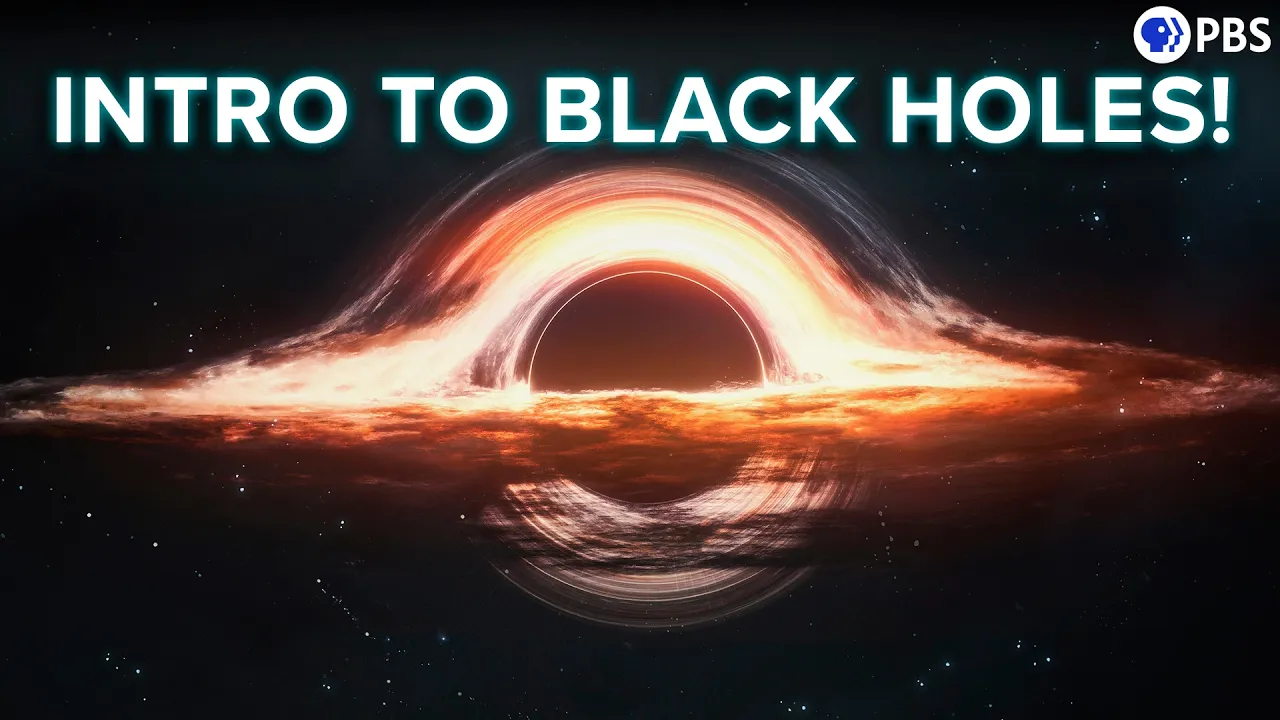

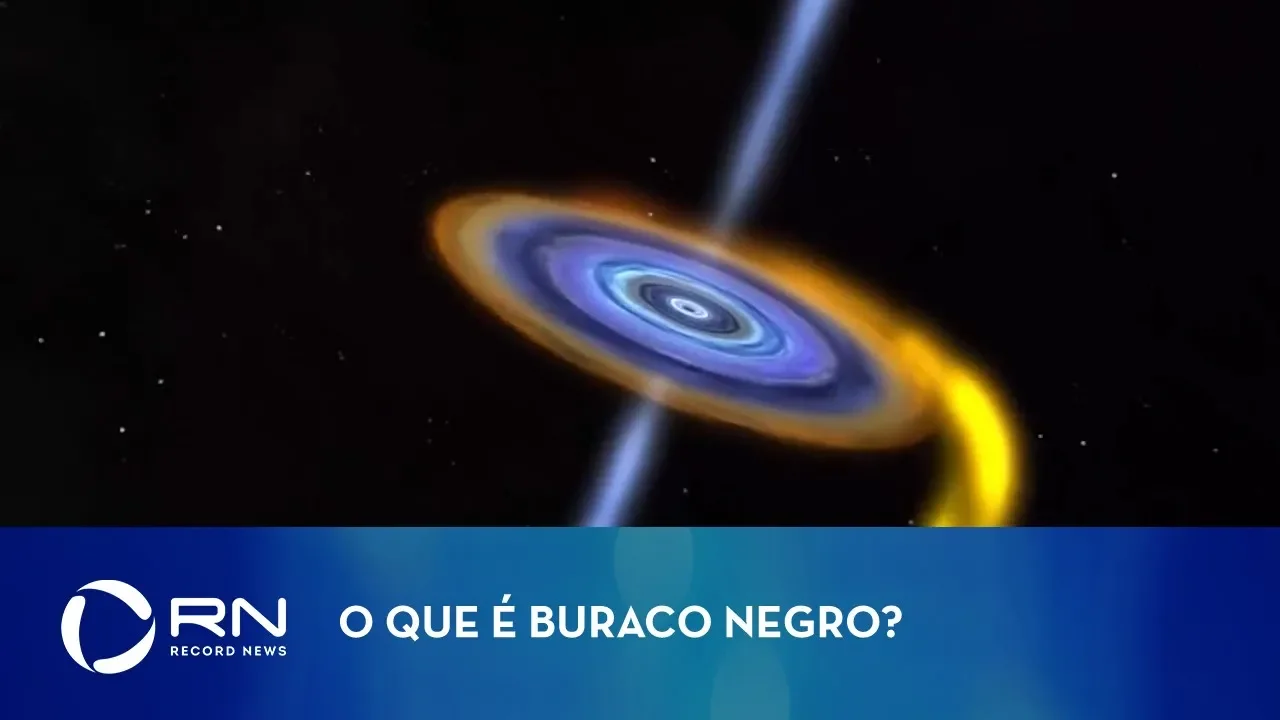



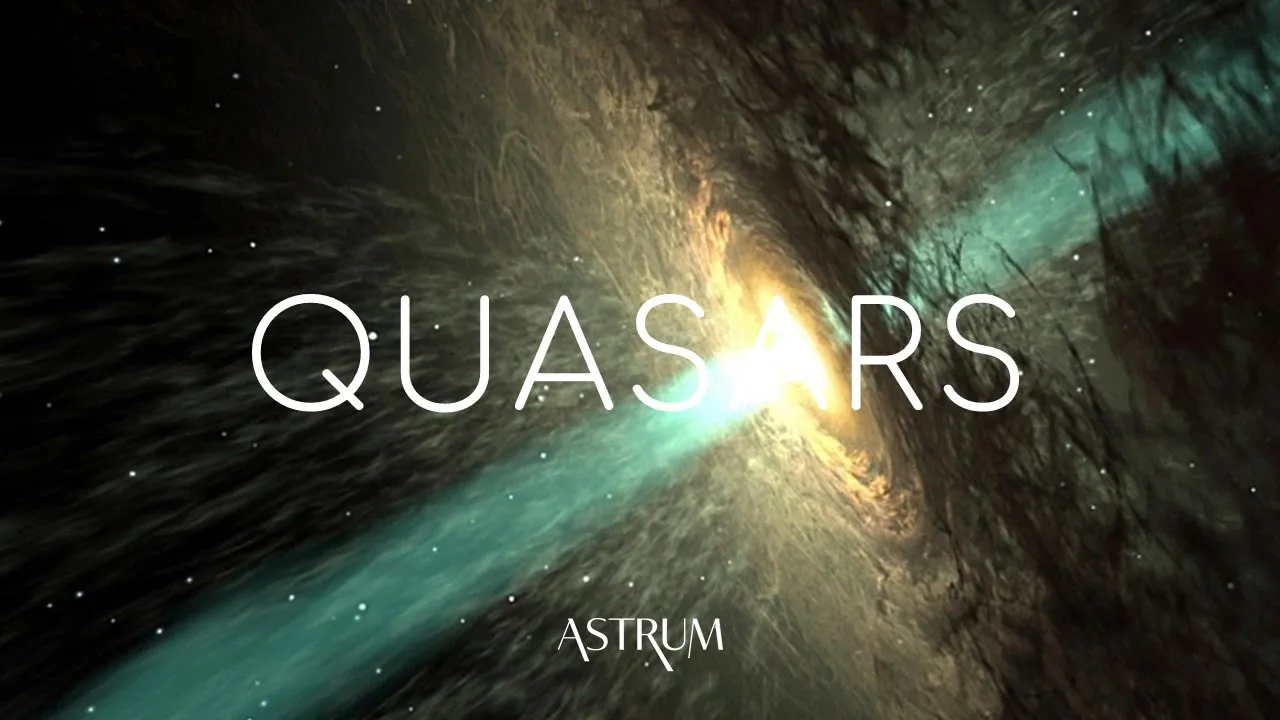
Quasars are among the most luminous objects in the universe, appearing star-like but actually being supermassive black holes at the centers of galaxies that emit prodigious amounts of energy through accretion processes. Despite their extreme brightness (equivalent to a thousand galaxies), quasars are compact, with emission regions smaller than our solar system, and they exhibit rapid variability indicating gas clouds moving at thousands of kilometers per second. The discovery of quasars in 1963 resolved the apparent contradiction of how something so bright could exist at such vast distances, revealing that these objects trace the early life of galaxies and the properties of intervening space. The unified model explains that quasars, Seyfert galaxies, and radio galaxies all represent the same physical phenomenon—supermassive black holes accreting matter—with differences arising from viewing angles relative to a dusty torus surrounding the accretion disk.
Quasars and Black Holes: Cosmic Lighthouses | Astronomy Lecture
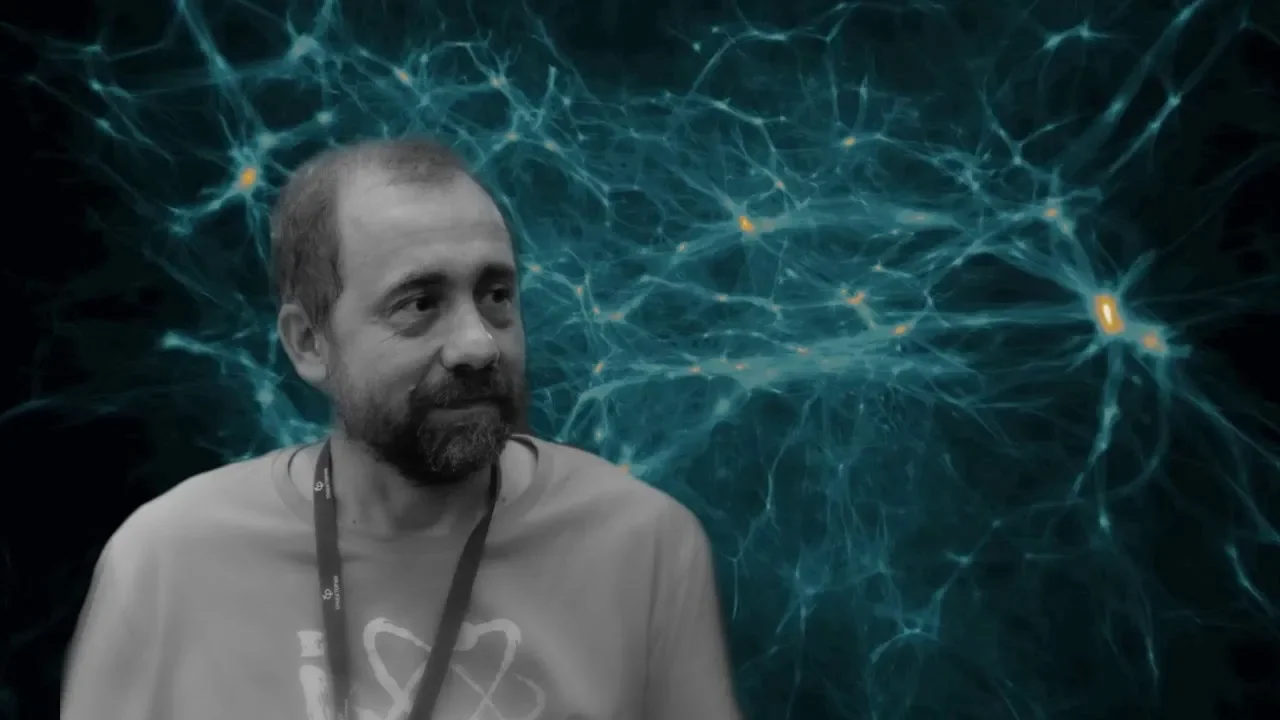
Added:welcome everyone it's not quite 1 o'clock but given that we've got a full house I might as well start on today's topic which is craze ours and talking about how these are manifestations are some of the the brightest black holes and how that kind of apparent contradiction how you can have a bright black hole is resolved but to start off with I want to show you this picture it's the hundred thousandth image that was taken with the Hubble Space Telescope amazingly enough that was back in 1996 and if you look at the image you can see there are a couple of stars and then there are a few faint galaxies scattered around them and I know those are distant galaxies they're very small they're very dim and they lie a long way away however things are not quite as they seem within this image because I can tell you that although this is a star the object at the center is not it looks for all the world like a star but it's a billion light-years further away that means it is the most distant object within this image it lies even further behind all these faint galaxies that you see and the problem here is you've got something that looks like a star it's about the same brightness as the star but it's a million times further away which means that it is its intrinsic it's the amount of light it's actually giving out is a million million times more than a single star so you have something that is halfway across the universe but it looks like a star and it is putting out the luminosity equivalent of a thousand galaxies this is the wonderful world of quasars where things are not quite as they seem or as they first appear and I'm going to tell you about how these prodigious emitters of luminosity are still really relevant for astronomy today because another reason for celebrating quasars is that they were discovered 50 years ago I'm going to tell you about a bit about that discovery but what I want you to realize they don't they were of interest and great they were great enigma 50 years ago but even though they were discovered serendipitously in the first place they are still one of the targets that most astronomers study for all kinds of different reasons because they're so far away that means that light has taken a long time to travel from them to us we're seeing them back in when the universe was incredibly young so you're seeing not just the early universe you're seeing more extreme physical processes going on in these objects than you see in the nearby universe as well and for all these reasons and many more quasars continue to be a very hot topic of study today however let's backtrack I said they were discovered 1963 50 years ago well we can move even further back from Len and talk about more general kinds of activity in galaxies now there are billions of ordinary galaxies and universes that ography no galaxy is ordinary everything's got something little bit different about it but you've got these collections of stars gas and dust all held on to get together under gravity and you've also got the dark matter which is not producing the light but is kind of anchoring everything in place and there are billions of them through the universe and if you take the light from any one of these galaxies you will find it is predictable it is the light that you would get from you know 100 thousand million stars along with associated dust clouds and gas clouds and the light that's given off it's according to the temperature of most of those bodies is most elites what we call blackbody radiation so you know how much light is given out depends on how hot an object is very simple kinds of stuff that we understand as generic collections of stars however even a hundred just over 100 years ago whereas it is less than 100 years ago it was recognized that there were some galaxies that looked a little odd now this is a very modern picture of a large elliptical galaxy but even in 1918 the American astronomer Heba Curtis a photograph of this galaxy is called m87 and he remarked that there seem to be this kind of ray coming from the center right throughout to the outer envelope of the stars of the galaxy and you know that just remained an enigma nobody knew quite why this one galaxy showed this ray and it remained a bit of an oddity and the story of things happening in the centres of galaxies doesn't come a doesn't sort of get revisited until the 1940s and it was picked up by again an American astronomer called Carl C foot and he was studying type of galaxies that had been known about for a while where you have an ordinary spiral galaxy except that it has this very bright core at the center that the right at the core of the galaxy it's more luminous than it should be and if I just show you a comparison here you have two spiral galaxies about the same redshift about the same luminosity about the same size what you will notice though is that the one on the left here it shows what we call diffraction spikes that's what you get from very bright sources it sort of scattering with inside the telescope and if you were to closely at this image you'd see that the that the CCD detector the detectives used has saturated in the middle there this is an ordinary galaxy this is a seafoot galaxy it's got that incredibly bright nucleus the thing that was different about what Calcifer himself did is he analyzed the light from those galaxies so this is not just taking a picture but it's splitting the light into a spectrum and working out what processes are responsible for the emission of the light and he found it didn't look like what you would get if you looked at this galaxy so if you take the light from galaxies like the one on the right here and you split it across all its colors I'll just show you what one looks like so this is going to introduce you to spectra this is color this is wavelength and this is how bright the light is at different colors and I've got two galaxies here and this is if you looked at a normal galaxy you would just see this kind of shape it's very red and then there isn't much blue light because this is blue this is red that's what you expect from lots of stars at slightly similar temperatures all stuff together and sometimes you might have a few spikes of light at certain colors that means they're excited gas clouds present and I'll talk a bit more about the light from excited gas clouds but it's just really what you would expect now when he looked at the Seyfert galaxies spectra first of all you've got that very bright nucleus but when you look at the nature of that light from the nucleus it doesn't look like these galaxies here are some of those spectra they are first of all they there's very little of that underlying stars you may be say well you've kind of got a bit of this light that could be from all the stars some together underline it gets even less here and you've got two major features which are different one is that in some of the galaxies instead of dropping off as it gets to the blue it starts climbing away you've got an awful lot and if ever continues out to the ultraviolet very blue they're very bright very blue to ultraviolet light in these sources that you don't see an ordinary galaxy so that's the first difference the other thing you see is they have very strong emission lines there are large amounts of gas clouds which are being heated and the atoms and those gases be excited so you don't just have the gas clouds because of these lines you know that you need a source of very energetic radiation to excite the gas atoms in those clouds so there's got to be more than just the stars present and both of those processes this excess of blue light here all these emission lines tell you there's more than going on than just the Stars input terms of producing the light the other thing is these emission lines are Diagnostics all things like the pressure the density the contents and emotions of those gas clouds and let me just explain this in a little bit more detail because this is the first manifestation something exciting going on in the cause of these nuclei if you have one gas item of a certain element and you excite it maybe you blast it with UV photons it absorbs some of that energy and then it will reradiates it and the thing about atoms is that they will rear a v8 only at particular colors and which colors of a radiator depend on what chemical element that atom is of each element will produce a different set of emission lines so they excited gas atom in the cloud and then it releases the energy that energy will only come out of particular color so you have if you imagine had a whole cloud of gas atoms you excite them all they all radiate you'd expect a huge burst of light at one color and that's your emission line wavelength against intensity bright spike of emission but you did notice that those lines will kind of spread their slight range of colors and you need to account for the fact that these atoms are not still within a gas cloud and you've got the Doppler effect that just affects the wavelength that the line the color that the lines are emitted to you may have heard of the Doppler effect just to summarize if something is moving towards you its line is shifted slightly to blue wavelengths I mean obviously gross well I haven't got a scale there but I mean I'm exaggerating a bit here it is coming towards you it gets blue shift is going away from you it gets red shifted and so if you have a gas cloud you're summing up all the motions of all those atoms within the cloud that are giving off the light and the broadening of the line how much dispersion is to the blue to the red tells you about the motions of the atoms in the cloud now the first thing you know is those atoms are never still as long as then the things not to absolute zero is moving around the atoms in the gas cloud will be jiggling they'll be moving they'll just be constantly in motion some be coming towards you some be coming away to you and that's something that's very predictable we call that thermal broadening and that just spreads the line a little bit okay just a little bit makes it broader than it would be and this is something we can do in the lab on earth we understand the broadening just depends on the temperature it depends on the mass of the atoms however what we're seeing in these galaxies is far more substantial than just due to the motions of the gas you have to appeal to bulk flows of gas clouds and there are a number of different ways you can get this you could have an inflow or an outflow so some stuff is coming towards you some stuff is are going away in both cases you could have influenced our flow or you can have rotational motions and again some stuff is coming towards you some stuff going away and that's broadening the line and the width of the line you know how much the spread is towards the red and the blue tells you about the motions of the clouds and how fast that motion is for those of you who want an equation because it's a physics lecture here's your equation there'll be one other later on but all only mean that the bottom line is just that you measure the width of the line and it tells you the range of speeds that the gas and the gas atoms emitting it are traveling at and when you look at those lines in the seafoot galaxies even the narrow lines suggest that gas clouds are moving at hundreds of kilometres per second and those very broad lines that were in the top plot I just showed you more see it again will see these broad lines again they indicate those gas clouds are traveling at speeds of thousands of kilometers per second you have to realize that is far more than just the ordinary tation of stars and a spiral galaxy which is say of the order 200 to 300 kilometers per second it's a factor of 10 greater at least so you're looking at phenomenal velocities though again that suggests these gas clouds are traveling very fast which indicates if it's orbital motion you know again summer travel it was somewhere orbiting very fast on the inside some are orbiting more slowly on the inside and suggest there could be something that they're responding to the gravity of again it's still an enigma and it's something you're only seen in these Seifert galaxies that show the bright nucleus so a bit of a problem in terms of the interpretation a little later on another kind of active galaxies came around nobody really understood the seafoot galaxies they were just a separate class they're saying son Kuras is going on in the core of these galaxies and it wasn't to the late 1940s and early 50s that they realized there were other galaxies where something strange was going on in the core and these are the radio galaxies discovered through prodigious amounts of radio emission now in the early 1950s radio astronomy was in its infancy and they were still detecting and mapping out the most luminous sources in the sky and this is obviously a very modern picture of the radio emission from one of these sources I'm going to talk about but it has a characteristic shape you can see it's got a bright core here and then it's got two fuzzy lobes that are linked by as a radial spur back to the compact core now originally when you start off with your radio dishes and antennae in the late 1940s 1950s you can measure the brightness of a source at a certain frequency and you can say it's in that kind of area of the sky you can't quite get the position accurately enough and so try to work out what object that you see in the visible wave band is emitting all this huge amount of radio emission was not obvious how to do it many of them were identified as stars you know in our galaxy however enough of these systems happened where you would see a little galaxy sitting right close to this central compact core just to show you again more modern pictures of one of these examples here's the radio emission that you see and discover a source by if you look in the optical you see that core is associated with the center of an elliptical galaxy and here's just a montage of the radio and the optical together so again here you have an otherwise unassuming very boring elliptical galaxy in the optical that is producing huge amounts of radio emission and far too much radio emission then you would expect far more than something like our galaxy or an ordinary spiral galaxy admits and again suggesting there's something weird going on in the core and also stuff that is not connected to the Stars the dust in the gas you need to be able the power required to both generate these Jets made them and these are jets of plasma ionized material electrons mostly traveling at relativistic speeds barreling along magnetic field lines this is not the thermal emission due to the temperature of things this is non thermal processes going on and you need power to accelerate these Jets and push this matter right out of the galaxy until it's splatters out in space so there were a few radio galaxies identified and you had this idea sort of by the early 1950s that there were radio galaxies and these were also somehow active galaxies something going on in the core but there still persisted a number of the most powerful sources where there was no faint galaxies near the the compact core even though they kind of understood these there were a whole lot of radio sources where they had the same radio structure but no little radio galaxies sitting at the center and there were tentative identifications made with stars again just remind you you're still at the early stages you don't have a very good place on the sky that you can't pin down the exact radio position and this is just an early radio map and you can see there's one two three four radio sources identified in there we're going to be talking about this one 3c273 in a minute but in the early 1960s some of these radio sources were tentatively identified with stars here's one of the early identification plates in 1962 and the best source they could get the best pinpointing they could get the source of all that radio emission was a star now not an ordinary star it was a very blue star it was varying in brightness a lot so it's something a little bit weird about it but nobody could understand how a radio star could produce as luminosity and not just that when you looked at its spectrum again the light given off all wavelengths it was weird it was not the you'd expect a star to go along and then get fainter even blue it would not give off this much light and how do these emission lines but the emission lines weren't at the places you'd associate with any of the known chemical elements you know we study them in the lab you see what lines they're given off these are all at the wrong places they would they couldn't identify the elements so these radio stars persisted as an enigma and there were another couple of these sources again identified as radio stars but a chance came in 1962 to do a very precise determination and it was of this sauce 3c273 here you can see the very crude map and it was going to be occulted by the moon three separate times during the year and a culture just means but if this I know we're talking radio sources but this is an optical star it just means the moon moves across it this gives you a chance to work out the exact position all you need to do is obviously observe the moon we know exactly where the moon is in the sky in particular where the outer edge of the moon is and all you have to do is map the exact position of the moon at the point that that radio source disappears from sight because it's been eclipsed by the moon and then it'll be out of sight while the moon moves in front of it and then re-emerge a bit later and you can then map the other side of the moon's arc and where those intersect give you very precise positions for the emitter of the radio source now Cyril hazard and his colleagues he's the new parks radio dish in Australia to do this and pinpointed a very accurate position which again pointed towards a star for this source 3 C 2 7 13 3 C stands for third chemical log by the way that would be the big catalogue of all-powerful sources in radio sources in the northern hemisphere which was published in 1959 so you've still got one of these bright radio stars they passed the coordinates onto American astronomers and if you looked at this star and you could see not was it just a star but it had one of these Ray's attached to it as well and indeed by doing this occultation they were able to look at the radio structure in much more detail and they found the radio emission from missiles was not just one point but it also had a long jet and the jet of emission aligned with the the kind of spur from the star they passed the coordinates on to Martin Schmidt American astronomer who used the Palomar 200-inch to take the spectrum of this radio star and lo and behold it looked like the spectrum of all the other radio stars in it was very blue and it had lots of emission lines but the problem was you've got I think pre four or five of these radio stars now and the emission lines were all in different places they had basic similarities to each other but it wasn't the same spectrum his breakthrough was to realize that these were the right emission lines but in the wrong place so you've got the same relative sets of emission lines say from hydrogen or helium or oxygen but just shifted to the red so this is where they're observed these are how far they've shifted to the red and in fact it's probably easiest in this target because it's the one where that red shift is left so it's less of a leap of intuition to make the connection now such an idea have been considered before for the other radio stars but there are fundamental problems with this interpretation that amount of redshift means that the star is traveling at forty eight thousand kilometers per second away from us and you have two options one that is a style that's just been flung out of the galaxy and is moving away from us at that phenomenal speed or it's actually taking part in the general expansion of the universe and it's actually a long way away because the way the universe is expanding the faster something is receding away from you the further it is away from us now that's marginally the less bizarre explanation and it's the one that Schmidt and others have you know we've all finally plumped for the the problem with it in terms of this star is that not such that you know such a redshift due to the cosmological expansion the universe is a problem we see galaxies and certainly they all astronomers even in the early part of the last century knew about galaxies at those kind of red shifts but galaxies at those redshifts that that distance from earth were small and dim you have this problem again of the prodigious amount of luminosity if you've got something that is as bright as a star and yet is um in this case I think so like two-and-a-half billion light years away it has to be phenomenally bright and that's why people had rejected it up to that point and this was the breakthrough that led to the discovery of quasars or the identification of these radio stars quasi-stellar objects which has over the years got concatenated to quasars and then once this intuition intuitively to be made the other radio stars were also identified as quasars and suddenly a whole lot more started to be discovered now we know of a hundreds of thousands of quasars all the way across the universe they are all bright we don't use the radio mission to find them now we find only in about sort of 10% of all quays I'll show those big radio emission so even though the first ones were identified through their ad emission now we use the fact they're very blue that they're very variable and some of the other properties I'm going to be telling you about quasars of detective in all different wave bands not just the optical and the radio so quasars are common and there are things that are strange about them first of all they're spectrum as I'll show you later is amazingly similar here is observed wavelength here you have a fairly nearby quasar spectrum and then as the redshift increases you can see it's the same pattern of lines just gradually shifting to the red so we see now quasars out to redshift of seven I'll come back to that object that was the light left that object when the universe was 770 million years old okay so that's what I mean by right across the universe so there are connections that were immediately made between the quasars and the seafoot galaxies and it comes from the spectrum particularly these these words subclass asifa's where you've got the very broad lines and the blue light compared the spectrum of this seaport galaxy to the spectrum from a typical quasar you've got the same pattern of lines it's just that the quasar is brighter and there's far more of that blue light you've got less of the starlight contribution to the spectrum and so the immediate thought is what quasars are just the same process in the core of a galaxy it's just they're much more scaled up probably with that is that there was no galaxy around the quasars you could see in a safer the surrounding galaxies you know a nice big fluffy spiral however hard you looked all through the 70s the quasar remained crazy stellar and it was only during the 1980s when we had new detectors CCD detectors around photographs you could stack them digitally and pick out faint features within the photograph so when we have adaptive optics and space telescopes when you limit the amount of blurring of the quasar light into the surroundings then you can begin to detect a host galaxy so here's 3c273 and now with the hubble space telescope where they blocked out the light from the central quasar nucleus you can see beginning to get a hint of an underlying galaxy this was incredibly difficult work at the time the analogy I would like to make is it's like trying to determine the shape the color and the demand the size of a lampshade when you've got an incredibly bright light bulb on in the middle of it and you're looking directly at it the quasar swamps the surrounding light but then the discovery made of more and more of the host galaxies of the quasars here just a selection in false colors from the hubble space telescope and they were found in spirals and ellipticals sometimes ones that were showed some evidence perhaps a distortion perhaps undergoing an interaction gravitational interaction with the nearby neighbor and so it last you have the idea that quasars live within galaxies doesn't mean you necessarily know what they are and that was a sub of intense debate it seems simple that it was just a ramping up of the process you have a c42 system like this where the nucleus is fairly dim compared to the galaxy and there may be that process same physical process or whatever it is it gets more and more important compared to the surrounding galaxies and that's when you have the quasars and whatever this process is happens right at the center of the galaxies and there are certain features that give you a clue as to what this process is now remember these are hugely luminous and I've talked about thousand times the luminosity of a galaxy well having the light from a you know thousand galaxies worth of light it's not a problem you just have a thousand galaxies it doesn't explain the craters though because you get the wrong sort of spectrum and it comes from two smaller region the first thing to note is that quasars are so luminous not just in the visible not just in the radio if they have it but at all wavelengths particularly the most energetic wavelength this is an optical picture of some galaxies and a quasar down here we move to the same field in the x-rays you can see nothing else produces a lot of this very energetic x-ray emission just the quasar and in fact it's producing a jet in the x-rays they are hugely brighter all wavelengths in fact there they produce most of their power output in x-rays and ultraviolet light the most energetic radiation so the spectrum is non-thermal it's not just from stars and gas and dust at all wavelengths the other thing is the size of the region that this light comes from has to be tiny and we know that from the variability here for example is a plot of the x-ray brightness obviously for two galaxies which we call mcg minus six here's the brightness and time and it's flickering all the time changing and you can see here for example it drops by over a third and brightness in five and a half that means the size of the region producing this light less it has to be less than five and a half light hours in size because it's a very sharp drop and just to explain that a little bit you if you have an object any kind of object and there's a signal coming from somewhere that you have to change brightness across the object say it happens from the center the signal travels from the center out to the edges now that whole object is to light weeks across it takes perhaps one light week for this to receive the signal and another light week for this to receive the signal in terms of are seeing that change your brightness and the object we're going to see the light from this side before we see the light from the middle and you know again two weeks before we see the light from the other side so the whole change in brightness is smeared out very slowly with time imagine now that source is only 2 light hours across we see it very currently we see the whole brightness change happening within two hours and you get that sharp jump so just this very rapid variability allows you to constrain the region and saying that example of mcg minus six that kind of length of time indicates the size of the emitting region is about six billion kilometers that is less than your average distance between the Sun and Pluto so you've got your thousand luminosities of galaxies all crammed down into something the size of our solar system right so you know you've got something that is not just ordinary galaxies and stars right at the center this galaxy and the fine you know final things to add into the mix you've also got to produce some of these Jets and these radio lobes with the Jets splattering space you are accelerating particles plasma at relativistic speeds out across distances that a millions of light-years across you need to produce a lot of that power that is that there's a preferred kind of bimodal direction that the two Jets go in two different directions not just that that these are sustained for all the time it takes them to travel across these few million light-years I mean look at the straightness save this jet that's a few million light years long so you have a preferred direction for material to be squirted out from the scent of the galaxy and a memory and a process that lasts at least that long to continue that straight line and continue that powerful so you've got something very very massive compacted down into a tawny tawny living space you're producing huge amounts of energy at all wavebands you sometimes producing those twin jets of memory for long period twin Jets of plasma for long you know so you're retaining the memory of that direction and the whole process is the same all that time and remember you've got those incredibly broad lines that suggest things are moving very rapidly gas clouds moving a rapidly in that they could be in orbit around a strong gravitational field we can see how is all stucking up and it was in 1969 that the idea first came about the quasars and Cephas and the radio galaxies or manifestation of something going right on in the core of the galaxy that is related to a central black hole and it was Donald Lyndonville the English astronomer who came up with what pointed out the matter falling through a gravitational field onto a black hole is one way of liberating a huge amount of energy and showed how this could be done and this is the start of the paradigm we use to interpret all of this activity is that you have a black hole accreting matter at the center of the galaxy now you can tell just from the width of the lines and how fast they're orbiting around that it's a very massive black hole I'll come back to this it's not just a black hole it is a super massive black hole much more than you get just from one massive star collapsing down and all the different manifestations of activity are due to the activity going on around this black hole so to explain by the accretion of matter on falling through gravitational field onto a supermassive black hole you can liberate the rest mass amount material here's you at the second equation okay we'd like this one equals MC squared you liberate all the energy from the the rest mass now of course no process is completely efficient you don't liberate all the mass and get all the energy out there's an efficiency argument and a very conservative bet for quasars and for this process accretion onto a black hole is that perhaps you liberate 10% of the mass that's falling onto it you convert that to energy if you assume that then you know a quasar that's a million million times the the brightness of our Sun so a very average quasar you just need to feed it probably less than one so one Sun a year and you compare it it's incredibly efficient if 10% doesn't sound efficient let me remind you that nuclear fusion the core of stars is less than 1% efficient and 10% is still about 10 billion times greater than any chemical efficiency such as you know burning petrol in a car or even your body's digesting breakfast here in front of us so it is phenomenally efficient way of extracting energy and you don't need a huge supply of matter it can be stuff you know random stars that come near the black hole or gas clouds or maybe new stuff funneled into a gravitational merger and interaction with another galaxy it doesn't require a huge amount of accreted material so we have a power source and it can explain all these properties that we observe we think it comes in it doesn't just go straight on to the black hole it has to lose angular momentum and as it does so it kind of swirls down a vortex and it creates a flat accretion disk I've talked about this before my rotation lecture but effectively material swirls round settling down in a flat thin accretion disk you know again this is still on tiny scales only a couple of times the size of our solar system and it comes down and then finally gets secreted onto the black hole at the center but all the material that creation this is heating up is jostling it's being squeezed it begins to heat up to temperatures of tens of thousands of degrees and as it does so it will glow in the ultraviolet in the blue and that can be in the source of that great amount of blue light that we see in these quasars and c4 galaxies the inner regions of those accretion discs not just that you have to have regions where you produce these Jets now jet production is something we don't understand we can't observe it directly it's very much a theoretical problem we think is to do with magnetic fields laced through the spinning accretion disk they kind of act like a dynamo they can produce you know and they can act to squirt out the material along you know charge material out along these these Jets and they would naturally come out and say the spin axis of the accretion disk in the central black hole so the jet production happens outside the black hole above and below and you know you can have an entire lecture about jet mechanics it's a very you know the Jets themselves are fascinating subjects for study and it x-rays the phenomenal amount of x-ray emission we see we think is connected with that jet production happens here at the base of the jet and not just you don't just see the x-rays from there they're also absorbed by the accretion disk and re-radiated you get reprocessed x-rays they have a role to play in heating up the accretion disk and so you begin to get all these different elements and what we observe from these active galactic nuclei put together you've got your black hole surrounded by your creation disk the central parts of the accretion disk get heated up you've got jets produced above and below you've got x-rays somehow in the Krone or above and below the accretion disk you've got the ultraviolet light coming from the center of the accretion disk where it's warmer that's all the accretion process but way out you've got stuff that isn't actively being accreted but it's still affected by the gravity of the black hole and these are the gas clouds the red ones are the ones that are closer in those the ones that are moving it you know up to thousands kilometers per second they're moving fast they're closer into the black hole and then green blobs are supposed to represent ones which are further out they're still feeling the gravity of the black hole but they're not moving so fast there are hundreds of kilometers per second and they produce the narrow lines so you begin to get all the different components however you don't see everything in every active galaxy there are differences between different kinds of secrets not all show the broad lines not all show that blue light right from the core of the accretion disk and so it's not just well I mean you can say you've got a safer and a galaxy and it depends on the how much accretion as to how much power is generated you have to appeal to something else that it also matters which angle you're looking at this activity from if you want this all to be the same process and we do this by invoking a kind of hidden screen imagine all the faces going on and remember tiny scales right at the center for galaxies regions only a few times the size of our solar system now further out we see evidence or I mean they're gay artists impression I should have told you the smartest impression Felix because we don't see right down to the core around the black hole and the accretion central accretion disk because it's all too small but we think all of this is involved by a big obscuring donor to tourists of dusty material we see the outer edges of this the core some galaxies so all the nuclear activity accretion disk and everything the broad lines are down there and we're beginning to see just the outer edge of a dusty torus obscuring all of that and so how much the central activity you see depends whether you're looking that way or that way to it you shrunk it all down and again just the cross-section view here's the ring of obscuring matter well you can see you're going to see different things from different directions the light the ultraviolet light escapes from just these regions it's blocked traveling that region but it escapes out kind of to funnel directions and that's where it can light up the gas clouds and excite them and indeed when you look in nearby galaxies okay it's not coming out very well because it's red but when you map out the distribution of those gas clouds they can have kind of conical shape suggesting that there's obscuration here and here stopping the gas in those directions being lit up to produce those gas clouds so shrinking it down further here's your dust Torre's fancy black hole there's your accretion disk creation has produced the blue light the broad lines are close in and the narrow lines are further out and they all act along the poles of the black hole if you look this way you don't see the broad lines you don't see the blue light from the disk you see some activity you see the green ugly green see the narrow lines and maybe you see some infrared light as the dust absorbs some of the light and then reradiates but you see a little hint that there's some activity but not much however if you look down this angle you also see the broad lines and you see the blue light from the accretion disk and so you've got the same object just see you just see different bits of what's going on at the core at a higher power so scaling from a c4 galaxy to a quasar you get a full blast of stuff going on at the core and that's when you see a quasar now it's not a hard-and-fast dichotomy but in general we see sefa and some of the quasar activity a round spiral in spiral galaxies it's more the elliptical galaxies where you would get the Jets you've got a radio galaxy where you see nothing of a central activity maybe a little bit of emission line activity but if you look almost like pole onto the jet you see everything going on in the quasar and so we have a unified picture that can count for all the different kinds of active galaxies that we observe and you know and and kind of account for all the different things that we observe so far so good so we've got a simple process that happens in different kinds of galaxies at different kind of powers and then it changes according to how you look at it but of course there's always another variable which is that sometimes not all if this stays the same sometimes there might be more obscuration maybe the black hole at the center will be accreting sometimes and sometimes not and so another thing that affects whether or not you see quasar activity within a galaxy is basically they go through periods of being active and not and indeed when you look at if you count quasars if you do surveys out into space and you count the number of quasars are certain luminosities at different volumes and space moving out from us and of course different volumes of space are happening back at different epochs in the history of the universe you find the quasars are very rare around as I mean obviously they took a long while for them to be discovered probably about one in a hundred thousand galaxies it shows some kind of quasar activity nearby but if you go back in time quasar activity is far more common probably about a hundred to a thousand times more common than it is in the current day here's just a sketch showing you how quasar that the number if you like space density of quasars back in time now you were here this is the current day BIGBANG's somewhere in the mists of time back here and this is the number density of quasars and as you look up the number increases increases and they were most common when the universe was about a quarter of its present age okay and beyond that well kind of it's a bit difficult to tell because the further away something is the dimmer and more difficult it is to find but there does seem to be a genuine drop-off in the number of quasars there are few more powerful quasars at high redshift so you have something that if you work out the statistics you find that most galaxies around now need to have gone through a period of this activity in their past and you don't know whether I mean you can interpret this that all galaxies were active here and then the activity drops off but what we prefer to deduce from this is that there are this is just a population there were just more galaxies active here fewer galaxies of here so is lots of different generations of quasar activity maybe even the same galaxy you've got stuff that switches on and off through time so there's a time dependence in all of this and the furthest Gallic the furthest quasar we know about which is zooming into here our alleged alluded to it before so the red shirt is seven it was formed with things it was when the galaxy through the universe was 770 million years old and this causes a problem it's bet you can barely see it at the back it's even I'm struggling it's that tiny little red dot there okay it's a long way I bet you thought it was the bright one it's not it's that it's an excuse distance away from us the problem is that you've got a quasar you've got a supermassive black hole when you look at the speed of the clouds and orbit around it you find it's a two billion solar mass black hole sitting in the galaxy when the universe is only kind of 800 million years old that means you need to build your central black hole very very quickly for it to be in place at that point and so you have a problems how do you get black holes in place in galaxies early enough on that you begin to see quasar activity in these really young objects and this is something that again it's very cutting edge people are still trying to understand how you generate perhaps you need some kind of seed black hole massive progenitor that accretes quickly to form this kind of object within this this kind of time the additional thing is when you go back in redshifts that here we're just seeing the shift of quasar spectra out to higher redshift there's a ticker out here all quasar spectra incredibly similar even when you go to read shifts of six or seven the very earlier quasars they show the same lines you've got not just the elements hydrogen helium you've got some heavy elements so even at that age eight hundred million years old your galaxy surrounding that black hole is fueling with material then has got those heavy elements in it needs to be in some rapid generations of star formation because that's where you make those heavy elements and look in the cause and in the supernova explosions of those giant stars so you've got black holes you're going to create a seed black hole alongside a whole load of stars and there are various ideas about how you can do this first one is you could just have gravitational collapse of a gas cloud and maybe just in a very early universe you had large gas clouds creating large stars maybe a few hundred maybe a thousand times the mass of our Sun will then collapse down to form a black hole very rapidly the problem with the simulations and again remember this is not stuff we can study observation we have to do this theoretically is that you don't get a big enough black hole out it wouldn't sink to the center of the forming galaxies and be able to be in place to gobble all its surroundings and grow very rapidly instead you have to say either will probably you've got a concentration of the lots of large stars forming early on and maybe a star cluster at the center of the cloud that's going to be the galaxies now either those all are so close that they're dynamically interaction they merged from one huge star that then turns into a black hole and I mean it eats all its surroundings and could grow very quickly so you've got you know a thousand mass black sorry several thousand times the mass of our Sun star turning to a large black hole eating its surroundings immediately and starting to grow or you get the evolved remnants of all the stars when those clusters merging to form a big black hole but you need to get your act together quickly to get lots of massive stars to produce the elements and to produce the seed black hole and people are still playing with all these different ideas and what they you know what we think might have happened right at the start the formation of a galaxy not just that but that you then have to recruit quite rapidly and there are limits as to how fast you can feed a black hole and the more matter it accrete the more radiation it gives off and the trouble of the light is that has a push we don't notice this much on every day baby something as bright as a quasar is producing so much energetic radiation every one of those photons produces a push on the surrounding material so here's my schematic here's your photon comes in and hits the surface or something could be an electron it could be a dust grain it could be absorbed it could be reflected but nonetheless it produces a slight outward push on that material now you go to brightest quasars reducing phenomenal amounts of these photons it has a net outwards pressure so if you feed a quasar to much feed a black hole too much it produces too much light because at some point the radiation pressure nabob that light is going to dispel the accreting material so you've got a kind of limit as to how bright a quasar can burn and indeed when you work out how fast it has to grow through the age of the galaxy to grow the black holes we see it's going most of the luminous quasar got to be creating it close to this limit we call it the Eddington limit so they're about as creating as fast as they can without dispersing the surrounding material because once they do that then they can't create anymore maybe they switch off and so maybe this is part of the reason that quasars go through duty cycles with time and then of course once you've fed a black hole at the core of a galaxy question is what happens next you can't get rid of it it stays there so another handle we have and how fast and how much black holes were created through the history of a galaxies to look at the core of nearby galaxies and we do find black holes at the core but not actively accreting ones that you see in the Seifert snow and the the quasars but these are the remnants of what's left after they've got their immediate environment so this is m87 that galaxy where he because saw that that radial spur in his photograph from 1918 one of the early results from the hubble space telescope was to look right round the core of the galaxy here were most of the light is in the light of excited gas atoms and you find that there's if we just zoom in there's a rotating cloud of yes and they did observations where they measured the rotational speed of this gas okay this is lost in translation but this side is coming towards you that sides going away from you orbital motion about 500 kilometers per second that is stuff in motion around a supermassive black hole one there's four billion times the mass of our Sun you don't see the black hole it's not actually accreting so it's not producing all that bright numerosity around it but it's still there and it's still got gravity to pull this stuff in orbit around it so this is one extreme another extreme can be seen at the center of our own galaxy right in the core here is only 26,000 light-years away now if you zoom in right to the center and it goes right through the disk of our galaxy and you're looking through lots of cloud of dust and gas ships use infrared measurements that allow you to see through that cloud and clouds of dust and gas and if you keep zooming in right at the central galaxies there's a large cluster of stars and for the last 20 years American and German astronomers have been following the motions of the stars at the center of that that little star cluster and they're moving and they're moving in orbit around something so now it's going to jump to just a sort of animation of those orbits and you can't see what they're in orbit against but you can weigh it how fast the star is moving around in its orbit depend how far away's is from the center of that orbit and the mass of whatever it's rotating around in the same way you know the Earth speed round the Sun depends on the separation between them - and the mass of the Sun you can use all these orbits and their speed to infer that all those stars in the center of our galaxy are going around a black hole of the order of four million times the mass of our Sun but again one that is currently dormant so you've got the end product of nearby galaxies where all the quasar activity is ceased but there's a massive black hole just sitting there lurking right at the center and how big that black hole dictates how much chrétien is had to do through the past history of the galaxy how often that galaxy is active but there's a catch and there's something nice let's come out when you weigh the black hole and you weigh the surrounding galaxy you find there's a very tight relationship between the two here we're measuring the mass of the surrounding galaxies and we're measuring the mass of the black hole and what you find is the mass of the black hole is always about about three percent of the mass of the surrounding galaxy maybe it's point three percent I can't remember but it's a fixed relationship between the two and here you have the mass of the black hole knows about the mass of the galaxy and vice versa what this is telling you is there is a very tight relationship with the behavior of the two and indeed we think that the black hole and the galaxies form in tandem and then the behave of the black hole can perhaps stop the formation of the galaxy around it and again this is cutting-edge science nobody's there are several different ideas going around but maybe the black hole switches off star formation in the galaxies when the black hole gets to a certain size or it gets to a certain accretion rate there I mean it's not just the light that's going out from the black hole and heating the gas clouds so they stopped collapsing into stars because that's what you need you need to just send out some energy that warms the gas clouds are they no longer collapse into stars and the galaxy stops forming so there's plenty of energy being radiated from a black hole that can stop the formation of a galaxy in fact there's a bit too much if you tapped all the energy being given off for by black hole you just dispel the whole galaxy you need to be able to tap just a tiny fraction of that and that's enough that you can just curtail star formation and how you tap the energy of a black hole different ideas maybe it generates winds physical winds which then go out and heat the surroundings all there are ideas linked to that radiation pressure so when you've got your black hole it's accreting at that maximal Eddington limit excuse me it can also have an effect on further out it's going to push away there's going to be a radiation pressure on the dust grains within those gas clouds and again push them away stop the accretion on to the black hole and heat them up and stop the stars from collapsing and forming the galaxies so there's an interesting symbiosis between the growth of the black hole and the growth of the galaxy and how the black hole it's no longer just an interesting and decorative feature at the center of galaxies it actually has a key role in the general formation of that galaxy and that needs to be wound into all our scenarios about how you form galaxies there's just one final point I want to show you I talked about dormant black holes at the center of our galaxy well at all galaxies and the center of our galaxy now a double black hole would just sit there until something interesting comes along that it can snack on and that's what our black hole may be doing in the near future these are pictures of those stellar motions round the black hole over the last sort of 10 years and again it is ringed there and there was a very faint blob that is moving it's shown in red on this animation here so the stars doing their orbits and there's a red blob that's moving that's a gas cloud small gas clouds about three times the mass of the earth not very big and it's falling towards the black hole no it's not going to fall on to the black hole we asked faith in that regard but here's just a simulation showing you what we predict about its orbit if that's the surrounding the black hole which is of course not shining brightly at that it's not accreting it's not active it's just showing you the place but it's gradually going to get stretched and torn round and I don't it you may just caught the date now that's beginning to happen now it's been happening over the summer so for the first hand we're seeing something that it's not fully onto the black hole but it's getting stretched and pulled around the black hole as we speak and even though we have different ideas about what might happen to that gas cloud you can see it's getting just we expected to get dispersed and stretched along its orbit and indeed this is already beginning to happen these are the latest results in the summer where you can see the dispersion and cloud velocity and the thing is all getting stretched now some of it will carry on an orbit but something's getting dragged back round and it's possible that that could form just a tiny bit of fuel for our black hole at the center but again nothing to boost it into any kind of dangerous quasar luminosity but enough to get scientists interest piqued that we might actually begin to see just a microcosm of these events that we you know we determine are going on in all these galaxies halfway across the universe we might just have a nice little snapshot of these processes at a much lower level close to hand and for us that's going to be really exciting will illuminate what we think is going on in those quasars so thank you very much that's the end of quasars if I may I'm just going to flag that in a month's time I'd be talking now I've mentioned radiation pressure around black holes going to be talking worried about radio prey radiation pressure also much closer to home radiation pressure from the Sun in our solar system and the role that it has in producing comets so come along in a month time to find out more thank you
Up Next

Supermassive Black Holes in Galactic Astrophysics
@georgiatechphysics5150
3K views•2016-08-02
First Billion Years of the Universe with the Square Kilometre Array
@iaaudc
121 views•2022-05-26

Kepler's Laws of Planetary Motion Explained (Educational Astronomy Video)
@Peekaboo_Kidz
404.9K views•2023-02-17

Gamma-Ray Bursts: Cosmic Snipers Explained | Astronomy
@kurzgesagt
15M views•2016-07-31
Related Study Plans & Knowledge Roadmaps
Structured learning paths in Astronomy