









![PHILOSOPHY - Language: Conventional Implicature [HD]](https://i.ytimg.com/vi_webp/YD82l_bUhLc/maxresdefault.webp)












![PHILOSOPHY - Language: Gricean Pragmatics [HD]](https://i.ytimg.com/vi_webp/we6uSVf4qss/maxresdefault.webp)

![Spoken & Written Language [TESL600 Discussion]](https://i.ytimg.com/vi/v2hL6wG8-no/hqdefault.jpg?v=60157203)
Conversational implicature is a pragmatic phenomenon where a speaker S saying utterance U to listener L conversationally implicates proposition q if: (1) S and L mutually presume cooperativity in communication; (2) To maintain this cooperativity given U, it must be supposed that S thinks q; (3) S believes L can infer q. This occurs when the speaker's utterance appears to violate conversational maxims (like relevance or quantity), prompting listeners to infer additional meaning beyond the literal content. For example, when Bob replies 'he lives in California' to Ann's question about which city Paul lives in, the implicature that Bob doesn't know the specific city emerges from assuming Bob is cooperative but provided insufficient information, requiring the listener to infer that the stronger, more informative answer (the city) was unavailable to Bob. Similarly, saying 'Sandy's work was satisfactory' conversationally implicates that it was not excellent, because using the stronger term would have been more informative and thus expected under the maxim of quantity, unless prevented by the maxim of quality (truthfulness).
Conversational Implicature: Definition & Examples | Semantics & Pragmatics
Added:Hi.
I'm Chris Potts.
The goal of this screencast is to review the definition of conversational implicature using representative examples.
The definition itself seems complicated and sort of arbitrary when you first encounter it, but it actually captures a very interesting kind of social cognition that is worth understanding deeply.
I'm assuming you've read Grice's paper 'Logic and conversation' already.
In our version, the definition of conversational implicature starts on page 49, with the line, "I am now in a position to characterize the notion of conversational implicature".
The passage itself is long, it's meant to cover a lot of different philosophical perspectives, it contains lots of hedged phrases, and it is vague about some crucial concepts.
So, definitely read it and muse upon it.
But I propose to work with the simpler definition given here.
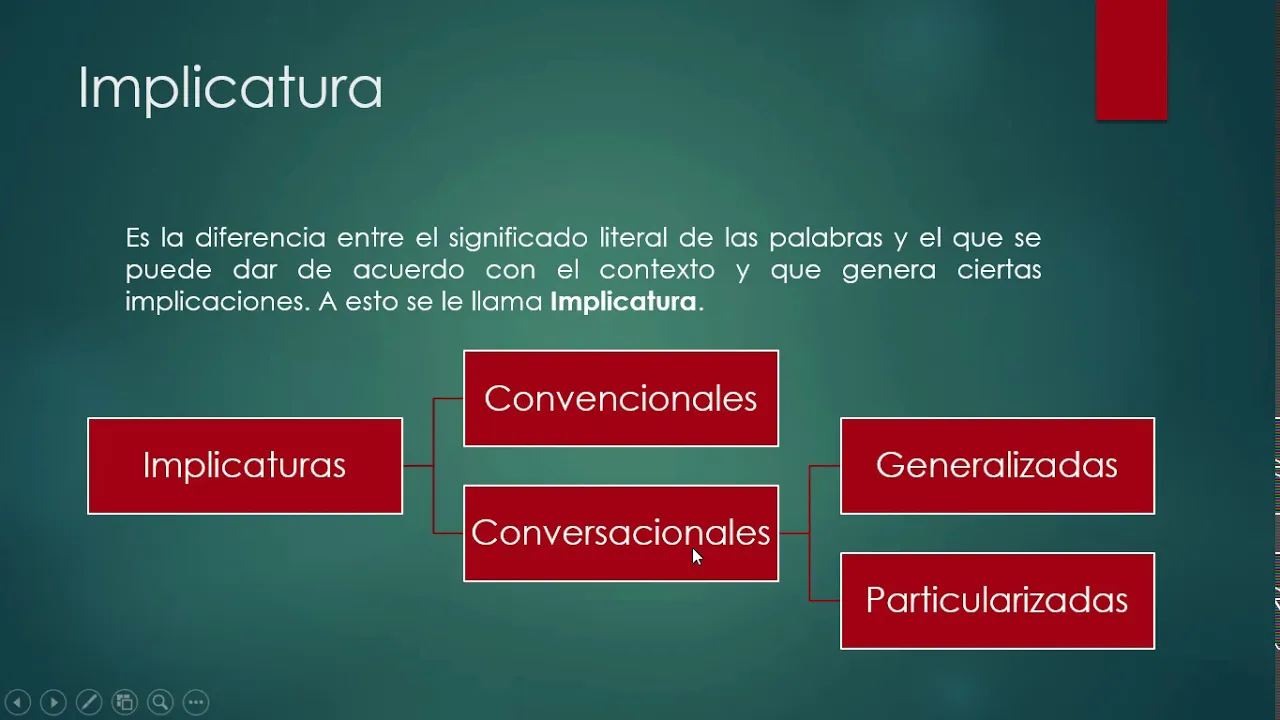
The definition reads: A speaker S saying utterance U to a listener L conversationally implicates a proposition q if, and only if, First clause -- let's call this the cooperativity assumption.
S and L mutually, publicly presume that S is cooperative in the Gricean sense of the cooperative principle of communication.
The second clause is kind of rescue clause.
To maintain the cooperativity assumption in 1 given that the speaker S produced this utterance U, it must be supposed that speaker S thinks that q.
In other words, the speaker's action, in producing this utterance U, was in some sense at odds with the cooperativity assumption in 1.
Maybe it was too long, or under-informative, or partly irrelevant -- in some sense an apparent violation of one or more of the maxims of conversation.
Thus, the reconciliation: if we assume cooperativity, then we have to assume the speaker thinks that q.
Then all is well: the cooperativity assumption is reconciled with the seemingly uncooperative behavior of the speaker.
Finally, clause 3 sort of licenses the speaker to force the listener to go through this reasoning process.
It says, "S thinks that S and L mutually, publicly presume that L is willing and able to work out that 2 holds".
This defines where it's a stable strategy for the speaker to rely on the listener to figure out that q needs to be inferred.
Let's see how this plays out with a basic example.
This is one that people often connect with the maxim of relevance because it involves the relevance of an answer to a question.
We imagine Ann asks Bob "What city does Paul live in?"
Bob replies, "Hmm... he lives in California."
Now, Bob's reply is only a partial answer.
Ann asked about the city, and Bob replied with the state.
Our goal is to get to the implicature that Bob doesn't know which city Paul lives in.
To get the reasoning started, we make the contextual assumption that Ann and Bob are planning a trip of some kind, and both of them are at least open to visiting Paul, and they both know this about each other.
Next, assume Bob is cooperative, at least insofar as he is truthful, seeks to be informative, and is forthcoming about where Paul lives.
This corresponds to clause 1 of the definition of conversational implicature.
Now, Bob supplied less information than was required, seemingly contradicting this cooperativity assumption.
Suppose, though, that we posit that Bob doesn't know which city Paul lives in.
This is the target implicature.
Then we've resolved the tension.
Bob's answer is then optimal given his evidence.
So the implicature follows, in this context, as a consequence of cooperativity.
Now, this implicature seems very natural, but it is actually heavily dependent on the particular assumptions we've made about the context.
As a result, it can disappear with slight changes to that context.
For instance, if we deny the assumption that Bob will be fully cooperative about this topic, then the implicature disappears.
Say Bob is reluctant to give out personal information about Paul.
Then we do not reach the implicature, because we can't assume cooperativity in the relevant sense.
Alternatively, imagine that Ann and Bob are planning a trip but have already sworn off going to California.
Then Bob's answer might contain exactly the needed information, namely, that they won't be visiting Paul.
In this case, assumption 4 doesn't hold, so the calculation doesn't go through.
Again, I think this matches intuitions, in that, in this new context, we don't draw the target implicature as listeners.
This behavior is typical of conversational implicatures.
They seem natural, even automatic, and yet they are highly sensitive to subtle details about the context.
This is what makes them such powerful tools for understanding linguistic meaning and communication.
For the previous example, I left some assumptions about the context implicit in order to try to get across the intuitions.
For the next example, I'm going to try to be even more systematic.
We can never expose all the relevant assumptions for illustrations like this, but the more of them that we state clearly, the clearer the picture gets about what implicature inferences are actually like and how they arise.
Here's the example -- it's very simple.
A says, "Sandy's work was satisfactory".
And the target conversational implicature is that Sandy's work was not excellent -- call that not-q.
This is a pretty strong inference.
When we choose low scalar terms like 'satisfactory', we tend to convey that the stronger ones are false, because it's so conspicuous that we didn't use them.
In the background here is the semantic idea that scalar adjectives like 'satisfactory', 'excellent', and 'superb' are ordered by entailment.
'satisfactory' is extremely general, in that it semantically conveys only *at least* satisfactory.
Stronger terms like 'excellent' are then subsets of that larger space, so that 'excellent' entails 'satisfactory' and 'superb' entails 'excellent'.
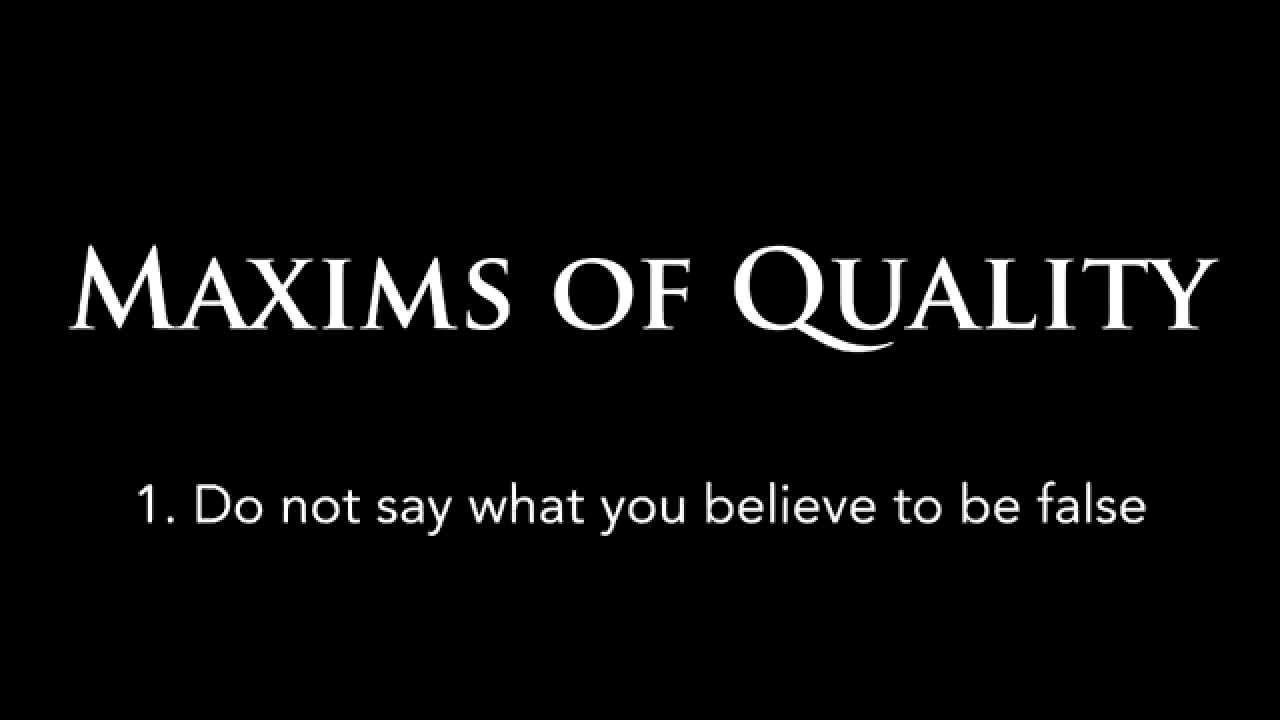
Roughly, the dynamic we want to capture is that the Gricean maxim of quantity -- the pressure to be informative -- pushes you to pick the strongest term you can, so where you don't choose the strong term, it must be that the pressures of quality -- the pressure to be truthful -- are preventing you from using it.
In other words, pick the strongest, most restrictive, most informative term you can, but don't go so far as to violate quality.
This is very natural, but actually involves a lot of assumptions about the context.
Let's take a pretty detailed look at the reasoning process.
First, we need to assume that the speaker A intends to exhaustively answer a question like, 'What was the quality of Sandy's work this term?'
Second, we need to assume that A has complete knowledge of Sandy's work for the term.
For instance, we assume A has done all the grading and crunched through all the numbers to arrive at a final score for Sandy.
Now the conversational implicature logic begins.
In 3, we assume A is cooperative in the Gricean sense of communication.
In 4, we observe that the proposition q that Sandy's work was excellent is more informative than p, the actual content of what A said.
That corresponds to the argument that I just reviewed briefly before.
In 5, we make a kind of catch-all assumption that q, the proposition that Sandy's work was excellent, is as polite and easy to express for A in this context as p is.
Now we can reason to the implicature.
In 6: by assumptions 1 and 4, q is more relevant than p.
In 7: by assumptions 3-6, A must lack sufficient evidence to assert q.
In 8: by the expertise assumption 2, the only reason A could lack evidence for q is because q is false.
That is, Sandy's work was not excellent.
That was our original target, not-q.
So we've achieved our goal.
Now, that was a lot of work for a seemingly straightforward inference.
I think I can make a case that all the pieces are relevant, though.
For instance, suppose we change the contextual premise.
Suppose the speaker is just answering a simple question like, "Was Sandy's work satisfactory?"
In that case, we can't make assumption 6, because we can't assume that 'Sandy's work was excellent' would have been more relevant to say.
In that case, the reasoning breaks down.
We don't make the target implicature.
Now suppose we remove the assumption that A is an expert.
For instance, if only part of the grading is done, A might know that Sandy passed but not yet know whether the work is excellent overall.
Then we do get all the way to 7.
So we do make an implicature inference.
It's one about a lack of knowledge though -- much weaker than an inference that the stronger statement is false.
Let's fiddle with one more assumption -- this is number 5.
If it would seem like bragging to say that Sandy's work was excellent, then we don't get even the weak implicature in 7.
Or -- and this is a bit more far-fetched -- if we assume that A has a very limited vocabulary, so that 'satisfactory' is the only word A knows for talking about school work, then we can't assume 5, and the implicature disappears, again because we can't conclude 7.
That's hard to imagine for this simple domain, but it's easy to imagine in technical domains where someone might have a limited vocabulary that lacks the strong forms that create the competition we see here between 'excellent' and 'satisfactory'.
In any event, the point is that, if we can find reasonable alternative explanations for why the speaker didn't say 'excellent', then the implicature will probably disappear.
The overall point is again that even simple implicatures require complex reasoning about the context and about the goals and beliefs of the people involved.
Up Next

Flouting vs Violation of Maxims in Pragmatics Explained
@PlatformOfLearningLinguistics
7.9K views•2022-03-30
Constraint Interaction in Optimality Theory: Epenthesis & Deletion
@Vidyamitra
180 views•2018-08-20

Forensic Linguistics: How Language Solves Crimes | PBS
@pbsstoried
1M views•2024-01-25

Accent Expert Explains U.S. Regional Dialects | Part 1
@WIRED
9.3M views•2021-01-21
Related Study Plans & Knowledge Roadmaps
Structured learning paths in Linguistics