In pragmatics, flouting a maxim involves breaking a conversational rule in an obvious way to imply additional meaning (e.g., answering 'Is your report finished?' with 'It's on your desk'), while violating a maxim involves deliberately breaking a rule to deceive by only conveying the surface meaning (e.g., lying about studying when asked).
Flouting vs Violation of Maxims in Pragmatics Explained
Added:Deep Dive
An introductory understanding of Pragmatics as the subfield of linguistics that studies context and meaning.
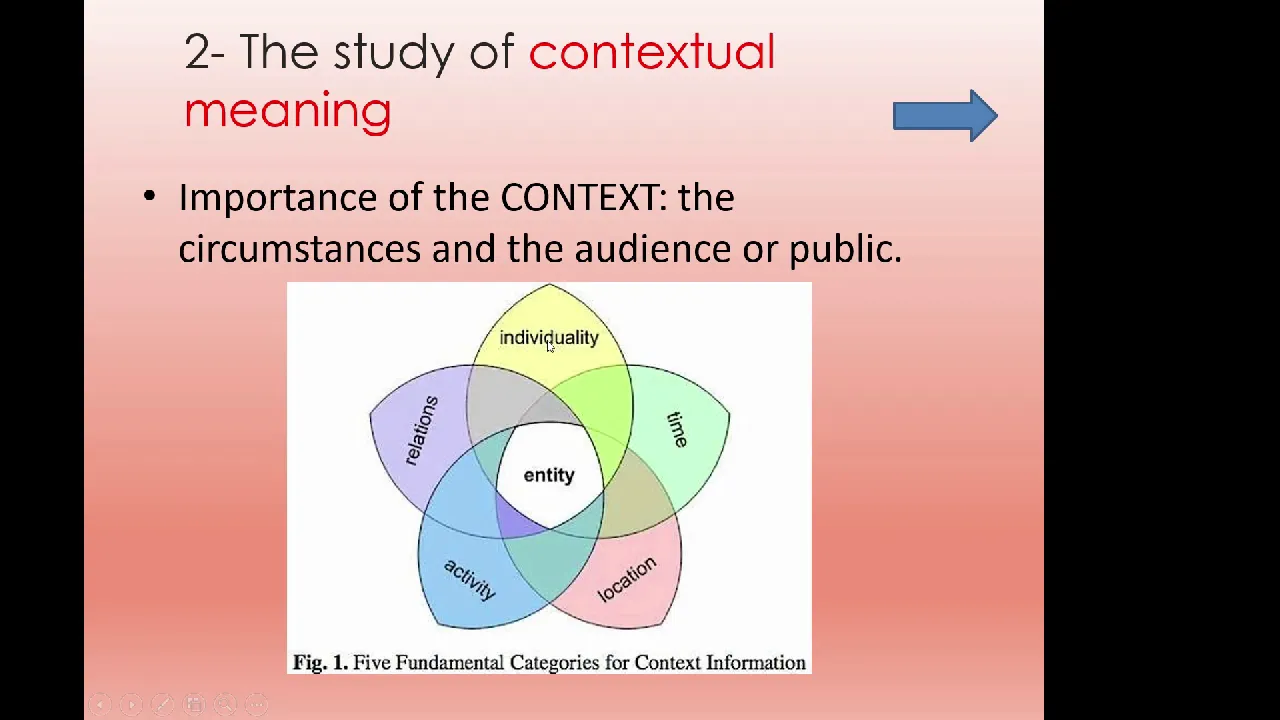
What is Pragmatics ?
14.8K
Pragmatics is a branch of linguistics that studies how context influences the interpretation of speaker meaning, distinguishing it from semantics which focuses on word meanings; it examines how speakers convey intended meanings through contextual factors like physical environment, shared knowledge, and inferences, enabling listeners to understand implicit communications such as relative distance expressions and implied intentions.
Click to watch →

Pragmatics and Grice's Maxims | Crash Course Linguistics
338.9K
Pragmatics is the area of linguistics that studies how meaning is created through context. Unlike semantics (which focuses on word and sentence meanings), pragmatics examines how speakers use context, shared knowledge, and social conventions to convey intended meanings beyond the literal words being used.
Click to watch →

Pragmática
36.4K
Pragmatics is the study of how language interacts with context, examining the relationship between linguistic systems and cognitive/social factors that influence language use; it distinguishes between meaning (the literal, systematic content encoded in language) and interpretation (the contextual understanding that considers who speaks, to whom, where, when, and why), and analyzes phenomena like deixis (context-marking elements such as pronouns and temporal references), speech acts (utterances that perform actions like declaring, promising, or condemning), and conversational maxims that guide effective communication.
Click to watch →

INTRO TO PRAGMATICS
2.7K
Pragmatics is a branch of linguistics studying the hidden meaning behind utterances, influenced by context including setting, participants, intentions, gestures, vocal features, instruments, social norms, and genre. It differs from semantics (which studies literal meaning within utterances) by focusing on intended meaning. High-level cultural communication involves indirect expression through metaphors and implied meanings, common in Eastern cultures. Understanding pragmatics requires analyzing how context shapes meaning beyond literal words.
Click to watch →

구글 번역기가 한국어에서 실패하는 이유 (옥스퍼드 박사의 비밀 공개) @rikutalk
201K
Pragmatics is a branch of linguistics that studies how context influences the interpretation of language. Unlike semantics (which studies word meanings) and syntax (which studies sentence structure), pragmatics examines how the same sentence can have different meanings depending on who is speaking, who is being spoken to, and the social context. The speaker explains that while semantics and syntax are central topics in linguistics, pragmatics has historically been considered a peripheral or 'fringe' area. This is because traditional linguistic analysis focused primarily on abstract, decontextualized language forms rather than how language functions in real-world communication situations.
Click to watch →
Deep Dive
Paul Grice's Cooperative Principle and the foundational assumption that conversational participants cooperate.
جورج يول-الفصل الحادي عشر-تحليل الخطاب
10.9K
An underlying assumption in most conversational exchanges is that participants are cooperating with each other. This principle, described by philosopher Paul Grice, states that conversational contributions should be such as are required at the stage at which they occur by the accepted purpose or direction of the talk exchange. Grice's four maxims guide cooperative conversation: Maxim of Quantity (make contributions as informative as required), Maxim of Quality (make contributions true), Maxim of Relation (be relevant), and Maxim of Manner (be clear, brief, and orderly).
Click to watch →
![PHILOSOPHY - Language: Gricean Pragmatics [HD]](https://i.ytimg.com/vi_webp/we6uSVf4qss/maxresdefault.webp)
PHILOSOPHY - Language: Gricean Pragmatics [HD]
129K
Herbert Paul Grice proposed that conversations are cooperative efforts among rational agents who follow implicit rules. The Cooperative Principle states: 'Make your conversational contribution such as is required, at the stage at which it occurs, by the accepted purpose or direction of the talk exchange.' This principle is explained through four maxims: Quantity (be as informative as required, but no more), Quality (be truthful and provide adequate evidence), Relation (be relevant), and Manner (be clear, brief, and orderly). These rational rules govern not just conversation but all cooperative human activities.
Click to watch →
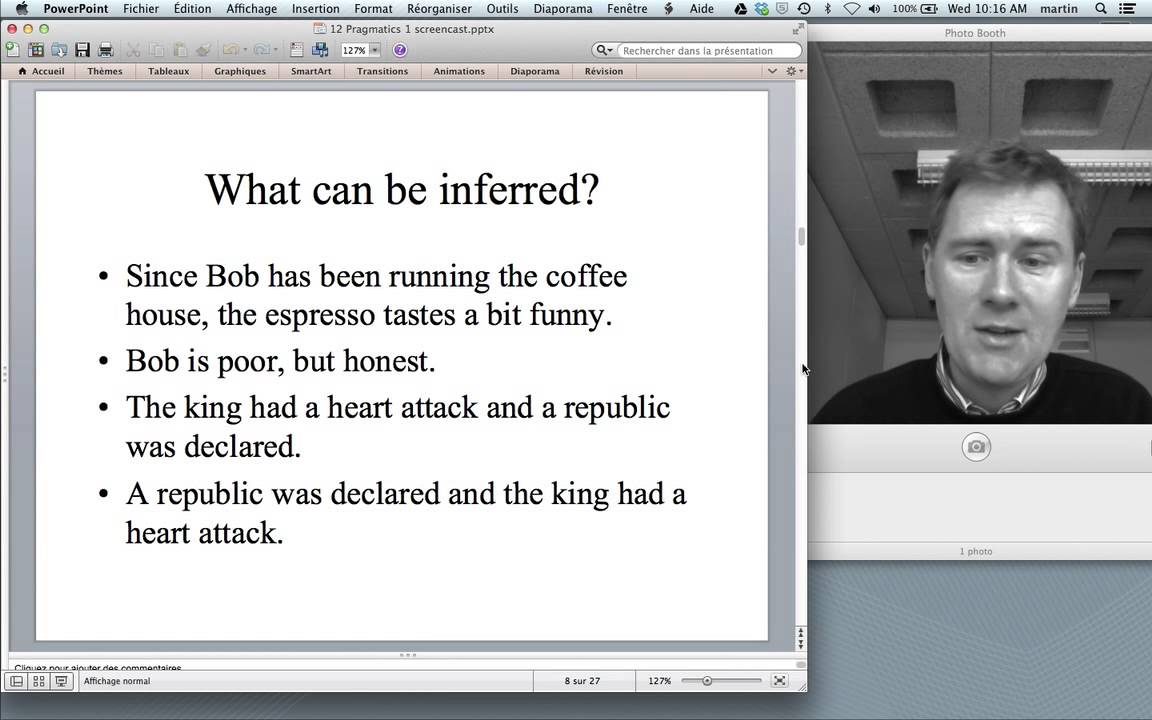
Speech acts and conversational maxims
90.9K
Paul Grice proposed that speakers cooperate by following four maxims: Quantity (enough but not too much), Relevance (stay on topic), Manner (be orderly), and Quality (be truthful). This cooperation is rational - without it, communication would fail. Austin classified speech acts into six categories: Representatives (assertions), Commissives (commitments), Directives (directives), Declarations (creating states), Expressives (attitudes), and Verdictives (judgments). These frameworks explain how speakers convey complex meanings through structured linguistic choices.
Click to watch →
Pragmatics and Grice's Maxims | Crash Course Linguistics
338.9K
Pragmatics is the branch of linguistics that studies how meaning is derived from context rather than just words themselves; according to philosopher Paul Grice's Cooperative Principle, effective communication relies on four key assumptions (called Grice's Maxims): Quality (speakers tell the truth), Quantity (speakers provide sufficient but not excessive information), Relevance (speakers stay on topic), and Manner (speakers communicate clearly and directly); when these assumptions are violated, listeners infer alternative meanings through implicature, allowing speakers to be polite and indirect while still conveying their intended message.
Click to watch →
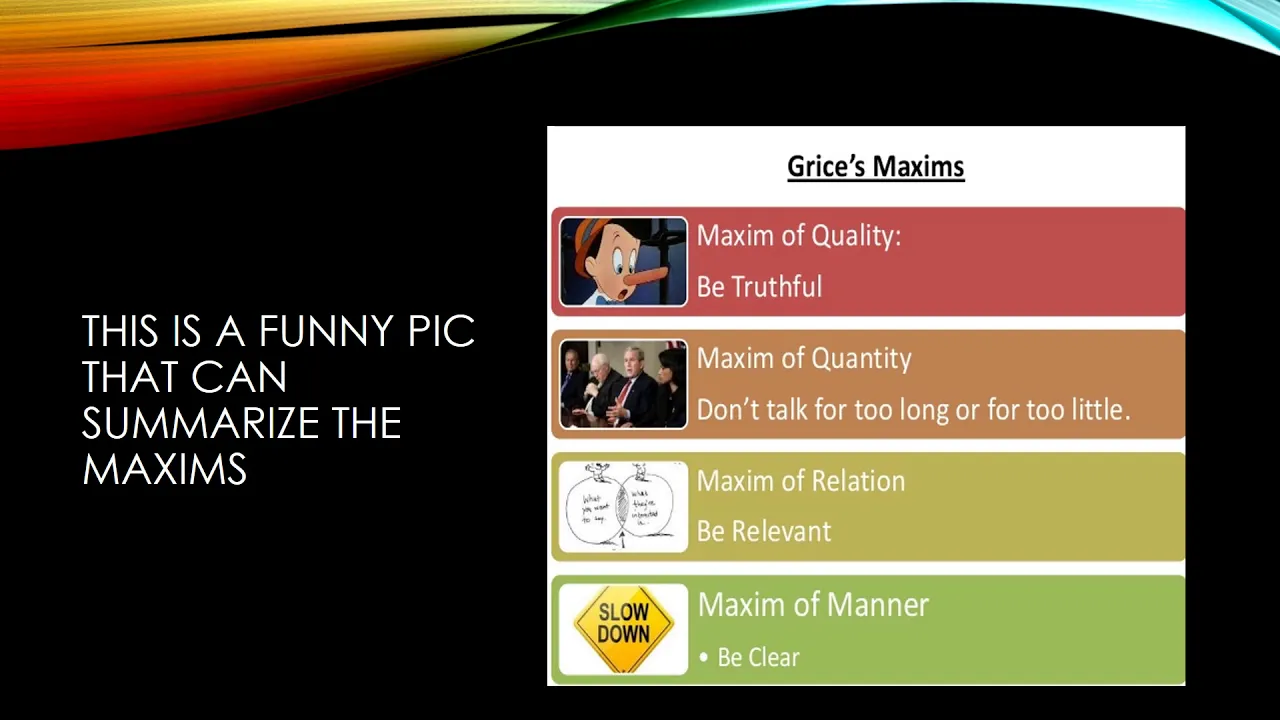
The co-operative Principle, Hedges and Implicatures
7.6K
The co-operative principle, introduced by British philosopher Paul Grice, establishes that communication requires mutual cooperation between speakers. Without cooperation, effective communication cannot occur. This principle assumes all participants are following the direction of the exchange, whether joking, telling truths, or describing events. The principle is specified through four maxims: quantity (neither too much nor too little information), quality (truthfulness with evidence), relevance (staying on topic), and manner (clarity and orderliness). These maxims guide how speakers should contribute to conversations to maintain cooperative communication.
Click to watch →
Deep Dive
The definitions and expectations of the four Gricean Maxims: Quantity, Quality, Relation, and Manner.
Speech acts and conversational maxims
90.9K
Paul Grice proposed four maxims governing cooperative communication: (1) Quantity - provide enough information but not excessive; (2) Relevance - stay on topic; (3) Manner - be orderly and clear; (4) Quality - be truthful. These maxims explain indirect speech acts - when someone asks 'Do you have any pets?' and responds 'I'm allergic,' the hearer infers the speaker has no pets. The maxims create expectations that guide interpretation, allowing speakers to convey complex meanings efficiently through shared assumptions about communicative norms.
Click to watch →

Overthinking: How Improving The QUALITY Of Our Thoughts Can Fix QUANTITY Errors
81.8K
Grice's maxims are unwritten rules governing cooperative conversation: (1) Maxim of Quantity - present the right amount of information, neither too much nor too little; (2) Maxim of Quality - be truthful and don't state what you know to be false or lack evidence for; (3) Maxim of Relevance - say what is relevant to the conversation; (4) Maxim of Manner - be clear, direct, and organized. When people naturally follow these maxims, conversations flow smoothly. Overthinking often occurs when we violate these maxims internally, producing too much information because we cannot parse out what is relevant and important.
Click to watch →
COMPLETE TOEFL iBT FULL TEST #1
591
Grice's maxims are rules governing effective conversation, developed by H.P. Grice in the 1970s. The four main maxims are: (1) Maxim of Quality - do not say what you believe to be false; (2) Maxim of Relevance - be relevant to the conversation; (3) Maxim of Manner - be clear and avoid ambiguity; (4) Maxim of Quantity - give as much information as is required. These maxims help speakers and listeners make logical inferences. People sometimes intentionally violate these maxims for strategic purposes, such as in recommendation letters where brief statements imply negative qualities without explicit criticism. Politicians and advertisers also violate maxims to deceive audiences by implying untrue things without stating them directly.
Click to watch →

4) EDİM BİLİM TÜRKÇE ÖABT DİL BİLİM SORU ÇÖZÜMÜ DEVAMI
4.8K
Paul Grice established four maxims that guide effective communication: (1) Quantity Maxim - provide sufficient but not excessive information, (2) Quality Maxim - provide truthful and verified information, (3) Relation Maxim - stay on topic and maintain relevance, (4) Manner Maxim - be clear, orderly, and avoid ambiguity. These maxims guide effective communication and help speakers and listeners achieve their communicative goals. Violations of these maxims can be detected through conversational implicature.
Click to watch →

The Discourse Ethics of Jürgen Habermas
7.8K
Paul Grice identified four maxims that guide effective communication: (1) Maxim of Quantity - make contributions as informative as required but no more than necessary; (2) Maxim of Quality - be truthful and only say what you have adequate evidence for; (3) Maxim of Relation - be relevant and get to the point; (4) Maxim of Manner - be perspicuous, avoid ambiguity, be brief, and be orderly. These maxims help explain conversational implicature and are empirically well-confirmed.
Click to watch →
Deep Dive
The basic concept of conversational implicature, or how speakers convey meaning beyond their literal words.

Conversational Implicature in Semantics| Conversational Implicature in Pragmatics /Discourse Studies
458
Conversational implicature is the process of deriving meaning beyond literal word meanings through cooperative communication. Speakers respond only as much as listeners ask, following four maxims: relevance, quality, quantity, and manner. This framework enables effective communication by ensuring responses are neither excessive nor insufficient. The concept divides into generalized implicature (based on general conversation principles) and particularized implicature (context-specific), with violations creating opportunities for deeper meaning derivation.
Click to watch →
4) EDİM BİLİM TÜRKÇE ÖABT DİL BİLİM SORU ÇÖZÜMÜ DEVAMI
4.8K
Conversational implicature (sezdirim) refers to the implied or suggested meaning that goes beyond the literal meaning of words. When a speaker makes an utterance, they may intend to convey additional meaning that is not explicitly stated but can be inferred by the listener. This concept is central to understanding how communication works at a pragmatic level. For example, when someone mentions a conflict of interest, they may be implying that they cannot fulfill a request, even though they do not explicitly state this.
Click to watch →

Logika użytkowa - implikatury konwersacyjne - Marcin Wróbel
435
Conversational implicature is a pragmatic concept developed by Paul Grice that explains how speakers convey additional meaning beyond the literal content of their words by following implicit conversational rules; when speakers appear to violate these rules (such as the maxims of quantity, quality, relation, and manner), listeners infer the speaker's true intentions, allowing us to understand complex social interactions and implicit meanings in everyday communication.
Click to watch →

Group 10-Conventional and Conversational Implicatures | Semantics and Pragmatics
734
Conversational implicature is an additional message listeners infer from what is said by applying conversation rules. It is the antonym of explicit communication, representing assumptions not directly derivable from linguistic content. The meaning conveyed goes beyond literal word meanings. Conversational implicatures are divided into conventional and non-conventional types. Conventional implicatures are not based on Grice's cooperative principle or maxims, do not require conversation or specific context, and are associated with specific words producing additional meanings. Examples include 'Cumi-cumi tapi bahagia' (squid but happy) implying poverty and happiness are incompatible, and 'Khalid belum ada di sini' (Khalid is not here yet) implying expected arrival. Conjunctions like 'dan' (and) and 'tetapi' (but) carry additional meanings implying sequence or contrast.
Click to watch →

Implicature | types | Conventional implicature | conversational implicature | full info #linguistics
14.5K
Conversational implicature arises from how people typically expect conversations to be conducted. It is based on Paul Grice's Cooperative Principle, which includes four maxims: Quality (be truthful), Quantity (provide sufficient information), Relevance (be relevant), and Manner (be clear). When one or more of these maxims are violated, additional meaning is conveyed beyond the literal words. This type of implicature depends on context and shared knowledge between speaker and listener.
Click to watch →
Prerequisite Knowledge
- Concept 01An introductory understanding of Pragmatics as the subfield of linguistics that studies context and meaning.
- Concept 02Paul Grice's Cooperative Principle and the foundational assumption that conversational participants cooperate.
- Concept 03The definitions and expectations of the four Gricean Maxims: Quantity, Quality, Relation, and Manner.
- Concept 04The basic concept of conversational implicature, or how speakers convey meaning beyond their literal words.
Subsequent Learning
- Step 01Other forms of non-observance of Grice's maxims, such as 'opting out', 'infringing', and 'suspending' a maxim.
- Step 02Relevance Theory by Sperber and Wilson, which serves as a major cognitive-pragmatic alternative to Gricean maxims.
- Step 03Neo-Gricean pragmatic frameworks, such as Laurence Horn's division of labor and Stephen Levinson's Q-, I-, and M-principles.
- Step 04Analyzing real-world discourse, including humor, sarcasm, advertising, and political rhetoric, through the lens of maxim non-observance.
Flouting Explained
Violation Defined
Flouting Explained
0:00Playing Section
- 1
Flouting breaks maxims openly for implied meaning.
- 2
Speaker expects hearer to infer hidden intent.
- 3
Example: response 'on your desk' flouts relevance.
Relevance Theory
Relevance Theory, developed by Dan Sperber and Deirdre Wilson, offers a major cognitive alternative to Grice’s cooperative framework. While Grice relies on a complex set of distinct maxims (and the division between flouting and violating them) to explain implicatures, Relevance Theory argues that communication is governed by a single, biologically-grounded cognitive principle: the search for relevance. According to this view, listeners do not systematically evaluate whether a speaker is breaking specific rules of quantity, quality, relation, or manner. Instead, they automatically assume any utterance is designed to yield maximum cognitive benefits for minimal processing effort. This eliminates the need for Grice’s multi-maxim system and the distinction between flouting and violating, reframing pragmatic interpretation as a natural cognitive process rather than a socially negotiated cooperative contract.
Deep Dive
Other forms of non-observance of Grice's maxims, such as 'opting out', 'infringing', and 'suspending' a maxim.
Cooperative Principle in Pragmatics!
510
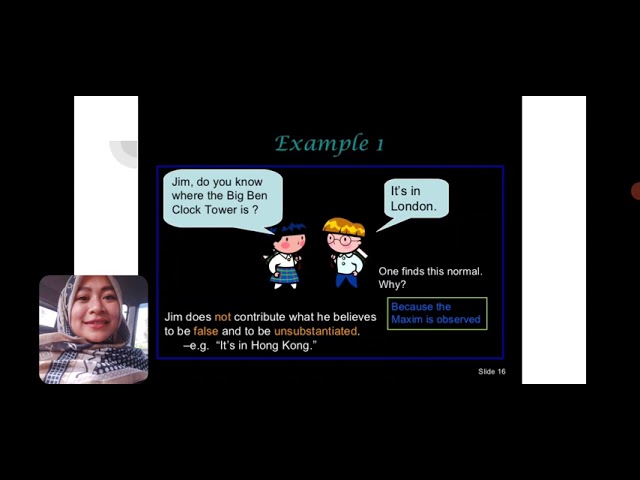
Beyond floating and violating, there are three additional types of maxim violations: (1) Infringing - minor or accidental violations, such as making mistakes or being impaired; (2) Opting out - intentional refusal to follow maxims when speakers are unwilling to cooperate as required; (3) Suspending - when participants have no expectation that maxims will be followed, such as in ritualistic or ceremonial contexts. These advanced violations demonstrate the flexibility of conversational rules and how speakers can strategically manipulate communication norms for various purposes, from deception to ritual performance.
Click to watch →
Maxims of Conversation
28.9K
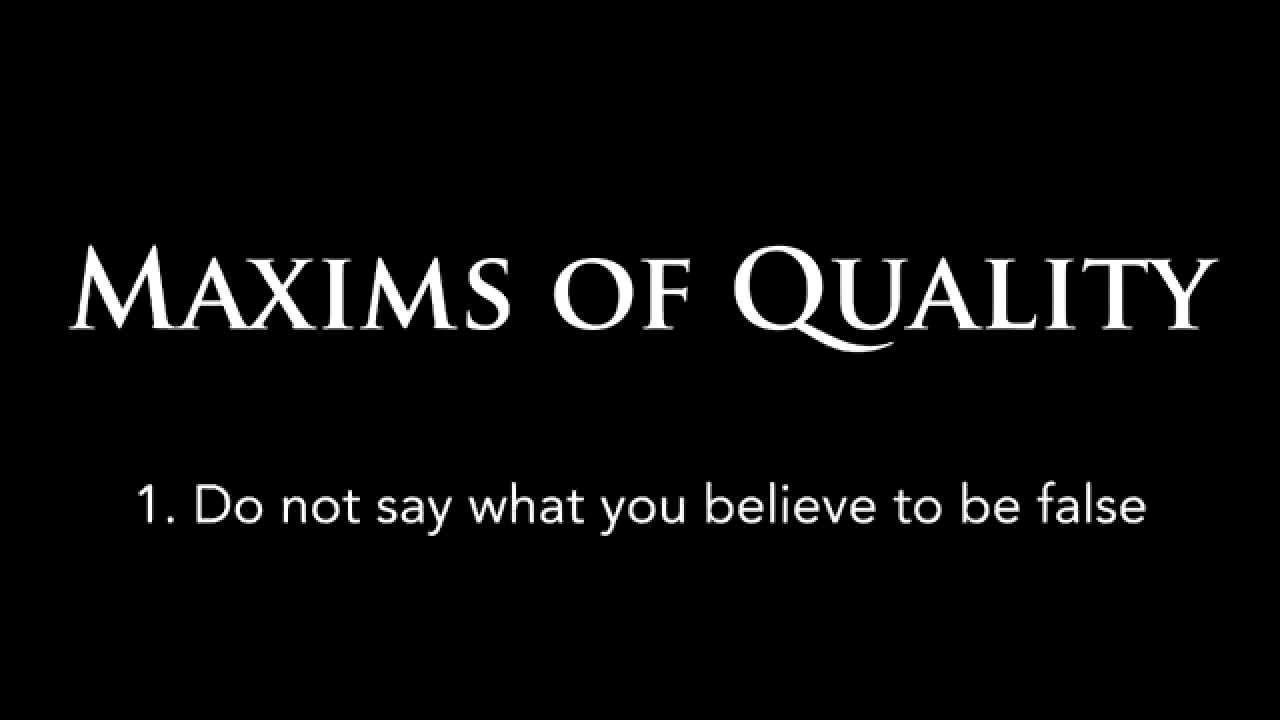
Grice's Cooperative Principle states that conversational participants should make contributions that are appropriate to the stage of the conversation and its accepted purpose, following four maxims: Quantity (provide as much information as required, not more), Quality (be truthful and have adequate evidence), Relation (be relevant), and Manner (be clear, brief, and orderly). Speakers may flout (openly violate for implied meaning), violate (quietly ignore), infringe (fail due to circumstances), opt out (refuse cooperation), or suspend maxims (in chaotic situations) to achieve communicative goals.
Click to watch →
Understanding Grice's Cooperative Principle and Maxims of Conversation
187.3K
Grice's Cooperative Principle states that effective communication requires speakers to cooperate by following four maxims: Quality (tell the truth), Quantity (be concise), Relevance (stay on topic), and Manner (be clear and orderly); violations of these maxims can be unintentional (lying), deliberate (flouting), or strategic (opting out), and understanding these principles helps explain how we infer meaning beyond literal statements through implicatures.
Click to watch →

Violating and flouting Grice’s Maxims | Lec # 21 | Semantics | #semantics #linguistics
4.6K
In semantics, Grice's Maxims (Quality, Quantity, Relevance, Manner) guide successful communication, but they can be intentionally violated or flouted; violating means secretly breaking a maxim without the listener's awareness (e.g., lying or withholding information), while flouting involves openly breaking a maxim in a way that all conversation participants recognize (e.g., using irony, giving incomplete answers, or speaking unclearly), with flouting being more socially acceptable than violation.
Click to watch →
Lying Is Way More Complicated Than You Think | Otherwords
242.4K
Philosopher Paul Grice identified four Maxims that govern cooperative conversation: Quality (be truthful, don't say what you know is false or lack evidence for), Quantity (provide appropriate information, neither too much nor too little), Relation (include only relevant information), and Manner (be clear, avoid obscurity, repetition, or disordered narration). These maxims represent assumptions we hold about speakers, creating a framework where speech becomes a cooperative effort between participants rather than a solitary act. Literal words alone cannot convey true meaning—they must interact with these underlying assumptions to produce implied meanings called implicatures.
Click to watch →
Deep Dive
Relevance Theory by Sperber and Wilson, which serves as a major cognitive-pragmatic alternative to Gricean maxims.

Relevance Theory -- Sperber & Wilson
7K
Relevance Theory, developed by Dan Sperber and Deirdre Wilson in 2002, proposes that relevance serves as the unifying principle underlying all communication, replacing Grice's four maxims (quality, quantity, relevance, manner) with a single relevance principle; according to this theory, human cognition naturally seeks to maximize relevance, meaning that speakers encode messages considering their audience's socio-cultural context and cognitive abilities, while listeners decode utterances by applying cognitive effort to infer the speaker's intended meaning, with more explicit messages being more relevant and requiring less cognitive processing than implicit ones using metonymies, similes, or irony.
Click to watch →

Relevance theory | Wikipedia audio article
316
Relevance theory, developed by Dan Sperber and Deirdre Wilson, is a pragmatic framework that explains how speakers convey meaning by providing just enough information for hearers to infer their intended meaning, based on the presumption that every utterance is optimally relevant—worth the cognitive effort required to process it—while relying on shared context and mutual cognitive environments between communicators.
Click to watch →

【言語学講義a】第4回 認知的関連性の原理【認知語用論入門】
214
Grice's Cooperative Principle and conversational maxims (Quantity, Quality, Relation, Manner) face significant criticisms: Why should these maxims be followed? Are they truly universal across all cultures? If they vary by culture, how are they acquired? Why exactly four maxims? Are there other important maxims? Relevance Theory, proposed by Sperber and Wilson, offers an alternative by taking a cognitive approach rather than focusing on social norms. This theory addresses the limitations of Grice's framework by examining how the mind processes information during communication, shifting from social norms to cognitive mechanisms underlying communication.
Click to watch →
#introl 2018 Diferencia Semántica Pragmática
28.5K
Relevance theory (Sperber and Wilson) centers on the search for relevance: listeners interpret utterances by finding explanations most relevant to their context with minimal effort. Politeness theory (Brown and Levinson) explains how language reflects social relationships and face concerns. In all cultures, people manage their social identity (face) during interactions, which can be positive or negative. Language choices reflect and reinforce social hierarchies. For example, Spanish 'tú' versus 'usted' reflects social distance, and Japanese honorifics depend on gender, age, and status. These variations show pragmatic meaning is deeply shaped by cultural values.
Click to watch →

ENG508_Topic109
903
Relevance Theory, proposed by Sperber and Wilson in the 1980s, is a cognitive framework in pragmatics that explains how speakers and hearers understand each other by relating conversations to context; the theory holds that communication succeeds when there is sufficient relevance between utterances and context, governed by two key factors: contextual effects (what inferences are available from the context) and processing effort (how much cognitive work is needed to infer meaning), with the fundamental principle that communication aims to enlarge mutual cognitive environments rather than simply duplicate thoughts.
Click to watch →
Deep Dive
Neo-Gricean pragmatic frameworks, such as Laurence Horn's division of labor and Stephen Levinson's Q-, I-, and M-principles.

A Brief Introduction to Neo-Gricean Pragmatics
3.6K
Neo-Gricean pragmatics, founded by Lawrence Horn, Steven Levinson, and Jay Atlas, streamlines H.P. Grice's original four maxims (quality, quantity, relation, manner) into two core principles: Q (say enough, meaning provide as much information as required) and R (don't say too much, meaning avoid unnecessary elaboration). These two principles create a tension that pushes speakers toward a middle ground where they provide just the right amount of information, enabling hearers to infer additional meaning (implicatures) beyond what was explicitly stated. Quality operates hierarchically above the other maxims, taking precedence when conflicts arise, while the manner sub-maxims are considered less useful for generating implicatures.
Click to watch →

Pragmatics: Neo-Gricean Theories of Conversational Implicature (Horn, Levinson)
1.9K
Neo-Gricean theories, developed by scholars like Laurens Horn and Stephen Levinson, provide frameworks for understanding how speakers and hearers derive meaning beyond literal utterances through principles of conversation. Horn's approach reduces Grice's four maxims to two fundamental principles—the Cue Principle (Q) covering quantity and relevance, and the Horn Principle (R) addressing informativeness and manner—that work in opposition to limit each other's effects. Scalar implicatures emerge from Horn scales, which are semantic hierarchies of related terms differing in intensity (e.g., warm/hot), where choosing a weaker term licenses the inference that stronger alternatives are false. Levinson's alternative framework introduces three principles (QED, AI, AM) with specific inference rules, emphasizing the relationship between literal meaning and contextual speaker meaning.
Click to watch →

P.Grundy: Optimality in Neo-Gricean Pragmatics: the Challenge for E2L Users
2.5K
This section introduces neo-Gricean pragmatics as an update to Grice's original theory, distinguishing it from post-Gricean approaches focused on relevance. The Q Principle (Quantity Maxim) dictates that speakers should not provide weaker statements than their knowledge allows—they select the strongest paradigmatic alternative consistent with facts. When someone says 'I should be back by 8,' the hearer infers 'he probably won't be back by 8' because 'should' is weaker than 'will.' The M Principle (Manner Maxim) states that abnormal or marked expressions indicate abnormal situations. Saying 'you know what the trains are like' with the definite article signals a specific subset of trains rather than trains in general. These principles explain how minimal or marked expressions convey additional meaning beyond literal content.
Click to watch →

Introduction to Linguistics: Pragmatics 1
25.8K
H.P. Grice analyzed the cooperative principle into four maxims: (1) Quality—speakers don't say what they believe false or lack evidence for; (2) Relevance—contributions relate to conversation goals; (3) Quantity—provide appropriate information, neither too much nor too little; (4) Manner—avoid unnecessary complexity and ambiguity. Violations allow inference of hidden meanings: under-informative responses imply withheld information, over-informative responses imply irrelevance, and verbose phrasing implies unusual circumstances.
Click to watch →
PHILOSOPHY - Language: Gricean Pragmatics [HD]
129K
H.P. Grice's theory of pragmatics explains how people communicate more than the literal meanings of their words by following four rational conversational maxims (Quantity, Quality, Relation, and Manner) under the Cooperative Principle, allowing listeners to infer implicatures—meanings suggested or implied rather than explicitly stated—based on conversational context, purpose, and shared world knowledge.
Click to watch →
Deep Dive
Analyzing real-world discourse, including humor, sarcasm, advertising, and political rhetoric, through the lens of maxim non-observance.

【悪用厳禁】倫獄先生が教える「会話術」とは!?
301.5K
Grice's Conversational Maxims are four rules that facilitate effective communication: 1) Maxim of Quantity - provide the right amount of information, not too little or too much; 2) Maxim of Quality - be truthful and avoid spreading rumors as facts; 3) Maxim of Relation - stay relevant to the topic; 4) Maxim of Manner - be clear, concise, and unambiguous. These rules are typically followed unconsciously in everyday conversation. When violated, they can create humor (sarcasm) or be used strategically to evade questions. Understanding these maxims helps recognize when someone is being deceptive or intentionally misleading.
Click to watch →

Dạy học trên truyền hình dành cho học sinh lớp 9: Môn Văn, bài 5
14.9K
The Maxim of Quality requires truthfulness and evidence-based claims. The Maxim of Relevance requires staying on topic. The Maxim of Manner requires clarity and conciseness. Violations include lying, going off-topic, or speaking in vague, lengthy, or confusing ways. Idioms like 'dây cà ra dây muống' (long-winded) and 'lúng túng như ngậm hột thị' (hesitant and unclear) describe violations of the Maxim of Manner.
Click to watch →

Виды и способы коммуникации (Рациональность для начинающих 17)
755
People often have hidden agendas in communication related to their values, status, or important topics they want to promote. Propaganda violates relevance and quantity maxims by persistently pushing particular topics regardless of audience interest. Humor intentionally violates cooperative principle maxims to create additional meaning through implicature. This makes language rich and interesting but also complex. The speaker notes this is why language is 'strange' and not simply like formal logic. Understanding these phenomena helps navigate the complexities of real-world communication.
Click to watch →

Grice's Maxims: The Hidden Rules of Conversation
5.8M
Product packaging often uses flouted maxims strategically to imply certain qualities without directly stating them. Examples include 'vegan tomato' (implying other tomatoes aren't vegan), 'asbestos-free cereal' (implying other cereals contain asbestos), and 'low in fat' or 'low in sugar' (implying other products are higher in these substances). These examples show how flouting the Maxim of Quantity can be used for marketing purposes while technically remaining truthful.
Click to watch →

ROSANNE BARR GOES OFF ON PIERS MORGAN! SHE WASN'T PLAYING!
947.6K
The video discusses the role of satire and sarcasm in political discourse and the challenges of communicating with different audiences. The speaker argues that 'as far as her delivery goes, the satire, the sarcasm merged together, I completely agree with it' but that 'Obviously, I don't get down with the derogatory use of the language and you know, you don't always have to use that foul sort of tone to get the message across.' The speaker notes that 'the essential message, the foundation of what she was saying is going to trigger a whole lot of folks on the left' and that 'they try to cancel her because if they can even catch the sarcasm, a lot of times it goes way over their head.' The speaker argues that 'People on on on the left side of things are just fed and perpetuated this nonsense and just regurgitate it without actually thinking and having their own thoughts and logical discussions.'
Click to watch →
Flouting Explained
Violation Defined
Flouting Explained
0:00- 1
Flouting breaks maxims openly for implied meaning.
- 2
Speaker expects hearer to infer hidden intent.
- 3
Example: response 'on your desk' flouts relevance.
Relevance Theory
Relevance Theory, developed by Dan Sperber and Deirdre Wilson, offers a major cognitive alternative to Grice’s cooperative framework. While Grice relies on a complex set of distinct maxims (and the division between flouting and violating them) to explain implicatures, Relevance Theory argues that communication is governed by a single, biologically-grounded cognitive principle: the search for relevance. According to this view, listeners do not systematically evaluate whether a speaker is breaking specific rules of quantity, quality, relation, or manner. Instead, they automatically assume any utterance is designed to yield maximum cognitive benefits for minimal processing effort. This eliminates the need for Grice’s multi-maxim system and the distinction between flouting and violating, reframing pragmatic interpretation as a natural cognitive process rather than a socially negotiated cooperative contract.
An introductory understanding of Pragmatics as the subfield of linguistics that studies context and meaning.
Paul Grice's Cooperative Principle and the foundational assumption that conversational participants cooperate.
The definitions and expectations of the four Gricean Maxims: Quantity, Quality, Relation, and Manner.
The basic concept of conversational implicature, or how speakers convey meaning beyond their literal words.
Other forms of non-observance of Grice's maxims, such as 'opting out', 'infringing', and 'suspending' a maxim.
Relevance Theory by Sperber and Wilson, which serves as a major cognitive-pragmatic alternative to Gricean maxims.
Neo-Gricean pragmatic frameworks, such as Laurence Horn's division of labor and Stephen Levinson's Q-, I-, and M-principles.
Analyzing real-world discourse, including humor, sarcasm, advertising, and political rhetoric, through the lens of maxim non-observance.
7.9K views119likes3:44@PlatformOfLearningLinguisticsOriginal Release: 2022-03-30
hello guys welcome to my youtube channel platform of learning linguistics today we're gonna talk about the difference between flooding and violation of a magazine first we will discuss about flowering and then we will move towards violation of a maxim flooding happens when a speaker feels in observing the maxim but expecting the hearer to recognize the implied or intended meaning it is not a deliberate breaking of a magazine it is a kind of implicature if we flat a maxim we break it in a flagrant or obvious way so that it is obvious to all concerned that it has been broken if this happens then it is clear that the speaker is intending the hearer to infer some extra meaning over and about what is said for example if a says have you finished your report b answers or replies is on your desk here we can't see that b flats the maxim of relevance is the answer or reply should be yes i have finished my report but a can understanding infer what the sender says and what he intends to say so this kind of breaking of a maxim is called flouting maxim now let's discuss the violating a maxim or violation of a maxim violation of a magazine happens in order to deceive the hearer with the letting the hear only knows the surface meaning of an utterance it is a deliberate breaking of a magazine it is said in a straightforward way rather than using any kind of implicature for instance mom asks her son who has been playing all day long that have you studied all day long or did you study all day long the sun replies yes i have been studying to love here you can see that the sun is telling a lie and this kind of breaking of a maxim is called violation of a magazine in the last it is important to note that when we float a maxim we say something indirectly or we use implicature okay and when we violate a maxim we want to deceive or to tell a lie so there is the main difference between flowering and violation i hope you have understood the difference and in the last i will make a request to please subscribe to my channel and hit the bell icon in order to receive the notifications of the next videos as well
Up Next

10:56
Face Theory Explained: Positive & Negative Face (A-Level English Language)
@englishlanguageA-level
24.8K views•2021-04-18
36:52
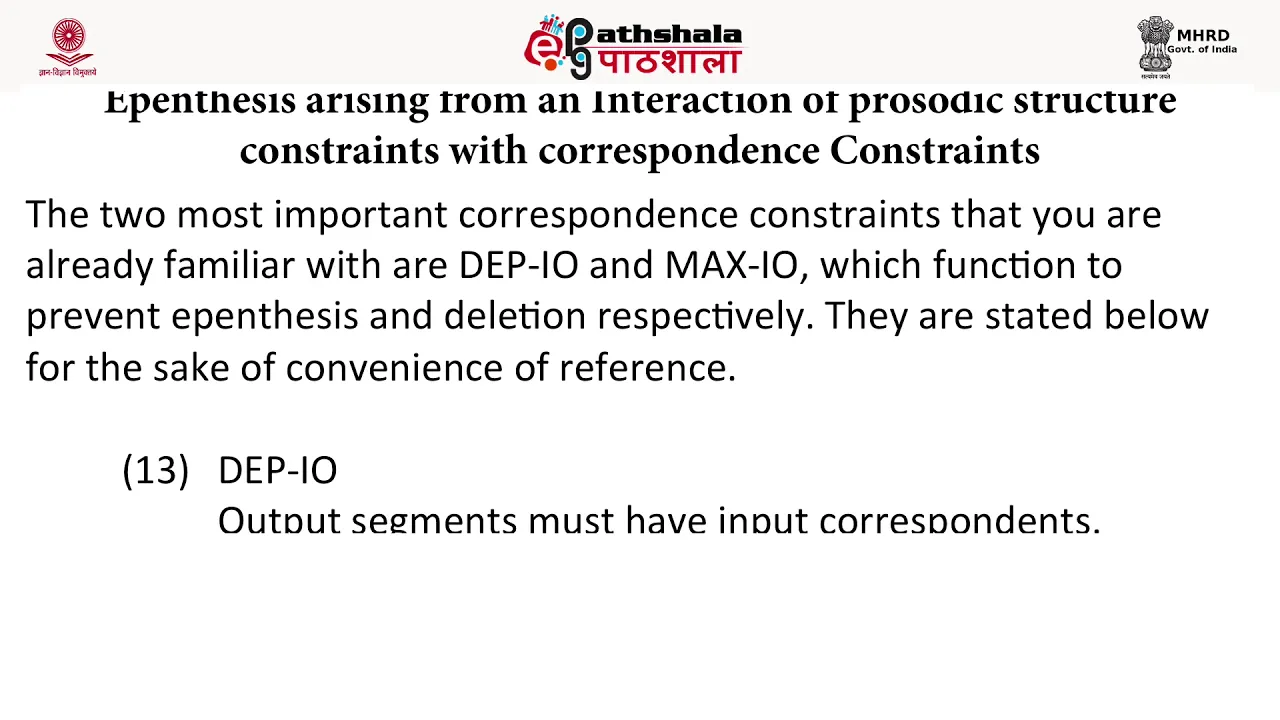
Constraint Interaction in Optimality Theory: Epenthesis & Deletion
@Vidyamitra
180 views•2018-08-20

8:59
Forensic Linguistics: How Language Solves Crimes | PBS
@pbsstoried
1M views•2024-01-25

21:32
Accent Expert Explains U.S. Regional Dialects | Part 1
@WIRED
9.3M views•2021-01-21
Related Study Plans & Knowledge Roadmaps
Structured learning paths in Linguistics
linguistics
Optimality Theory: Tableaux & Constraints
01Phonological Basics: Sounds, Syllables & Rules
02Foundations of Optimality Theory: GEN, CON, and EVAL
03The Constraint Inventory: Markedness vs. Faithfulness
+ 2 more learning modules
15h5 modules
Explore Roadmap
linguistics
Morphosyntactic Alignment: S, A & P Systems
01Foundations of Syntax: Transitivity and Arguments
02The Linguistic Variables: Mapping S, A, and P
03Nominative-Accusative Alignment
+ 3 more learning modules
12h6 modules
Explore Roadmap
linguistics
Analyzing Sign Language: Phonology & Syntax
01Foundations of Sign Language Linguistics
02Phonology: The Five Parameters of a Sign
03Morphology: Word Formation and Classifiers
+ 2 more learning modules
14h5 modules
Explore Roadmap
linguistics
Pragmatics: Speech Acts, Grice & Politeness
01Introduction to Pragmatics: Meaning in Context
02Grice’s Cooperative Principle & Implicature
03Speech Act Theory
+ 2 more learning modules
14h5 modules
Explore Roadmap