![Vektörler-1 [Temel Kavramlar]](https://i.ytimg.com/vi_webp/5EpXmysicZA/maxresdefault.webp)



























Crystallographic directions in crystal structures are represented by Miller indices written in square brackets [hkl], where the direction vector is determined by placing its tail at the origin (or moving the origin +1 for negative indices) and finding the endpoint based on the indices; when indices contain fractions or numbers greater than 1, common factors should be removed to simplify the direction, and families of directions include all permutations and reciprocals of the base indices.
Miller Indices for Crystallographic Directions Tutorial
Added:Familiarity with the 3D Cartesian coordinate system (x, y, z axes) and basic vector operations, including tail-to-head vector representations.
Fundamental concepts of material science crystallography, specifically the definition of a unit cell and lattice parameters.
Basic arithmetic operations required to clear fractions and find the lowest common denominator.
An understanding of basic crystallographic notation, particularly the use of square brackets [uvw] to represent directions and overlines to indicate negative values.
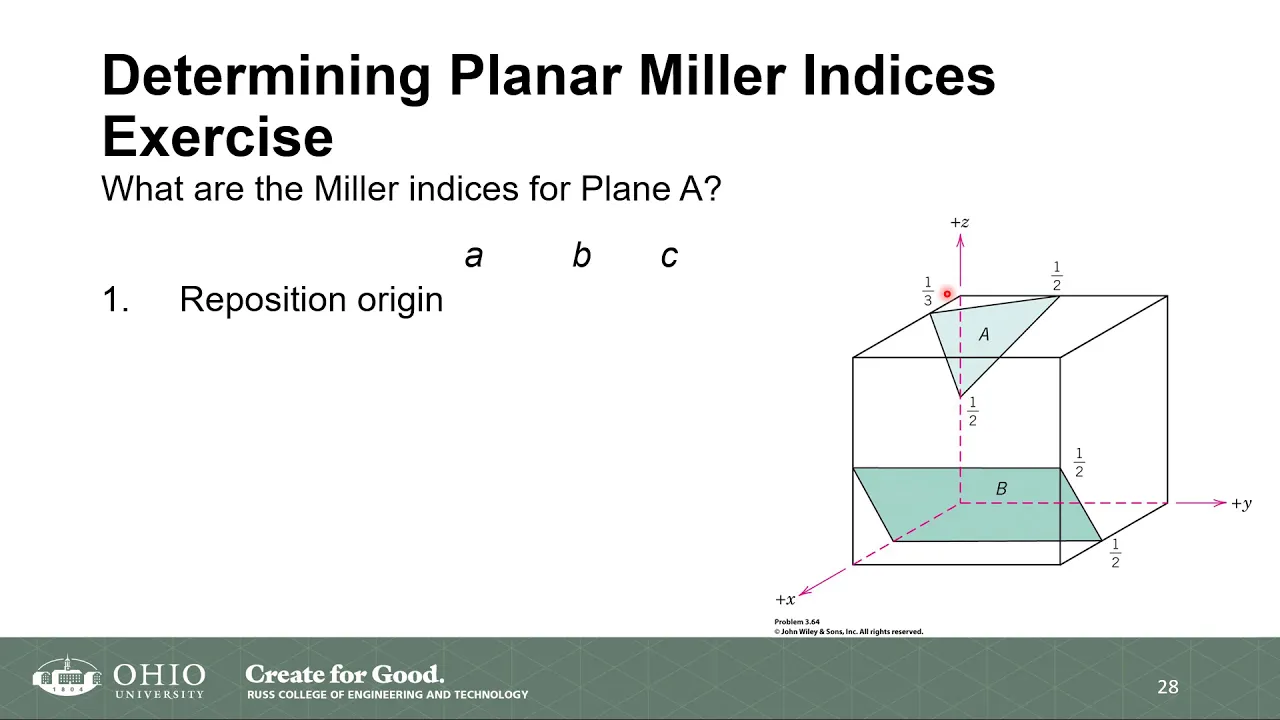
Learning to determine and sketch Miller indices for crystallographic planes, which requires taking the reciprocals of plane intercepts.
Understanding families of directions (denoted by angle brackets ⟨uvw⟩) and families of planes (denoted by curly braces {hkl}).
Calculating linear and planar atomic densities for various crystal structures (such as FCC, BCC, and HCP) along specific directions and planes.
Studying slip systems and dislocation movement, analyzing how plastic deformation occurs along specific close-packed directions in metals.
Applying Miller indices to interpret X-ray Diffraction (XRD) data and understand Bragg's Law in materials characterization.
809.6K views7.1Klikes7:13Original Release: 2012-09-25
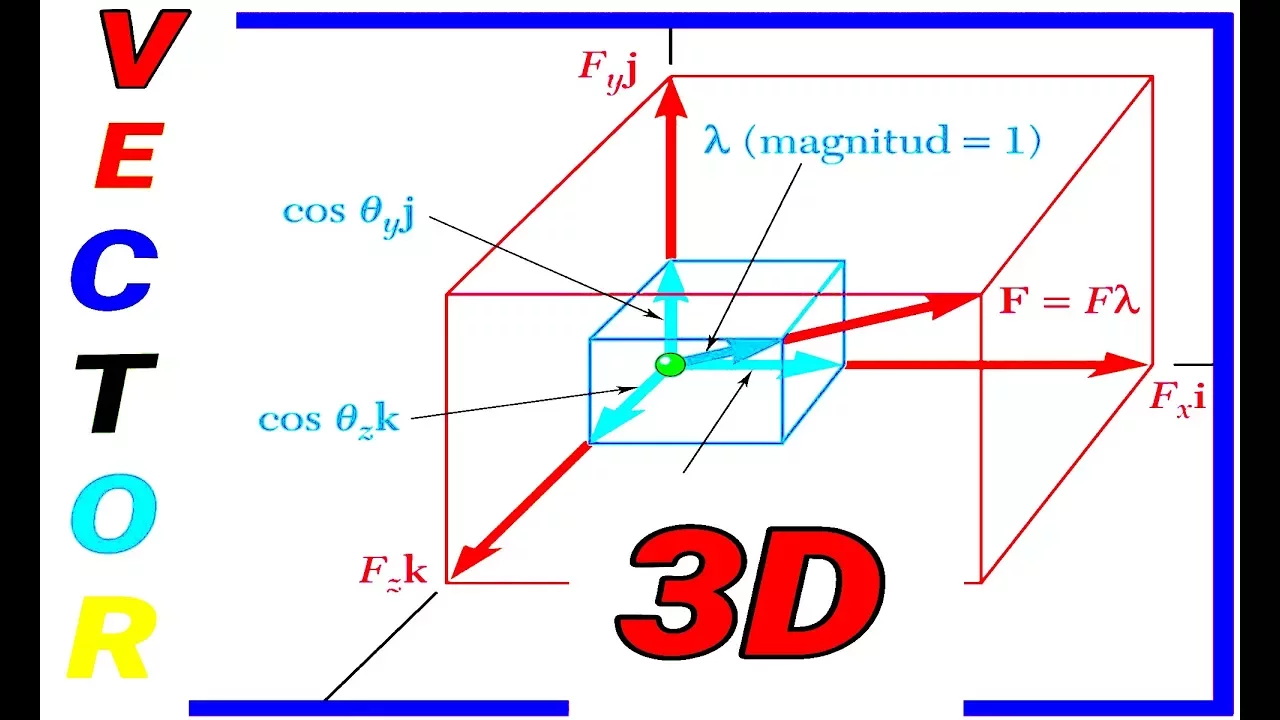
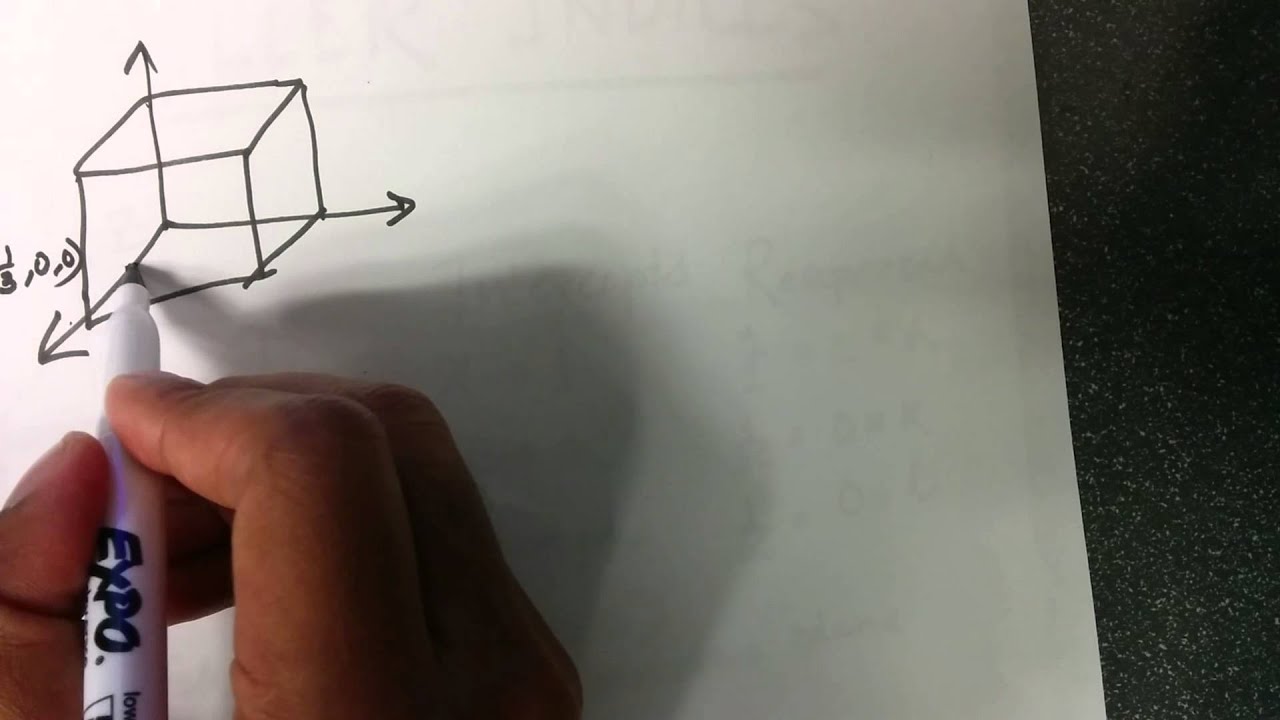
okay I want to go over briefly how you create more indices of directions and this is from your reading the Ashby guided unit and it want to point out the Miller indices of a direction that's what we're working on are always written in square brackets okay so this is the way they're designated and they're basically the they are components of a vector so you'll see them written in two ways one with the square brackets as shown here and then another with these sort of these carrots these angled brackets and these are fan twenties are these are a direction excuse me they're family of directions and then you could see that this family of directions contains all of these individual directions and by the way it also contains the reciprocals of those it contains the 1 bar 0 0 the 0 1 0 excuse me 1 bar 0 and then the the reciprocal for that that 0 0 1 bar so it's all permutations of these directions and that's considered a family that they're all basically rearrangements of these and then also the opposite directions of those ok let's look at how these directions were derived and I'll just admit that these drawings aren't super great so let's let's kind of start out and we'll start with this one this one's pretty obvious so we have the XYZ axes and the the direction they're wanting to draw here is the 0 1 0 direction and so what what I do is I put the the endpoint of the vector at the origin and then I think I'll use another color I'll use the screen here and then it goes 0 in the X Direction 1 in the Y direction and 0 in the Z direction and I place my next endpoint and then I draw a vector from the origin to the endpoint that I've identified and you can see that that's this red line now they extend it beyond the unit cell which is a little bit confusing in my opinion as is this one right here so let's do this one together so the 0 1 1 vector put the endpoint of the vector at the origin or the originating point the end of the what is that the tail of the vector ok and then we need to go 0 in the X Direction 1 in the Y direction ok so 0 I'm starting here 0 in the X direction I do not move 1 in the Y Direction 1 in the z direction and then I put the dot there and my vector goes from the origin to this point right here now what's a little tricky is when you have in the direction you have a 1 bar in the direction or any number barred so what that means is you basically have to move the origin if this is a negative number move it from the 0 0 0 point 2 in that particular direction so so I'm going to move this plot this origin plus 1 so I'm going to go plus 1 I'm going to start the vector here ok so I can't I don't think I can erase that other point right here I'll use a different color I'll start the vector here and I'll go OK negative 1 in the X Direction negative 1 in the X direction oh wait yeah negative 1 in the X Direction 1 in the Y Direction 1 in the Y Direction 0 in the Z direction and there is my new end point so my direction vector is from here to here now notice they drew that same vector but they drew it up here it's equivalent inside this unit cell it's a little bit arbitrary but you can see this direction is the same as this direction you know obvious if we actually drew it out here it'd be the same as that you know as long as it's parallel so it depends on where you put the origin and what I recommend is placing the origin if there's a negative number placing it plus 1 in that direction so here's let's do this one here this one's kind of goofy now when you have greater than one inside or what I would recommend doing is pulling that number out so that you know common factor out and I would say to pull the two out to and do one bar one half one to get that same direction so you're saying to two times this direction that's to is just the magnitude of the vector so this is would be half of the size and direction of the vector but the direction would be the same okay so we need to go since we have a 1 of 1 bar in this x place right here the X Y Z I would personally I would add 1 so I would start at 0 0 0 I would add 1 so now here's my new origin I'll use a different color I'll use green here's my new origin and I'll start from there so I'll go negative 1 in the X Direction negative one in the X 10 I'll do 1/2 in the Y Direction 1/2 that will put me right here then I go 1 in the Z direction that will put me right here so the direction vector would be from here to here see they've draw the head outside there and that's that makes it confusing in my opinion anyway I hope this helps ok let's go over the procedure here so let's see first thing that you want to do is draw the XYZ axes the second thing is to determine the origin as the the tail of your vector the direction vector ok and in this case if there is a negative number in the direction vector move the the origin in the positive direction or that axis and then next thing you want to do is determine the end point and you want to do this this would actually require you to remove a common factor if any of the indices are larger than one okay determine that you have now that the tail of the vector the end point of the vector and then last thing draw the vector
Up Next

14:03
X-Ray Production: Characteristic and Bremsstrahlung Radiation
@TheMrAyre
157.9K views•2012-08-27

12:53
21cm Hyperfine Transition in Neutral Hydrogen: Radio Astronomy Basics
@AaronRobertParsons
12.4K views•2011-10-13

32:32
NMR Spin Physics I: Zeeman Effect, Resonance Condition & Larmor Frequency
@nptel-indianinstituteofsci8064
2.3K views•2024-01-17

27:14
Entropy and the Second Law of Thermodynamics Explained
@veritasium
27.5M views•2023-07-01
Related Study Plans & Knowledge Roadmaps
Structured learning paths in Physics
physics
Nuclear Physics (Decay, Fission & Reactors)
01Atomic Structure and the Binding Force
02Radioactive Decay and Half-Life
03Nuclear Fission Mechanics and Chain Reactions
+ 2 more learning modules
12h5 modules
Explore Roadmap
physics
Soft Matter (Polymers, Colloids & Rheology)
01Foundations of Soft Matter & Thermal Forces
02Polymer Physics and Macromolecules
03Colloids, Surfactants, and Self-Assembly
+ 2 more learning modules
38h5 modules
Explore Roadmap
physics
Analytical Mechanics: Lagrangian & Hamiltonian
01Mathematical Foundations: Calculus of Variations
02From Newtonian Mechanics to Constraint Dynamics
03The Principle of Least Action & Lagrangian Mechanics
+ 3 more learning modules
28h6 modules
Explore Roadmap
physics
General Relativity (Spacetime & Cosmology)
01Foundations of Relativity: Special Relativity
02The Geometry of Spacetime: Equivalence Principle & Curvature
03Einstein's Field Equations: The Mathematics of Gravity
+ 2 more learning modules
55h5 modules
Explore Roadmap