


















![[HÓA ĐẠI CƯƠNG 2] ÔN TẬP GIỮA KÌ HĐC2 (MỨC ĐỘ CƠ BẢN)](https://i.ytimg.com/vi/bA0C-x-wPaE/maxresdefault.jpg)

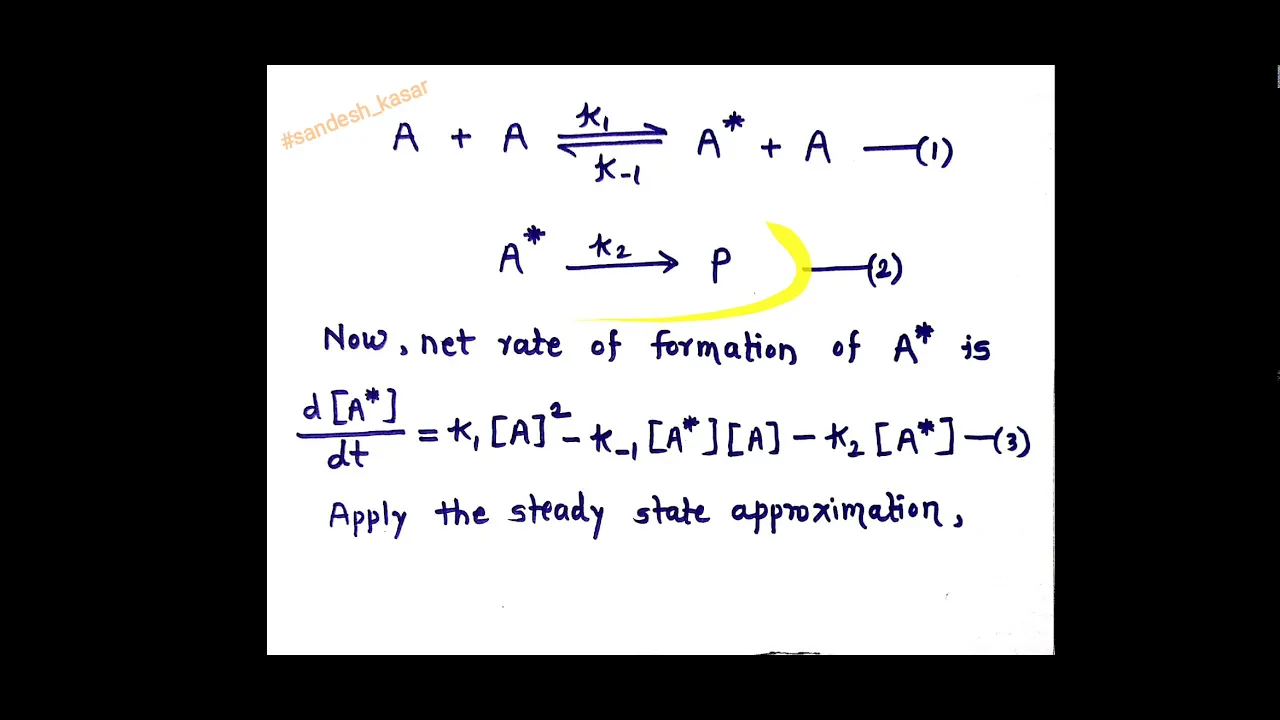
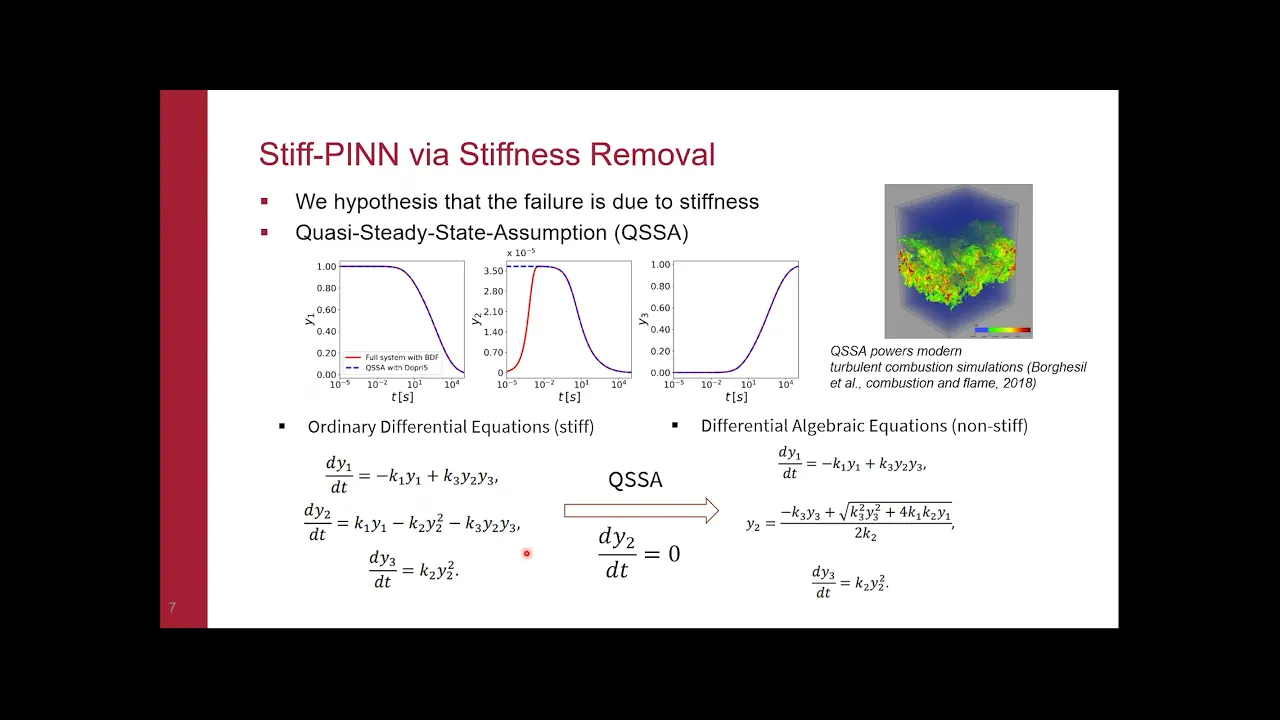
The steady-state approximation is a method in chemical kinetics that assumes the concentration of a reaction intermediate remains constant over time (its derivative with respect to time equals zero), allowing chemists to derive the overall rate law for complex reaction mechanisms by setting the production rate of the intermediate equal to its consumption rate; this approximation is valid when the intermediate is consumed much faster than it is produced (k2 >> k1²[R]₀), meaning any intermediate formed is instantly converted to product before accumulating.
Steady-State Approximation in Chemical Kinetics | Intermediate Concentration
Added:Fundamentals of chemical reaction rates, including differential rate laws and reaction orders.
The distinction between elementary reaction steps and overall multi-step reaction mechanisms.
The definition and characteristics of a reaction intermediate compared to reactants, products, and transition states.
The Rate-Determining Step (RDS) approximation and how to write rate laws based on it.
The Lindemann-Hinshelwood mechanism for unimolecular gas-phase reactions.
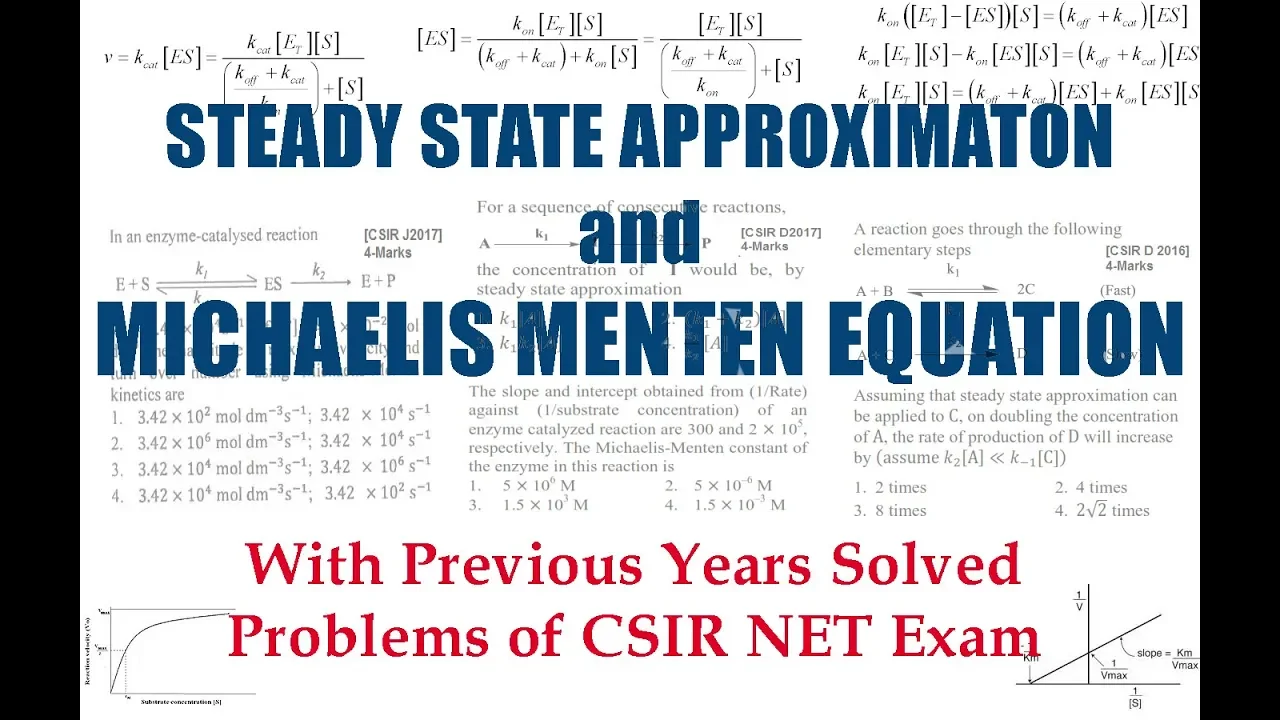
Michaelis-Menten enzyme kinetics, which utilizes the steady-state approximation for the enzyme-substrate complex.
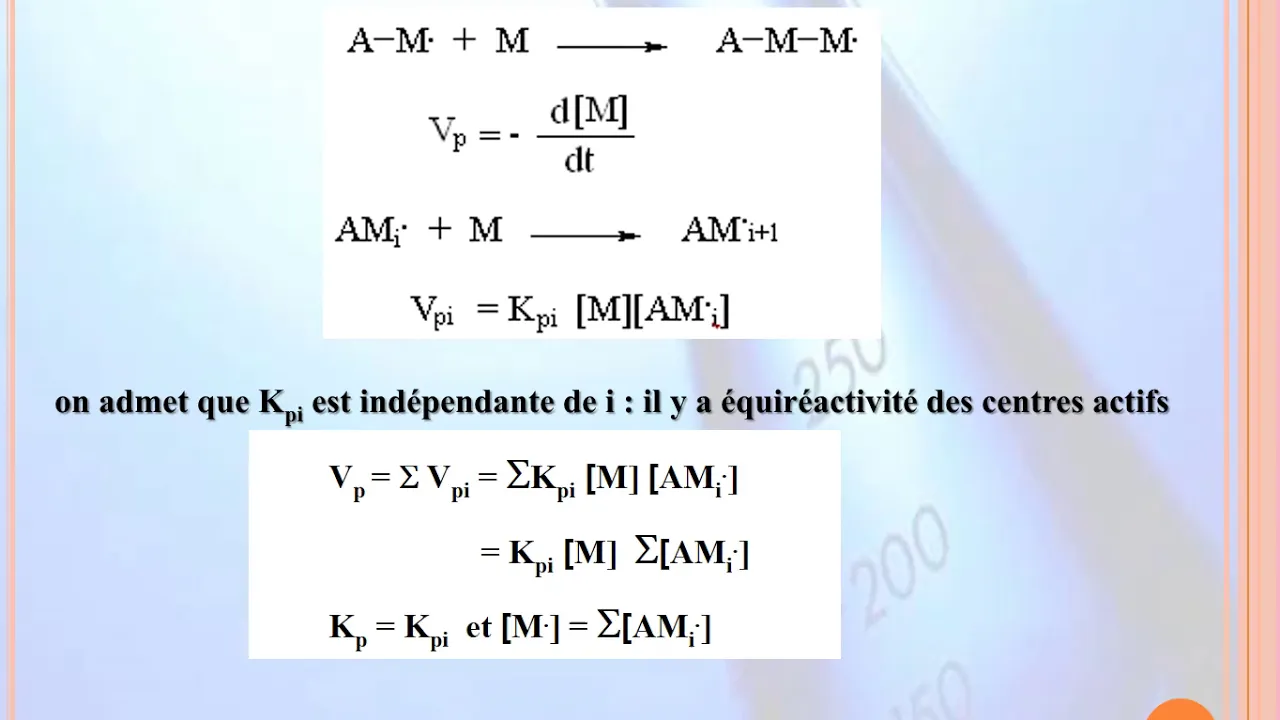
Kinetic analysis of complex chain reactions, such as radical polymerizations and combustion reactions.
Using computational and numerical methods to solve stiff differential kinetic equations when the steady-state approximation is invalid.
80K views441likes6:10Original Release: 2016-09-15
this video will discuss the steady state approximation in chemical kinetics so let's assume we have a reaction here going from our reactant R to the product p let's assume that this complex reaction is composed of two Elementary steps Step One is R goes to I with a rate constant of K1 step two is I goes to p with the rate constant of K2 I being the intermediate in this reaction we're going to assume that at T equals zero that the concentration of our reactant equals R naught and that the concentration of the intermediate end product is equal to zero all right so let's look at some different cases here so if K1 is much much greater than K2 what we'll have is that the intermediate will build up as K1 is very fast waiting for K2 to happen and then slowly over time all of that intermediate will convert to product alternatively if K1 is much much slower than K2 what will happen is any in any intermediate that is produced will instantly be consumed a product so our intermediate is just waiting to be produced to instantly go to product so any intermediate that is produced is instantly consumed into product so what we can use in a lot of cases where we have complex derivations that occur based off of these rate laws is we're going to get a simplification that helps us which is called the steady state approximation so the steady state approximation is going to be the approximation that the derivative of the concentration of an intermediate with respect to time is equal to zero this will allow us to get the concentration of that intermediate in many complex mechanisms which will be needed in order to get the rate law for the product okay so in this case we're going to see that the concentration or the change in the concentration of the intermediate with respect to time is equal to well it gets produced in reaction one so that's K1 times the concentration of the reactant it gets consumed in reaction two so that's minus K2 times the concentration of the intermediate and according to the steady state approximation that's equal to zero so since this is equal to zero we can solve for I so the concentration of our intermediate is equal to K1 times the concentration of the reactant divided by K2 so we can see that from this type of expression here that our rate law for the reactant Dr DT is going to be well the only thing that can change the concentration of the reactant is consuming it in reaction One so Dr DT equals minus K1 times r so that means that our concentration of r as a function of time due to this first order dependence is going to be R naught times e to the minus K1 t all right we saw that our concentration of i as a function of time is going to be equal to well we have K1 times R over K2 here's our equation for r so the concentration of I equals K1 R naught over K2 times e to the minus K1 t so according to the steady state approximation the derivative of this should be zero over time so let's take the derivative of this so that's a constant constant constant e to the minus K1 and then T is our time so D DT of e to the minus K1 T is minus K1 e to the minus K1 t so didt is going to be minus K1 squared r naught K2 times e to the minus k1t and this is supposed to equal zero so when is this going to equal zero so e to the minus k1t that's not going to equal 0 until T is very large and that's the trivial case because at T equals infinity we don't have any reactant left to consume so at finite times what makes this equal to zero so this is not zero so that means that this has to be zero so how do we make this zero well we could do that by making our initial reacting concentration zero but that would be trivial because then we wouldn't have any reaction to to to consume there'd be no reaction if there was no initial reactant all right similarly the only other thing in the denominator that can make this zero is k1 so our steady state approximation here is valid if K2 is much much greater than K1 squared times the concentration of R naught so this means that we must have the type of situation that we described here where any intermediate that we produce is basically instantly consumed a p so if we have a diagram of of this over here if K2 is much much greater than K1 then as our reactant goes down we get a little bit of intermediate but it's basically all initially consumed going down so we get basically a flat curve with respect to zero giving us that steady state approximation where our intermediate is constant over time alternatively if K1 and K2 are competitive as the reactant decreases and gets consumed we're going to get a little bit of a build up of the intermediate and our product is going to take some time before it starts being produced as we get a maximum in intermediate so here would be a situation where steady state approximation is less valid where our rates are competitive and in the alternative case that we didn't talk about as K1 gets bigger and bigger this becomes a less and less valid approximation to use
Up Next

12:59
Langmuir-Hinshelwood Kinetics: Derivation and Model Verification
@LearnChemE
59.4K views•2011-11-28
83:56
Biocatalysis and Catalysis in Islatravir Synthesis | Merck Webinar
@SCIwheresciencemeetsbusiness
675 views•2020-10-08
6:39
Force Field Parameters in Computational Chemistry
@TMPChem
21K views•2017-03-16

17:31
Edible Water Bottles: A DIY Guide to Sodium Alginate Spherification
@ryan
10.5M views•2019-06-21
Related Study Plans & Knowledge Roadmaps
Structured learning paths in Chemistry
chemistry
Nuclear Chemistry: Decay, Meds & Fuel Cycle
01Introduction to Nuclear Structure and Radioactivity
02Decay Dynamics and Kinetics
03Radiation Interaction and Detection
+ 2 more learning modules
24h5 modules
Explore Roadmap
chemistry
Supramolecular Chemistry: Forces & Machines
01Foundations of Chemical Bonding and Intermolecular Forces
02Introduction to Host-Guest Chemistry
03Thermodynamics and Dynamics of Self-Assembly
+ 2 more learning modules
16h5 modules
Explore Roadmap
chemistry
Photochemistry: Excited States & Reactions
01Foundations of Light-Matter Interactions
02Molecular Orbitals and Electronic States
03Photophysical Processes and Jablonski Diagrams
+ 2 more learning modules
18h5 modules
Explore Roadmap
chemistry
Coordination Chemistry: Bonding & Properties
01Introduction to Transition Metals and Ligands
02Crystal Field Theory (CFT) and Geometry
03Magnetic Behavior and Spin States
+ 2 more learning modules
14h5 modules
Explore Roadmap