

















![How To Sell On Amazon FBA For Beginners [NEW 2021 Step-By-Step Tutorial]](https://i.ytimg.com/vi_webp/a6Vbk2wFgG4/maxresdefault.webp)








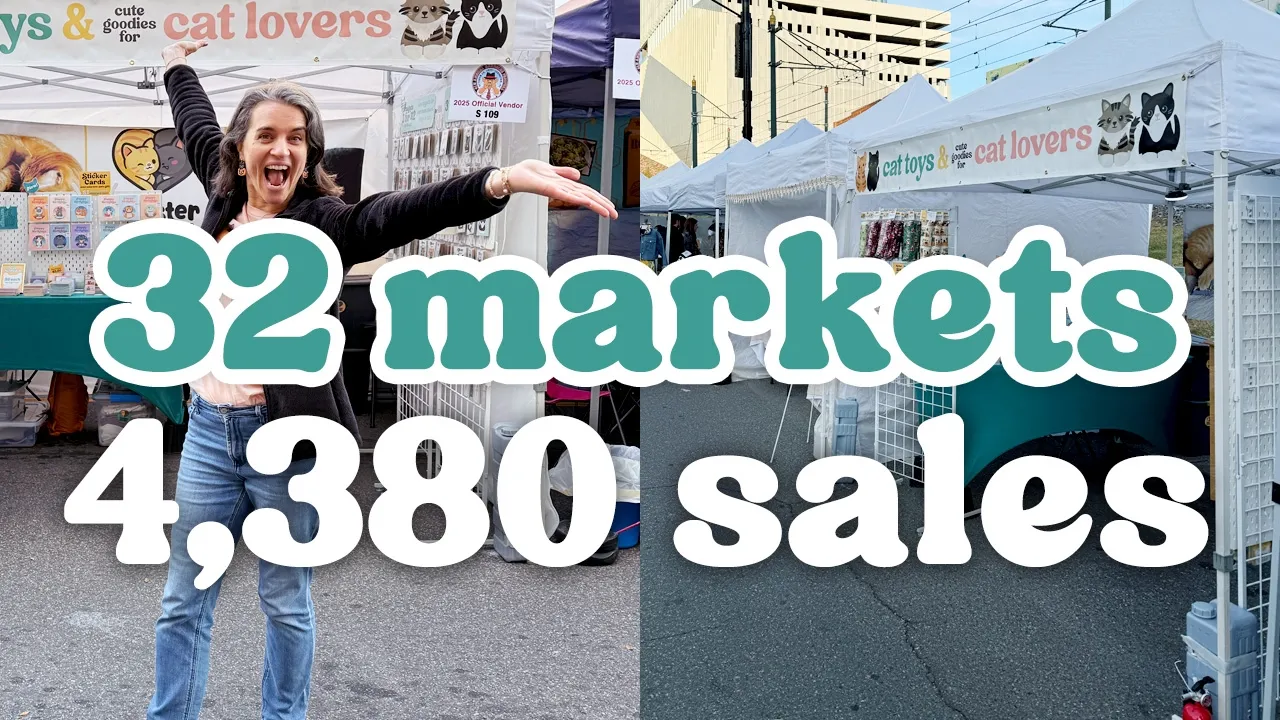
Small business owners should set realistic sales goals for pop-up markets by aiming to make 10 times the vendor fee (e.g., $1,000 for a $100 fee) and at least $1,000 in total sales, as this reflects proper valuation of your time, physical energy, and effort while ensuring profitability beyond just covering costs; historical data shows improvement in achieving these goals over time (from 0% to 53% for 10x and 0% to 84% for $1K+ sales), demonstrating that consistent application of these benchmarks leads to better business outcomes.
Setting Sales Goals for Craft Markets: A Small Business Guide
Added:The difference between gross revenue and net profit, specifically how overhead costs impact take-home earnings.
Basic product pricing strategies for handmade goods, including calculating Cost of Goods Sold (COGS) and labor costs.
The concept of opportunity cost and how to assign a monetary value to your personal labor time as a business owner.
An understanding of fixed market expenses, such as application fees, booth rental fees, and travel costs.
Post-market financial analysis, including calculating Return on Investment (ROI) and identifying break-even points.
Inventory forecasting techniques to ensure you have sufficient stock to meet your target sales volume without overproducing.
Sales conversion metrics for physical events, such as booth traffic, engagement rates, and average transaction value (ATV).
Cash flow management and sales tax obligations for seasonal or event-based micro-businesses.
2.2K views185likes21:11Original Release: 2026-03-20
So, I want to explain [music] why those are my general goals. All that means is that you just gave away [music] that amount of product for free. Value your self-worth. Value your [music] time.
Value your physical energy. Have higher expectations for yourself. Well, hello there [music] and welcome. I am Tracy and I run Chester and Pearl, my small business where I draw cute cat art that I use to make products that bring joy to cats and cat lovers. We are going to be doing a lot of market vlogs this spring.
We've already had two and I don't have a market this week. So, I thought I would explain something that I'm going to be mentioning in a lot of those market vlogs. And that is that my goals are always to 10x the vendor fee and or make at least $1,000 in sales. So, I will be mentioning that a lot. So, I want to explain why those are my general goals and maybe get you thinking about maybe they should be your goals as well. I don't remember the first time that I heard the 10x goal, which is to make 10 times the vendor fee in sales at an event, but it's not my original idea, so I can't claim it. And it has just stuck with me. And there are other reasons to do events besides this sales goal, like visibility and networking and things like that, but we're just going to discuss sales goals in this video today.
So hopefully this will get you thinking about your market sales goals and whether you are properly valuing your time and the effort that you're putting in to do markets and possibly to raise your expectations for what you want to get out of markets sales-wise. And I'm just going to warn you, two warnings actually. One, you might hear noise in the background because even though it is a weekday, my neighbor has decided apparently just as of less than an hour ago to do deck work. So, if you hear noise in the background, that's it. I just wanted to stay on schedule and record [laughter] when I was planning on recording. And the other is just that this video, it it's going to be numbers heavy. We're going to do some easy math, but that's necessary when you're running a business.
[music] So, a goal of wanting 10 times your vendor fee in sales might sound like expectations are too high. So, I thought we would compare this first to some other sales platforms because it is actually not quite high enough because if you make 10x your vendor fee in sales, that's 10% of your vendor fee.
So, let's compare that percentage to some other platforms. And in this comparison, we are going to completely exclude credit card processing fees because that is always on top of your vendor fee. And that's something you're going to be paying no matter what platform you're on. And yes, they vary a little bit, but it's really negligible and not important for this comparison.
So, let's talk first about an online shop. And a lot of us use Shopify.
That's what I use. And you may also have some I need to do something with my hands. [laughter] And you may also have some additional monthly fees for add-on apps. But as far as your base monthly plan is concerned, you have the basic plan. And that one's going to cost $29 a month if you pay upfront for an entire year or $39 a month if you pay monthtomonth. And so this is kind of what's most comparable to a market fee. Cuz with your website, you are going to have certain upfront one-time costs like buying your theme or paying a designer or something like that. And that's the equivalent of like, you know, buying the tent, buying the displays that go with your market setup.
But as far as those recurring fees, again, we're comparing sales to a vendor fee. It's that monthly fee to keep your online shop online. So, we'll say with Shopify, $29 a month. So, in order to match that 10% expectation for markets, that would mean that you would need to make $290 a month in sales. And if you somehow think of a month's worth of online sales to being like one market, then yeah, you're paying a $29 vendor fee. 10 times that in sales is $290, which is a pretty good deal. I think there's also Squarespace for online shops. I don't have any experience with that, but I looked at all of their plans. It looks like the core plan is one that most people probably go with, and that one's $23 a month. So, very similar, $23 a month. So, if you figure you want to do 10 times that in monthly sales, you're talking $230 in sales. And let's compare it to Etsy, cuz we all have opinions on Etsy's fees. [laughter] And again, totally disregarding their credit card fees. So, we're just going to look at their transaction fee, which is 6 12% plus you have a 20 cent relisting fee every time an item sells.
So that's a tiny bit more. And they might be charging you automatically for off-site ads. So that could be a little more. So maybe even figure a maximum of 8%. So even Etsy fees are less than that 10x goal for your markets. And a few years ago, I was regularly paying a $100 fee for events that brought me about $500 in sales. That is way more than Etsy fees. And then you might also be selling on fair wholesale. And this is I mean on wholesale you're automatically cutting your prices by 50%. Plus there's commissions on top of that if the customer didn't come to you through fair direct. So yeah, the 10x the vendor fee is a really good deal in that case.
[laughter] And obviously there's different goals cuz with wholesale, you know, you're putting your products in front of someone else's audience, usually in other states and countries, and you're making large quantity sales.
Um but that's a steep price. So 10% might seem like a lot when you're talking about markets, but wholesale aside, you're probably getting a better deal with your online shops. So raise your expectations if you're only expecting twice or even five times your vendor fee, cuz even that is not nearly as good as what your online sales are.
[music] So, let's go through some scenarios of total sales expectations as a multiple of the vendor fee so we can see why 10x might be a good goal. We're going to use a $100 vendor fee in all these examples because that just makes the math really easy. Let's just start with 1x.
Basically, that just means you're making your feedback. And can I be real here?
[sighs] because the number of times I see small business owners here talking about how at least I made my feedback or I hope to just make my feedback. And of course, every event can have different expectations and sometimes it can be unexpected. But honestly, it just frustrates me so much. And please don't keep going back to events where that is the norm. And I am always there to advocate for trying events more than once. Don't let one event at one location determine whether you're going to keep going back to that event because any number of factors can contribute to a poor sales day. But have higher expectations for yourself [laughter] because everything is not profit once you hit that vendor fee. All that means is that you just gave away that amount of product for free. It doesn't even mean you've broken even. It's not just profit after that. If the fee was 100 and you have made your vendor fee, that just means that you gave away $100 worth of products for free. So, let's move up to 2x. So, you make $200 in sales.
You've made your feedback and then you've made an additional $100 in sales.
So, it's like selling that $200 worth of product for 100. It's like it's 50% off, which is wholesale pricing. So, I kind of feel like that is the bare minimum expectation that I would want at an event. Then we move up to 3x the vendor fee. So, $300 in sales. The $100 fee is covered. Maybe at this point, you want to consider $50 of that is paying yourself for actually being at the market that day. Don't forget about the time that you're actually spending at market and that you're covering your expenses for that. So, $100 fee, $50 to pay yourself for the day. So, then you figure the remaining $150. Again, that's a 50% sale on all your products. Or maybe with your pricing strategy, you figure in paying yourself for a market into the price of your goods. So, that just means you're selling $300 worth of product for $200 if you're covering your vendor fees. So, everything is being sold at a one-third discount. And then we move up to 4X, so $400 in sales. the $100 fee is easily covered. And so then the remaining is just like having a 25% sale on all of your items. So think about that because 4x your vendor fee is starting to sound really good, but would you normally have a 25% off sale on your online shop? Is that a steep sale for you? Because if you are 4xing your vendor fee, that's exactly what it is.
So let's jump right ahead to 10X then.
So at 10x you have covered your vendor fee. Maybe you're going to use another $100 to pay yourself for working that day. 5 hour event, $20 an hour. So then the remaining $800 is what you've earned from the $1,000 worth of product you've sold, which is like a 20% off sale. Or again, if you don't figure the paying of yourself for that day in because that's already worked into the pricing, 10X is really selling all your products for 10 to 20% off depending on how you work it.
So considering that 10x is still 10% off all your products, I don't think that's a high expectation. And that's pretty much why that is my norm. I feel like that is the minimum that I should be expecting at an event. And I also know that this is the most simplistic comparison here. [laughter] I am still missing a lot in these numbers. There's other expenses like paying off the sales tax or lodging and transportation if it's an event out of town, but I'm just keeping all the numbers simple for this example. And just know that all of those exclusions here make that 10x minimum even more necessary.
[music] So, is 10x even realistic? Honestly, some of the events I do that have a $150 vendor fee, that's becoming pretty common, I don't make 10x a lot. And then there's other events where the fee is $250 and I make well over 10x the fee.
So, it just depends on the events and other goals that you have. Um, but as far as the percentage of events that I've done where I have gotten 10x or more, none in 2019 and 2020. [laughter] 15 of my events in 2021 I 10xed my vendor fee, 31% in 2022, 35% in 2023, 50% in 2024. So, half of my events that year, and then last year in 2025, 53%.
So, just over half. So, even though this is my goal, it's still something that I really, really need to be working on.
[music] And then I also have a secondary goal, something that I have mentioned in my videos before and I'm going to be mentioning in a lot of my vlogs to come, is that I pretty much only apply to an event if I expect to make at least $1,000 in sales. And that's just kind of what what I like to earn in sales to make it worth the physical energy and the time to actually go out on a weekend day and work a market because my time and physical energy is valuable and limited. Just never underestimate the time that you're spending actually working at markets. and that a 4-hour market might actually be 8 hours of total time figuring in transportation and setup and cleanup and all that stuff. So, in the beginning, I would do a monthly market a lot, for example, that had only a $50 vendor fee. Great.
Those events that have the lower fees are very attractive. And I averaged about $500 to $700 in sales. So, I was doing 10x the vendor fee. But now, I'm doing regular monthly markets where the fee is $165.
and I usually make between 1,000 and 1,500 in sales. So, not 10x the vendor fee. However, I am choosing this event with the higher fee and higher sales over that smaller event like almost every time now. And that is because despite having three times the vendor fee and only two times the sales, the net sales at the end of the day minus all the expenses and everything are still going to be higher than that smaller event and my time is valuable.
So for me, filling up my weekends with those smaller events that still require the same amount of physical labor and the same amount of time, it just could quickly lead to burnout if I was just going to really start filling up my schedule with those. Because there are certain elements of a market day that are going to be the same no matter how big the event is, what the vendor fee is. For me, that is loading up the car about a half hour. Transportation to the event, if it's somewhere in town, figure another half hour. Setup time can be 1 to two hours. The event itself, most of my events now are 5 hour events. There's very few 4-hour events anymore. So, 5 hours. Breakdown at the end is usually only an hour. It takes less than setup.
Transportation back home, another half hour. And then unloading the car, another half hour. It just takes a while. half the stuff needs to come up to the second floor. It's just a whole ordeal. So, a 5-hour event can easily consume 10 hours out of a day. And at that point, it basically is my whole day because I'm going to come home after that and just not do anything. I'm going to be tired for the rest of the day. So, with all that time and labor investment, I'm going to choose the event that's going to have higher sales. even if the fee is higher, even if I don't quite 10x because the net sales are going to be higher than a smaller event. And so it makes my time and physical exertion all that more worthwhile. So another way to look at it is maybe there are two smaller events on a weekend. So Saturday and Sunday, both a $50 fee, both about $500 to $700 in sales. and compare that to just doing that Saturday event that was $165 and $1,000 to $1,500 in sales.
Those two small events combined are now a $100 vendor fee with a total sales of $1,000 to $1,400. So sales for the whole weekend are almost the same. The fee is just a little bit less, but now you're going out all weekend long. [laughter] you have so much more of a time investment. Maybe you don't have to unload the car from day one and then reload it and you can just keep the car all packed. So, you save time there, but you're still spending maybe four to five hours at the markets each day. You still have transportation each day. So, I would much rather do just one event that's on one day than two smaller events that take up two days. as long as it's a good larger event where I'm earning over $1,000 and it's fairly close like maybe 7 8 9x the vendor fee.
But I would take that over two smaller events where I'm 10xing my vendor fee at both of them or else I'm going to get burned out. At the same time, I did a lot of those smaller events early on when I did markets and still highly recommend doing like as many as you can early on because you learn so much about which organizers you want to work with, which locations attract your ideal customer. There's just a lot you can learn from doing a lot of smaller markets. But once you've learned those lessons and know what works for you, just remember that your time is expensive and you want to protect that.
So I started working smarter and not harder and I started purging a lot of those smaller events. Hello Pearl.
Because it wasn't worth my time even if the fee to sales ratio benefited the smaller events because the hourly net sales are higher and I would have to spend far less time at the markets.
Hello darling.
>> [laughter] [music] >> So, how realistic is it having $1,000 in sales at events? For me, I had none in 2019 and 2020. In 2021, it accounted for 7% of my events. In 2022, 20% of the events, 2023, 47%.
2024 was really when I started focusing on the larger events, even if they had larger fees. 79% of my events I made $1,000 in sales. And then last year in 2025, 84%. So last year, I only had one event that had a vendor fee under $100.
Just in this area in Raleigh, that's kind of the norm now to have vendor event fees over $100. And five of the events I did had under $1,000 in sales.
[music] So, the biggest takeaway that I hope you get from this vlog is to value your self-worth, value your time, value your physical energy when it comes to market season because the time that you spend at markets is so valuable. So, don't forget to compensate yourself. Whether you work that into your pricing or kind of figure that into the profit you're making from an event as a whole, make sure you're compensating yourself for all that time you're spending actually working on market day. Make sure you're paying yourself for that time in addition to the time that it's taking to actually make the products. So, continuing to apply to events where you've historically made 10x the vendor fee is a great way to start. or maybe 7x works for you or maybe some other static minimum sales amount. So just analyze your sales in your markets and be aware of all the time that markets are consuming for you and make sure that your sales goals match your worth. And you might see these numbers and some things that I pointed out today and realize, oh well, markets really aren't worth it. And that's okay, too. Markets aren't for everybody. I've mentioned many times before, they're part of my business that's really, really working right now, while other things like wholesale are not. [laughter] So, just lean into what's working for you. Definitely give markets a chance and try lots of different things, but if it's just not working, then don't keep wasting your time. Or also remember that these are just sales numbers and there's many other benefits of markets like brand visibility. People will take a card and buy later online. Maybe they'll take cards to give to friends. Anytime you keep showing up to events, it's just a good thing that people keep seeing you. [laughter] Hello, Pearl.
So, just keep all of that in mind. So, that's it. [laughter] So, this is why you are going to continue to hear me say that I just reached 10x the vendor fee or I did not or I made the $1,000 threshold in sales.
I just wanted to take time to explain why those are my goals because you'll hear that a lot in all of the market vlogs that are coming this season. So, let me know what are your average sales goals. Are you hoping to make a certain multiple of the vendor fee and sales like I do, or do you have a certain amount that you're always shooting for?
And also, let me know what the average vendor fee is in your area cuz it didn't used to always be $100 around here, but it is now. And I feel like that could be a lot. [laughter] and I feel like it's probably smaller in some areas. So, let me know what your average market fee is and your where your area is because honestly, I'm just curious. Thanks again so much for watching. More vendor vlogs coming obviously, [music] as I keep saying, many more to come. And I hope you found this useful. Again, make sure [music] you are valuing your time and be sure to subscribe and hit the bell notification so [music] that you see all the vendor vlogs that are going to come. And thank you so much for watching and I hope you have a great day.
[music] >> [music]
Up Next
18:12
Building a Pop-Up Store in 4 Days: A Behind-the-Scenes Vlog
@allegrashaw
28.3K views•2022-11-17

12:54
Triumph of Orthodoxy Icon: Byzantine Art & History Explained
@BenCallan
2.1K views•2024-08-06

9:49
FastAPI vs Flask vs Django: Choosing the Right Python Web Framework
@TechWithTim
302.5K views•2024-05-26

1:42
Game of Thrones Opening Credits: A Cinematic Analysis
@gameofthrones
46.3M views•2011-04-18
Related Study Plans & Knowledge Roadmaps
Structured learning paths in General & Interdisciplinary Studies
general-studies
Elevator Engineering: History, Physics & Cities
01From Hoists to Safety Brakes: The Dawn of Vertical Lift
02Hydraulic vs. Traction: The Engineering Physics of Elevators
03Modern Speed, Safety, and Algorithms
+ 2 more learning modules
12h5 modules
Explore Roadmap
general-studies
Rubber: Material Science, History & Geopolitics
01Origins of Natural Rubber & Mesoamerican History
02The Chemistry of Natural Rubber & Vulcanization
03The Geopolitics of the Rubber Boom & Colonization
+ 2 more learning modules
12h5 modules
Explore Roadmap
general-studies
Containerization: Evolution, Logistics & Trade
01Ancient Trade & Bulk Cargo: Amphorae to Barrels
02The Industrial Revolution & Cardboard Packaging
03The Containerization Revolution: Malcom McLean
+ 2 more learning modules
12h5 modules
Explore Roadmap
general-studies
Textile Tech: Evolution, Labor & Global Impact
01Pre-Industrial Textiles: Handloom & Cottage Industry
02Mechanization: The Spinning Jenny to the Power Loom
03The Factory System & Global Labor Transformation
+ 2 more learning modules
10h5 modules
Explore Roadmap