

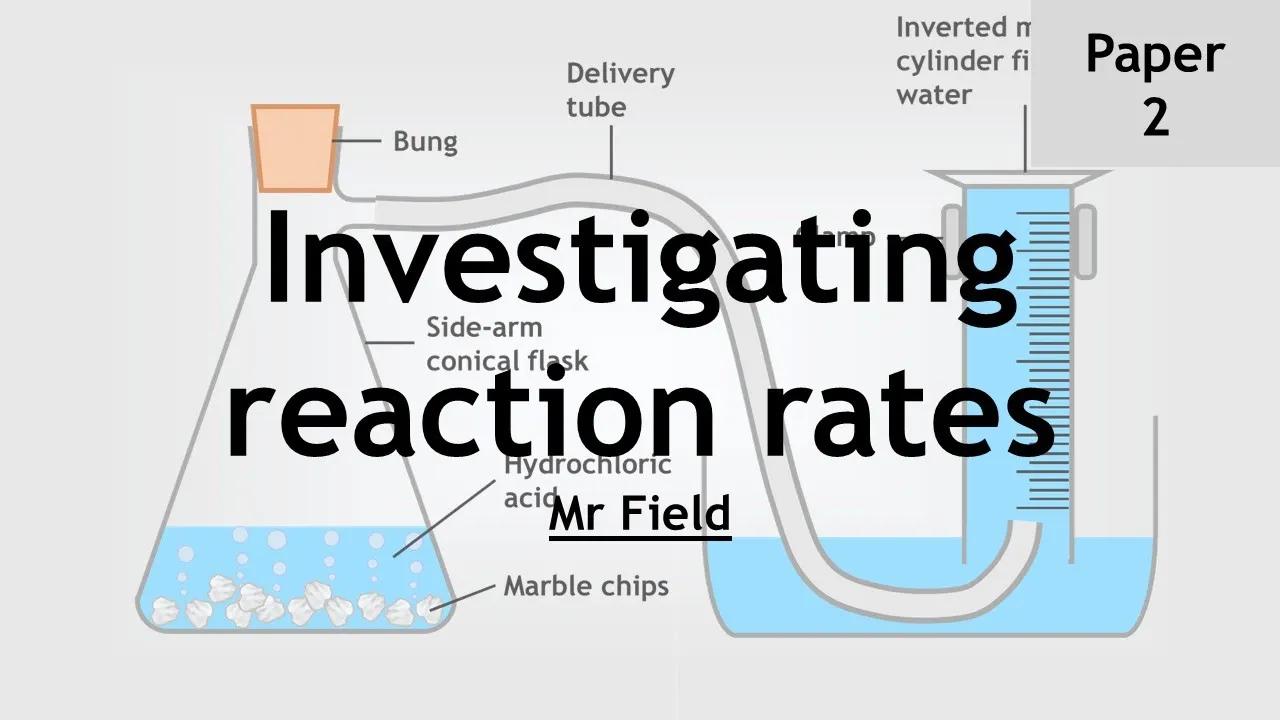








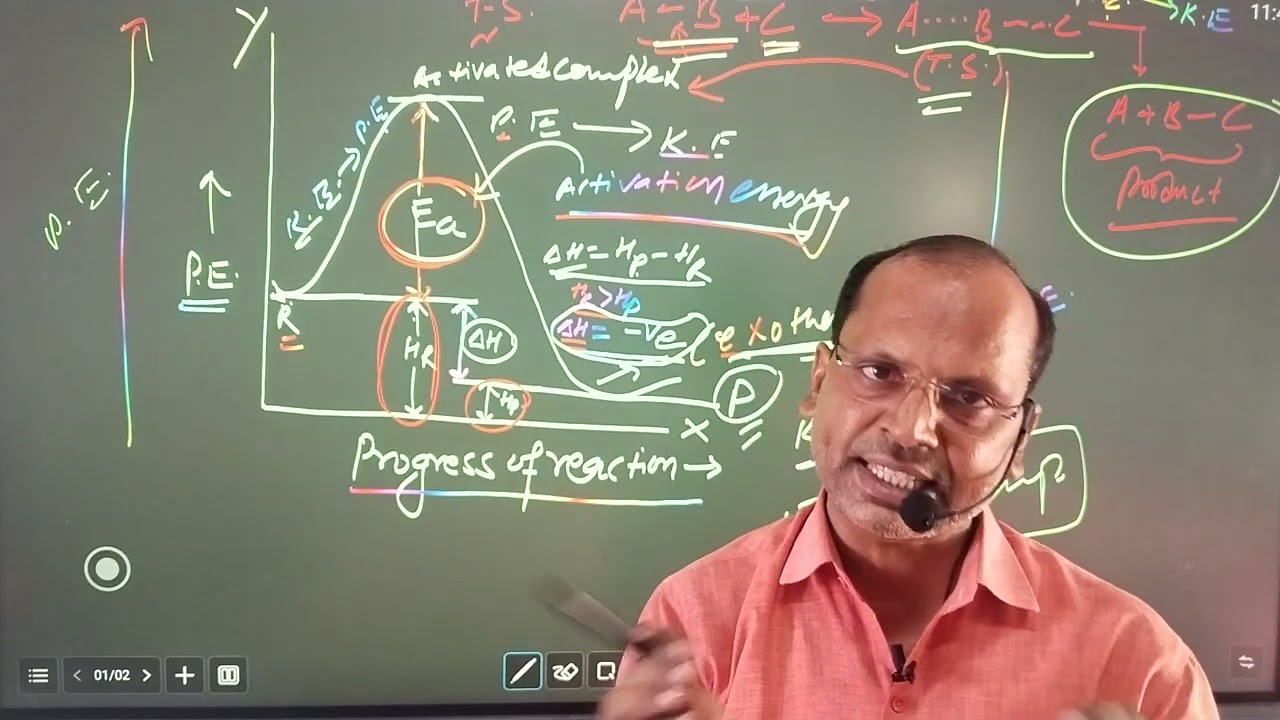










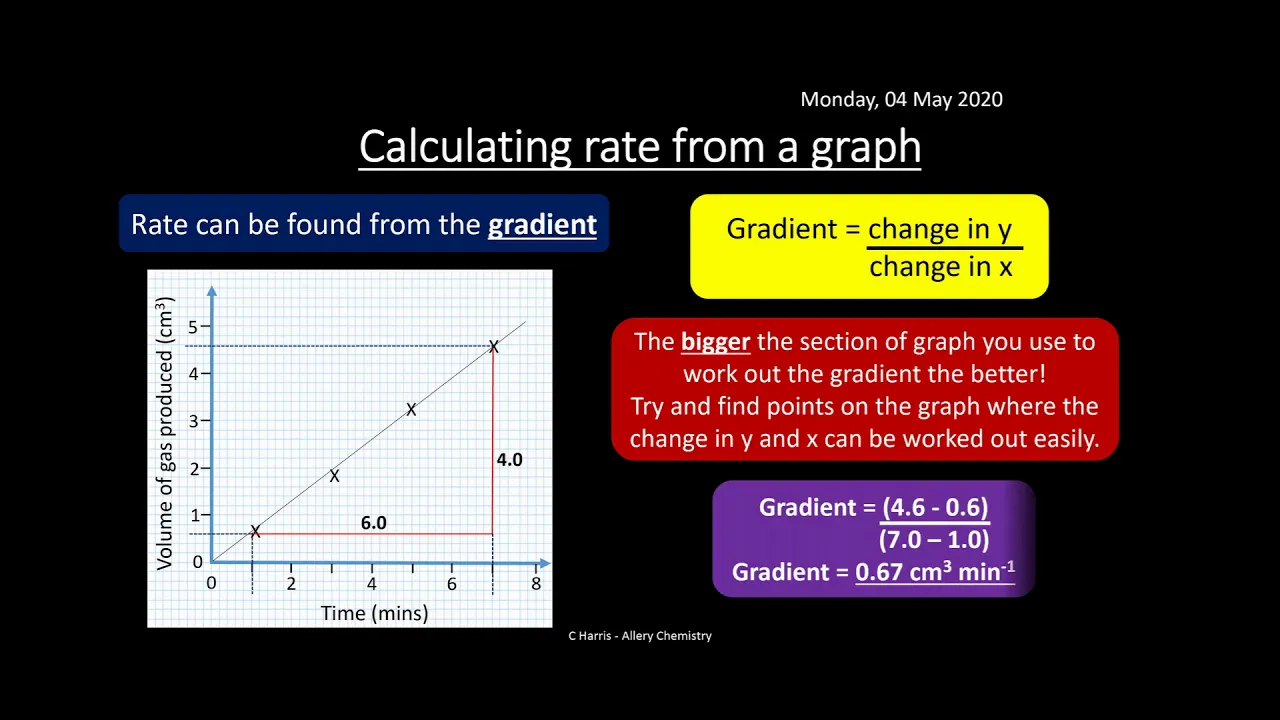




Chemical kinetics studies the rates of chemical reactions, governed by collision theory where reactions occur when particles collide with sufficient energy (activation energy). The rate depends on several factors: concentration (more particles in a given volume lead to more frequent collisions), temperature (higher temperature shifts the Maxwell-Boltzmann distribution curve to the right, increasing the number of particles with energy ≥ activation energy), pressure (for gases, higher pressure increases particle density and collision frequency), and catalysts (which provide an alternate reaction pathway with lower activation energy, increasing the proportion of successful collisions).
AQA A-Level Chemistry: Kinetics Explained | Collision Theory & Rates
Added:GCSE-level foundation of reaction rates, including how concentration, temperature, and surface area qualitatively affect the speed of a chemical reaction.
The kinetic theory of matter, specifically understanding how temperature relates to the average kinetic energy of particles in a system.
Basic enthalpy concepts and energy profile diagrams, including the distinction between exothermic and endothermic reactions and a introductory definition of activation energy.
Fundamental mathematical graphing skills, including interpreting the area under a curve and understanding how to read distribution graphs.
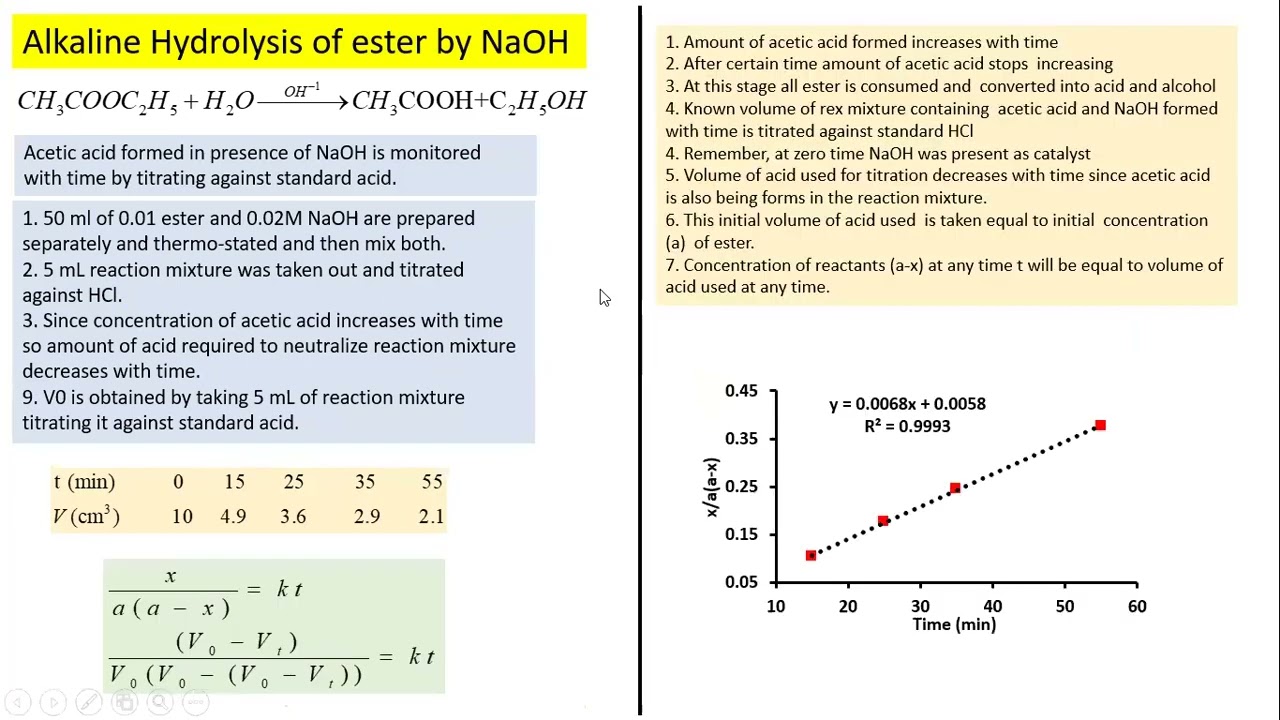
Formulating and interpreting rate equations, including determining the orders of reaction (zero, first, and second-order) and calculating the rate constant (k) with its units.
Applying the Arrhenius equation quantitatively to calculate the activation energy or pre-exponential factor from experimental rate data at different temperatures.
Deducing multi-step reaction mechanisms and identifying the rate-determining step (RDS) from experimental rate laws.
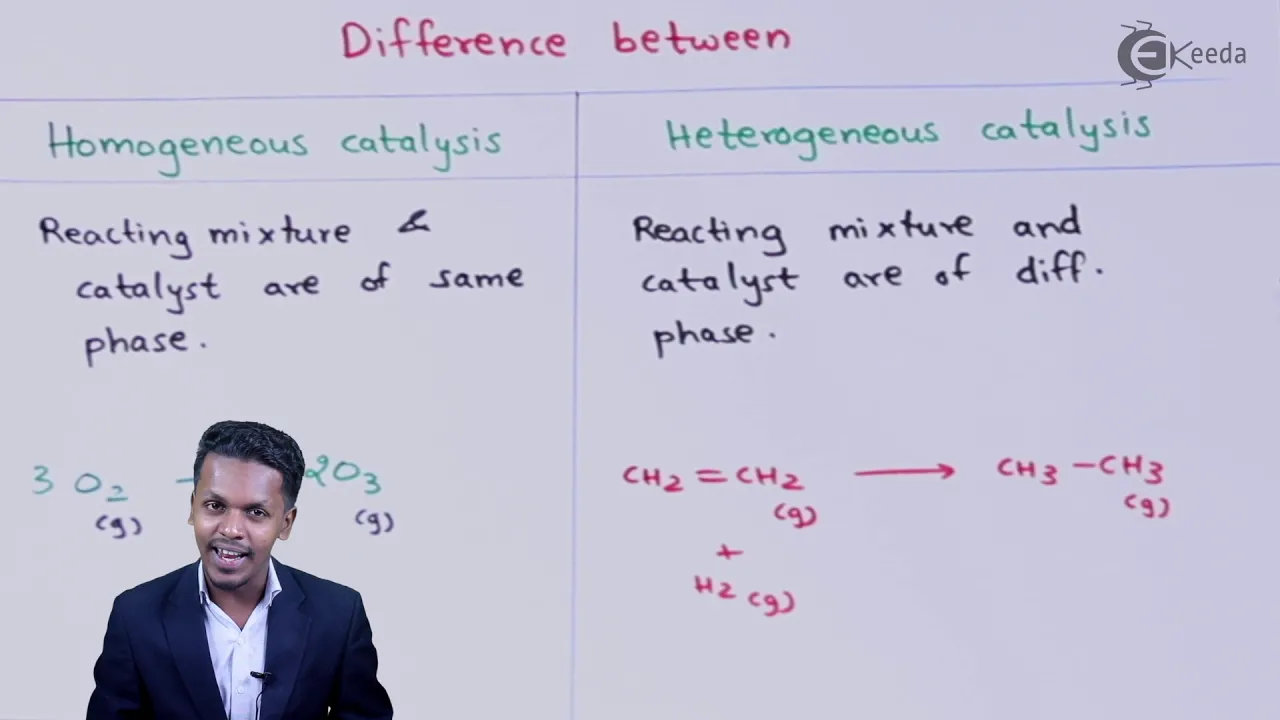
Exploring the specific chemical mechanisms of catalysts, including the differences between homogeneous and heterogeneous catalysis and their applications in industrial chemistry.
211.6K views2.4Klikes20:37Original Release: 2014-06-02
all right so this video is all about kinetics from the AQA a hue qi AQ o AQ AAS specification kinetics is one of the easier topics yet sometimes can trick people up based on questions funny questions when it talks about chains and things like temperatures and pressures and all the rest which hopefully I'll go through and listen people will be absolutely ok at least and afterwards so kinetics what is kinetics what kinetics is this idea really of it's the easiest way I think to explain is it's it's comparable if not almost identical to the kind of rates of reaction topic that you would you would have done at GTAC which I I'm pretty sure as in all specifications you know Excel OCR AQA you know I would guess the Cambridge I just see and all the rest and so just a starting point really is to say well let's think of a reaction this reaction my old favorite a plus B going to C plus D so this is a delightful chemical reaction of some generic chemical compounds that have reacted to reactants to products it's fun how this reaction occur well this reaction occurs because a and B collide so a and B must come together into a collision now that's the very crucial thing and this this comes into the whole the guise of collision theory and really there's there's a lot to be said about collision theory because it as far as I'm aware no it has quite an important effect on on chemical reactions and all the sort so collision theory they've collided we have a collision two things can happen one nothing fairly easy to remember that you just remember that nothing happened that's the first option the second one reaction so they're the two the two options the first one they'll it simply bounce of each other go their separate ways probably never to meet again a being come together their reaction we produce C and D that's a great thing now that reaction it's very important if that reaction is to occur then the energy of the particles must be greater than or equal to the activation energy the energy of activation and that is this thing here and if you look at energetics which is also in this topic in this er this unit should say the activation energies the energy required it's the minimum energy required for the reaction to take place so if we do not have that about energy we are not going to get a reaction it's like a fee to get into a gig it's ER it's the price to go to the cinema it's the you know it's the cost of you shopping if you haven't got enough you're not getting it that's that's the end of it so that's the options nothing or reaction to build on the TTC very slightly and to kind of recap in some ways you have and it has come up I think once certainly you are still experts to have that GCSE idea and the best way to sort of talk about that is is to show you a kind of a GTC type graph so something like this one now this is a graph that is showing us the reaction of which whatever it is I don't want it don't maybe decomposition of hydrogen peroxide it could be anything we produce an oxygen and we're producing over time now we are going from this point here and we're going up here so it's completely a qualitative graph there's no numbering associated with it's just completely qualitative now there are a few sort of questions that can be asked about this so the question could be we could we could find that this reaction and I'm just going to pick some numbers out of the air so we found that to get this curve 100 centimeters cubed of one mole this meter cubed hydrogen peroxide was used and that's what gave the curve are now let's think well what would happen if I were to use a a concentration that were different so say I were to use the no naught point naught 0.5 mole bliss meter cube so we've got half a concentration therefore the reaction is going to only reach half the point that it got to previously but also let's concentrate and therefore it's gonna it's going to occur more slowly so in this case we're going to find that we're going to get we're going to reach half the position we reached previously so we're going to get to about this point here no we're not gonna go bit lower than match looking about one and a quarter to come these lovely lines now give me here and obviously we're not going to get at the same point we are going to it's going to be slower to get there and there we go we have our nice line continuing across it's a really the important thing here is that the curve is shallower than the other one i applies the slow rate of reaction and certainly the height or the the maximum height the the curve reaches this straight line here is a correct proportion to the original so I've gone for half the original because I'm using half of the concentration I could get something different and so this would be line Q for example let's have a look at if I were to do line P and we could set peas two moles per decimeter cubed now this case I'm increasing the concentration and think back this I didn't explain that really in this case when we increase the concentration we've got more particles this will come up later more particles in a given area or a given volume sorry and therefore more collisions therefore a higher chance of collisions taking place therefore the reaction rate would increase the opposite is true for here less molecules in a given volume less rear collisions and therefore statistically a less lesser chance of successful collisions or a less chance of am a successful collision so I've increased the concentration my right reactions going to be increasing I'm going to go to double where I got to before so I'm going to hit this line up here boom there we go hope for your lines would be straighter than mine and we've leveled out at that level here so I've got the point where I've gone to double because I've got double concentration therefore double the amount of moles and therefore double the potential of oxygen to be produced and I've got there quicker because here we go steeper line steeper more shallow submitted slower even more shallow means it's slower again final line I could say well and I see I've got another color for this here just about I could say well line X was at a higher temperature and again this is GCSE higher temperature means we've got more energy faster more frequent collisions and therefore more successful collisions this right reaction is going to be quicker but would not change the amount so I'm still gonna get to my same ending point so factor that across to about here but I'm gonna do it quicker so there we go up and all that you know what's redo that one there's my point I'm gonna reach gonna go up and I'm gonna go a bit better than last time and I'm going to go right across that there was line X this was line P so that's just another way to think about this one a whole rates of reaction now as a as an extension really of GCSE which was which is relatively straightforward really when it came to rates of reaction in all honestly those ideas still stand true we look at something now called a Maxwell Boltzmann distribution curve and that looks something like this so I've got a delightful set of axes that I've drawn incredibly professionally and these axes as far as the way you would be given these in the exam and you'll be giving a line on them and now they have obviously we need some labels this one number of molecules the particles would work as well and this one energy just generally energy now the distribution curve looks something like this it might be under this first time we'll see so it starts about here it goes up and then it comes down and up like that not touching zero okay that's import because you will pretend you have to draw this yourself not touching zero now this is my normal distribution curve for my whatever for a set temperature temperature which we say temperature a so temperature a and wyvern up there and there there we go so a Kelvin couple things about this we we can say that well no particles have zero energy that's that's fairly clear no particles can have zero energy that's that's ridiculous majority the particles have have this sort of energy in the area under here equals the number of molecules in in total actually the area under here is the number of molecules the total number of molecules and what this is in it so here this is this an axis tells me that it gives me the total number of molecules at a given energy now this one here this point right here which comes down to about here would be the most probable energy I'm not saying it's the average energy it's the most probable energy it's the energy that most particles have this one around about over here this this point there and on to this we can also write down we can also put on something like the activation energy so I can draw a delightful line like this and I could sell this is the activation energy right there that is it and actually now the idea of this rate of reaction becomes a lot more it becomes a little bit easier to understand because we can see well all these particles do not have enough energy these particles do that's a good thing particles have more energy particles do not have enough energy they must at least be at this line okay so we have this number of particles that can indeed react so the area here is the number of particles that can react that's your basic Maxwell Boltzmann distribution curve then it's fairly fairly straightforward now you're going to give this an exam what they probably gonna do is they're going to say to you a student increases the temperature draw a drawn to the sketcher curve to show the distribution curve for this reaction at an inker at the increased temperature so we can say temperature is going to be now we're looking at it at temperature B so B Kelvin so this was a line at a Kelvin which was lower so B is so a is smaller than B okay so we draw a line it is going to be we're saying a is smaller than B I forgot what I was even saying there so B is at a higher temperature well when we have a higher temperature we we're going to get more particles that are going to be above the activation energy so we've drawn to this a new line and that new line needs to needs to accommodate that fact I'm going to get rid of this number of molecules let me look in overlap what I'm doing there's a couple of things we've drawn the line I'll draw the line first and I'll explain a few points so it starts at the same point it goes like this and then it goes like this so key thing is a higher temperature this be shifted right that's a very important thing it has been shifted to the right so the peak could be a little bit better then it's not going to like the peak should be really idea would be a little bit further over there but there we go it's it could be what could be better could be worse key thing is it's been shift to the right it's lower than before okay what we find is that generally we have more particles certainly this area now we have this whole area where particles have greater than the activation energy so in increasing my temperature I have significantly increased number particles with the require activation just so increased temperature more particles have greater than or equal to that vase energy and the end result of that is that we get more successful or productive collisions easy so that's very similar to GCC the kind of Alex looking at and this is any question where they're talking about the idea of the how does the increasing temperature increase the rate of reaction this is the kind of Mount so you can be thrown out more particles have greater than or equal to the activation or you could say significantly more particles have greater than or equal to this activation energy therefore more successful collisions and we can flip it the other way around I could say what happens if I decrease the temperature so let's decrease temperature now this time we'll try and draw this one a little bit better Oh bit daughter that Oh yours doesn't really have that little bit there and they will probably give a line higher than the black line that I drew I probably thought about that but there we go this time and try and get my arrows the right way around so a is bigger than C so odor labeled is really C Kelvin be Kelvin I apologize about this in advance so @c Kelvin which is lower than my initial a it has been shifted left ok I've shifted it to the left that's very important because now we find that most of our most probably know G is now lower as we would expect it versus the higher temperature there and now medium temperature there and again as we expect here it drops down and we get this delightful lying down here it's beautiful work about we actually find the area under this part actually now hat is smaller therefore there are a few a number of molecules that have the required activation energy which gives us there now the link into our rate of reaction which if we were to change this move to say that we decrease the temperature less particles the wonders of computers and less successful collisions so reasonably straightforward there a couple of things about when you drawing these curves first of all make sure it's shifted to the left and shift to the right this should be higher whereas very important this might seem picky this should be lower than the original peak and there are marks in the exams the exam is going to look for a couple of things gonna look for be shifted to the left in the case the lower temperature and fit being higher higher shifts the right and lower the other thing is going to look for is that your new line only crosses the original once if you look at this it's difficult cuz I've got all three on here I know that if you look at this here my lower temperature line only crosses the original one once there the rest of time it does not cross terribly the bottom I know there we go higher temperature one only crosses once it does not cross again and that's very important your line starts crossing like this is a rollercoaster you can lose the mark instantly and that's not something what we're doing so that's the Maxwell Boltzmann distribution curve now one of the thing actually our before I before I forget that is how catalysts affect the rate of reaction now a catalyst decreases the activation energy and in this case that actually makes this quite easy decrease the activation energy what we just drop it down here and we can see the matter what happens now we have this new area depends which lineup I've gone for the the black one there ignoring the other two I have this now this greater number of particles that can react so we have we have exactly met those expectations that the catalyst increases the rate of the reaction by dropping the activation energy very very important so it decrease the activation energy by dropping the activation Janet does so realize I have actually mentioned this already and I thought it had so catalyst then well I think it comes up in energetics against a catalyst decreases the activation energy it does so by providing alternate or and/or words in an alternate pathway for the reaction to take place if your aid to person that will make a bit more sense if you're not a to don't worry about if you're doing a to you'll make more sense if you don't even a to just learn it and you'll be fine so the key thing is drops it down here there are points where they have asked you to draw I think and I think in the past they have put lines on Aniceto draw draw a line to show the activation energy with a catalyst and you just need to draw it lower than this one basically that's that's all they're looking for so that's basically in terms of looking at in terms of temperature and we've talked about about catalysts the other thing to think about is you can't really look at it in terms of energy here but a separate point in with the kinetics is again thinking about rates of reaction at GCC we can talk about concentration obviously concentration increase in the concentration is ultimately going to increase the rate of the reaction and the reason is that in in more molecules we could say or particles I guess more molecules in given volume so therefore we're going to get more frequent collisions of course which is going to mean statistically more successful collisions if you don't like this term statistically more you could say there is a a higher chance of successful collisions so statistically more successful collisions are a higher chance for successive collisions so that's really the same point we made again so it's be aware of and I have seen this once asked increase in concentration they were quite sly one time and they they talked about it was actually equilibrium but in think that the thing that was important was that they were talking about all of these were gases and if we increase the pressure the same thing happens increase the rate because the same thing we have more molecules in a given volume more frequent collisions and statistically or higher chance of successful collisions so increasing the pressure if we're dealing with a gaseous situation although you might be going or equilibria but not to do the the idea behind the equilibrium was just it was talking about the rate of of which the equilibrium is reached and so it was still talking about kinetics it was a kinetics question hole hardly there was no actual equilibrium knowledge required it was purely kinetics but it just threw it into an equilibrium situation to make people I guess a bit confused the reason that it worked was because they were gases you increase the pressure and therefore the particles are closer together more molecules in a given volume more frequent collisions and therefore statistically more successful collisions or a higher chance of successful collisions and that's really it that right there is kinetics in a nutshell so I hope that's been of some help quite a nice topic to get in an exam it's quite a nice easy mark often comes at the start question one or two normally but I hope that's been of some help please do stick some comments on if you've got any problems and there you go
Up Next
23:19
Collision Theory and Arrhenius Equation Explained
@ChadsPrep
68.9K views•2022-01-20
83:56
Biocatalysis and Catalysis in Islatravir Synthesis | Merck Webinar
@SCIwheresciencemeetsbusiness
675 views•2020-10-08
10:06
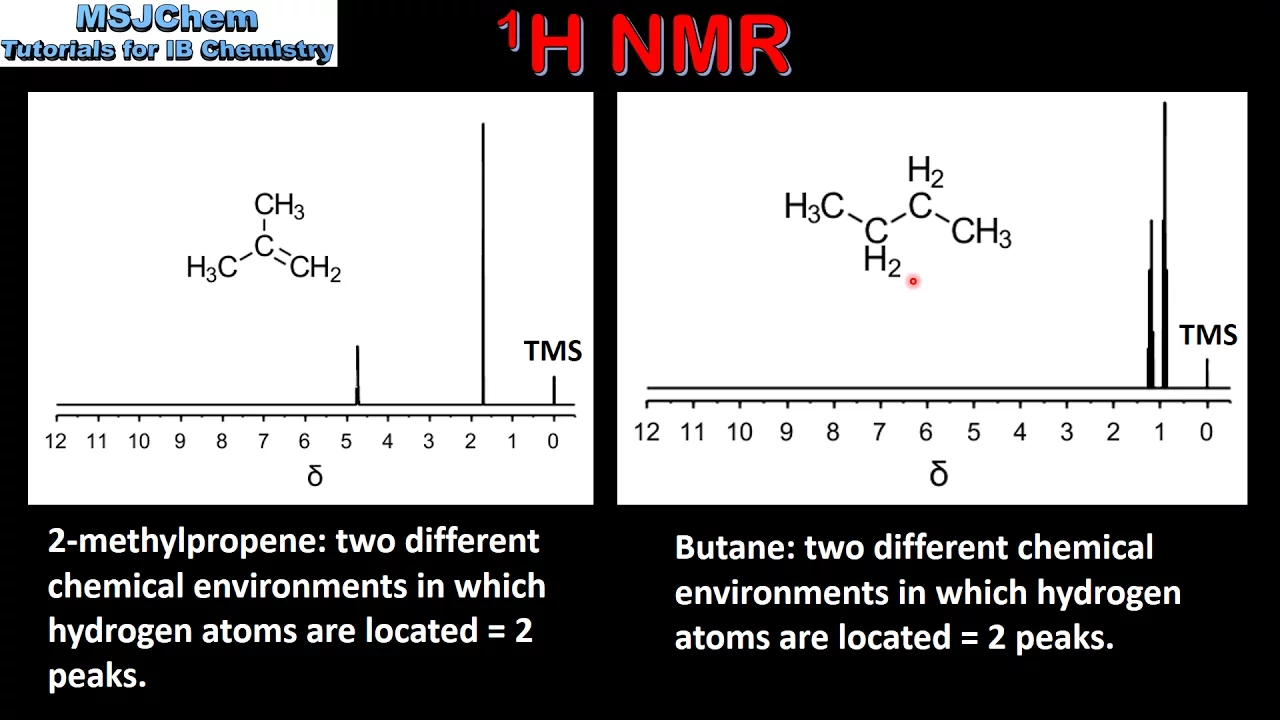
1H NMR: Determining Number of Peaks from Structure
@MSJChem
59.2K views•2017-04-06

17:31
Edible Water Bottles: A DIY Guide to Sodium Alginate Spherification
@ryan
10.5M views•2019-06-21
Related Study Plans & Knowledge Roadmaps
Structured learning paths in Chemistry
chemistry
Nuclear Chemistry: Decay, Meds & Fuel Cycle
01Introduction to Nuclear Structure and Radioactivity
02Decay Dynamics and Kinetics
03Radiation Interaction and Detection
+ 2 more learning modules
24h5 modules
Explore Roadmap
chemistry
Supramolecular Chemistry: Forces & Machines
01Foundations of Chemical Bonding and Intermolecular Forces
02Introduction to Host-Guest Chemistry
03Thermodynamics and Dynamics of Self-Assembly
+ 2 more learning modules
16h5 modules
Explore Roadmap
chemistry
Photochemistry: Excited States & Reactions
01Foundations of Light-Matter Interactions
02Molecular Orbitals and Electronic States
03Photophysical Processes and Jablonski Diagrams
+ 2 more learning modules
18h5 modules
Explore Roadmap
chemistry
Coordination Chemistry: Bonding & Properties
01Introduction to Transition Metals and Ligands
02Crystal Field Theory (CFT) and Geometry
03Magnetic Behavior and Spin States
+ 2 more learning modules
14h5 modules
Explore Roadmap