













![[지구과학1 톺아보기] 23강. 별의 표면 온도](https://i.ytimg.com/vi_webp/bSHTKEnf2wU/maxresdefault.webp)




![Journey to the Edge of the Universe [4K]](https://i.ytimg.com/vi_webp/QhM5zAVvOI4/maxresdefault.webp)




Light is a form of electromagnetic radiation whose wavelength determines its energy and color; shorter wavelengths correspond to higher energy (bluer light) and longer wavelengths to lower energy (redder light). Astronomers use spectroscopy to analyze the light emitted by celestial objects, which reveals their temperature, density, motion, spin, and chemical composition. Different atoms emit or absorb light at specific wavelengths, creating unique spectral fingerprints that allow scientists to identify what elements make up distant stars, gas clouds, and planets across the universe.
Understanding Light & Spectroscopy: Astronomy's Key Tool
Added:Basic wave properties, including wavelength, frequency, and the mathematical relationship between them.
The fundamental structure of an atom, specifically how electrons occupy discrete energy levels and transition between them.
An introductory understanding of the electromagnetic spectrum, recognizing that visible light is only a small fraction of it.
The basic concept of temperature and heat transfer at a molecular level.
The Doppler Effect in astronomy, detailing how redshift and blueshift are used to measure the radial velocity of celestial bodies.
Stellar classification systems (the O, B, A, F, G, K, M sequence) based on spectral lines and surface temperatures.
Transit spectroscopy and its modern application in detecting the chemical compositions and biosignatures of exoplanet atmospheres.
The study of active galactic nuclei (AGN) and quasars through high-redshift spectroscopy to understand the early universe.
2.8M views40.6Klikes10:34Original Release: 2015-07-09
Hey, Phil Plait here and this is Crash Course Astronomy. In last week’s episode, I mentioned that nearly all the information we have about the Universe comes in the form of light. But how does that light get made? What can it tell us about these astronomical objects?
And honestly, what is light?
Here’s a hint.
Light is a wave. It took centuries of thought and experiments to figure that out, and to also figure out that, at its most basic, light is a form of energy. It travels in waves, similar to waves of water in the ocean. Except with light, the things doing the waving are electric and magnetic fields. Literally—light is a self-contained little bundle of these two fields, intertwined. That’s why we call light electromagnetic radiation. The details of this are very complex, but we can make some pretty good overall observations about light just from thinking of it as a wave.
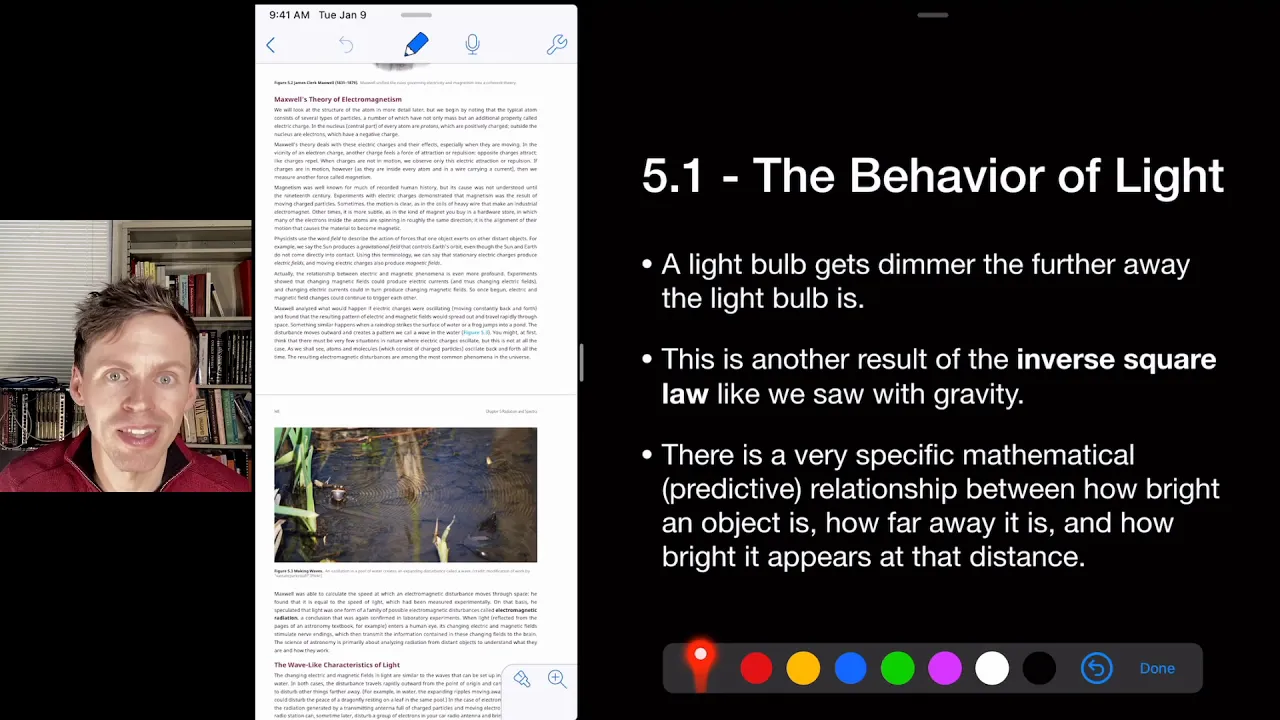
If you’re floating in the ocean, you’ll move up as a wave passes you, then back down, then back up again when the next wave rolls by. The distance between these crests in the wave is called the wavelength. Since light is a wave, it has a wavelength as well, and this may be its single most important feature. That’s because the energy of light is tied to its wavelength.
Light with a shorter wavelength has more energy, and light with a longer wavelength has less energy. And our eyes have a really convenient way of detecting these different energies: color!
What you think of as the color violet is actually light hitting your eye that has a short wavelength.
Red light has a longer wavelength, about twice the distance between crests as violet light.
All the colors in between—orange, yellow, green, blue—have intermediate wavelengths.
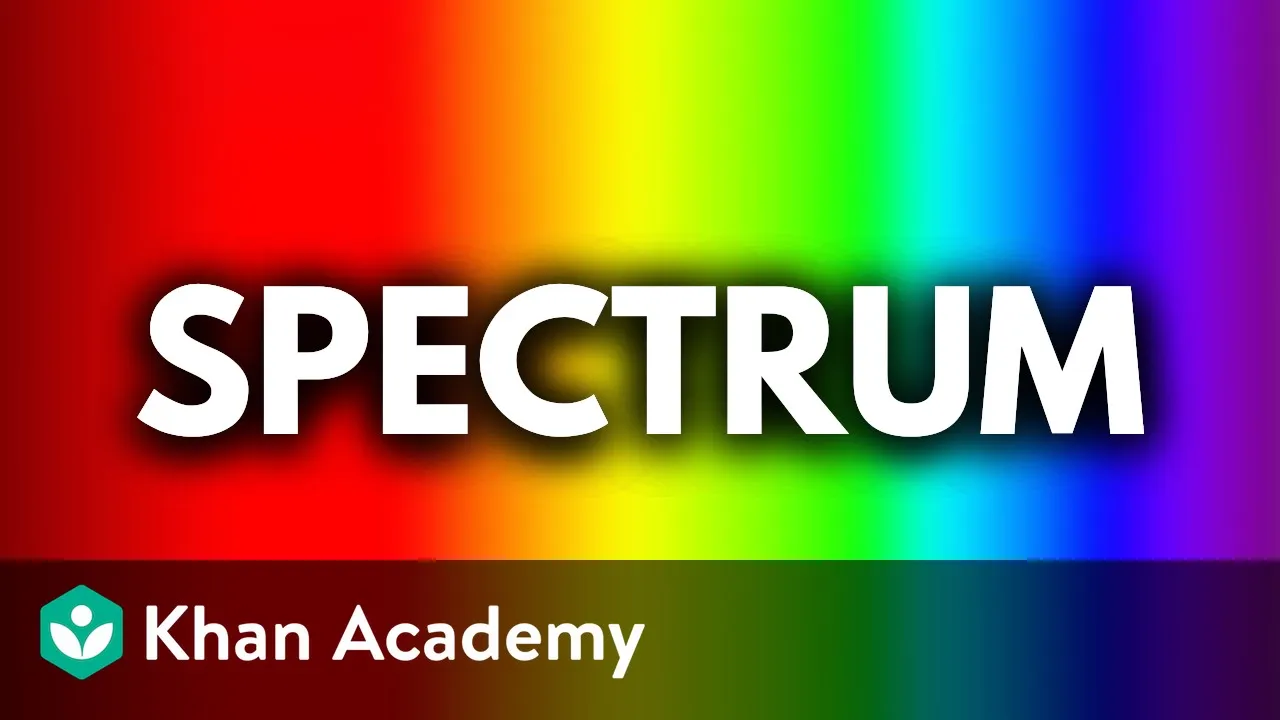
This spread of colors, wavelengths, is called a spectrum.
Over millions of years, our eyes have evolved to detect the kind of light the Sun emits most strongly. Well, that makes sense; that makes it easier for us to see! We call this kind of light visible light.
But that’s just the narrowest sampling of all the different wavelengths light can have.
If light has a slightly shorter wavelength than what our eyes can see, it’s invisible to us, but it’s still real. We call that ultraviolet light. Light with shorter wavelengths than that fall into the X-ray part of the spectrum, and light waves with the shortest wavelengths of all are called gamma rays.
At the other end, light with slightly longer wavelengths than the reddest color we can see is called infrared light. Light waves longer than that are called microwaves, and those with the longest wavelengths of all are called radio waves. These different groups don’t really have hard and fast definitions; just think of them as general guidelines.
But together, we call all of these different kinds of light the electromagnetic or EM spectrum.
And remember, energy goes up when the wavelength gets shorter. So ultraviolet light has a higher energy than violet, X-rays have a higher energy than that, and gamma rays have the highest energy of all. Infrared light has lower energy than red light, microwaves lower than that, and radio waves have the lowest energy.
When you look at the whole EM spectrum, you’ll probably notice that we really do only see a teeny little sliver of it. Most of the Universe is invisible to our eyes! That’s why we build different kinds of telescopes -- to detect the kind of light our eyes can’t detect. They let us see a lot of stuff that otherwise we’d never notice.
So you might be asking: how is light made? Well, one of the most basic properties of matter is that when you heat it up it gains energy, and then it tries to get rid of that energy. Since light is energy, one way to get rid of energy is to emit light.
Another important property of matter is that the kind of light an object emits depends on its temperature. An object that’s hotter will emit light with a higher energy, that is, a shorter wavelength. Cooler objects give off light with a longer wavelength.
You may have seen this in action. Heat up an iron bar and it starts to glow red, then orange, then yellow as it gets hotter. The color, the wavelength, of light emitted changes as the bar heats up.
Astronomers use a shorthand for this. We say that light with a shorter wavelength is “bluer”, and light with a longer wavelength is “redder”. Don’t take this literally! We don’t really mean more blue or more red, just that the wavelengths are decreasing or increasing.
So in this lingo, ultraviolet light is bluer than blue, and X-rays are bluer than ultraviolet.
So objects that are more energetic, that have a higher temperature, are bluer than cooler, redder objects. This rule of thumb works really well for dense objects like iron bars and stars. Even humans! You emit light, but it’s in the far infrared, well beyond what our eyes can see.
There are less dense objects in space, too, like gas clouds, and the way they emit light is different. To understand that, we have to zoom in on them. Way, way in, and look at their individual atoms.
And to understand that, we need to take a brief diversion into atomic structure. Atoms are the building blocks of matter. In general, atoms are made up of three subatomic particles: Protons, neutrons, and electrons. Protons have a positive electric charge, electrons a negative charge, and neutrons are neutral. Protons and neutrons are much more massive than electrons, and occupy the centers of atoms, in what’s called the nucleus. Electrons whiz around the nucleus, their negative charge attracted by the protons’ positive charge.
The type of atom depends on how many protons it has in the nucleus. Hydrogen has one proton, helium two, lithium three, and so on up the periodic table of elements.
It’s common to think of the electron as orbiting the nucleus like a planet orbits the Sun, but that’s not really the case. The real situation is fiendishly complex and involves pretty hairy quantum mechanics, but in the end, the electron is only allowed to occupy very specific volumes of space around the nucleus, and those depend on the electron’s energy.
Think of these like stairs on a staircase, where the landing is the nucleus. When you walk up the stairs, you have to use energy to go up. And when you do, you have to go up a whole step at a time; if you don’t have the energy to get to the next step, you can’t move. You can be on the first step, or the second step, but you can’t be on the first-and-a-halfths step. There isn’t one!
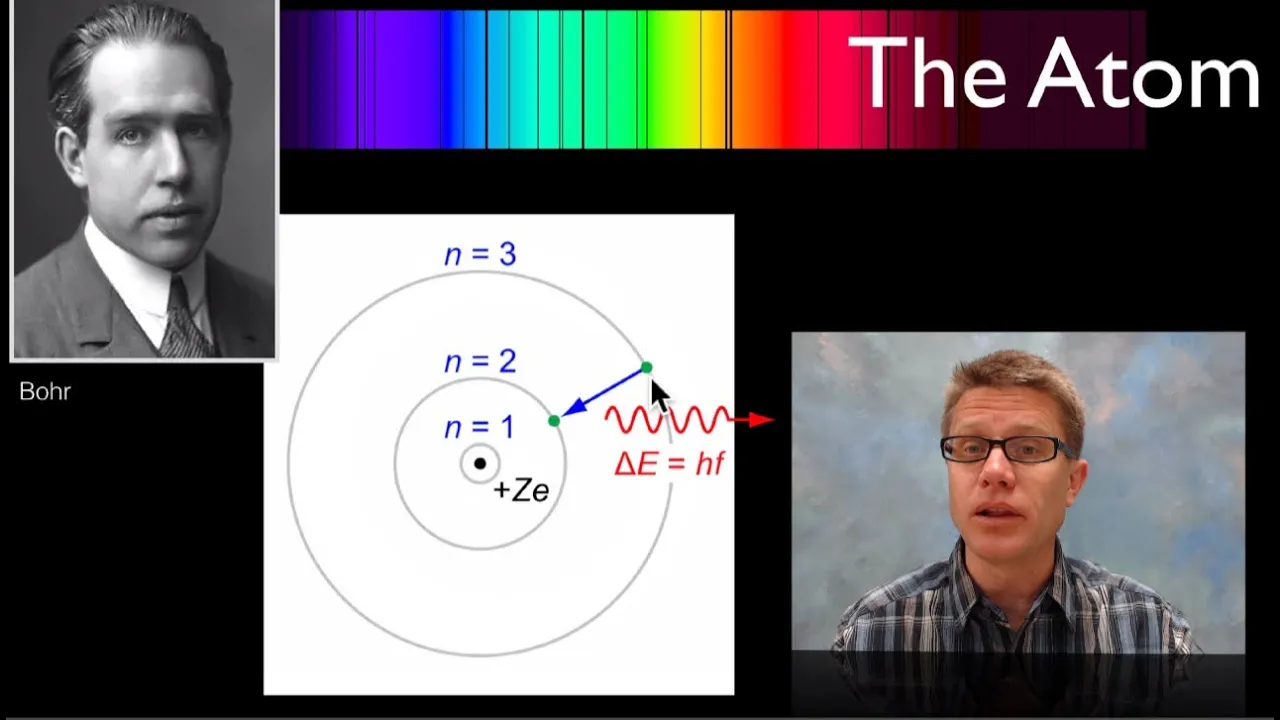
Electrons are the same way. They whiz around the nucleus with a very discrete amount of energy. If you give them an additional precise amount of energy, they’ll move up to the next energy level, the next step, but if you give them the wrong amount they’ll just sit there.
The opposite is true as well; electrons can be in a higher energy state, up on a higher step, and then give off energy when they jump down. The amount they give off is exactly the same amount needed to get them to jump up in the first place.
How do they get this energy? Light!
If light hitting the atom has just the right amount of energy, the electron will absorb it and jump up. It can also jump down and emit light at that energy, too. An electron can also jump two steps, or three, or whatever, but it needs exactly the right energy to do it.
But as I said earlier, energy and wavelength are the same thing, and that’s equivalent to color. So when an electron jumps up or down, it absorbs or emits a very specific color of light.
Not only that, but the steps are different for different atoms. To stick with our analogy, it’s like different atoms are different staircases, with different heights between the steps. So when an electron jumps down a step in a hydrogen atom, it emits a different energy, a different color of light, than an electron jumping down in a helium or calcium atom.
And this, THIS, is the key to the Universe. Because different atoms emit different colors of light, if we can measure that light, in principle we can determine what an object is made of, even if we can’t touch it. Even if it’s a bazillion light years away! And we can.
Can you tell the difference between these two squares? They’re a very slightly different shade of red. Your eye probably can’t tell the difference, but a spectrometer can.
This is a device that can precisely measure the wavelength of light, and can for example distinguish light emitted by a hydrogen atom from light emitted by helium. When you hook one of these spectrometers up to a telescope, you can figure out what astronomical objects are made of.
In the case of thin gas clouds in space, the atoms are basically floating free, rarely bumping into one another. The atoms emit those individual colors of light, allowing us to identify them. Unlike dense stars, the color of the thinner gas depends more on what’s in it than its temperature.
And this is how we learned what the Universe is made of. Stars and gas clouds in space are mostly hydrogen, with some helium and heavier elements thrown in. Jupiter has methane in its atmosphere, Venus carbon dioxide. Everything in the Universe has its own mix of ingredients, like cakes at a bakery. With spectroscopy, we can taste them.
But wait! There’s more.
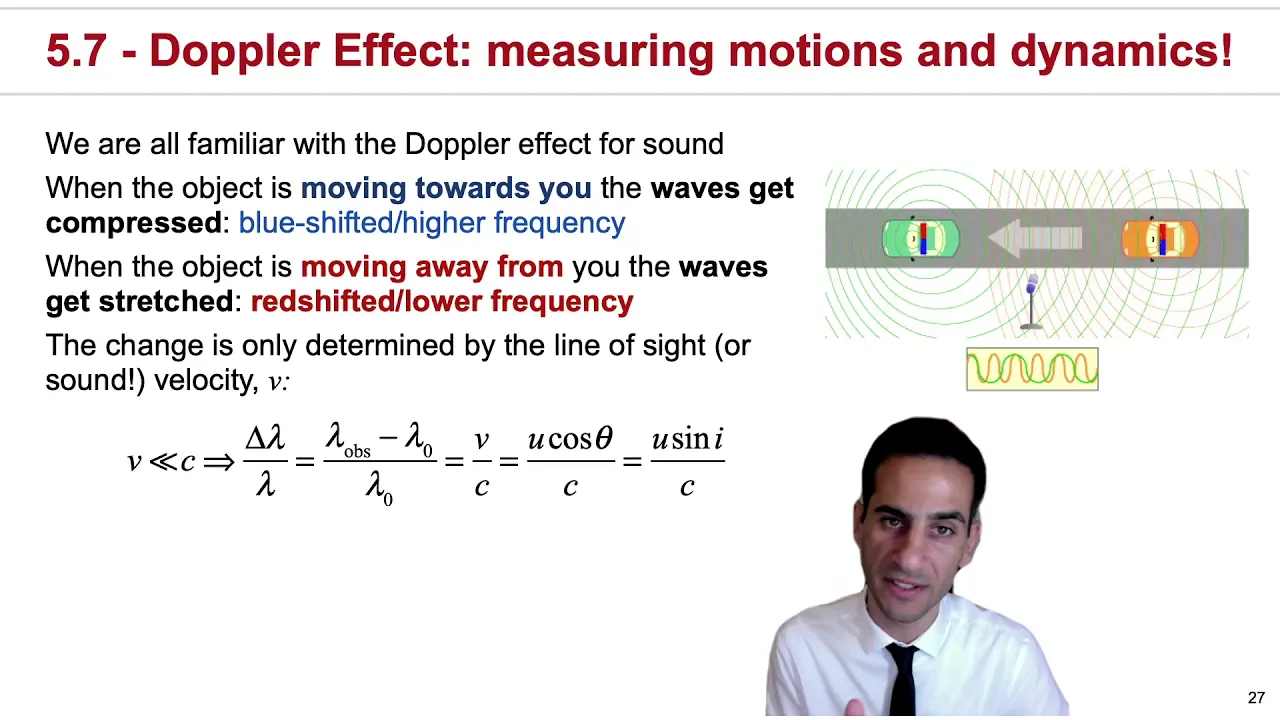
You’re probably familiar with the Doppler effect; the change in pitch when, say, a motorcycle goes by. In sound, the wavelength defines the pitch; higher tones (“eeeee”) have shorter wavelengths, and lower tones (“eeeee”) longer wavelengths. When the motorcycle is headed toward you, the sound waves get compressed, causing the pitch to rise. After it passes you, the pitch drops because the wavelengths get stretched out.
The same thing happens with light. If an object is headed toward you, the wavelength of light from the source gets compressed, shorter. We say the light is blue-shifted. If it heads away, the wavelength gets longer, and it’s red-shifted. Apply that to a spectrum, and by measuring that shift we can tell if an object is moving toward or away from us.
Here’s a teaser: This becomes super important later, when we talk about galaxies.
Spoiler alert: The Universe is expanding, and it's this redshift that allowed us to figure that out.
And that’s still not the end of it. With other spectroscopic techniques we can determine if an object is spinning and how fast, whether it has a magnetic field and how strong it is, and even how massive and dense an object is. A vast amount of the fundamental properties of astronomical objects can be found just by dissecting their light into individual colors.
Almost everything we know about the Universe comes from the light objects in it give off.
Pictures of astronomical objects show us their structure, their beauty, and hint at their history. But with spectra, we can examine their blueprints.
Today you learned that light is a form of energy. Its wavelength tells us its energy and color. Spectroscopy allows us to analyze those colors and determine an object’s temperature, density, spin, motion, and chemical composition.
Crash Course is produced in association with PBS Digital Studios. Head over to their channel for even more awesome videos. This episode was written by me, Phil Plait. The script was edited by Blake de Pastino, and our consultant is Dr. Michelle Thaller. It was directed by Nicholas Jenkins, the script supervisor and editor is Nicole Sweeney, the sound designer was Michael Aranda, and the graphics team is Thought Café.
Up Next

40:28
Stellar Properties & HR Diagram | Measuring Star Temperatures and Masses
@matthewmalkan137
1.4K views•2014-10-13
61:17
First Billion Years of the Universe with the Square Kilometre Array
@iaaudc
121 views•2022-05-26

58:12
The Universe Becomes Visible: Cosmic Dawn and Reionization Explained
@crashcourse
81.5K views•2024-06-05

6:10
Gamma-Ray Bursts: Cosmic Snipers Explained | Astronomy
@kurzgesagt
15M views•2016-07-31
Related Study Plans & Knowledge Roadmaps
Structured learning paths in Astronomy
astronomy
Reionization: Pop III Stars, IGM & 21cm Line
01Foundations of Cosmology & the Early Universe
02Population III Stars & Cosmic Dawn
03Physical Mechanisms of Reionization
+ 2 more learning modules
17h5 modules
Explore Roadmap
astronomy
Planetary Rings: Dynamics, Roche & Resonances
01Foundations of Gravity and Orbital Mechanics
02Tidal Forces and the Roche Limit
03Structure, Composition, and Collisions
+ 2 more learning modules
10h5 modules
Explore Roadmap
astronomy
Asteroseismology: Stellar Waves, Ages & Cores
01Foundations of Stellar Astrophysics & Wave Mechanics
02Stellar Oscillation Modes: P-modes and G-modes
03Mathematical Framework of Asteroseismology
+ 2 more learning modules
35h5 modules
Explore Roadmap
astronomy
Adaptive Optics: Physics, Engineering & Control
01Foundations of Wave Optics and Wavefronts
02Atmospheric Turbulence & Optical Distortion
03Wavefront Sensing Technologies
+ 3 more learning modules
35h6 modules
Explore Roadmap