







![⚡️เสียง 3 : คลื่นนิ่ง สั่นพ้อง บีต ดอปเพลอร์ คลื่นกระแทก [Physics#66]](https://i.ytimg.com/vi/VV7dsl_p5wY/maxresdefault.jpg)





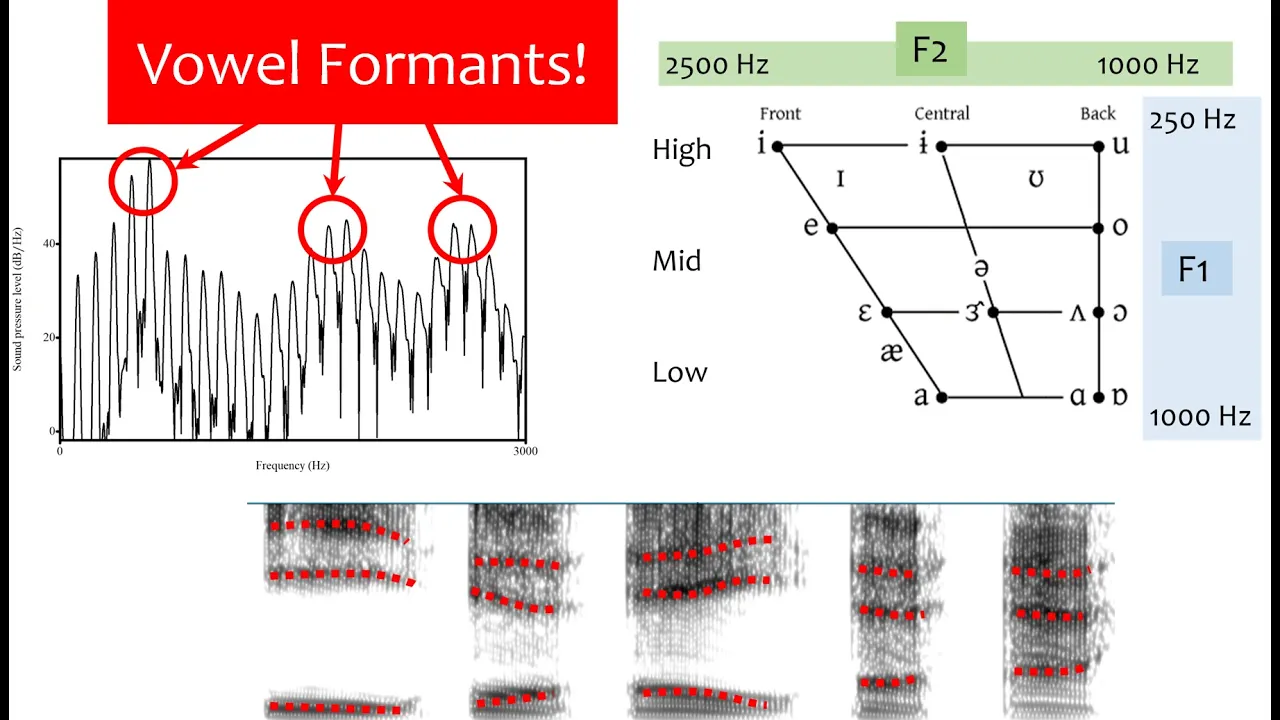









The human vocal tract acts as a resonating tube that filters the sound wave produced by vibrating vocal folds, with formants (resonant frequencies) determining vowel quality; higher tongue positions produce lower first formant (F1) values while tongue frontness affects the second formant (F2), and lip rounding extends the vocal tract to further modify these resonances.
Formants in Speech: Resonance and Vowel Acoustics Explained
Added:Basic acoustics of sound, including the concepts of frequency, amplitude, harmonics, and fundamental frequency (F0).
The Source-Filter Theory of speech production, specifically how the larynx generates source sound and the vocal tract filters it.
Basic anatomy of the vocal tract, including the oral cavity, pharyngeal cavity, tongue, and lips, and how they alter the tract's shape.
The physical concept of acoustic resonance, particularly how air columns in tubes of different shapes amplify specific frequencies.
Acoustic analysis using software like Praat to measure, visualize, and map formant frequencies (specifically F1, F2, and F3) on spectrograms.
The relationship between formant frequencies and the IPA vowel chart, mapping F1 to vowel height and F2 to vowel backness.
Formant transitions and coarticulation, exploring how formants change dynamically during the production of consonants and diphthongs.
Practical applications in speech technology, such as speech synthesis, automatic speech recognition (ASR), and clinical speech therapy for articulation disorders.
59.5K views1.3Klikes9:06Original Release: 2015-09-09
So let’s talk about tubes. You have a lot of tubes inside you - You Tubes. And to a linguist, probably the most interesting of these various passages is your vocal tract, also known as your mouth and throat. You can make a lot of different sounds with your whole acoustic setup - I mean, I’ve made a lot already, and I haven’t even gotten to half of what we can do. But how do all these sounds actually happen when we make them? Well, it’s all in how you shape your tubes. I’m Moti Lieberman, and this is the Ling Space.
If you try blowing across the top of a bottle, and you do it just right, you might notice you can produce a cool hollow sound. And maybe you’ve also noticed that the kind of sound you produce is dependent on how full the bottle is. A mostly empty bottle produces a deep, resonant sound, while a half-full one has a medium sound, and a mostly full one makes for a high-pitched sound. But why is that? What makes the sounds work differently?
Well, the basic idea is this: when you blow across the top of the bottle, you’re introducing a wave into the air inside. And that wave bounces off the fluid in the bottle, and comes back out, crashing into the flow that you’re continuing to produce with the air in your mouth.
Now, in that massive wave mashup, some parts of the wave fare better than others. At those frequencies, the wave that you’re sending in and the wave that’s coming out have the same shape. And when two parts in the wave fit together so nicely, they become super good friends. They double up on top of each other, getting twice the power, which is the strongest sound you can get from the air plus bottle setup. So that’s the quality of the sound you hear emanating from that bottle: that amped up frequency in the wave, flying out of the bottle back to your ears.
So that explains the bottle… but not completely, right? Why is it that the same bottle, with the same you blowing the same way across it, lets out different sounds if you have different amounts of liquid inside of it? Well, it’s not the liquid in there that matters, but the amount of air. The more empty the bottle is, the more space that the wave has to travel through. And if there’s more space, then the parts of the wave that are longer – so, the parts that take more time to go up and down – are going to be the winners in the power doubling competition. When you add more liquid, there’s less space, and so those longer portions of the wave don’t have the room they need to work right. Suddenly, though, ones that are shorter have the advantage – they don’t need all that wiggle room. So they’re the ones that get boosted.
Okay, so there’s only one question left for the bottle. Why do we hear the empty bottle as a low sound, and the mostly full one as a high-pitched sound? Well, the answer is almost hidden right in the question. The longer your wave is, the lower your frequency. Frequency is measured in hertz, which is the number of cycles of a wave you can get through in a second.
Waves like these get repeated over and over: from the crest of the wave, down to the trough, and then all the way back up to the crest again. The longer your wavelength, the fewer times you can complete going through your cycle in a second, because of how far you have to travel between the crest and the trough. And so the lower your frequency. And our ears experience these differences in frequency as pitch. Low frequency sounds have a low pitch, and the pitch rises as your frequency does. Exciting!
But like, weren’t we going to talk about… talking? Not bottles? Well, like we said in the beginning, your whole vocal tract is basically a tube, like the bottle we’ve been talking about. It’s just a more complex bottle than the one you buy for your soda. Let’s say you want to make some speech sounds, get some good vowels going. You blow up air from your lungs, which goes up into your vocal folds, and they start vibrating. That vibration in your larynx is the source of your speech wave.
But your vocal folds basically vibrate at a set rate when you’re talking. They can go up or down a bit, but by and large, your basic, fundamental frequency is just part of your biological makeup. Your vocal folds vibrate at the rate they vibrate. You do you.
So… if you can’t really change the fundamental frequency of the wave, how do we make all the huge variety of different sounds in human language?
Well, basically, it’s by moving our tongue and mouth and lips around when we’re talking.
The wave that’s coming up from the vocal folds might always be pretty much the same, but the position of all that articulatory apparatus in your mouth doesn’t have to be.
By shifting everything around, we can filter the wave in interesting ways, to make parts of it stronger and more resonant, and leave other parts weak.
These resonant frequencies in the wave that we create are known as formants, and they’re pretty much the most important thing when it comes to understanding human speech. The properties of a sound’s formants straight-up tell us what kind of sound it is.
And as we rearrange our vocal tracts for another sound to come out, the changes in the formants tell us where we’re going, and where we’ve come from. Formants mean SO MUCH.
Acoustic phonetics people spend a lot of time looking at spectrograms, where formants are really obvious features, and we’ll be discussing those back on our website. But for here, let’s just look at this: if you know what the first and second formants are, you can pretty much define acoustically what vowel you have. Here’s how this works.
Remember what we said when we talked about what you need to describe a vowel in terms of how you make it – it’s how high your tongue and how open your jaw is; how far front or back in the mouth your tongue is; and whether you’re rounding your lips.
The first of these criteria, so open vs. close, tells you how high the body of your tongue is in your mouth, so how far from your vocal folds the air gets before it really rounds out into the mouth. And that’s super connected to the first formant, or F1.
If your tongue is higher up, like if you make an [i] or [u], there’s more space at the back of your throat there, and so lower frequencies are going to be favoured. Like, an average F1 value for English-speaking women for [u] is 370 Hz.
But if your tongue is lower in your mouth, then you have less space, and F1 is going to be relatively high. So your F1 values for vowels like [ɑ] or [æ] are hundreds of hertz higher; say, an average F1 for [ɑ] for women is 850 Hz. So that’s one piece of information: a low F1 value and your tongue is high, a high F1 value and your tongue is low.
What about the second formant, or F2? Well, this one is related to the position of your tongue relative to the end of your vocal tract, at your lips, where the wave you’ve created escapes out into the world. The further back in the mouth your tongue is, the longer the space to the front of your mouth and sweet airy freedom, and so the lower the frequency.
So, say you’re making an [u]. Your tongue is way far back in your mouth, and there’s a lot of space to the front. That’s why the average woman’s F2 value for [u] is so low, around 950 Hz.
On the other hand, if you make an [i], your tongue is much further forward in your mouth – you can feel it if you go from [u] to [i]. And so your wave is getting filtered through a smaller space, giving you a higher frequency F2 for [i]: about 2790 Hz. This is just like getting a higher pitch from your bottle if there’s more liquid in it!
But wait, you may be thinking. What about the lips? We haven’t accounted for that part of vowels. Well, feel what happens when you round your lips, like when you move from [i] to [y]. They move outwards, right? And so what lip rounding does is extend your vocal tract that little bit. And that makes the F2 value go down: now there’s more space before your speech wave can escape. Lip rounding makes things sound like they’re further back in your mouth.
From an acoustic perspective, this is why languages usually have you round your lips for back vowels, but not for front ones. It keeps the distinction crisper: once you round a front vowel, it makes it sound more back-y. That helps explain why when English speakers hear the French [y], as in [tsy] “tu”, they classify it as [tu], and not [ti].
So when you’re thinking about vowels, just remember that inverse relationship between space and frequency: the more space, the lower resonant frequencies your formants will have.
And if you just know what those two formant values are, you can do a really good job of working out what vowels people are saying.
That’s basically what our brains are doing the whole time when we’re listening to people talk – they’re tracking those formants. The acoustics of consonants get a bit more complicated, and we’ll come back to talk about those in the future. But so much of speech comes down to the way you mess with the tubes in your face. It gives YouTube a whole new meaning.
So we’ve reached the end of the Ling Space for this week. If you followed all of my formants, you learned that different parts of waves get amplified depending on the properties of the space they’re traveling through; that your vocal tract is a filter on the wave produced by the source at your vocal folds; and that the first two resonant bands, or formants, produced by your mouth filter can define vowels.
The Ling Space is produced by me, Moti Lieberman. It’s directed by Adèle-Elise Prévost, and it’s written by both of us. Our editor is Georges Coulombe, our production assistant is Stephan Hurtubise, our music is by Shane Turner, and our graphics team is atelierMUSE.
We’re down in the comments below, or you can bring the discussion back over to our website, where we'll have some extra material on this topic. Also, try dropping by our new store, where we have a bunch of cool linguistics stuff. Check us out on Tumblr, Twitter and Facebook, and if you want to keep expanding your own personal Ling Space, please subscribe.
And we’ll see you next Wednesday. To:fa:!
Up Next

3:11
Praat Tutorial: Measure Vowel Formants (F1 & F2) in Acoustic Analysis
@linguistiklaboralbert-ludw3514
44.5K views•2019-05-04
36:52
Constraint Interaction in Optimality Theory: Epenthesis & Deletion
@Vidyamitra
180 views•2018-08-20
10:17
Optimality Theory: Constraints on Linguistic Sounds Explained
@thelingspace
42.9K views•2016-12-01

21:32
Accent Expert Explains U.S. Regional Dialects | Part 1
@WIRED
9.3M views•2021-01-21
Related Study Plans & Knowledge Roadmaps
Structured learning paths in Linguistics
linguistics
Optimality Theory: Tableaux & Constraints
01Phonological Basics: Sounds, Syllables & Rules
02Foundations of Optimality Theory: GEN, CON, and EVAL
03The Constraint Inventory: Markedness vs. Faithfulness
+ 2 more learning modules
15h5 modules
Explore Roadmap
linguistics
Morphosyntactic Alignment: S, A & P Systems
01Foundations of Syntax: Transitivity and Arguments
02The Linguistic Variables: Mapping S, A, and P
03Nominative-Accusative Alignment
+ 3 more learning modules
12h6 modules
Explore Roadmap
linguistics
Analyzing Sign Language: Phonology & Syntax
01Foundations of Sign Language Linguistics
02Phonology: The Five Parameters of a Sign
03Morphology: Word Formation and Classifiers
+ 2 more learning modules
14h5 modules
Explore Roadmap
linguistics
Pragmatics: Speech Acts, Grice & Politeness
01Introduction to Pragmatics: Meaning in Context
02Grice’s Cooperative Principle & Implicature
03Speech Act Theory
+ 2 more learning modules
14h5 modules
Explore Roadmap