

















![#14 O ANIMAL SOCIAL (Elliot Aronson e Joshua Aronson) - CAP 2 - Parte 11 [Série Dissecando Livros]](https://i.ytimg.com/vi_webp/PQvhqxG-mA8/maxresdefault.webp)







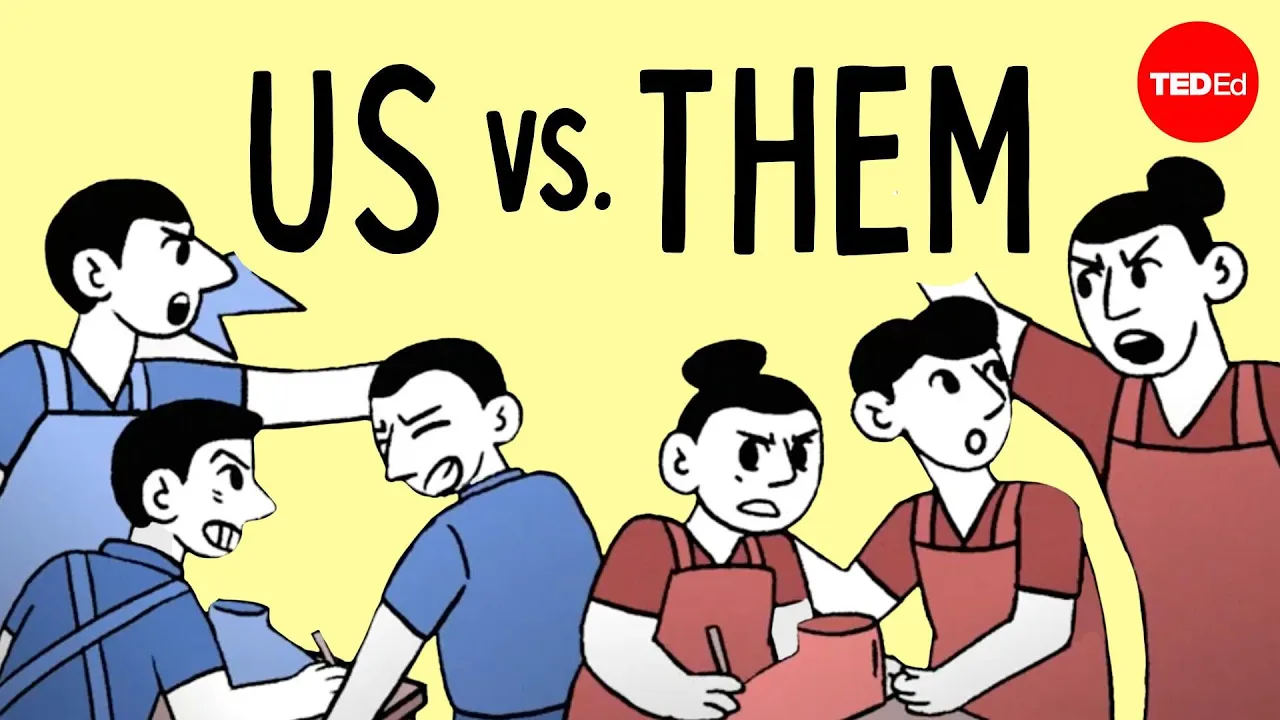
Social identity theory, pioneered by Henri Tajfel, explains that simply belonging to any group—whether meaningful or arbitrary—can create bias through in-group favoritism and out-group derogation, as demonstrated by the minimal group paradigm where participants discriminated against strangers based on meaningless assignments like overestimating or underestimating dot counts.
Social Identity Theory Explained: Us vs. Them Psychology
Added:Basic concepts of Social Psychology, including how social contexts and social structures influence individual behavior.
The cognitive process of categorization, specifically how the human brain groups objects and people to simplify information processing.
The psychological definition of self-concept and self-esteem, and how individuals derive their sense of worth.
The fundamental distinctions between prejudice (attitudes), stereotypes (beliefs), and discrimination (behaviors).
Henri Tajfel's Minimal Group Paradigm experiments, which served as the empirical foundation for Social Identity Theory.
Self-Categorization Theory (SCT), which extends SIT by explaining the cognitive processes behind depersonalization and group cohesion.
The Contact Hypothesis and the use of superordinate goals (e.g., Sherif's Robbers Cave experiment) to reduce intergroup conflict.
The Common In-group Identity Model, exploring how recategorizing 'us' and 'them' into a single subordinate group can mitigate bias.
87.3K views1.9Klikes13:36Original Release: 2021-01-25
if you've ever heard of people talk about in-groups versus out-groups tribalism or an us versus them mentality we can understand those concepts through an influential theory in social psychology called social identity theory so let's start with the basics what do we mean by social identities to find out i talked to dr j van bavel a psychology professor at nyu and an expert on social identity theory and so it's basically changing uh the way we think about ourselves from me to we and when you have that social identity activated so for example i'm canadian and i've been watching the world junior hockey championship which probably means almost nothing to anybody who listens to this podcast unless you're canadian and it's like this this tradition around christmas and when i watch it and i see all these players in the red with my beliefs on their jerseys and they play the national anthem after the game i'm i'm thinking about myself as a canadian so i'm i'm a fluid person i'm a somewhat of a social chameleon just like we all are and that whichever person i'm interacting with or when i'm watching on tv or interacting how i'm interacting with people on social media activates different types of uh shared identities that i have with people and then i see myself in a different way and think in a different way and act in a different way so again our social identities are the parts of us defined by the groups that we belong to and this gives us a handy set of terms for talking about things first in groups are the groups you belong to they're your social identities your hometown religious affiliation school those are your in-groups they're part of who you are so then out groups are the groups we don't belong to like i'm from the united states and so for me canadians are my out group growing up i was a cubs fan and so sox fans would be my out group now i gave some relatively innocuous examples of in-groups and out-groups and it's just to make the point that this is all just a basic way that our brain thinks about our social identities but of course the kinds of identities we're often more interested in are things like racial gender and sexual identities and researchers have even recently started looking at politics as an important social identity for example the animosity that we're seeing between democrats and republicans in the united states may in part be a case of social identity theory in action because all of this co-mingling of our identity the people in our in groups the people in our out groups it can make for some trouble and to understand why we need to acknowledge that people oftentimes want to see themselves positively we like our self-esteem to be high generally and one place we get our self-esteem is from our social identities i get to feel good when i belong to a group that is good it's a concept called basking in reflected glory and some of the earliest evidence for it came from research on sports fandom they tracked college students at seven different universities over the course of a football season and in particular they were paying attention to what these students were wearing the monday after a school's football team won a game students were wearing university apparel all over the place but the monday after a school's football team lost a game there was neri a university logo to be found on campus in later experiments they would ask students to describe a game that their school's football team had won and in those cases students would say things like we made a lot of great plays but when they instead asked them to describe a game that their school's team had lost they say things like yeah they fumbled the ball a lot the idea is that we take our group's virtues as our own we use our group's successes to fuel our own self-esteem but the connection between how we see ourselves and how we see our groups it's a two-way street one of the core reasons we identify with groups is because it makes us feel better about ourselves we want to be part of distinctive positively distinctive groups groups that are doing well in society um you know you don't want to often identify with low status groups and in fact people will shift how they identify to align with you know i i have the flexibility as i said to identify as a canadian as an academic as a dad um as an ohio state alumnus and that might shift depending on what's going on in the world so while basking in reflected glory is a way for us to gain self-esteem from our groups being good our need for self-esteem can also warp the way we see our groups to begin with you can think of it like a simple logic problem i'm a good person and i belong to this group therefore that group must be good after all what's a good guy like me doing in a bad group it's got to be the good group this results in two key biases in-group favoritism and out-group derogation in-group favoritism just means that all else equal we have a bias to see our in-groups positively and out-grouped irrigation is just the opposite our bias to see out-groups negatively and both of these biases can serve our self-esteem either by convincing ourselves that we belong to the good group or that at least we don't belong to the bad group okay so this can be pretty tricky to study because after all social identity theory says that just belonging to a group any group is enough to kick this stuff into motion but of course the kinds of prejudice we're usually interested in understanding are dripping with history preconceptions struggles for power so how can we strip away all the baggage that comes with our identities and test the very simple prediction that simply associating with any group is enough to create discrimination now it turns out there's a pretty simple elegant way to do this and it goes back to the research of a guy named henry toshville taj fell was born in 1919 into a jewish family in poland in the 30s he went to study chemistry in france and later joined the french military during the second world war he was captured by the germans and survived as a prisoner of war the rest of his family wasn't so lucky after the war taj fell discovered that his whole immediate family and many of his friends had been killed by nazis in the holocaust and in the wake of such an enormous tragedy tascheval couldn't shake the question how could this happen what gives rise to this kind of hatred between groups as an aside it's worth noting that despite his painful history and his contributions to understanding prejudice it's recently been highlighted that taj fell was frequently engaged in sexual harassment against young women at his university and even though gender is a social identity like any other tashvel was resolutely uninterested in applying social identity theory to understanding gender dynamics anyhow by the 1960s tashfl had started to study social psychology and at the time psychologists had a few ideas about where prejudice comes from some of the research was focused on personality traits that are related to prejudice other research was looking at how things like frustration can make people lash out aggressively at other people but taj fell just wanted to start from scratch he thought let's conduct an experiment where we create totally random arbitrary meaningless groups we'll establish a baseline for when there are groups but no prejudice and then we'll slowly layer meaning onto those groups until we see prejudice emerge then we'll really understand things but it turned out taj fell never had to add any meaning to those groups he found that just creating groups any group arbitrarily was enough for prejudice to emerge yeah in many ways the minimal groups are like one of the most interesting control conditions in the history of social sciences let's look at one example of how he did this i'm about to show you a random set of dots on the screen and i just want you to guess how many dots there are and and really do this make a guess ready [Music] okay how many do you think there were the right answer is 36. now it turns out that some people have a tendency to overestimate numbers in games like this so if you guessed a number above 36 that makes you an overestimator but other people have a tendency to underestimate numbers in games like this so if you guessed a number below 36 that makes you an underestimator and this is exactly what taj fell did to create groups based on totally artificial meaningless information he was able to assign people to a social identity either as an overestimator or an underestimator and here's the thing i lied to you there were not 36 dots on the screen so the group you think you belong to is even more bogus than you realized but in his experiments he would tell people that they had to decide how much money to give to other participants in the study and all people saw were a couple random id numbers and whether they belonged to overestimators or underestimators sure enough despite only knowing meaningless information about strangers they would never meet people who thought they were overestimators tended to give more money to their fellow overestimators at the expense of underestimators and vice versa this kind of study came to be known as the minimal group paradigm because they were creating groups out of basically nothing groups that had nothing to do with the kinds of decisions that people would end up having to make and yet over and over and over again studies have shown that these dumb little identities lead to discrimination okay before we wrap up there's a couple issues that i want to consider i've given you the classic version of social identity theory and it's held up pretty well one of the great things about social identity it was developed in the 70s you know the minimal group studies are turning 50 years old this year and so it is one of those uh mo you know one of the most foundational insights instead of studies and launched this whole theoretical framework but in all of that time we've made some refinements one interesting point that i like to emphasize is that bias can come from in-group favoritism by itself out-group derogation by itself or both at the same time and when researchers have looked closely at how much of prejudice is due to each of these biases they actually find that it's in-group favoritism that often carries more of the blame after all we know it's wrong to dislike someone because of the group they belong to but it doesn't always feel nearly as wrong to go out of your way to help someone a little extra because they're connected to you somehow now this isn't to say of course that outgroup derogation never happens and it's also definitely not to excuse in-group favoritism however you slice the prejudice pie it's still prejudice pie and why do you have prejudice pie in the first place the other refinement has to do with the self-esteem stuff i made a big deal about the early days of social identity theory really emphasized how our need to feel good about ourselves fuels this kind of discrimination but when researchers have looked more closely at the evidence self-esteem isn't always a clear culprit so even though these social identity biases show up again and again and again the exact reason why is still something we're testing in the end social identity theory has been a powerful force in the study of prejudice and discrimination sheerly by virtue of having social identities our psychology sets us up to see the world in terms of us versus them which can have some pretty ugly consequences now it's important to note that social identity theory is not all you need to make sense of prejudice things like racism and sexism go way deeper than simple social identity and i'm not trying to say that racism is equivalent to prejudice against overestimators but the research and social identity makes it clear that it does at least have a small but reliable role in the social biases that we see and it's given us some ideas about how to address those biases but more on that later thanks for watching to learn more about this topic you can check out my podcast opinion science where you can find the full interview with dr j van bavel about social identity theory and all sorts of other topics in the world of our opinions and how they change so subscribe to the podcast subscribe to this youtube channel for more about social psychology and i'll see you next time you
Up Next

11:38
The Psychology of Decision-Making: Soldier vs. Scout Mindset
@TED
2.3M views•2016-08-08

68:32
Cognitive Skills for Differentiated Instruction | Teacher PD
@BrainWareLearning
631 views•2017-12-17

9:55
Thinking, Fast and Slow: Daniel Kahneman Animated Book Summary
@FightMediocrity
2.3M views•2015-06-05

6:40
The Nocebo Effect: How Beliefs Can Cause Real Harm
@CGPGrey
10.4M views•2013-12-23
Related Study Plans & Knowledge Roadmaps
Structured learning paths in Psychology
psychology
Neuroscience of Creativity: Networks & Training
01Foundations of Creative Cognition
02The Cognitive Neuroscience of Insight & Fixation
03The Triple Network Model of Creativity
+ 1 more learning modules
15h4 modules
Explore Roadmap
psychology
Imposter Syndrome: Etiology & CBT Framework
01Defining the Imposter Phenomenon
02Socio-Developmental Etiologies
03CBT Fundamentals & Thought Distortions
+ 2 more learning modules
15h5 modules
Explore Roadmap
psychology
Adult ADHD: Executive Dysfunction & Scaffolding
01Neurobiology of the ADHD Brain
02The Core Triad of Executive Deficits
03Executive Dysfunction and Emotional Regulation
+ 2 more learning modules
12h5 modules
Explore Roadmap
psychology
Loneliness: Evolution, Neurobiology & CBT
01Evolutionary Origins of Human Connection and Loneliness
02The Neurobiology and Physiology of Chronic Loneliness
03Maladaptive Social Cognition: The Psychological Loop
+ 2 more learning modules
12h5 modules
Explore Roadmap