Neuroscience of Creativity: Networks & Training
Learning Goal: Deconstruct the neurocognitive mechanisms of creative problem-solving and insight—specifically the interaction between the default mode and executive control networks—and design an evidence-based cognitive training protocol to overcome mental fixation and enhance divergent thinking.
- Prerequisites: Introduction to basic neuroanatomy (highly recommended but not mandatory).
- Estimated Total Study Time: 15 Hours
Module 1: Foundations of Creative Cognition
This module establishes the foundational cognitive frameworks of creative thought. You will explore the operational definitions of creativity, distinguishing between divergent thinking (the generation of multiple open-ended solutions) and convergent thinking (the analytical convergence on a single optimal solution). You will also be introduced to network neuroscience, which models the brain not as a collection of isolated regions, but as a complex system of interconnected functional nodes.
Recommended Videos
Why this video
Dr. Tina Seelig provides a concise, high-impact conceptualization of divergent thinking. She illustrates how divergent tasks bypass traditional analytical blocks to generate a vast space of possible solutions, serving as an excellent baseline introduction to the cognitive mechanics of creativity.

Why this video
This video systematically unpacks divergent thinking from a cognitive psychology perspective. It highlights the core differences between structured, non-linear ideation and logical, single-answer convergent thinking, establishing the cognitive metrics (originality, fluency, flexibility) used in research.
Why this video
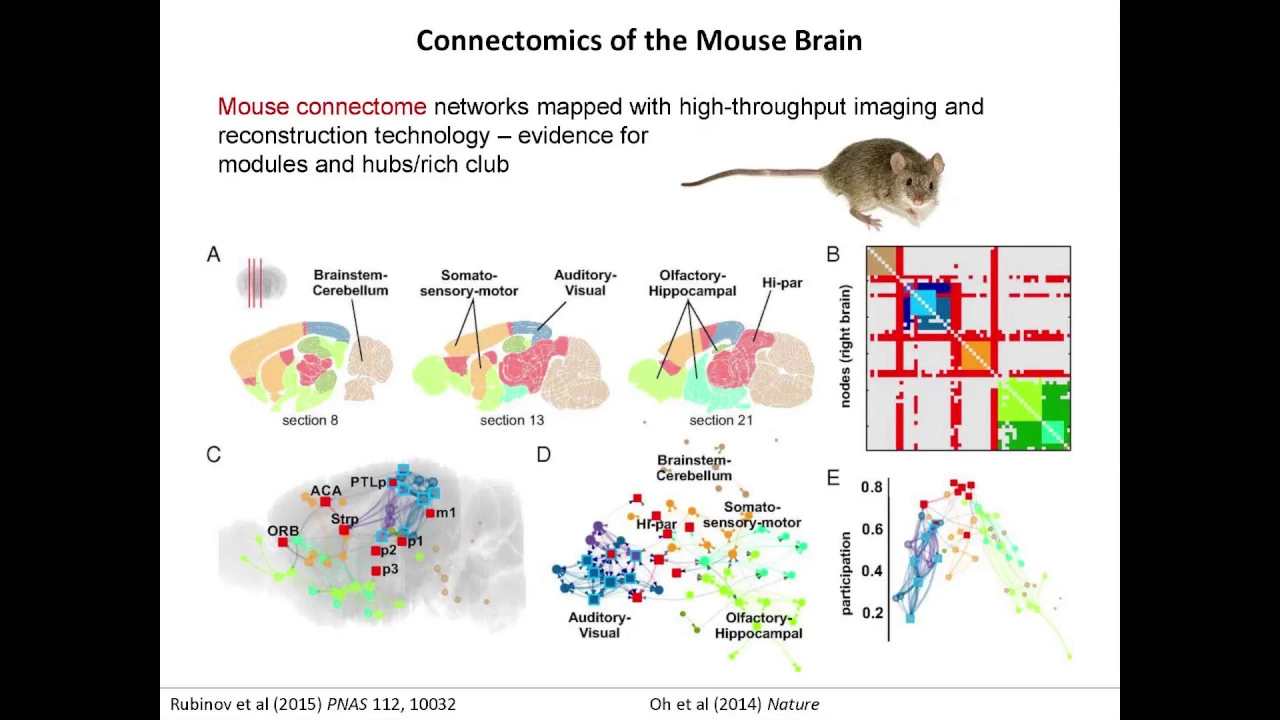
Presented by Olaf Sporns, a pioneer in the field of connectomics and network neuroscience, this academic lecture explains how graph theory and network science are applied to the human brain. It details how the brain functions as a complex network of nodes (brain regions) and edges (structural or functional connections), which is crucial for understanding how large-scale brain networks interact during creative tasks.
Knowledge Checkpoint
- Define the core differences between divergent and convergent thinking.
- Explain how creativity is mathematically and behaviorally evaluated (originality, fluency, flexibility, elaboration).
- Understand the basic components of network neuroscience (nodes, edges, structural connectome, and functional connectivity networks).
Module 2: The Cognitive Neuroscience of Insight & Fixation
This module dives deeply into the neural and psychological roadblocks of creativity: mental sets and functional fixedness. You will learn how the brain gets stuck on conventional object uses or analytical pathways. Conversely, you will examine the exact neurocognitive transitions that occur during the "Aha!" or Eureka moment—deconstructing how the right hemisphere (specifically the right anterior superior temporal gyrus) suddenly integrates distant semantic concepts to yield immediate, structural breakthroughs.
Recommended Videos
Why this video
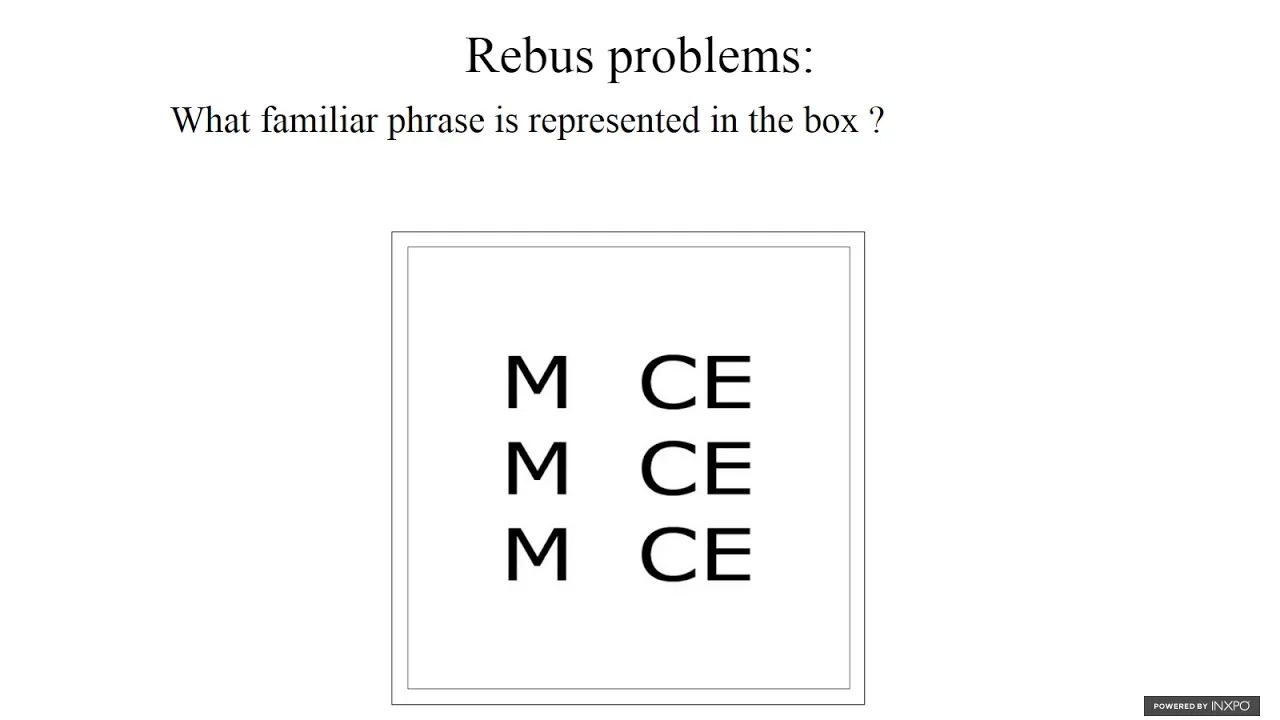
This comprehensive seminar is a masterclass on the biological mechanisms of the insight experience. It details how insight-based problem-solving differs structurally and neurologically from step-by-step analytical problem-solving, showcasing advanced fMRI and EEG findings.

Why this video
John Kounios, a leading cognitive neuroscientist in the study of creative insight, explains how researchers design experiments (like the Remote Associates Test) to isolate and measure the precise moments of "Aha!" under fMRI and high-density EEG.
Why this video
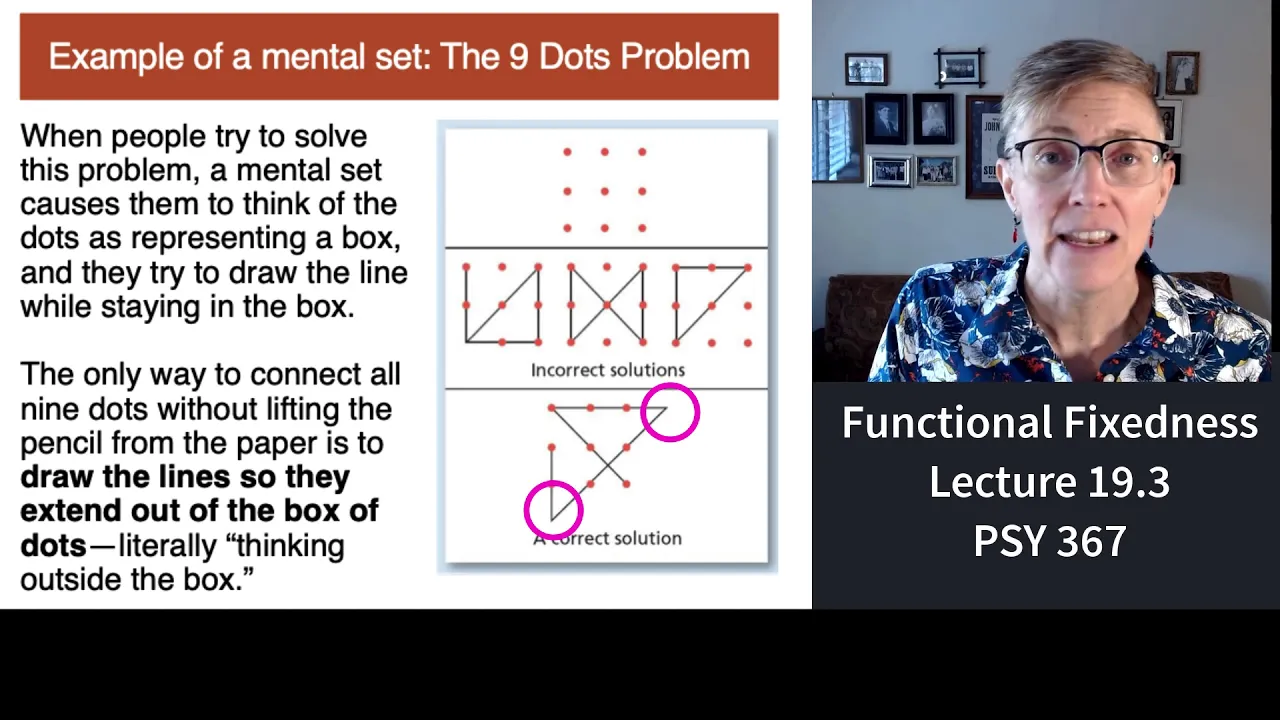
This academic lecture provides a rigorous breakdown of functional fixedness and mental sets. By analyzing classic cognitive psychology challenges—such as Duncker's Candle Problem and the Two-String Problem—it highlights how top-down executive biases restrict alternate categorization of objects.

Why this video
This clip focuses on the pivotal neuroimaging research of Mark Beeman. It points out the exact spatial location in the brain—the right anterior superior temporal gyrus (aSTG)—that lights up with a burst of high-frequency gamma-band oscillations at the exact millisecond of an insightful breakthrough.
Knowledge Checkpoint
- Describe the difference between analytical problem-solving and insight-based problem-solving.
- Explain "functional fixedness" and identify the cognitive biases that enforce it.
- Pinpoint the specific brain region and neural signal frequency (e.g., gamma burst in the right anterior superior temporal gyrus) associated with insight.
- Articulate how a "mental set" prevents individuals from adopting more efficient, novel solutions.
Module 3: The Triple Network Model of Creativity
The core of modern creative neuroscience rests on the dynamic interaction of three large-scale brain networks: the Default Mode Network (DMN), the Executive Control Network (ECN), and the Salience Network (SN). In this module, you will analyze how creative generation is not local to a "creative right brain" but relies on these networks cooperating over time. You will also examine dynamic functional connectivity—how the brain moves between highly integrated and segregated states on a second-by-second basis to balance raw exploration with critical evaluation.
Recommended Videos

Why this video
Dr. Roger Beaty, a primary investigator in the neuroscience of creative networks, outlines how the DMN (associated with spontaneous thought and imagination) and the ECN (responsible for goal-directed evaluation) dynamically cooperate during creative tasks—challenging older models of hemispheric dominance.
Why this video
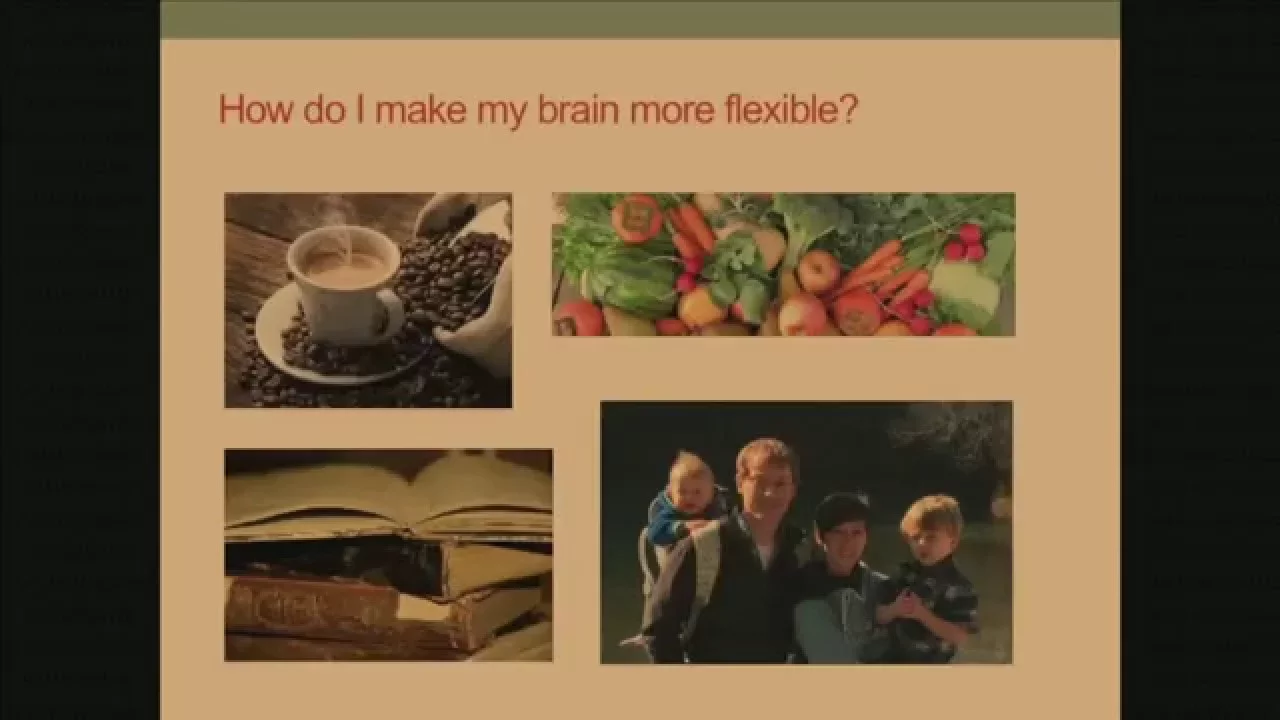
Dr. Danielle Bassett applies network science to the cognitive dynamics of human thought. This lecture explains how the brain's network architecture reorganizes during learning and novel ideation, showing how network flexibility acts as a predictor of cognitive adaptability.

Why this video
This rigorous neuroimaging seminar explores "Dynamic Functional Connectivity." It introduces advanced methodologies like sliding-window correlation analysis used to capture how functional connections between networks shift over time, rather than averaging them into a single static model.
Educational Note & Gap Advice
While the underlying lectures from pioneering neuroscientists (Beaty, Bassett, Chang) establish the mathematics of dynamic connectivity, fMRI analysis, and basic triple-network interactions, there is a minor content gap in direct, simplified visual animations of the Triple Network Model specifically operating during the creative cycle.
To supplement this visually, search independent platforms for the term:
"Triple Network Model creativity fMRI animation"or"DMN ECN Salience Network interaction in creative cognition"
Focus your self-study on how the Salience Network (SN) acts as an active switch, detecting internally generated ideas from the DMN and passing them to the ECN for execution, monitoring, and structural selection.
Knowledge Checkpoint
- Detail the classical cognitive functions of the Default Mode Network (DMN) and the Executive Control Network (ECN).
- Explain how the Salience Network (SN) acts as a dynamic "switch" between these two networks.
- Describe the methodology of "sliding-window analysis" in fMRI and what it reveals about time-varying functional connectivity.
- Explain how highly creative individuals are able to co-activate the DMN and ECN simultaneously during tasks.
Module 4: Evidence-Based Cognitive Training Protocols
This module translates neural insights into deliberate, scientifically validated interventions. Rather than relying on commercial "brain games," you will focus on training paradigms designed to overcome functional fixedness and boost divergent thinking. You will analyze protocols utilizing cognitive flexibility training, Alternate Uses Test (AUT) practice, and tactical cognitive shifting—demanding that you construct a targeted, empirical training framework.
Recommended Videos
Why this video
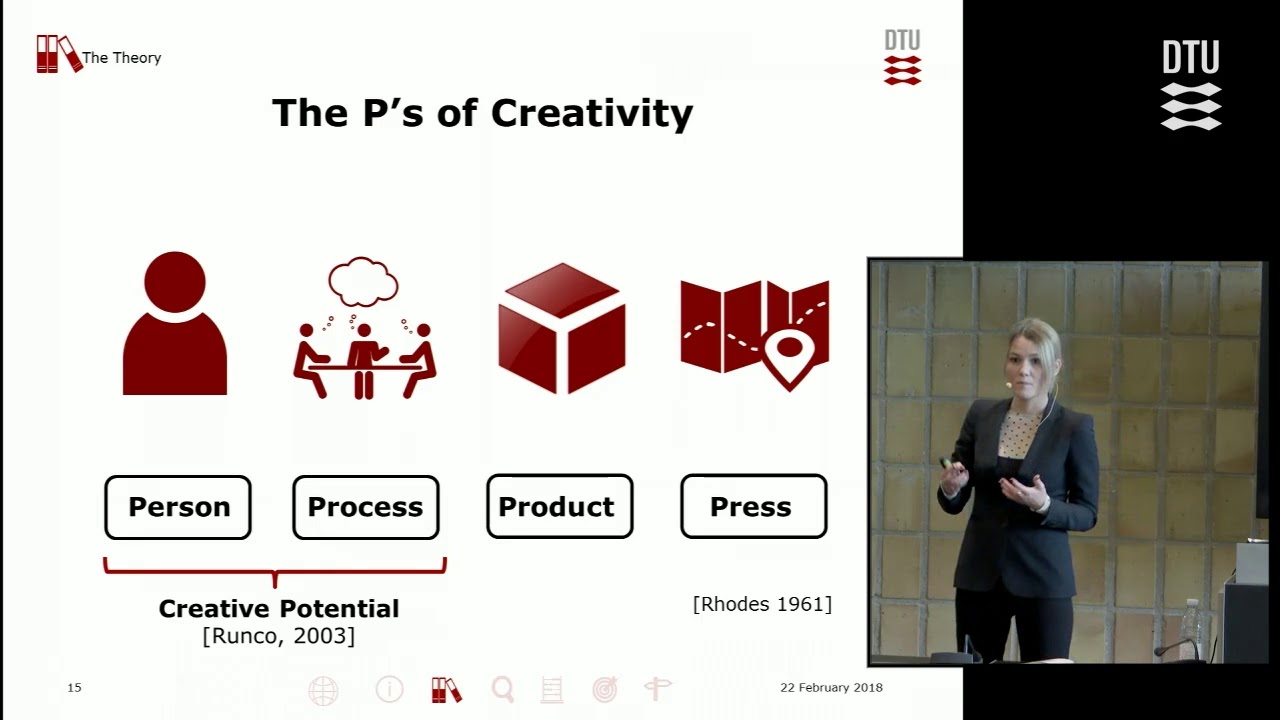
This video profiles an empirical study evaluating a structured training program. It demonstrates how researchers utilize pre- and post-testing (using the Alternate Uses Test and Remote Associates Test) alongside a Metacognitive Awareness Inventory to scientifically track and confirm modifications in creative thinking capabilities.

Why this video
This clip outlines explicit cognitive flexibility training techniques. It introduces structured exercises such as "steelmanning" (arguing against your own position as strongly as possible), the "devil's advocate protocol," and "assumption audits." These represent highly practical, cognitive interventions designed to shatter rigid mental sets and default assumptions.

Why this video
This video provides a structural framework for what makes cognitive training effective. It outlines key principles: protocols must have measurable goals, be evidence-based, feature progressive challenges, cross-train multiple integrated cognitive systems, and provide structured feedback.
Academic Gap Protocol
The general YouTube ecosystem lacks highly technical, step-by-step videos detailing clinical and laboratory-based protocols for divergent thinking training (such as exact semantic distance training or targeted executive inhibition paradigms).
To build your evidence-based cognitive training protocol, perform an academic search on Google Scholar, PubMed, or your institution's database for:
"Alternative Uses Task cognitive training protocol"(Focus on studies showing how training participants to decompose objects into their physical properties, i.e., "generic parts technique," systematically reduces functional fixedness)."Tactical cognitive shifting interventions creativity"(Research how deliberate switching between divergent generation and convergent editing over tight intervals trains the Salience Network's flexibility)."Transcranial direct current stimulation (tDCS) of ECN/DMN in divergent thinking"(Explore how neuromodulation of the left dorsolateral prefrontal cortex affects functional fixedness).
Knowledge Checkpoint
- Differentiate between commercial, unvalidated "brain-training" games and scientifically validated cognitive training protocols.
- Explain the "Generic Parts Technique" (decomposing an object into its basic material properties) and how it neurologically bypasses functional fixedness.
- Detail how to structure a pre-test/post-test framework to measure changes in divergent thinking (fluency, originality, flexibility) and convergent insight.
- Formulate a daily 20-minute cognitive flexibility drill incorporating a specific combination of tactical shifting and assumption audits.
Course Map
Below is the recommended sequence of modules. Each module acts as a prerequisite for the next, moving from foundational neurobiology to target-driven practical application.
Key People Index
- John Kounios, PhD (Drexel University): Pioneering cognitive neuroscientist focused on the neural substrates of insight, co-author of The Eureka Factor. He pioneered the use of combined fMRI and high-density EEG to record the sub-second transitions of the "Aha!" moment.
- Mark Beeman, PhD (Northwestern University): Leading researcher on the hemispheric differences in processing semantic information. He discovered the critical role of the right anterior superior temporal gyrus (aSTG) in processing insightful solutions.
- Olaf Sporns, PhD (Indiana University): Distinguished professor of brain sciences, co-founder of the field of Connectomics. His work establishes how network topology and graph theory explain the communication across large-scale brain networks.
- Danielle S. Bassett, PhD (University of Pennsylvania): Physicist and network neuroscientist. Her work utilizes network control theory and dynamic functional connectivity to map how the brain transitions between different cognitive states.
- Roger Beaty, PhD (Penn State University): Director of the Cognitive Neuroscience of Creativity Lab. His research explores how the creative brain coordinates large-scale networks (DMN, ECN, and SN) during creative thought processes.
- Adam Zeman, MD (University of Exeter): Professor of Cognitive and Behavioral Neurology. He specializes in the neural basis of visual imagination and has extensively researched the spectrum of visual imagery (including aphantasia and hyperphantasia).
Final Self-Assessment
Review your understanding of the entire curriculum by assessing whether you can confidently execute and answer the following operational requirements:
- Can you define "creativity" using the scientific consensus definition (novelty and usefulness within a given social context)?
- Can you diagram the structural and functional differences between divergent and convergent thinking?
- Can you explain the cognitive bias of functional fixedness, using Duncker’s Candle Problem to illustrate how top-down semantic constraints limit problem-solving?
- Can you outline the exact electrophysiological signature of an insight moment, including the hemisphere, specific gyri, and wave frequency?
- Can you detail the classical, distinct roles of the Default Mode Network (DMN) and Executive Control Network (ECN)?
- Can you explain how the Salience Network (SN) functions to switch dynamic states between the DMN and ECN?
- Can you explain the concept of "Dynamic Functional Connectivity" and how sliding-window analysis differs from static functional connectivity maps?
- Can you design a pre-test/post-test cognitive experimental protocol to track changes in a subject's creative original ideation over a six-week training protocol?
- Can you apply the "Generic Parts Technique" to systematically deconstruct a novel physical object into non-functional, raw material components to bypass a mental set?
- Can you draft a 15-minute training drill that explicitly exercises "tactical shifting" between raw generation (DMN active) and analytical editing (ECN active)?