



















Brain networks are mathematical representations of the brain as collections of nodes (brain regions or neurons) connected by edges (physical or functional connections), enabling researchers to analyze brain architecture across species using network science principles such as modularity, hub nodes, and rich club organization; this framework reveals that despite vast differences in brain complexity—from C. elegans with 300 neurons to the human brain with hundreds of regions—fundamental organizational principles including modular structure, spatial embedding constraints, and the trade-off between communication efficiency and metabolic cost are remarkably conserved across species, with implications for understanding both normal brain function and neurological disorders.
Computational Connectomics: Mapping Brain Networks | Olaf Sporns Lecture
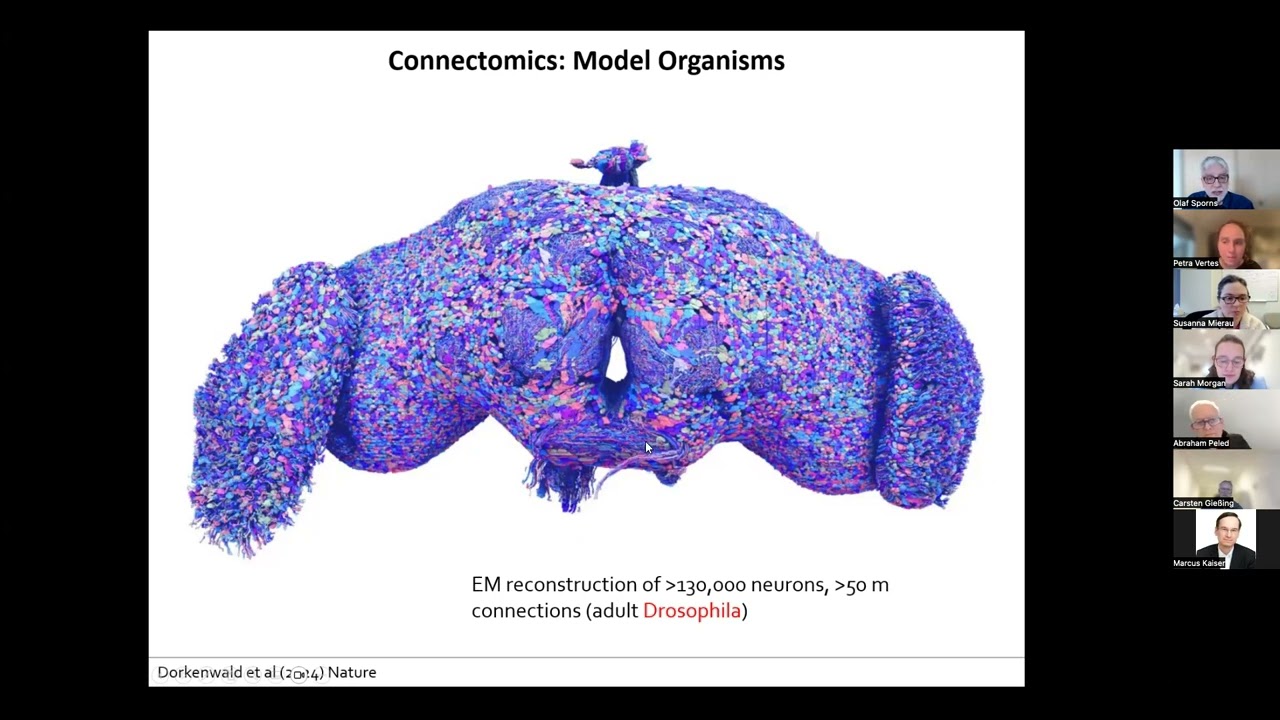
Added:[Music] about seven years ago I got an email from a young researcher on Spain who was interested in complex systems and the brain and so I got this email from a young guy in Spain interested in brain and and complexity inquiring about a postdoctoral fellowship and I was very quick in responding dear 14 great CV but I have no funding good luck that was literally the length of my email and happily her keen persisted and sent a follow-up email and I managed to get one year of funding for a postdoc shortly thereafter and I would say the rest is history who are keen came in 2011 and ushered in what I would call but I still called the golden period in my lab with her keen arriving to other graduate students on Drive in our clinics Berger and Ric Petzl who you see and talk and that was one of the most exciting productive creative paths in my life and I'm very thankful for that and I'm also very happy to see that her keen has found a good spot for us for its next stage in his career and I'm very happy that he see at Purdue brain networks I don't use the term network in a metaphorical sense I mean it literally as a mathematical object of a collection of nodes and edges it's a very common description of complex systems such as the brain that systems that can be broken down into elements and their interactions Network science has made a lot of inroads in other disciplines from social sciences to technology to biology examples here social networks Twitter or blog networks and interactions among proteins in a Cell and there's now a new area I think the last one where networks have made a difference in that's neuroscience and that's the science now of brain networks brain networks have a lot of history now behind them about 10 years 20 years of research and I want to give you a little bit of an overview in the beginning what do I mean by brain networks what are they before turning over to topics networks across different species including the human functional connectivity and I'll end with a little outlook this is the diagram that may seem familiar to many of you who have studied computational neuroscience actually deliberately built on a graph 25 years ago now from teri synopsis work we recently had this on every and a review article and it's supposed to show that we can actually acquire Network data in but neurobiological systems across very many different levels of scale and both in both time and space on the extreme lower left-hand corner of this diagram you see molecular networks interactions among molecules that make up cellular systems up our right hand corner of this diagram we have interactions among individuals organisms in the wild social interactions etc that are playing out any environment very large scales often long time scales as well in the middle is that space off connectomics where we acquire and represent interactions among neurons or brain regions either anatomical or physiological or functional acquired with very many different measurement technologies all the way from e/m electron microscopic reconstruction all the way up to human neural imaging and those datasets are proliferating there's more and more of these types of data out there and we need a framework within which we can analyze and describe and model and understand these relational data and that is given to us in part in large part I think by Network science and in the past a lot of network science methodology has been made available to us in neuroscience simple descriptive measures of how nodes and edges relate to each other in a topology there are simple things like the node degree how many connections are attached at each given element in in your system added so neuron our brain region well things like clustering coefficient how cliquish is the neighborhood of a central node how many of its neighbors are also friends of each other decomposing our graph into a motifs subgraphs and counting them looking at the statistics of those to get an a feeling for how the graph is actually built the very important kinds of path length and distance in a graph which relates not to metric distance expressed in millimeters but in number of steps that it takes to travel from point A to point B the distance from A to B is the minimal distance the minimum and not number of steps typically taken by for example as an agent or a message or information it's a very important concept in the brain and I'll come back to that throughout my talk at the bottom two other aspects that are very heavily researched in our field now one is modularity by that I don't mean for Dorian modules as in as in cognitive science but simply a decomposition of a larger graph or larger network into components that are very densely connected internally but somewhat more weakly connected amongst each other very important in that context are those nodes those elements in the graph that are critical for keeping the whole system connected all together from for allowing information to flow between communities and these are these so-called hub nodes which are bridging between communities allowing information to travel between them finally the rich Club is a concept that's coming also from the Social Sciences you get the idea based on a name which is simply a Association a dense connectivity between very highly connected parts of the network now social context highly connected members of a social group often are also highly connected amongst each other more so than expected by chance it turns out that's an important concept also for the brain at all it'll be weaker throughout my talk one of the struggles that we have in our field and brain networks is that our data is extremely hard to acquire and to collect and we have to spend I would say sometimes 8090 percent of our time making sure our data is of high quality and that noise sources have been accounted for and have been eliminated this is true for datasets from different species whether it's the nematode C elegans the rodent brain the human brain on human primates you name it and constructing extracting brain network data from anatomical or physiological observations is a time-consuming process entire careers are built on making methodology testing methodology just on this slide alone very briefly and all too briefly on the left side of this what you're seeing is a rough work workflow of how we construct structural networks anatomical networks which describe the associations between brain regions or neurons in anatomical terms quite often we end up in human imaging with a volume of the brain that we cut up into pieces coherent brain regions and we're estimating the density and strength and magnitude of the tracts of the connections between these brain regions often with the use of non-invasive neural imaging information you can also do astrology not in humans but in other species the end result of that is what we've called now about ten years ago a connect home a connectome which is an ohm why because it's fundamental it's universal and it's comprehensive a description of all the connections in a brain at some level of scale mathematically it's a matrix it's a matrix of pairwise relationships between nodes after brain regions and these nodes have either have a connection or they don't and that connection may also have a weight in a direction that's a matrix that's a network a description of a network that we can now use for for graph theory and and network science analysis on the right of this diagram is a whole different workflow now we are not measuring Anatomy we're measuring something about time series about responses of the brain either to stimuli or responses that occur spontaneously that results in recordings of voltages or bold activations across time wiggly lines over there which we can process during using time series analysis tools into once again a matrix of pairwise dependencies this can be as simple as a cross correlation or it can be much more sophisticated that's this matrix that you see on the right we we loosely call a functional Network a collection of all pairwise interactions which can also be analyzed and modeled using the tools of network science so we getting a very nice approach here of looking using a coherent set of tools on both anatomical observations that are about structure and for zoological observation that are about responses and that's the framework within which now the field of brain connectivity and network neuroscience is operating a few words about how these two modes are different from each others come on underscore this because sometimes misunderstood both structure and function in this representation have network characteristics that are nodes and edges and relationships and they may have topology even multi scale organization there may be modules within modules etc but there's also important differences but the connectivity is physical it's real it's something that you can technically speaking poke with your finger there's a synapse there's a connection there's a projection that you can estimate the magnitude off but it's it's physical it's real it's often sparse it's a sparse type of connectivity and it has may have complex properties such as you know fire physical properties and our transmitter properties strength affect effectiveness etcetera changes across time typically on a very slow slow timescale to development and across the lifespan perhaps faster during plasticity functional connectivity is very different it's a statistical estimate of some association between time series as simple as a cross correlation it is for that reason a very different type of object individual estimates of edges for example are not independent of each other it is intrinsically dynamic it changes the cross time much much faster we think in fMRI and the time scale off of seconds and in perhaps with eg energy and fast recordings even faster than that and there's an extremely large possible number of configurations that are plane Network a functional brain network can go through on top of an ultimately fixed anatomical skeleton so on the top physical connections often spar that we can estimate across across the brain but they have military fixed on the bottom something which is a very much much fuller description of interactions it changes much faster and it has an average Lee an infinite number of configurations that can go through both of these are analyzed in the context of connectomics both of them form the basis of that new emerging field of connectomics but i want to really emphasize that they are different ways of measuring looking at the brain and not all methods not all network science tools modeling tools out there are equally appropriate for both domains so now a few words about connectomics across species this is from a recent review article I had with Martin Mull arrival a longtime collaborator where we just sort of wanted to give a visual impression of the different species for which we now have connecthome diagram this ranges from the nematodes the elegans with about 300 individual neurons to a very Marquess clear descriptions of the human brain of hundreds of brain regions and their interactions with each other this sets up the possibility we can actually compare we can actually say well are there features that are different across different species or are there features in in this network architecture that are actually the same or have been conserved and I mean it turns out the give you my bottom line that a lot of what we see in brain architecture anatomical structure connectivity and how it's built across species is actually quite conserved it's actually quite similar whether you look at an at an organism as simple as C elegans or as one that well sophisticated is a tough word here but that you might that is as you know complex as the human brain this is where the whole field got started in a sense about 30 years ago now with the manual largely manual reconstruction with e/m micron micrographs of the individual neurons and their connectivity in the nematode C elegans roughly 300 and neurons and about two and a half thousand actually about 3000 chemical synapses between them and it continues to this day to be the only complete fairly comprehensive connectome diagram at the cellular level of any organism this will study years ago I call it's not the moonshot sometimes because just like you know going to the moon we haven't been back since then it's it really hasn't been done although this is we're gonna see more cellular level connect homes I think in the next few years especially from the Baffler yes work that I hear some the pipeline that's gonna be much much larger give us much much larger connection matrices and what we see here for a for another invertebrate now this matrix this this dataset which was acquired 30 years ago is still being analyzed today still being as busy papers coming out all the time actually that are looking at various aspects of this connectivity diagram fewer highlights recently a few things that happen have been looked at with newer methodology there's a modular organization there's evidence for some neurons having a lot more connections than others so not all neurons have the same number of connections and in this nervous system there are some that have a lot more others have a lot less and the neurons that are highly connected that of a high degree that have many connections with other parts of the brain also tend to be densely connected amongst each other the they have a higher likelihood making connections with each other than expected by chance based on a null model and that is the so-called rich Club organization the rich Club feature I mentioned to you earlier it's going to another invertebrate species very important one drosophila this was work where i collaborated with Raph beans Ralph Greenspan at UCSD and aintry and yang at Tsingtao University and Taiwan could they constructed a miso scale representation off the dose offal of brain on the basis of individual observations of fluorescently labelled neurons mapping those neurons into a template spec common template space and I'm reconstructing on the basis of that with tens of thousands of observations a pic Meisel scale picture of what brain region is connected to what brain region how strongly and that's the little matrix you see on the lower left it's also got modular organization above chance it also has highly connected local processing units or brain regions in the Sala brain and those LP youths are also connected amongst each other more densely than expected by chance common features that we have seen already and C elegans going to the to the vertebrate brain the mouse this is the rock coming from the Allen Institute now three years ago to some very great fanfare the version of the Mouse connectome was published in nature based on hundreds of injections in different animals high throughput imaging of fluorescent label reconstruction automated reconstruction and then modeling projecting it all down into a single matrix description of the mouse connectome and this was then analyzed by mica verbena finet bull more a year later paper in PNAS and one of the you know the current features here once again are that there are some more well-connected regions these well-connected regions tend to also be interconnected amongst each other in a rich club organization fashion these are regions and their anterior cingulate in the orbitofrontal cortex and the thalamus basal ganglia etc and you can see these in the in the matrix representation here these are the red stripes that go one vertically horizontally where the striping is of the pattern indicates these are very highly connected regions that also interconnect amongst each other going to another rodent species at a rat cousins of work that I've carried out now with past three four years with Larry Swanson at USC Larry and his coworkers are hard at work scanning the existing literature on tract tracing astrology in the rat brain and are building from that an annotated collated data set and so the what what Larry does is scans literature extracts connection reports among among brain regions based on published data and then builds he builds a connection matrices again think of them as large Excel spreadsheets that are recording what's connected to what lookup table and our first foray into this was the cerebral cortex single hemisphere weighted connections direct connections with histology track tracing and then looking at again the organizational features of this modularity is present rich Club organization is present highly connected regions are present and when we take those modules we map them back onto the the rat brain in a flat map representation which is one of Larry's ways representing connectivity and and the architecture of the rat brain we see that the modules we find are spatially contiguous they they involve regions that are next to each other on the cortical surface a contiguity is a property that predicts pigs being being member of the same module and that highlights the importance of spatial embedding in in the way brain networks are laid out the proximity of brain regions on the cortical surface is a strong predictor of whether they are connected or not and in tirana predictor of whether they are members of the same community and perhaps functionally related I come back to the importance of spatial embedding in just a second more recently Larry and at Rohan have expanded this map of the cerebral cortex to include both hemispheres and all the commissural connections between them most of those traveling through the corpus callosum and that allowed us to to actually examine interhemispheric connections for the first time early systematically I shouldn't say for the first time because the mouse brain the Allen Institute Mouse map had chemistro connections also and a paper on that had has come out almost simultaneously without with ours just a few of the rules we've been able to this to discover some of the numbers here this involved the the annotation and curation of 32,000 connection reports from the literature 77 cortical regions on both hemispheres forty-four in total data coverage 95% today's information on the presence or absence of connections in almost across the entire matrix and we found that not all homotopic connections existed so only our two thirds of those homotopic connections between corresponding brain regions on a left number right side actually did exist there was an even smaller density of heterotopic connections only about 490 of those and the comas neural connections were made across the two hemispheres where an exact subset of the Association connections on the same side so in other words if there was a commissural connection going across from from the left of the right side of the brain there also was an absent of the time a corresponding connection on the same side karma sewer connections were in almost all cases weaker and if you had a strong association connection on one side a strong projection between two brain regions on the left or on the right side of the brain you had a very high probability 50% or so of having a common sewer connection to the opposing hemisphere as well see that some of the rules that caused coincidentally were also confirmed independently by classic attack and co-workers who looked at the Mouse Allen dataset so that was very pleasing to us that these rules that we had extracted actually weren't weren't restricted to the rat this gives our some mad we might speculate that comest commercial connections might actually have similar organizational features across at least a few of the mammalian species certainly may be among rodents finally to finish up the rat here we also looked at with Mary Swanson at the basal ganglia the cerebral nuclei essentially Strider and pallidum and those structures have very different gray matter and white matter architecture and and the connectivity pattern that we that we looked at with tools for modularity detection for example indicated to us I'll skip forward here we'll real quick that the communities that we find in the basal ganglia have a much more asymmetric relationship with each other yes much more if a PUD you know if module 3 projects to module 2 really strongly there's only a very weak back projection between these two communities this is something we don't see in current cortex cortex is much much more symmetrically organized I don't want to go backwards now because then have to pay some beers since there will be having a head in a lab when who are keen was around because he had a tendency to go backwards 10 slides and I said every time you go backwards it's a beer now ok anyway we stopped counting at 237 or something anyway we so don't want to go backwards but but it's actually a very different way in which different communities are so city with each other across these two major structures major subdivisions after brain we are currently analyzing the rat brain zebra cortex and so you will nuclei on both hemispheres so that matrix is starting to grow it's now 244 regions and we're starting to get data from Larry about the thalamus and the hypothalamus the hippocampus which is now being integrated into the Steve I think the vision is to gradually build from the existing anatomical literature out there a connection matrix of the entire rat brain and and look at this with our with our tools and modeling techniques finally the nonhuman primate in some ways that's where I got started with the first and only data set in existence in 1991 from the Rockefeller man and Vanessa nan into error connections in the macaque visual cortex that's been refined and expanded over the years into a database called Coco Mack and a study we did a few years ago in the macaque sabor cortex looked at the existence of highly connected regions once again and their interconnections and you see up there the names if you are familiar with your macaque nor Anatomy you'll recognize these are prefrontal regions cingulate regions medial parietal regions some temporal regions widely dispersed highly connected to the rest of the brain and also densely interconnected amongst each other in a rich club organization here's where these regions are I despite the fact that they are spatially distributed remote from each other they have connections that are quite dense also than we would expect based on some random now model I'm going to skip the cellular analysis here and go straight to my sort of summary of this part of the talk there's a number of features that perhaps you've noticed have recurred in my presentation almost you know all all data sets that have been looked at have some admixture of highly connected brain regions this is a non-trivial observation you might expect that brain one brain region it's like any other brain region it's got inputs and outputs and about equally many but that's not true there are some brain regions that have a lot more connections or not more diverse connections widespread connections and others and those are pure ative have regions punitive regions that are important for integrating information for dispersing information and they'll they'll make an appearance a little later and the human brain as well and I talked about that we also have for every brain region we ever looked at we have a specific connection profile in some ways or you think about a network your status in the network your contribution to the network is dependent on your connections this is a very different way of looking at at neural processing or at cognitive perhaps you know cognitive function in a system s as such as human brain you're not we're not looking so much we are not looking so much at what's happening within each region we are looking more at what's happening between regions and the capacities that arise based on the interconnections and and every brain we've looked at so far every node every region has its own specific connection profile which is actually quite predictive of its functional specialization of its capacities we find interconnected modules and we also find that highly connected parts of the brain tend to aggregate together into our core sometimes called a core sometimes Levitch club sometimes a clique there's different terminologies out there but basically indicating the same kind of kind of organizational feature which is that there's some sort of central processing unit CPU if you wish where information from individual modules comes together and is shared why are they these common features many of them can be explained on the basis of spatial embedding the brain is a spatial spatially embedded system is a geometric object this is a trivial fact right we don't think of it that way sometimes but the fact that the brain has to exist in space it's actually very important with respect to how it's connected why because connections incur cost connections are there all cylinders that have to be biologically maintained they take up energy they take up space and volume and so there is a premium on having a connection it's there's a cost associated with it that is one of the main driving factors already recognized by romona kaha we have working with at will more some years ago now if we came up with a sort of an idea or framework for how to understand the features of brain connectivity actually shared across species that has to do with the idea of a trade-off on the one side the brain wants to be cheap has to be cheap it has to fit in between your ears if it doesn't fit between your ears you are not going to have any offspring sorry and that means you're not this is not going to happen okay so it has to fit in it has to fit in here that's number one it seems like a trivial point but it's actually an overwhelming importance it has to be metabolic be sustainable the cost of signaling has to be has to fit within the overall energy budget of the organism and turns out the brain is pushing the boundaries twenty percent of our energy is devoted to two percent of our body mass and so it wants to be really cheap as cheap as possible at the same time a really cheap brain might look like the one on the left which is that only nearest neighbor brain regions or kin or neurons are connected that's cheap but it's also terribly inefficient if you need to share information from the back of the brain to the front well good luck with that because you're gonna have to go through one two three four I don't know how many steps we've got okay so yeah that's not good from a functional form the point of view of functioning a random network on the other side can share information extremely quickly but being random it has it has no organization to it it's it you know the nodes have lost their of specialization they have lost their fingerprints that's not a good brain it's cheap I'm sorry it's it's it's efficient but you really can't do anything with it plus it's super expensive somebody wants computed still one of reconstruct this at some point that with all the neurons we have in our head if those neurons were randomly connected the volume of the connectivity would blow the brain up to a size of something like 10 miles across so absurd number but scatter I've got to be a bug in that in that calculation but just suffice to say it's probably going to be not gonna fit anymore right it's actually very wasteful so that that isn't gonna be helpful at all so the idea is we have we have a trade-off it's like an engineering concept right or an economic concept we have we want to optimize two things efficiency and cost we have to settle on a compromise most of the time the brain is very cost efficient and then some of the time features of the brain are features of brain connectivity appear such as rich club organization that are actually quite costly because they're connecting widely dispersed regions that cost a lot of a lot in terms of volume but you need to do it because you have to integrate information and you have to guide behavior and and cognition that way so that's why we think that's a useful framework to to to to pursue it is something that we've looked at in the context of my office space is something idea that's actually a of interest to people here and an idea that we continue to pursue in cross-species comparisons as well okay what about the human brain I've only talked about animal brain so far when I went to high school and then to university in Germany I saw an instant in brain but the only thing I could find about brain anatomy was pictures like this and medical textbooks this is actually a photograph from my core detected brain off of a dead person obviously and and I mean literally you know it gives you a nice visual impression of some of the white so-called white matter tracks in the interior of the brain myelinated axon bundles that connect remote brain regions with each other and now there you can see that this matter of doing this it's not gonna be a person you can bring back to the lab to ask some questions about their cognition and behavior and test them again no that's a one-way road right here and you can't do this on thousands of specimens either and you have a biased sample when you do post-mortem brains not a good way of getting an idea of how brain structure varies across the population etc well enter the arrival of diffusion imaging intact ography these images here that are now very commonly seen including on their on one of your newsletters on the front page of saw today where unknown ten years ago basically okay we had no just just about ten years ago we had no essentially no comprehensive information about human brain connectivity anatomical brain connectivity the also resting state was resting so it was something that crazy people did like like like like we so it you know ten years ago we had it was really there was nothing okay and we had detect the technique was just being developed it continues to be we find it is rather tricky and on both of the I on the acquisition side as as well as on the reconstruction side this is a picture that's a computational model is not a photograph obviously so you have to appreciate that what what one does here is infer the most likely layout of white matter connections based on a very obscure signal you get from the inside of the brain while the person is alive so it's very different than histological anatomical direct observation there's many caveats to this technology nevertheless about ten years ago I got together with Patrick Hagman my longtime colleague and friend from Switzerland and he had been are you finding this Tecna we had been working on networks with animal data we decided to combine our expertise unfunded by the way completely unfunded and and and constructed the first diagram such as this one here a matrix of connectivity of a thousand nine and ninety eight parcels or brain regions across the cerebral cortex that describes the pairwise anatomical relations between these between these regions and I say it's an early draft because many many many such maps have since been constructed many of higher quality than this and it's an ongoing project of further refining the accuracy and the validity of these of these types of reconstructions the the results we came up with enough no ten year old paper echo some of the things I mentioned earlier this is not a chronological talk actually this lot of this work here on this slide proceeded what happened earlier in the talk okay in some ways we got started on the human brain and work backwards to animal species unique fingerprints broad degree distributions which means which which means an add an admixture of high degree nodes some brain regions were more connected and others clustering modules and highly connected core we call it a structural core at a time later on we called it a rich Club these are descriptive markers of brain architecture in the human brain that can be quantified that can be compared across individuals that can be modeled and has a lot of descriptive analysis had that has happened the last decade or so but I'm increasingly more important method now is to construct generative models to construct models that there are asked questions about what are the principles behind why did widest connectivity look the way it does what generative mechanism can explain that and a couple of the recent papers one from our lab one from mica or be enough that have been examining this it's an important issue because if all you do is describe features of connectivity you can be you can be fooled into thinking something is highly adaptive significant important but it actually turns out that it can't be any other way it turns out that your brain has look this way because it's spatially embedded or some other factor plays a role and but then it can't be adaptive right if it has to be that it's a spandrel argument from evolutionary theory so that's why generative models are very important to sharpen our understanding of where the features of connectivity we actually observe where they actually come from I want to revisit just very briefly the rich Club with you just to hammer that home one more time here's a here's how this works on the left left diagram is a schematic of a network with modules communities that are densely more densely connected amongst each other but we live weekly between we have these highly connected nodes that connect them to each other those black nodes you see there in the middle all I've done is I've added a few connections between these highly connected nodes now I have dense connectivity you can perhaps see right away why that's beneficial I can now I now have an infrastructure in place in this network where information can be sampled from different communities that are perhaps functionally specialized to do very different things vision auditions a Madison station what have you and I can now bring this information together in this central red colored rich club network so we were interested in understanding based on this intuitive notion that the rich club would be a great sort of infrastructure feature of the human brain we wanted to see whether it's actually there and that was that work started with my collaboration with Martin Mull arrival and long story short analyzing a set of human subjects the different resolution levels yes we find evidence for more dense connections among highly connected nodes and we would expect based on a I think reasonably conservative now model and furthermore if we we asked the question if we want to communicate it from any point to any other point in this network how often do we have to go through the rich Club it turns out 90% of the time any any pair of nodes in the brain you want to send a message on the shortest path possible the most efficient way of sending the message you have to access that central red blob that you saw earlier despite the fact that that's only about 10% of the brain I don't want to start another meme here I'll be only using 10% of our brain ok do not get me wrong this is not what I'm saying but but they but there is a tendency of that central core it sort of absorbs traffic traffic naturally goes into it and comes back out if you want to communicate across different parts of the brain at least in a model that's the case finally if we if we lesion this central core of the brain it has disproportionate effects on communication potential communication on the coherence of the network and that in turn is of crucial interest to people who have clinical translational interests I think one of the big payoffs of connectomics has been its application mostly in human neural imaging two disorders of various kinds and just just throw this one slide out here because as a whole separate talk to be given our whole course to be given about the importance of hub regions and interconnections among them for human brain and mental disorders the diagram here on the left is from meta-analysis of over 20,000 structural scans with people from people with various conditions I think 30 or so disorders everything from autism schizophrenia to depressive disorder epilepsy to panic disorder chronic pain dementia you name it it's on that it's on that it's on that list and the question that was asked here by Anna Crosley and at Baum or in this meta-analysis was in these people where was the why was evidence for a trophy for a structural damage to the brain what were what were those regions and how well connected where them where these regions it turns out that there's a statistic statistically significant bias in the direction of most disorders are associated with structural damage to nodes that have high degree and are therefore put putative hubs in the brain there's a plethora of evidence not just this meta-analysis but a plethora of studies now that point to brain disorders and mental disorders manifesting predominantly through some disruption of highly connected nodes you might say if you think about what we think these nodes might be doing this seems obvious yes think just just by analogy you think about the air transportation system you know if Chicago shops down it's bad for many people in the India transportation system if Indianapolis shuts down not so much sorry to say it but we're we're we're not a hub although we have now one flight to Paris as you know so not nobody it doesn't disrupt the system as much as if a hub shuts down this is perhaps a basic insight but but I would say that that was not at all part of the conversation even just five 10 years ago so there's a lot of interesting leads now it turns out hubs metabolic metabolize glucose differently it turns out that when we stimulate them but the perturbations travel differently across the brain there's a lot of interesting they have different gene transient expression patterns there's a lot of set of systems-level the Cooley era tease about them that that placed them high on the list of interest in clinical translational studies now finally functional connectivity I've talked a lot about Anatomy so far past because I'm very fond of Anatomy but ultimately we want to know how the brain responds to stimuli or perhaps how it is become spontaneously active that's a movie on the right that shows you a projection of fMRI bold responses onto the surface of a brain in a person who does nothing in the scanner so-called resting state just like the fella before the piece ignore me you the instruction to people going into this type of experiment is don't think of anything in particular it's a task to me but okay and so resting state is essentially spontaneous self generated by an activity and looks like this the amplitude of these ball responses by the way it's as is anything you do during a task so it is highly processed sort of task you know bold pictures we are very familiar with the hot spots the attitude of those Peaks are actually about the same as this so if I through a task in here you wouldn't you wouldn't notice it but it would become part of the ripple pattern of this waveform unfolding across the surface yes doesn't it just as an aside so it's not noise it's not a little bit of background hiss you know in the in the in the microphone it's actually using up sixty to eighty percent of our brain metabolism goes into resting state activity and down now such things as resting state networks that have names such as default mode say leniency visual etc how do we construct those we take frames from a movie like this chop it up into frames do a cross correlation cluster it to get coherent blocks of brain regions like coherently active and then we project it back onto their cortical surface and we give them names now we know what things do what once we give it a name we know what it does and it's all over default mode visual network fronto-parietal these are now names that are frequently used in the neurocognitive literature as building blocks of cognitive processes this is a very very much accepted way of mapping brain networks now the you can reproduce this very easily in any cohort out there it's a very highly reproducible feature of brain network organization now functional networks mind you so how can we model this we actually started in a lab over ten years ago now trying to simulate as I'm not a response this in a computer using computational neuroscience tools we started with a coupling matrix this is a connectome anatomical coupling matrix in this case coming from the macaque brain because that's where the whole thing got started in the 90s and each node in this matrix is now given some biophysical properties x territory inhibitory currents some time constants so in other words this is this is now about physical and so-called neuro mass that can behave it can oscillate once we take a bunch of these equations that bottom couple them up with those coupling terms to the top essentially we're getting now a coupled system of nonlinear differential equations this is physics engineering this is engineering right we can we can numerically simulate this in a you know in a running and going you know piping it through an OD solver and we get time series we can then perversely perhaps take these millisecond times C times gear time series and pass them through a filter that's like an fMRI response and then we can get cross correlations from that a functional connectivity matrix we did this work back with Chris Hanney 2006 2007 before resting-state was actually accepted in the community as a as an honorable thing to do and the great thing about a computational model like this is you can do you can manage you can manipulate the model you can perturb the matrix you can you can make lesions you can take out a brain region and see what the rest of the brain is doing you can add a connection if you want you can make connections Rica and stronger you can provide inputs that might stimulate tasks conditions and you get variations of this connection matrix on the right which you can then compare to empirical data in our case we had no fMRI resting-state data back in 2007 but years later the Assoc meeow meeow sita and tokyo contacted us wanting to compare our simulation to empirical data he had acquired and to our great happiness the relationship between the two was I would say well bust given that we did no data fitting at all given how simple the model was no neurons just neuron masses 47 of them with a matrix that had many gaps and holes we were actually quite pleased with agreement between empirical and model data now one way that we can pursue this further is to make more detailed models we make spiking neuron models we have put in layers we put in more brain regions we put an inhibitory neurons to knows what but partly as a result Kings interest in in this we actually there you are we we actually went a different route to Tots much more simple models which are in fact analytic that you solve them directly under under connectome matrix and this was a multi linear model of four different graph descriptors that we laid to communication a couple of them were path length and another one was so called starch information what is the degree to which a path is hidden from discovery by a random walker turns out that starch information becomes more it's growing more you need more and more information the more you have high degree nodes along the way if you travel through Times Square your chance of getting lost are much higher than if you just walk down a village which has a single main road and that's it no no branchings and as Joaquin elegantly showed in this wonderful paper that came out now three years ago we can do we can do really well predicting functional connectivity with a simple linear combination of graph descriptors related to communication this fancy I really like the environment graph on the left side of it we have an FM eyeball response cost correlation matrix coming from resting state in individuals the right part of the diamond is the model section based on the structural connections of those same individuals based on the anatomy which you don't see here and despite the simplicity of the model and the factor that runs in MATLAB in under a second you can we can predict this very very well fitting only four parameters and as you can see it works quite well across different parts of the brain as well that whole line of work kind of triggered in the lab all interest in communication and communication dynamics that goes on to the present day we kept thinking about and we had many sessions on the whiteboard in the lab back when working was the was around about how communication can can unfold on a network and especially especially in our brain network think of the topology of an anatomical network as constraining their way in which information can can disperse and flow obviously it can't flow through the ether or you know the the air but it has to go through these paths and while the connect these connections are quite sparse there's many many many astronomically many paths in these networks I mean a numbers are astronaut communic infinitely important communication involves arguably involves communication events signaling events action potentials traveling through axons and pathways and a lot of these connections because the network is sparse a lot of these events have to occur through indirect pathways so there it has to go from A to B to C to D it doesn't go from E to D directly if AMD are not connected just as a back of the envelope calculation we have about you know give or take eighty to a hundred billion neurons and that would be a matrix now think of an Excel spreadsheet with a hundred billion rows and columns and you're making entries as two richer of these neurons are connected it turns out only one in a million or one in ten million of all the entries in the R matrix would be filled so the likelihood of having two connections to neurons that are connected if you pull them at random from the brain is one in a million which it's written it stands to reason that a lot of communication has to has to occur certainly to develop individual neurons has to occur across indirect pathways otherwise the brain simply could not come up with an integrated response to anything and the concepts that have been most inferential in the past have been shortest paths by the most efficient way of passing from A to B is to let's say a minimal number of two steps and it's a so-called efficiency which is the inverse of the past across all pairs of nodes in the network and and those have been dominant concepts in our in our field most papers that deal with efficient information transfer so far make reference to these two concepts but it's a problem with what we might call the classical view shortest paths are great because them being short they're efficient there's not much noise corruption delays are minimized information arrives fast travels fast but how do you find it you know put yourselves into the shoes of a little neuron and in your brain if it has shoes or feet for that matter okay it doesn't know anything it's just it gets an input now and then or some inputs of produces a spike that's it but it has no map where information should travel it has no concept obviously after the pathology of the brain network as a whole we when we plot shortest paths in a given data set we use powerful algorithms you know that have names like Dijkstra algorithm that allow us to to find these paths efficiently and fast but in the brain nobody can do that those little neurons and the little shoes they can't they can't do this so how does information know how two neurons know how information should flow efficiently if it in fact does four efficiently there's a problem of global knowledge which we supply when we do computational analysis but neurons don't have so we have sort of some alternatives first of all there's many many alternative paths and believe me our numbers are in fact staggeringly large there are almost as short as the shortest path but not quite that's work that Andrea Vina clinics Berger has done a couple of years ago now and the concept that she's calling his path ensembles these are samples sets of paths that are almost equally short but actually involve a lot of the infrastructure of the brain and another thing we have to think about is that not all paths are equally likely to be functionally meaningful efficiency says if it's the inverse of the path length over all pairs of potential interactions but nobody says that all of them are equally important or likely to occur or meaningful so we have to kind of think of we have to we have to think of communication in different ways we are now having a framework in mind in our lab where we're thinking of communication events as being real drivers of functional connectivity this is sort of a new concept essentially it says functional connectivity the time series fluctuations we observe after we record from neurons or brain regions are the result of lots and lots and lots of communication events signaling events about that occur underneath we actually don't see those directly we have a review coming out in just actual you know and next week in late reviews in neuroscience that articulates that that theory or that that framework has a bit in a bit more detail abut just to give you the the rough idea so I've talked a lot about structure connectivity anatomy physical wiring that's the infrastructure also the highways if you wish that are costly because they are built from asphalt you know and require and require to be maintained etc they are sparse and they are the connector then we have on top of that lots and lots of communication events neurons are spiking brain regions are sending out compressed and coded signals or messages down their external pathways those are spreading on top of the connectome on top of the AB structural network and constitute communication events or communication dynamics communication events and unfold in time and then as a result of all this happening we see that time causes responses of neurons and brain regions have these characteristics deviations up and down have certain characteristic patterns to them and we capture those with functional connectivity the point is that we can access this because we can be caught from from the brain and do things like cross correlations we can also access that it's is hard to do but we can measure the connecthome better and better every year we have no access to this we actually don't know how to observe individual signaling events unfolding cost time in the brain and we're in in real time as the brain is responding and I actually have a hunch that this is a different mode of connectivity it perhaps is akin to what Cal Forrestal and others have been written about I've been writing about in terms of effective connectivity causal interactions among neural elements that are driving behavioral responses and cognition and we have in this in the context of this review that that will be out next week we've tried a sort of put all these different communication models that are out there including routing which has Trotters paths communication and also random walks which is diffusion sort of on a spectrum a spectrum of the amount of information that's needed to actually make this scheme work here you have to have a lot of information a map this is like FedEx you know sending you a package and it depends on send it to a random at least I shouldn't send it to a random you know office and then that office throws a die and sends it off to another random office you would never get your package right and sometimes that does happen apparently but this that will be a random walk it's very inefficient but you also need almost no information at all so that's an informational cost to communication that has been underappreciated we have been in our thinking in the field largely on this side but we have ignored the fact that we actually don't we can't get this or the neurons can't get this but if neurons work like this it's extremely wasteful and in fact the whole notion of messaging or information transfer is lost it's more like broadcasting it's more like shouting and I am this is one thing not many things you know make me wake up at night but this is one of them here's something that has occupied me over the years I actually started my career as a biochemist so I was down here somewhere I worked my way up the scale and I'm all the way up there and I I someone who is a sparked interest and has been involved in many many projects over my career it has occurred to me that we really do have networks operating systems at very different levels of scale and organization in the brain almost any process that we're that we are excited about or interested in that they're involved systems in neuroscience involves networks and multi multiple levels of organization interacting proteins inside cells cells interact to form tissues and circuits and ultimately whole brain systems that support and enable cognition and behavior and to have a deep understanding of what goes on here and an integrative level we need to do better in neuroscience to connect these levels up with each other we have many specialists who are down here we have many specialists web who are up there but we don't have a lot of concepts and models and theories that actually can effectively link these different levels together and in part to promote that and since I have nothing else to do with my life I started a journal last year called networked neuroscience published by MIT press open access obviously that is devoted to first of all network science and neuroscience interactions and intersections both empirical and computational work but I also hopefully can pave the way to a greater appreciation of the network basis of brain function across different levels of organization and with that I thank you again for the invitation and I'm very happy to be here I hope I'm back soon thank you very much [Applause] [Music]
Up Next
Eureka Moments: Brain Mechanisms of Creative Problem Solving
@BrainFactsorg
2.4K views•2019-03-21
Deciphering Neural Circuits Controlling Anorexia in Mice | Richard Palmiter
@AllenInstitute
2.3K views•2011-10-10

Vagus Nerve (CN X): Anatomy, Nuclei & Functions Explained
@Alilamedicalmedia
305.2K views•2022-10-31
How Exercise Benefits Your Brain: Science Explained
@TED
11.4M views•2018-03-21
Related Study Plans & Knowledge Roadmaps
Structured learning paths in Neuroscience