Divergent thinking is a cognitive approach that generates an infinite number of answers to a problem, unlike convergent thinking which leads to a single correct answer; this concept is illustrated through kindergarten math problems (where rephrasing '5+5' to 'what two numbers add up to ten?' yields infinite solutions including negative numbers, fractions, and decimals) and Oxford University's All Souls College admissions exam, which asks applicants to write extensively on a single word prompt to assess their creative thinking and ability to integrate diverse experiences into coherent narratives.
Tina Seelig Explains Divergent Thinking & Oxford's One-Word Exam
Added:Deep Dive
Basic cognitive psychology concepts regarding how the brain processes information and approaches problem-solving.

タイムマシン部G第49回「マイティ・スノー」
1.8K
在极端困境中,人类认知能力会达到平时无法达到的水平。讲述者因找不到家门钥匙而陷入绝境,平时只使用大脑30%左右的人,在紧急情况下可能调动全部认知能力。男性思维中的'也许'心理(もしかしたら)在困境中会放大,导致冒险决策。最终在厕所中突然想起钥匙可能留在自行车上,体现了压力下的认知突破。
Click to watch →

Junjunが語る仏教哲学入門 その弐
143
大脑为了处理海量信息,必须对感知进行筛选和简化,这导致我们对世界的认知必然是不完整和扭曲的。例如,我们感知不到头发以毫米为单位的变化,只能察觉到累积到一定程度后的变化。这种信息处理的局限性意味着我们永远无法获得对世界的完整认知,我们所感知的只是大脑构建的简化模型。
Click to watch →
第3回「心の働き」〜瞑想でたどる仏教〜
678
念(Sati)包含两个要素:感官捕捉(直接感知)和概念捕捉(使用语言和概念识别)。在日常生活中,人们通常不区分注意指向的心(能)和被注意的对象(所),但正念练习可以让人意识到这两者是分离的。这种能所分离是佛教认知心理学的重要概念,揭示了人类认知的本质结构。
Click to watch →

Pensamiento y resolución de problemas
3.8K
Cognitive psychology studies higher mental processes including thought, language, memory, and problem-solving. Thought involves manipulating mental representations of information, which are always concrete (visual images, sounds, data) rather than abstract. Concepts help categorize the world by defining distinguishing characteristics. Problem-solving uses algorithms (guaranteed solutions) and heuristics (fast but error-prone strategies). Key heuristics include representativeness (judging by category similarity), availability (judging by memory ease), and familiarity (preferring known elements).
Click to watch →

Clase 3: Diplomado: Terapia Cognitivo Conductual para abordaje de trastornos psicológicos (01/10/25)
330
Cognitive psychology emerged as an information processing approach to understanding mental processes. Key concepts include: (1) The mind as an information processing system similar to computers, (2) Input (stimuli) processed through encoding, storage, and retrieval, (3) Output (responses) generated from processed information, (4) Focus on perception, memory, reasoning, and problem-solving, and (5) Experimental methods to study cognitive processes. This approach emphasized how people acquire, store, transform, and use knowledge.
Click to watch →
Deep Dive
The fundamental difference between closed-ended questions (with one right answer) and open-ended questions (with multiple possibilities).

Actividades para Tercer Grado Miércoles 23 de Abril
233
The fundamental difference between open-ended and closed-ended questions lies in the freedom of response. Open-ended questions allow respondents to provide any answer they wish, giving them complete freedom to express their thoughts. Closed-ended questions restrict responses to predetermined options, limiting what respondents can say. This restriction means closed-ended questions control the range of possible answers, while open-ended questions allow for unexpected but potentially valuable insights.
Click to watch →

Question types & piloting. Part 1 of 3 on Questionnaire Design
94.1K
The fundamental division in questionnaire design is between open-ended and closed-ended questions. Open-ended questions invite respondents to write their own answers in their own words, providing more representative responses and capturing ideas researchers might not have considered. Closed-ended questions provide predefined response options from which respondents select one or more answers. Closed questions are easier to score and analyze numerically, while open questions require extensive coding and classification work. Researchers often use both types together, using closed questions for primary data collection and open questions to capture unexpected responses or additional insights.
Click to watch →

FBISE CLASS 10 COMPUTER SCIENCE UNIT 8 ENTREPRENEURSHIP IN DIGITAL AGE EXERCISE NBF Federal Board
1.4K
The main difference between open-ended and closed-ended questions lies in how people are allowed to respond. Open-ended questions allow participants to answer freely in their own words to give details, while closed-ended questions require participants to choose from fixed options like yes/no or multiple choice.
Click to watch →

रात 8 बजे से | 3 घंटे लगातार #CTET अगस्त 2023 | गणित PEDAGOGY | महामैराथन | BY AD SIR |
4.5K
Open-ended questions (मुक्त अंत वाले प्रश्न) have multiple possible answers and encourage divergent thinking. Closed-ended questions (निश्चित उत्तर वाले प्रश्न) have a single correct answer. For example, 'What is the area of a rectangle with length 24 cm and width 4 cm?' is closed-ended (answer is fixed at 96 sq cm), while questions asking for opinions or multiple solutions are open-ended.
Click to watch →

JTET MARCH 2026 | MATHS PEDAGOGY | Primary Level Paper 1 | Old & New Syllabus Based |
4.1K
Open-ended questions (मुक्त सिरे वाले प्रश्न) have multiple possible answers, while closed-ended questions (बंद सिरे वाले प्रश्न) have only one correct answer. For example, 'Write the qualities of your friend' is open-ended because there are many possible qualities to list. However, '5 × 6 = ?' is closed-ended because it has only one correct answer (30). The question asks which option is NOT an open-ended question, so the correct answer is the one with a single definite answer.
Click to watch →
Deep Dive
An introductory understanding of standardized testing paradigms and how traditional education systems typically measure intelligence.
How should we measure intelligence? | Mary-Helen Immordino Yang
175.8K
The current education system measures intelligence by assessing a young person's ability to perform on predetermined, pre-designed assessments at specific times and provide expected answers based on what was given to them. This standardized approach evaluates performance under controlled conditions but does not capture potential or broader cognitive abilities.
Click to watch →
Everybody Loves Frank & Marie | Everybody Loves Raymond
469.4K
Standardized tests measure academic intelligence through standardized scoring systems where scores are compared against population averages. A score one standard deviation above the mean indicates significantly higher intellectual ability. However, standardized tests only measure book smarts and do not capture street smarts or practical life intelligence.
Click to watch →
The big problem with how we measure “intelligence” | Mary Helen Immordino-Yang
7K
The current education system measures intelligence by assessing a young person's ability to perform on predetermined, pre-designed assessments at specific times and provide expected answers based on what was given to them. This system reveals what students can do under those particular conditions but does not indicate their potential.
Click to watch →
RPSC 2nd Grade teacher 2025 | Education Psychology | शिक्षक ग्रेड-2 and CTET Online Class
117K
Intelligence testing evolved from Binet-Simon (1905) to Stanford-Binet (1916) and Army Alpha/Beta tests (1917). Group tests (Army Alpha/Beta) save time but may have less detailed assessment; individual tests provide comprehensive information. Educational systems include: Formal education (structured learning in schools with fixed schedules and methods) vs Informal education (family learning without fixed schedules). Family education is informal, while school education is formal.
Click to watch →

Tested, Tired, and Totally Talented | Lenora Felix | TEDxTRINS Youth
927
Standardized testing primarily measures memorization and test-taking skills rather than true intelligence, creativity, and problem-solving abilities; education systems should shift focus from timed exams to nurturing thinkers and innovators who can imagine, create, and solve real-world problems, as historical inventors like Edison, Einstein, and Zuckerberg succeeded not through exam excellence but through unconventional thinking and curiosity.
Click to watch →
Deep Dive
The concept of creativity as a cognitive skill that can be developed and structured, rather than an innate, unteachable talent.

تحرير عبقريتك المخفية|علم الأعصاب والإبداع| كن مبدعاً | مهارة يمكن تعلمها| Creativity Can Be Learned
208
Creativity is not an innate talent reserved for artists and musicians but a cognitive skill that can be developed by anyone. According to the American Association for the Advancement of Science, creativity is the ability to generate new ideas with practical utility. Research indicates that 87% of humans possess creative capacity, yet many fail to utilize it due to fear of failure, lack of self-confidence, or inability to recognize creative potential. Creativity involves making changes to existing things to increase their value and usefulness.
Click to watch →
Lo que nadie te ha contado sobre las neurociencias de la Creatividad - Mentes Innquietas Ep. 1
47.2K
Creativity and innovation are cognitive skills that can be developed and applied within organizations. They are not innate talents but abilities that can be trained and enhanced through structured programs. This understanding challenges the myth that only certain people are creative and opens the door to systematic approaches for developing organizational innovation capacity.
Click to watch →

#082 Growing Creativity in Gifted Kids w/ Stephanie Higgs
125
Creativity is not an innate talent possessed by only some people, but rather a skill that can be developed and strengthened over time. It involves thinking about new ways to do things and demonstrating growth or change. Many people mistakenly believe they are not creative because they cannot play instruments or create visual art, but this narrow definition excludes the vast majority of creative thinking that occurs in daily life and professional work. Creativity encompasses problem-solving approaches where individuals look at everyday situations and think there must be a better, quicker, or more efficient way to accomplish tasks. Research demonstrates that creativity can be improved through deliberate practice, similar to how physical muscles strengthen with exercise.
Click to watch →

The shape of ideation | Stefan Mumaw | TEDxLawrence
52.9K
A second major misconception is that creativity is simply an innate talent some people have and others don't. However, since creativity is defined as problem solving, it is actually a skill rather than a talent. This distinction has significant implications - if creativity is a skill, then people can get better at it through practice. Most people view creativity as an innate, mystical force that sometimes appears unexpectedly, but understanding it as a skill means it can be developed and improved.
Click to watch →
Creativity is not a gift | Dustin Timbrook | TEDxHuntsville
62.7K
Creativity is a skill that can be developed like a muscle, not a gift bestowed by the universe. Treating creativity as a gift creates harmful stereotypes: creative people must have chemical imbalances, be part of countercultures, or sacrifice mental health. The speaker argues that just as athletes train to improve their abilities, creative people must practice and develop their skills. Natural talent alone is insufficient; deliberate practice and training are essential for creative development.
Click to watch →
Prerequisite Knowledge
- Concept 01Basic cognitive psychology concepts regarding how the brain processes information and approaches problem-solving.
- Concept 02The fundamental difference between closed-ended questions (with one right answer) and open-ended questions (with multiple possibilities).
- Concept 03An introductory understanding of standardized testing paradigms and how traditional education systems typically measure intelligence.
- Concept 04The concept of creativity as a cognitive skill that can be developed and structured, rather than an innate, unteachable talent.
Subsequent Learning
- Step 01Design thinking methodologies (such as the Stanford d.school framework) that systematically cycle between divergent and convergent phases.
- Step 02Edward de Bono's Lateral Thinking techniques, including the 'Six Thinking Hats', to deliberately generate non-obvious ideas.
- Step 03The role of open-ended assessment design in modern pedagogy and how to construct evaluations that measure critical and creative thinking.
- Step 04Cognitive barriers to creativity, such as functional fixedness and the Einstellung effect, and strategies to overcome them.
Two Thinking Types
Exam Value
Two Thinking Types
0:03Playing Section
- 1
Convergent thinking yields single right answers to fixed questions.
- 2
Divergent thinking opens infinite possibilities from open-ended prompts.
- 3
Both use identical math but produce vastly different solution counts.
The Necessity of Domain-Specific Knowledge and Convergent Discipline
While divergent thinking and open-ended prompts like Oxford's one-word exam are praised for fostering creativity, cognitive psychologists and education theorists argue that meaningful creativity cannot occur in a vacuum. Under the domain-specific view of expertise, creative problem-solving relies heavily on a deep, well-structured foundation of factual knowledge—typically acquired through rigorous, convergent learning. Critics of overemphasizing divergent thinking point out that without domain-specific constraints and analytical rigor, open-ended ideation often yields superficial or unfeasible ideas rather than genuine innovation. Furthermore, cognitive load theory suggests that novices struggle with highly unstructured, open questions because they lack the mental schemas to organize their thoughts, making structured instruction and convergent tasks essential prerequisites before divergent exploration can be fruitful.
Deep Dive
Design thinking methodologies (such as the Stanford d.school framework) that systematically cycle between divergent and convergent phases.
![[UFMS Digital] Design Thinking - Módulo 2 - Unidade 2](https://i.ytimg.com/vi/x8zSIImPRTU/maxresdefault.jpg)
[UFMS Digital] Design Thinking - Módulo 2 - Unidade 2
483
Two foundational methodologies for design thinking are presented. The Double Diamond, developed in 2005 as a British model, uses four stages forming two diamond shapes: the first diamond focuses on discovering the problem through investigation and understanding user sensations, while the second diamond focuses on developing and delivering the solution. It involves a cycle of diverging and converging, allowing teams to return to previous phases if needed. The Stanford Design Thinking Process is the original five-phase model: Empathy (understanding the user), Definition (identifying the real problem), Ideation (generating solutions), Prototyping (creating tangible representations), and Testing (evaluating with users). This methodology is considered easy to adapt and apply, making it the most commonly used approach.
Click to watch →
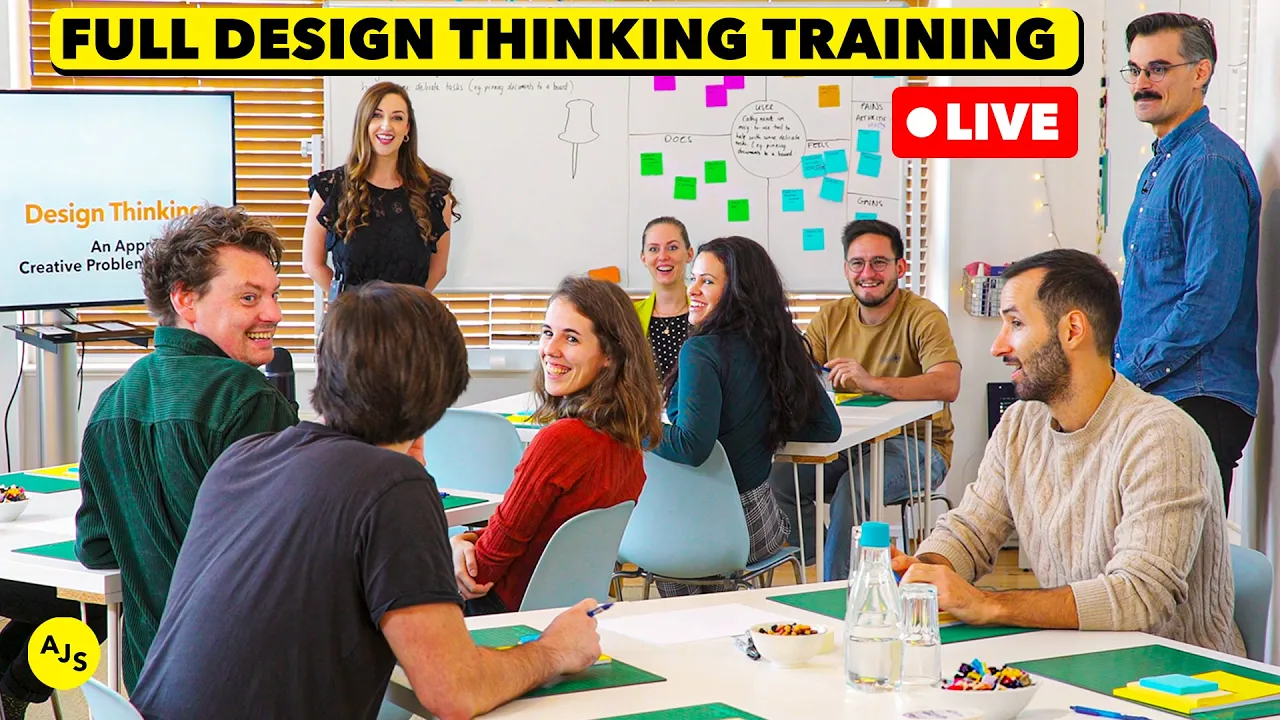
How To Run a Design Thinking Workshop (2-hour Live Training)
83K
Divergent thinking is the process of generating many different ideas to solve a challenge, opening up possibilities without judgment. Convergent thinking follows, where teams narrow down these numerous ideas to focus on the most promising solutions. Throughout the design thinking process, teams alternate between these two modes—flaring up with many ideas and then refining them—to systematically move from broad exploration toward focused implementation.
Click to watch →

#Webinar: Design Thinking
141
The Stanford d.school Design Thinking model operates through five interconnected phases: (1) Empathy - creating understanding with clients through interviews and brainstorming; (2) Definition - identifying real problems and creating user personas; (3) Ideation - generating and prioritizing ideas using affinity diagrams; (4) Prototyping - developing tangible representations through storyboards; (5) Testing - validating solutions through user feedback. The Two Diamonds Process visualizes this as divergence phases (Empathy and Ideation) generating many ideas, followed by convergence phases (Definition and Prototyping) narrowing to specific solutions. Key tools include: Empathy Map Canvas for understanding user needs; User Personas for defining target customers; Ideation techniques using post-it notes; Storytelling through storyboards; Customer Journey Mapping for touch point analysis; Value Proposition Canvas aligning product features with customer needs; and Business Model Canvas for sustainable business models. These tools enable teams to systematically move from understanding users to building viable solutions.
Click to watch →

How FILTERCOPY, DICE MEDIA & GOBBLE Were Built ft. Aditi Shrivastava | The Ranveer Show 89
96.1K
Design thinking is a methodology for innovation with four main steps: (1) Empathy - learning about clients or audiences, (2) Ideation - brainstorming any idea without judgment, (3) Prototyping - putting constraints on ideas and narrowing down to top options, and (4) Implementation - having team members become owners of pilots. This approach, developed at Stanford, helps companies involve others in creation, making them feel like participants in the journey. Resources include Stanford's d.school website which offers free tools and exercises.
Click to watch →
Designing For Public Good: Design Thinking For The Public Sector
1.8K
Design thinking relies on two distinct thinking modes that must be separated: divergent thinking (creative, open-minded exploration of possibilities) and convergent thinking (analytical evaluation and judgment). These modes cannot overlap—teams must first diverge together generating many ideas without criticism, then converge together evaluating and selecting ideas. A common mistake is having leaders converge on ideas while team members are still diverging, which stifles creativity. The 'How Might We' question frames problems positively, transforming complaints into solvable opportunities. Teams should have cross-functional representation across organizational levels, from CEOs to frontline staff, to ensure diverse perspectives inform solutions. This structured approach enables organizations to shortcut lengthy decision-making cycles and obtain real customer data more efficiently.
Click to watch →
Deep Dive
Edward de Bono's Lateral Thinking techniques, including the 'Six Thinking Hats', to deliberately generate non-obvious ideas.
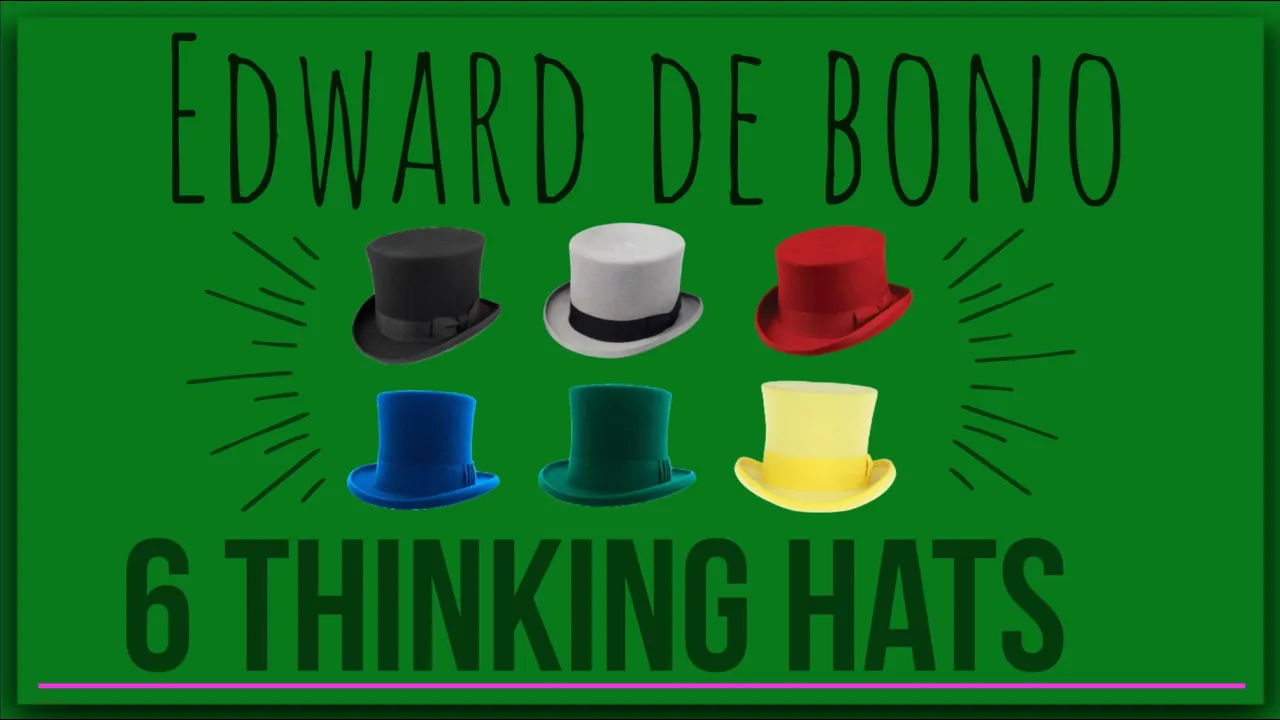
Six Thinking Hats By Edward De Bono: animated Summary
193.9K
Edward de Bono's Six Thinking Hats is a structured thinking process that separates emotions from logic, creativity from information, and allows room for both positive and negative perspectives. The framework uses parallel thinking, where all participants focus on the same aspect simultaneously rather than arguing different viewpoints. Each hat represents a distinct type of thinking: White Hat focuses on objective information gathering, Red Hat legitimizes emotional expression without justification, Black Hat provides cautious analysis to identify risks and avoid problems, Yellow Hat promotes optimistic identification of benefits, Green Hat stimulates creative generation of new ideas, and Blue Hat manages the overall thinking process. This systematic approach ensures comprehensive exploration of any subject by dealing with one aspect at a time.
Click to watch →

"Los seis sombreros para pensar", de Edward de Bono
2.3K
Edward de Bono, a Maltese psychologist born in 1933, authored 25 books including 'Lateral Thinking' (1967) and 'Six Thinking Hats' (1985). The Six Thinking Hats method represents the most significant change in human thinking in the last 230 years. The method has three objectives: improving thinking quality, providing a matrix for group interactions, and generating new ideas. De Bono was known for having only one or two powerful ideas throughout his intellectual production, which he explored in multiple ways.
Click to watch →

Не будь как все! Открой свой талант. Креативное мышление - ваш путь к успеху. Аудиокнига целиком
135.5K
The Method of Six Thinking Hats was developed by English psychologist Edward de Bono. With this method, one can develop thinking, creativity, mental flexibility, overcome creative crisis, and make correct decisions. The method is based on parallel thinking—situations that do not contradict each other coexist. The entire thinking process is divided into 6 types associated with metaphorical hats of different colors. The white hat is associated with a blank sheet of paper on which all available information must be recorded. When wearing this white hat, a person should focus not only on existing facts but also on data that is missing to resolve the task. The red hat is the hat of emotions and intuition—when wearing it, a person expresses their intuitive guesses and emotions honestly. The yellow hat—yellow is the color of the sun, optimism—when wearing it, a person must find all positive sides of the given proposal. The black hat is the complete opposite of the yellow hat—the hat of the pessimist, giving critical evaluation of the situation, ideas, or solution. The green hat is the hat of creativity and creativity—green is the color of energy and life. When wearing it, a person must switch to creative mode and propose alternative points of view. The blue hat is the hat of thinking—a person in this hat is the first to set tasks for reflection. This method can be used in any work in any fields. Large corporations like British Airways and PepsiCo have been using it for a long time. The method has many advantages—if simply asked to investigate a subject or solve a task, people may become confused. The Method of Six Thinking Hats allows seeing a situation from different sides, eliminating one's own thinking bias, and putting forward all pros and cons. The method helps find fresh ideas. Why hats? Because they are easy to put on the head and take off just as easily. A person must learn to change their thinking. The complexity of the method is that it is difficult to use in a large collective, but much depends on the moderator's ability to manage the audience so that the discussion does not turn into a simple bazaar. It is desirable to distribute hats so they do not correspond to the person's character, even being the complete opposite—a pessimist, for example, should wear the hat of an optimist and vice versa. Analogy is correspondence or similarity of phenomena, objects, or processes. This method helps break through thinking, find a creative solution to a task, and get rid of psychological inertia. The method is based on the theory of similarity—the essence is that in a given task or situation, an object or technical object is selected as an analogy, which can be taken from a completely different field. Analogies can be direct (from nature), subjective (personal immersion), symbolic (poetic comparisons), or fantastic (unreal objects). Brainstorming (or brainstorming) serves for finding new solutions in diverse fields and for searching creative thoughts when there is a lack of information. It helps optimize creative thinking of a collective and put forward the most effective solution. This method was invented in 1941 by Alex Osborn. The essence of brainstorming is that a person can overcome their fear or shyness and put forward their idea for discussion in a collective. Very often, a person knows the solution but, fearing disapproval, does not express it. In brainstorming, it is categorically forbidden to criticize or evaluate ideas on the initial stage. The technique involves gathering a collective of people of various professions with no strict restrictions on candidate selection. It is desirable not to invite superiors to the discussion so they do not limit the course of the brain attack. The rules include: criticism is forbidden on the initial stage, the most bold and even crazy ideas are welcomed, there should be as many ideas as possible, all ideas must be recorded. After all ideas are put forward and recorded, some time must be given for their consideration (incubation).
Click to watch →

A brief celebration of Edward de Bono's ideas on thinking
26.7K
Edward de Bono introduced the Six Thinking Hats framework as a structured approach to creative thinking that separates different cognitive processes—white hat (information), red hat (emotions), black hat (caution), yellow hat (optimism), green hat (creativity), and blue hat (process control)—allowing individuals and groups to switch thinking modes without ego conflict, thereby enabling more effective parallel exploration of ideas compared to adversarial debate; this methodology is complemented by lateral thinking, which uses provocation (signal word 'PO') combined with movement to break free from conventional thought patterns and discover innovative solutions.
Click to watch →

An introduction to the Six Thinking Hats
289.6K
The Six Thinking Hats is a structured thinking framework developed by Edward de Bono that separates six distinct modes of thinking—Blue Hat (control and facilitation), White Hat (facts and data), Black Hat (caution and risk assessment), Yellow Hat (optimism and benefits), Green Hat (creativity and innovation), and Red Hat (feelings and intuition)—into separate metaphorical 'hats' that can be worn one at a time by individuals or groups to facilitate clearer, more focused, and more effective decision-making and team collaboration.
Click to watch →
Deep Dive
The role of open-ended assessment design in modern pedagogy and how to construct evaluations that measure critical and creative thinking.

Habilidades del Pensamiento Crítico y Creativo (Docente Pedagogo)
103.9K
Critical and creative thinking skills are essential cognitive abilities that enable individuals to analyze information, solve problems, and develop innovative solutions; these skills are organized into three hierarchical levels—basic thinking (observation, description, comparison, relation, classification), analytical thinking (self-observation, judgment, hypothesis formulation, implications, logical analysis), and critical-creative thinking (enriched cognitive processes with originality and refinement)—and educators play a crucial role in developing these skills through metacognitive practices, self-reflection, and active guidance, ultimately preparing students to become reflective, critical, and proactive individuals capable of improving their world.
Click to watch →

CTET 2025 | HINDI CLASS:01 पहली क्लास | पास करना आसान | हिन्दी CLASS 01
100.5K
To assess creative thinking (रचनात्मकता का आकलन), teachers should use open-ended questions (खुले अंत वाले प्रश्न) that require divergent thinking (अपसारी चिंतन). These questions force students to think creatively and provide unique responses rather than selecting from predetermined options.
Click to watch →

CTET Previous Year Question Paper | Math Pedagogy | Easy Trick | ctet most important questions
83.1K
Open-ended questions (questions with multiple possible answers) promote creative thinking and divergent thinking. Questions like 'What would happen if there was no electricity in your village?' allow for multiple valid responses. These questions develop students' ability to think beyond single correct answers and explore various possibilities. In contrast, closed-ended questions with single correct answers limit creative thinking.
Click to watch →

“CTET 8 फरवरी 2026 🔥 150 में से 120 प्रश्न पक्के | तुक्का TRICKS जो YouTube पर नहीं मिलेंगी”
12.5K
Critical thinking is developed through: open-ended questions that have multiple possible answers, questions requiring analysis and synthesis, and avoiding closed-ended questions. Creative assessment should: be conducted regularly, involve student participation, and focus on supporting learning rather than just measuring performance. Teachers should avoid: standardized testing that doesn't account for individual differences, exam-focused learning, and textbook-centered approaches. When students engage in inquiry and critical thinking, they develop deeper understanding and problem-solving skills.
Click to watch →
Cultivating Creativity and Critical Thinking in the classroom
380
Assessing creativity presents inherent tensions between evaluation criteria and authentic creative expression. Design thinking frameworks (empathy, define, ideate, prototype, test) provide structured approaches that celebrate the learning journey rather than focusing solely on endpoints. Success criteria should be co-constructed with students to enable differentiation where some achieve one rubric level while others reach higher levels. Portfolios and log books document the iterative process of inquiry and revision, contrasting with traditional assessments that capture only final outcomes. The OECD Critical Creative Thinking Project offers class-friendly rubrics breaking down skills into teachable components including strengths/weaknesses analysis, empathy, ideation, and design evaluation.
Click to watch →
Deep Dive
Cognitive barriers to creativity, such as functional fixedness and the Einstellung effect, and strategies to overcome them.

Практический интеллект. Часть 2. Как критически мыслить, моделировать ситуации,глубоко анализировать
124
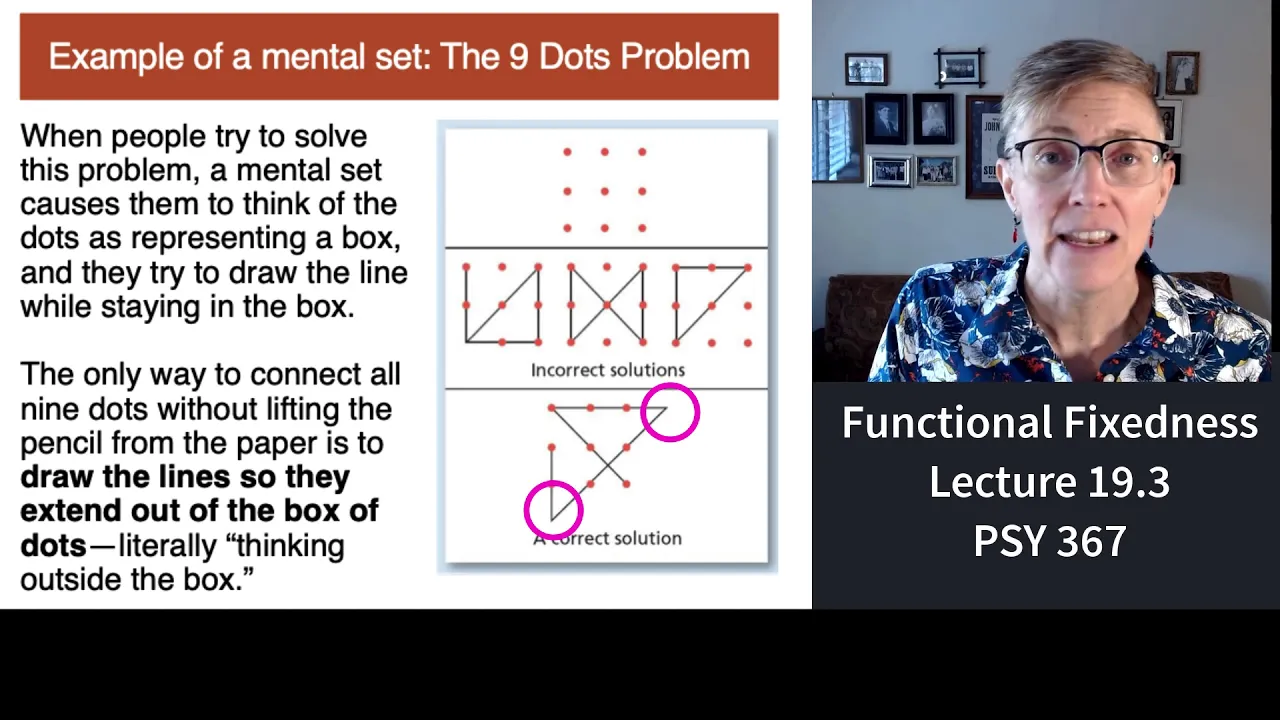
Functional fixedness is a cognitive barrier that prevents creative problem-solving by limiting us to conventional uses of objects. The classic example is the 'two rings problem': connecting two heavy steel rings using only a 2-inch steel wire, a candle, and a match. The solution requires recognizing that the candle's wick can be used as a string to tie the rings together. Overcoming functional fixedness requires thinking about objects in more general terms rather than their specific functions. To overcome this, one should think in more general terms about objects - for example, instead of thinking of a candle as a light source, recognize it has a wick which is essentially a string. This generalization allows for creative applications that wouldn't be obvious with specific thinking. The Morphological Box (Idea Box) is a method for generating creative ideas by systematically combining different parameters. To use it: identify key parameters for your problem (e.g., location, shape, material, purpose), create a grid with these parameters as rows and possible options as columns, then generate ideas by combining one option from each parameter. A 4x4 grid can produce 256 potential ideas, stimulating the brain to consider combinations that might not have been thought of otherwise.
Click to watch →
CTET CDP Paper 1 & 2 Marathon | CTET CDP Marathon | CTET CDP Practice Set | CTET CDP By Monika Ma'am
25.6K
Functional fixedness is a cognitive barrier that prevents people from seeing alternative uses for familiar objects. It limits creative problem-solving by restricting thinking to the conventional or traditional uses of objects. Overcoming functional fixedness requires flexible thinking and the ability to see objects in new ways.
Click to watch →
Öğrenme Bellek ve Düşünme -1 | 33 Günde AYT Felsefe Grubu Soru Çözüm Kampı 6.Gün | AYT 2025 |
4.5K
Functional fixedness is a cognitive bias that limits problem-solving by restricting thinking to the conventional uses of objects. In the example, Erhan could not think of using a lighter as a bottle opener because he only thought of its conventional use (lighting fires). Functional fixedness is one of the main obstacles to creative thinking. Overcoming functional fixedness requires: (1) Recognizing that objects can have multiple uses; (2) Thinking beyond conventional functions; (3) Being open to unconventional solutions.
Click to watch →

41- AGS - Eğitim Temelleri - Öğrenme Psikolojisi - Gestalt Kuramı - II - Bünyamin ATALAY
14.1K
Functional fixedness is a cognitive barrier that prevents creative thinking by causing individuals to see objects only in terms of their traditional or conventional uses. When experiencing functional fixedness, people fail to recognize alternative uses for familiar objects. Examples include: (1) Seeing a pencil only as a writing tool, not as a hair tie or other object; (2) Seeing a book only as something to read, not as a seat or shelter from rain; (3) Seeing a knitting needle only as a tool for knitting, not as an ear cleaner. Overcoming functional fixedness requires recognizing that objects can serve multiple functions and that creative solutions often involve using familiar objects in novel ways.
Click to watch →

Chapter 23 CREATIVITY (Advanced Educational Psychology) #creativity
834
Functional fixedness is the tendency for people to use objects or tools in only a certain or specific way. If someone only thinks about an object in a limited way, they cannot think of creative uses for that object. For example, students who only see pencils as writing tools and post-it notes as paper will struggle with creative assignments. Creative students overcome this barrier by using pencils as fans or post-it notes as building materials for dioramas.
Click to watch →
Two Thinking Types
Exam Value
Two Thinking Types
0:03- 1
Convergent thinking yields single right answers to fixed questions.
- 2
Divergent thinking opens infinite possibilities from open-ended prompts.
- 3
Both use identical math but produce vastly different solution counts.
The Necessity of Domain-Specific Knowledge and Convergent Discipline
While divergent thinking and open-ended prompts like Oxford's one-word exam are praised for fostering creativity, cognitive psychologists and education theorists argue that meaningful creativity cannot occur in a vacuum. Under the domain-specific view of expertise, creative problem-solving relies heavily on a deep, well-structured foundation of factual knowledge—typically acquired through rigorous, convergent learning. Critics of overemphasizing divergent thinking point out that without domain-specific constraints and analytical rigor, open-ended ideation often yields superficial or unfeasible ideas rather than genuine innovation. Furthermore, cognitive load theory suggests that novices struggle with highly unstructured, open questions because they lack the mental schemas to organize their thoughts, making structured instruction and convergent tasks essential prerequisites before divergent exploration can be fruitful.
Basic cognitive psychology concepts regarding how the brain processes information and approaches problem-solving.
The fundamental difference between closed-ended questions (with one right answer) and open-ended questions (with multiple possibilities).
An introductory understanding of standardized testing paradigms and how traditional education systems typically measure intelligence.
The concept of creativity as a cognitive skill that can be developed and structured, rather than an innate, unteachable talent.
Design thinking methodologies (such as the Stanford d.school framework) that systematically cycle between divergent and convergent phases.
Edward de Bono's Lateral Thinking techniques, including the 'Six Thinking Hats', to deliberately generate non-obvious ideas.
The role of open-ended assessment design in modern pedagogy and how to construct evaluations that measure critical and creative thinking.
Cognitive barriers to creativity, such as functional fixedness and the Einstellung effect, and strategies to overcome them.
25.7K views117likes2:49@ecornerOriginal Release: 2011-10-07
In kindergarten, this would be a typical question.
Five plus five equals what? What's the answer?
Ten. You guys are so great.
You must go to Stanford. OK, why do we all know this is ten?
We know this is ten because this problem has one right answer.
This requires convergent thinking.
We all converge on that one right answer - a five plus five equals ten.
But what if I ask the question in a slightly different way, what if I ask X plus Y or two question marks, what two numbers add up to ten? How many answers are there to that?
Infinite.
And I'm so delighted you say that, because I'm often in rooms where people were going, "Well, one plus nine, two plus eight, three plus seven."
And I go, "Whoa, Whoa, whoa, what about negative numbers?
What about fractions? What about decimals?"
The fact is there is infinite number of answers to this question.
Why? Because this requires divergent thinking - we ask the question that doesn't have one right answer.
Now, think about it. It's the same type of math, right?
The same principles.
And yet when we ask the question one way, we got one answer.
When we ask it in a slightly different way, we got an infinite number of answers.
This isn't just true in kindergarten. Let's go off to college.
Maybe somebody can tell me recognize this place.
Anyone know what school this is?
It's in the UK. It's very old. Oxford, yes. Here we are Oxford.
And at Oxford, they do something that is totally brilliant.
In order to get in to one of the colleges, All Souls College, you have to answer the one word exam.
Now, this doesn't mean that the answer is yes or no or black or white. The question is one word.
It will be a word like 'integrity', or 'water' or 'bias' or 'innocence' and you were given three hours to write using that one word as a prompt.
Now, first of all, how many of you would like to take that type of exam? Great.
I actually love that, because most people find that kind of scary and intimidating.
What does this type of exam teach the people who read your answer?
What does it tell them?
It tells them how you think, how you connect and combine ideas, how you can sort of draw a line through all of your experiences and your knowledge to create some integrated story.
It's about seeing how creative you are.
Up Next
7:01
Functional Fixedness & Mental Sets in Problem Solving
@csunprofmaggie1163
1.1K views•2020-11-06

68:32
Cognitive Skills for Differentiated Instruction | Teacher PD
@BrainWareLearning
631 views•2017-12-17

9:55
Thinking, Fast and Slow: Daniel Kahneman Animated Book Summary
@FightMediocrity
2.3M views•2015-06-05

6:40
The Nocebo Effect: How Beliefs Can Cause Real Harm
@CGPGrey
10.4M views•2013-12-23
Related Study Plans & Knowledge Roadmaps
Structured learning paths in Psychology
psychology
Neuroscience of Creativity: Networks & Training
01Foundations of Creative Cognition
02The Cognitive Neuroscience of Insight & Fixation
03The Triple Network Model of Creativity
+ 1 more learning modules
15h4 modules
Explore Roadmap
psychology
Imposter Syndrome: Etiology & CBT Framework
01Defining the Imposter Phenomenon
02Socio-Developmental Etiologies
03CBT Fundamentals & Thought Distortions
+ 2 more learning modules
15h5 modules
Explore Roadmap
psychology
Adult ADHD: Executive Dysfunction & Scaffolding
01Neurobiology of the ADHD Brain
02The Core Triad of Executive Deficits
03Executive Dysfunction and Emotional Regulation
+ 2 more learning modules
12h5 modules
Explore Roadmap
psychology
Loneliness: Evolution, Neurobiology & CBT
01Evolutionary Origins of Human Connection and Loneliness
02The Neurobiology and Physiology of Chronic Loneliness
03Maladaptive Social Cognition: The Psychological Loop
+ 2 more learning modules
12h5 modules
Explore Roadmap