








![[수원화서박문각] 공인중개사 민법및민사특별법](https://i.ytimg.com/vi/v5cNJgfsRfw/hqdefault.jpg)



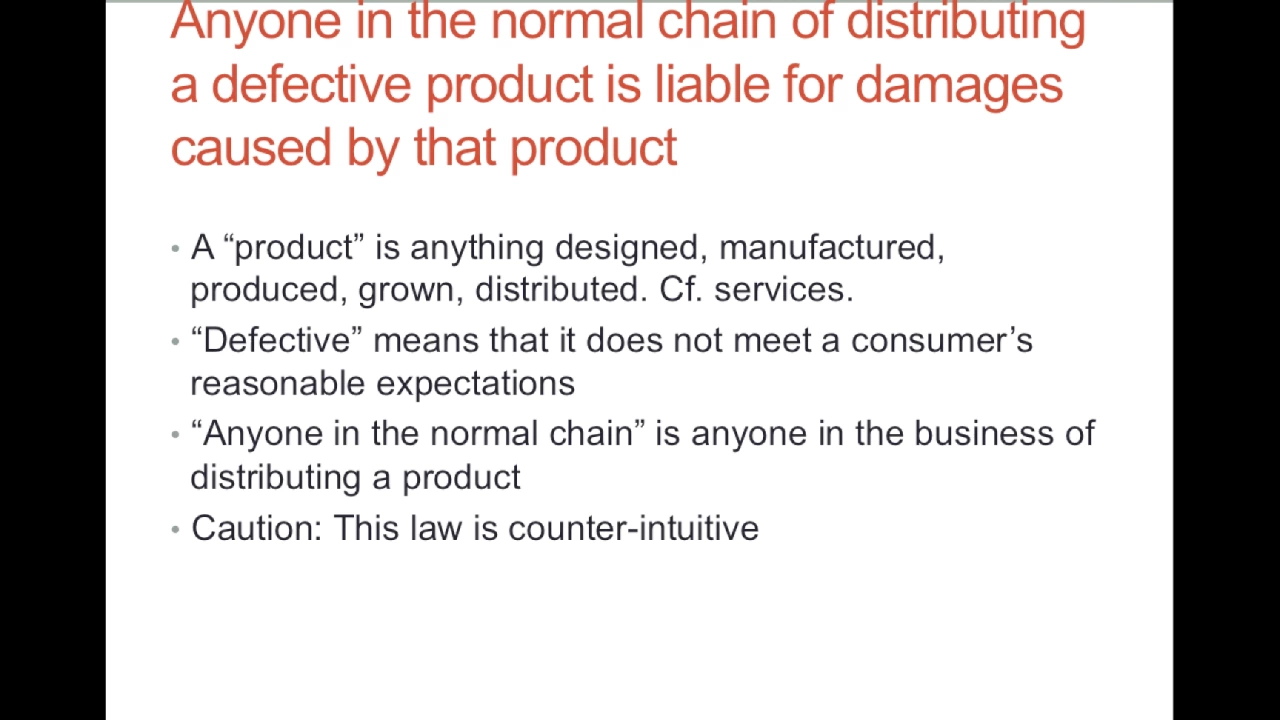












Product liability claims fall into three categories: (1) Manufacturing defect occurs when a mistake during production creates an unintended danger in a specific product; (2) Design defect exists when a product is manufactured correctly but the underlying design is inherently dangerous, making all units unsafe; (3) Failure to warn arises when manufacturers do not adequately inform users about non-obvious dangers that they knew or should have known about.
Product Liability Claims: Manufacturing Defect, Design, Failure to Warn
Added:Introduction to Tort Law: Understanding civil wrongs, liability, and the basic framework of civil litigation.
The Distinction Between Negligence and Strict Liability: Knowing when a defendant can be held liable without proof of intent or carelessness.
The Concept of Causation: Understanding how actual cause ('but-for' causation) and proximate cause are established in legal disputes.
The Legal Relationship Between Buyers and Sellers: A basic awareness of privity of contract and how it historically limited consumer lawsuits.
Defenses to Product Liability: Examining legal arguments such as product misuse, alteration, assumption of risk, and statutes of limitations.
Design Defect Evaluation Tests: Deep diving into the 'Consumer Expectations Test' and the 'Risk-Utility Test' used by courts to determine if a design is defective.
Damages and Mass Torts: Exploring compensatory and punitive damages, class-action lawsuits, and multi-district litigation (MDL) involving defective products.
Regulatory Compliance Defense: Analyzing how adherence to federal safety standards (such as FDA or NHTSA regulations) impacts a manufacturer's liability.
7.5K views87likes4:02Original Release: 2021-12-14
in this video we will introduce three types of product liability claims the three types of claims that we'll look at are manufacturing defect design defect and failure to warn we'll start with the manufacturing defect where something went wrong when the product was made so let's say we have a cell phone company acme phones and acme phones manufacturers cell phones but a key employee gets distracted and doesn't do his job as a result of the many cell phones produced that day one cell phone has a defective battery together with the other cell phones the defective cell phone is put on a ship and sent to buyers around the world one unlucky buyer purchases the defective cell phone not only does the battery fail on the cell phone but it catches on fire and our unlucky buyer is injured the buyer should have a manufacturing defect claim the other cell phones were fine but something went wrong when this phone was made an error in the manufacturing process caused an unintended danger in this particular product the next type of product liability claim that we'll look at is the design defect in a design defect the product was manufactured according to plan without a mistake but the plan was too dangerous so let's say acme phones has a meeting to redesign its cell phone and they come up with a brand new acme phone 2.0 what no one realizes is the plan for this new phone is going to result in a dangerous battery but the cell phone 2.0 gets manufactured according to this plan and every cell phone that gets manufactured according to this design has the same defective battery the cell phones get shipped off to the world and a bunch of consumers buy these cell phones with the dangerous batteries and they're all exposed to the same dangerous condition because of the malfunctioning battery this is a design defect claim all of the products were manufactured without a mistake with no error but the design itself was defective so now all the products are too dangerous the last product liability claim that we'll look at is the failure to warn where the manufacturer did not adequately warn users about a danger in the product so let's say after the disaster of acme phone 2.0 acme phone meets and decides to put together acme phone 3.0 the phone has a new battery system and it includes a warning keep away from children and pets but the warning label is silent as to danger if the battery is exposed to direct sunlight and heat unaware of the danger the owner of the phone leaves it on a cafe table in direct sunlight as a result the battery heats up and the flames cause an injury this may lead to a product liability claim based at least in part on failure to warn because the manufacturer did not warn the phone user about this danger and the manufacturer certainly knew or should have known about this danger which was not obvious to the owner of the phone to summarize a manufacturing defect is where a mistake results in an unintended danger when a product is manufactured a design defect is where the product is manufactured as intended but the design itself is faulty so all products are more dangerous than they should be a failure to warn is where the manufacturer fails to adequately warn users of a non-obvious danger [Music] you
Up Next
14:57
Product Liability: Design Defects Explained
@LawShelf
6.8K views•2021-06-28

4:27
US Secondary Sanctions Impact on EU Businesses and Blocking Legislation
@Bureauvandijk
1.6K views•2019-03-20

2:55
Riley v. California: Warrantless Cell Phone Searches Explained
@USLawEssentials
14.9K views•2014-07-21

24:42
Police Interrogation Tactics: False Confessions & Legal Reform
@LastWeekTonight
7M views•2022-04-18
Related Study Plans & Knowledge Roadmaps
Structured learning paths in Law
law
Self-Defense Law: Imminence & Castle Doctrine
01Foundations of Self-Defense Law
02Imminent Threat & Reasonable Belief
03The Principle of Proportionality
+ 3 more learning modules
12h6 modules
Explore Roadmap
law
Defamation Law: First Amendment & Actual Malice
01Introduction to civil torts and the First Amendment
02Elements of Defamation: Libel and Slander
03Public Figures vs. Private Individuals
+ 2 more learning modules
8h5 modules
Explore Roadmap
law
Hearsay Rule: Trial Evidence & Exceptions
01Introduction to Trial Evidence & Courtroom Basics
02Demystifying Hearsay: The Core Definition
03Non-Hearsay: Exclusions Under FRE 801(d)
+ 3 more learning modules
14h6 modules
Explore Roadmap
law
Medical Malpractice: Law, Liability & Care
01Foundations of Tort Law and Civil Liability
02The Four Elements of Medical Malpractice
03Defining and Proving the Standard of Care
+ 2 more learning modules
12h5 modules
Explore Roadmap