






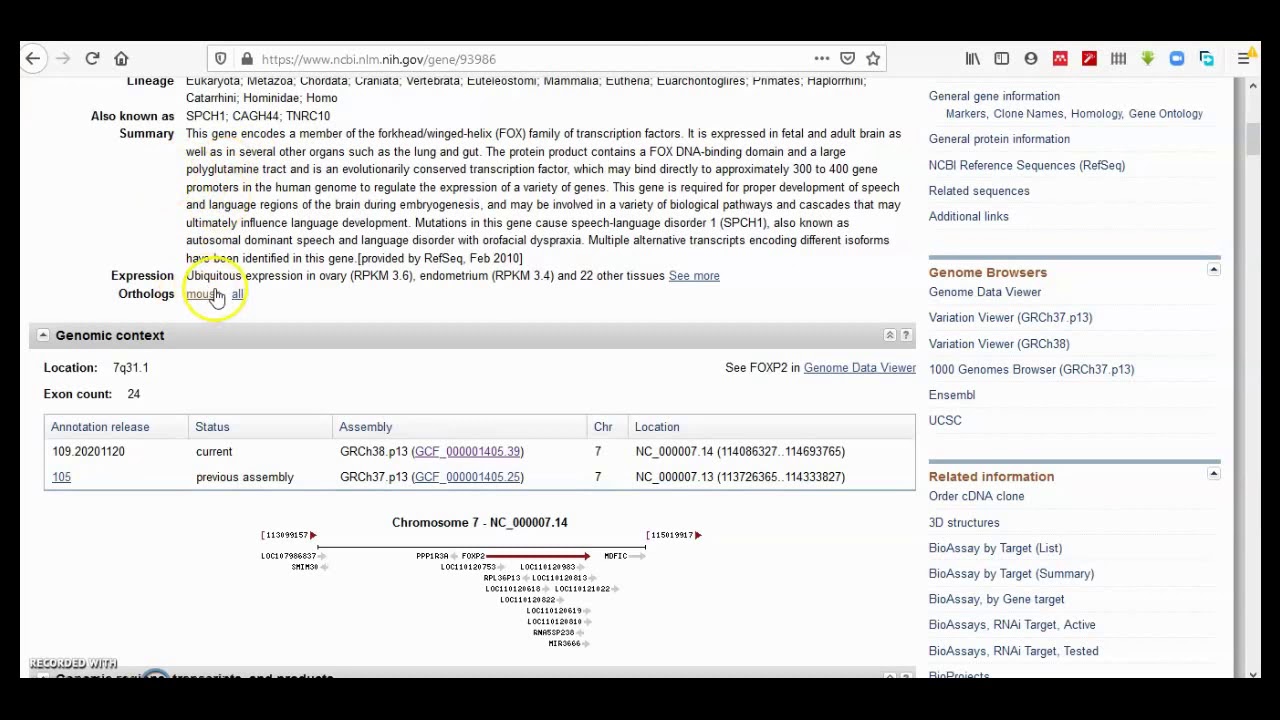











This tutorial demonstrates how to search for unique sequence data using official identifiers (accession numbers or HGNC gene names) on both Ensembl (European database) and NCBI (U.S. database). On Ensembl, users navigate gene pages with multiple tabs to find chromosomal locations, neighboring genes, and transcripts, then access protein sequences starting with methionine and download them as FASTA files. On NCBI, users search using NM numbers for mRNA sequences and can view GenBank format files containing locus information. Both systems require official identifiers to ensure retrieval of exact sequences needed for homework assignments.
Finding Sequence Data on Ensembl & NCBI: Accession Numbers
Added:Understanding the Central Dogma of Molecular Biology, specifically how DNA is transcribed into mRNA transcripts and translated into proteins.
The concept of gene structure, including exons, introns, promoters, and alternative splicing which leads to multiple transcript variants.
Familiarity with the purpose of biological databases as repositories for genomic, transcriptomic, and proteomic data.
An introductory awareness of gene nomenclature standardization, such as the HUGO Gene Nomenclature Committee (HGNC) guidelines.
Performing sequence similarity searches and alignments using tools like BLAST (Basic Local Alignment Search Tool) with retrieved sequence data.
Understanding and working with common sequence file formats such as FASTA, GenBank flat files, and GFF3/GTF feature formats.
Navigating interactive genome browsers (e.g., Ensembl Genome Browser or NCBI Sequence Viewer) to analyze gene neighborhoods, regulatory regions, and genetic variations.
Utilizing programmatic data retrieval methods, such as NCBI's Entrez Direct (command-line) or Ensembl's REST API, to download sequence data in bulk.
1.3K views9likes3:50Original Release: 2022-02-23
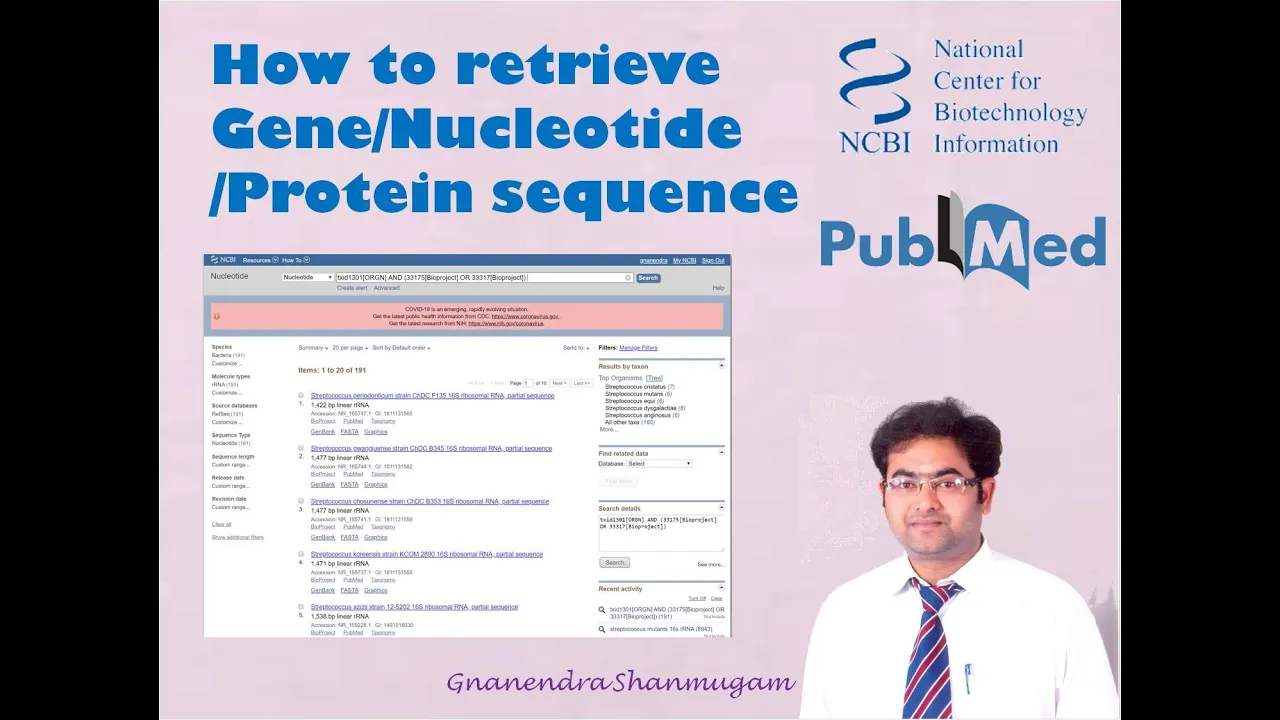
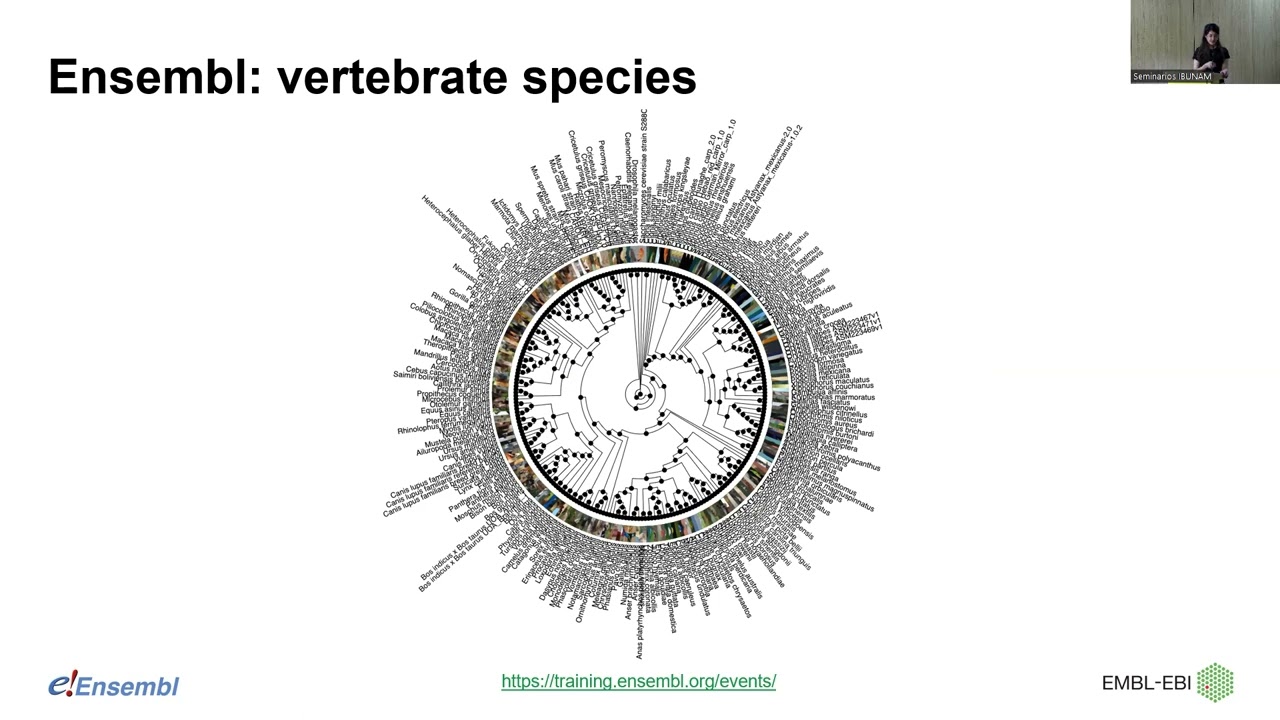
in this short video i'll show you how to search both the u.s databases for sequence data ncbi and the european sequence databases on ensembl in both systems we want to make sure that we're finding a unique sequence that is exactly what we're looking for and we can do that by using accession numbers or hgnc gene names so official names official numbers are going to make sure you get exactly what you're looking for i'm going to start on ensemble by looking up the xpo1 gene in the human genome and once i open the gene page we're going to see that the way ensemble organizes the information is with multiple tabs so i can look at the genome level i can see with the location the chromosome chromosomal location on chromosome 2 i can look at neighboring genes and i can look at what transcripts this gene makes so i'm going to click on show transcript table that'll be the easiest way to view all the transcripts and the assignment for this week asks you to look at transcript 220. so if you scroll down you can see all the different xpo1 numbers xp01-222 xp01-241 we're looking for 220 it's the second one once i have this transcript i can click on the transcript and i can go to the protein page that that transcript matches so every single alternate transcript of this gene every single messenger rna molecule will have a corresponding amino acid sequence i click on the protein the protein i can either hide the transcript table to see the protein or i can scroll below the transcript table protein will show up here and we can see that it starts with our start codon methionine and we have the whole protein sequence and i can download it as a fasta file and when i go to download as a faster file one of the things that comes up in the file name is the protein code once i download it that will answer the first couple questions i'll know what is the protein associated with the transcript and what is the amino acid sequence and the last thing i'm going to do is do a similar process of finding a unique sequence on the u.s system so i'm going to paste the nm number this is going to be for messenger rna so just like we explored messenger rnas or enst numbers on ensemble they're n m numbers on ncbi and we see that this is the messenger rna that encodes the beta subunit of hemoglobin we're not going to paste the fasta sequence we're going to look at the genbank sequence so if i click on fasta you see it switches over to the faster view and if i click on genbank it goes back to something that looks more like an encyclopedia entry to highlight this i'm going to start highlighting the word locus i'm going to use the keyboard controls hold down shift and use the down arrow to select all of the file but none of the other parts of the website so i want to get all the information that's in the genbank file without getting anything that's in the sidebars so that's everything that you need for the homework this week make sure that you feel comfortable searching both databases
Up Next

11:23
NCBI Bioinformatics Tools & Databases: A Beginner's Guide | Genomic Research Tutorial
@Science.Buddies
115.2K views•2021-10-06
26:22
Walking in the City: Urban Rituals and the Flâneur in Contemporary India
@PSBTIndia
1.9K views•2016-08-02
9:49
FastAPI vs Flask vs Django: Choosing the Right Python Web Framework
@TechWithTim
302.5K views•2024-05-26

1:42
Game of Thrones Opening Credits: A Cinematic Analysis
@gameofthrones
46.3M views•2011-04-18
Related Study Plans & Knowledge Roadmaps
Structured learning paths in General & Interdisciplinary Studies
general-studies
Artificial Light: History, Tech & Human Impact
01The Pre-Electric Era: Fire, Oil, and Gas Lighting
02The Incandescent Revolution and Grid Electrification
03Gas Discharge and Fluorescent Illumination
+ 3 more learning modules
14h6 modules
Explore Roadmap
general-studies
Elevator Engineering: History, Physics & Cities
01From Hoists to Safety Brakes: The Dawn of Vertical Lift
02Hydraulic vs. Traction: The Engineering Physics of Elevators
03Modern Speed, Safety, and Algorithms
+ 2 more learning modules
12h5 modules
Explore Roadmap
general-studies
Rubber: Material Science, History & Geopolitics
01Origins of Natural Rubber & Mesoamerican History
02The Chemistry of Natural Rubber & Vulcanization
03The Geopolitics of the Rubber Boom & Colonization
+ 2 more learning modules
12h5 modules
Explore Roadmap
general-studies
Containerization: Evolution, Logistics & Trade
01Ancient Trade & Bulk Cargo: Amphorae to Barrels
02The Industrial Revolution & Cardboard Packaging
03The Containerization Revolution: Malcom McLean
+ 2 more learning modules
12h5 modules
Explore Roadmap