
![When are promises legally enforceable? Contracts as formal promises [No. 86]](https://i.ytimg.com/vi_webp/ZIS9CduR4oI/maxresdefault.webp)



![Law of Crimes-1 part-2 [ LLB 1st semester ] Difference b/w Civil Law and Criminal Law](https://i.ytimg.com/vi/azwhGO6xVQg/maxresdefault.jpg)










![Real Property: Land Sale Contract, Merger Doctrine, and Marketable Title [LEAP Preview]](https://i.ytimg.com/vi/IQJeBkTXKR4/maxresdefault.jpg)


![Contract Law: Defenses to Formation and Enforcement (Overview) [LEAP Preview]](https://i.ytimg.com/vi_webp/r0d9ERDa7U8/maxresdefault.webp)
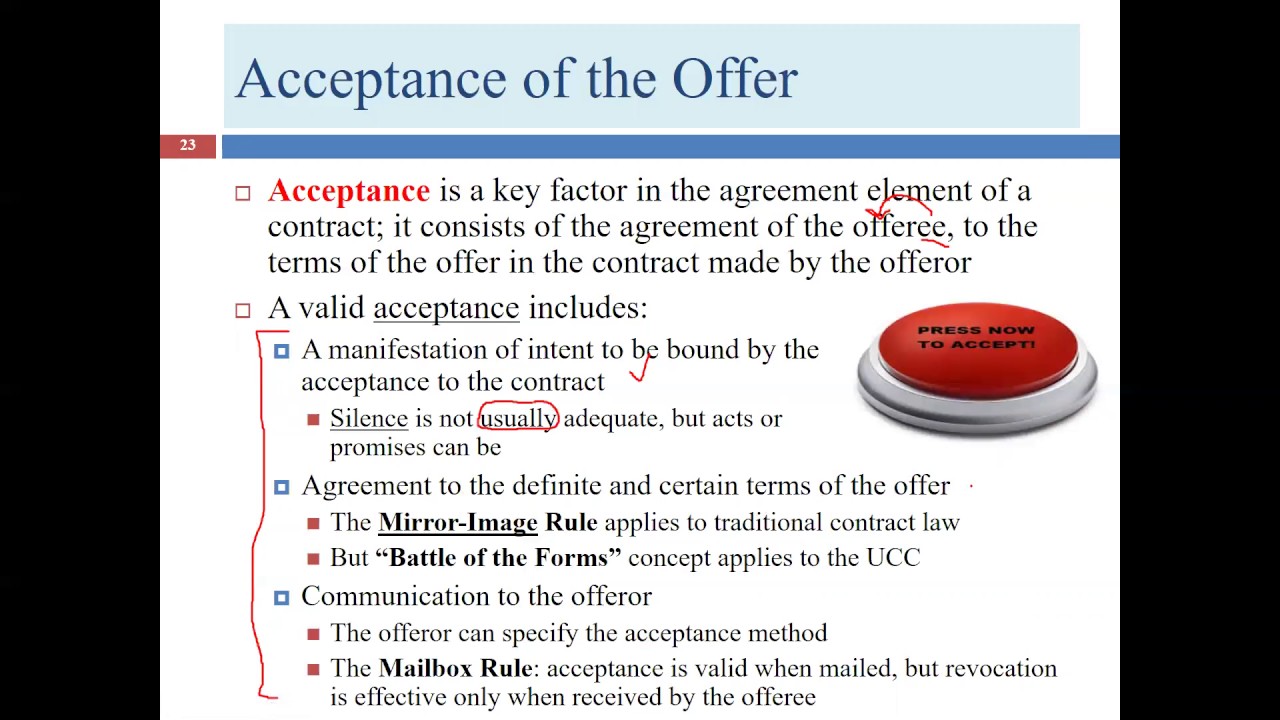






A legally enforceable contract requires three essential elements: an offer (a willingness to do something), an acceptance (exact agreement to the offer without modifications), and consideration (an exchange of value between parties). Oral agreements, text messages, emails, and other forms of communication can create binding contracts as long as these three elements exist, though the Statute of Frauds creates specific exceptions for certain categories like real estate transactions, trust creation, and contracts involving minors.
Contract Law Essentials: Offer, Acceptance, Consideration Explained
Added:The conceptual distinction between a moral or social promise and a legally binding obligation.
A basic understanding of the difference between civil law (resolving disputes between individuals/entities) and criminal law.
Familiarity with foundational legal terminology, such as 'parties', 'liabilities', and 'obligations'.
An overview of how basic business transactions and commercial exchange function in a modern economy.
The Statute of Frauds, which outlines specific types of contracts (such as land sales) that must be in writing to be legally enforceable.
Defenses to contract formation, including capacity (minors/mental competence), duress, misrepresentation, and unconscionability.
Breach of contract and the legal remedies available, such as compensatory damages, consequential damages, and specific performance.
The distinction between Common Law contract principles and the Uniform Commercial Code (UCC) governing the sale of goods.
22.5K views248likes8:41Original Release: 2017-02-20
Welcome everyone, this is Amer Mushtaq from You Counsel.
Many people do not have a clear understanding of what is a legally enforceable contract.
Often times when I've spoken with my clients and I brought the issue that they were bound by a specific contract, they were at times in denial.
Their responses or excuses were, for example, that “we had nothing in writing,” or “we had an agreement, but we never signed any contract,” and things of that nature.
And so that led me to think that I should post a lecture video on what is a very basic legally enforceable contract so people have a clear understanding of when a contract, when an agreement, becomes enforceable.
So today's lecture is really about the fundamentals of a very basic legally enforceable contract We began with the disclaimer that this course is not legal advice.
If you have any specific questions, you must contact a legal professional So are oral agreements enforceable?
That's always a question in people's mind.
What about unsigned written agreements?
There were terms of agreement put on paper in writing but parties, one party or more than one party, did not sign the agreement: is that enforceable?
What about agreements over text messages, emails, written on paper napkins – are they enforceable agreements?
And the answer is absolutely yes.
For a contract to be legally enforceable it must have three components: an offer, an acceptance, and consideration.
There are only a few exceptions in which case the contract will not be legally enforceable and we’ll talk about those exceptions but otherwise you have entered into a legally binding contract, which will be enforceable by the court.
An offer, an acceptance and consideration – so let's talk about what these three elements are.
An offer is simply willingness to do something.
For example, I’ll give you a very basic example: “I will wash your car if…” So this offer of washing the car is the offer.
What is an acceptance?
An acceptance is the exact acceptance of the offer.
So, whatever was offered, if you accept that without any changes, without any modifications, then that's acceptance.
If you make any changes then that becomes a counteroffer and we're not discussing that today.
So, the exact offer that has been made, if that's accepted by the other party, that's called an acceptance.
So, in our example, “yes, you can wash my car.” Simply the answer “yes” is sufficient to say that there is an acceptance.
And what is consideration?
It is an exchange of value between parties, and the value could be anything.
It could be money, it could be services or anything else.
So let's complete this example, and in this example we say that I will wash your car if you let me drive it for 15 minutes.
So one party is saying “I will wash the car,” the other party is getting the benefit of getting the car washed, and the first party is getting the benefit of driving the car for 15 minutes so there is an exchange in value.
One party gets the car washed, the other party gets to drive the car for 15 minutes.
So, when these three elements are present, a legally binding contract is in place.
Offer is there, acceptance is there, and there is consideration, so this is a legally binding contract.
And I've picked up this benign simple example to make this point, that even this small interaction, small exchange, is a legally enforceable contract.
So, let's say you had offered me that you will wash my car and I will let you drive it for 15 minutes and I said “yes,” we now have a legally binding contract.
If you do not wash my car, and I have to spend $500 to get my car washed for example, then I have a claim against you for $500 in damages and that's legally binding, that's legally enforceable.
So what are some of the exceptions to oral agreements?
Even though this exchange was not in writing, it wasn't signed, it wasn't on paper, it was an agreement and oral agreements are binding.
The only exception to oral agreement is stated in Statute of Frauds.
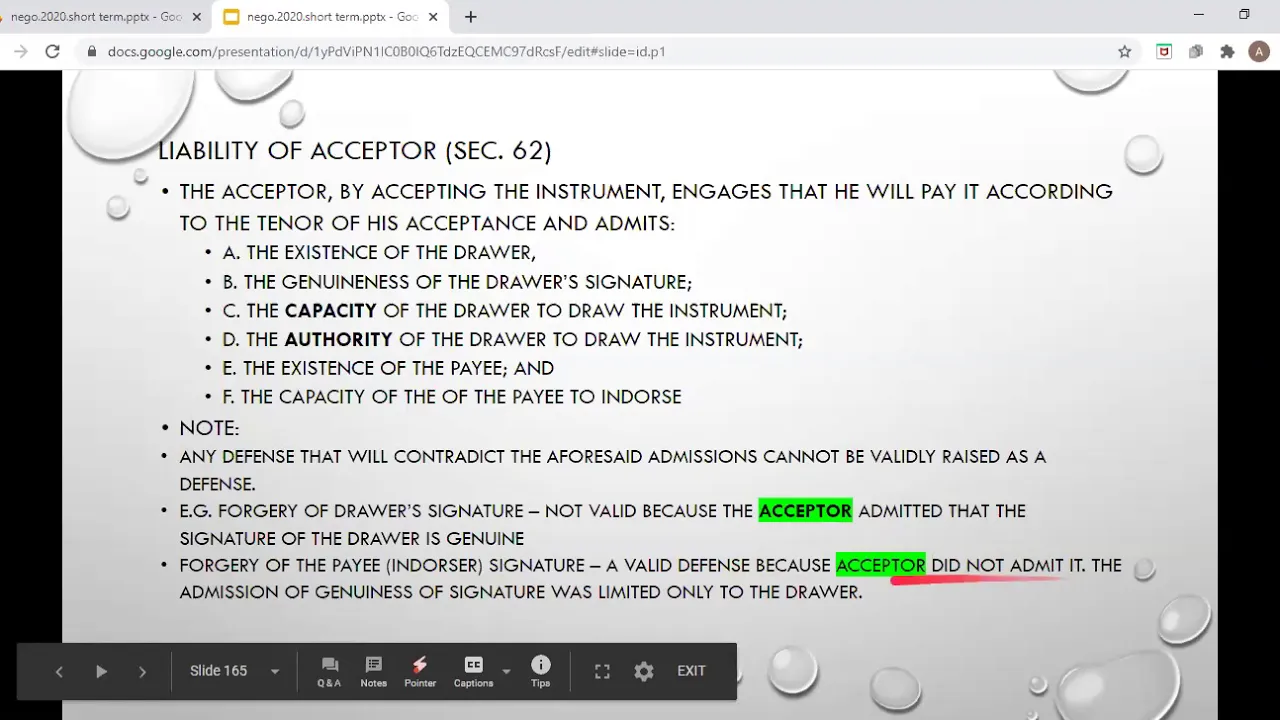
It's a specific legislation in Canada.
You can Google this name and you'll find the legislation, it's not very long.
And the Statute of Frauds really lists down certain categories of agreements that cannot be made verbally, cannot be made in writing.
And the history, if you Google “the history of Statute of Frauds”, it arose where there were circumstances where certain frauds were occurring, and the legislatures at that time decided that the only way to avoid those kind of frauds was to ensure that parties entering into those agreements were doing so in writing.
So one example of what's an exception to all agreements is contracts relating to land: if you're buying or selling any property that agreement has to be in writing otherwise it's not enforceable because of the Statute of Frauds.
Creation of Trust, Conclusion of Trust…anything to do with trust has to be in writing, it cannot be done verbally, providing surety for somebody, someone else, that requires something in writing.
Any contracts that were entered by a minor when the minor becomes an adult the minor has to, or the adult at that time, has to put that contract that agreement in writing and sign it and that's how that agreement becomes enforceable, otherwise Statute of Frauds prevents those agreements to be enforceable.
So those are really some of the exceptions and there may be a few more in the Statute of Frauds, but outside of that any oral agreement is as much binding as a written agreement.
Okay so what is it that you want to remember?
Oral agreements are binding as long as the Statute of Fraud does not apply.
Text messages, emails, Instagram, Twitter, whether these messages are signed or unsigned…if they're agreements that are in place, which contain an offer and acceptance and consideration, those are binding agreements, those are enforceable.
So when parties suggest that they had entered into an agreement but never eventually signed the contract therefore there's no contract in existence, that's not correct.
As long as there is an offer, as long as there's an acceptance, and as long as there is some consideration, the agreement is binding whether it's in writing or not.
So keep in mind that those three basic elements, and sometimes it is difficult to imagine that those three elements would be sufficient and later on when you have changed your mind and not put those things in writing then there may not be an agreement.
The law of contracts is obviously very complicated; this was a very basic lecture on explaining to you what could be a legally enforceable contract.
And you know the jurisprudence is filled with cases where you know what constitutes an offer is challenged, what constitutes an acceptance is challenged, whether there was an appropriate consideration or not, whether there were mistakes in contract, how do you rectify contracts?
So all of that is already disputed in legislation in jurisprudence.
But what you want to remember is that the basic principle of law, is that law wants to make people accountable, make people liable for the promises that they make to each other.
So if there is a legally binding contract the law will make sure that it is enforced, unless there are other reasons for not enforcing it.
And the reasons could be certain legislation; the reasons could be certain public policies etcetera.
But fundamentally it's the fundamental rule of law that people are accountable for their promises that they make to each other.
So hopefully this at least clarifies what a basic legal contract is, when it is enforceable and when it's not.
And we will keep adding more lectures to talk about some of the complex issues of Contract Law and hopefully that will help you understand the law of contracts a bit better.
Thank you for watching and please post your comments.
We will appreciate it and any questions you may have please ask us and we’ll add those in our future lectures.
Thank you for watching.
Up Next

2:26
Specht v. Netscape Communications Corporation Case Brief Summary | Law Case Explained
@QuimbeeDotCom
1.7K views•2021-01-08

4:27
US Secondary Sanctions Impact on EU Businesses and Blocking Legislation
@Bureauvandijk
1.6K views•2019-03-20

5:27
Forensic Phonetics: Speaker Identification in Legal Cases
@nptel-nociitm9240
539 views•2025-03-19

24:42
Police Interrogation Tactics: False Confessions & Legal Reform
@LastWeekTonight
7M views•2022-04-18
Related Study Plans & Knowledge Roadmaps
Structured learning paths in Law
law
Self-Defense Law: Imminence & Castle Doctrine
01Foundations of Self-Defense Law
02Imminent Threat & Reasonable Belief
03The Principle of Proportionality
+ 3 more learning modules
12h6 modules
Explore Roadmap
law
Defamation Law: First Amendment & Actual Malice
01Introduction to civil torts and the First Amendment
02Elements of Defamation: Libel and Slander
03Public Figures vs. Private Individuals
+ 2 more learning modules
8h5 modules
Explore Roadmap
law
Hearsay Rule: Trial Evidence & Exceptions
01Introduction to Trial Evidence & Courtroom Basics
02Demystifying Hearsay: The Core Definition
03Non-Hearsay: Exclusions Under FRE 801(d)
+ 3 more learning modules
14h6 modules
Explore Roadmap
law
Medical Malpractice: Law, Liability & Care
01Foundations of Tort Law and Civil Liability
02The Four Elements of Medical Malpractice
03Defining and Proving the Standard of Care
+ 2 more learning modules
12h5 modules
Explore Roadmap