













Hybridoma technology, developed by Milstein and Kohler in 1975 and awarded the Nobel Prize in 1984, enables the production of monoclonal antibodies through a multi-step process: immunizing mice with an antigen to stimulate B lymphocytes, fusing these activated B cells with immortal myeloma cells to create hybridomas, selecting viable hybridomas using HAT medium (which eliminates unfused cells by blocking nucleotide synthesis pathways), isolating individual hybridoma clones through limiting dilution, screening for desired antibody specificity using techniques like ELISA, and finally characterizing and storing the monoclonal antibodies for therapeutic and diagnostic applications.
Hybridoma Technology: Monoclonal Antibody Production Explained
Added:Basic structure and function of antibodies (immunoglobulins) and how they specifically bind to antigens.
The role of B-lymphocytes (B cells) in the adaptive immune response, specifically their ability to produce unique antibodies.
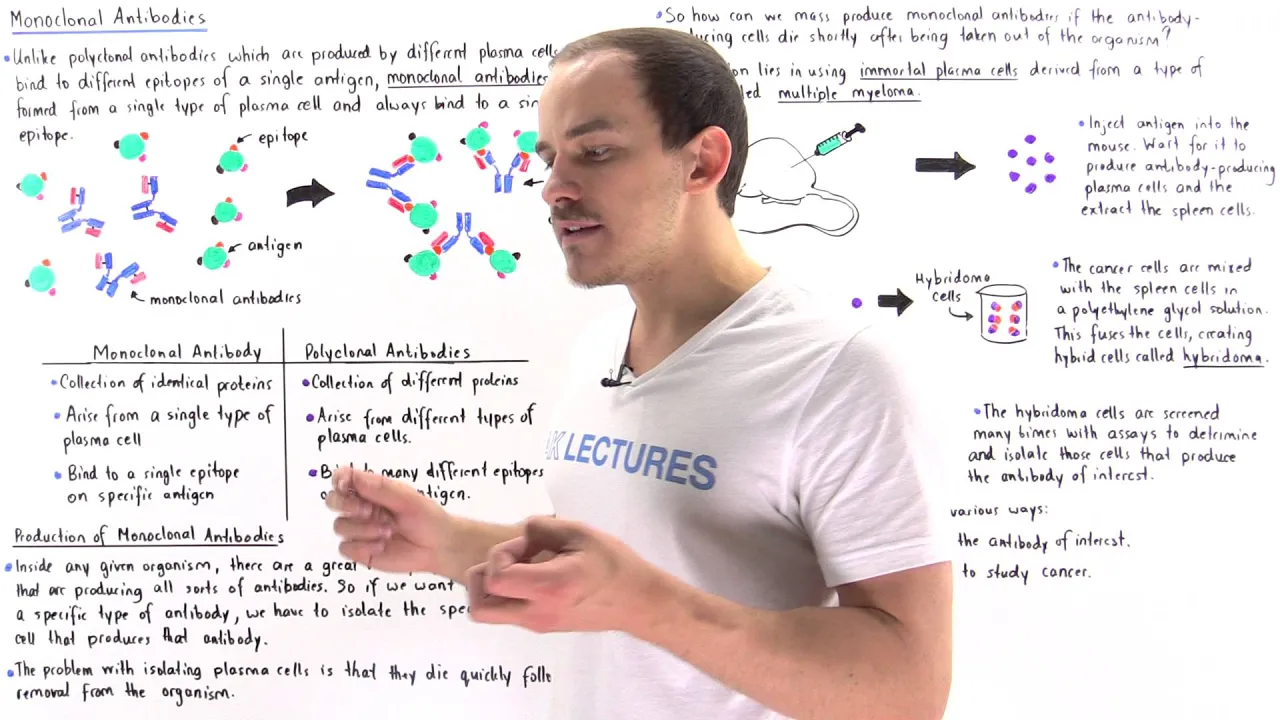
The difference between polyclonal and monoclonal antibodies in terms of their specificity, production, and biological origin.
Fundamental concepts of cell biology, particularly cell culture techniques, cell fusion (somatic hybridization), and the nature of immortalized cancer cells (myelomas).
The mechanisms and significance of antibody humanization (chimeric, humanized, and fully human antibodies) to prevent adverse immune responses in patients.
Clinical and therapeutic applications of monoclonal antibodies (mAbs) in treating diseases like cancer, autoimmune disorders, and viral infections.
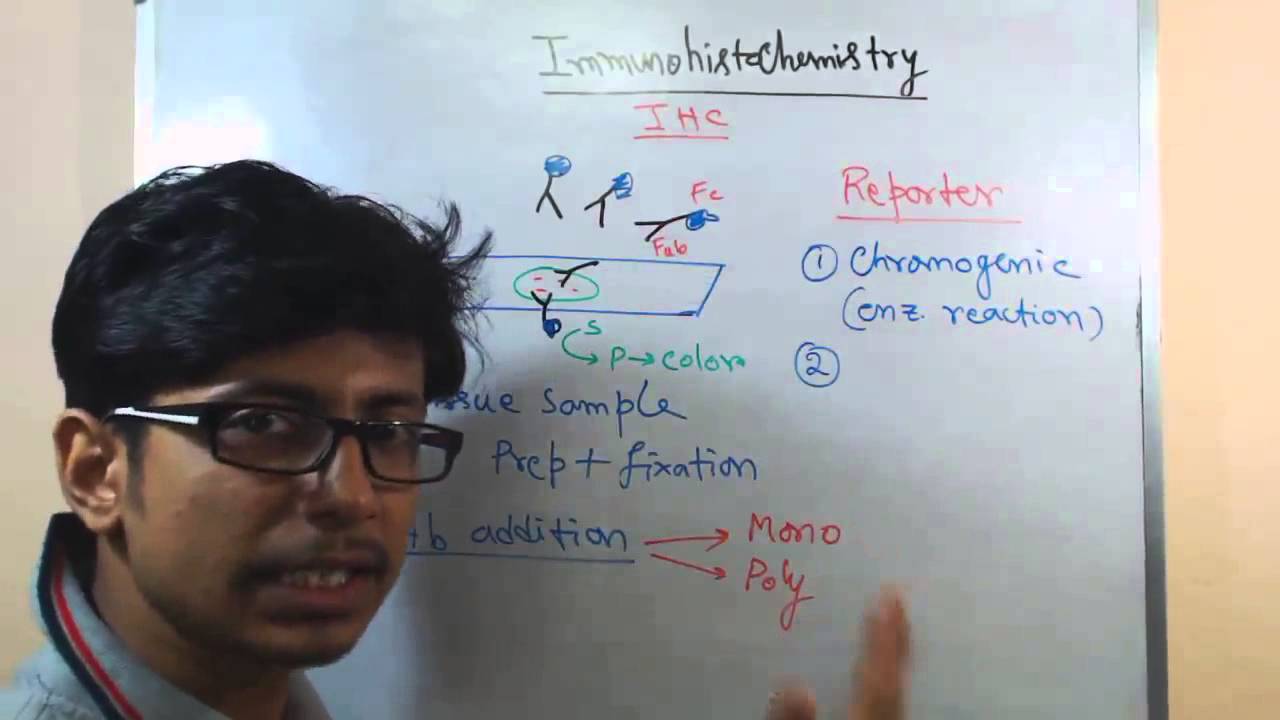
Diagnostic and laboratory applications of monoclonal antibodies, including ELISA, immunohistochemistry, and flow cytometry.
Alternative, modern methods of antibody production, such as phage display technology, single-cell B-cell cloning, and recombinant DNA technology.
41.8K views726likes7:41Original Release: 2020-01-21
this video lecture is about the production of monoclonal antibodies by hybridoma technology we know that in response to an antigen our immune system produces a heterogeneous mixture of antibodies these antibodies are of different specificities and they recognize different epitopes on the same antigen the antibodies derived from the multiple clone cells are known as polyclonal antibodies polyclonal antibodies represent a collection of antibodies from different B cells that recognize multiple epitopes on the same antigen today we talk about monoclonal antibody monoclonal antibody preparations contain only one type of antibody derived from a single cloned B cell so these antibodies will recognize and bind only one particular epitope on an antigen we can also say that monoclonal antibodies are identical antibodies with same specificity Milstein and color described the first technique developed for stable monoclonal antibody production in 1975 this technique is known as hybridoma technology they were jointly awarded Nobel Prize in Physiology or medicine in 1984 hybridoma technology is used for the production of large number of monoclonal antibodies against a particular antigen and these monoclonal antibodies are used for the different purposes for example in the treatment of cancer let's study in detail the technique of monoclonal antibody production first steppin production of monoclonal antibodies is the immunization of an animal usually the animal used as the mouse mouse is immunized with the antigen against which we need antibodies let's say this is our antigen and it has four different epitopes mouse is injected with the antigen several times as a result mouse B lymphocytes are stimulated against the epitopes or antigenic determinants of the injected antigen after several weeks when these B lymphocytes reach to an optimal amount the mouse is sacrificed spleen of mouse is removed aseptically it is known to us that spleen is the secondary lymphoid organ and we can easily harvest activated B lymphocytes from spleen then we have activated B cells which are capable of producing antibodies against the specific epitope present on the antigen activated B cells produce the antibodies of interest but cannot replicate in culture the second step is cell fusion in the step activated B lymphocytes are fused with me lomas cells the rationale behind fusing these two cell types together is that spleen cells produce the antibodies of interest but cannot replicate in culture thus it is difficult to harvest antibodies from them me Lomas on the other hand do not produce antibodies but to replicate in culture quite easily hybridomas take advantage of the properties of both cell types to mass produce antibodies of interest as a result of cell fusion we will have five type of cells unfused b-cells and fused b-cells unfused me Lomas and fused me Lomas cells and hybrid cells formed by fusion of an activated b-cell and in me loma cell these hybrid cells are also known as hybrid Dumas in our illustration we have four types of activated b-cells each specific to one of the four epitopes on the antigen so hybrid cells will also be of four types now our next aim is to select these hybrid dermis from this mixture of cells selection of hybrid dermis from the mixture can be accomplished through the use of media containing high pox and fin MN afteron and thymine hat in order to understand the rationale behind this approach it is important to note that mammalian cells can synthesize nan nucleotides using two different pathways the de novo and Salvage pathways under normal conditions mammalian cells will use the de novo pathway to replicate but the novo pathway is blocked by a man after him when the de novo pathway is blocked cells will then utilize the salvage pathway as an alternative means to replicate but this will only happen if high pox Anthon and thymidine are present the key to this approach is to use meal oma cells that are deficient in an enzyme called hg PRT which is required for the salvage pathway in this scenario unfused myeloma cells that are deficient in an enzyme called hg PRT melanomas are unable to replicate because the de novo pathway is blocked by N and after him and the salvage pathway is blocked by deficiency and HG PRT fused and fused b-cells died within few days because of their short lifespan they are not able to divide indefinitely in cell culture fused and unfused meal oma cells also die this is because de novo pathway is blocked by M and op Turan and the salvage pathway is blocked by deficiency and HG PRT hybrid cells almost survived in hat medium these hybrid cells are able to synthesize nucleotide by the salvage pathway the functional HG PRT enzyme is contributed by the activated b-cell partner and these cells are able to divide indefinitely our aim is to select legate single antibody producing hybrid cell we need to isolate these hybrid ms and grow them individually therefore next step is the isolation of hybrid ms of single specificity this is done by a method known as limiting dilution in this method the cells are hybrid dumas are distributed in multi well culture plates at very low density this is done such that on an average each will contain a single cell in the next step these hybrid dumas are screened for the secretion of the antibody of desired specificity this screening is done mostly by two techniques namely ELISA and RIA once the hybridoma cells producing the desired antibody are identified they are isolated and cloned in the next step we have separate clones of activated b-cells each producing antibodies of a single specificity in each case the antibodies produced are known as monoclonal antibodies in the final step these hybrid Dumas and monoclonal antibodies are characterized and stored mostly they are stored in liquid nitrogen now these monoclonal antibodies are ready to use in treating and diagnosing diseases [Music] for more information please visit creative Diagnostics dot-com thank you
Up Next
11:07
DNA Cloning and Recombinant DNA | Molecular Genetics | MCAT Biology Prep
@khanacademy
1.2M views•2016-06-02
14:12
Quantitative Real-Time PCR (qPCR): Principle, Method & Data Analysis
@animatedbiologywitharpan
129.2K views•2023-09-06
23:33
Microbial Degradation of Plastics: Biodegradation Pathways & Sustainability
@majeedhammad
2.9K views•2021-04-11
16:04
CRISPR and Genetic Engineering: How Gene Editing Works and Why It Matters
@kurzgesagt
30.5M views•2016-08-10
Related Study Plans & Knowledge Roadmaps
Structured learning paths in Biotechnology
biotechnology
AAV Production: Transfection, Prep & qPCR
01Introduction to Gene Therapy and AAV Biology
02Mammalian Cell Culture: Suspension HEK293 Cells
03Upstream Bioprocessing: Triple-Transfection Optimization
+ 2 more learning modules
18h5 modules
Explore Roadmap
biotechnology
Building Gut-on-a-Chip: PDMS, Cells & TEER
01Foundations of Microfluidics and Gut Anatomy
02Cleanroom Fabrication & PDMS Soft Lithography
03Epithelial Cell Culture and On-Chip Seeding
+ 2 more learning modules
26h5 modules
Explore Roadmap
biotechnology
Optimizing CFPS: E. coli Extract & Yield
01Fundamentals of Molecular Biology and Translation
02Introduction to Cell-Free Protein Synthesis (CFPS)
03Preparing E. coli Crude Lysate (The Extract)
+ 2 more learning modules
19h5 modules
Explore Roadmap
biotechnology
Haematococcus PBR: Design, Stress & Astaxanthin
01Biology and Life Cycle of Haematococcus pluvialis
02Bench-Scale Photobioreactor (PBR) Design and Engineering
03Culture Media Formulation and Inoculation
+ 2 more learning modules
15h5 modules
Explore Roadmap