












![26 - Curso Relatividad General [killings: cantidades conservadas]](https://i.ytimg.com/vi_webp/XAioMiHRRLI/maxresdefault.webp)
Emmy Noether proved that every continuous symmetry in physics corresponds to a conservation law, meaning translational symmetry leads to conservation of momentum, rotational symmetry leads to conservation of angular momentum, and time translation symmetry leads to conservation of energy; however, in our expanding universe, time translation symmetry is broken, so energy isn't conserved globally, though it appears conserved locally due to the approximate nature of time symmetry on human timescales.
Noether's Theorem: How Symmetry Defines Physics
Added:Familiarity with classical conservation laws, such as the conservation of energy, linear momentum, and angular momentum.
Basic understanding of Lagrangian mechanics, specifically the concept of the Lagrangian function (L = T - V) and the Principle of Least Action.
An introductory grasp of mathematical symmetries, including continuous transformations like translations in space and time, and spatial rotations.
Elementary calculus of variations, which is the mathematical framework used to find stationary points of functionals (like physical action).
Application of Noether's theorem in Quantum Field Theory (QFT) to derive conserved currents and charges from internal field symmetries.
The study of Gauge Symmetries and how they dictate the mathematical structure of the fundamental forces in the Standard Model of particle physics.
Spontaneous Symmetry Breaking, exploring how physical systems (such as the Higgs mechanism) lose their underlying symmetry at lower energy states.
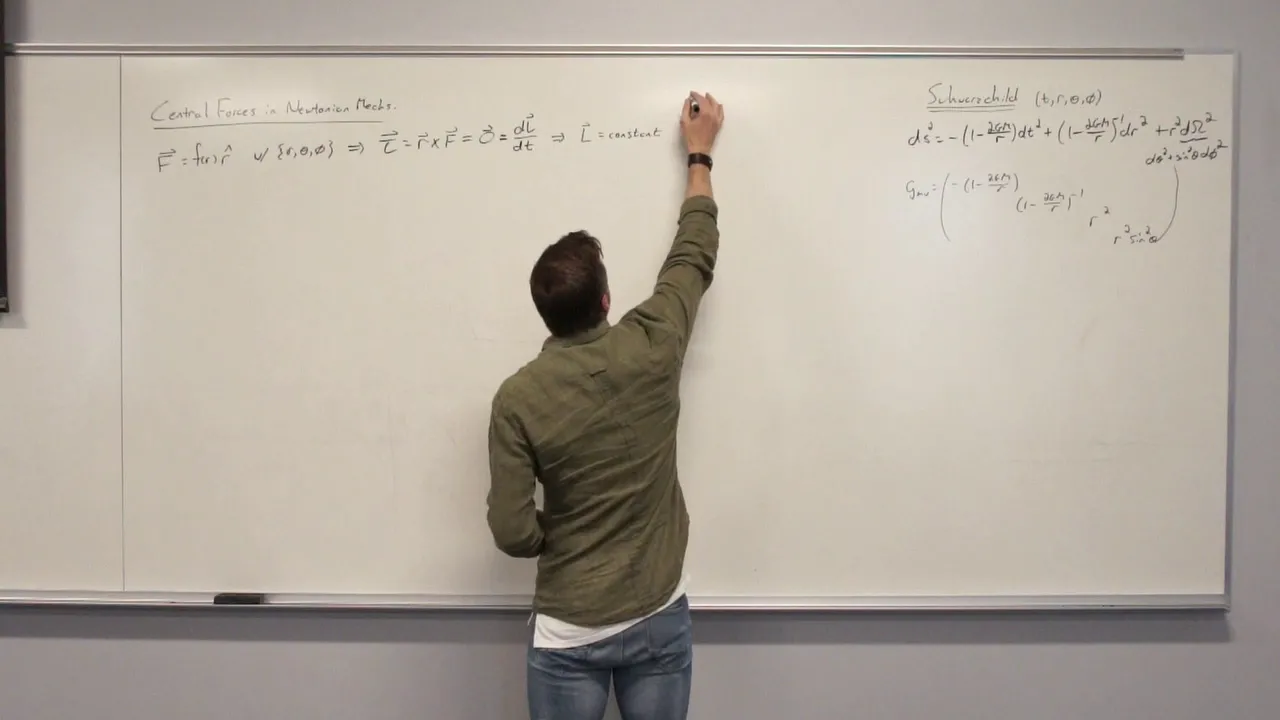
General Relativity and spacetime symmetries, analyzing how Killing vectors define conserved physical quantities in curved spacetime.
12.2M views279.7Klikes27:39Original Release: 2025-04-14
- Imagine you are an astronaut out drifting in deep space when you throw a rock as hard as you can.
What's gonna happen to that rock?
Well, you would think that it would continue with constant velocity in a straight line.
That's just Newton's first law.
But what actually happens is it eventually slows down and stops.
So why does this happen?
Where did all the rock's energy go?
(pensive orchestral music) At the turn of the 20th century, the problem of energy conservation baffled some of the greatest minds, including Albert Einstein.
Einstein came up with a possible solution, but then a little-known unpaid mathematician named Emmy Noether proved he was wrong.
And in doing so, she created a whole new paradigm for physics, one that underlies all of particle physics and explains why anything is conserved.
(gentle inquisitive music) It all started in 1915 at the University of Gottingen, where Einstein was giving six lectures on his new theory of gravity.
What would become the general theory of relativity.
The lectures were well received, but Einstein hadn't yet settled on the final form of the field equations.
One problem he was facing was how to show that total energy was conserved in his new theory.
- And this is the whole beginning of this story, right?
Classically, they thought they had this understanding of what the energy of the gravitational field was.
All of a sudden with these new equations, they go, "Where is it?
You know, is it in the curvature?
You know, is it in the stress-energy tensor?
Where's the term that we're looking for?"
- [Derek] Einstein suggested that the principle of conservation of energy, long established as a bedrock of physics, might hold the key to working out the correct field equations.
In the audience, legendary mathematician David Hilbert was intrigued.
So he started to look for the energy conservation equations in Einstein's new theory, but the best he could find was a set of equations known as the Bianchi identities.
They showed that energy was conserved, but only in a completely empty universe.
So for one like ours filled with stuff, they seemed useless.
Hilbert was stumped.
- Fortunately, he knew just the person for the job.
His new assistant, Emmy Noether.
(light thoughtful music) - [Derek] From an early age, Noether had dreamed of following the footsteps of her father, a mathematics professor at the University of Erlangen.
She got special permission to attend lectures at the university, but they refused to admit her as an official student.
The Erlangen Academic Senate held that the admission of women "would overthrow all academic order."
(lively orchestral music) So in 1903, she spent a semester at Gottingen instead.
There she learned about a new way to approach geometry using symmetry.
(gentle thoughtful music) Symmetry is one of those ideas that's easy to recognize but harder to describe.
- If I align a mirror on this triangle like so, then it looks the same as without the mirror, and that's because this is an axis of symmetry.
The reflections about this axis leave the triangle unchanged.
And the same thing happens if I put the mirror like this or if I orient the mirror like this.
So this triangle has three axes of symmetry.
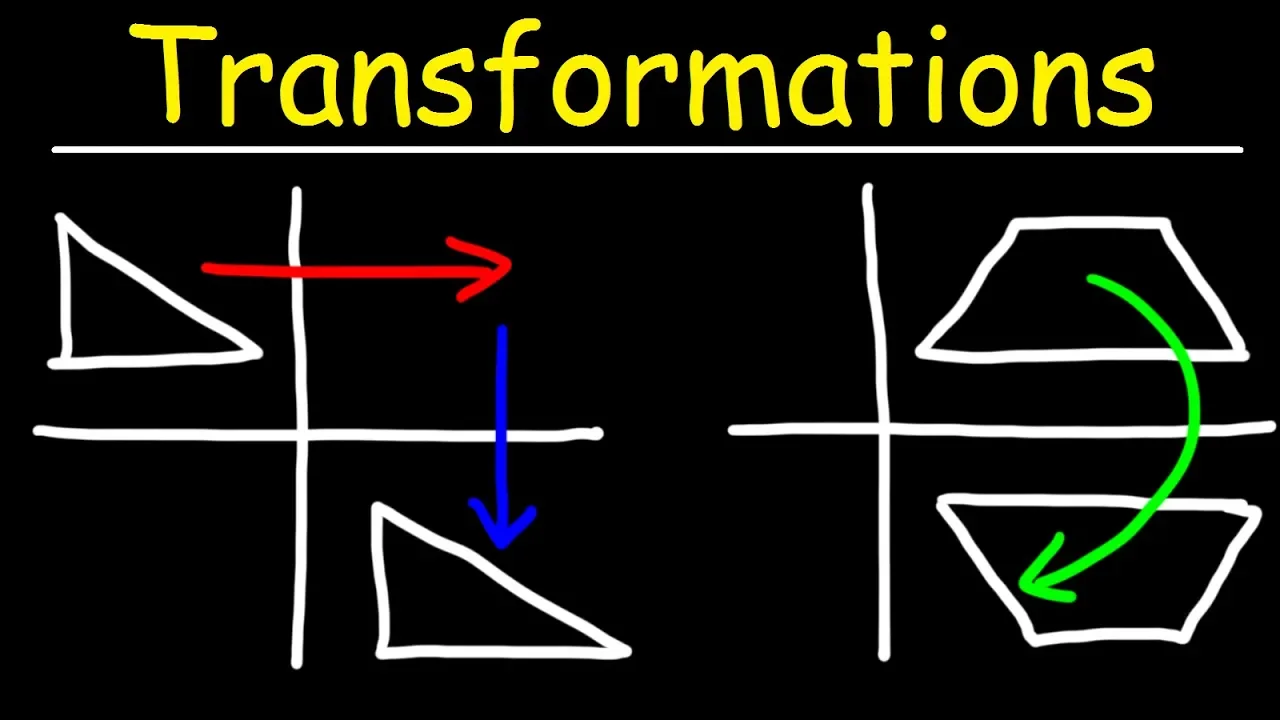
Now, mathematicians generalize the idea of symmetry further to be any action you can take that leaves an object unchanged.
So something else I could do is I could rotate this triangle by 120 degrees or by 240 degrees or by 360 degrees.
Together, these six actions capture all the symmetries of the equilateral triangle.
- [Derek] But you can also have more abstract symmetries, for example, with a mathematical function.
If I shift this function up or down by some constant amount, call it a, then all of its y values will change.
But if I differentiate that function, I get the slope, and that remains unchanged regardless of whatever constant is added.
So you can add any constant to this function, and its derivative always stays the same.
So there is a kind of translation symmetry.
And unlike the symmetries of the triangle, this is a continuous symmetry, meaning you can shift it by any amount you like.
Over the next 12 years, Noether became a leading expert on symmetry.
She became only the second woman in Germany to earn a PhD in mathematics, and she used this expertise to help Hilbert and Einstein with their problem of energy conservation.
The issue had bothered Einstein so much that he proposed a new conservation equation.
It said that if we add together the energy of matter and the energy of the gravitational field, then that total remains constant.
Its change over time and space is zero.
But when Noether saw this, she was convinced Einstein had made a fundamental mistake because this equation disregards the foundational principle that general relativity is built on.
(light pensive music) 10 years earlier, in 1905, Einstein had introduced his special theory of relativity, and it was built on the idea that the laws of physics were independent of your frame of reference.
But so far Einstein had only applied this principle to inertial frames of reference.
Those are frames that move at a constant speed.
- He began wondering what would it take to generalize that, to consider more general states of motion.
After all, trains on the platform; he loved trains.
Trains would speed up or slow down.
People, you know, moving around the world don't only move at a single constant speed forever.
- In 1907, he wrote, "Is it conceivable that the principle of relativity also applies to systems that are accelerated relative to each other?"
This made him wonder; perhaps his principle could also be applied to accelerating and rotating frames, frames that move in any way in general.
That's the "general" in general relativity.
So Einstein got to work on this largely intellectual pursuit.
- But then, as he was daydreaming in the patent office, he had what he called the happiest thought of his life.
- [Derek] He imagined the window cleaner at the top of the opposite building falling off.
(window cleaner screams) And Einstein realized that while the man was falling, he wouldn't feel his own weight.
He would be weightless, and anything he dropped on his way down would remain stationary relative to him.
It would be just as if he was floating in outer space.
- It's ironic, we would've said, "Oh, he's being pulled down to the ground because the gravity of the Earth is exerting a force.
But Einstein said, while that person is in motion, what we call free fall motion, they would actually feel no gravity at all.
There must be some equivalence between accelerated motion and the action of gravity.
So Einstein arrived at what he called the equivalence principle.
- [Derek] If you were stuck in a rocket in outer space accelerating at 9.8 meters per second squared, then it would be the exact same as if you were standing on the surface of Earth.
- And this was huge because it meant that if Einstein could figure out how to understand accelerating frames, then he didn't just get a more general theory; he would also have a new theory of gravity.
- But to achieve this, Einstein needed to make sure the laws of gravity had the same form in every frame of reference.
(train whooshing) This is the idea of general covariance, and it's one of the core tenets of general relativity.
To satisfy it, Einstein knew he had to use special mathematical objects called tensors.
A simple kind of tensor is a vector.
You can write a vector as a set of components multiplied by their basis vectors.
For example, this vector can be written as 3x hat plus 2y hat.
But I can also write this using a different coordinate system.
And with these new basis vectors, the original vector is now written as 2a plus 1b.
So the components, the numbers in this list, changed, but the vector didn't.
It stayed the same.
And that's because when the basis vectors change, the components adjust in a complementary way to keep the vector the same.
The vector itself is independent of which coordinate system you use.
And the same is true for tensors, only now instead of having just two components, a general tensor can have any number of them in the form of a matrix.
And just like with vectors, you can change a tensor from one coordinate system to another, and the tensor stays the same.
So that's why Einstein had to use them to build his new theory.
- And that was exactly the problem that Noether found because when she looked at Einstein's proposed energy conservation equation, it contained a pseudotensor.
And as the name implies, that isn't quite a tensor.
When you try to transform it from one frame of reference to another, it doesn't remain the same quantity in different frames.
The gravitational energy you might observe in one frame completely disappears in another.
- And Einstein, you know, he had some strange thoughts about this.
I mean, people were trying to stamp conservation of energy into relativity by bending the rules of mathematics.
- So, Noether knew that Einstein's proposed solution couldn't be the answer, and that made her think, "What if general covariance and energy conservation are simply incompatible?
And if that's the case, then why?"
General covariance says that laws of physics must stay the same when you change reference frames.
So that is a kind of symmetry, exactly what Noether had spent her career studying.
So she started thinking about the symmetries of the universe, beginning with the simplest possible case, an empty static universe.
(light contemplative music) Imagine you are an astronaut in this universe.
Since it's empty, there is nothing special about any particular point.
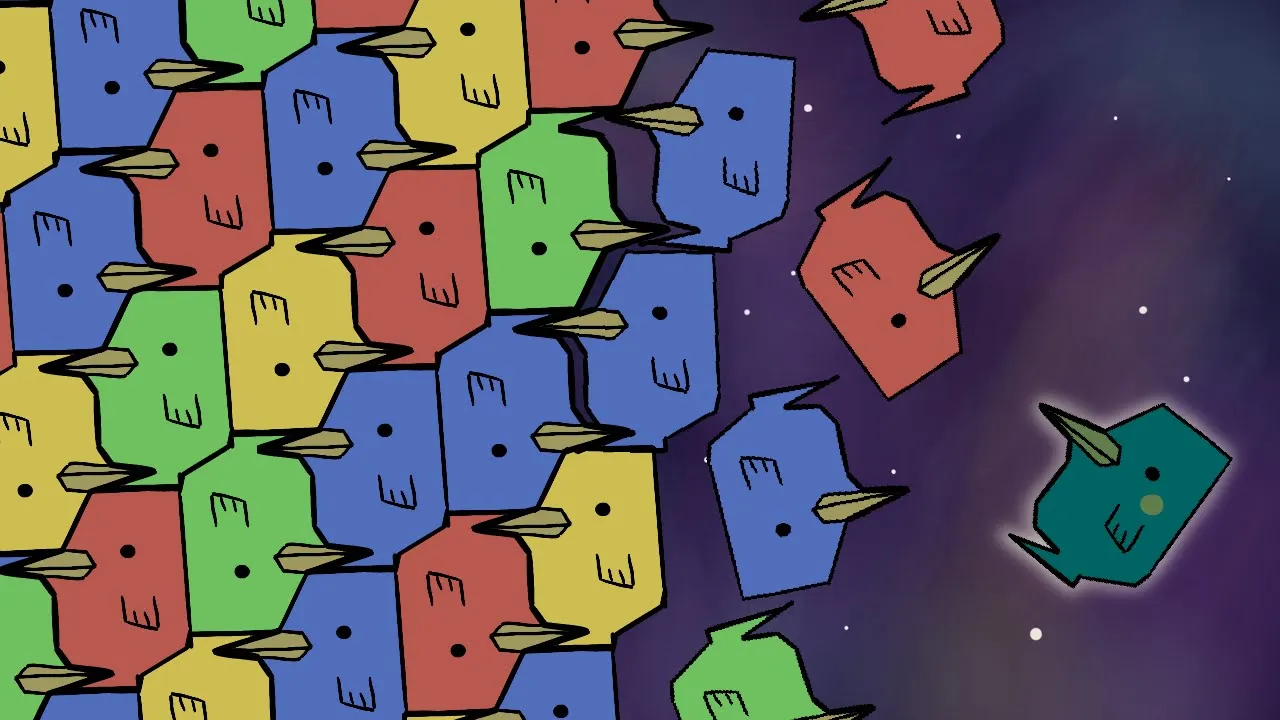
I mean, it doesn't matter if you're over here or over there; the universe is completely symmetric under translations in space.
So suppose you throw a ball; well, it'll travel at a given speed, and after a short amount of time, it will have traveled some distance.
But since the laws of physics are the same here as just before, we can shift the whole universe, and we're back to the situation we started with.
And we can keep doing this over and over, and this shows us that the object will continue with that same speed indefinitely.
So what we've discovered is that the principle of conservation of momentum is a direct result of the fact that there's a translation symmetry in the universe, that an experiment done in one spot will give identical results to that same experiment done somewhere else.
You could move everything from one place to another, and the physics won't change.
Similarly, the laws of physics don't depend on whether you perform an experiment like this or rotate everything by 90 degrees.
This universe is symmetric under rotations.
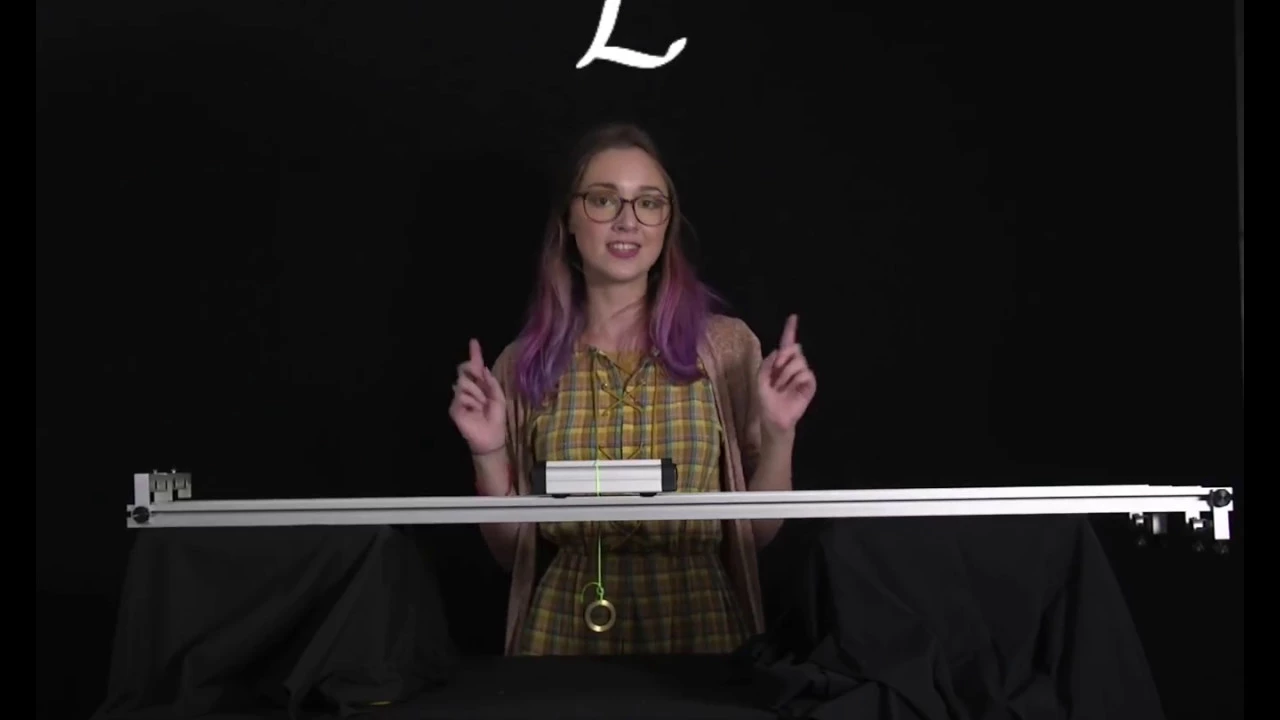
So imagine we take a metal rod and spin it.
If we let it rotate for a minute, then it will have moved through a small angle, but we can rotate the whole universe back by that same angle and now we're at the starting position again.
And we can keep doing this so that each instant looks exactly the same as the one before, which means the object will keep rotating this way indefinitely.
So the law of conservation of angular momentum comes from the rotational symmetry of the universe.
Now, another important symmetry of this universe is time symmetry.
The laws of physics don't change over time; if you do an experiment today or tomorrow, you will get the same result.
So what does this symmetry lead to?
Well, to understand this, we're gonna dig into some math and a different way of doing mechanics using the principle of least action.
Previously on Veritasium, we learned that everything always follows the path that minimizes a quantity known as the action.
This is equivalent to the integral of the Lagrangian L over time.
In the simplest case, that's just the kinetic minus potential energy.
Euler and Lagrange found that the principle of least action is obeyed, so long as this set of differential equations is satisfied.
So Noether used action to see how physics was affected by different symmetries.
- So suppose we do an experiment where the result is the same now as some tiny time interval epsilon later, then how does this affect the action?
Well, the time is going to change from just t to t plus epsilon, and as a result, the Lagrangian is also going to change.
So the new Lagrangian will be L prime, which is equal to the old Lagrangian, plus how much the Lagrangian changes over time, that's just dL by dt, multiplied by how long that change lasts, so multiplied by epsilon.
But now also remember that the result is gonna be the exact same now as a little while later, which means that whatever this term is, the dL over dt, doesn't affect the equations of motion, and it's from this symmetry in the action that we're gonna be able to find the conserved quantity.
So let's take dL/dt and rewrite it using the chain rule.
That gives us the partial derivative of L with respect to X times dx over dt, plus the partial derivative of L with respect to v times dv over dt.
But we can sub in the partial derivative of L with respect to x with this term from the Euler-Lagrange equation.
And we can simplify this further by writing dx over dt as v, and that gives us this expression.
And now notice what we've got right here.
We've got the time derivative of some function, dL over dv, times another function, plus that first function times the time derivative of the second function.
So we can use the reverse of the product rule to simplify this to the time derivative of dL over dv times v.
Then as a final step, we can bring dL over dt to the right.
So what we found is that if you take the time derivative of this quantity, it's equal to zero, which means that whatever this is has to be a constant.
So what is it?
Well, remember that in the simplest case, the Lagrangian is just equal to the kinetic minus potential energy, which we can write as 1/2 mv squared minus v.
So if we take the partial derivative of the Lagrangian with respect to v, we're just gonna get d over dt, m times v multiplied by v, so this is gonna become mv squared.
And then we can sub in the Lagrangian.
So this becomes minus 1/2 mv squared minus v, but also minus here.
So this becomes plus v, and all of that's equal to zero, which we can simplify to just 1/2 mv squared plus v is equal to zero.
But wait a second because this is just the total energy.
So what we've discovered is that time translation symmetry is equivalent to saying that energy is conserved.
(dramatic orchestral music) - The principle of conservation of energy is a direct consequence of time translation symmetry.
In a theorem, Noether proved that all of these examples are no coincidence.
For centuries, people had no idea where conservation laws came from.
But now Noether had discovered the origin of all of them.
She proved that anytime you have a continuous symmetry, you get a corresponding conservation law.
Translational symmetry gives you conservation of momentum, rotational symmetry gives you conservation of angular momentum, and time translation symmetry gives you conservation of energy.
But these are all symmetries of a static empty universe.
The universe we live in is very different.
In the 1920s, astronomers measured the velocities of distant galaxies, and they realized all of them are moving away from us.
The farther away they are, the faster they're moving.
The implication was clear.
In the distant past, everything must have been much closer together.
In the 1990s, precise measurements of supernovae revealed that not only was the universe expanding, but that expansion was speeding up.
This means over large timescales, our universe is not symmetric in time.
It was very different 13 billion years ago, and it'll be different billions of years from now.
Since we don't have time symmetry, that also means energy, as we usually think of it, isn't conserved.
- There's no reason for energy to be conserved anymore 'cause you don't have that symmetry.
- [Derek] Think about a photon of visible light emitted 380,000 years after the Big Bang, it travels through the universe unimpeded to arrive at our telescopes, not as visible light but as a microwave.
It has lost 99.9% of its energy.
- Where did the energy go?
Doesn't go anywhere.
Energy's not conserved.
- [Derek] And this is exactly what's happening to the rock as well.
It starts off with energy, but as it travels through the expanding universe, it slows down and stops.
(gentle thoughtful music) The energy doesn't really go anywhere; it just disappears.
- It ends up coming to rest with regard to the other particles in the universe.
- This doesn't violate any laws of physics because energy and momentum aren't conserved if there is no time or spatial symmetry.
- So once you know that symmetries give you conservation laws, and so once those symmetries are gone, you don't have to worry about those conservation laws anymore, then you can start dropping these concepts of trying to force something that you want to say is fundamental into the theory, and you just deal with what the theory gives you.
- But if energy isn't conserved in our universe, then why does it usually seem like it is?
(light mysterious music) That's because when you're looking at the short timescales that we're used to, time translation symmetry pretty much holds; an experiment done today will give the same results as the same experiment done tomorrow.
So that means for all intents and purposes, energy is conserved.
But over large timescales on the order of millions of years, well, then the expansion of the universe can't be neglected, and the symmetry is broken.
So only when you look at timescales that big do you notice that energy isn't conserved.
Noether's first theorem explains why a rock or a photon loses energy, but it didn't fully solve the problem of energy conservation in general relativity.
See, so far, Noether had only dealt with an empty universe where you could shift the whole universe and the laws of physics would stay the same.
But this doesn't work in general relativity, where the curvature can change from one point to another.
Now if you shift the whole universe, rotate it, or let it evolve in time, things don't stay exactly the same.
So you no longer have these global symmetries, but Noether realized there are still other symmetries left.
See, no matter how you're moving, the laws of physics always look the same.
That's general covariance, and it is a kind of symmetry that holds everywhere.
It means that in any small region, we can always change our frame of reference.
We can transform the points of space around as much as we like.
And since these transformations aren't global but local, these are called local symmetries.
In a second theorem, Noether proved that for these local symmetries, you no longer get proper conservation laws like we're used to in classical physics.
Instead, you get something that only works locally: a continuity equation.
One example of a continuity equation describes the flow of water through a pipe.
This first term tells you how the amount of water changes in a section of the pipe, and the second tells you the difference between how much water is flowing out and how much is flowing in.
In this case, the first term is positive because the water level in this pipe section is increasing, and the second term will be negative because less water is flowing out of the section than in.
Together, the two terms cancel to give zero, which guarantees that no water is created or destroyed.
If the total amount of water changes in a section, there must either be excess water flowing in or out.
- In the case of general relativity, Noether found a similar continuity equation, but with an important difference.
Imagine that now our pipes are little patches of space-time, and the water is energy flowing from one patch to another.
In any individual section, the continuity equation looks exactly the same as before, so that in any small region of space-time, energy is conserved.
But when we link these sections together, we need to take into account the curvature of space-time.
And this changes the equation.
Now, it's as if there are little cracks appearing between different sections of pipe, between the local patches of space-time, and through those cracks, energy can leak out.
- In special activity, the pipe is imperturbable because the pipe is fixed.
And in general activity, you know, we have to account for the energy that goes into other kinds of change over time, and that gets correspondingly more tricky.
- [Derek] Now that we have this new equation, we can see how it works by expanding it as a sum of different terms.
This first term is analogous to the continuity equation from before, the one which conserves energy within a local patch of space-time.
But now we have all these extra terms.
These describe the curvature of space-time.
So as energy decreases in the first term, these curvature terms increase.
- The energy that you lose from the system you're tracking, we now start attributing it to things like the gravitational field, which has changed 'cause the whole universe is stretched.
We have to account for the energy that we attribute to the action of the gravitational field as well because space and time themselves aren't sitting still.
- And all of this can be described by the continuity equation Noether had found.
But when she looked at it, she realized something.
It was exactly equivalent to the Bianchi identities, the half-solution Hilbert had found.
He had dismissed it because it only gave you proper energy conservation in an empty universe.
But now Noether proved that it was the best you could do in general relativity.
With one paper, she had uncovered the source of all conservation laws, and she had solved the problem in general relativity that eluded Hilbert and Einstein.
- She was so amazing.
I mean, I would go out on a limb, and I would say these two theorems are probably the most important theorems for physics of the 20th century.
- [Derek] In the following years, the University of Gottingen took steps to make Noether's position more official, allowing her to do what she loved most: to teach.
They made her a professor, and she even got a small salary starting in 1923.
But all of that changed on the 30th of January, 1933, when Hitler became chancellor of Germany.
The Nazis banned Jewish people from working at universities, and almost immediately, one of her former students told the authorities of her Jewish heritage, and she was suspended.
Despite this dismissal, she continued teaching in the kitchen of her home.
Then one day, one of her old students knocked on her door.
(hand knocking on door) Clothed in the brown shirt of the Nazi stormtroopers, Noether let him in.
He had come to learn math, and Noether was happy to teach him.
- I love what this sort of shows about Noether.
You know, she truly, deeply cared about math, and she wouldn't discriminate.
Whether someone was wearing a Nazi shirt or not; she taught all.
- [Derek] But staying in Germany became untenable.
Fortunately, with the help of other academics, she managed to obtain a teaching position at Bryn Mawr, a woman's college in America, where she would teach until her death.
In an obituary for the New York Times, Einstein wrote that "Fraulein Noether was the most significant creative mathematical genius thus far produced since the higher education of women began."
- The reason that Noether's theorem is so important is that everybody just changed their state of mind.
All of a sudden, the physicists were thinking about physics in terms of these symmetries.
- Physicists started applying these ideas to the quantum world too, realizing that charged particles like electrons also have symmetries.
Electrons have a phase, which you can think of as an arrow pointing in some direction, but you can offset this phase by any arbitrary amount so long as you do it simultaneously for all electrons.
And that doesn't change anything physically, so there's another symmetry.
So what does this offset or gauge symmetry lead to?
Well, it leads to the conservation of electric charge.
In the 1960s and '70s, Noether's insights led directly to the discovery of new fundamental particles like quarks and the Higgs boson.
It taught us where the forces of nature come from, and it even helped to explain the origin of all mass in the universe.
Noether's two theorems, although little known, are what has gotten us the closest we've ever come to a theory of everything.
But all of this and much more will be covered in a second video.
So make sure you're subscribed to get notified when that video comes out.
(radio waves whizzing) When Emmy Noether set out to study mathematics, she was following in her father's footsteps, but from there she forged her own path.
And before long, she was coming up with a whole theory that reshaped our understanding of the universe.
That is the great thing about learning.
You start by following instructions, building on what others have done before you.
But then at some point, you start asking your own questions; you start experimenting and making discoveries.
I've loved watching my own kids start this journey, and my longtime sponsor, KiwiCo, has been a big part of it.
This month they sent me their Rapid-Fire Disc Launcher crate, and at first, we followed the instructions carefully, putting it together step by step.
But as soon as it was built, my kids immediately started experimenting.
- [Child] Can I launch it?
- Testing different launch techniques to better hit the target, changing the launch angles, and figuring out what would make the discs fly farther.
Without even realizing it, they were engaging with the same questioning mindset that drives real scientific discoveries.
So who knows, maybe a simple disc launcher will inspire a young scientist who will go on to make the next great breakthrough in science or engineering.
KiwiCo makes this easy by delivering everything you need in a single box, and they have projects for all ages designed by experts and tested by kids to make sure they're not only loads of fun, but they also inspire kids to ask questions and get creative with learning.
So if you want to try out KiwiCo, click the link in the description or scan this QR code.
Use my code Veritasium to get 50% off your first monthly crate.
I wanna thank KiwiCo for sponsoring this video, and I wanna thank you for watching.
Up Next
10:39
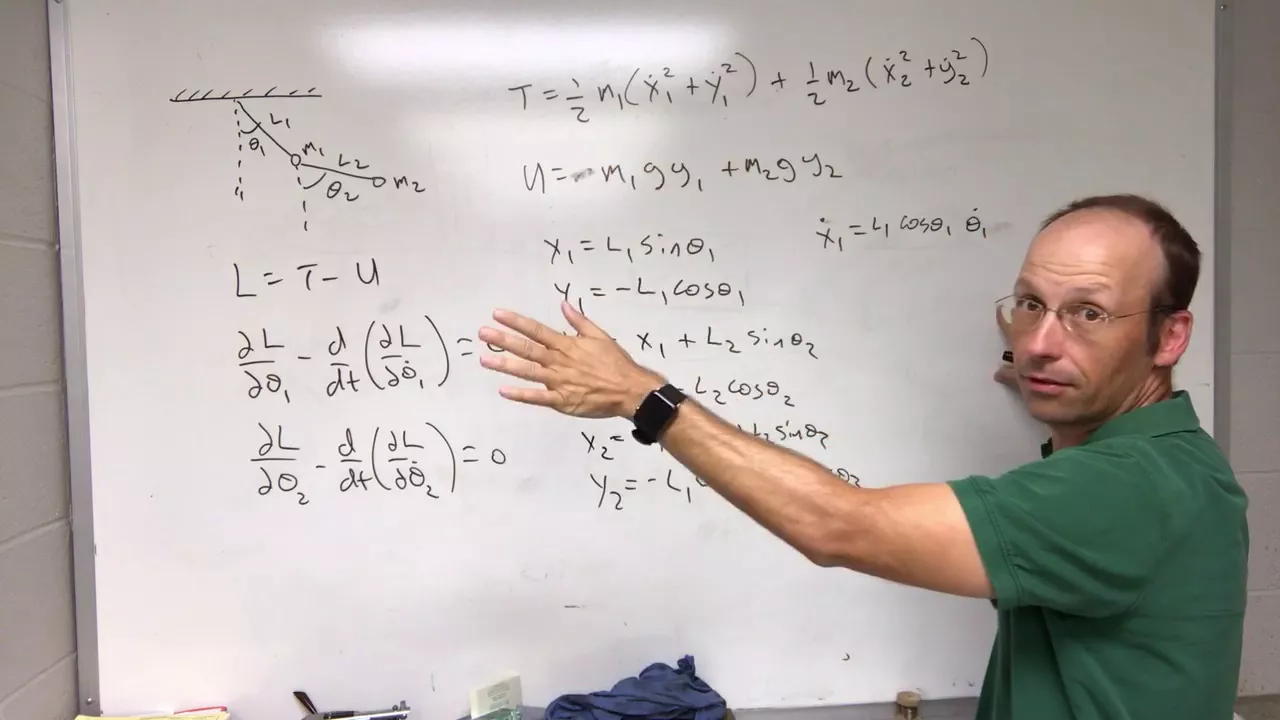
Lagrangian Mechanics: Setting Up the Double Pendulum Problem
@rhettallain
46.1K views•2017-09-11

12:53
21cm Hyperfine Transition in Neutral Hydrogen: Radio Astronomy Basics
@AaronRobertParsons
12.4K views•2011-10-13
6:32
Schlieren Imaging: How to See Air Currents and Temperature Gradients
@veritasium
1.6M views•2017-06-15

27:14
Entropy and the Second Law of Thermodynamics Explained
@veritasium
27.5M views•2023-07-01
Related Study Plans & Knowledge Roadmaps
Structured learning paths in Physics
physics
Nuclear Physics (Decay, Fission & Reactors)
01Atomic Structure and the Binding Force
02Radioactive Decay and Half-Life
03Nuclear Fission Mechanics and Chain Reactions
+ 2 more learning modules
12h5 modules
Explore Roadmap
physics
Soft Matter (Polymers, Colloids & Rheology)
01Foundations of Soft Matter & Thermal Forces
02Polymer Physics and Macromolecules
03Colloids, Surfactants, and Self-Assembly
+ 2 more learning modules
38h5 modules
Explore Roadmap
physics
Analytical Mechanics: Lagrangian & Hamiltonian
01Mathematical Foundations: Calculus of Variations
02From Newtonian Mechanics to Constraint Dynamics
03The Principle of Least Action & Lagrangian Mechanics
+ 3 more learning modules
28h6 modules
Explore Roadmap
physics
General Relativity (Spacetime & Cosmology)
01Foundations of Relativity: Special Relativity
02The Geometry of Spacetime: Equivalence Principle & Curvature
03Einstein's Field Equations: The Mathematics of Gravity
+ 2 more learning modules
55h5 modules
Explore Roadmap