






![Multi Degree of Freedom (MDOF) Systems [V.2]](https://i.ytimg.com/vi/mjpWI1kVjAw/maxresdefault.jpg)








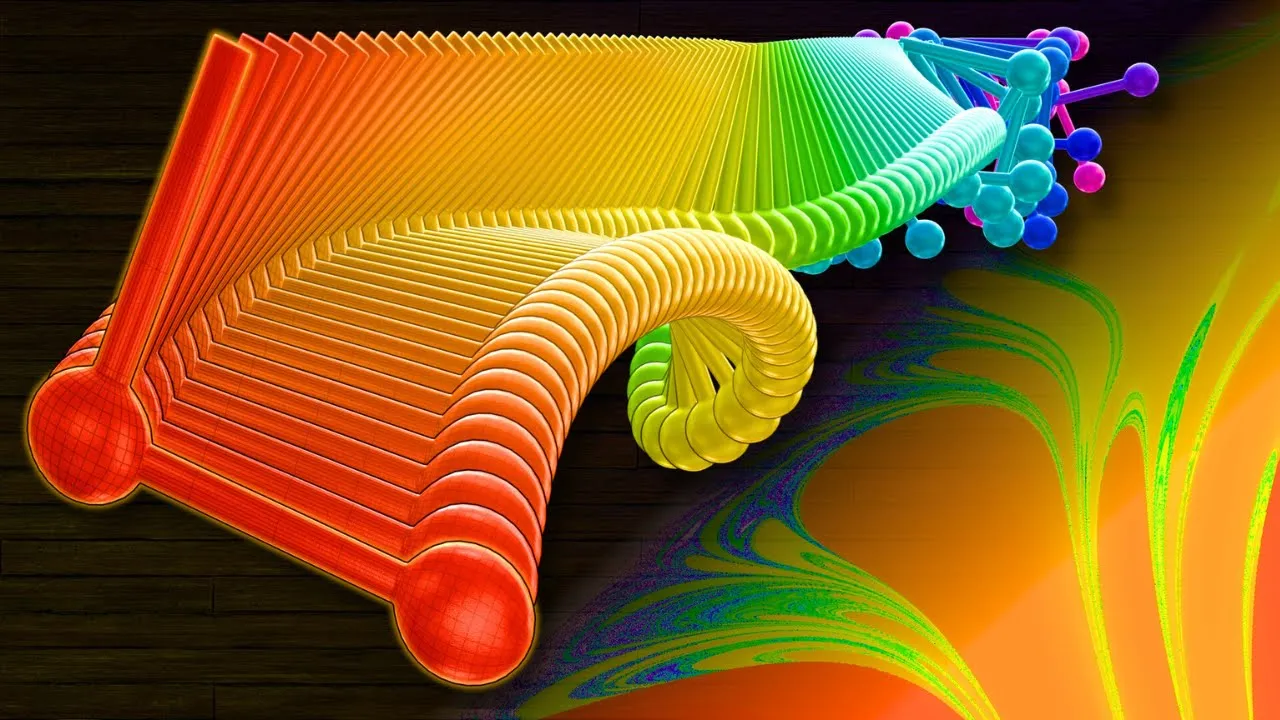
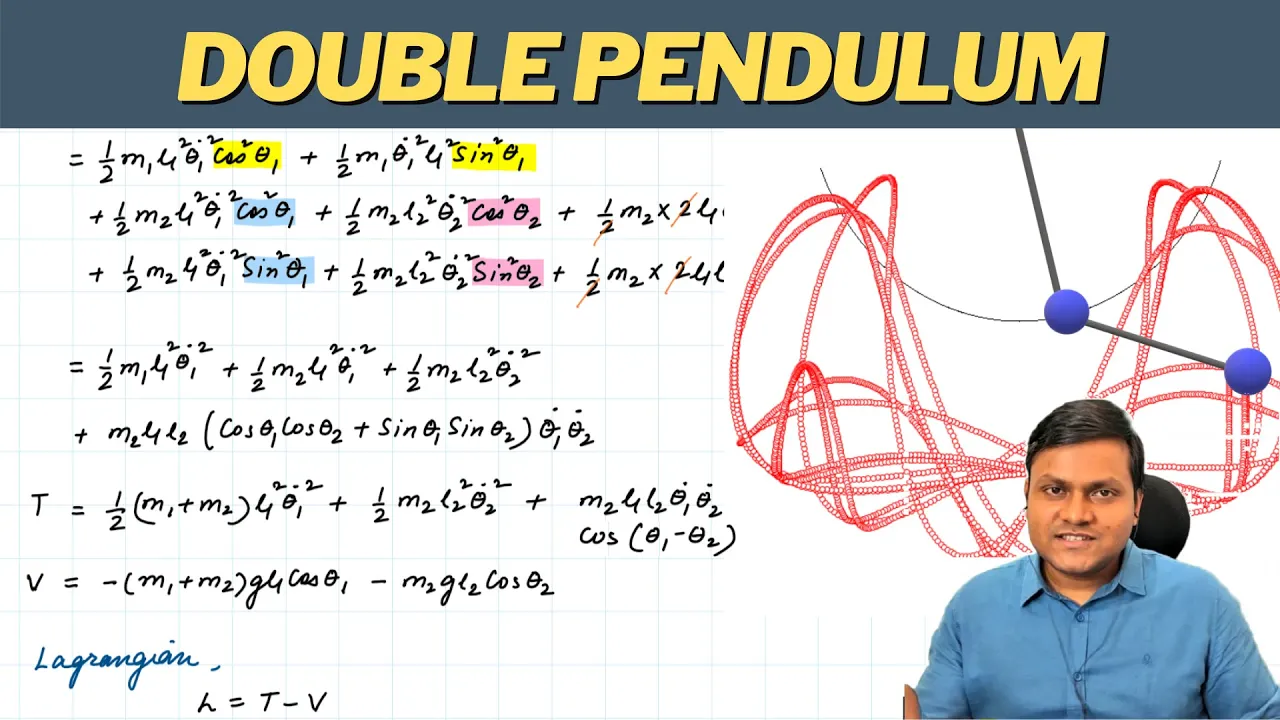





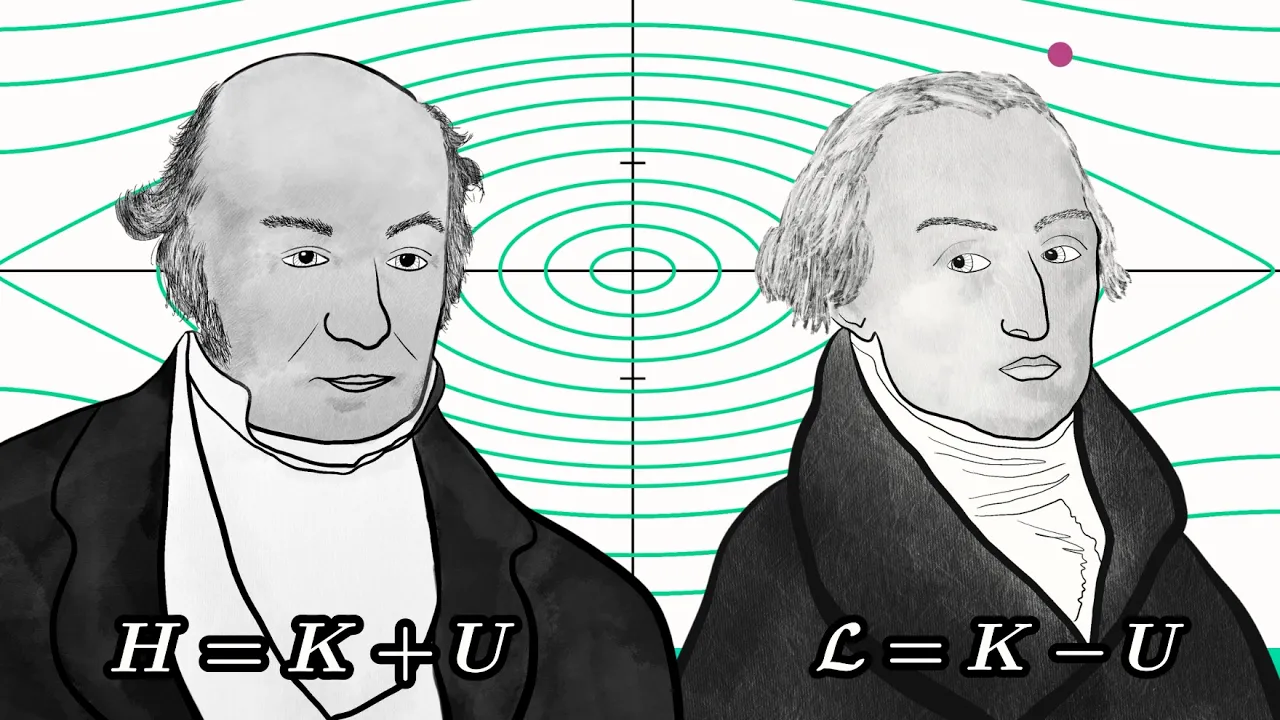
The double pendulum cannot be solved using Newtonian mechanics due to the complexity of constraint forces, but Lagrangian mechanics provides an effective alternative by expressing the system's kinetic and potential energies in terms of generalized coordinates (angles θ₁ and θ₂), then applying the Euler-Lagrange equations (∂L/∂θ - d/dt(∂L/∂θ̇) = 0) to derive the equations of motion, which can subsequently be solved numerically using methods like the Euler method.
Lagrangian Mechanics: Setting Up the Double Pendulum Problem
Added:Core principles of Lagrangian mechanics, including the formulation of the Lagrangian (L = T - V) and the application of Euler-Lagrange equations.
Coordinate transformation techniques, specifically converting Cartesian coordinates (x, y) to angular coordinates (theta) for rotational systems.
Basic concepts of kinetic and potential energy for systems with multiple degrees of freedom.
Intermediate calculus, particularly partial differentiation, the chain rule, and taking total time derivatives of time-dependent angular variables.
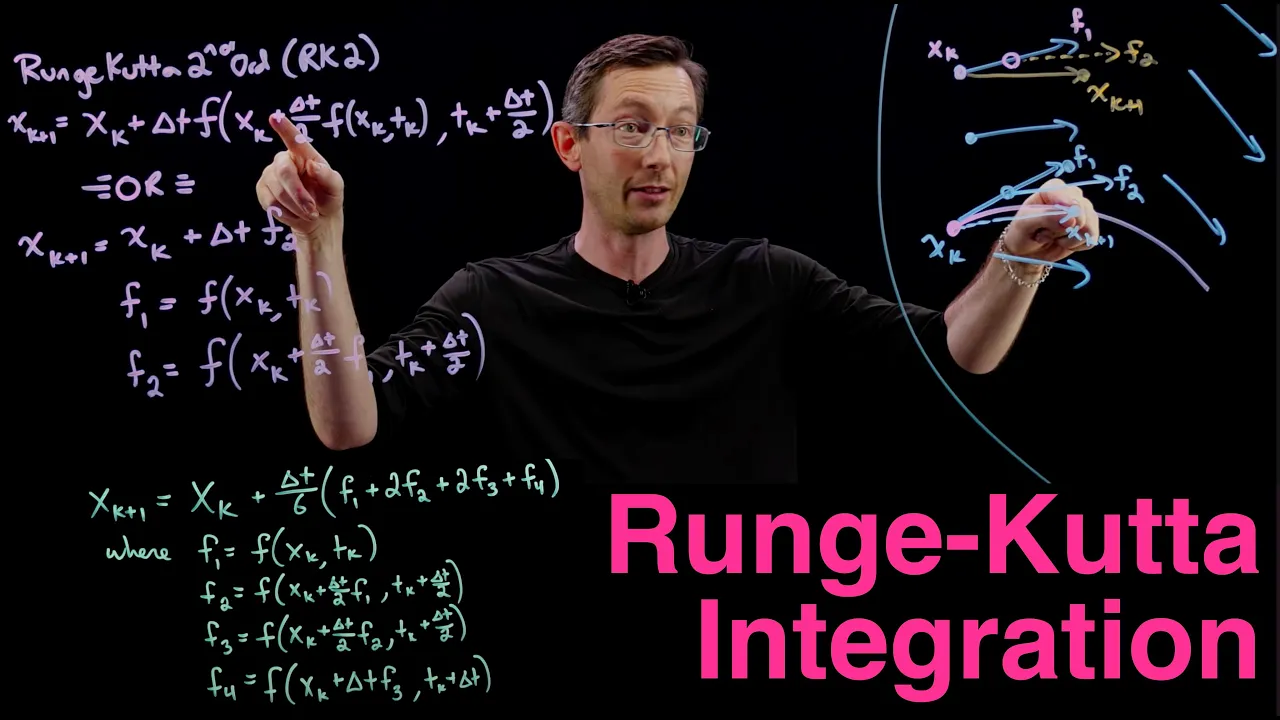
Numerical simulation techniques (such as the Runge-Kutta RK4 method) to solve and visualize the non-linear differential equations over time.
Chaos theory and non-linear dynamics, analyzing the double pendulum's extreme sensitivity to initial conditions and plotting its phase space.
Linearization of the equations of motion under the small-angle approximation to analyze the system's normal modes and natural frequencies.
Hamiltonian mechanics, applying the Legendre transform to the Lagrangian to study the system using Hamilton's equations.
46.1K views594likes10:39Original Release: 2017-09-11
okay double pendulum this is not easy okay I'm gonna set it up I'm not gonna work out the whole thing but I think you should be able to see the path forward and how to get to the end and I will post a link to another website not mine that does have a solution so that you can get the solution turn this little bit okay so here's the double pendulum I have two masses and then I have a string of length l1 l2 and then they're at some angle theta1 and theta2 now you can't use the plane momentum principle or newtonian mechanics because you don't know that you can find the gravitational force on these two masses but you can't find these string forces because they depend on lots of things like how fast they're moving and the angles and all that stuff so it's just not it's not a doable thing these forces are forces of constraint this string makes it this maste a distance L two from that mass that's all it does and the same thing for l1 but it gets really complicated so we're going to use the Lagrangian so the Lagrangian says this it says l equals t minus u or t is the total kinetic energy and use potential energy and then if I do that I'm gonna have these two variables State of 1 and theta 2 then I have the following the partial of L with respect to theta 1 minus the derivative with respect to time of the partial of L with respect to theta 1 dot equals 0 and then I have the same thing for the other variable theta 2 okay so this what we want to do so I have to get T and you in terms of theta 1 and theta 2 and that's not so easy okay I mean it seems easy but it's not - well let's just do it okay I'm gonna start with mass 1 so it's not obvious to see what the kinetic and potential energy are in terms of this angle theta so I'm going to do it in Cartesian coordinates where it is much easier so I'm gonna say T equals one-half m1 x1 dot squared plus y1 dot squared because I know it fine that's the kinetic energy in terms of the X&Y coordinate of this that's pretty easy where I did take the derivatives and then I can get the potential well let's let's write it out the whole way plus one-half m2 x2 dot squared plus y2 dot squared so that's the total kinetic energy I can do that also I can get the potential energy u equals let's say this is y equals zero so it's going to be I think I put it as this is a negative why I don't know why I did that let's see I don't think it's really gonna matter in the end let's say yeah that's right so it's gonna be negative m1 actually it's gonna be m1 G Y 1 plus em 2 gee Y 2 that's right ok that one's easy to do but you see here I need to get I can take the derivatives and get X 1 in terms of theta 1 and theta 2 and then take the derivative that's what I wanted to so let's get let's say X 1 it's going to be equal to l1 sine theta 1 y 1 is negative l1 cosine theta 1 X 2 equals x1 plus l2 sine theta2 this is the difficult one so this is why we're using Cartesian coordinates because the position of mass 2 depends on this angle with respect to mass 1 I don't want to define this angle from something else it doesn't make any sense this mass depends on that mess so I can write that in terms of Cartesian coordinates pretty easily and the same thing for y2 it's going to be equal to y1 minus l2 cosine theta2 so I have the Cartesian coordinates but to put it in here this is pretty easy right why I want us put in this why - I just put in this but or Y one is that so I could write it out okay in fact let's do that so let's say X - it's going to be equal to l1 sine theta 1 + l2 sine theta2 Y 2 equals negative l1 cosine theta 1 minus l2 cosine theta2 so up here I have y1 and y2 in terms of theta 1 and theta 2 that's easy okay it's the kinetic energy of this stuff ok so let's take the derivative of x1 x1 dot is going to be equal to l1 cosine theta 1 times theta 1 dot right don't forget when I take the derivative of l1 its constant when I take the derivative of sine theta is cosine theta but I have to take the derivative of the thing inside which is data so I get this data 1.2 then I can do y1 dot it's going to be equal to negative I was going positive prints it cuz I'm drew because I'm son something positive it doesn't really matter in the end l1 sine theta 1 theta 1 dot now you see what happens when I take X 1 dot squared plus y 1 dot squared for this term appear I get cosine squared theta plus sine square theta so this whole term is going to be l1 squared theta 1 dot squared so it's pretty easy I don't know where to put that let's just write this x1 dot squared plus y1 dot squared it's going to be equal to l1 squared theta 1 dot squared because the signs words can now not so trivial for x2 plus y2 squared so let's take the derivative of this x2 dot squared I'm not gonna do the whole thing you can tell them ran out the board pretty fast I'm not gonna finish the problem okay x2 dot squared is going to beat let's choose this one here it's gonna be let's just do x2 dot L 1 cosine theta 1 theta 1 dot run no space not gonna pull and go all the way over here okay plus l1 l2 cosine theta2 theta2 dot yeah and then why to dot is going to be equal to negative l1 sine theta 1 theta 1 dot minus l2 sine theta2 theta2 dot okay so now you see what's gonna happen when i square these i'm gonna have a cosine theta 1 sine theta 2 term in there and a cosine theta 2 sine theta 1 term so so I am gonna get hey L 1 theta 1 dot squared because I'm gonna get this x plus this squared plus this squared so I do get some camps up but it's not all gonna cancel so my kinetic energy term is not good I mean it's not bad you can do it but it's a little bit Messier and I'm running out of time because I can't handle 10 minute videos so once you get that you get the kinetic energy in terms of theta 1 dot theta 2 dot and theta 1 theta 2 and the potential energy is easy then you can assert now we have the hard part taking the derivatives that I'm not gonna take these derivatives okay but you it's not okay this Pripet I'm in once you do that the whole point is I want to get theta 2 dot double dot equals theta 1 double dot equals I want these expressions for these two things and it can be as messy as you want it doesn't matter okay if songs I can calculate the second derivative of theta 2 dot then I can say theta 1 dot equals theta well theta 1 dot 2 theta 1 dot 1 plus theta 1 double dot DT I can use this the Euler method to find the new angular velocities because I know the angular acceleration and then I can do that again to find the new angular position and then do the whole thing again and again again so I can make a numerical calculation out of this so yeah I didn't finish this Lagrangian problem but I did set it up and I gave you a way to do it if you've never done this before I could I have another video on that and I'll post a link to the video at ugh website that shows the actual solution for theta 2 dot and theta 1 dot so you can program it
Up Next
3:15
Hamilton's Equations of Motion Derivation | Classical Mechanics
@PrettyMuchPhysics
89.2K views•2018-09-02

12:53
21cm Hyperfine Transition in Neutral Hydrogen: Radio Astronomy Basics
@AaronRobertParsons
12.4K views•2011-10-13

32:32
NMR Spin Physics I: Zeeman Effect, Resonance Condition & Larmor Frequency
@nptel-indianinstituteofsci8064
2.3K views•2024-01-17

27:14
Entropy and the Second Law of Thermodynamics Explained
@veritasium
27.5M views•2023-07-01
Related Study Plans & Knowledge Roadmaps
Structured learning paths in Physics
physics
Nuclear Physics (Decay, Fission & Reactors)
01Atomic Structure and the Binding Force
02Radioactive Decay and Half-Life
03Nuclear Fission Mechanics and Chain Reactions
+ 2 more learning modules
12h5 modules
Explore Roadmap
physics
Soft Matter (Polymers, Colloids & Rheology)
01Foundations of Soft Matter & Thermal Forces
02Polymer Physics and Macromolecules
03Colloids, Surfactants, and Self-Assembly
+ 2 more learning modules
38h5 modules
Explore Roadmap
physics
Analytical Mechanics: Lagrangian & Hamiltonian
01Mathematical Foundations: Calculus of Variations
02From Newtonian Mechanics to Constraint Dynamics
03The Principle of Least Action & Lagrangian Mechanics
+ 3 more learning modules
28h6 modules
Explore Roadmap
physics
General Relativity (Spacetime & Cosmology)
01Foundations of Relativity: Special Relativity
02The Geometry of Spacetime: Equivalence Principle & Curvature
03Einstein's Field Equations: The Mathematics of Gravity
+ 2 more learning modules
55h5 modules
Explore Roadmap