

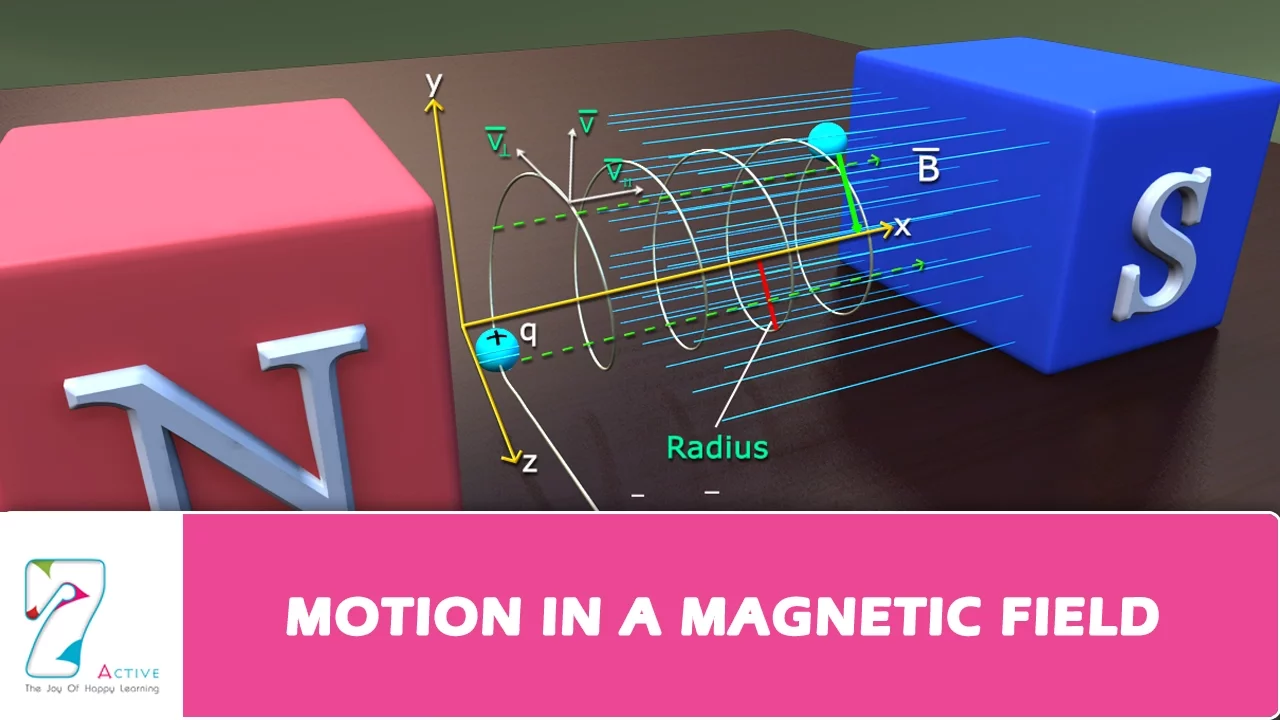






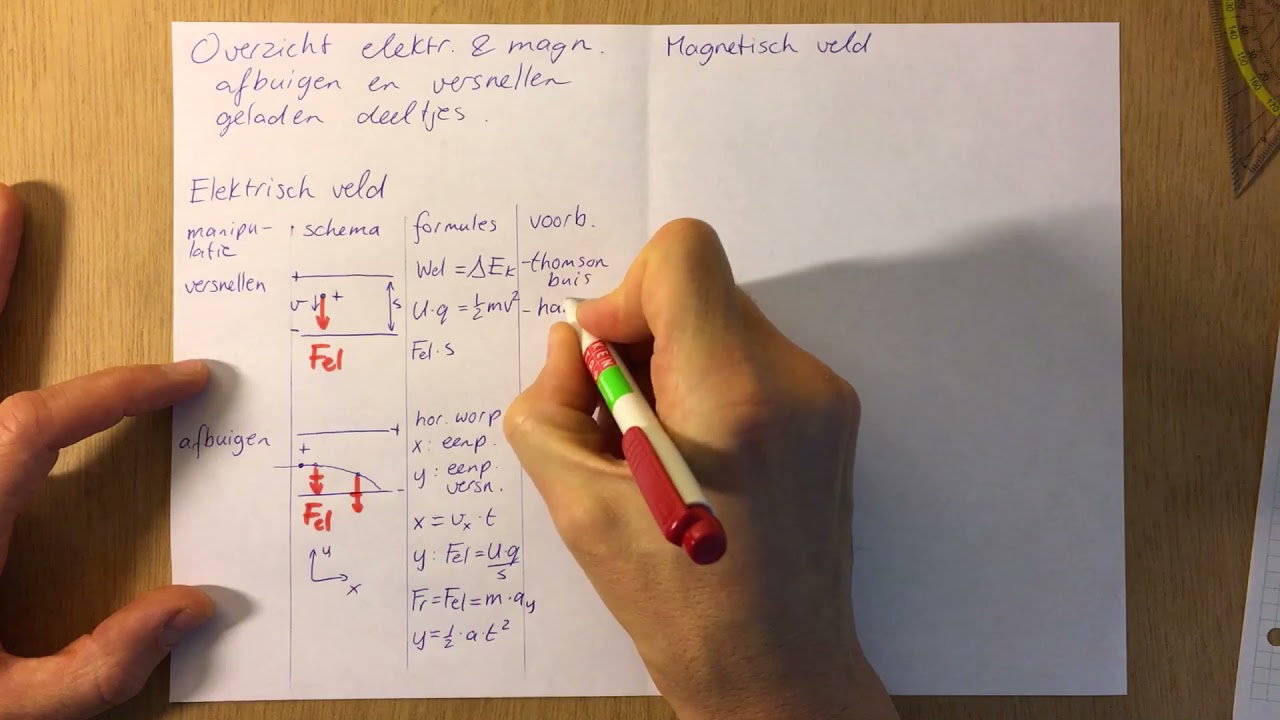





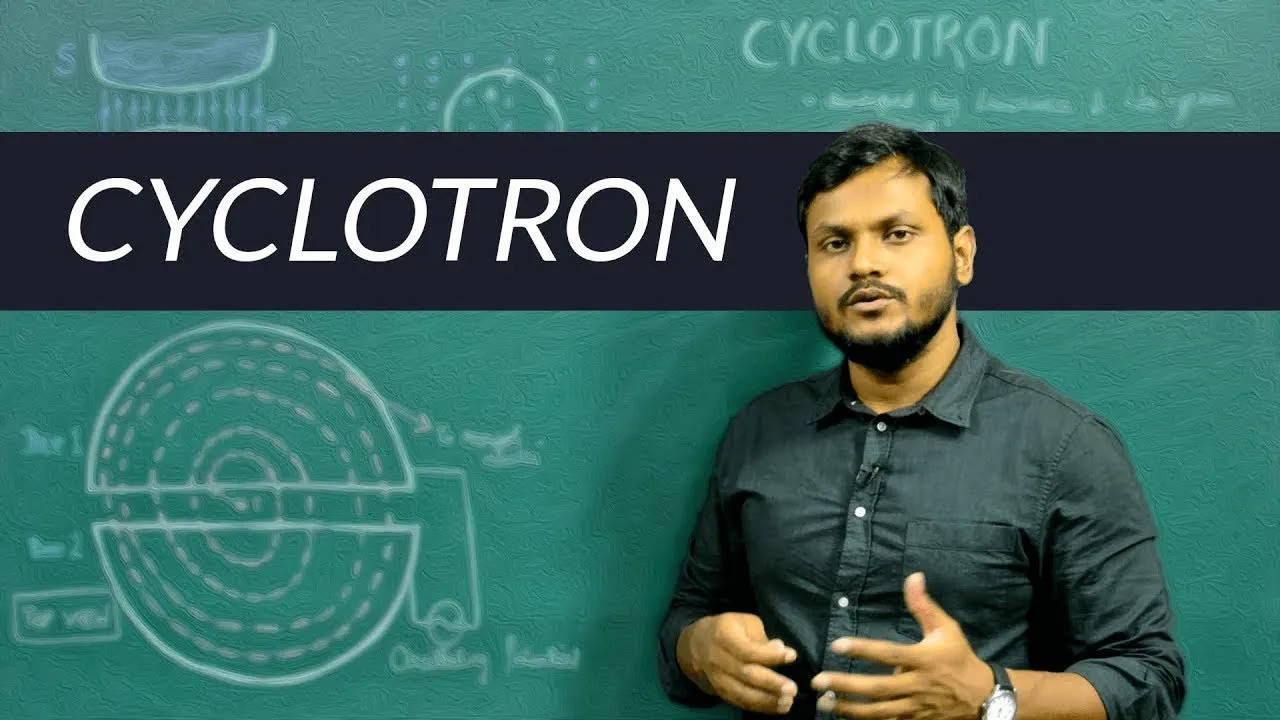












A cyclotron is a particle accelerator that uses perpendicular electric and magnetic fields to accelerate charged particles in a spiral path; the charged particle gains kinetic energy each time it crosses the electric field gap between two hollow metal containers called dees, while the magnetic field provides centripetal force causing circular motion with increasing radius as velocity increases.
Cyclotron Principle, Construction & Working Explained | Class 12 Physics
Added:Magnetic force on a moving charge (Lorentz Force) and the circular motion of charged particles in uniform magnetic fields.
The concept of centripetal force and its mathematical relationship with magnetic force ($F_c = mv^2/r$).
Electric fields and potential difference, specifically how electric fields exert force to accelerate charged particles.
Basic principles of alternating current (AC) and high-frequency electric oscillators.
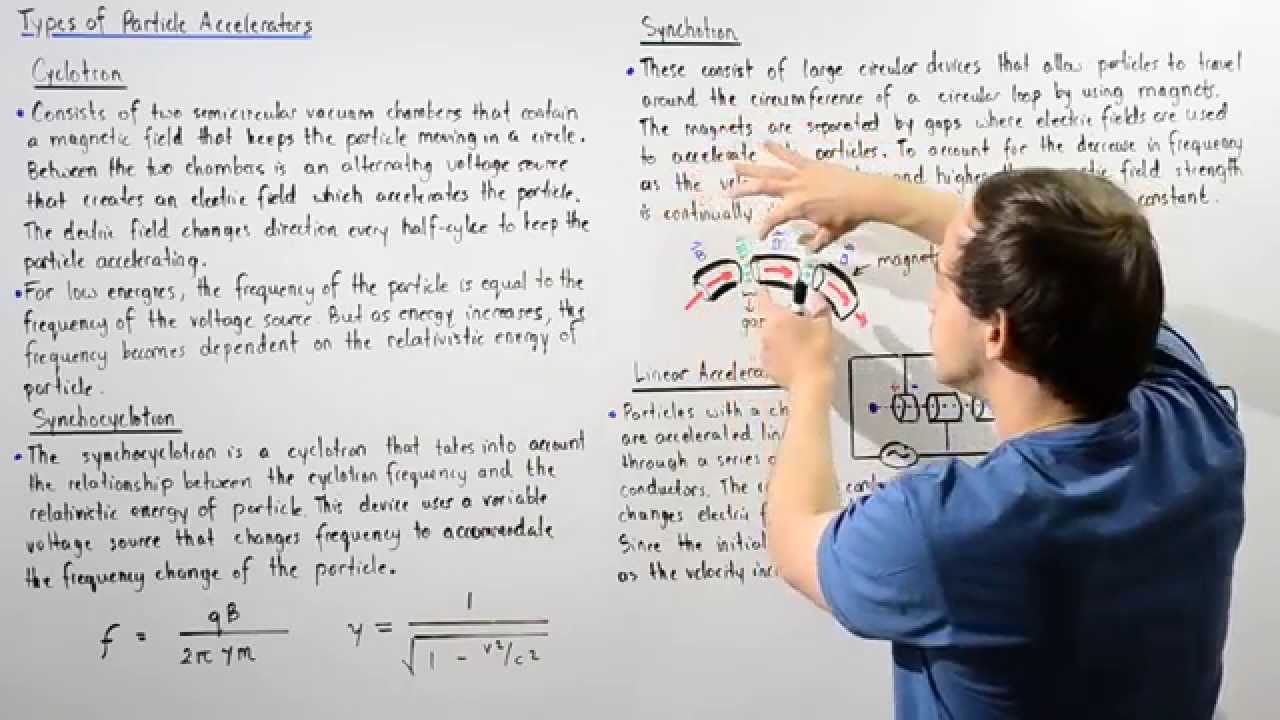
Relativistic limitations of cyclotrons, where particle mass increases at high velocities and alters the resonance frequency.
Advanced particle accelerators designed to overcome these limits, such as Synchrocyclotrons and Synchrotrons.
Medical applications of cyclotrons, including the production of radioactive isotopes for PET scans and proton beam therapy.
How high-energy accelerated particles are utilized in nuclear transmutation and studying fundamental particle physics.
1.5M views27.9Klikes6:44Original Release: 2016-11-01
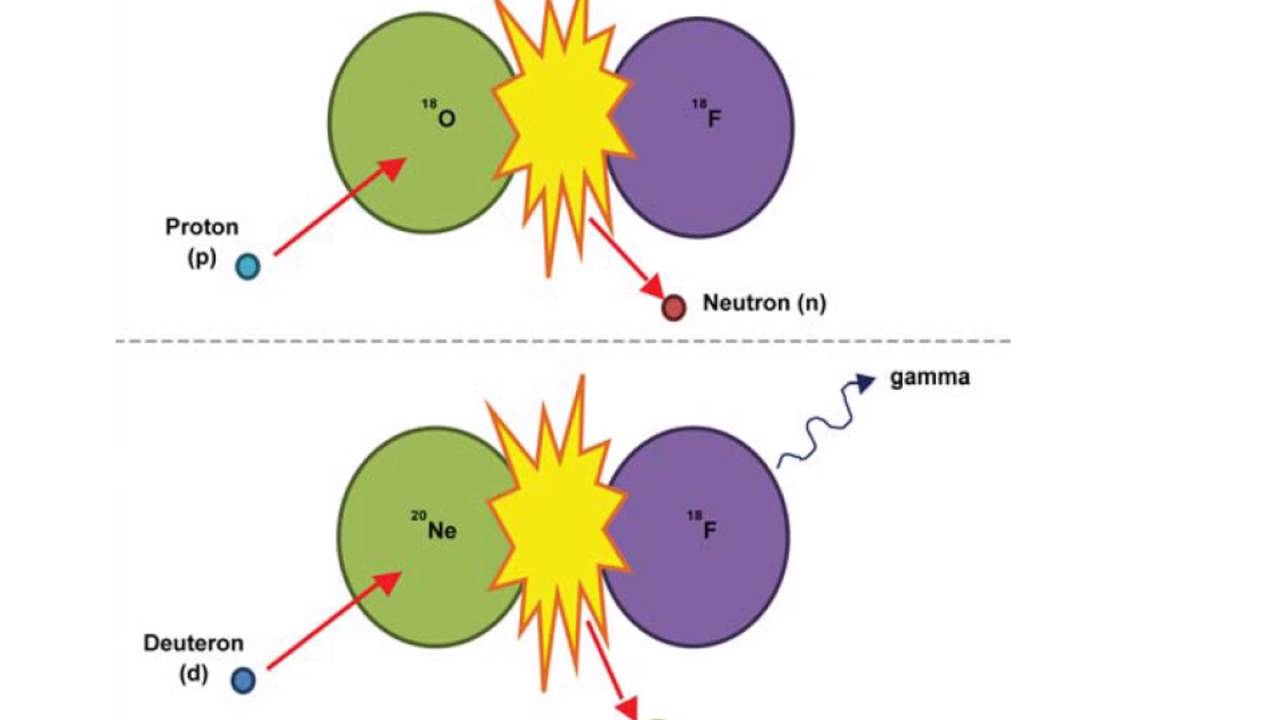
Cyclotron is a device developed by E.O. Lawrence and M.S. Livingstone in 1934 It is used to accelerate charged particles like protons and deuterons This results in the production of high energy charged particle.
In nuclear physics such energized particles are used to bombard nuclei causing nuclear reactions.
A positively charged particle can be accelerated to high energy with the help of an oscillating electric field, by making it cross the same electric field time and again with the use of a strong magnetic field.
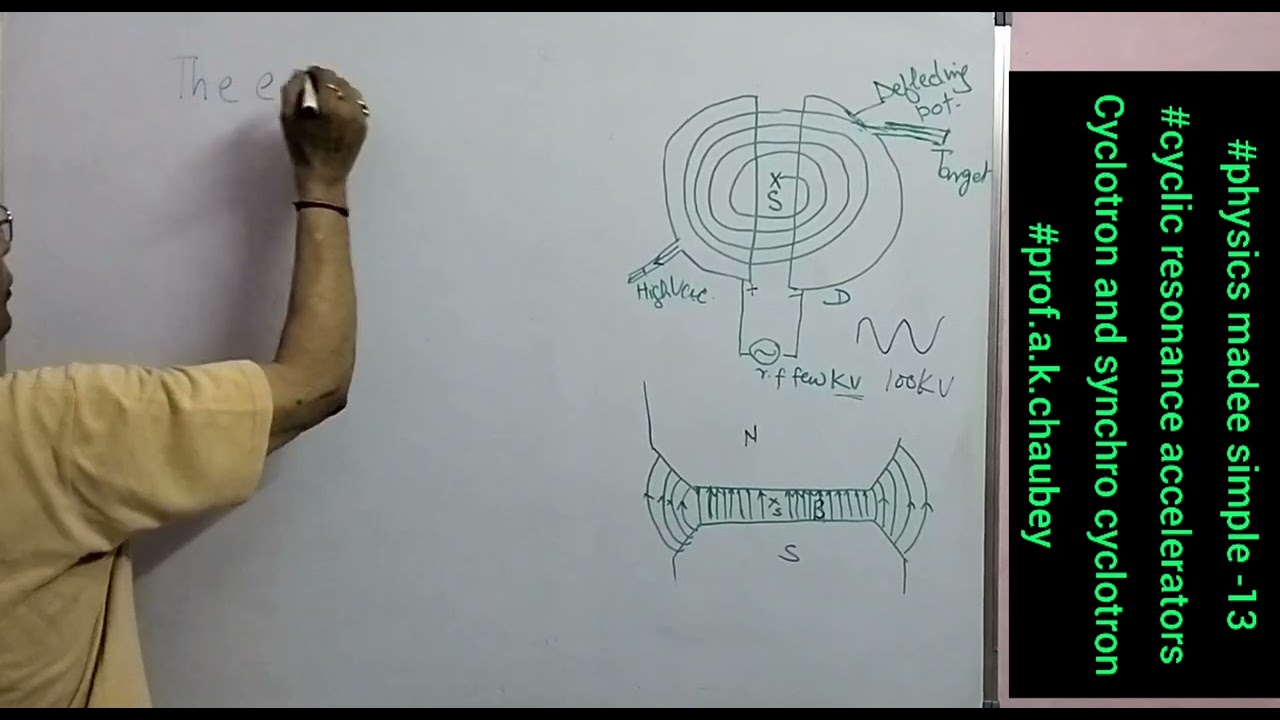
Two hollow half cylinders made of high conductive metals known as dees are so placed, that the straight edge will be face-to-face with a small gap between them.
Now these two Dees are connected to two terminals of an alternating voltage source an oscillator It would help in changing polarity.
If one D1 is in the positive potential than D2 will be in exact opposite negative potential at same time.
In this way they would be oscillating and an electric field would be created between them.
One electromagnet is kept below the two Dees and one E.M is kept above the Dees.
Bottom E.M will have north pole above and top E.M will have south pole below.
This would create a magnetic field perpendicular to the direction of the electric field.
This entire arrangement is sealed in a vacuum box.
The two Dees create an electric field.
The direction of Electric field is horizontal.
The direction of magnetic field vertical.
When we place a positively charged particle which may be a proton or a combination of proton and neutron both.
Since D1 is positive D2 is negative there is an electric field between them.
A force acts upon the charged particle and its direction would be the direction of E.
Because of this force the charged particle gets acceleration and because of acceleration the speed increases till it enters the D.
Since D is an enclosed container and so the value of electric field is zero.
So force becomes zero and acceleration becomes zero.
So inside the container there is no electric field But there is magnetic field and its direction is north.
The charged particle now moves perpendicular to the direction of the magnetic field.
It experiences a force in a direction perpendicular to the plane containing V and B.
This force provides the centripetal force and makes the charged particle move along a circular path of radius r=mv/qB The particle makes a semi circle and comes to the gap the time taken is t/2 If the time taken to complete one circle is T T then the time taken to complete semi circle would be T/2 As soon the pareticle comes to end it is influenced by electric field When the particle was born its velocity was Zero when it enters the Dee its velocity is v and it is constant because the magnetic field cannot change the velocity.
The oscillator will change the polarity.
When it comes out of Dee it again comes under the influence of electric field.
The electric field accelerates the charged particle to v1.
When it enters D2 the velocity would remain constant Now D2 becomes + and D1 becomes – When it comes out of Dee it again comes under the influence of electric field.
The electric field accelerates the charged particle.
The particle would now move from D2 to D1 because its velocity would increase to v2 When it enters D1 again the velocity would remain constant because the magnetic field cannot change the velocity but the particle would make a greater semi circle because it is coming inside the Dee with a greater velocity When it comes out of Dee it comes under the influence of electric field.
Once again the electric field accelerates the charged particle.
and now the velocity becomes v3.
In this way the particle moves in a circular path and with each circle the velocity of the charged particle increases If the velocity of a charged particle increases the radius of the charged particle would also increase.
Finally when the particle has no more space to grow in radius.
It is thrown out through a window.
With such a high velocity the particle has high energy and it hits the target.
Up Next

13:48
A-Level Medical Physics: Nuclear Medicine & Radiotracers
@PlymCollSci
23.6K views•2013-04-18

12:53
21cm Hyperfine Transition in Neutral Hydrogen: Radio Astronomy Basics
@AaronRobertParsons
12.4K views•2011-10-13

32:32
NMR Spin Physics I: Zeeman Effect, Resonance Condition & Larmor Frequency
@nptel-indianinstituteofsci8064
2.3K views•2024-01-17

27:14
Entropy and the Second Law of Thermodynamics Explained
@veritasium
27.5M views•2023-07-01
Related Study Plans & Knowledge Roadmaps
Structured learning paths in Physics
physics
Nuclear Physics (Decay, Fission & Reactors)
01Atomic Structure and the Binding Force
02Radioactive Decay and Half-Life
03Nuclear Fission Mechanics and Chain Reactions
+ 2 more learning modules
12h5 modules
Explore Roadmap
physics
Soft Matter (Polymers, Colloids & Rheology)
01Foundations of Soft Matter & Thermal Forces
02Polymer Physics and Macromolecules
03Colloids, Surfactants, and Self-Assembly
+ 2 more learning modules
38h5 modules
Explore Roadmap
physics
Analytical Mechanics: Lagrangian & Hamiltonian
01Mathematical Foundations: Calculus of Variations
02From Newtonian Mechanics to Constraint Dynamics
03The Principle of Least Action & Lagrangian Mechanics
+ 3 more learning modules
28h6 modules
Explore Roadmap
physics
General Relativity (Spacetime & Cosmology)
01Foundations of Relativity: Special Relativity
02The Geometry of Spacetime: Equivalence Principle & Curvature
03Einstein's Field Equations: The Mathematics of Gravity
+ 2 more learning modules
55h5 modules
Explore Roadmap