

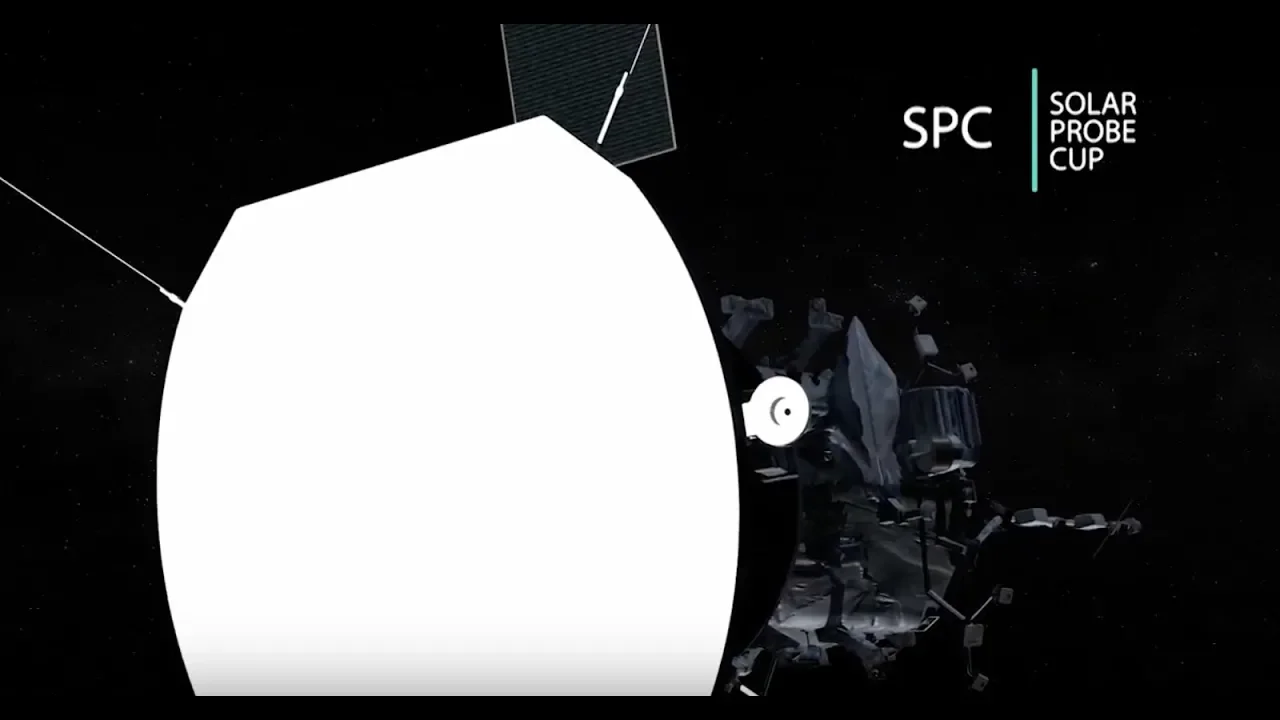





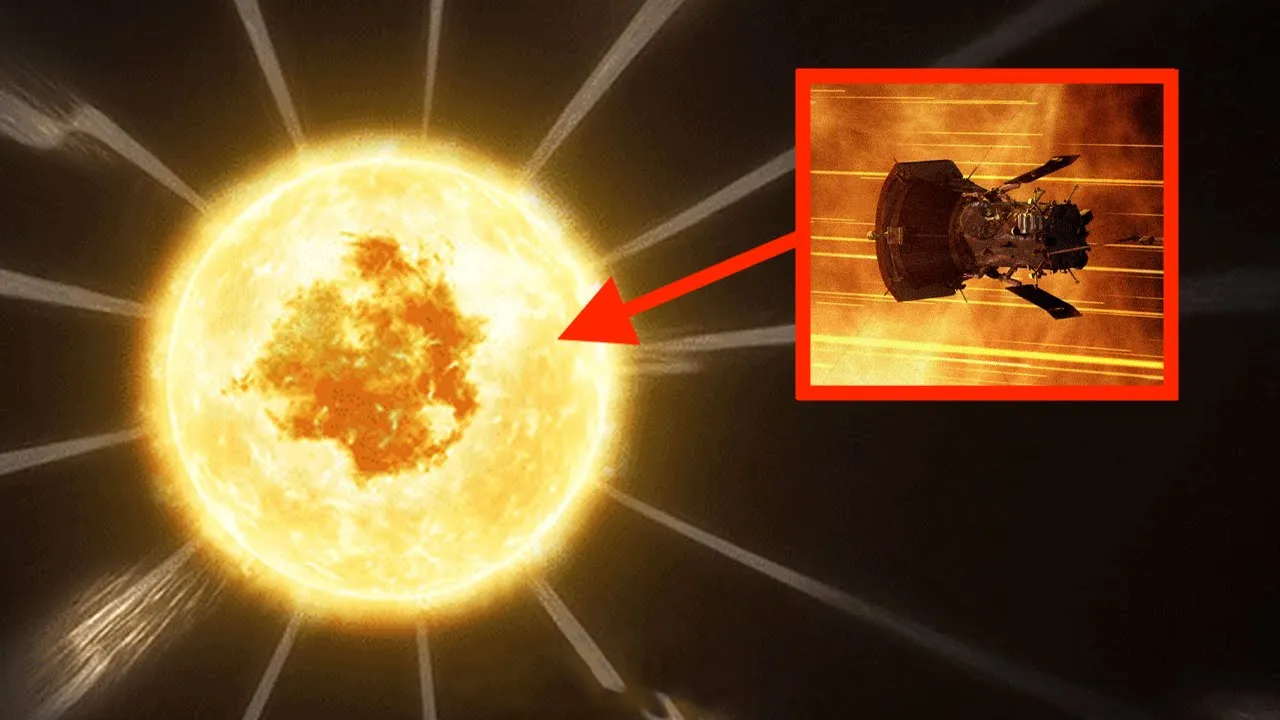



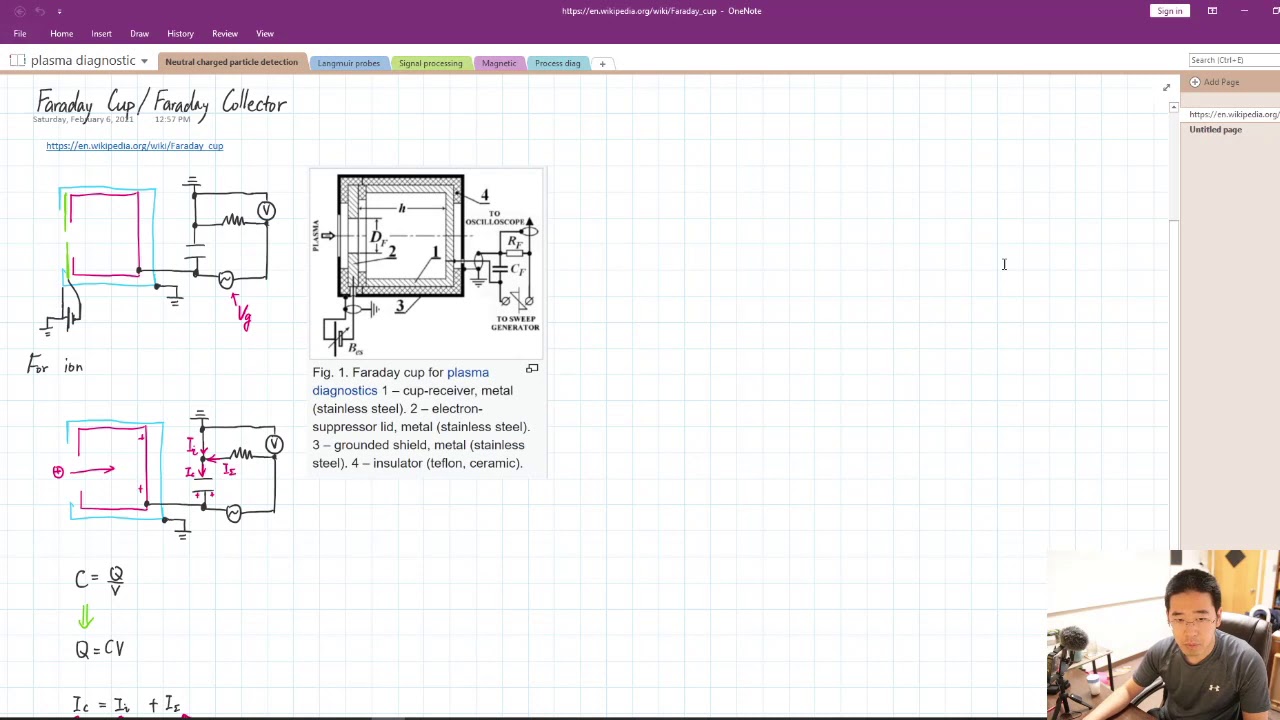





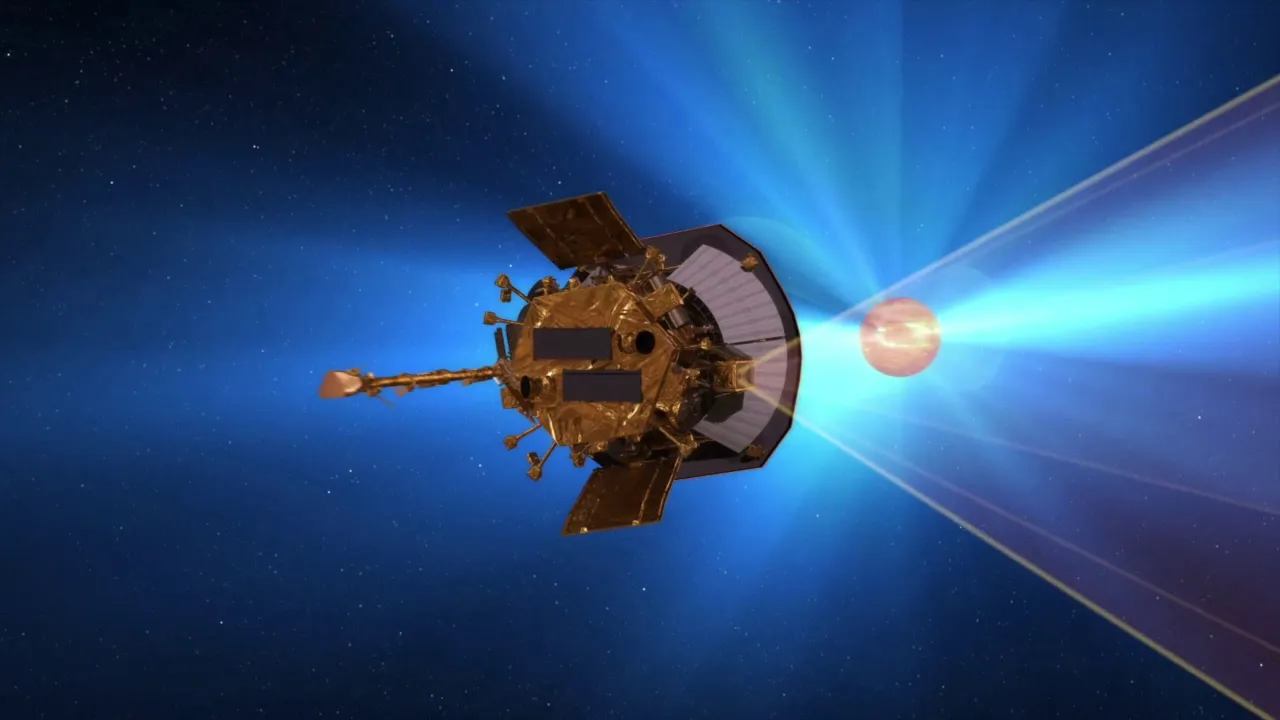




The Parker Solar Probe's Faraday cup is a specialized instrument that measures the solar wind by detecting charged particles (hydrogen ions and helium alpha particles) as they pass through a tungsten mesh grid and impact a metal collector plate, with the particle speed determined by applying specific voltages to create electric fields that filter and direct the particles; this technology enables scientists to study how solar wind accelerates and heats near the Sun, improving our ability to predict space weather effects on Earth.
Parker Solar Probe Faraday Cup: Dr. Tony Case Interview
Added:Understanding of solar wind composition, specifically that it consists of high-energy plasma (charged protons, electrons, and helium ions) ejected from the Sun.
Basic principles of electromagnetism, particularly how charged particles behave in electric fields and how electrical current is measured.
The primary mission objectives and extreme environmental conditions of NASA's Parker Solar Probe as it orbits close to the Sun.
The fundamental concept of electrostatic detection instruments, specifically how a Faraday cup captures charged particles to measure current.
Methods for analyzing solar wind plasma parameters, such as calculating velocity, density, and temperature from the raw current data collected by the Faraday cup.
The engineering and materials science behind spacecraft survivability in extreme environments, such as using refractory metals and sapphire insulators to withstand intense solar radiation.
The physical theories of coronal heating and solar wind acceleration, and how the probe's in-situ measurements help solve these long-standing heliophysics mysteries.
The application of real-time solar wind data in space weather forecasting to predict geomagnetic storms and protect satellite and power grid infrastructure on Earth.
83.5K views3.9Klikes14:44Original Release: 2018-08-24
hey it's me Destin welcome to the second channel here this is an interview with dr. Toni case an astrophysicist from the Smithsonian Astrophysical Observatory the man is brilliant and I really appreciate the time because he was tired he had been interviewing all day but he took the time to educate me on the Faraday cup for the Parker Solar Probe this is extremely interesting check it out I'm Destin tell me Tony Hayes and and who are you with I'm with the Smithsonian Astrophysical Observatory so we're part of the Smithsonian which is a lot of museums and a lot of research centers and the Smithsonian Astrophysical Observatory is affiliated with Harvard up at the harvard-smithsonian Center for Astrophysics in Cambridge Mass and so this is the instrument that's poking out from behind the thermal protection system this is it so this is a qualification model we used it to test before we built the actual version that's on the spacecraft so it's a one-to-one cup this is a one-to-one copy exact size exact same materials and everything who are you based out of Huntsville okay yeah we do the want testing at Marshall did you yeah with this instrument yeah like shake and bake what did it we did so we did most of our performance testing down at Marshall Space Flight Center so they have a place called the solar wind facility and we have that in Huntsville yeah so at Marshall Space Flight Center there's a vacuum chamber we can put it under vacuum and then there's essentially a simulation of the solar wind so they've got an ion gun an electron gun and we can set them up so that they're shooting right into our instrument and we can measure essentially the same thing les will be measuring in space and make sure it works that's awesome do you do under a solar load like so we did testing in two different ways on this instrument usually with NASA you want to test as you fly and so you want to recreate the exact conditions that you have in space on earth and demonstrate that it completely works before you put it onto the spacecraft in this case it's not actually possible because we have 500 times the amount of sunlight that we have here on earth so we did testing where we put this into a chamber and we illuminated it with a ton of light and it got super hot and we show that it didn't break and then we did separate testing where we put this into a chamber without the light and we performance tested it so we could see that it was making the measurements we wanted to make and we only did just a little bit of testing where it was under this huge light load and making the measurements at the same time just to demonstrate that we could do it but for the most part we had to separate those two so what's the mesh right here so that's a tungsten a fine tungsten grid 90 percent transparent and the particles flow through that and it's tungsten because it has the highest melting point yep and it's the hottest portion of the instrument right at the centre of that grid gets up to a 3,000 degrees Fahrenheit and then behind the grid you can see in the front is another grid that we put at 6,000 volts that creates an electric field the charged particles then get reflected out because of that electric field or they make it through if they have a high enough speed and then you're detecting those and we detect them in the very back there's a piece of metal and that you won't be able to see here but these four wires connect to that piece of metal and so as the charged particles impact the metal they deposit their charge and we measure that as a current that's coming out through those wires so on these wires right here yeah so this is high-voltage going up that drives the high-voltage grid and then the wires inside here are carrying the signal coming back so you're driving the high-voltage grid to guide what's coming in we can select the speed of particles that we want to measure by putting a certain voltage on the grid so it is your wire made out of copper it's made out of niobium what yeah copper would melt it's way too hot for copper okay so it's made out of niobium so how do you insulate something like that so it's insulated by a little sapphire beads so it's noisy I'm on the outside here and then sapphire beads what and then the niobium wire runs through each of those little bits of sapphire and through these little corners where there's little elbows made of sapphire and in that way the center conductor is insulated from the outer conductor so this is like so basically you get a bunch of unobtainium and fantastical lloyd and you put them together and made a CRT tube that's way more fancy than that yeah no I mean think of it as a like a vacuum tube that's basically what it is it operates in vacuum so you don't have to enclose it in glass and so that's pretty much what it is and you can select the speed of particles that are come and then and regulate the current that you end up with on your collector plates in the ultimate goal of this device which is one of the main main pieces of science on the spacecraft is to count neutrinos what is that the word I am a mechanical engineer I understand wrenches this is think of it as like what the Sun is made of okay there are a lot of neutrinos coming from the Sun but it's made of mostly hydrogen and helium okay the constituents of the universe and of the Sun and so the the hydrogen comes out as ionized hydrogen or just protons and the helium comes out as typically doubly ionized helium so typically it would have two electrons both of those are stripped off we call those alpha particles if you're talking about radiation and those are the two main constituents of the solar wind along with electrons and we measure all of those so you're measuring flux yes so you're measuring like as you get closer and closer to the Sun you're going to be able to understand the density of solar wind not coronal mass ejections because I'm assuming that would kill you if that happened oh well well measure those bull yep so bull you're not gonna be able to you're to take a coronal mass ejection to the face right to the face the cool thing about coronal mass ejections is it's basically the same plasma that is there all the time it's just ejected in slightly more dense form and faster what are you talking about I can see it what are you saying slightly a solar wind - okay in a coronal mass ejection so let's let's make sure we understand the difference between a flare and a coronal mass ejection first of all I don't okay and I would love for you to tell me all right here we go so the flare is what we see in light so if you look at the solar surface and especially if you look at it with an x-ray telescope then when one of these large releases of energy happens there are particles that like get accelerated and flow back down toward the surface and end up mini emitting a lot of light a lot of that's in x-rays and we measure and it's just this huge increase in the flux of light that we see in addition to that there is all this plasma around the Sun in the corona and near the surface of the Sun and that plasma at the same time that flare is happening gets accelerated and flows away from the Sun so that part the particle part is what we call the coronal mass ejection the white part is what we call it the flare they tend to happen about the same time in which one is solar wind and the solar wind is essentially the same thing as the coronal mass ejection but it's like the steady-state happening all the time portion of ash like constant pressure yes it's just constantly flowing out all the time and the reason and if you go back to gene Parker's description of why this is happening is essentially the Sun is a lot of hot gas and that's at high pressure and then you get a way way way away from the Sun and what do you have the vacuum of space there's hardly any particles out there so you can almost think of this as like a vacuum cleaner there's such a pressure differential and the thing at the center is so hot that there's really no other option physics wise besides these particles flowing outward to sort of fill the balloon oh I'm starting to think about Matthew things so so is the art of the fourth or you predict that you're predicting obviously with a model of some sort an art of the fourth value decrease as you go out from the Sun the density falls off as one over R squared oh it really what am I thinking something wrong obviously flux I don't know so whatever R square yeah 1 over R squared so when we go in - and if that's the same as the light falling off and the reason the way you get that 1 over R squared is if you picture something that's a sphere and then thing think about either the light or the particles flowing radially away from that sphere then you're basically flowing these particles into an area of R squared and so that's basically how both of those things work and so the light when we get close to the Sun would be 500 times brighter the density that we're trying to measure is also going to be 500 times higher than what we measure here at Earth which is why this is so small compared to other Faraday cups of there were mystic because we have a huge density to work with I see so you're trying to yeah I got it so you're trying to take a smaller sample over a no the same sample over a smaller surface area because you have more total energy coming in yeah and you don't want to just cook everything or I mean you're gonna have solar pressure to deal with that will actually turn the spacecraft there is yes so that is something we have to worry about they have to make sure that the center of pressure of the spacecraft that is when the light hits it it exerts a force and because it's 500 times brighter than here it's actually a measurable force and if the center of gravity is not right behind the center of pressure then it tilts the spacecraft it's a torque this is one of the things that's causing a torque because we stick out only on one side of the spacecraft so the GNC people hate you they've learned to live with us okay so next question maybe last question what's the data gonna look like I mean we're not gonna see pictures of the Sun coming out off of the spacecraft so there is one instrument on the spacecraft that takes pictures but what it takes pictures of is the solar wind so just what we're measuring and when what happens is as this solar wind is flowing away from the Sun light also comes off the Sun and then it reflects off of the solar wind and comes back to the camera and the camera can take a picture of that so it's basically you've got the Sun and you're gonna have a circle that blots it out right in the middle and you're gonna see it turns out the circle that we use is just the heat shield so the camera sits behind the heat shield that blocks the Sun and then the camera looks out at the dim light that's bouncing off of the solar wind so alignment matters but aren't you gonna see a tab aren't you gonna see that on one side of the heat she's on the other side of the spacecraft so the the camera basically looks out in front of the spacecraft like the direction that the spacecraft is heading got it the idea being that it images the solar wind and then the spacecraft some number of hours later flies through that same solar wind so you get a global picture of what it looks like from the image and then we get a measurement actually inside the solar wind once the spacecraft gets there okay since so once you let's say we complete the mission you do how many passes 24 passes you have son so you're going to have an idea of one particular elliptical arc as it approaches on that orbit yep so how how are you picking the arcs because you're trying to get an overall picture of the Sun you know hemispherical II or what's the word I mean not the intent the entire 3d structure of the Sun is really important if you want to model what the output of the Sun is going to be in terms of the solar wind or coronal mass ejections or flares and all that you have to really have a picture of the entire surface of the Sun what are you gonna do with that data are we gonna be able to orient future interstellar spacecraft off this what are you thinking so the basic idea is to like learn more about the physics of how the solar wind is being accelerated at the surface of the Sun or in the corona of the Sun I should say what we do right now is we try and predict what the solar wind is gonna be when it gets to earth we want to do that because it affects things like so we have geomagnetic storms that can cause like radio blackouts they can cause problems with GPS they can cause Aurora which is maybe a nice thing and they can cause radiation damage to spacecraft all of these things would that we call space weather we want to be able to predict when those things are going to happen people like Airlines and power industry all those people care a lot so if we learn about the physics of how the solar wind is actually accelerated and heated near the Sun then we will much better be able to predict what it's gonna be like when it gets to earth and that's that's sort of the practical purpose the scientific purpose is the Sun is a star there are countless stars throughout the universe and we want to know how those stars work this is the only star that we can go up to take a cup like this stick it into the solar wind that's coming off of the star and figure out precisely the physics processes that are going on near that star and then we can use that to understand how all the other stars work so when I was a kid I had never flown in an airplane and I asked my dad if I could go in an airplane with him one day and we could get a little piece of cloud in a bottle so you're saying we're doing that with the Sun absolutely we don't get to bring it back we just have to send back radio signals and tell us what it's like but that's essentially what we're doing we're capturing a little bit of the corona in our instrument and figuring out what it is and that data doesn't come through this wire it comes through these wires come through those three little wires goes to electronics that if you looked at it looked just like a computer board or something preamplifiers because it's a small signal so we amplify the signal we digitize it we send it back down to earth and tells us all about what the solar wind is made of got it that's awesome what about Parker libros with Parker I've met Parker he's a great guy he's a member of one of the science teams so he comes to our meetings sometimes and he's come and lectured and like my university was when I was in grad school and you know we learned about like the Parker spiral and like all of these things that are like named after him and discovered by him and and so it's a real honor to have the spacecraft named after him and I mean for me it couldn't be named after anybody else this is just you know it's it stems from his thinking so many years ago and it really is just like a continuation of all the science that he's done that's awesome okay I hope you enjoyed that interview there two other ones here on the second channel you should check out number one is dr. Angela elenco she's the Dean of physical sciences at the University of Chicago a peer of dr. Eugene Parker's you should go listen to her interview she is fascinating also philippe from John Hopkins Hopkins University Applied Physics lab he's the deputy lead my cannibal engineer for the Parker Solar Probe talks a lot about integration of all this stuff and how it works it's really fascinating so check those out also feel free to subscribe to this channel if you're interested in checking out the behind the scenes stuff thanks for watching I'm Destin you're getting smarter every day have a good one bye
Up Next
80:30
Simple Harmonic Motion in Physics | Oscillations Explained
@MathAndScience
127.7K views•2016-02-04

12:53
21cm Hyperfine Transition in Neutral Hydrogen: Radio Astronomy Basics
@AaronRobertParsons
12.4K views•2011-10-13

32:32
NMR Spin Physics I: Zeeman Effect, Resonance Condition & Larmor Frequency
@nptel-indianinstituteofsci8064
2.3K views•2024-01-17

27:14
Entropy and the Second Law of Thermodynamics Explained
@veritasium
27.5M views•2023-07-01
Related Study Plans & Knowledge Roadmaps
Structured learning paths in Physics
physics
Nuclear Physics (Decay, Fission & Reactors)
01Atomic Structure and the Binding Force
02Radioactive Decay and Half-Life
03Nuclear Fission Mechanics and Chain Reactions
+ 2 more learning modules
12h5 modules
Explore Roadmap
physics
Soft Matter (Polymers, Colloids & Rheology)
01Foundations of Soft Matter & Thermal Forces
02Polymer Physics and Macromolecules
03Colloids, Surfactants, and Self-Assembly
+ 2 more learning modules
38h5 modules
Explore Roadmap
physics
Analytical Mechanics: Lagrangian & Hamiltonian
01Mathematical Foundations: Calculus of Variations
02From Newtonian Mechanics to Constraint Dynamics
03The Principle of Least Action & Lagrangian Mechanics
+ 3 more learning modules
28h6 modules
Explore Roadmap
physics
General Relativity (Spacetime & Cosmology)
01Foundations of Relativity: Special Relativity
02The Geometry of Spacetime: Equivalence Principle & Curvature
03Einstein's Field Equations: The Mathematics of Gravity
+ 2 more learning modules
55h5 modules
Explore Roadmap