















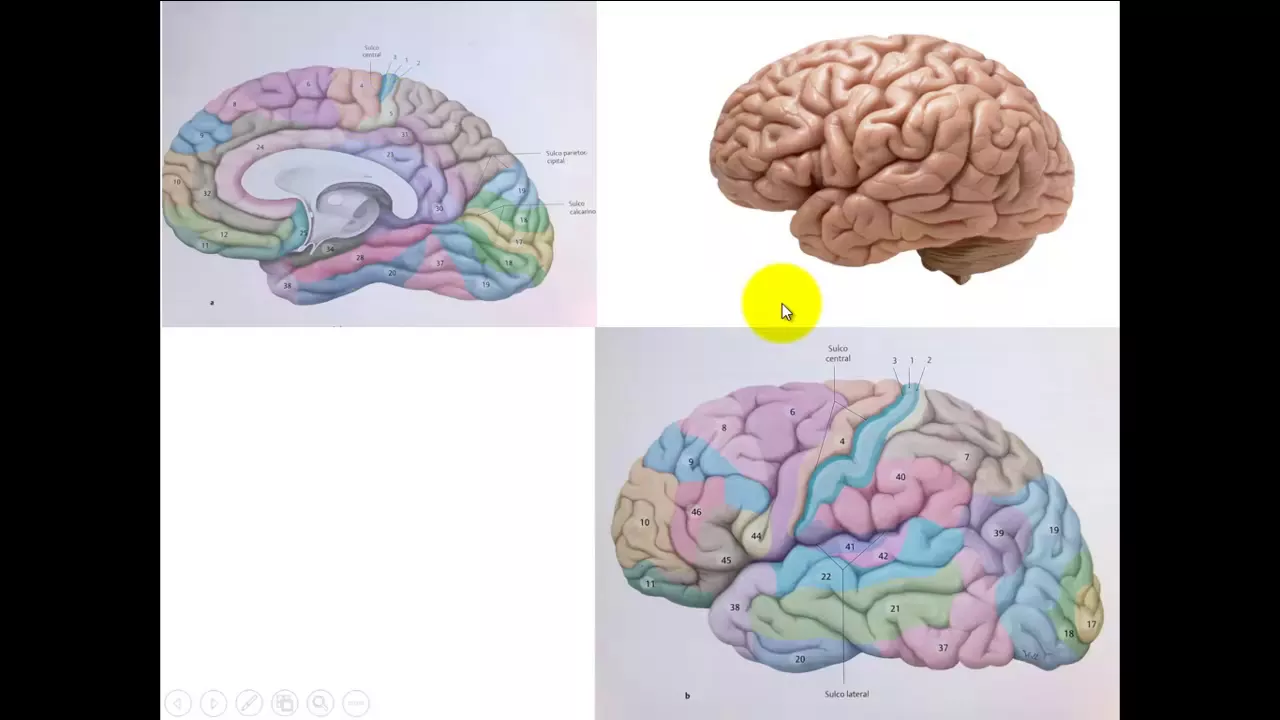









The cerebral cortex is the outer layer of gray matter on the cerebrum, characterized by ridges called gyri and grooves called sulci, which divide it into four lobes named after corresponding skull bones: frontal, parietal, temporal, and occipital. This highly complex structure processes sensory information and controls motor functions through a contralateral organization, where each hemisphere primarily processes information from the opposite side of the body; it also contains primary cortex for basic functions and association cortex for integrating information to perform higher cognitive functions like language (predominantly in the left hemisphere) and attention (with the right hemisphere specializing in monitoring both sides of the body).
Cerebral Cortex Structure and Function | MCAT Biology
Added:Voiceover: In this video, I'm going to talk about the cerebral cortex.
The cerebral cortex, and that's the layer of gray matter on the outside of the cerebrum.
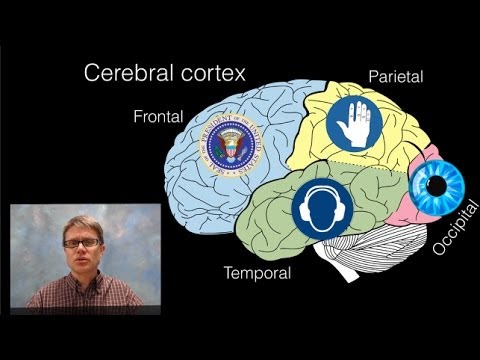
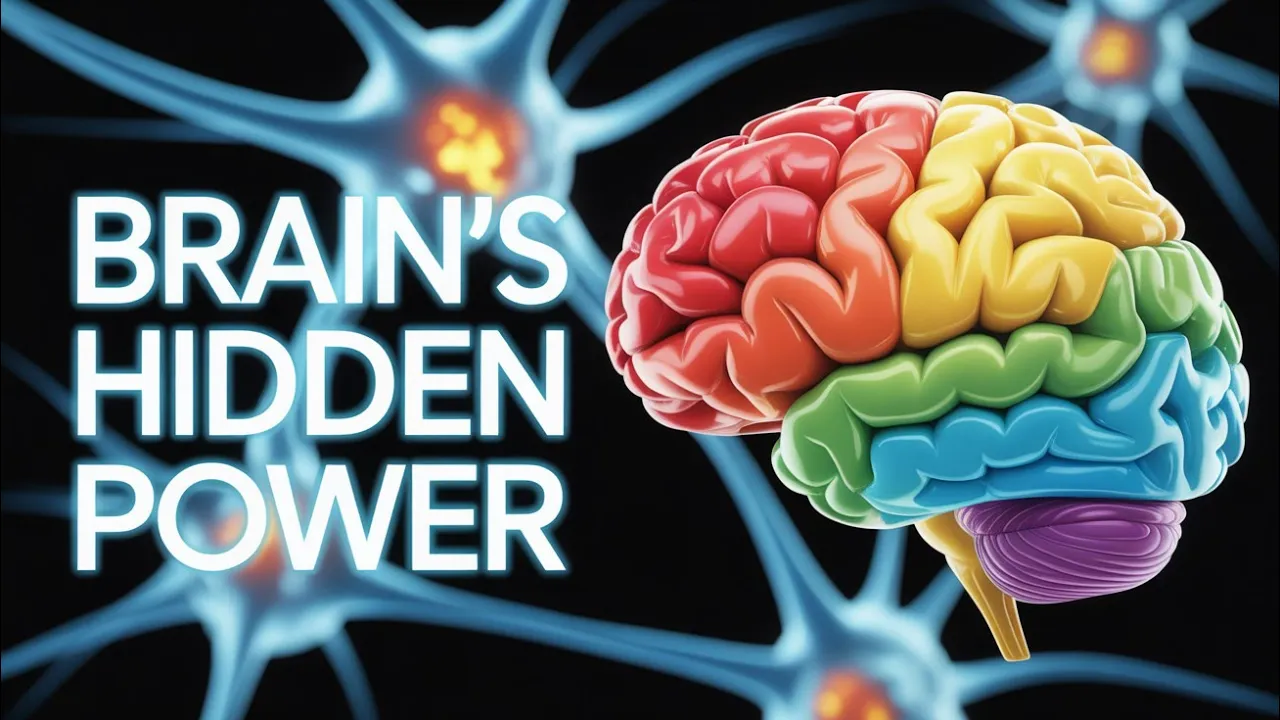
So here we're looking at a brain from the left side, and there's been some colors drawn in here, but this is all gray matter, cortex, on the outside of the cerebrum.
And down here is the cerebellum and here is the brainstem.
And the cerebral cortex has these ridges and these grooves on its surface.
It's all wrinkled up and folded up.
And these ridges, like let me just pick this one right here, these ridges are called gyri, gyri, that's the plural, a single one is called a gyrus, multiple is called gyri, and then these small grooves that are on either side of a gyrus like this are called sulci.
Sulci, that's multiple, it would be sulcus for just one.
So this would be one sulcus right here.
So that's a small groove, but there's also some really large grooves like this one right here, and those large grooves we usually call fissures.
Fissures, like this one right here, if we go back like that.
We divide this cerebral cortex into lobes, and we name them the same as the bones of the skull that are right over these areas of cerebral cortex.
So that this big lobe right in the front here, under the frontal bone, is called the frontal lobe.
Frontal lobe, it's this one right here.
This one behind the frontal lobe is right next to the parietal bone of the skull, so we call that the parietal lobe.
This one right here, on the other side of this big fissure from the frontal lobe, is by the temporal bone, so we call that the temporal lobe.
Temporal lobe, and this one way in the back is by the occipital bone of the skull.
Occipital, so we call it the occipital lobe of the brain.
There are some other areas of cerebral cortex that we can't see with this illustration.
Like if we pull apart this fissure right here, there's some in there.
And on the other side, on the side in between the two cerebral hemispheres, there are some other areas.
But when people talk about cerebral lobes, they're usually referring to one of these four.
The frontal, parietal, temporal, or occipital lobes of the brain.
There's a lot going on in the cerebral cortex.
It's really the most complex part of the entire nervous system, and the most complex types of information processing and functions of the nervous system occur in the cerebral cortex.
I'm just briefly going to touch on a couple of the functions of the cerebral cortex, because there's so much going on, but I'll save lots of the other details for later videos.
I want to mention a couple things about some of the senses and motor functions of the cerebral cortex.
And that's that a couple of the senses and the motor functions of the cerebral cortex on one side of the brain tend to be involved with the other side of the body and the environment.
For example, visual information coming in onto one side of the body, so that's a visual information over here on the right side of this person, coming in this way, is going to end up being processed in part of the cerebral cortex on the other side of the brain.
Let me just draw a little bit of color over here to represent that that visual information from the right side of this person is going to end up on the left side of the brain and vice versa.
Actually, it ends up tending to be back here in the occipital lobe, where most of the visual processing areas of the cerebral cortex doing visual stuff handles that information.
The same is true for somatosensory information.
Somatosensory information, coming in to one side of the body, because of the way this information travels in the nervous system, is primarily going to get processed in areas of cerebral cortex in the other side of the brain.
So for example, if something hot or cold, some kind of temperature stimulus, is applied to the skin over here on the right side of this person, that information will actually end up over here on the left side of the brain in the cerebral cortex, somewhere around here to get processed and brought to consciousness so that it can be perceived.
Almost all of the other senses besides vision and somatosensation, tend to get processed in areas of cerebral cortex on both sides.
So if stimuli involving these other senses are coming into this person from the right side, usually there's going to be areas of cerebral cortex on both sides of the brain that are going to do some processing of that information.
But for visual information and somatosensory information, that predominately makes it over to the other side of the brain.
Similarly, motor information, information about movement and control of skeletal muscles, which involves areas of cerebral cortex around here, this area of cerebral cortex will be controlling muscles in general on the other side of the body, if I can draw some red in over here on the left side of this person's cerebrum, that information will get carried by upper motor neurons down to lower motor neurons on the other side of the spinal cord and that's going to affect movement on the other side of the body.
So for instance, I'll just shade in this leg red here, that muscles of the right leg would primarily be controlled by areas of cerebral cortex on the left side of this person's cerebrum.
Now if we take a big step back and look at the cerebral cortex as a whole, we can divide up the cerebral cortex into a couple of types based on what kind of function that area of cerebral cortex is performing.
The first type we call primary.
So a primary cortex is one that's performing basic motor or sensory functions.
That's in contrast to other areas of cerebral cortex that we call association cortex.
Association.
And the idea with this word is that they're associating different types of information to do more complex processing and functions.
So for example, for the areas of motor cortex, there's a primary motor cortex that's doing the basic motor functions, and then there are association motor cortices that are doing more complex motor functions like planning of movements.
And then there are areas of association cortex that are taking in different types of information like maybe somatosensory information and visual information, and they're integrating that information and doing higher-level processing to perform complex motor or sensory functions and to produce the higher functions of the nervous system like cognition, emotion, and consciousness.
One aspect of cognition is language, which could be described as the ability to turn thoughts into words, and vice versa.
And in most people, that's performed by certain areas of cerebral cortex in the left hemisphere.
There are some people that have language functions in the cerebral cortex on both sides, or even all on the right side, but most people have language functions occurring in cerebral cortex just in the left cerebral hemisphere or predominately in the left cerebral hemisphere.
One last thing I want to mention is attention, which is another important function of the cerebral cortex.
There are lots of areas of cerebral cortex on both sides that play a big role in attention, but in particular, in most people, the right cerebral hemisphere, areas of cortex over there on the right cerebral hemisphere, play a role in paying attention to both sides of the body and the environment, whereas in a lot of people, the left hemisphere seems to predominately just pay attention to the right side of the body and the environment.
So there are some additional attention functions being carried out by the right hemisphere that are not carried out in most people in the left hemisphere.
So I'll stop there, there's a lot more to talk about in terms of the structure and the function of the cerebral cortex, and how these areas of cerebral cortex connect to and work with other areas of the nervous system.
For example, these motor cortices work with the basal ganglia, some of those deep subcortical cerebral structures and the cerebellum to perform a lot of different motor functions, and for almost all these parts of the cerebral cortex and the functions they perform, there are lots of connections between areas of cerebral cortex and between areas of cerebral cortex and other parts of the nervous system that are important.
But I'll stop there just to give a little bit of an overview of the structure and some of the functions of the cerebral cortex.
Up Next

Web Audio API Tutorial: Introduction and Core Concepts
@MusicandCoding
11.8K views•2022-06-16

Triumph of Orthodoxy Icon: Byzantine Art & History Explained
@BenCallan
2.1K views•2024-08-06

Social Reproduction and Social Inequality | MCAT Prep
@khanacademymedicine
121.3K views•2015-03-27

Game of Thrones Opening Credits: A Cinematic Analysis
@gameofthrones
46.3M views•2011-04-18
Related Study Plans & Knowledge Roadmaps
Structured learning paths in General & Interdisciplinary Studies