















![Cancelling the Apocalypse | Robert Wright & Luke Kemp [The Wright Show]](https://i.ytimg.com/vi/CPogpo-n_Xc/hqdefault.jpg)








Throughout human history, societal collapse has often benefited the majority of people rather than the elite, as evidenced by archaeological findings showing that when centralized power structures fell, ordinary people gained access to resources, experienced reduced violence, and sometimes achieved greater equality—demonstrating that collapse can be a reclamation opportunity for more decentralized, democratic, and equitable social arrangements.
Why Collapse Benefits the 99% | Luke Kemp
Added:Understanding the concept of social stratification and how complex societies historically concentrate wealth and power in the hands of elite classes.
Familiarity with the historical definition of 'societal collapse' (e.g., the dissolution of centralized political authority and complexity, rather than total human extinction).
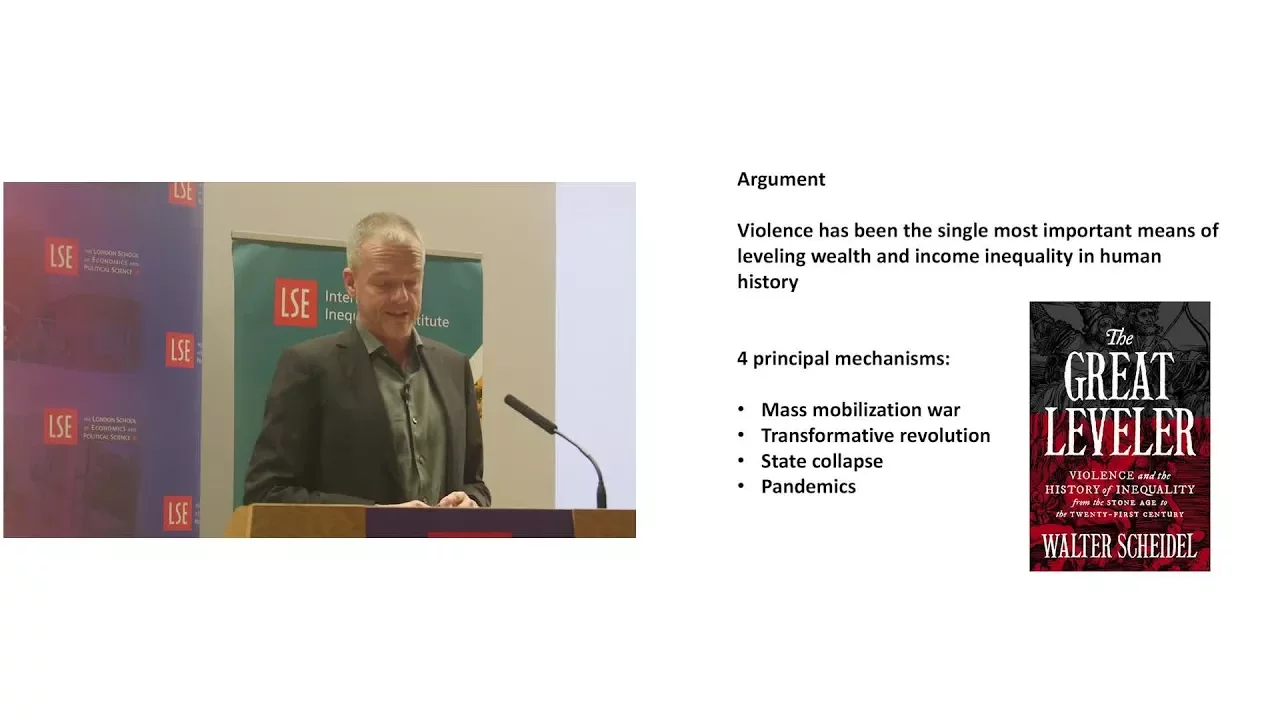
Basic knowledge of Walter Scheidel's 'Great Leveler' theory, which argues that mass violence, plague, revolution, and state collapse are the primary historical drivers of economic leveling.
An introduction to the economics of labor supply, specifically how labor scarcity (often resulting from demographic or systemic crises) increases the bargaining power of the working class.
Exploring the field of Cliodynamics, which uses mathematical modeling to study historical cycles of social instability, elite overproduction, and state collapse.
Analyzing modern existential risks (such as climate change and nuclear war) to determine if a contemporary global collapse would still follow historical patterns or result in total extinction.
Investigating political theories of anarchism and decentralization (such as James C. Scott's work on non-state spaces) to understand how communities self-organize without state structures.
Studying the 'Degrowth' movement and steady-state economics as proactive, non-violent frameworks designed to achieve economic leveling and ecological balance without systemic collapse.
25.8K views1.1Klikes1:00:16Original Release: 2025-08-28
Collapse we view through the eyes of its greatest victims, the 1%. In general, we have a 1% view of history. Most writers throughout human history, they were a very small enclave who were employed by either kings or the richest people in society.
>> Yes.
>> Hence, we tend to get this really warped view of both human history but also of claps in particular. And one of the most fascinating things I found while doing the research for this book was some of the lamentation literature. This is basically literature made by scribes a few decades or even centuries after the collapse of one empire. They spend most of the time actually talking about and ftting about the inversion of the social order. So they said they're talking about, oh no, servant girls now talking back to the mistresses.
>> Poor people who would didn't have a tomb previously now have a sarcophagus.
People who had no corn now collectively own the corn. And collective ownership of collectively produced food is not usually what one associates with collapse. We do tend to have more this image of >> things going to absolute hell. It's kind of like Mad Max or the road for instance.
>> Yeah.
>> And that's just not true when you look at historically collapse often can be a good thing for a lot of people.
Hello and welcome to Planet Critical, the podcast for a world in crisis. My name is Rachel Donald. I'm a climate corruption journalist and your host.
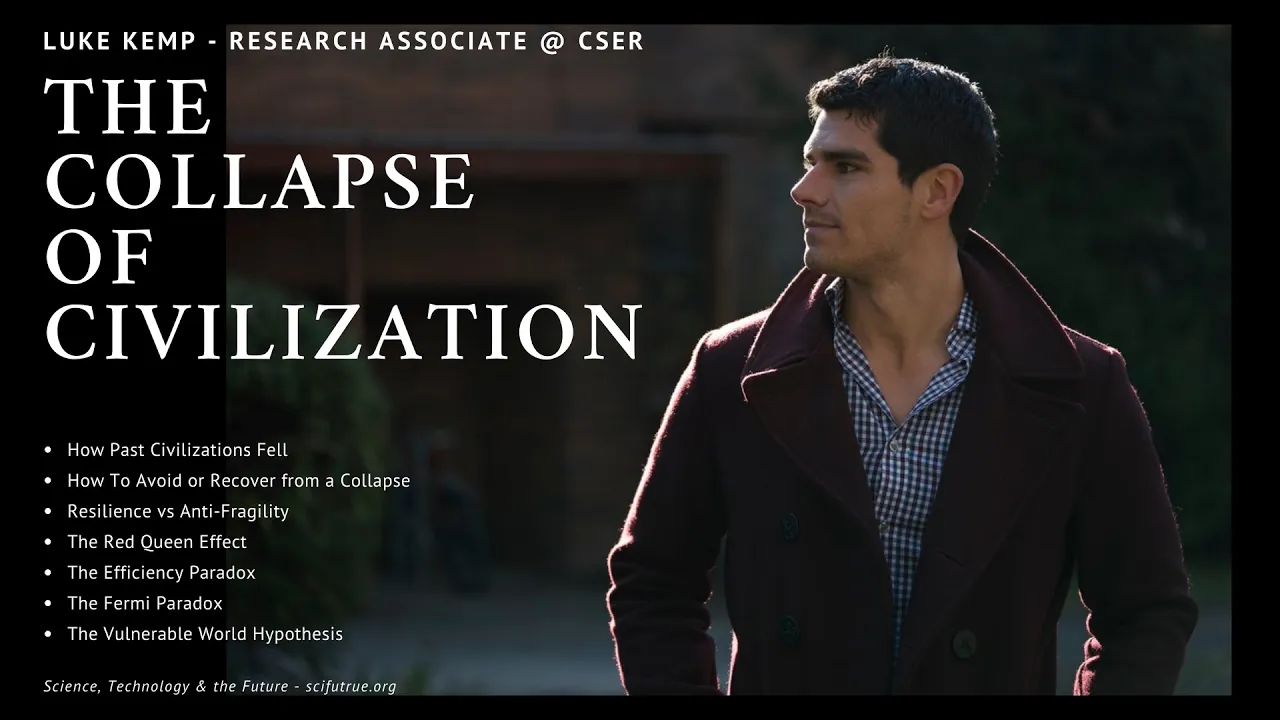
Every week I interview experts who are battling to save our planet. My guests are scientists, politicians, academics, journalists, and activists. They explain the complexities of the energy, economic, political, and cultural crises we face today, revealing what's really going on and what they think needs to be done. These are the stories of the big picture. Go to planetcritical.com to learn more and subscribe. My guest this week is Luke Kemp. Luke is a research associate at the Center for the Study of Existential Risk at the University of Cambridge and he's the author of Goliath's Curse: The History and Future of Societal Collapse. In one of those lovely and serendipitous moments, Luke and I actually reached out to each other within about 18 hours to get him on the show quickly to discuss the book, and I'm so glad I did. First of all, the book is wonderful. It's brilliantly researched. It's brilliantly written. It is a real deep dive into the deep time of human civilization. And Luke is very clear to make the distinction between human civilizations and what he calls Goliaths, the societies in which select individuals dominate others by controlling collective resources and through the threat of violence. It's very obvious given the inequality of the world that we live in today that such conversations are very important and an true understanding of history is also important because to my real surprise in the second half of the episode Luke explains the huge complexity that existed in human civilizations. cities that were democratically managed and egalitarian, where resources were shared, that homeed up to 50,000 people, that traded far and wide, that had really low levels of violence, and were pretty developed technologically. This provides a whole other avenue for imagining what the future could be like.
And you'll hear Luke say, as any good scientist will these days, "No, the future is not certain. We don't have a crystal ball. We cannot say for certain that we are in a moment of collapse now.
But these are the different trajectories that we could take but say that we do go down the worst one. Even though that collapse would be global, the first in our human history, we can also imagine it opening up avenues of possibility because no matter what happens before the end of this century, something is going to have to give. Power is either going to fracture or we're going to have to dismantle it. And so I'm delighted to report that a conversation about collapse actually not only ends on a a positive note, but also speaks to the reality of our human history and thus our human nature, our huge potential for egalitarianism, compassion, ingenuity, and resilience. I hope you all enjoy the episode. If you do, please share it far and wide. And if you're loving the show, become a patron on Patreon or support Planet Critical with a paid subscription at planetcritical.com.
By signing up, you'll get the Planet Critical newsletter inspired by each episode delivered straight to your inbox every week. You'll also have access to the wonderful Planet Critical community who are full of inspiring thoughts, ideas, critiques, and determination. The links are in the description box below.
I'm so grateful to everyone who chooses to support the project. I'm a vehement believer in adree and open access content. So, Planet Critical wouldn't exist without the direct support of the amazing community. Thank you so much to all of you who believe in Planet Critical and keep the project going every week. Look, welcome to Planet Critical. It is a pleasure to have you on the show, >> Rachel. Thank you for having me.
>> I'm so excited to speak to you. As I was saying in, you know, our pre pre-recorded chat, the audience is primed for a collapse conversation that they didn't quite get recently. Um, so I think that it's just excellent timing to have you on to discuss this book that that's come out, Goliath's Curse. But before we get into it, can you answer the first question? Why is the world in crisis?
due to a set of root causes which are primarily in our skulls. I think the big ones status competition through domination, the authoritarian impulse, our ability and desire to look for authoritarian leaders when we face a threat, >> power corrupting, and what's often called the dark triad or dark tech. And all of those 5,000 years ago combined with certain environmental circumstances to create huge dominance hierarchies that fall into things like arms races and status races. And that has led us to our current predicament we face today and one which can be very difficult to escape unless we address those root causes.
>> Okay. Just one thing on the authoritarian leaders. Um because a point that you make in the book and a point that a lot of researchers have kind of brought up is that people are generally pretty egalitarian and sort of socialist and generally quite quite nice around the world and throughout history.
>> So >> is it just the face of a threat that turns us towards authoritarian leaders?
I mean why do we sort of shuck off the values that we normally exist with when faced with a threat?
It's worth remembering there's always a variation across populations. So it's not like everyone is less authoritarian.
There's usually depending of what population somewhere between at least in OD countries 10 to 25% of people are more authoritarian. Usually more right-wing authoritarian.
There seems to be different factors here. So some some say it's more having an underlying competitive view of the world. But one of the few things that actually seems to shift people across the spectrum towards being more authoritarian is having that kind of external threat. Whether that be disease, violence, economic procarity, something of that sort. There are other factors which can make people more willing to of course accept authoritarian structures. One is simply a good story. So in the book I talk about stories of subjugation that whenever you have a big power structure I call Goliath or people usually call or civilization a big state forming the leader always has a somewhat compelling usually supernatural story to justify why they're in charge. So pharaohs were either representatives of gods or gods themselves. Sumerian kings roughly the same. Some of the first priest kings in certain cities like Cahokia seem to have claimed an ability to divinely control the weather. And of course today we believe that >> unless we trust the indispensable genius of a couple of individuals like the Iron Man himself, Elon Musk, we're doomed to stay earthbound and all die out. Um, but either way, people always find a pretty splendid divine story justify why they're in charge. And to be frank, they're almost always complete [ __ ] We have no reason to believe pharaohs were gods. And likewise, we have no reason today to believe that >> without Musk and Zuckerberg, we're going to have a complete stall in innovation.
>> It's kind of like this transferral of meaning, isn't it? Like even if you even if your life isn't going to kind of advance statusely beyond I don't know being a peasant a thousand years ago or whatever if you sort of align yourself and believe in this wonderful fiction of the possibility of a human normally a man somewhere doing that thing and you belonging to his tribe then it's isn't it it's a way for you to then also sort of ascend.
>> Yeah. Uh I didn't want to make the book too complicated but there is a really good literature Harvey White House at Oxford's pretty well published on this on how we basically confuse our identity as an individual with a larger group and we do this all the time right we have notions of nationalism and patriotism and one of the things I mentioned in the book is that after 911 the sales of US flags jumped to roughly 250,000 the same day the previous year it was roughly 10,000 um sold at Walmart so enormous always increase and a lot of that is because people have fused their identity to the nation state and nation states by and large rely on that. If people didn't do so they'd be in trouble and historically these ideologies do exactly that as well. They build some kind of relationship between the greater whole which the leaders usually infuse to as well and the everyday peasant. Often they don't do so very successfully. I think this has been much more potent in the last few centuries as we've had obviously much better instruments in mass communication and media but nonetheless it has improved over time and people are highly fused with a group identity now.
>> That's so so interesting. It makes me think about the fact that there is so much about the way that we the way that we live, the way that we behave, the way that we think that is helpful up until a point. And then once you sort of flip past that binary, it becomes incredibly destructive in the way that centralizing pulling resources is really really helpful for a wider community to survive and collaborate and develop you know slightly technologically. But the minute that that becomes a mass centralization in order to support a nation state or even a city I think is as often sort of is proven in the case of Cahokia I think is how you pronounce it. Um then that causes destruction.
>> Yeah. And even I think the the basic idea of status competition is the same.
>> In the book I identify status competition as being one of the root causes. It's not the root cause behind our current planetary crisis. And this is for several reasons. One is that it ends up being one of the drivers for having these dominance hierarchies. So historically for 300,000 years or so, we've been nomatic galitarians. We're not bred or evolved for being in unequal structures. And eventually with, as you mentioned, Cahokia, the first city in the US, roughly 5 500 km southwest of modern day Chicago, you start to see emergence of these both big grand structures. Literally, they were building roughly 200 different mounds, these flat top earthn pyramids, but also a kind of social pyramid as well, where you had some people placed on top of others in a ranking system, what we call dominus hierarchy, and they essentially rule for the threat of violence.
>> And it's worth noting we have these all the time now. You know, the distinction between boss and worker, management of others, they're usually based upon the ability for one person to fire and hence have control to a certain extent of the economical livelihood of someone else.
>> And that largely comes down to status competition. Some people want to be on top of the hierarchy because we have numerous studies suggesting that status tends to have a very big reproductive advantage. um it tends to result in people having more children and those children will likely be living to adulthood. Hence why every emperor ends up getting harams most big generals etc end up prioritizing sleeping with lots of people basically >> but status competition more than that also has a big driver in terms of material footprint. So when you look at the archeological record some of the big things we look for in inequality are things like having grand burials. So having burials replete with weapons, jewelry, etc. What we call grave goods.
Human sacrifice. So either having people sacrificed as part of ceremony or even as part of the burial itself. These can be pretty industrial scale. So the Shong dynasty, which was the second dynasty within Egypt, not Egypt, China, of course. I still haven't had my caffeine yet. Um the Shan dynasty they sacrificed 13,000 people over the space of 200 years which is just monstrous. Um and even within Kahokia one of the mounds has >> I believe roughly 200 human sacrific sacrificial victims including I think in one case this is just one by itself that had 52 women um sacrificed. I should actually say 53 52 of them were all of reproductive age.
>> Um so they may have been virgins but we're really sure. But the key thing here is that in all these cases what's happening whether it be big grand monuments, human sacrifice or these grave goods, you're basically doing conspicuous consumption.
>> You're wastefully using resources and energy. And this is remarkably different to what pneumatic egalitarian hunter gatherers usually do where despite some variation the general rule of thumb is what we call the principle of least effort. They basically try to conserve most of their energy. They prioritize leisure over conspicuous consumption and excessive use of energy which also makes sense. They don't have a large surplus of energy. So hence they're very frugal of it. But even when they do get it again they're very frugal. They tend to prioritize leisure rather than accumulating a surplus. And what seems to happen once you get these dominance hierarchies is suddenly you get a real big prioritization of having just grotesque conspicuous consumption which in many ways is what a pyramid is, right? You're >> putting a huge amount of labor and energy into a monument which actually has no real functional benefit for the rest of society.
>> And when you look at most emissions today, bearing in mind that what is it The top 1% globally emits more than the bottom 66% of humidity. A lot of the vast majority is conspicuous consumption.
>> My god, this is um all such interesting stuff. I mean, do we have an understanding of of how these flips happen? How is it that we can kind of go from a nomadic society to one of, you know, priests regularly sacrificing women uh on their pyramids.
>> It's worthwhile bearing in mind this was never a quick flip or even a revolution per se. It takes on average roughly 3,000 years to bear from intensive agriculture towards having a state towards having a a set of centralized institutions that extract resources from an imposed rule in a given population and territory.
>> And even when you do see states emerging like in Egypt or Uruk in Mesopotamia roughly 5,000 years ago, it seems to be a very stop start stacato process where they're basically trying to centralize power. it seems to fail and they keep doing it until eventually it succeeds.
But the story here why the flip occurs it is a story of organized crime. When you look at the five areas where we actually develop states across the world. So Rurk in Mesopotamia, the first dynasty of Egypt in Egypt of course the Sha dynasty in China, Mud Daban in Meso America in Tiwanaku potentially in South America. They all have certain shared characteristics. One really big one is they all have access to a certain type of resource. In this case, usually some kind of grain. So wheat, rice or corn in particular. Even the case of Cahokia, you don't see it actually starting as a city until you have the importation of corn in roughly 900 CE. And then roughly a century later after that scales up, voila, you get a dominance hierarchy.
>> And this seems to be true of most of these areas that have that kind of resource.
This isn't the simple story that even Marx and Smith once told of once you have a surplus you have to have leaders.
That always didn't quite sit right with me. First of all, because we have things like large scale irrigation systems, monuments without having inequality and large leaders. So the coordination argument doesn't really seem to check out. And on top of that, I just never quite understood why is it that if you have to have someone coordinate others, they also have to call themselves God and take 100 times more resources than others. That's just nonsense.
>> The key thing here seems to be not a surplus. When you look across the world, there's other areas which have our culture but never develop states. So Papa New Guinea has a culture roughly the same time as China approximately 7,000 years ago. They never developed pharaohs. They never build pyramids. The key difference is Papa New Guinea, they're growing banana and taro. And in the case of Egypt, they're growing wheat.
>> And the key distinction here is that wheat can be seen, stolen, and stored.
So it advertises itself when it's ready to be harvested. You have really tall stalks, exactly the same as in the case of corn.
>> It's pretty easy to collect on mass. And additionally, it can be stored for up to a decade. Actually, decades, >> right?
>> Banana, you can only store bananas for usually a couple weeks top. Taro, maybe six months.
>> Taro, it does have a harvest period, but you can actually leave underground for months after its harvest period.
>> So, it's not easy for a tax collector to come by.
>> So, the key thing here is what I call lootable resources. It's not about having a surplus, it's about having a lootable surplus. And on top of that, you usually see states start to emerge once you have certain weapons. So in the case of Uric and the first dynasty of Egypt and also the Shard dynasty in China, they'll emerge shortly after you have the introduction of bronzeheld axes and swords. So suddenly one group has the ability to take resources by force much more effectively off everyone else.
Last but not least is caged land. So most of these areas have a lack of exit options which there's been numerous large studies suggesting that when you have a lack of exit options when people can't move as freely they're more likely to have to accept authoritarian structures and lo and behold when you look at Mesopotamia in Greek it literally means the land between two rivers the Tigris and the Euphrates in the case of Egypt it's buffered between the Nile and the Red Sea. So the story is pretty clear here. Basically a small group using monopolizable weapons.
People can't escape and they take their resources only some of them and use that as a basis to form the state. And we even see this actually in the modern world. Um there's been some fantastic and pretty disturbing studies showing that when we have big price jumps in colan a rare earth metal in the Democratic Republic of Congo suddenly our militias start popping up around the mines and basically charging the miners to come in and out but they also apart from that start to charge them for protection and they start to develop a court system for dispute settlement.
They start to act like a state. It's a very frightening picture that you're describing there because essentially all of that is the fundamental framework of how modern capitalism functions today.
Um whether it's the violent extraction of Earth's resources with no recourse as to the harm done. Um the looting of surplus that does belong to other people. Um the threat of violence that is now completely insurmountable. I mean, what are you going to do in the face of of nuclear weapons or even just drones and the fact that there is nowhere to go because the system is now global? Um, and that's only really happened in the past sort of, >> well, I don't know, probably following the CIA campaign that Vincent Beavenon so brilliantly documents to topple, you know, the natural leaning socialist uh, governments all around the world that were popping up in the 50s and 60s. So, >> yeah. I mean would you say then that we are perhaps living through a collapse?
>> It's difficult to tell collapse for those who are living through it. They often can't tell it's a collapse. You feel the individual disasters. So the people of the Roman Empire would have known that Rome was sacked for instance.
They probably wouldn't have stepped back and said oh the West Roman Empire is falling apart never to appear again for instance.
It is difficult to tell, but it's also hard to know if you're past this kind of point of no return. I personally think not. However, I do think, as you've alluded to, were locked into a single Goliath system. So, when I use this term in the book, Goliath, I'm referring to essentially a collection of different dominance hierarchies. So, Rome wasn't just the empire. It was also the distinction between slave and master, rich and poor, men and women. And those were all different ideas and dominance hierarchies that supported the empire.
The empire was largely built upon those things. You know, you needed to have patriarchy and slavery for Rome to be what it was.
>> Mhm.
>> And I would say that today we do just have one large interconnected Goliath system. You know, when you look at most states, even those who are forceworn enemies like China, the US, they're actually pretty similar. Yeah, they're both organized as big nation states.
They both act as imperial powers as well.
>> They both have militaries which are structured in a very similar way. They both have nuclear weapons >> and they both are part of a despite China's leanings shared clapular system.
You know, the fact that you can actually move capital so easily across borders in the space of seconds is because they all have very shared legal systems um usually stemming from either British Commonwealth law or New York state law.
Mhm.
>> So they're all pretty much whether we like or not part of one big shared dominance hierarchy.
>> And as you mentioned nuclear weapons, it's a new monopolizable weapon. You know, when it comes down to it, the president can ultimately make that one decision to send the world into thermonuclear war. It's >> in many ways the ultimate optimized weapon.
>> And instead of just grain being a little resource, we have fossil fuels. Most fossil fuel companies either previously were highly centralized national ones like BP, British Petroleum >> or they still are like sortco etc. >> And we also have a new form of literal resource in those which is data.
>> It's notable that when you look at the top 10 companies by market capitalization, they're pretty much all either fossil fuel companies or usually big tech companies. So they're all in some way harvesters of lutable resources.
>> And on top of all that, you have caged land now in the form of mass surveillance. And I'm not sure if one can say we're living through a collapse. And I definitely don't think we can put a date on doomsday. We >> just don't have the evidence evidence that you can make good predictions more than a year out. And even for that, it's usually making predictions about much less complex questions. So if someone tells you that we're certainly doomed by next decade or something like that, they're largely for a show. What we can do >> is we can tell what kind of trajectories we're on. You know, if you look at the kind of causal mechanisms of the last 5,000 years, you can tell roughly what's going to be more likely or not in the coming decades or centuries.
>> And in the book I put forward that in the very long term, the most likely outcome here is probably going to be self- termination of the system. And on a very basic level, if you have constant status races and races for resources on a finite planet, unless you have godlike innovation, how's it going to work out?
>> And likewise, if you have arms races with increasingly potent weapons, where does that ultimately end?
>> Mhm.
>> You can't rely upon deterrence and good luck for the space of centuries or even decades necessarily. We've already had 12 nuclear misses and most of those were just sheer dumb luck that we didn't actually end up in a nuclear war.
>> The second and I think much more likely outcome in the near term is what I call silicon Goliath. So we're part of the single big global system but it is changing and unfortunately it's changing I think in the for the worse. In particular, AI is enabling much more intense, large scale, ubiquitous forms of surveillance with the mass massive crackdown crackdowns and protests across the world. And on top of that, we have, as you mentioned, the introduction of things like what are sometimes called lethal autonomous weapons, what I prefer to just call killer robots. Basically, armed drones that sometimes have the ability to identify and kill targets themselves. and something that gives any kind of leader, any kind of hierarchy, an ability to potentially suppress their citizens in a just unprecedented way.
>> And of course, data, the ultimate resource being harvested on mass. So you're basically heading towards a more, I think, totalitarian, more surveillance-based system. We of course see democratic backsliding across the world. 5.1 billion people already live in autotocracies.
And the very last trajectory is we somehow reverse the 5,000-year process and we essentially level the different forms of power and democracize most of the world. And I don't think unless we do that, we probably escape our planetary crisis.
>> I'm interested then why do you think that we are not then living through one? Is it because you don't want to kind of ring the doomsday bell and and and be a little bit more precise with your language and and as to the phases as well of a of a process like this?
Like what are the things that give you hope then >> um for this unlikely but possible good trajectory?
>> Yeah. So part of it is me being a nerdy pedantic person where I don't know what the threshold is hence I want to be careful about it. The part of it is I do think there are genuine ways to escape these traps. Um, one, so at the end of the book I try to actually give something of a a rough guide to what are the different interventions we can do.
Most of these revolve around how do we flatten different sources of power. So when you see the emergence of the first states, they're basically combinations of different forms of power. One is control of decision-m, political power, control of resources, economic power, control of information, whether that be ideology or actual data, information power, and last but not least is control of violence, violent power.
>> And when you see the first states and rulers, they tend to try to fuse all those together. So the first rule is Cahokia. You know, probably claims some kind of divine status. They definitely have more wealth than everyone else.
They'll be buried of far greater g grave goods. They could wield a violent power as seen the human sacrifices and of course they were the leaders and this is common across most early states and of course even today as well the executive and the president is usually also the commander-in- arms.
>> Mhm.
>> So you have to level each of those forms of power to get back towards what I would call civilization. As a society, it's more based upon egalitarian, voluntary cooperation, which when you think about the term civilized conduct, you know, moderation, political restraint, virtue, it's much more that rather than building nukes and sacrificing people.
How do you do that? One of the things that gives him the most hope is technology and old practices when it comes to democracy. So while Athenian democracy had its problems including the fact it was limited just to basically men of fighting age and those who own property slaves and women weren't included. So roughly 10 to 15% of society democracy still worked pretty well in some regards much better than other states. And additionally, this practice of choosing people by lottery, having them deliberate, exchange genuine information, and be briefed by experts, we have a really good growing body of evidence. This seems to work. It results in less polarization, more legitimacy, and usually better outcomes as well.
>> And an idea I put forward in the book is that it would probably result in far more risk adversity.
So, two quick examples. One here is what I call the Trinity Jury. So you're probably familiar with the Trinity test in 1945. Okay. So the Manhattan project basically creates the first atomic weapon in the US.
>> And in 1945 they face a choice of to whether to detonate the first bomb, the Trinity bomb or not. And they decided to go ahead and this is in July of 1945 in the sands of New Mexico.
>> Some key things here. By that stage, the US knew that the Nazis were no longer pursuing the wor weapon. It was no longer about beating the Nazis to the bomb. Okay.
>> And additionally, Edward Teller, one of the physicists on the project, had made a calculation that while they couldn't rule it out, they couldn't rule it out, but there was a very small chance that detonating that weapon would create a runaway fishing process that would ignite the entire atmosphere of Earth, thus killing not just every single human, but every single shred of life, potentially the entire cosmos silent.
They still went ahead and detonated the bomb. And the example I like to give is imagine if you had instead a jewelry and assembly where you just randomly selected people >> farmers plumbers cleaners and you ask them should we go ahead and buy this bomb what would be the response >> [ __ ] no and everyone I ask always responds with yeah of course not and I think >> that's also echoing back to how would they what would they say if they were part of that jury >> and likewise I think of in the 1980s when you had BP and Shell doing their own modeling of climate change, seeing how bad it could be and then deciding to bury the evidence and run disinformation, misinformation campaigns. If you had citizens juries sitting next to the actual board, they would not say, "Yeah, go ahead." That's a that's a smart move. Um, and this is just as you've probably covered in the podcast numerous times, this is endemic across the different problems we face.
Exactly the same with noble entities, things like PAS. they knew about the dangers to the public and they did studies on them and they intentionally buried it and lobbied the EPA.
>> Again, if you had democratic oversight, I don't think that happens. So, one of the things I talk about in the book is that if we can have a move towards much more genuine deliberative democracy or open democracy, I think that would be a huge leverage point. And we also have the tools to do this at scale now particularly through things like polus frankly different online platforms that allow large numbers of people to deliberate together that gives me hope. I think also the fact that people seem to be slowly moving towards this like populism for better or for worse is also an acknowledgement that people are very upset that they feel like they're not being heard in the democracies and they want to have more of a direct voice.
>> And I do think that open democracy provides a really clear example of how to do that at scale.
>> And apart from that there's lots of other things I think we could do, you know, wealth taxes. Let's just cap wealth at $10 million. So you don't need any more than that any >> billionaires and millionaires of the past been very clear that I think it was Harold S Hunt back in the 1920s as an old harco. He literally said that anyone else who has $200,000 is for all intents and purposes as well as well off as me.
He had I think 600 million roughly.
Money is just a way of keeping score.
>> Yeah.
>> But it's a way of keeping score. It has huge detrimental impacts. I mean look what's happening in the US. It spills over into politics. It makes it basically impossible to have a democracy. And I think one of the reasons we see democratic backsliding globally is in large part because we've had rising wealth inequality since the 1980s. The share of the top 1% has gone from 25% of global wealth to roughly 40%.
>> Mhm.
>> It's naturally going to spill over in all part other parts of the world. Um so have a wealth cap and we do have the administrations, the bureaucracies now to do so. So I think we actually have the capability to do most of these things and we importantly know what to do. The problem of course is always going to be that there's people in power who don't want to be done.
>> Mhm. Yeah. I also think that the all the ideas that we need are lying around. Um and of course the the problem is the politics of it. There are reasons why you know good ideas don't come forth.
There are reasons why socialist governments are toppled by capitalist intelligence agencies.
>> Good old fashioned coups.
>> But I do I have to say I do wonder about the capability of all of these things on a resource level as well.
>> Um >> the just the amount of surplus that it requires to maintain states of the size that we have now. Even if you were to sort of strip back a lot of conspicuous consumption, it would still demand a level of violence that against the planet when you it's when we're talking 8 billion people, >> I think will just cause sort of irreversible harm when placed on top of the centuries of untrabled extraction.
And I think that's that's sort of the thing that I worry about with regards to even the solutions that >> that if you create a constellation of would be really really helpful. It's well how much how much electricity would it take to have everybody you know online and voting all the all the time quite frankly you know how how much uh >> how many resources from earth would have to be extracted in order to feed and fuel the the bureaucrats or the administrators or whatever word that you wanted to use that would also be you know ensuring that all of these things were implemented. I mean, that's I suppose that's the thing that that gives me the sense of of vertigo when thinking about the future. It's not that we aren't it's not that we don't have the imagination for it, even if we could get past the political power problem though can Earth do it.
One of the other things I talk about a book which I think is key is just simply internalizing externalities as we say making companies and people pay for the social environmental damages that are done by products and I think as soon as you start to do that things would slow down and of course for a lot of people that sounds very scary but ultimately I think it would be a good thing when you look at what actually makes people happy over the course of their lifetime it doesn't tend to be material possessions it tends to be past a certain level of affluence, it's usually all about social connections, leisure time, sense of purpose and meaning, etc. >> Mhm.
>> And I do think that once you start to make a more honest economy, and that's all you're doing realistically, is just making things more honest if you make people pay for social environmental damages. I think that leads to pretty radical transformation and one that hopefully would make sure we're not kind of overstepping Earth's boundaries.
>> That being said, quite clearly, I do not have all the ideas here. I don't want to try to make a utopia. The only thing I put forward in the book is >> less levely source of power. Let's make things more honest and then let's see what happens from there. Basically, I think that people should decide what future they want. And >> yeah, >> the book is maybe pretty pessimistic about the future, but much more optimistic about people. And I I trust if we gave them the right information and we had the right systems in place, we'd actually come up with pretty good solutions to what to do going forward.
And I don't think there's any perfect solution here. like we are just in a difficult situation and a lot of it's also going to depend upon how much value and faith you put in innovation as well. Um I presume you and I are probably less on the side of thinking we can simply technoix our way out of every single problem we face.
>> Yes, because I'm not a child.
>> That is an excellent response.
Yeah, I always found it weird that often people who are very technopian, they kind of almost frame themselves as being the reasonable adults. I'm like, no, you literally just believe we should just go to space. That's that's incredibly childish.
>> Yeah, it's it's the equivalent of it's the adult equivalent of believing in the tooth fairy. Um or, you know, or Father Christmas or whatever it is. something somewhere will come along and fix it for me and give me money in the process of doing so.
>> But at least the tooth fair is a fair exchange. In the case of, you know, SpaceX, I'm not sure if that's a fair exchange.
>> That's true. It's definitely other people's teeth he's pulling out.
>> Yeah, precisely. Well said.
>> All right, let's leave the future alone because we don't have a crystal ball.
Um, and let's go back to the past. I'm very curious about what you found about the civilizations that are not Goliaths and also the scale of them because I think for a lot of people the fear is of what >> a nonentralized future might look like.
Um and even for some of us who genuinely think that that's the only thing that's going to have to happen and yeah maybe it would be nice also don't really have a vision don't have a sense from history of what that could genuinely look like.
So could you describe to me what you found through your research of these non-Goliath civilizations?
>> So it's worthwhile bearing in mind that Goliaths are very recent. We've only had states for approximately 5,000 years, at least the first states in the near east.
And states didn't really take over the world until it's hard to tell, probably somewhere between the turn of millennium, so 1 CE to roughly maybe like 1,000 CE or something like that. We don't have really good high resolution population estimates, but the vast majority, 99, even 99.9% of human history has been under non-state societies.
And we actually did pretty well. It's worthwhile bearing in mind that during the paleolithic, the series of ice ages from roughly 300,000 years ago and we emerged as modern anatomically modern humans to 12,000 years ago, we entered the holene, a period of climatic stability and warmth. That was a period where >> yeah, it did seem it seemed like a good idea at the time. It seemed nice initially and then the narrator it was not. Um but yeah basically during that time we have what at least eight other homminid species on earth. So denisven forenszis thels all them die out while we survive.
And part of that seems to be the fact that we were egalitarian decentralized and highly mobile. So I think people often have >> definitely an over pessimistic if not warped view of what humans are actually like of our power structures. When you look at the best evidence we have of what we were like in the Paleolithic, we were not just in these small rag tag groups of kind of solitary parochial selfish individuals or families. The bands would have ranged from roughly 20 to 40 even up to 200 people. And importantly, they weren't just families.
Less than 10% and not modern egalitarian bands are actually closely blood related. And often they come from people who speak different languages for instance. They're fairly cosmopolitan in some regards. And people constantly move across different groups during their lifetime. So the individual may not have actually just lived with 20 people in their entire life, but thousands.
They're probably closer to a a citygo in terms of social connections.
>> And that movement encouraged both genetic diversity, so the exchange of genes obviously, but also encouraged an exchange of culture and technology. So if you look 120,000 years ago in Africa, we have examples of shared instruments, tools, technology, and culture and genes all the way from the west coast to the east coast. It's like one big fluid, what I call fluid civilization, a shared area of culture mobility.
That would have been hard to do if we were also constantly killing each other.
And obviously we've been fed a constant narrative. There's people like Steven Pinker saying that without a government, we probably kill each other at a rate of 15%. So for every 100 deaths, 15 of those are people killing each other.
That's just nonsense. When you actually look at the archaeological evidence and the genetic evidence, it's probably close to a maximum of 2% and likely more like 1.3%. Which makes it about as safe, even safer if you include suicide than the modern world.
>> Wow.
>> And again, it makes sense. It's really hard to actually survive as a species through multiple ice ages and huge volcanic eruptions if you're constantly killing each other and you're not moving across groups to create genetic diversity.
>> And when you look at other species and how they died out like neatls, the the leading hypothesis for the neotols is not that we killed the male. There's actually no evidence of that. We only have two skeletons of signs of violence and we don't know how it happened. It may have happened near the tall neon, maybe a hunting accident. But either way, the leading theory at this stage is that it was primarily driven by their demographics. The fact that they in particular didn't have a lot of genetic diversity. There's certain burials in the Enls where essentially they have the same genetic diversity as you see with small numbers of mountain gorillas. Um they just didn't have very large communities. They didn't move much across the communities. They're more disconnected. So for us, and some people are going to hate hearing this, it was actually our mobility which saved us and allowed us to become the sole surviving species homos.
And apart from that, we probably wouldn't be where we are if it wasn't for egalitarianism.
So if you look at say for instance a chimpanzeee hierarchy, they can still kind of imitate and learn from each other which seems to be one of our key skills but they will not learn as much sometimes even at all from a lower ranking chimpanzeee. So they basically just tend to do the higher highest ranking one. We have a particular advantage in the fact that we basically will raise children in a community and that child can basically learn skills from the best hunters, best fishes, best storytellers, best craftsmen, etc. It basically puts what we call cultural evolution, the ability to develop new norms, practices, ideas and pass them down to cost generation, accumulate them. It puts that process on steroids.
And we wouldn't have that if you had a gorilla type situation where one male was trying to basically monopolize reproduction. Um, so that's probably an explanation also as to why humans become so much more technological and culturally advanced as well. It's our egalitarianism.
Again, not a message a lot of people like to hear, but either way, the key thing here is we actually do pretty well for a very long period of time without having state structures. And we can seem to do this at scale when you look at some of the earlier cities and one great example here is the inter valley civilization which is in modern day Pakistan the harapen they're a collection of different cities and they have things like actual plumbing so this is just remarkable they had plumbing at a period of roughly 5,000 years ago they have a large number of different interconnected cities with big shared bath houses monuments etc. And additionally, some of the cities scale up to 40 to 45,000 people.
Importantly, we don't have any signs of an elite or hierarchy.
>> Yeah, it's it's really quite fascinating. We have this uh one little figurine of a guy sitting on a chair basically, which archaeologists would usually call the priest king cuz I just kind of assumed, well, there must be someone here calling the shots and that dude's on a chair, so that's probably a good answer. But archaeologically there's no other evidence to support this. Um there's a great paper written by Adam Green a archaeologist here at Cambridge called Killing the Priest King. Basically putting forward look we've been excavated in this place for over 100 years now. We just haven't seen signs of inequality or hierarchy. We just have to accept this was different.
And it seemed to work pretty well. It survived much longer as a continuous community than many others. Um well over a thousand years.
>> Wow. And you know it had long distance trade all the way to me Mesopotamia as well and didn't have high rates of violence. It seems to have worked pretty well and even many of the areas and communities which did become more Goliath like they often start and achieve some pretty remarkable things without having large hierarchies. Um so we have tewitan which is basically a city of about 100,000 people in Meso America and granted it does seem to start in a very hierarchical fashion. So you have the big monuments, you have mass sacrifice alongside them, but there seems to be some kind of rupture within the society. The leading fury is probably a rebellion and after that you don't have any signs of leaders or you have some signs of inequality but not large scale and there's no written documents, genealogies or depictions of leaders. Um the housing becomes remarkably similar. So the genie coefficient in this place I think is half of Denmark >> and it seems to work pretty well. You know they have a functioning for society I think for roughly two or two two or three centuries before things start to fall apart and it starts to fall apart with the first signs of inequality.
>> So this idea that we need to have rulers in order to actually do great things doesn't really check out. It's there's definitely cases where you have states pop up and then you start suddenly have the big monuments etc. But there's numerous ones where you actually have the cool monuments first, you have the large scale irrigation, the large scale food systems, and then afterwards the elites pop up, they hijack it, they take the credit.
>> Yes, of course. And that's what we see all the time today. I I I cannot believe how hopeful I feel. Uh despite sort of the topic of your book really, I mean, it's extraordinary and it's such a shame that that isn't more sort of common knowledge like our bread and butter. of of course I mean of course it isn't but about how we are capable of organizing and I suppose in many ways it makes sense I mean >> the manpower i.e. people doing the labor, the people measuring the things, the people, you know, of course it's the same people doing the same things.
They're just deciding what they want to put there instead of being told. I think it makes perfect sense as to why those things would last longer. People want to maintain their own homes and their own sense of well-being.
>> And again, we're just a naturally a cooperative social species and for most of human history, we haven't had to rely upon one person ordering another. So it makes sense that we do this stuff pretty well. I do think there's still a need for kind of larger studies to look at where a hierarchy is useful, where they're not, but we don't really do that. The de facto process here is that once we have more than three people in the room, we assume that someone needs to be in charge in order to make things work, which again just I'm not sure why that is the deacto assumption apart from the fact that some people took charge roughly 5,000 years ago.
And additionally, again, if you even if you do have a hierarchy, and I think there's some situations where a hierarchy can be useful. Um, you know, I used to do lots of boxing, there's good reason you have the coach at the front telling everyone else how this technique should be done, for instance. But there's no reason they have to basically have huge amounts of violent power over everyone else. There's no reason they have to have a wage that is 100 or even 10 times larger than everyone else. you know, you can have a certain level of parity in equality even if you have some degree of hierarchy.
>> Well, yes, but I I it seems to me that the sort of very um wise way to do that would be to not say that everyone is equal in all things and that everybody's voice is equal, which does also seem to be kind of the like >> the reaction as well to increasing authoritarianism. this sort of very hom b bludgeoning homogeneous sort of narrative but rather that you whoever knows the most gets about the thing gets to speak about the thing. There is a consensive group sort of decision-making process going on as to who should we put in charge for this bit and then who should we put in charge for the next bit. It's once again fundamentally democratic and not that difficult to envision surely.
>> Yeah. When you look at open democracy, in many ways that's the idea is while you do have the decisions being made by a citizen's jury or assembly, they're briefed by experts. It's not everyone walking in and saying >> climate change isn't real and the earth is flat. It's experts who know their stuff, who've been vetted and can provide different perspectives on important issues.
>> And that's kind of what you want as well. Um I while I have some sympathy for it, I think doing the idea of basically having just huge assemblies where everyone does m checks across, you know, thousands of people and everyone can speak up, that's not something that really is going to scale. You're not going to be able to reach important decisions, particularly through consensus through that kind of mechanism. But we have to approach things like democracy as experiments.
you know, they're really important things that we should be actively experimenting in and trying to innovate with and we're not. And I think this is the ultimate case of what you call real preferences in economics that if you look at how much money we're spending on say nuclear weapons or facial recognition, it would be at least 100 times higher than what we're spending improving democracy. And that really tells you what the West values. It's not democracy and freedom.
I think this is an excellent antidote to the the myth of progress that sort of justifies the social contract uh and does so through the threat of what will happen if things go away whether that's of course you know security or economic security but also the sense of belonging to the powerful part of the world the sense of belonging to an important moment in history as well. Um, and of course you don't want to, you know, end up living like a bandit, do you? Um, yes, I would. Yes, please tie me up.
>> I, for one, want to be dead. Kelly, this is an important point. It actually goes to two points I make in the book.
One is that collapse we view for the eyes of its greatest victims, the 1%. In general, we have a 1% view of history.
Most writers throughout human history there were a very small enclave who were employed by either kings or the richest people in society.
>> Yes.
>> Even if you look at say for instance maine Greece. So this is basically the societies that existed in Greece in rough roughly the late bronze age.
And they're basically a set of different power economies with rulers who throw these big feasts who extract things like wool etc from the peasants and war with each other. And we often used to talk about how oh no their writing system what we call linear B goes missing after they collapse. But the thing is it only seems like probably about a couple of dozen people were actually writing and almost all the writing was accounting for the kings. So, >> of course, naturally, if you no longer has power economies, and no one's employing the writers, it's not necessary.
And in general, when you look at archaeological digs, they usually target things like cities, big monuments. They're easier to spot. And of course, you're more likely to get funding if you're digging up a big monument. They're just some random peasants house. On top of that, >> things like pyramids are much better preserved than someone's house made of wood, which is bodegradable. We have this unfortunate tendency in archaeology to split up time periods by different types of resources. You know, copper age, bronze age, iron age, but they're all elite resources. You know, bronze was not used by most people. If you actually did this by the most commonly used resource, pretty much all of human history is the wood age. Everyone uses wood. That's the most commonly used resource, but it's biodegradable. It's something that doesn't last.
So hence we tend to get this really warped view of both human history but also of claps in particular and one of the most fascinating things I found while doing the research for this book was some of the lamentation literature.
This is basically literature made by scribes a few decades or even centuries after the collapse of one empire usually looking back more fully at it. And there's one great example during the first what's called the first intermediate period in Egypt basically the first collapse of feronic rule and they have this thing called the admon admonitions of which is essentially a collection of different poems written on paparus and it's funny because basically while they do talk about civil war cannibalism all these horrible things happening they spend most of the time actually talking about and ftting about the inversion of the social order. So they said they're talking about, oh no, servant girls now talking back to the mistresses.
>> Poor people who would didn't have a tomb previously now have a sarcophagus.
People who had no corn now collectively own the corn.
>> And collective ownership of collectively produced food is not usually what one associates with collapse. We do tend to have more this image of >> things going to absolute hell. It's kind of like Mad Max or the road for instance.
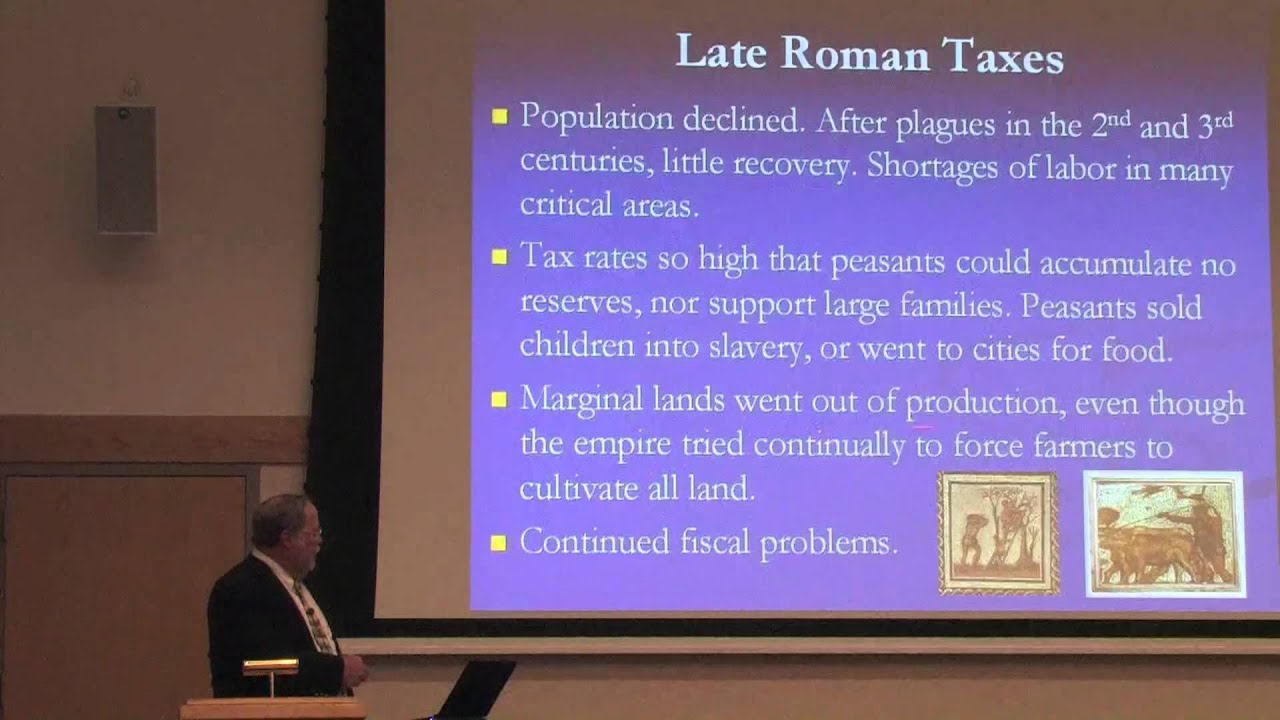
>> Yeah. And that's just not true when you look at historically collapse often can be a good thing for a lot of people. Um even today in the case of Somalia Somalia falls apart in 199191 when the B regime begins to crumble and 10 years later it actually looks better on almost every quality of indicator quality of life indicator. So maternal mortality is reduced by 30% infant mortality by 24% extreme poverty by 20%. And that's not just because the entire region is getting better. Even the countries surrounding Somalia don't basically progress as rapidly in their politically stable. They haven't undergone a state of failure. Um when you look at Rome for instance, after Rome, the fall of Rome, people get taller and they have less holes in their teeth and what appears to be kind of less damage to their bones, so stronger skeletons. That's all overall a really good picture of their biohysical health.
Naturally, the kind of rhetorical from most people is survivors bias. Uh it's because so many people died and so many people moved that people were left with more resources afterwards. That doesn't really check out in large part because when you look at people outside the Roman Empire, they were also taller. The idea of this kind of big muscle-bound barbarian German is kind of true in so far as they would have looked like that to the average Italian. And additionally, when Rome rises up, human high is actually increasing quite rapidly and it starts to stall once Rome becomes dominant in the area. So empires just often weren't good for people necessarily. And therefore, >> despite this entire narrative of golden ages and dark ages, their fall was often good for most people.
>> Great. Well, then that's that's exactly where we should end it, I think. Look, because that's a wonderful note and a hopeful note to end it on.
I'm what I'm hearing what I'm hearing you say is that the process of collapse can also be a reclamation.
>> Um, that's what I'm choosing to hear.
>> It can be I mean in the book I do say that collapse in the future could be in many ways a very grim bad thing. People are more dependent upon infrastructure.
We're vastly more interconnected and we have much much worse weapons at our disposal. Caveat collapse is not everyone killing each other. It's not Hobsian drama. That's [ __ ] >> It's very much small groups of young armed men trying to basically create a new power structure. That's true all the way from the very first states through to Iraq and Syria in the modern world.
Um, but while it could be worse, I think you're on to something here in so far as if collapse is about the fracture or contraction of power structures, then if you want a more decentralized, democratized world, you're going to have to do that. It's going to be much more controlled.
>> Yeah.
>> And I think that is actually going to lead to not just a safer world, but also a much more just, better one.
>> I completely agree with you. Thank you so much for your book and thank you so much for your time. This has been really really interesting and I don't think I've ever come away from a conversation about the the reality of erosion and whether or not that is also collapse feeling quite so good about it. Um exactly as you say something is going to have to be done and something probably will be done either way. either things will continue to centralize until they fracture or we do something here the next 5 years, 10 years, 20 years, whatever it is to try and break apart break apart those power structures before they do. Um it's quite rare I think when discussing these things to be left with a sense of empowerment. So I thank you for that.
>> My pleasure.
>> My final question for you is who would you like to platform?
Oh, that's a good question. Have you spoken to Audrey Tang at all?
>> I haven't.
>> Okay. Audrey would be fantastic to speak to. So, she was the first digital minister of Taiwan and is now their cyber ambassador and is doing some of the most cutting edge work on how you do democracy at scale. And >> Audrey is incredibly well spoken, incredibly knowledgeable. I highly recommend her. Um, if I mean James C. Scott isn't still alive, but he was kind of the intellectual inspiration for a lot of my work. So, I guess you can do something to cover some of his work. That would be cool as well.
Um, >> but yeah, in terms of living beings, I think or Drew be my key key suggestion.
>> Wonderful. Look, thank you so much, >> Rachel. Thank you.
>> If you want to learn more, I've put links to everything in the description box below. Remember to subscribe to the channel if you're new here and share the episode if you enjoyed it. To support the show, subscribe at planetcritical.com where you can read the weekly newsletter. You can also become a Planet Critical patron. All links are in the description box below.
As always, my deepest thanks to that community. Planet Critical wouldn't exist without your support. Thank you everyone for listening and for coming on this journey together.
Up Next

8:27
Fordism Explained: Mass Production and Economic Strategy
@nudeanswers1448
25.2K views•2014-06-09

33:02
The Great Schism of 1054: Causes and Consequences
@SacredCathedrals
113.5K views•2026-02-19
91:57
The Geopolitics of the Ukraine War and the Rise of Global Autocracy
@JordanHarbingerShow
468K views•2025-04-19

17:05
Understanding the Cold War: Superpower Conflicts and the Road to Détente
@OverSimplified
46.1M views•2019-01-24
Related Study Plans & Knowledge Roadmaps
Structured learning paths in History
history
Byzantine Iconoclasm: Theology, Art & Politics
01Foundations of Byzantium and Early Christian Images
02The First Iconoclasm: Leo III and the Crisis of Images
03Empress Irene, Nicaea II, and the Second Iconoclasm
+ 2 more learning modules
9h5 modules
Explore Roadmap
history
Iranian Revolution (Causes, Events & Legacy)
01The Pahlavi Dynasty and the Roots of Discontent
02The Spark of Rebellion and the Rise of Khomeini
031979: The Fall of the Shah and the Climax of the Revolution
+ 2 more learning modules
8h5 modules
Explore Roadmap
history
Mali Empire: Mansa Musa, Trade & Timbuktu
01Foundations of the Mali Empire
02The Trans-Saharan Gold and Salt Trade
03The Reign and Pilgrimage of Mansa Musa
+ 1 more learning modules
6h4 modules
Explore Roadmap
history
1947 Partition: Politics, Borders & Legacies
01Foundations of British India and the Divide
02The Political Negotiations and the Mountbatten Plan
03Drawing the Boundary: The Radcliffe Line
+ 2 more learning modules
8h5 modules
Explore Roadmap