

















![unique factorization domain || if R is U.F.D then R[x] also a U.F.D](https://i.ytimg.com/vi/6v2GEV9vOvA/maxresdefault.jpg)



A ring is a set equipped with two binary operations, addition and multiplication, where addition forms an abelian group with identity zero, multiplication is associative and closed, and the distributive laws hold; rings may or may not have a multiplicative identity (called a 'rng' when they don't), and multiplication is not necessarily commutative (commutative rings are those where multiplication does commute). Examples include the integers, modular integers, polynomial rings, square matrices (non-commutative), quaternions, and fields like the rationals, reals, and complex numbers. A field is a special type of commutative ring where every non-zero element has a multiplicative inverse. The direct product of rings combines two rings into a new ring, though the direct product of two fields is not itself a field.
Definition of Ring | Ring Theory Basics
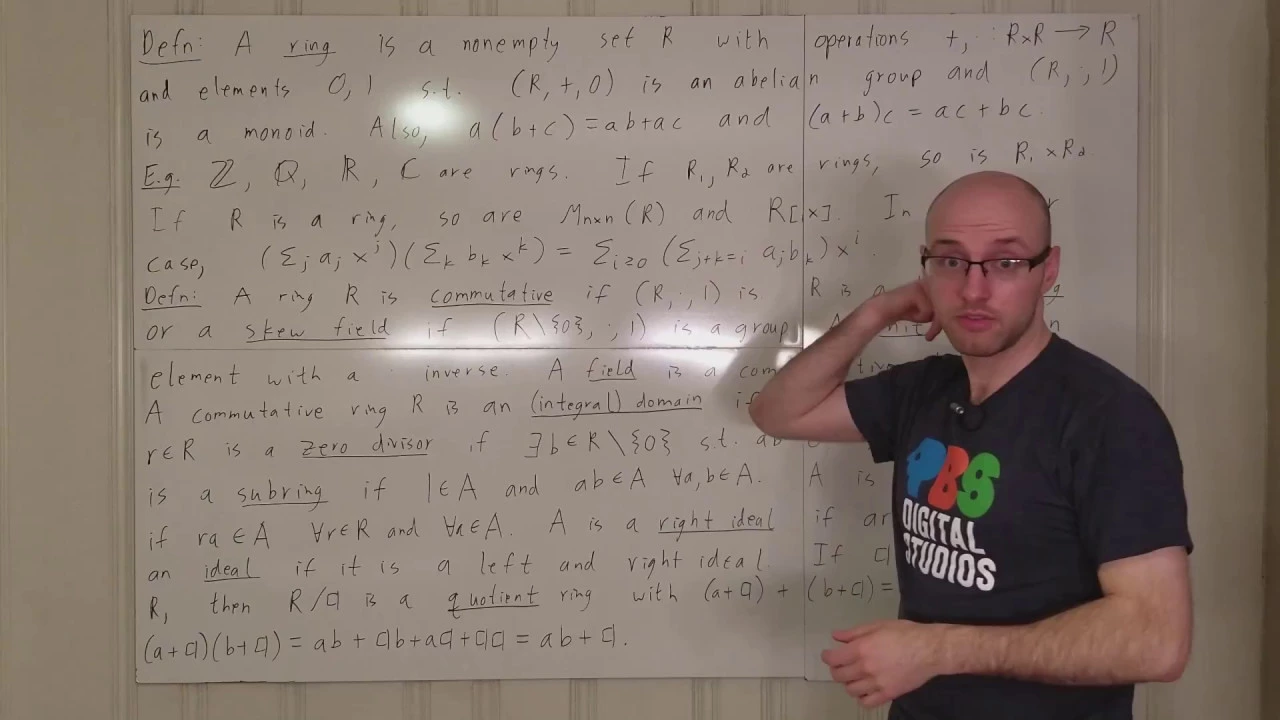
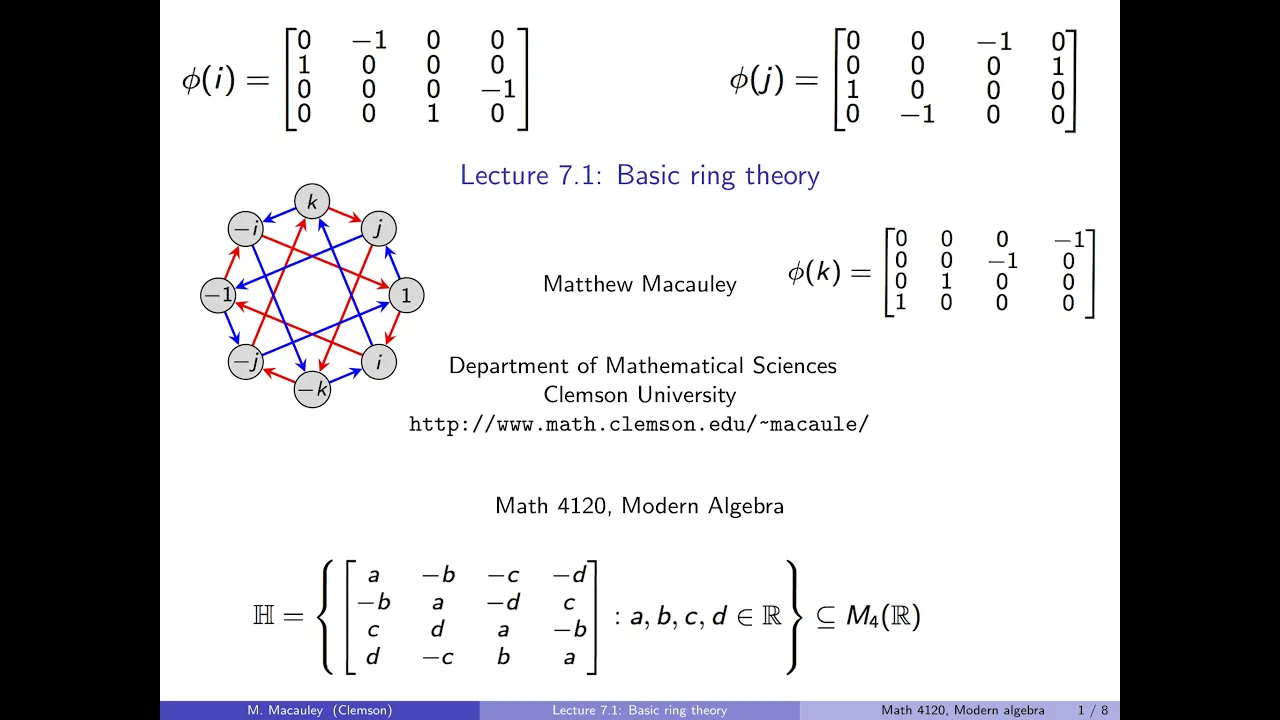
Added:if you've made it through group Theory we continue with ring Theory here ultimate goal is to lay down foundations for number Theory and gwa Theory we'll see other interesting results along the way now as with group Theory okay rings are going to come in many shapes and sizes so we're going to want a nice state of examples to match our intuition to the theory for this part we'll just give definitions and these examples now when I think about rings for the first time okay everything is going to be pretty much based off of what we can do with the integers so for instance when we talked about groups okay we talked about set with a single operation but we know many groups which have two operations okay integers being our primary case so a ring is going to be a set with two operations an addition and a multiplication it'll have the following properties under addition okay a ring is going to be an AB bilon group okay we'll call the identity zero under multiplication okay we don't insist on the full group properties I'll just want that our ring is closed under multiplication then to make sense of the addition and multiplication at the same time we have the distributive law okay so this should be familiar now for us we're going to insist on two of the other group operations for multiplication we'll want that our rings are associative under multiplication okay so that just means when we multiply I can remove the parentheses and we'll want a multiplicative identity okay usually so this is going to be an element one not equal to zero such as 1 * x = x * 1 is equal to X for all X in the ring now sometimes we don't have a one in our ring and then we just call it an RNG so we take the I out of ring we need not insist on our multiplication being commutative so the addition is always commutative not necessarily the multiplication if multiplication is commutative then we'll just call R a commutative ring so here we talk about commutative we're talking about the multiplication basic examples okay so like I said before the first ring we encounter is the integers okay so the integers all of our definitions up to here are based on the integers then integers sit inside the rational numbers sit inside the real numbers sit inside the complex numbers so so far these are all all commutative rings from the integers we can also pass to modular integers so there we have addition as usual Clockwork addition then we have multiplication which also works so we have a Clockwork multiplication just by adding or subtracting multiples of n now for these commutative Rings okay what we can do okay the operation of adjoining I could pass from our ring to our ring adjoint X so what it means to a joint X okay this is just going to be forming the set of pols okay in the variable x with coefficients in our ring okay we say that as over the ring so you'll knowe if we have pols okay there's going to be some highest degree If I multiply two pols together I get another polom so this set's going to be closed under our usual multiplication of pols if we add two pols together we get another polom they can just start working through our list we can adjoin objects other than a variable X for instance if I take the integers I can jooin square Ro of two it's not in the integers this is going to be the pols in square two with coefficients in the integers to describe all of these elements okay well if I have a polinomial and square of two okay with a constant term I have a square two term if we take Square two and square it we get back two which is an integer so we're going to wind up back here so I only need two integers to describe every element here for the cube root of two we'll only need three integers to describe all of these elements and so on now an example we'll come back to later okay we have the gaussian integers so we're going to take the integers and we're going to join I so this is a subset of the complex numbers we have i s equal to minus one now these three examples okay something special about these which we'll note consider the example Z adjoin Pi so this is going to be the pols in pi coefficients in the integers we won't have a description of these that's as simple as these three examples okay the idea is pi is a transcendental number so that means Pi is never going to be a root of a polinomial with coefficients in the integers so we're not going to be able to have a description like of these three in fact if we adjoin Pi okay this is almost the same as just adjoining X and we'll make that precise later on now okay to contrast with transcendental I would call square of two cube of two algebraic numbers so that means these numbers going to be roots of some polinomial over the integers okay so 2 is a root of x^2 - 2 cube of 2 is a root of x cubus 2 now we've only considered so far commutative Rings how about some non-commutative rings so here we want the multiplication to be non-commutative first example from linear algebra okay so we'll use a commu of ring R just to keep things simple I could take the N byn matrices with entries in R so if you've taken linear algebra you've seen M subn of the real numbers and you may have seen M subn of the complex numbers if we have n equal to 2 okay so we're just looking at 2 by two matrices our addition is going to be coordinate wise okay as so for the multiplication somewhat more complicated it's going to be row column multiplication and that's something that you can look up now things to note for the additive identity we just have the Matrix full of zeros for the multiplicative identity okay we're going to have ones on the diagonal Zer off and we could also check pretty easily that this multiplication is not commutative so we have a non-commutative ring here for another example let's consider the querian ring now recall how the querian group works we have eight elements plus - 1 plus - A Plus - J plus - k for the multiplication we have the following rules for the letters so if I have i^2 j^2 k^2 they're all equal to minus1 If I multiply I * J that's equal to K is equal to minus J * I and so on so the way we summarize this we put our letters in a circle going counterclockwise if we multiply any two going counterclockwise we get the third if we multiply going clockwise we get the third but with a minus sign now for the querian ring okay we call these the hamiltonians so that's why we have an H it's going to be a vector space over the reals of Dimension four okay we have a basis 1 i j and k okay the addition is Pretty Natural for the multiplication we use the rules given from the group now addtive identity zero multiplicative identity is one and by definition quarians are not going to be commutative so I * J is not equal to J * I it's equal to minus J * I we could check all the properties for a ring okay the only thing we lose in our list it's going to be the commutativity now an interesting thing about querian is that they fit into a bigger picture so there's a bit of Machinery that lets us go from the reals to the complex numbers from the complex numbers to the quarians then from the quarians to what we call the octonian or Cali numbers okay these are going to be a vector space over the reals of Dimension 8 with this process as we move from left to right we start losing things so as I go from the reals to the complex numbers we lose the total ordering less than or equals as we go from the complexes to the quarians we lose commutativity as we go from the quarians to the KY numbers we lose associativity and so on now there's still one last group property we have't addressed okay the notion of inverse so let's take a look at that now recall okay if I have an element X inverse call that the inverse of x if we have x * X inverse equal to X inverse x equal to 1 and this case Okay in our Rings we'll call x a multiplicative unit now when we can find inverses under multiplication for all elements except zero we have a special ring that we call field so say f is called a field if f is a commu ring every non-zero element X has a multiplicative inverse now the prototype for a field is not going to be the integers instead we use the rational numbers also note the real numbers satisfy these properties complex numbers satisfy these properties we'll have a few others later we'll see Alpha is algebraic then if I take the rationals and AD joint Alpha that's a field for instance if we take Q ad joint squ two okay we take a generic element so a plus b s 2 I take the inverse so I can write that as 1 over a plus b 2 how do I get the square of two out of the denominator well we just use rationalization so I multiply top and bottom by a minus b^ s two now in the denominator we'll have an a^ squ minus 2 b^2 we have to worry about that being equal to zero but that'll never be equal to zero because we have square of two not a rational number so you'll note this inverse is in Q adjoint square of two since A2 minus 2 b^2 is a rational number how about something like Q jooin the cube root of two well this trick isn't going to be so useful here so instead what I would do is is we just use the formal definition of inverse so we're looking for a y such that x * Y is equal to 1 so if I took a plus b cuun of 2 plus C cubk of 2^ 2ar if I want the inverse of that I don't put it under a one instead I just take another element in Q adjoin cubot of two and try to solve for a prime B Prime and C Prime when we multiply and get a one so that I'll leave to you as an exercise to contrast let's take Q adjoin Pi this is not a field so the idea here let's consider the element x equal to Pi itself if we assume that X inverse is in here well that would mean I could write X inverse as some polom of Pi if this element existed then well we multiply that by pi we get a one so rearranging terms that means that Pi is going to be a root of okay some polom x * FX minus one now this is a polom over the rationals but just as easily make it a polinomial over the integers by clearing out all the denominators so if I could do this this would show that Pi is algebraic that's a contradiction now another example slightly different if we pick P Prime integer then we can consider the modular integer Zod P now to make this work we invoke bazo's identity so this is for the integers so if I have two integers M and N whose greatest common denominator is equal to one I can always find integers J and K such that J * n plus K * n is equal to 1 now if I let N be equal to P in my statement if we pick an X that's non zero so that'll represent the M greatest common denominator of X and P is equal to one so when we pass to Zod P I'll have that J * X is equal to 1 that means I found the inverse for x and that's going to be the J note here this doesn't give us much help in actually finding J so for now we just go to special cases for instance if I'm in Zod 5 okay we have 2 * 3 is equal to 6 which is equal to 1 so 2 is inverse to three 3 is inverse to two we take 4 * 4 we get 16 that goes to one also so four self inverse one more field related item let's consider the querian ring here every non zero element has a multiplicative inverse now because the querian are not commutative okay we call it instead a division ring if we have Alpha non zero given as follows formula for the inverse is given here I'll leave it to you to check that Alpha time Alpha inverse is equal to one final construction let's consider direct product of rings so we assume we have two rings R and S for the set we'll take all order pairs okay we have R in the first slot s in the second we have a natural addition and multiplication okay we do both coordinate for the multiplicative identity we have 1 one for the additive identity we have 0 0 now if we use this construction here the direct product of two Fields will not be a field so to see this let's just consider the element one Zer okay that's not equal to zero we'll show that it doesn't have an inverse now if I go fishing for an inverse say R comma s okay I multiply 1 Z by that we set it equal to 1 one the multiplicative identity when we solve we see from the second coordinate we get 0 equal to 1 by assumption that's not true so I can never solve this equation to get our inverse so not a field now one use we have for direct product okay if I have G of finite aent group fundamental theorem of finite abing group says we can write G as a direct product of cyclic groups now now with the direct product I can now put a multiplication on our finite billion group so every finite billion group can be made into a commutative ring
Up Next

Addition, Multiplication, and Division in Galois Fields GF(2^m)
@BillBuchanan
33K views•2021-01-04

Elliptic Curve Cryptography Explained: ECC, ECDSA, ECDH
@PracticalNetworking
28.5K views•2024-10-21
Fourier Series Introduction: The Big Idea Explained
@DrTrefor
387K views•2021-05-03

The Mathematical Impossibility of Accurate World Maps
@Vox
23.3M views•2016-12-02
Related Study Plans & Knowledge Roadmaps
Structured learning paths in Mathematics