
















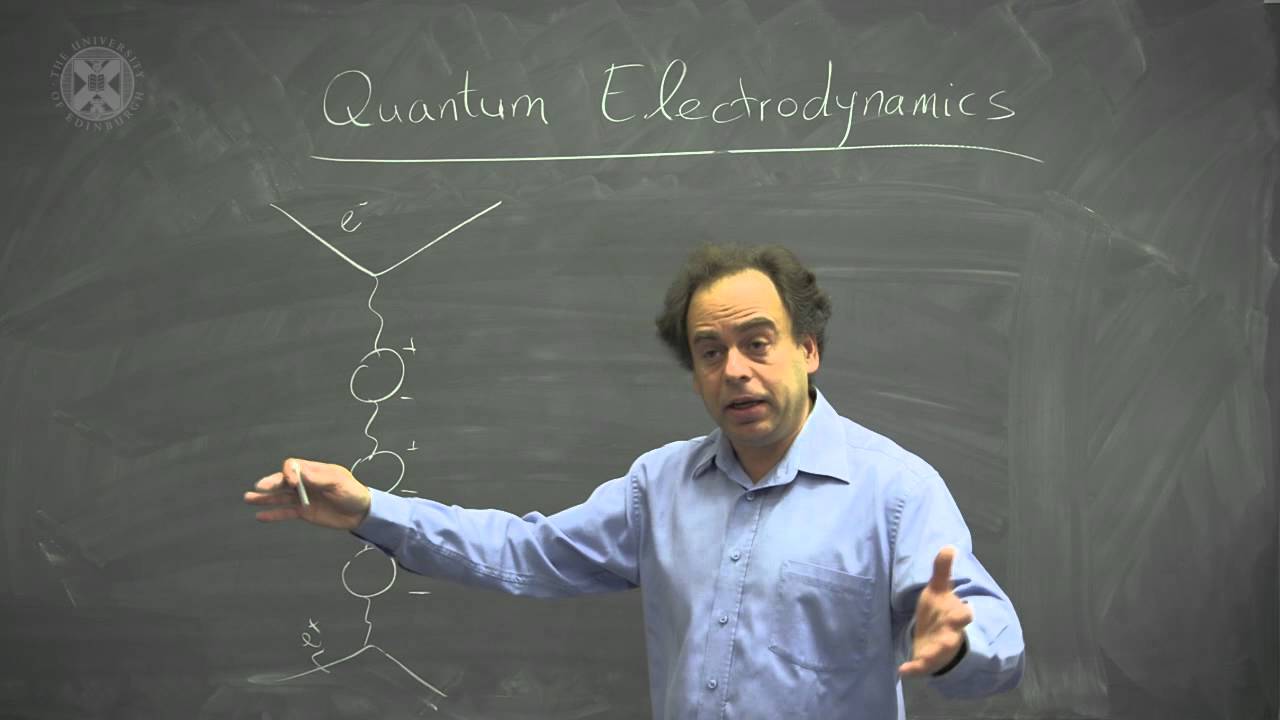
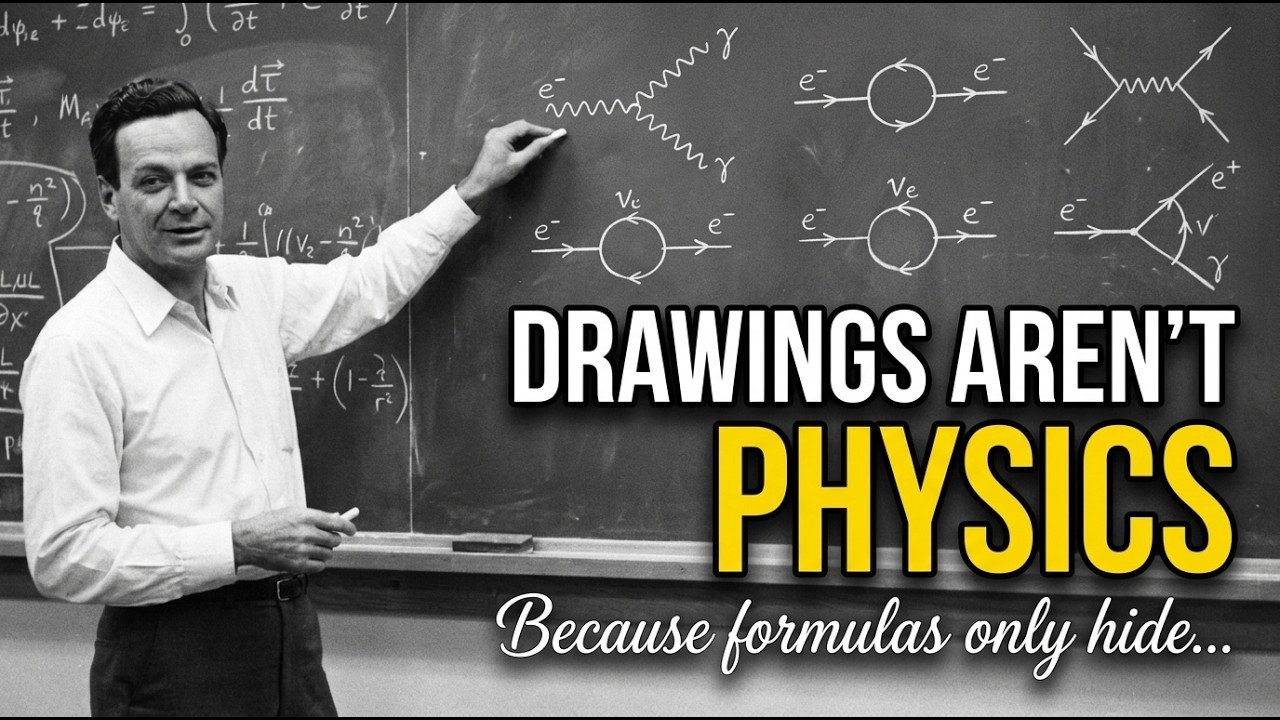



Feynman diagrams are visual tools that represent particle interactions, where straight lines with arrows represent fermions (matter particles like electrons and quarks) and wavy/dashed lines represent bosons (force carriers like photons, gluons, W/Z bosons, and the Higgs); arrows point forward in time for matter particles and backward for antimatter particles, while conservation rules ensure valid diagrams must maintain equal numbers of particles entering and exiting, with appropriate charge and spin conservation at each interaction vertex.
Reading Feynman Diagrams: A Beginner's Guide to Particle Physics
Added:Basic understanding of the Standard Model of particle physics, including the division of particles into fermions (quarks and leptons) and bosons (gauge bosons).
Familiarity with the fundamental forces of nature (electromagnetic, weak, and strong) and the concept of force carrier particles.
An introductory concept of antimatter, specifically how antiparticles possess the same mass but opposite electric charges compared to their matter counterparts.
Familiarity with basic conservation laws in physics, such as the conservation of energy, momentum, and electric charge.
Application of Feynman Rules, which define how to translate the visual lines and vertices of a diagram into precise mathematical integrals.
An in-depth study of Quantum Electrodynamics (QED) and Quantum Chromodynamics (QCD) to model electromagnetic and strong interactions.
Understanding higher-order interactions, including loop diagrams, virtual particles, and the concept of renormalization to handle mathematical infinities.
Analysing experimental particle physics data, such as scattering cross-sections and decay rates measured at particle accelerators like the Large Hadron Collider (LHC).
245.9K views9.6Klikes9:18Original Release: 2021-03-19
Hi how you doing? I’m going to teach you how to make sense of Feynman diagrams, know what all the squiggly lines mean, and work out if they are representing a valid particle interaction or if they are defying the laws of physics. Ugh. A Feynman diagram is a picture of what happens when particles interact with each other. Particles go in one end, come out the other, and some stuff happens in the middle. And to make sense of Feynman diagrams you need to know three things. What all the lines and arrows mean. What all the particles in the standard model are as well as their special properties like charge and spin. What the overall rules are. These are called conservation rules, but you could call them in-out rules, as in, you can’t get out a different amount out than what you put in. Here’s a Feynman diagram. The lines represent different particles which are travelling through space and time which are represented by these axes. Note that with one dimension of space we are losing some spatial information here so these really are schematics of what a particle interaction looks like rather than an accurate depiction of our four dimensional reality. Here’s an example with a little animation to go with it. Two electrons move towards each other, exchange a photon, and move away from each other again, and that’s what this looks like as a Feynman diagram. In this video I’m drawing time going upwards, but some people draw it going sideways, which is quite annoying. So, the first thing when you look at a Feynman diagram is to check which way time is going, hopefully they tell you and if they don’t they are bad people. Drawing time going upwards is the most common way so that’s what I’m doing here. Okay that’s the basics, now let’s go onto part one of the three things we need to know. What are the squiggly lines. These are the four kinds of lines, each corresponding to a kind of particle. And I can only explain this if I show you all the particles, so here they are. These are the fundamental particles of the Universe that everything is made of (as far as we know so far). But why are they organised like this instead of being organised like this? Ugh. It’s because some particles share similar properties so we can group them together. Kind of like my cheese collection. The straight lines represent the fermions which are these particles. These other particles are all called bosons. Now the difference between fermions and bosons at a basic level is the fermions make up the stuff in the universe and the bosons are how the stuff interacts with each other and they are called force carriers. In fact, everything we experience is made of just these three fermions: the up and down quarks which make protons and neutrons, and when you add electrons to protons and neutrons you get atoms, that we’re made of and everything is made of and you’re made of. The bosons, the force carries, are all the other lines. We use a squiggly line for the photon, which is the force carrier for the electromagnetic field, The spiral lines are for gluons which carry the strong force that keeps the nucleus of atoms together and interacts only with these specific fermions which are called the quarks. Now onto the weak force. The mediators of the weak force are the W and Z bosons and are represented with a dashed line. All particles interact with the weak force apart from the gluons. If this is all a bit much to take in don’t worry I’ve made a companion poster which you can study in your own time the link in below. Finally there is the Higgs boson which we also use a dashed line for. And those are all the lines. What about gravity the fourth fundamental force?. Haha, we don’t have gravity here. This is particle physics! You’re supposed to ask about the arrows. But what about the arrows? Thanks for asking! These only appear on the solid lines of the fermions, and they point forwards in time for matter particles and backwards in time for anti-matter particles. Because weirdly, in particle physics, an antimatter particle is exactly the same as a matter particle that’s travelling backwards in time. But where on my little picture are the antimatter particles? Oh yeah, nobody ever bothers to draw them on the standard model, so I’ve done it here, here they all are. There are antimatter copies of all these particles, which have the same mass as the matter versions, but opposite everything else. And while we’re actually drawing actually all the particles I may as well draw the different colour charges of the quarks and the eight kinds of gluons. These colours aren’t real by the way just our labelling system for keeping track of the rules of the strong force. So this is actually all of the fundamental particles. Goodness, there are a lot of rules aren’t there? I’m sorry it’s all so complicated, but that’s just life isn’t it? So now we’ve covered part one and part two: what the squiggly lines mean and what all the particles are. This is enough to be able to read Feynman diagrams and make sense of what is going on. So let’s apply this knowledge with some examples. Here’s one we met earlier showing two electrons interacting with a photon and is an example of an interaction via the electromagnetic force. Here are a couple more but these are interactions involving the weak force and here’s a couple involving the strong force. You’ll notice that these are all a similar shape, and I did that on purpose because I want to talk about vertices. If you chop these in half you get a vertex, which is basically a meeting point between three particles, and you can think of these vertices as the building blocks of Feynman diagrams. You can build most feynman diagrams out of this basis set of vertices, which I’m not going to describe in detail now, but pause the video now if you want to study them more. What is interesting about these is that they mean different things depending on how they are oriented in space and time. For example, this is an electron that has a change of momentum when it emits a photon. But if I rotate it this electron becomes a positron, remember that rule about matter travelling backwards in time is just antimatter travelling forwards in time. And then this shows a positron and an electron coming together to annihilate into a photon. So different orientations can mean very different things. So with this basis set of vertices put in different orientations, you’ve got pretty much all you need to build any feynman diagram. Let’s look at some more complicated examples. Here are the electrons interacting again, but in the middle the photon spontaneously turns into an electron positron pair, before annihilating and turning into a photon again. See if you can work out what’s going on here? This is a neutron, which is made of three quarks: up, down, down. It decays into a proton via the weak force. A proton is made of up, down, up quarks. The w boson that is emitted then decays into an electron and an anti-electron neutrino. So this is how neutrons can turn into protons via the weak force and is known in nuclear physics as a beta decay emission. This last one I’m going to leave to you to disentangle. See if you can work out what is going on here and specifically can you answer which force is mediating this interaction? Let me know in the comments below what you think.. Now you know how to read Feynman diagrams, congratulations! But, we don’t yet know how to analyse them to see if they are valid or not. For that we need to learn the underlying rules the particles follow called the conservation rules of particle physics, but to avoid information overload I’m going to cover that in my next video, so stay tuned for that. I recently watched a great documentary on quantum physics on Magellan TV who are sponsoring this part of the video. If you are outside the UK you might not know Jim Al Khalili as he’s mostly on british TV, but he’s a fantastic science communicator and big inspiration to me when I started this channel. And this is a brilliant summary of the origins of quantum physics. If you wanna watch it you can get it on a free trial of Magellan TV, a new streaming service founded by filmmakers, which has over three thousand documentaries covering science, technology, health, physics and many other fascinating subjects. It has over three thousand documentaries so far and new shows are being added on a weekly basis with a growing selection of shows available in 4K. So if you want to check it out you can get a one month free trial to see what you think at this link which you can click on in the description below, and this also helps me and my channel out because they know you’ve come from here. Thanks for watching and I’ll see you soon to delve deeper into this poster of the standard model where we’ll lear the third part of feynman diagrams where we understand the underlying rules that the fundamental particles follow. See you then.
Up Next

16:43
The Standard Model Lagrangian: The Equation Explaining Particle Physics
@pbsspacetime
1.5M views•2022-10-19

12:53
21cm Hyperfine Transition in Neutral Hydrogen: Radio Astronomy Basics
@AaronRobertParsons
12.4K views•2011-10-13

27:08
Black Holes Explained: Structure, Detection, and Mysteries
@domainofscience
597.5K views•2021-08-22

27:14
Entropy and the Second Law of Thermodynamics Explained
@veritasium
27.5M views•2023-07-01
Related Study Plans & Knowledge Roadmaps
Structured learning paths in Physics
physics
Nuclear Physics (Decay, Fission & Reactors)
01Atomic Structure and the Binding Force
02Radioactive Decay and Half-Life
03Nuclear Fission Mechanics and Chain Reactions
+ 2 more learning modules
12h5 modules
Explore Roadmap
physics
Soft Matter (Polymers, Colloids & Rheology)
01Foundations of Soft Matter & Thermal Forces
02Polymer Physics and Macromolecules
03Colloids, Surfactants, and Self-Assembly
+ 2 more learning modules
38h5 modules
Explore Roadmap
physics
Analytical Mechanics: Lagrangian & Hamiltonian
01Mathematical Foundations: Calculus of Variations
02From Newtonian Mechanics to Constraint Dynamics
03The Principle of Least Action & Lagrangian Mechanics
+ 3 more learning modules
28h6 modules
Explore Roadmap
physics
General Relativity (Spacetime & Cosmology)
01Foundations of Relativity: Special Relativity
02The Geometry of Spacetime: Equivalence Principle & Curvature
03Einstein's Field Equations: The Mathematics of Gravity
+ 2 more learning modules
55h5 modules
Explore Roadmap