





![Economia Experimental (Aula 19, parte 1) [Metodologia da Economia]](https://i.ytimg.com/vi/UUSd57m3oPE/hqdefault.jpg)









![[COMSOC 54] Hadi Hosseini and Martin Bullinger](https://i.ytimg.com/vi/Lfe-70vF-7U/maxresdefault.jpg)

Dynamic matching mechanisms for college admissions, which provide continuous feedback and allow students to revise their choices iteratively, can achieve near-optimal stable and efficient outcomes when revision opportunities are frequent enough, and they demonstrate behavioral advantages over static mechanisms like the Boston and deferred acceptance mechanisms, particularly in complex environments with high preference correlation.
Dynamic Matching in College Admissions: Theory & Experiment
Added:The Gale-Shapley Deferred Acceptance (DA) algorithm and classic two-sided matching theory.
Fundamental concepts of market design, specifically stability, Pareto efficiency, and strategy-proofness.
Basic game theory principles, including Nash equilibrium and strategic manipulation of preferences.
An introduction to experimental economics, including how laboratory experiments are designed to test theoretical economic models.
Analysis of real-world dynamic matching systems, such as the Chinese college entrance examination (Gaokao) parallel recruitment system.
Advanced dynamic mechanism design, exploring how markets clear when agents and options arrive sequentially over time.
Behavioral game theory, focusing on cognitive biases, bounded rationality, and why participants misrepresent preferences in dynamic environments.
Algorithmic market design and the computational complexity challenges of scaling dynamic matching systems to large-scale populations.
216 views3likes21:54Original Release: 2020-11-26
thanks i'm very excited to share with you my work on a new dynamic college emission mechanism this is a joint project with being gong who is a professor at east china normal university as we all know that college admissions has significant impact on individuals educational labor outcome and their millions of students go through this each year and many countries use a centralized college admission mechanism based on standardized scores and china is one of them each year roughly 10 million high school seniors can people 6 million college seats and this is the largest margin market centralized marginal market we know by far and traditionally uh two mechanisms are widely used the first one is the boston mechanism also called immediate acceptance mechanism the problem with the bouncing mechanism is that students will losses their prior priority if they don't rank the score high enough and it is not efficient and it is efficient now stable and not strategy proof so in value 18 mechanism we usually use three measures one is whether it's efficient or not in this in the sense that uh whether by switching students at location if we can make at least one student better with without making all the other students worse off without making any other student worse off and stable a matching stable if there does not exist a student a school pair said such that they mutually prefer each other to their current allocation and finally a matching a mechanism is strategy proof if truth telling is a weekly dominant strategy despite the theoretical disadvantages the boss mechanism is widely used globally the second weather use mechanism is the deferred acceptance mechanism unlike the boss mechanism it has very good theoretical properties it is stable it is strategy proof it is also efficient when students have the same priority schools and as a result it has been recommended as a placement for the boston mechanism but the problem with the deferred acceptance mechanism is it is very complex in a way that its dominant strategy is not obvious and meaning that if a subject if an agent is cognitive and limited then she will not be able to figure out the dominant strategy and that we have evidence from the lab and also from the field that about one-third of students fail to play failed to play the dominant strategy and that leads to worth outcome in terms of stability and efficiency and the problem with the boss mechanism is also obvious because this is not strategy proof it requires students to acquire information and other preferences to best respond so enabled by information technology there has there's been several dynamic mechanisms emerged from the field so previously without helping of the computer the web there's no way we can do this but currently we can do this now one is the public school summit in wake county one is the college of nations in brazil and the third one is what we're going to focus in this paper uh is the college admission mechanism in the mongolia so uh what i mean by by dynamic mechanism is comparison the traditional static mechanism where students have made a complete regulation of their preference and then they get a result in a dynamic mechanism the system will provide feedback to students and then students can always revise their choices based on the temporary based on the temporary allocation feedback they receive and so the dynamic mechanism is considered to be superior by the practitioners and a few data shows that compared with the year 2007 where the truncated boston mechanism is used the retake of the college exam falls from 2023 to 7 and the acceptance rate increased from 91 to 99 but then are these dynamic mechanism really straightforward do they are they really superior more efficient and efficient compared with the static mechanism we don't know and with these questions in mind we investigate the dynamic mechanism in the mongolia okay so here's the overview of the results so theoretically i proved that the dynamic mechanism does not have a dominant strategy it is almost stable and almost efficient when the revision opportunities are frequent enough and experimentally i observe that the dynamic mechanism have behavior advantage in a complex environment and i will explain what complex me in my experimental design and i proposed two possible explanations to why it has behavior advantages the first one is each stage game under the dynamic mechanism has the obvious strategy obvious strategy proof is obviously strategy proof so it has obviously dominant strategy and the second explanation is the number of schools a student need to rank under the dynamic mechanism is only one in each stage game and that greatly reduces the strategy space whereas under dn boston if you're not the highest ranked student then you always need to consider more schools and how to rank them so here's some background knowledge about college admissions in china so students priorities are determined by their college entrance exam score and therefore they have the same priority across different colleges and college admissions are centralized at a province level and all the other provinces have adapted the parallel mechanism which is a version of truncated d.a inner mongolia is the only backhanded the only province that use the dynamic mechanism the story behind is that the person who is in charge of this allocation is a computer scientist and that he come up with this mechanism and he thinks he's super cool and he's very proud of it so and in the mongolia used to use the truncated boston and each year across approximately 190 000 students attend the college entrance exam and go through this process and this is where in the mongolia is located on the map let me show you an example of this a toy example of the online system so students enters online system at the same time in the system they will see each school their quota and the current applicants for each school as well as their scores which is their priority okay uh the student who scored 652 right now she is currently outranked in school c because lucy only has two seats and then knowing that um she she'd better switch to somewhere else and then if she decided to switch to school a and then she would temporarily have the seat have a c at school a she could also decide to switch to b where she has a higher priority and the students with score 631 is already and that student might not might want to revise because she's already and then if she moved to school a then all students would currently have a seat in their lunar school they're applying and if the system closes now this would be the final allocation outcome okay so we'll formally model this game we model this game uh using a possum process each player has its own personal arrival and then it's independence identical but independent from other players the reason we model it using a stochastic process is because compared with continuous time the history of the game under stochastic arrival is accountable so that makes it more trackable and compared with modeling edge in deterministic arrivals the stochastic process captures reality in real life for example there might be network failure or congestion congestions that prevent students from some mating choices so therefore students total number of chances to submit their choices may not be deterministic because of time i'm i'm not going to go into the detail of the modeling but um i define i'll go through the three main definitions that we'll use the first one is we define best school available for student i at time t this is the highest ranked school on player i's preference list which she could temporarily have a seat and then we define my out tip myopic best responding strategy a player is playing myopic best responding strategy if she always selects her best school available at each arrival and then we define a slightly different concept which is choose talent strategy a player is playing truth telling if at the rivals she make a revision she choose to go she choose the best school available so the difference between the truth telling strategy and my update best response is that for truth-telling strategy we don't track every arrivals we only look at the rivals when players make a revision so the reason we might we define it this way is to account for inattention um so because it is um practice in practice it's not feasible for anyone to keep track of information set at each arrival and then respond at each arrival so in a lab if we observe someone not acting at some time we simply cannot tell whether this person decide not to react for strategic reason or it is just simply due to not paying attention um and we have two main theoretical results the first one is when the rivals are frequent enough the stable and efficient outcome arises almost certainly this is very intuitive let me walk you through the intuition so think about the student who hides the highest priority she has a dominant strategy which is to select her most preferred school at her first arrival and just stay there and knowing that this is her dominant strategy the student who has who has the second highest priority would choose her most preferred school her best school available after the first student made her choice and for the third student she would wait for the first two students made their choice and then choose the best school available so as long as we have a sequence of sequence of arrivals at the same order of the rankings of players then we'll reach the stable inflation outcome under this game and so um this implies that uh we would expect the dynamic mechanism for force worse than the a but better than boston terms of t and in terms of efficiency because both the and boston are efficient in this environment we would expect the dynamic mechanism perform worse and our second main theoretical result is that there doesn't there isn't a dominant strategy under the dynamic mechanism it is also very intuitive um if the high high ranked players let's think uh suppose that high ranked players play a random strategy and then the lower ranked players basically have no best response so the lower ranked player will try to wait till the end to to choose a school but then they also don't know how many rivals they they will have and then because d.a is strategy proof we expect to see higher proportions of truth-telling under da than both dynamic and boston so in practice because there are large number of students the province also divides students into different school groups and ascend different ending time to them a higher score group would exit the system first earlier the ending time of a higher score group is always earlier than the ending time of a lower score group and then we briefly discussed the implication of dividing students into different score groups so um dividing them into different score group and assign a different ending time is theoretically equivalent having several sequential markets suppose in this case we have three different score groups this is equivalent as having three sequential market in the first market we have students group one and all college seats and in the second market we have students in group two and the remaining college seats left from the market one and then in the third market we have the student group three and then the remaining college c left from the previous to market and in each sub-market what we just proved still hold and then if each sub-market reaches the stable and efficient outcome then the overall market also reached the stable inflation outcome because a student in a lower market can never have justified envy against students in the previous market so these theoretical predictions may not necessarily hold in practice and because field experimentation is not possible we conduct a lab experiment to see to what expand extent these theoretical predictions would hold we have environment of four schools and four students with two different preference correlations one we call the high correlation environment the other we call the low correlation environment so we have incomplete information setting this is to resemble the real chinese college admission environment students know their own preference they don't know others preference but they know the composition of the group and subject the random rematch at the beginning of each period their ranking rotate every five periods and we use the between subject design across different treatments so let me talk about why do we have different uh environments we vary the level level preference correlation so that we can vary the complexity of reaching a basic nash equilibrium and then we measure complexity using a measure we define here which is called minimum strategy which is the minimum number of colleges the students need to report in order to best respond when we assume when assuming rationality okay under dia and boston we will require students to report a complete preference list this is suppose we don't require them to report complete preference list how many schools they need to rank so the highlighted column shows the minimum strategy under each environment each mechanism we can see that for each mechanism the low correlation environment always requires less molecule than the high correlation environment meaning that the low correlation environment is more complex and we want to see how different mechanisms respond to this complexity and this is our payoff table and we completed five independent sessions uh under each mechanism each environment except for in the mongolia dynamic mechanism the low correlation environment we completed six sessions so in terms of experimental result we first look at individual behavior um the truth telling so the dynamic mechanism is as uh has the same proportion of truth telling compared with the da in a high correlation environment it outperformed the dna in a low-carbohydrate environment so our hypothesis is rejected because a dynamic mechanism performed better than theoretical prediction the second result is about decision timing one concern we have about the dynamic mechanism is whether their snapping behavior and that would cause um congestion and unstable at the end of the game so surprisingly we have a very little snapping behavior in our experiment only about six percent of last revisions happen in the last two seconds and then point six percent of last revisions are sub optimal because there's no time to best respond so sniping uh sniping exists in our experiment but it's not the main contribution to instability and inefficiency and we look at aggregate performance the third result is about stability we measure stability using the proportion of just that and the the higher the proportion of justified envy the lower stability the both da and dynamic perform relatively well in terms of stability but the da still performs slightly better than the dynamic in a high correlation environment and there's no difference between the two in a low correlation environment and we also observe a strong learning effect for the dynamic mechanism in a low correlation environment and then our last result is about efficiency where we predicted that the dynamic mechanism would perform the worst in terms of efficiency it is the case in a high correlation environment in a low correlation environment the dynamic is as efficient as a boston mechanism which outperforms the theoretical prediction we track down what is the course of what is the reason low efficiency we found it's because they're students not allocated under the dynamic mechanism and why are they not allocated our experimental data shows that students are now revising enough when they're still time left and we attribute that to inattention and a random matching between the unallocated student and unfilled seat would increase the efficiency of the dynamic mechanism to the same level sda and so here is a very brief summary of the result so we saw that in a low complexity environment the dynamic mechanism performed exactly as what theory predicted and in a high complexity complexity environment the dynamic mechanism performed better than their theoretical prediction it is as stable as da and it can also be as efficient as dna with random rematching in the end and it has higher truth telling than both of them and so sorry just you're at the one minute mark yeah so uh this is uh my last slide and so we observed that the dynamic mechanism has behavior advantages in the high complexity environment and we propose uh two potential explanations for this and we also have clear policy implant implications so the dynamic mechanism can be a good substitute for dna in complex environment and if we're going to use the dynamic mechanism then we'd better have some practice runs because we saw there's learning effect and we can also use a random matching in the end to remedy as a remedy for the low efficiency yeah uh i saw there are a question in the chat i can either take them now or after dorothea finish the discussion and then take these questions well i think what we'll do is we'll have dorothea do the discussion i thank you for a very good talk by the way i'll have georgette uh to go through her discussion uh when that's done we'll take uh first questions for yunji's talk and then if people want us to after we can open up and have some discussion and questions about all three of the talks but first the discussion please okay
Up Next
20:53
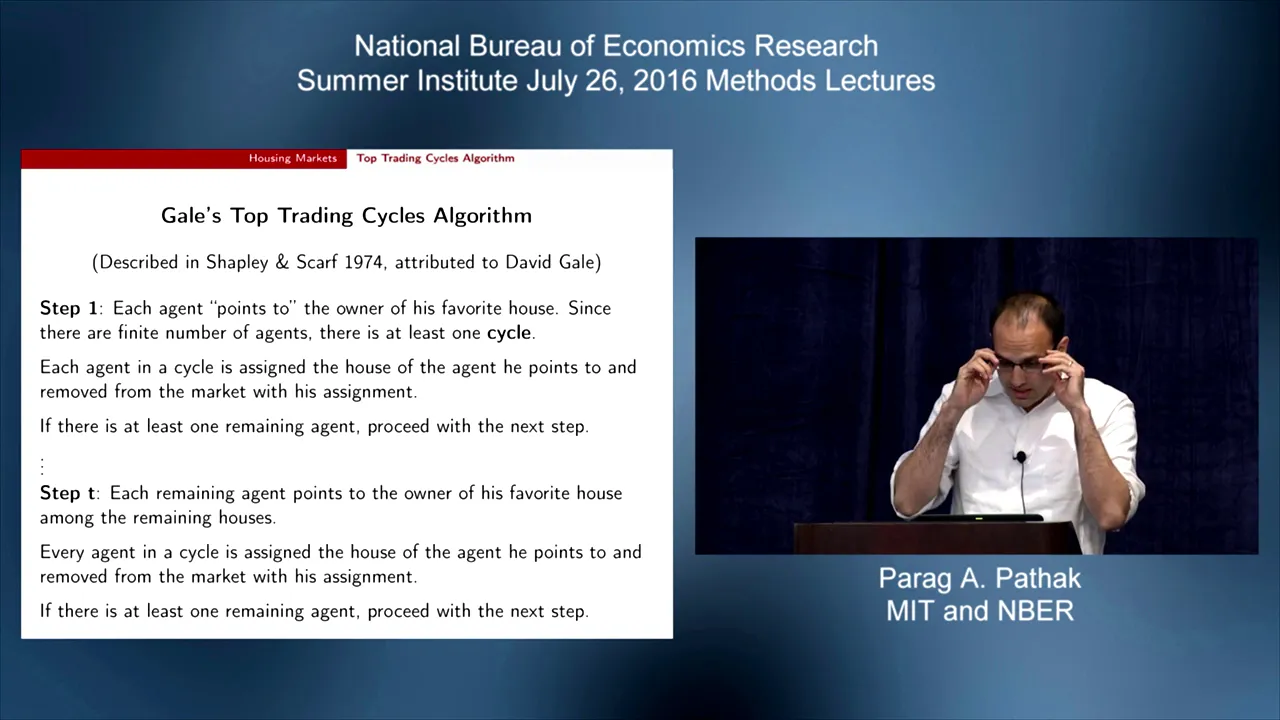
Matching Market Design: A Theoretical Overview | Parag Pathak
@NBERvideos
1.1K views•2020-05-22

5:07
Impact of Yuan in Indo-Russian Trade Amid Sanctions
@WION
261.9K views•2022-07-01
10:33
Behavioral Economics Explained: Rationality, Nudges, and Risk
@crashcourse
1.1M views•2016-03-12

113:18
The Age of Easy Money: Fed & Inflation | Full Documentary
@frontline
21.2M views•2023-03-15
Related Study Plans & Knowledge Roadmaps
Structured learning paths in Economics
economics
Sovereign Debt: Defaults, IMF & Restructuring
01Introduction to Sovereign Debt & Government Bonds
02Debt Sustainability & Credit Ratings
03Anatomy and History of Debt Crises
+ 2 more learning modules
12h5 modules
Explore Roadmap
economics
Market Design: Matching Theory & Gale-Shapley
01Introduction to Market Design and Price-Free Markets
02Two-Sided Matching & The Gale-Shapley Algorithm
03School Choice Systems and Mechanism Design
+ 2 more learning modules
10h5 modules
Explore Roadmap
economics
Impossible Trinity: Forex, Capital & Policy
01Introduction to Monetary Policy and Central Banking
02Exchange Rates and International Capital Flows
03The Mundell-Fleming Model
+ 2 more learning modules
8h5 modules
Explore Roadmap
economics
Healthcare Economics: Market Failures & Systems
01Introduction to Healthcare Markets and Market Failure
02Asymmetric Information and Adverse Selection
03Moral Hazard and Insurance Design
+ 2 more learning modules
12h5 modules
Explore Roadmap