















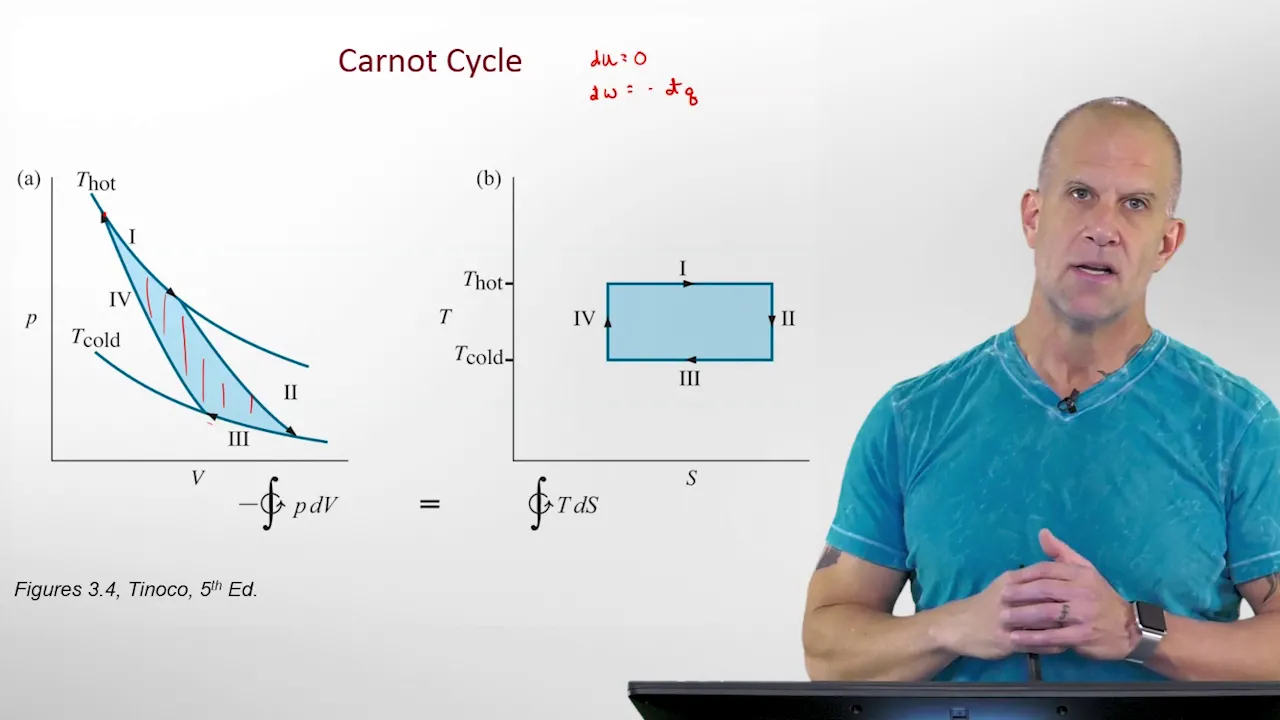












The Carnot cycle, a theoretical thermodynamic process consisting of two isothermal and two adiabatic processes, represents the most efficient heat engine possible. The maximum efficiency of any heat engine is given by η = 1 - (T_cold/T_hot), where T_cold and T_hot are the absolute temperatures of the cold and hot reservoirs. This efficiency depends only on the temperature difference between the reservoirs, not on the working substance or engine design.
Carnot Cycle Efficiency: Deriving Max Heat Engine Performance
Added:The First Law of Thermodynamics, including the concepts of work, heat, and internal energy changes.
The Ideal Gas Law (PV = nRT) and the relationships between pressure, volume, and temperature.
The characteristics of isothermal (constant temperature) and adiabatic (no heat exchange) thermodynamic processes.
The basic definition of thermal efficiency as the ratio of net work produced to the heat energy absorbed.
Basic integral calculus, specifically for calculating work done during gas expansion and compression using integral of P dV.
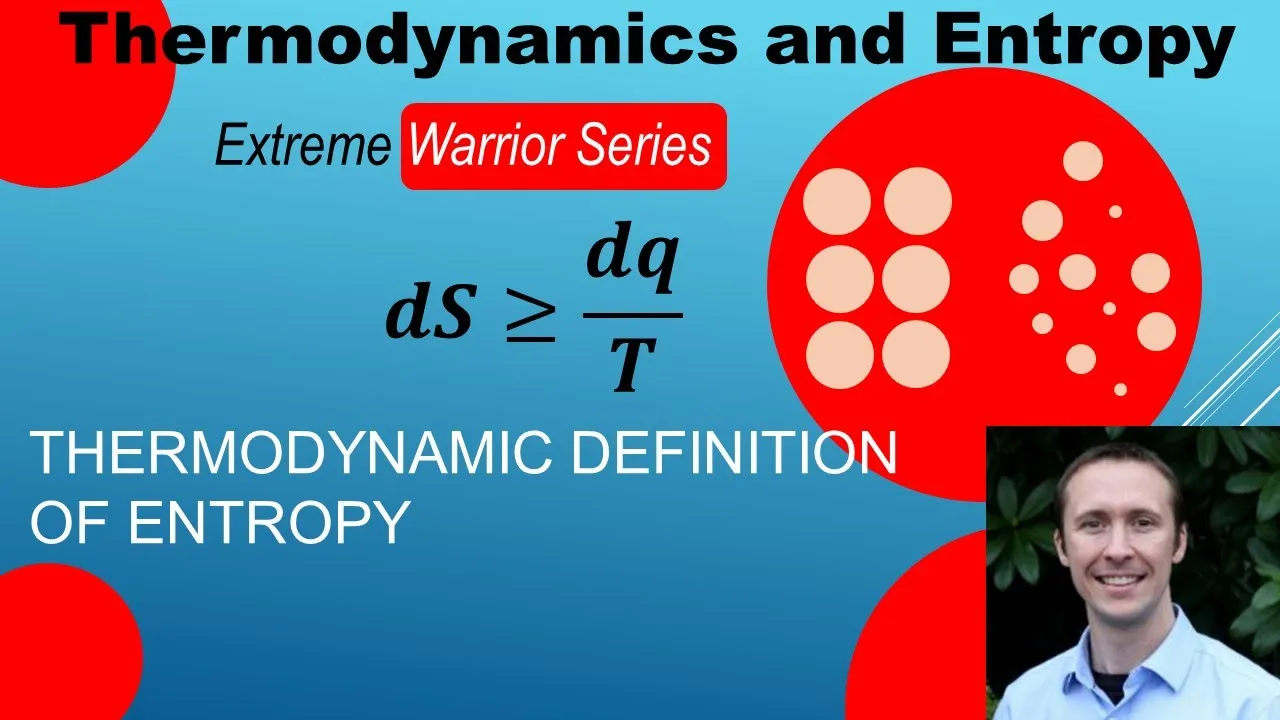
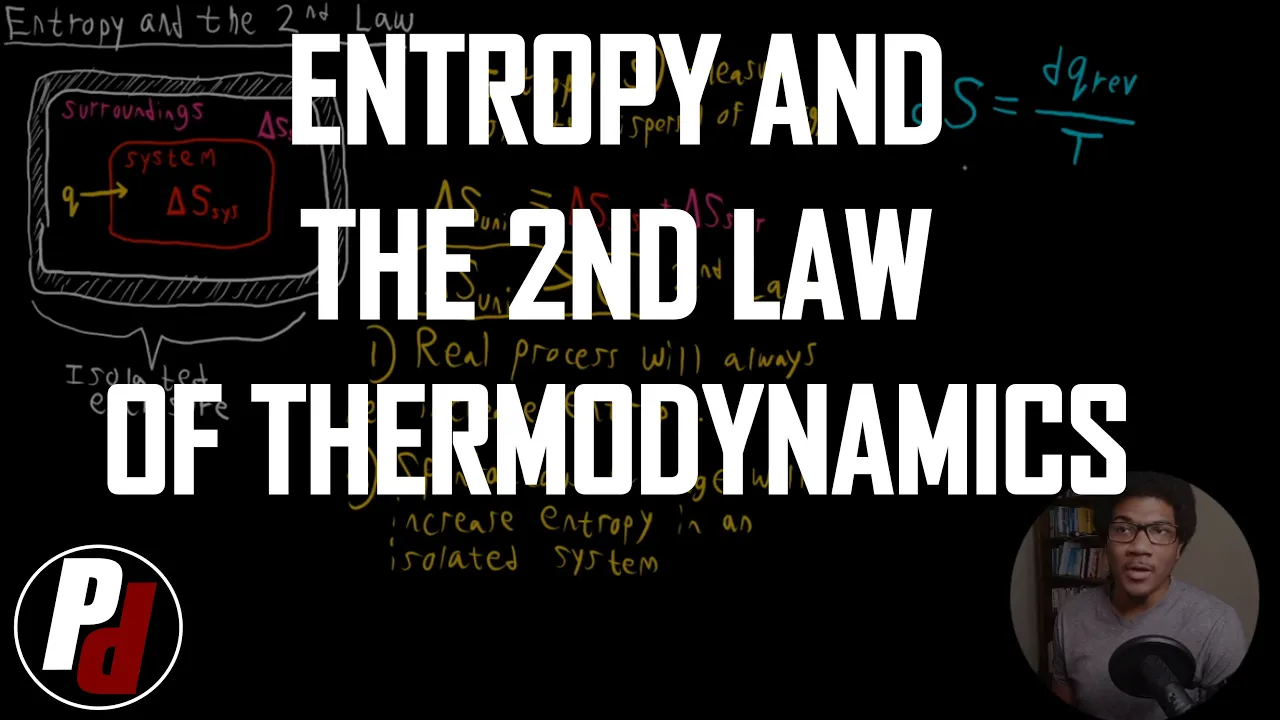
The Second Law of Thermodynamics and the formal thermodynamic definition of Entropy (S).
Carnot's Theorem, which proves that all reversible engines operating between the same reservoirs have the same efficiency.
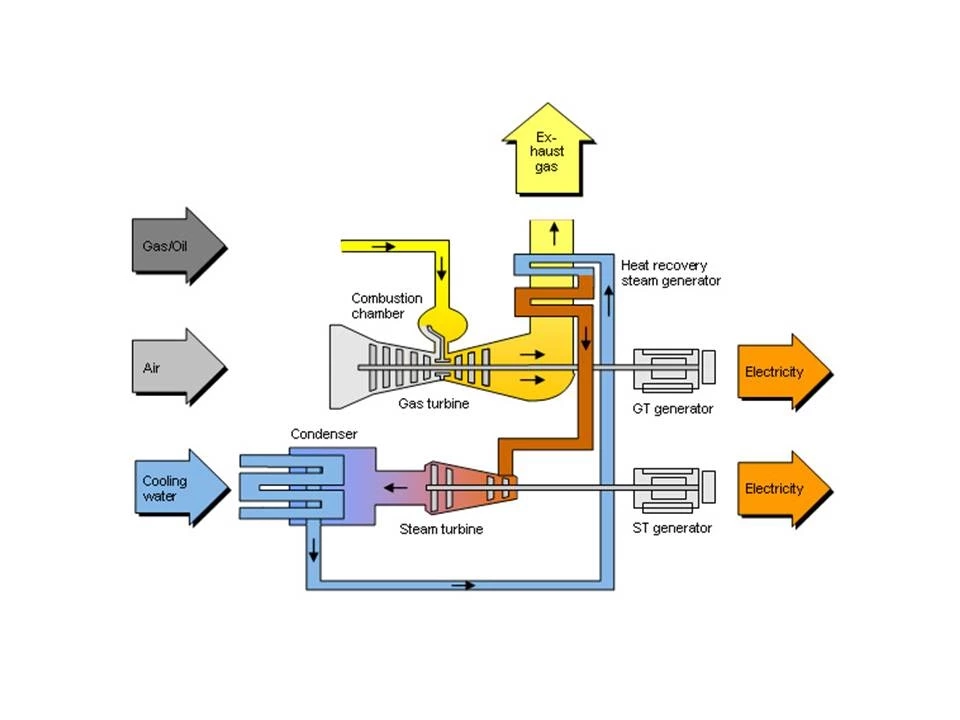
Practical thermodynamic cycles, such as the Otto (gasoline), Diesel, and Rankine (steam) cycles, and why they fall short of the Carnot efficiency.
The Reverse Carnot Cycle, which explains the theoretical limits and Coefficient of Performance (COP) of refrigerators and heat pumps.
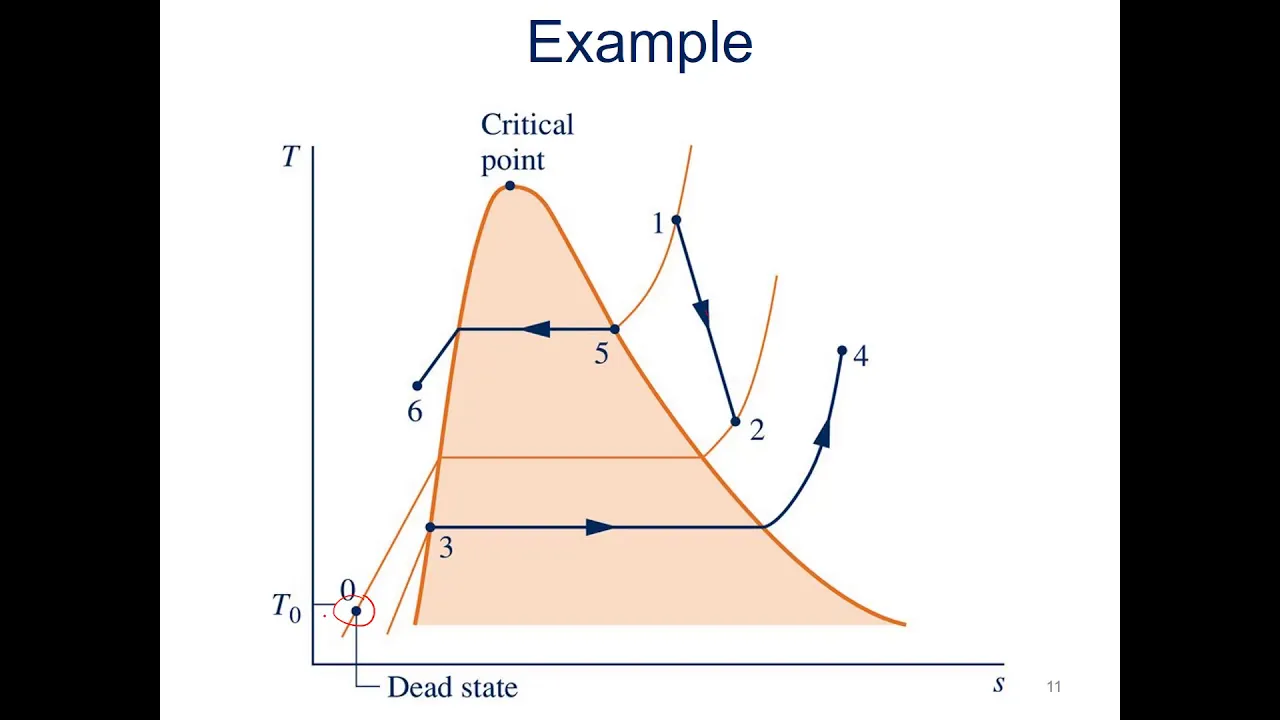
The concept of Exergy (availability analysis), which quantifies the maximum useful work possible from a system as it comes to equilibrium with its environment.
72K views595likes8:40Original Release: 2013-07-27
Welcome to lecture online and in this video we're going to take a closer look at the carno cycle which is based upon the theoretical carno engine. The engine that carno which famous physicist devised from a thermodynamic process.
This is of course not a real engine and not an engine you're going to go down to the shop and build yourself but an engine that's based on a theoretical model that exists as follows. We have a thermodynamic process that goes from A to B to C to D and back to A. From A to B we go along the isootherms. That's an isothermic process. From B to C that's an adabatic process. From C to D that's again an isothermic process. And from D back to A that is an adabatic process.
And and Caro showed and proved that this is the most efficient engine you can have. All other engines you can devise any other thermodynamic process will have an efficiency lower than the efficiency of this particular engine.
Remember the equation for efficiency.
Efficiency is equal to work done divided by the heat that you derive from the hot reservoir. And work done can be written as Q hot minus Q cold / Q hot. And if you divide this into that, you get 1 minus Q cold / Q hot. So what we want to do here is come up with an equation where we're going to divide Q cold by Q hot somewhere in this process. Now remember that in an isothermic process based upon the first law of thermodynamics deltaU is zero and therefore Q= W which is equal to NRT * the natural log of V final over V initial. So if we're going to use that let's start with Q Q Q the heat expelled at the cold reservoir. Q cold is equal to NR times the temperature cold because at that point that the temperature is T cold times the natural log of VFAL over V initial. So in this part of the cycle in this process V final is VB and V initial is VA. So we write VB / VA. Now to find the heat being put into the system or into the cycle at the hot temperature, we have QH and that is equal to NR time temperature H times the natural log and again that would be VFAL over V initial. So it would be V D over VC. Now there's a mathematical trick here. We're going to take the negative of this. In other words, if I put a negative sign in front of that and I exchange VC and V D, then that makes that negative as well. and they cancel each other out. So I can write QH is equal to the negative of N R TH * the natural log of VC over V D. Remember when you when you interchange those two variables that becomes negative and that's not negated by the negative over here. And again there's a reason why we did that because the next step we're going to divide Q cold by QH to get that right there.
So Q cold / QH can now be written as this right here which is N RT cold time the natural log of VB over VA that's this right here divided by the negative of N RT time the natural log of VC over V D. And now right away you can see that the N and R cancel out and now we have TC over TH and the natural log of VB over V8 time the natural log of VC over VD. So that's equal to Q q cold over Q hot which is the part of our efficiency equation we have over there. So the next thing we're going to do is look at the adabatic part of the cycle right here the two adabatic processes and use this equation to relate temperature to volume as well and then we should be able to solve those two equations simultaneously. So starting with going from B to C, we can write temperature at B and of course temperature at B is T cold times V at B and V at B well that's simply V at B to the gamma minus1 equals temperature at C which is T hot times V at C to the gamma minus one.
We can also do that at um for the other process right here going from D back to A. So we can say T at D and of course T at D that would be T hot. So T hot time V at D to the gamma minus one is equal to what we get over here that would be T cold time V sub A to the gamma minus one. So we use that equation to relate B and C and DNA because that's an adabatic process and that's an adabatic process. Now what I need to do is I need to somehow get rid of the TC and TH here. All right. So how do we do that? How do we get rid of the temperatures in these equations right here? Well, if I divide this equation by this one but turn around, then I have TC's lined up. I have TH's lined up. and then I think those will drop out. So let's try that. So we're going to take T C VB to the gamma minus1 and set equal to TH * V C to the gamma minus1 and we divide that by this equation but turned around I get T C VA to the gamma minus1 and on this side I get TH * V D to the gamma minus one. Notice what we've done here. You can see that the TC's cancel out and the TH's cancel out. And then you combine the VB over VA and VC over V D. So we could write that VB over VA to the gamma minus1 equals VC / V D to the gamma minus one. Now why did I do that?
Well, take a look at this equation again. I have VB over VA and I have VC over V D, which is exactly what I have over here. And you could say here then that if VB over VA to the gamma minus one equals VC over V D to the gamma minus one that these ratios have to be equal to each other. If those two ratios have to be equal to each other then this has to be equal to that and those cancel out because VB over VA is equal to VC over VD which I have over here. And then I look at this equation. I can write that QC over QH is equal to T C over TH.
Of course, don't forget the minus over there. Now, does the minus make sense?
Well, it depends.
Notice that if I only take the absolute value of the left side, excuse me, of that equation, because if I simply look at the quantity, not the sign, and if I then write it like this, if I say the absolute value of Q cold over QH is equal to, and I can just get rid of this negative sign right here and simply say that is equal to T cold over TH as a positive quantity. And then I can see over here if the efficiency is equal to 1 minus Q cold over QH and I have determined that Q cold over QH is equal to C cold over T over TH T cold over T hot. Then this equation then becomes the efficiency is equal to 1 minus T cold over T hot for a theoretical caro engine. And that then is the maximum efficient uh the maximum efficiency any engine can have simply 1 minus T cold over T hot. Now of course that can be written in a couple different ways but also can be written as E is equal to just like we did there. T hot minus T cold / T hot. And that's another way of writing the maximum efficiency of a Carno engine.
So that was pretty neat that Caro came up with this concept that there's no engine with any greater efficiency than this engine right here. Of course, not a real engine, theoretical engine, but at least for engineers, they know that they can never exceed this. And if they want to make an engine more efficient, they can do that by making this relationship as small as possible, meaning make tea cold as small as possible and make tea hot as big as possible. They get the greatest maximum efficiency an engine can produce.
Up Next
83:38
Thermodynamics Part 2: Entropy and the Carnot Cycle | MIT 8.333
@mitocw
159.6K views•2014-12-21

12:53
21cm Hyperfine Transition in Neutral Hydrogen: Radio Astronomy Basics
@AaronRobertParsons
12.4K views•2011-10-13

6:07
Lagrangian Mechanics: Why the Euler-Lagrange Equation Works
@MichelvanBiezen
187K views•2016-03-31

27:14
Entropy and the Second Law of Thermodynamics Explained
@veritasium
27.5M views•2023-07-01
Related Study Plans & Knowledge Roadmaps
Structured learning paths in Physics
physics
Nuclear Physics (Decay, Fission & Reactors)
01Atomic Structure and the Binding Force
02Radioactive Decay and Half-Life
03Nuclear Fission Mechanics and Chain Reactions
+ 2 more learning modules
12h5 modules
Explore Roadmap
physics
Soft Matter (Polymers, Colloids & Rheology)
01Foundations of Soft Matter & Thermal Forces
02Polymer Physics and Macromolecules
03Colloids, Surfactants, and Self-Assembly
+ 2 more learning modules
38h5 modules
Explore Roadmap
physics
Analytical Mechanics: Lagrangian & Hamiltonian
01Mathematical Foundations: Calculus of Variations
02From Newtonian Mechanics to Constraint Dynamics
03The Principle of Least Action & Lagrangian Mechanics
+ 3 more learning modules
28h6 modules
Explore Roadmap
physics
General Relativity (Spacetime & Cosmology)
01Foundations of Relativity: Special Relativity
02The Geometry of Spacetime: Equivalence Principle & Curvature
03Einstein's Field Equations: The Mathematics of Gravity
+ 2 more learning modules
55h5 modules
Explore Roadmap