

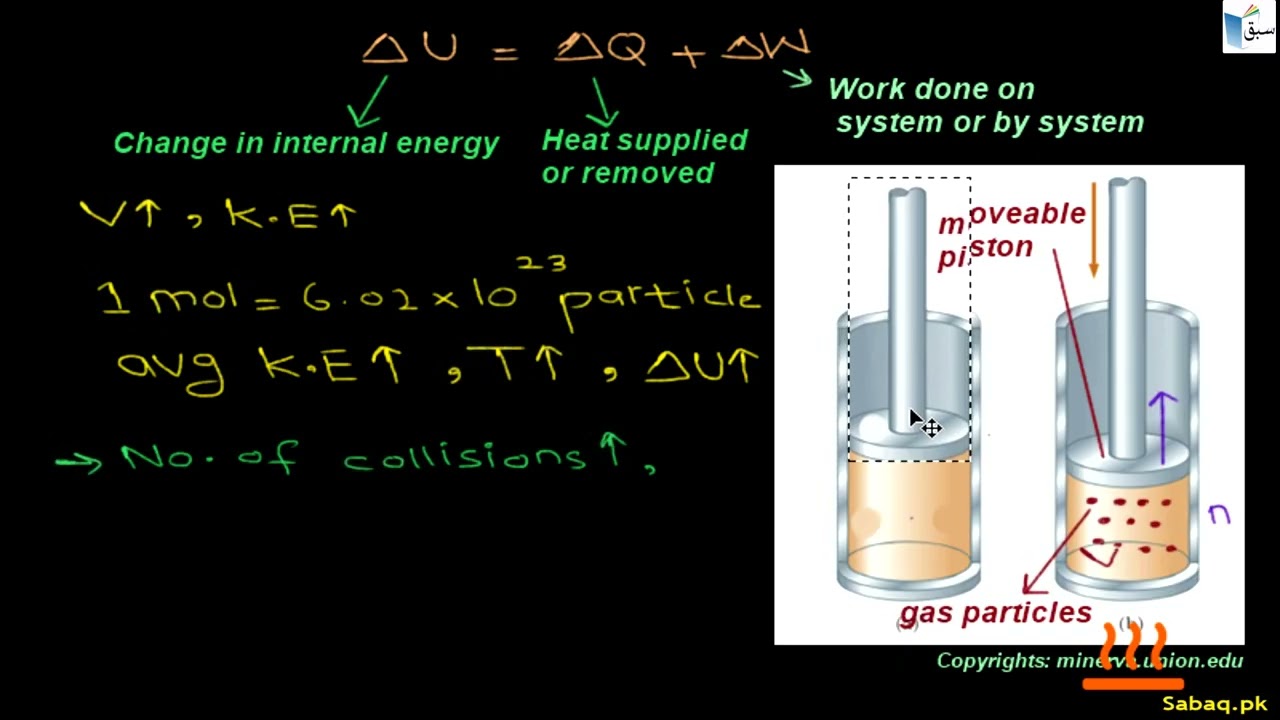
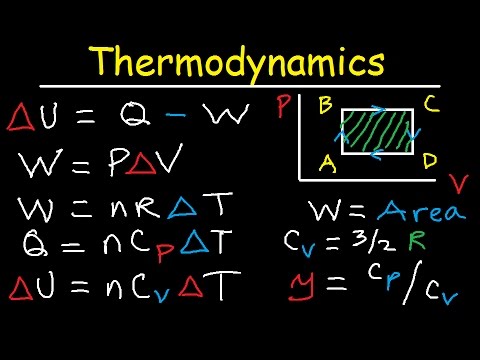

![FÍSICA - Termodinámica I [CICLO FREE]](https://i.ytimg.com/vi/oC6nWfA-EoY/maxresdefault.jpg)






















This lecture develops the thermodynamic framework by introducing the Second Law through Kelvin and Clausius formulations, demonstrating their logical equivalence, and deriving the Carnot engine as the most efficient heat engine operating between two temperatures. The key insight is that all Carnot engines between the same two temperatures have identical efficiency, independent of the working substance, enabling the construction of a universal thermodynamic temperature scale. This scale is defined such that efficiency equals 1 - TC/TH, where TH and TC are the thermodynamic temperatures of the hot and cold reservoirs. The lecture concludes by establishing that for any cyclic transformation, the integral of dQ/T is less than or equal to zero, with equality for reversible processes, which leads to the definition of entropy as a state function.
Thermodynamics Part 2: Entropy and the Carnot Cycle | MIT 8.333
Added:The following content is provided under a Creative Commons license.
Your support will help MIT OpenCourseWare continue to offer high-quality educational resources for free.
To make a donation or view additional materials from hundreds of MIT courses, visit MIT OpenCourseWare at ocw.mit.edu.
PROFESSOR: So I'll briefly review what we were doing last time.
We are gradually developing the structure that we need for thermodynamics.
And the first thing that we did was to state that it wholly depends on the existence of equilibrim-- is the first and foremost thing that we need to know, is that the objects that we are studying in thermodynamics are in equilibrium.
And once they're in equilibrium, we can characterize them by a set of properties.
So there's a list of coordinates that I would have the list here.
And we saw that since we will also need to think in terms of mechanical work, a good place to start-- and since we are familiar with mechanical coordinates-- is to enumerate here the mechanical coordinates that we would describe the system with.
And we said that we could, in principal, characterize or divide those coordinates in the form of some generalized displacements and the corresponding conjugate forces.
And typically, the displacements are extensive proportional to the size of your system.
The forces are intensive.
And the work is related to the product of those two in some fashion.
One of the things that I will do throughout is to emphasize that one of the main materials that we are going to look at, and illustrate the concept with, is the gas.
And in particular, the version of the gas that is the ideal gas.
But forgetting the ideal part for the time being, the coordinates that we use to describe the gas with is V and pressure.
And actually, we saw that in order to ultimately be consistent with how we will define work, it is good to think of minus pressure as the appropriate force.
And so basically, then if I want to characterize the equilibrium state of a gas, I need, for example, to specify where I lie in this P-V plane.
OK so that's the first thing to know.
But then we also realize that mechanical coordinates are insufficient to describe the properties of the systems that we encounter.
For example, if we are thinking in terms of a spring and we pull on the spring-- so we are looking at the relationship between displacement and the force-- the result that we get how easy it is to pull on this depends on something else-- depends on temperature.
So somehow, we need to include these properties that have to do with heat and heat transfer in order to have a complete description of systems that are in equilibrium.
And so going along that direction, we started with the Zeroth Law.
And the statement of the Zeroth Law was the transitivity of equilibrium-- if two objects are in equilibrium with each other they are-- two objects are in equilibrium with a third object, they're also in equilibrium with each other.
And we saw that what that means, is that once I am at some point in this coordinate space, I know that there exists some function.
I don't know its functional form.
This empirical temperature and being in equilibrium means that there is this important function of the coordinates of the first system equal to some other functional or form potentially, depending on the coordinates of the second system.
And this empirical temperature has to be the same.
We said that this is kind of like being on a scale, and having a balance between different things, and then they are in balance with each other.
So we know that there's something like mass.
Now, when we describe this in the context of the gas, we noted that for all gases in the limit that they are dilute, the isotherms-- the places that would correspond in this case to always being in contact with the object is at a fixed temperature, form these hyperboles.
So the isotherms in the limit of dilute are of the form PV is proportional to time span.
We can call that theta.
We can use that, even, to define the ideal gas temperature scale, provided that we choose some proportionality coefficient which was selected so that the temperature of water, ice, steam, coexistent at a particular value.
OK, so that's the specific property of the ideal gas as far as its temperature is concerned.
The next thing that we did was to look at how changes are carrying a system, a particular system.
And we found that if you take the system from one location in its coordinate space to another location, do it in a manner that does not involve the exchange of heat.
So basically, you idealize this thing and isolate it from any other source-- that the amount of work-- and we can then calculate mechanical work-- the amount of mechanical work that you do is only a function of the initial and final states, and does not depend on how you supply the work that produces this, et cetera.
And so that immediately reminded us of conservation of energy, and a suggestion that there exists this function that depends on where you are in this coordinate representation that gives the total energy content of the system.
What was important was that, of course, we want to relax the condition of making changes over which there is no heat exchange to the system.
And more generally then, we said that the changes that we obtain in energy are the sum of the two components-- the amount of work that you do on it, and that we know how to measure from our various mechanical prescriptions.
But if there is a shortcoming from the internal energy function that we had constructed previously, and the work that we compute for a particular process, we say that in that process, there was some heat that went into the system.
And it is, again, important to state that this dE really only depends on the initial and final state.
So this depends on state.
While these things-- that's why we put a bar on them-- depend on the particular path that we take.
Now again, if you ask, well, what can we say in this context for the ideal gas?
And there is the very nice experiment by Joule where he said, let's isolate our gas, let's say, into two chambers.
These are kind of rigid balls, very nicely isolated from the environment.
Initially, the gas is confined completely onto one side.
So let's say that the initial state is over here, with this volume.
And then we release this.
And so the gas goes and expands.
And we wait sufficiently.
We wait sufficiently.
Ultimately, we're settled to a place, let's say over here-- the final state.
Now, it's important to say that I don't know the intermediate state of this transformation.
So I can't say that somewhere between t equals to zero when I open the valve, and t goes to infinity where the whole thing is settled.
Zero and infinity points I know.
In between, I can't really have an idea of where to put my system.
It is at non-equilibrium by construction.
But this is a process that by definition I follow the path along which there was no input either in the form of work or heat into the system.
It was isolated.
So all I know for sure is that however amount of energy I had initially is what I have finally.
The observation of Joule was that if we do this for the case of a dilute gas, I start with some initial temperature Ti.
I go to some final temperature.
But that final temperature is the same as the initial temperature.
And that is actually why I put both of these points on the same isotherm that I had drawn before.
So although I don't know anything about the in between points, I know that this is the property of the system.
And essentially, we know, therefore, that although in principle I can write E as a function of P and V, it must be only a function of the product PV, because it only-- P changes in the process.
V changes in the process.
But PV remains constant.
Or if you like, E is really a function of T, which is related to the product.
And sorry about being kind of inconsistent with using T and theta for temperature.
OK, any questions?
So this is kind of recap of what we were doing.
All right, now, it would be good if we can construct this function somehow-- at least theoretically, even.
And you would say, well, if I had this spring, and I didn't know whether it was a Hookean or a nonlinear spring, what I could do is I could pull on it, calculate what the force is, and the displacement, and integrate f dx and use the formula that quite generally, the mechanical work is sum over i, let's say Ji dxi.
Now, of course you know that I can only do this if I pull it on this spring sufficiently slowly, so that the work that I do goes into changing the internal energy of the spring.
And then that would be a contribution to dE.
If I do that rapidly, then it will send this spring into oscillation.
I have no idea, again, where the system is in the intermediate stages.
So I can use this kind of formula if, in this type of diagram that indicates the state of the system, I proceed sufficiently slowly so that I can put points that corresponding to all intermediate states.
And so that's for things that are sufficiently slow and close to equilibrium that we call quasistatic.
And so in principal, I guess rather than opening this immediately, I could have put a slow piston here, change its position slowly, so that at each stage I can calculate where I am on the PV diagram.
And I could have calculated what the work is, and used this formula to calculate the contribution of the work to the change in internal energy.
OK, now I said that it would be ideal-- and what we would like to do, ultimately-- is to have a similar formula for dQ.
And if we look by analogy, we see that for W, you have J's times the X's.
The forces are the things that tell us whether systems are in equilibrium with each other.
So two-- if I have, let's say, a piston separating two parts of the gas, the piston will not move one direction or the other if the pressure from one direction is the same as the pressure from the other direction.
So mechanical equilibrium tells us that J's are the same.
And it suggests that if I want to write a similar type of formula for heat, that the thing that I should put here is temperature or empirical temperature, which is, again, a measure of thermal equilibrium.
And then the question that would immediately jump onto you is, what is the conjugate that I have put for the displacement?
And you know ultimately that it is going to end up to be entropy.
And so the next part of the story is to build that.
And we're going to do that through the Second Law of Thermodynamics.
Any questions?
Yes.
AUDIENCE: I mean, this is kind of a semantics question, but what always confuses me in thermodynamics when we talk about quasistatic is, I mean, if it isn't quasistatic, introductory formation of [INAUDIBLE] doesn't really give a means to address it.
So we have to rely on the fact that it's quasistatic.
And the only way we could check it is to assume that what we're already saying is true will be true.
So I guess my question is, in the context of a spring, like, there's obviously-- there exists a physical threshold at which-- that's not infinitely slow, and which you can get a reasonable measurement if you're doing an experiment.
PROFESSOR: So in all of these things, I would sort of resort to some kind of a limiting procedure.
So you could, for example, pull the spring at some velocity, and figure out what the amount of work is, and gradually reduce that velocity, and hope that the formula-- the values-- that you get are converging to something as you go to low velocity.
I don't think there's actually a threshold velocity, kind of implied that if you are slower than something, then it would work.
I think it really only works in the limit of zero velocity.
And so if you like, that's kind of procedure you would use to define derivatives, right?
So you can't say what's the meaning of velocity in physics.
So, but it is an idealization.
I said at the beginning that the very-- actually, I would say that more fundamentally, the thing that is really an idealization is this adiabatic walls.
Even the concept of equilibrium-- what do we see around us that we are absolutely 100% sure in equilibrium?
Nothing is.
The fate of the universe is that all of our atoms and molecules are going to separate out and go to infinity, if it expands forever.
Right?
OK, Second Law-- all right, so again, we want to sort of set our minds back to where these laws were developed, which is in the 18th century.
And the thing that was of importance at that time was sort of Industrial Revolution-- get things moving.
You need energy, and you would get energy from coal, and so you need to convert heat to work.
And this conversion of heat to work is important to you.
So typical thing that you have for your coal engine is you have something that is a source of heat.
So there's, for example, a fire that you're burning.
You have some kind of a machine that has components, such as a piston, that is being heated.
And during this process, you extract a certain amount of heat from your fire.
And then typically, you realize that you will be releasing a certain amount of energy back to the atmosphere, causing pollution.
So there is a coal sink.
But in the process, you will be extracting a certain amount of work.
And what you want to do is to make the best use of this set up.
So you're concerned with efficiency, which is defined to be the amount of work that you're going to extract out of a certain amount of heat that you expend in your coal, or whatever.
And again, based on conservation of energy, we expect that this W to be less than QH by an amount that you are setting to the exhaust.
And because of that, this eta has to be less than or equal to 1, in principal.
Now, another device that is using the same rough principles is the same thing going in reverse, which is a refrigerator.
So in order to cool this room, you use electricity or some other means of doing work on a machine whose job it is to extract heat out of the room.
So let's say this is our room.
We want to extract the heat.
But of course, that heat has to go somewhere.
So this has to have some kind of exhaust putting this again to the atmosphere or somewhere.
So how good is this thing performing?
So there is a measure of the performance-- figure of merit, if you like, for this-- which we will label by omega, which is how much heat you were able to remove from the room given some amount of work or energy that was put in.
And again, because of conservation, this W is going to be QH minus QC.
Now, this particular number, which is a useful measure of how well your refrigerator works, has no particular constraint.
It can be less than 1.
It can be larger than 1.
So again, you want it to be as large as possible, and in principle, it can be 200-- whatever.
So clearly, already these are very much idealizations of some complicated process that is going on.
And the thing that is interesting is that you can take a look at how well you are able to do these processes, and then make this equation that we wrote up here to be an exact differential form.
So how you do that is an interesting thing that I think is worth repeating and exploring.
And essentially, you do that by formulating things that are possible or not possible through the Second Law, and then doing some mathematical manipulations.
And we will use two formulations of the Second Law due to Kevin and Clausius.
So I will indicate them either by K for Kelvin-- so Kelvin's statement of the Second Law is the following-- no process is possible whose sole result is complete conversion of heat to work.
So what that is, is a statement about how good an engine you can make.
He says that you cannot make an engine that takes a certain amount of heat and completely makes it to work without having any waste QC.
So basically, it says that there is no ideal engine, and that your eta has to be less than 1.
There is a second variant of this, which is due to Clausius-- says that no process is possible whose sole result is transfer of heat from cold to hot.
So if you want to make an ideal refrigerator, what you want to do is to extract more and more QC for less and less W. So the ideal version would be where essentially, the limit of zero work, you would still be able to transfer heat from the room to the outside and get an ideal refrigerator.
And Clausius says that it's not possible.
So these are two statements of the Second Law.
There are other versions and statements of the Second Law, but these are kind of most close to this historical perspective.
And then the question is, well, which one of them do you want to use?
And since I will be kind of switching between using one or the other, it would be good if I can show that they really are the same statement, and I'm really not making use of two different statements when I use one or the other alternative.
So what I really want to do is to show that these are really, logically, the same statement.
And essentially, what that means is that the two statements are equivalent.
And two statements are equivalent to each other if one of them being incorrect-- which I've indicated by K with a bar on it-- implies that the other one is correct, and simultaneously, the other way around.
And since this does not take more than a few minutes, and is a nice exercise, I think it's worth showing this.
So let's say that somebody came to you and said that I have constructed a machine that violates Clausius.
We'll call that K bar.
So what does that machine do?
What that machine does is it converts heat, Q, completely to work, without needing to exhaust anything.
So this W is this Q, and there's no exhaust machine.
He says, OK I have this machine.
I say, OK, what I will do is I will use that work to run a refrigerator.
So I connect that to a refrigerator.
And that work will be used to take heat, QC, out of some room and exhaust it to the atmosphere.
And I will choose the exhaust location to be the same as the source of heat that I had for my anti-Kelvin machine.
OK?
So then if you look at how the sum of these two machines is operating together, from the perspective of looking at the sum of the two machines, the work is just an internal operation.
You don't really care.
So as far as the net thing is concerned, what you're seeing is that there is no work involved externally.
It's all internal.
But what is happening is that you're pulling QC out of the room, and exhausting, presumably, what you have here-- QH minus Q to the other side.
This, again, by conservation of energy must be the same as QC, right?
So if you have a machine that violates Kelvin, you connect it to a refrigerator, and what you have is a machine that transfers heat from a cold-air to a hot-air body, and violates Clausius.
So that's the first part we have established.
And to establish the second part, let's say that we have a machine that violates Clausius.
And this machine takes a certain amount of heat, Q, from the room, and deposits it to the hotter outside.
What we will do immediately is to take some of this heat that has been generated by this machine and use it in a regular engine to create some amount of work.
And then this has to take an amount of heat QH, deposit an amount of heat, QC, which we will select to be, essentially, the temperature or the room from which the anti Clausius machine is operating.
And then we will run this engine several times, or fractions of times, et cetera, and the other machine several times, ensuring that QC is the same as Q. That is, the engine puts out as much dumped heat as this anti-Clausius machine is extracting from the room.
Then if you look at the combined system, what we see is that the combined system is doing the following-- this was equivalent to this.
This is equivalent to a combined system that does a certain amount of work.
So there is a W that is coming out.
There is no heat exchange with the room, because we ensured that these two heats are completely balanced.
So you can sort of think of them as something that is internal to this bigger machine.
And so what is happening is that there's a certain amount of heat, QH minus Q that is taken here that has to be equal to W, by conservation of energy.
And we have converted heat entirely to work, violating Kelvin's statement.
So basically, we have proved this.
Any questions?
OK, one more step-- there is actually a couple more steps left before we get to construct our entropy function.
And the next step is the Carnot Engine.
So this is yet another one of these idealizations that-- again, theoretical construct, which you can try to approach as in some limiting procedure.
A Carnot engine is any engine with the following properties-- that is, one, reversible, two, operates in a cycle, and three, all inputs-- all heat inputs-- outputs at two temperatures.
OK, so let's go through the conditions.
Reversible implies that at any stage, if I change the directions of inputs and outputs, it will just go backward.
So can go forward, backward, by reversing inputs, outputs.
And so again, think of the case of our spring that we were pushing back and forth.
In order for it to have this property of reversibility, I should not only do it pulling down and up sufficiently slowly so that at each stage, I can define its tension, but also as far as its connection to the outside world, I have to do it frictionlessly, so that if I were to reverse the direction of the force that I have, it will either go forward or backward, reversing the path that it has.
If there is any friction that is involved, then I cannot do that.
So essentially, this reversibility is some kind of a generalization of the frictionless condition that we would use in mechanics.
The cycle part is easy.
Essentially, it says that the start and end points are the same.
And it kind of harks back to this statement that is part of either one of these formulations of the Second Law-- that is the net result or sole result is something.
So we want the engine to essentially be back to where it was, so that when we are looking at changes that are involved, we say, OK, the engine is not part of the equation.
It is where it was at the beginning and at the end of the cycle.
Now there's something that I didn't emphasize, but I was-- and actually, I was not really using, but you may have thought I was using-- is that in all of these pictures that I drew, I said there is a hot place and there's a cold place.
Now, I didn't specify exactly what these are, and whether this corresponds to a particular temperature.
Now, for the case of the Carnot engine, I have to be precise.
I have to say that this is always at one temperature.
This is always at the other temperature.
So these Carnot engines are defined implicitly with two temperature labels corresponding to the hot part and the cold part.
In principle, everything else that I talked about could have had a range of temperatures.
But the Carnot engine says, OK, just two temperatures.
OK, so for the Carnot engine, if I can now draw a diagram that would be kind of straight line version of what I had before.
And the Carnot engine will be extracting a certain amount of heat, QH, from here, QC from here, doing a certain amount of work.
And since it is reversible, I could actually run it backward.
I could have W. I could have QH, QC, and it would work as a refrigerator.
Now, it is good to have at least one example-- that such a theoretical construct as a Carnot engine can be made based on things that we have so far.
And we can be explicit, and show that for the case of the ideal gas.
So we said that a gas I can represent in equivalent by a point in the pressure-volume diagram.
So let's say that what is the working substance of this Carnot engine is a gas.
And part of this whole story is that it should be working between two isotherms-- the TH and TC.
But we've already established that we can have isotherms for the ideal gas that correspond to these curves that correspond to PV as constant.
So I could really choose one of the isotherms that we discussed before corresponds to TH.
One corresponds to TC.
And I can imagine taking a gas whose initial state is point A, and expanding it while maintaining it at this isotherm TH, and ending up at some point B.
So as I'm expanding this, let's say we have put this gas.
I have this piston that contains this gas.
My TH and TC correspond to two baths that correspond to, if you like, lakes-- a temperature TH, lakes at temperature TC.
I took my piston, put it into the hot bath, make it expand up to some point.
And in the process, there is certainly a certain amount of heat that will go into the system, QH.
So I have taken QH out of the hot source.
Now, next thing that I want to do is to take this, and put it into the colder lake.
But what the process is, is I have to do it in a way that there is no heat exchange.
So I have to find the path that goes from the hot bath to the cold path-- to point C, some point C-- without any heat involved.
We'll have to ask how that's possible, and what's the structure of that path.
Once I'm in the colder bath, then I can expand my gas up to some point D.
And clearly, I have to choose this point D sufficiently precisely so that then, when I take my gas from the cool to the original hot position, I end up at precisely the location that I started, so that I have completed a cycle.
So it's necessary that I should be able to construct these two paths, BC and DA, that correspond to no heat exchange.
And somehow I'm sure that I can complete this cycle.
So the paths BC and DA are called adiabats, or adiabatic paths, in the sense that this is what you would get if you put your system in a container with these adiabatic walls that allows no exchange of heat.
Now clearly, I also want to do this sufficiently slowly so that infinitesimally, I can draw this path as a series of points.
And so I don't want to do what was in the Joule expansion experiment, and suddenly expand the whole thing.
I have to do it sufficiently slowly so that the conditions of this Carnot engine are satisfied.
So along these paths, what do I know?
By definition dQ is 0.
And dQ is dE minus dW along those paths.
And since I'm performing these paths sufficiently slowly, I can write the W as PdV minus PdV.
Now, what you will show in the problem set is that I don't need to make any assumption about the functional form of energy on P and V. Just knowing that I'm describing a system that is characterized by two coordinates, P and V, is sufficient for you to construct these curves.
Turns out that if you have more than two coordinates-- three or four coordinates-- at this time you don't know that you will be able to do so.
But we're sticking with this.
For simplicity, I'm going to choose this-- the form that I have for the ideal gas, which I know that it's really a function only of the product PV.
This is what we had used before.
And again, so as to simplify the algebra, I will use the form that is applicable to a monoatomic gas.
And this-- I really have no reason to do this, except that I want to be able to get through this in two minutes with the algebra.
So I will write the energy to be 3/2 PV.
So then for that particular choice, what I have here is d of 3/2 PV plus PdV.
And that's 3/2 PdV plus V, 3/2 VdP plus PdV, which is 5/2 PdV plus 3/2 VdP is 0.
And you can rearrange that easily to dP over P plus 5/3 dV over V is 0.
And this is simply the derivative of log of PV to the power of 5/3.
And since this derivative is 0, you know that along the curves that correspond to no heat exchange, you have something like PV to the power of gamma-- in this case, gamma being 5/3-- that is some constant.
So after you have done your expansion, all you need is to, in this diagram, go continuously along the path that corresponds to this formula that we have indicated.
And this formula describes a path that is distinct from the isotherm.
So you start from somewhere.
You start along some path.
You are guaranteed to hit the other isotherm at some point.
You start from the starting point.
You go backward.
You're guaranteed to hit the isotherm at some point.
And then you join those two points, and you've completed your cycle.
And so you know that, at least for the case of the ideal gas, or actually for any two-coordinate system, you can construct a cardinal cycle.
That is, put your material, go through a cycle that is reversible with all heat exchanges at two temperatures only.
OK, now why is this idealization even useful?
Well, we said that this Carnot engine is stamped by really two temperatures-- TH and TC.
And the following theorem is important, which says that of all engines operating only between TH and TC, the Carnot engine is most efficient.
So we are going to move away from this idealization that we've made, but so far, only in one small step.
That is, we are still going to assume that all heat exchanges are done between TH and TC.
OK, and so let's say that we have some kind of an engine which does not have to be reversible.
So because it does not have to be reversible, it's not a Carnot engine, but otherwise, operates completely between these two points.
So it takes, let's say, heat QH prime, QC prime, and does a certain amount of work W.
And so somebody comes and says, I've constructed this engine that is actually very good.
It's better than your Carnot engine.
I say, no, that's not possible.
And the way that I will prove it to you is as follows-- I will take the output of your engine, connect it to a Carnot engine, and since the Carnot engine can be run backward, it will act as a refrigerator and extract heat and deposit heat precisely at the two temperatures that your engine is operating.
So if somebody looks at the combination of these two, what do they see?
The thing that they see for the combination is that there is some entity that is operating between TH and TC.
And there is some internal amount of work that is going on, and you don't care about that.
But there is a certain amount of heat, QH prime minus QH that becomes QC prime minus QC.
Now here we invoke Clausius.
Clausius says that if you see heat going between two temperatures, it could have only gone from the direction hotter to colder, which means that this amount of heat has to be positive.
QH prime should be greater than QH.
So this is why Clausius-- we know that this has to be case.
So then what I can do, is I can divide both expressions by W.
And then invert this thing.
And if I invert it, the inequality gets inverted.
So I get that W over QH prime is less than W over QH.
And the left-hand side is the efficiency of my non-Carnot engine.
And the right-hand side is the efficiency of my Carnot engine.
Carnot And what I've shown is that the efficiency of the non-Carnot engine has to be less than or equal to the efficiency of the Carnot engine.
OK, now, the next step is the following-- that all Carnot engines operating between TH and TC have the same efficiency.
And the statement is, suppose I have two different Carnot engines-- Carnot engine one and Carnot engine two.
I can use one to run the other one backward, and I would get that the efficiency of Carnot engine one is less than or equal to Carnot engine two, or the other way around-- that two is less than or equal to one.
And hence, the only possibility is that they are the same, which is actually interesting, because I told you that Carnot engines are stamped by two temperatures, TH and TC.
And what it says is that they all have an efficiency that is a function, therefore, of these two temperatures only.
It cannot depend on whether I constructed my Carnot engine out of an ideal gas.
I constructed it out of a rubber band that I was pulling or pushing, or any other substance in the world that you can think about, as long as that substance I can construct some kind of a Carnot cycle, irrespective of what the coordinate systems are, what the isotherms look like, et cetera.
Just working between two temperatures and two isotherms tells me that this reversible cycle will have this efficiency relating the amount of work and the amount of heat that these exchange as you go around.
OK?
Now, that's important because previously we wanted to define our temperature.
And we had to rely on some property of the gas.
We said OK, empirically we observe that for the gas, you have this relationship that when it is dilute, PV is proportional to T and we use that property of the gas to construct our ideal gas temperature scale.
Well, that's OK, but it relies on some observations additionally to everything else that we had.
Whereas now we have the means to define temperatures irrespective of any material.
This is much more of a universal quantity.
It' doesn't depend on any substance, any particular structure.
So it's a much better way to rely for constructing a temperature scale.
So in some sense, at least theoretically, we are going to abandon our previous temperature scale based on properties of the ideal gas, and reconstruct the temperature scale based on this.
Any questions?
OK.
So this is what will be called the thermodynamic temperature scale.
And what it amounts to is that somehow I use the efficiency between two temperatures or vice versa-- use that there are two temperatures.
Let's say one of them is a reference temperature.
I derive the temperature of the other one by the maximum efficiency of all engines that can operate between the reference temperature and the temperature that I wish to measure.
It's T.
But that means I-- before doing that, I need to know at least something, or some kind of a postulate about the structure of this function of two variables.
And I cannot write any arbitrary function.
It has to satisfy certain properties and symmetries.
And I can see what those properties are by putting a couple of these engines in series.
So let's imagine that we have a structure where I have the highest temperature T1, and intermediate temperature T2, and the lowest temperature T3.
And I put one Carnot engine to operate between these two temperatures, and one to operate between these temperatures.
And the first one is going to take heat that I will called Q1.
And release a heat that I will call Q2, in the process doing a certain amount of work that I will call W between 1 and 2.
Now what I will do is I will use the entirety of that heat, Q2, to run the second Carnot engine to temperature T3, reducing here the amount of heat, Q3, and doing a certain amount of work-- W23.
Clearly what I want to do is to say that when I look at the combination of these things, what happens at temperature 2 is an intermediate.
And the whole thing is equivalent to a Carnot engine operating between T1 and T3.
Again, the whole thing is reversible, operates between two temperatures, and since each one of them can be made to go back to where they started, is a cycle.
So the whole thing is really equivalent to another Carnot engine that takes Q1, deposits Q3, does a certain amount of work, W13, which is the sum of W12 plus W23.
So clearly, these two different perspectives on the same operation will constrain some-- give some constraint between the form of the functions that will be describing the efficiencies of Carnot engines.
So let's follow that mathematically.
OK, so the first one-- what do we have?
By conservation of energy, I have that Q2 is-- so this is-- let me be precise.
This is Carnot engine 1-- tells me that Q2 is Q1 minus W12.
All right, so how much heat I have here is the difference between this and the amount of work that I did-- conservation of energy.
W12 is the efficiency times Q. That was how it was defined.
So it is 1 minus the efficiency operating between T1 and T2 times Q1.
What do we know about Carnot engine number 2?
Carnot engine number 2 says that I can look at Q3 as being the difference between Q2 minus the work that is done over here.
The work is related to the heat through multiplying by the efficiency that is operating between T2 and T3.
And if I substitute for Q2 from the first equation, what do I get?
I will get Q2 being Q1, 1 minus efficiency T1, T2, multiplying by the second bracket that is 1 minus efficiency T2 T3.
But I can also look at the composite Carnot engine-- that is the sum total of them represented by the diagram on the right.
And what that states-- just writing the whole thing same way-- is that this Q3 is the same as Q1 minus this amount of W13, which is the same thing as Q1, 1 minus the efficiency between T1 and T3.
So suddenly you see that I have two equations that relate Q3 and Q1-- essentially two formulations of this ratio.
And what that says is that the efficiency functions calculated between pairs of temperatures, when we look at triplet of them, have to be related by 1 minus efficiency between T1 and T3 is 1 minus efficiency between T1 and T2, 1 minus efficiency between T2 and T3.
So when we are constructing our temperature scale based on properties of this efficiency function, we better choose and efficiency function that satisfies this equality.
And very roughly again, where did this type of equality come from?
It originated in the fact that this 1 minus eta was the ratio of two Q's.
This was the ratio of Q2 over Q1, and then the other one was Q1 over Q3, and you would multiply them, and you would get Q2 over Q3, et cetera.
And that gives you a hint as to how you should construct this function to satisfy the property that you want.
If I write the function as the ratio of some function of T2 divided by some function of T1, it would cancel in precisely the same way that when you were multiplying Q2's and Q1's, the cancellations occur.
OK?
So what I need to do is to postulate that this is of this form.
And then actually, I'm free to choose any function or form for F that I want.
So here we need to make a convention.
And the convention that we make-- so this is-- this was not required-- is that this is really the functional form is linear.
So this defines for you the thermodynamic temperature scale.
Yes.
AUDIENCE: Yes, the part, the step right before the convention, where you wrote F of T1 over T1, is this also an assumption, or is it a necessity?
PROFESSOR: I'm, let's say, 99.9% sure that it's a mathematical necessity.
I can't-- at this stage, think of precisely how to make that-- actually, yes, I can make that rigor.
So essentially think of writing this in the following way-- 1 minus eta of T1 and T2 equals to 1 minus eta of T1 and T3, 1 minus eta of T2 and T3.
OK?
The left-hand side depends on T1 and T2.
The right-hand side is the ratio of two functional forms involving T1 and T2 precisely as you have over here, as long as you regard T3 to be some arbitrary parameter or constant.
OK?
So that's the proof.
All right, unfortunately, it's like doing magic.
Once you reveal the trick, it becomes not so interesting.
Yes.
AUDIENCE: Does that mean more precisely if we assumed that T2 and T1 using F are empirical temperatures, and we define the different temperature to be F [INAUDIBLE] 2, something like that?
PROFESSOR: OK, what I wanted to say next maybe answers to that.
So why don't I give that answer first, and then come back to you?
Is that so far, we have defined two temperatures.
There is the thermodynamic temperature scale based on these efficiencies and there is one other statement, which is that this only defines the ratios.
So I need to also pick a reference temperature.
And for reference temperature, I pick the temperature of the coexistence of ice, steam, water, to be 273.16 degrees K, which is what I have for the ideal gas scale.
Because if I don't do that, I only know things up to some proportionality constant.
If I say that I pick that reference temperature, then in principle what I could do is, if somebody gives me a bath, I can run a Carnot engine between that bath of unknown temperature and this reference point, calculate the efficiency, 1 minus the efficiency, use this ratio-- 273.16-- and I have the temperature of my new object.
So we've completed that thermodynamic temperature scale.
If I understood correctly the question that was posed, is, well, what about the empirical temperature?
And I was going to answer something different, which is not really what you were asking.
So maybe you can repeat your question one more time.
AUDIENCE: If the, all of our computations where we assume that instead of T's, there are some thetas.
PROFESSOR: Right.
AUDIENCE: And which means that we use the [INAUDIBLE] at last we define the thermodynamic temperature, it seems to have more precise.
PROFESSOR: That's fine.
So you're saying that what I did with the Zeroth Law was to state that for somebody that exists in thermal equilibrium with a bath, I can characterize it with the theta.
And I can go through the whole argument that I had over here by constructing, let's say, Carnot engines that operate between empirical temperatures defined as theta H and theta C.
And nowhere in the process have I given you a number for what theta H and theta C is up to this point.
And at this point, I defined efficiency, which I have established is only a function of the empirical temperature operating between two isotherms, as some way through this process and this definition, giving an actual numerical value.
So that's fine.
Yes.
AUDIENCE: So should you also define temperature [INAUDIBLE] with ideal gas and infinite expansion?
PROFESSOR: Yes.
AUDIENCE: And doesn't it define what convention for effective we need to pick here?
So for all the definitions to be consistent with each other?
PROFESSOR: OK, so now that becomes a different question.
So I think the first question was, let's not define any temperature scale up to this point.
And this is the first time that we define a temperature scale.
Now, your question is the one that I wanted to originally answer, so thank you for the question, which is that I actually did define for you a temperature scale through some property of the ideal gas.
And indeed, that property of the ideal gas I implicitly used here in the shape of the isotherms that I had and constructing this energy functional in this fashion.
Now you say well, OK, you defined temperature two different ways.
Are they consistent with each other?
And you will have a problem set that will ask the following question-- let's run an ideal gas Carnot cycle between ideal gas temperatures theta H and theta C. OK?
Now you can-- and I have drawn for you the form of this Carnot cycle.
Using PdV, you can calculate what amount of work goes into this at different stages.
And the net work would be the area of this cycle.
So W would give you the area of the cycle.
You can calculate what QH is.
And you can calculate the efficiency of this as a function theta H and theta C.
And what you will find, if you do things correctly, is that using all of these definitions for the shapes of these isotherms, you can calculate what the efficiency is.
And the answer for your efficiency will come out to be theta H minus theta C divided by theta H, which is precisely what you would have expected based on the Carnot cycle.
So then you can establish that the ratio of theta H to theta C defined through the ideal gas temperature scale is the same as the ratio of the temperatures if you had defined through the thermodynamic.
So the two scales, once you set the same point for both of them, become identical.
Other questions?
OK, so we went through all of this in order to ultimately get back to the story that I was constructing at the beginning of the lecture, which was that I'd like to have the form ultimately for my energy.
I want to construct the energy.
And if I was looking only at mechanical systems, and there was no temperature in the world, I would construct it as sum over i Ji dxi.
But I know that that's not enough, because there are processes by which I can change the state by not doing any mechanical work-- go from one point in the diagram to another point in the diagram.
So there must be something else.
Now we said that it kind of makes a lot of sense that something else should be something like a temperature.
And before that, really, the only thing that we had that was a form of temperature was the ideal gas temperature, or the empirical temperature that we had defined through the Zeroth Law.
And neither of them had any nice connection to heat.
Through this Carnot engines, et cetera you have established some kind of a connection between heats, temperatures, et cetera.
And that's why this thermodynamic temperature scale is useful.
It is independent of any material.
And it's really the T that I should put here.
And so the next question is, what should I put here?
And that will also come through the Second Law.
I will develop that mostly the next time around, but I'll give you in the next two or three minutes a preview.
So the statement that we had was that the efficiency of any engine is less than the Carnot engine, right?
So let's imagine that we have some kind of a exchange process going between TH and TC.
And there is some engine-- I don't know what that engine is-- that takes heat QH here, QC here, and does a certain amount of work.
Now I know that W over QH is less than or equal to 1 minus TH over TC.
And W is really the same thing as QH minus QC.
So actually, I could also have written this as 1 minus QC over QH is less than 1 minus TC over TC.
I can eliminate the 1, and rearrange things, yes?
AUDIENCE: It's TC over TH.
PROFESSOR: 1 minus TC over TH, thank you very much.
Yes, and if you ever forget-- not that I forgot-- I miswrote-- but something to remember is that ultimately, I was kind of hinting this-- if you ever forget Q's are proportional to T's.
So what I have is that ideally, QH will be proportional to TH.
QC will be proportional to TC.
So the difference between them would be proportional to the differences.
Also, that means that if I were to rearrange this slightly, what I would get is that QH over TH plus minus QC over TC has to be negative.
So this is just a rearrangement of the whole thing.
But this rearrangement-- I wrote this as minus QC so as to look at things from the perspective of the engine.
So the engine is something that goes through a cycle.
As part of that cycle, it does some work.
But what this expression has to do is the heat that goes into the system.
So I can regard minus QC as the heat that goes into the engine coming from a reservoir of temperature TC, QH going through the engine, coming from a reservoir of temperature TH.
And you have a relation such as this because the efficiency of any type of engine has to be less than this efficiency of the Carnot engine that is stamped by the corresponding temperatures.
OK, now this is kind of limited.
And in order to be able to construct a general formula, we need to be able to make statements that's are relevant to arbitrary complex cycles and complex behaviors.
So what we will start next time is to prove something that ultimately will allow us to quantify entropy.
It's called Clausius' Theorem, which states the following-- imagine some kind of a generalization of your engine that takes place in some multidimensional space.
So rather than really thinking about an engine, I want to think about some substance.
This was an ideal gas run through some nice cycle.
But I want to think about some substance that is described by multiple coordinate system.
I take the system from some point A, and the only requirement that I place on it is that ultimately, I do something, and I come back to A. So it is a cycle.
What I don't even require is that this is a quasistatic process, so that the intermediate stages are well-defined in this coordinate space-- OK, so for any arbitrary cyclic transformation.
OK, now this transformation-- we'll do is that at various stages-- just like that simple example-- we'll do work on the environment, take work from the environment.
But most importantly from our perspective, there will be heat input into the system at various stages of the cycle.
And I'm going to look at it from the perspective of what goes into the system, just like in this engine.
So sometimes maybe this dQ is negative-- means that the system is really releasing heat, just like this engine was releasing the heat.
Now, Clausius' Theorem says that if you integrate all around the cycle, these elements of heat that you input to the system throughout various stages of the cyclic transformation, and divide them by some T.
And this is kind of something that needs definition.
And S is supposed to parametrize the cycle.
Let's say S goes from 0 to 1 as you go across the cycle.
Generalizing that is negative.
Next time, we will see if this system is non-equilibrium, what exactly I mean by this T of S.
And we will see, somehow, that once I define this, by doing part of this, I can actually define an entropy function integral from A to B dQ over S, and complete the definition of what needs to be put for the Q in order to give you an expression for T. OK.
Up Next

Legendre Transformation and Thermodynamic Potentials
@sprabha37
226 views•2025-05-09

21cm Hyperfine Transition in Neutral Hydrogen: Radio Astronomy Basics
@AaronRobertParsons
12.4K views•2011-10-13
Lagrange's Method with Examples | MIT 2.003 Engineering Dynamics
@mitocw
747.1K views•2013-09-03

Entropy and the Second Law of Thermodynamics Explained
@veritasium
27.5M views•2023-07-01
Related Study Plans & Knowledge Roadmaps
Structured learning paths in Physics