

























Isothermal Titration Calorimetry (ITC) is a label-free technique that measures heat changes during biomolecular binding reactions to determine binding affinity (KD), stoichiometry, enthalpy (ΔH), and entropy without requiring molecular labels; the method works by detecting temperature differences between a reference cell and a sample cell containing the biomolecule of interest, where small ligand injections cause measurable heat changes proportional to the amount of binding, allowing researchers to construct binding isotherms and extract thermodynamic parameters from the resulting data.
Isothermal Titration Calorimetry: Binding Affinity, Enthalpy, Stoichiometry Explained
Added:Basic chemical thermodynamics, specifically the relationships between Gibbs free energy, enthalpy, entropy, and temperature (dG = dH - TdS).
Chemical equilibrium concepts, including association/dissociation constants (Ka/Kd) and the molecular basis of binding affinity.
The fundamental principles of calorimetry, heat transfer, and distinguishing between endothermic and exothermic processes.
Basic stoichiometry, particularly the ratio in which molecules interact to form complexes (e.g., 1:1 binding).
Advanced ITC data analysis, including fitting experimental data to mathematical models (e.g., single-site, two-site, or sequential binding models).
Thermodynamic-driven rational drug design, focusing on optimizing enthalpy and entropy signatures to improve drug efficacy and selectivity.
Complementary biophysical techniques for measuring molecular interactions, such as Surface Plasmon Resonance (SPR), Bio-Layer Interferometry (BLI), and Microscale Thermophoresis (MST).
Applying ITC to study complex macromolecular assemblies, such as protein-DNA interactions, membrane protein binding, and nanoparticle-protein coronas.
108.9K views1.2Klikes3:45Original Release: 2014-07-22
Isothermal Titration Calorimetry or ITC is used to measure reversible reactions between biomolecules.
The methodology allows you to determine the binding affinity, the stoichiometry, the enthalpy and entropy of the binding reaction without any need for labels.
When binding occurs, heat is either absorbed or released and this is measured by the sensitive micro calorimeter during gradual titration of a ligand into the sample cell which contains a biomolecule of interest.
MicroCal ITC 200 is designed for ease of use and exceptional sensitivity.
Cell filling, injection and cleaning is semi-automated and handled through the syringe.
Let us show you how it works.
In the microcalorimeter there are two cells, one of which contains water and acts as a reference cell and the other may contain a protein and is called a sample cell.
The Microcalorimeter needs to keep these two cells at exactly the same temperature.
The heat sensing devices detect temperature differences between the cells and give feedback to the heaters which compensate for this and return the cells to the equal temperature.
The reference cell and the sample cell are set to the desired experimental temperature.
A ligand, often a small molecule, is loaded into a syringe which sits in a very accurate injection device.
The injection device is inserted into the sample cell containing the protein of interest.
A series of small aliquots of ligand are injected into the protein solution.
if there is a binding of the ligand to the protein, heat changes of a few millionths of a degree Celsius are detected and measured.
As the first injection is made, the Microcalorimeter measures all heat released until the binding reaction has reached equilibrium.
The quantity of heat measured is in direct proportion to the amount of binding.
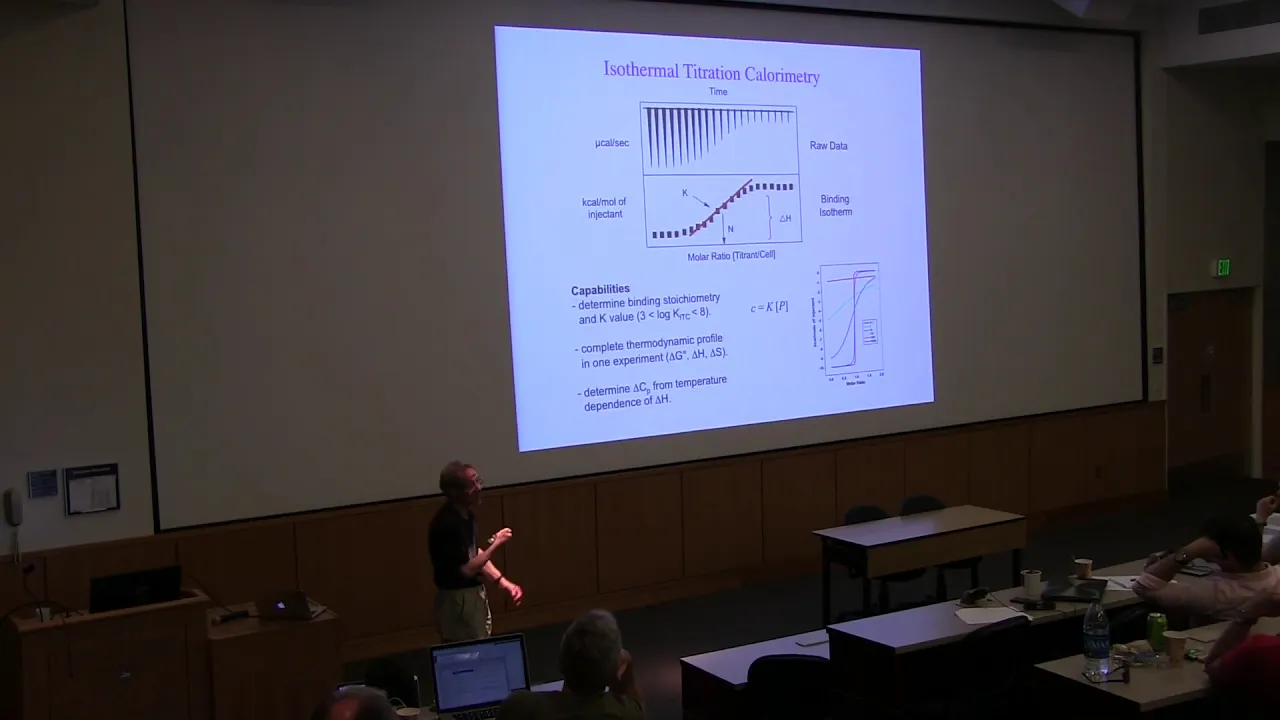
In this example the reaction is exothermic which means the sample cell becomes warmer than the reference cell and causes a downward peak in the signal.
In this case, less heat is given to the sample cell and as the temperature of the two cells comes back to being equal the signal then returns to its starting position.
A second small aliquot of ligand is injected into the sample cell and the Microcalorimeter compensates once again for the small heat change detected.
The molar ratio between the ligand and protein is gradually increased through a series of ligand injections.
The protein gets more and more saturated, less binding of the ligand occurs and the heat change starts to decrease until ultimately the sample cell contains an excess of ligand versus protein, bringing the reaction towards saturation.
The area of each peak is then integrated and plotted versus the molar ratio of ligand to protein.
The resulting isotherm can be fitted to a binding model from which the affinity, KD, is derived.
The molar ratio at the center of the binding isotherm gives us the reaction stoichiometry.
The plot shown here is an example of a one-to-one binding reaction.
The enthalpy, Delta H, is also derived directly from the isotherm and it's the amount of heat release per mole of ligand bound.
This means that in a single ITC experiment you now have obtained a wealth of information about your binding reaction which helps you understand the nature of the interaction and explore its thermodynamic drivers and all of this without using any labels.
Up Next
16:10
ITC Experiment Tutorial: Isothermal Titration Calorimetry Guide
@yalecbic
28.5K views•2011-12-30

12:54
Triumph of Orthodoxy Icon: Byzantine Art & History Explained
@BenCallan
2.1K views•2024-08-06
19:24
Dynamic Light Scattering (DLS) for Particle Size Analysis Basics
@MalvernPanalytical
81.3K views•2018-05-18

1:42
Game of Thrones Opening Credits: A Cinematic Analysis
@gameofthrones
46.3M views•2011-04-18
Related Study Plans & Knowledge Roadmaps
Structured learning paths in General & Interdisciplinary Studies
general-studies
Elevator Engineering: History, Physics & Cities
01From Hoists to Safety Brakes: The Dawn of Vertical Lift
02Hydraulic vs. Traction: The Engineering Physics of Elevators
03Modern Speed, Safety, and Algorithms
+ 2 more learning modules
12h5 modules
Explore Roadmap
general-studies
Rubber: Material Science, History & Geopolitics
01Origins of Natural Rubber & Mesoamerican History
02The Chemistry of Natural Rubber & Vulcanization
03The Geopolitics of the Rubber Boom & Colonization
+ 2 more learning modules
12h5 modules
Explore Roadmap
general-studies
Containerization: Evolution, Logistics & Trade
01Ancient Trade & Bulk Cargo: Amphorae to Barrels
02The Industrial Revolution & Cardboard Packaging
03The Containerization Revolution: Malcom McLean
+ 2 more learning modules
12h5 modules
Explore Roadmap
general-studies
Textile Tech: Evolution, Labor & Global Impact
01Pre-Industrial Textiles: Handloom & Cottage Industry
02Mechanization: The Spinning Jenny to the Power Loom
03The Factory System & Global Labor Transformation
+ 2 more learning modules
10h5 modules
Explore Roadmap