
![ВСЕСВІТ ПРОТИ КОМП'ЮТЕРІВ 😱 [VERITASIUM]](https://i.ytimg.com/vi/u3CetUR_1K8/maxresdefault.jpg)

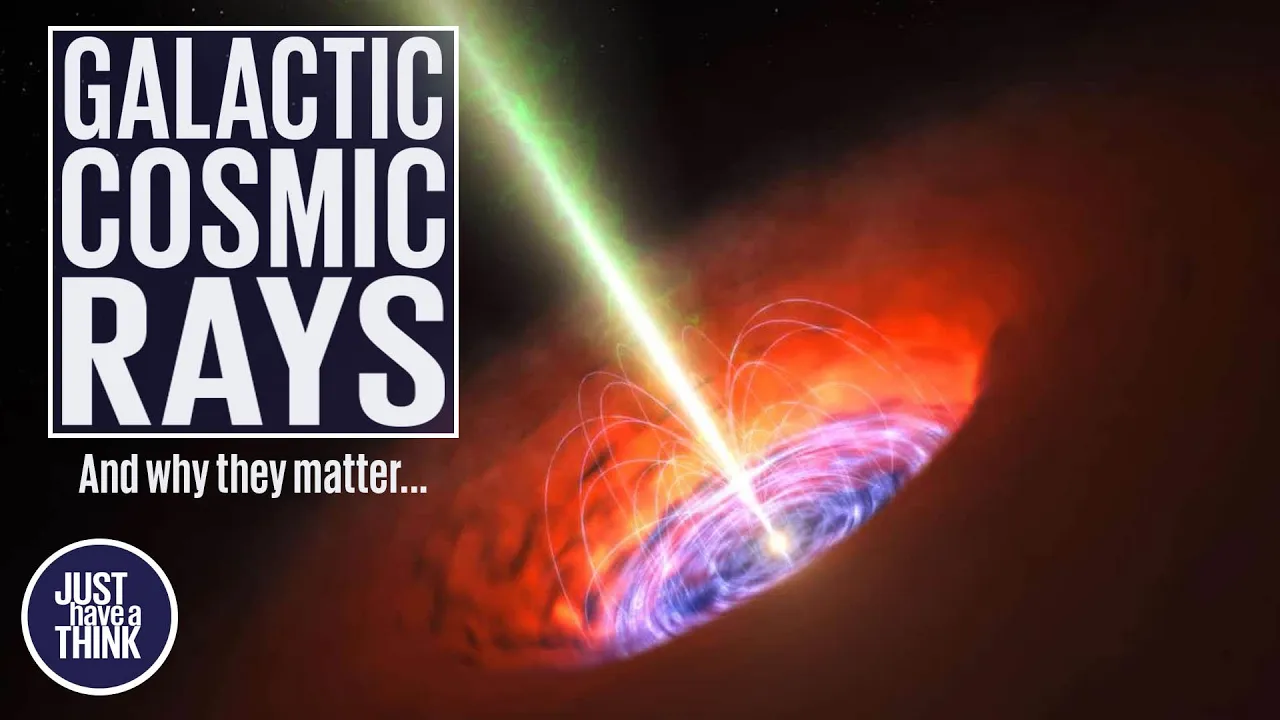















In 1991, an atomic nucleus struck Earth’s atmosphere with unprecedented energy, later named the Oh-My-God particle. This particle was not a ray, as cosmic rays are commonly misunderstood, but a single atomic nucleus traveling at nearly the speed of light. Unlike typical cosmic rays, which are low in energy and easily deflected, this nucleus possessed energy comparable to a macroscopic object, far exceeding any particle produced in human-made accelerators. It remains the most energetic cosmic ray ever detected. The event challenged existing theories about the sources and mechanisms capable of accelerating particles to such extreme energies. The origin of such particles remains a mystery, as their energy levels suggest they must come from extraordinarily powerful astrophysical phenomena, yet no definitive source has been identified. The detection of this particle highlights the limits of current understanding in high-energy astrophysics and underscores the rarity of such events. The video contextualizes this phenomenon within the broader study of cosmic rays, distinguishing them from electromagnetic radiation and emphasizing their particle nature. It does not explain the specific physical processes that could generate such energy, nor does it detail the detection methods used beyond noting the particle’s atmospheric impact. The Oh-My-God particle serves as a benchmark for extreme cosmic events and continues to drive research into the universe’s most violent accelerators.
The Oh-My-God Particle: Ultra-High Energy Cosmic Ray Mystery
Added:[MUSIC PLAYING] Long before the God particle, there is the Oh-My-God particle, a cosmic ray vastly more energetic than had ever been seen or was even thought possible.
These ultra-high energy cosmic rays still perplex scientists.
Where are these extra galactic death rays coming from?
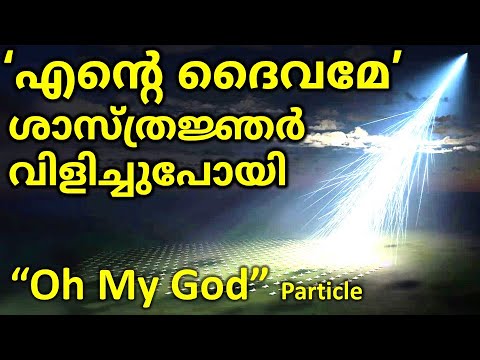
On October 15th, 1991, a single atomic nucleus travelling at 99.99999999999999999999951% of the speed of light crashed through our atmosphere and streaked across the Utah sky.
The nucleus quickly disintegrated into a shower of subatomic particles and lights.
That light was seen by the Fly's Eye Observatory, a collection of oversized tin cans that was an early experiment by the University of Utah to spot the highest energy cosmic rays in the universe.
Scientists analyzing the Fly's Eye data calculated that the cosmic ray responsible for this particular flash must have had a kinetic energy of 300 exaelectron volts.
That's 48 joules, an amount of energy we associate with macroscopic, not subatomic objects.
That single atomic nucleus carried as much kinetic energy as a good sized stone thrown at your head at 50 miles an hour.
The particle was dubbed the Oh-My-God particle.
Nothing like it had ever been seen before.
In fact, cosmic rays of that energy was supposed to be impossible.
Let's talk about cosmic rays for a second.
Radioactivity was discovered by Mary Curie and Henri Bacquerel at the end of the 1800s.
High energy particles, electrons, and small atomic nuclei, as well as gamma rays, are ejected when heavier radioactive elements decay.
We're bathed in a very low level of this radiation due to naturally occurring radioactive elements in the Earth.
Soon after its discovery, this ambient radioactive flux was found to weaken with height above the ground, because the radiation loses energy to air molecules.
But weirdly, above a certain height, this radiation starts to increase again.
Theodore Wulf first noticed this in 1909 when he took a detector to the top of the Eiffel Tower.
But the real proof came a few years later in 1912 when Victor Hess took some of Wulf's detectors on a hot air balloon ride.
Radiation levels increased with height.
And that meant there had to be a source of these high-energy particles somewhere above.
It turns out they were coming from space.
Cosmic rays had been discovered.
In the years following Hess's balloon ride, and even following the Fly's Eye detection of the Oh-My-God particle, we've come a long way in the art of catching cosmic rays.
They are elusive little critters.
You can't focus them into a camera like you can with light.
Also, as Hess discovered, most don't make it to the ground anyway.
For lower energy cosmic rays, one approach is to look for their Cherenkov radiation.
All cosmic rays are traveling at pretty close to the speed of light, but that's the speed of light in a vacuum.
Light travels slower in a medium like air.
So when cosmic rays enter the atmosphere, they're actually traveling faster than the new, lower speed of light.
This results in a burst of gamma rays, Cherenkov radiation, that is actually detectable from the ground.
Higher energy cosmic rays tend to obliterate themselves several kilometers above the ground in massive collisions with nuclei of air molecules.
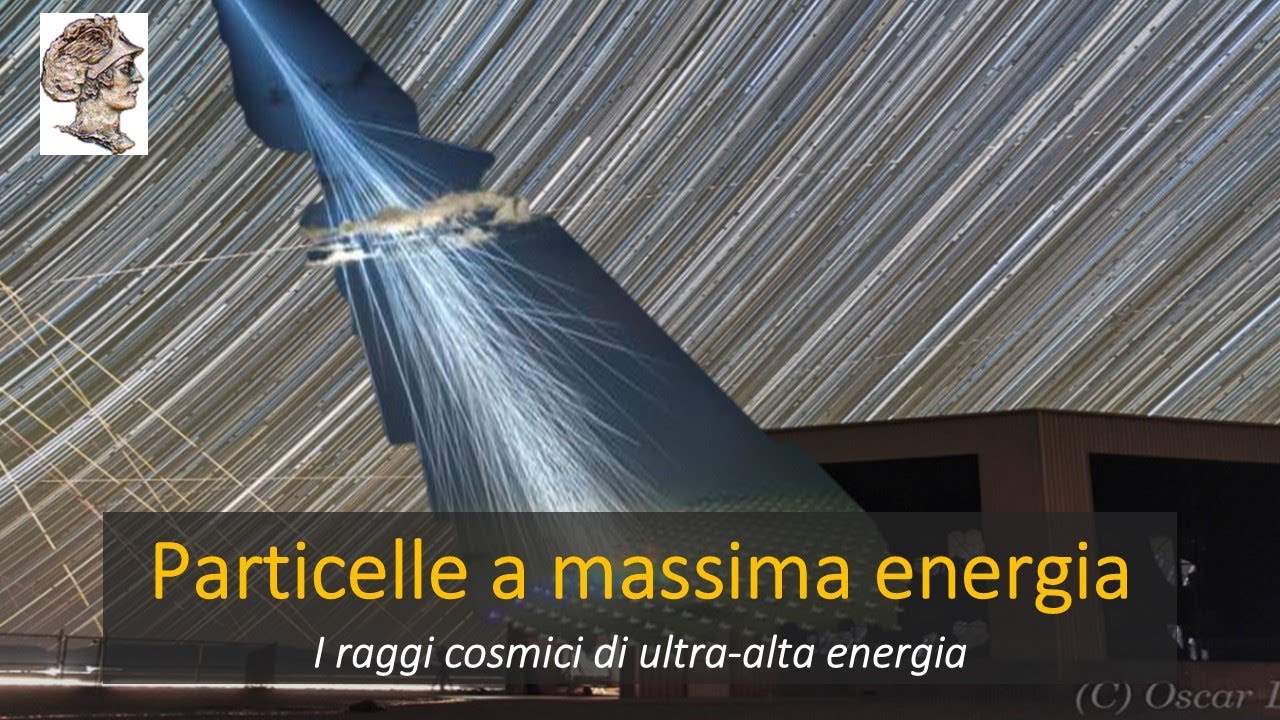
The result is a cascade of subatomic particles, the debris of the collision, that can spread itself out over several kilometers.
These cascades are called air showers, streams of charged particles cause the air to fluoresce, a glow that can be seen by specialized telescopes.
Many of the debris particles also reach the ground and can be detected there.
By analyzing the energies and trajectories of the debris, the collision that produced them and the nature of the original cosmic ray can be reconstructed.
Several facilities around the world are devoted to catching cosmic rays.
For example, the Pierre Auger Observatory in Argentina monitors a region around 3,000 square kilometers for high-energy cosmic rays.
It includes 1,660 giant tanks of water designed to see Cherenkov radiation when air shower particles pass through them, as well as telescopes to spot fluorescence in the air above, just like the old Fly's Eye.
The Fly's Eye itself has evolved into the Telescope Array Project.
It still uses upgraded fluorescence telescopes and has added scintillation detectors on the ground.
These are simple slabs of acrylic between metal plates designed to stop air shower particles and detect the light produced as they smack into nuclei within the slab.
By now, we have a pretty good census of the types of cosmic rays that tend to hit the Earth.
Most of them are single protons, the nuclei of hydrogen atoms.
And a fair number are helium nuclei.
But about 1% of cosmic rays are heavier nuclei, as heavier as iron.
We also see gamma rays and even anti-matter particles.
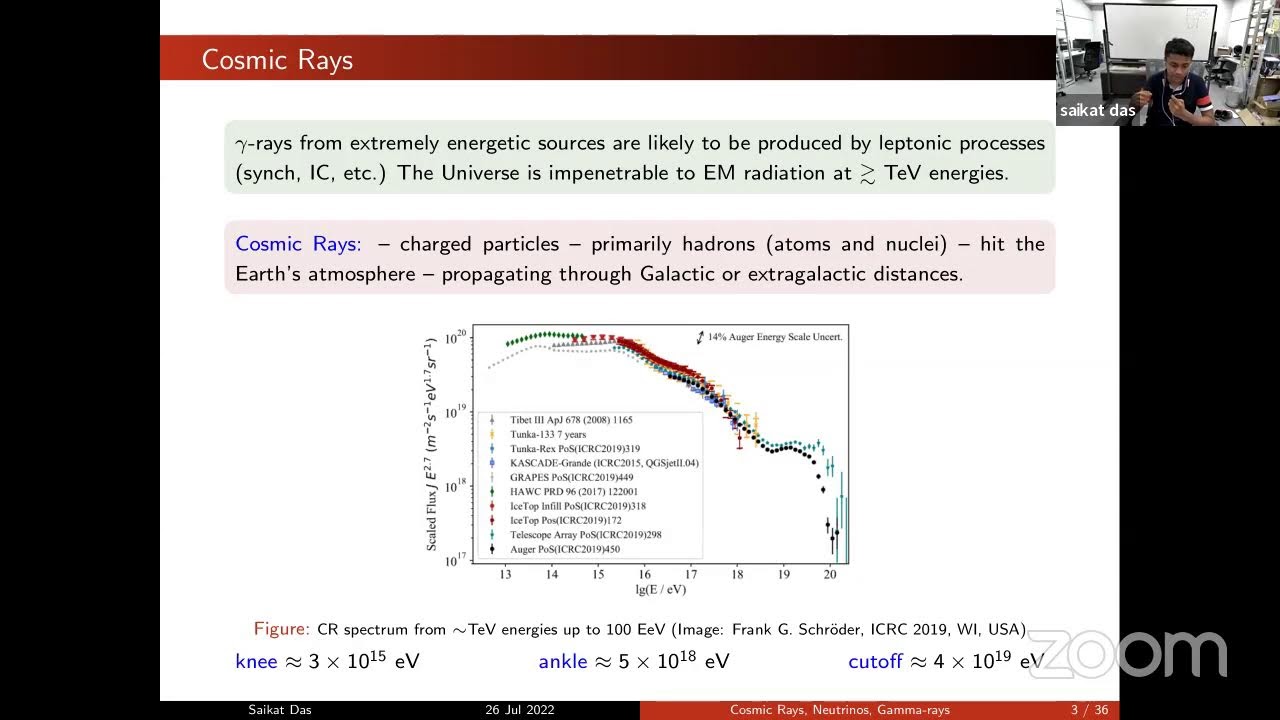
They come in at all energies, from a sickly billion electron volts at the low end to the crazy 10 to the power of 20 electron volts or higher, like the Oh-My-God particle.
The higher the energy, the rarer they are.
At the lowest energies, the cosmos flings one particle every second per square meter of the Earth's surface.
At energies up near that of the OMG particle, they are incredibly rare.
Only a handful have been spotted since the first, giving a rare estimate of 1 per square kilometer every couple of centuries.
So where do these things come from anyway?
To accelerate a particle to the energies of cosmic rays, you need a particle accelerator.
We build artificial ones on Earth using giant rings and powerful magnetic fields.
It turns out that the universe is full of natural particle accelerators.
For lower energy cosmic rays, it's believed that many, and perhaps most, come from supernova explosions within our galaxy.
When a star explodes, the expanding shock wave carries a strong magnetic field.
It can trap particles and accelerate them until they're energetic enough to escape the shock.
The higher the energy of the cosmic ray, though, the more likely it is to have originated from outside our galaxy.
The exact sources of these so-called extra galactic cosmic rays are more mysterious.
But they may come from magnetic acceleration in quasars, or perhaps they're blasted out in gamma ray bursts.
The most ridiculous cosmic rays, like the Oh-My-God particle, shouldn't exist at all.
See, the universe is basically opaque to particles with such high energies.
Empty space isn't really empty, it's full of low-energy microwave photons leftover from the heat glow of the very earliest of times.
This is the cosmic microwave background radiation.
We talk about it in this episode.
Cosmic rays with energies over 5 times 10 to the power of 19 electron volts, about 8 joules, can't travel far before smacking into these photons and giving up some of their energy.
This is the so-called Greisen-Zatsenpin-Kuzmin, or GZK, limit.
For years, it was thought that no cosmic ray could exceed it, except that the OMG particle was six times more energetic.
Only a very small number of these extreme energy cosmic rays have been seen since the OMG particle.
But those are perplexing.
See, they must have come from nearby, from close enough to our galaxy to not be wiped out by the CMB.
In Now I'm talking close by on cosmic scales, so within 1 to 200 million light years.
But at that distance, sources like quasars and gamma ray bursts should be very obvious.
Yet they seem to come from nowhere in particular.
We do see more than the average number coming from the direction of the Ursa Major cluster, but there's no obvious source there.
It's still a mystery exactly what produces these extreme cosmic rays and how close to us the sources are.
For cosmic ray astrophysicists, there's a giant invisible particle accelerating elephant in the room.
Part of the challenge in understanding cosmic rays is that our atmosphere and magnetic field shield the surface of the earth so well.
But we should count that as a blessing.
Apollo astronauts traveling outside Earth's magnetosphere reported strange flashes of light, which may be due to Cherenkov radiation from cosmic rays passing through their eye's vitreous humor, or from the particles hitting their optic nerves.
Even ISS astronauts are subjected to a significant radiation risk.
Along with solar outbursts, cosmic rays are one of the most serious obstacles to manned interplanetary travel.
As we figure out the origins of these particles, cosmic ray astronomy is becoming an increasingly powerful tool for investigating our amazing universe.
But even now, these particles are extremely useful.
The highest energy cosmic rays, like the Oh-My-God particle, generate collisions far more energetic than our largest particle accelerator, the Large Hadron Collider.
Studying cosmic rays may crack open the mysteries of both the largest and the smallest scales of space time.
This episode is brought to you by CuriosityStream, a subscription-streaming service that offers documentaries and nonfiction titles from some of the world's best filmmakers, including exclusive originals.
CuriosityStream's cosmic front series is one of my favorites.
It delves into some of the biggest mysteries and challenges facing astronomy and space exploration.
Get unlimited access starting at $2.99 a month.
And for our audience, the first two months are free if you sign up at CuriosityStream.com/spacetime and use the promo code spacetime during the sign-up process.
Last week, we talked about the prospects of building telescopes on the moon.
Let's see what you had to say.
Acousticpsychosis wonders why we're so obsessed with going to Mars when the moon makes such a perfect nearer station.
Well, I absolutely agree with this.
The moon is an incredible gift and we should make good and peaceful use of it.
Ragdala asks, who gives permission for moon landings.
In the case of the Moon Express program, the approval was from the US government.
But you're right, no one owns the moon.
So in principle, no one can regulate landing on it.
However, a country can regulate the activities of companies based in that country, even if those activities don't happen within national borders.
However, there are real legally binding regulations.
The United Nations developed the Treaty on Principles Governing the Activities of States in the Exploration and Use of Outer Space, including the Moon and Other Celestial Bodies, or, the Outer Space Treaty, which the United States has ratified.
It restricts the use of space for peaceful purposes, but otherwise grants free access to nation states.
That doesn't mean a nation state can't impose legal restrictions on its own citizens.
David Connolly emailed to remind us that the Constellation Program and its Ares rockets was discontinued in 2009 in favor of the Space Launch System.
Yet, and I even commiserated with rocket scientist friends when that happened.
Don't you hate it when knowing something doesn't translate to remembering you know it when it really matters?
Oh well, a few people wondered if I was sick during the comment responses of the last episode and wished me a speedy recovery.
Well, thanks guys.
I am feeling a lot better.
I shot the episode you just watched that same day, so apologies for the voice.
And Alexander Sedov and others wondered why I was wearing cowboy underwear in that episode.
Dude, I was sick.
You're lucky I got out of bed at all.
Having any type of underwear on was a major victory.
Up Next

How Supernovas Act as Cosmic Particle Accelerators
@pbsspacetime
295.5K views•2024-05-30

21cm Hyperfine Transition in Neutral Hydrogen: Radio Astronomy Basics
@AaronRobertParsons
12.4K views•2011-10-13
Understanding Geodesics and Curvature in Spacetime: Clarifying Parallel Transport
@pbsspacetime
341.3K views•2015-07-08

Entropy and the Second Law of Thermodynamics Explained
@veritasium
27.5M views•2023-07-01
Related Study Plans & Knowledge Roadmaps
Structured learning paths in Physics