

















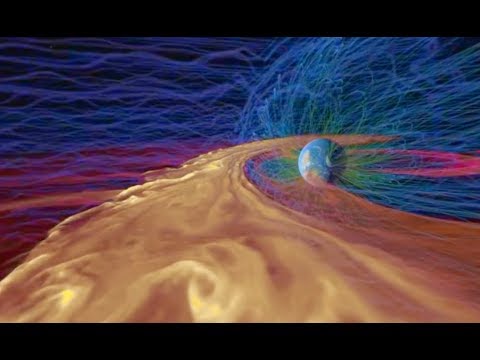

Supernovas act as the universe's largest particle accelerators through the Fermi acceleration mechanism, where shockwaves from exploding stars interact with magnetic fields to accelerate particles to energies up to 10^17 electron volts; this process involves protons bouncing randomly through tangled magnetic fields at the shockfront, gaining energy with each deflection until reaching extreme velocities, though the most energetic cosmic rays may originate from even more powerful sources like active galactic nuclei or galaxy-scale shocks.
How Supernovas Act as Cosmic Particle Accelerators
Added:The life cycle of massive stars, particularly how they collapse and end in supernova explosions, creating rapidly expanding remnants.
The definition and composition of cosmic rays, which are high-energy charged particles (primarily protons and atomic nuclei) traveling through space.
Basic principles of electromagnetism, specifically how moving charged particles interact with and are deflected by magnetic fields.
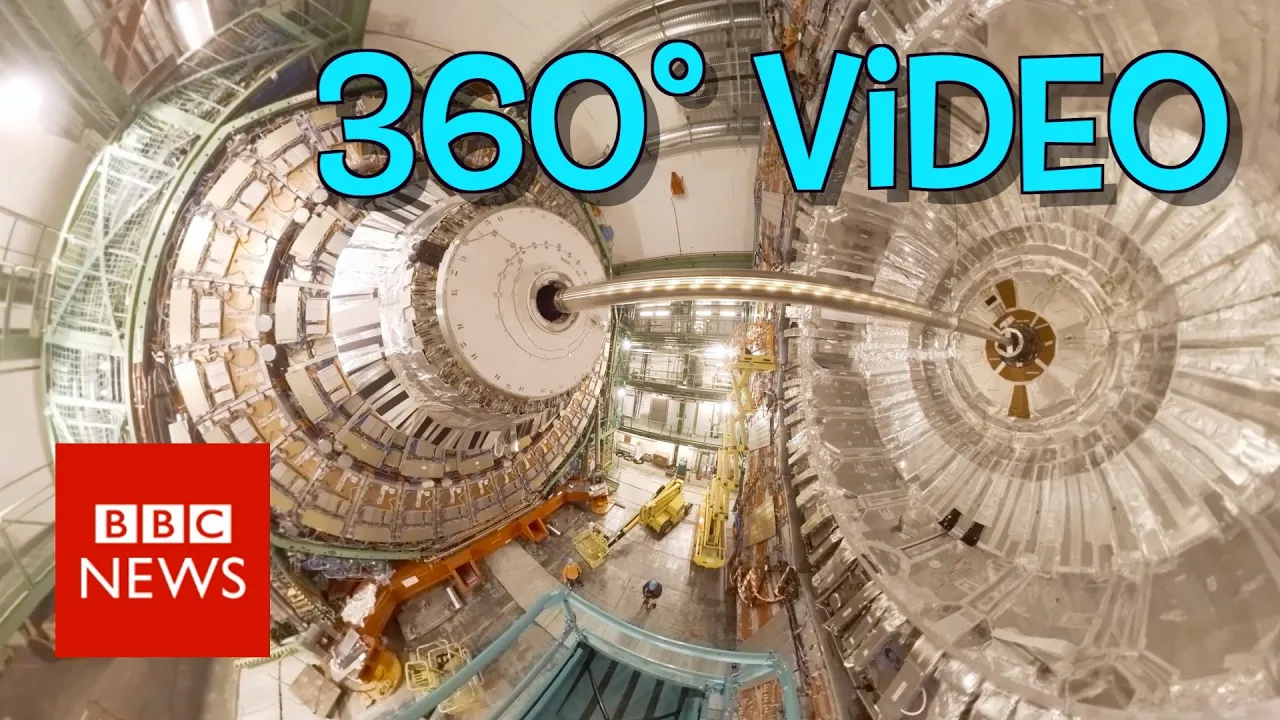
An understanding of human-made particle accelerators, such as the Large Hadron Collider (LHC), to provide a baseline for comparing energy scales.
Diffusive Shock Acceleration (Fermi Acceleration), the primary physical mechanism of particle acceleration across shockwaves in supernova remnants.
The GZK (Greisen-Zatsepin-Kuzmin) limit and Ultra-High-Energy Cosmic Rays (UHECRs), exploring sources beyond our galaxy like Active Galactic Nuclei (AGNs).
Observational techniques in cosmic ray astronomy, including detecting extensive air showers using ground-based observatories like the Pierre Auger Observatory.
The role of cosmic rays in astrochemistry, space weather, and their biological and technological impacts on Earth and space missions.
295.5K views12.6Klikes13:49Original Release: 2024-05-30
Hey Everyone. Before we get to the episode, just a heads up we have two new items at the merch store. There’s a link in the description Cern's Large Hadron Collider routinely collides particles at energies equivalent to a fraction of a second after the Big Bang. If this worries you, then the following fact will either put you at ease or scare the hell out of you. And that's that a particle with the energy of an LHC collision hits every square kilometer of the Earth every single second.
And we only relatively recently figured out where these cosmic rays are coming from.
—- In 1912, Victor Hess took a hot-air balloon ride and got a Nobel prize. Hess had equipped the balloon with devices sensitive to electrically charged particles. As the balloon rose, particle detections increased, quadrupling by the maximum altitude of 5 kilometers. Hess wondering if these might be charged particles coming from the Sun, and so repeated the experiment at night and during a solar eclipse. The results were the same. He concluded that the vastness of space itself must be pelting us with energetic charged particles. In this way cosmic rays were discovered. Hess’s Nobel followed a couple of decades later.
Now we routinely measure cosmic rays with a wide range of advanced observatories—enormous arrays of ground detectors like the Pierre Auger Observatory in Argentina, or orbiting detectors on satellites and the ISS. But for a long time the mystery only intensified. We learned that the energies of cosmic rays span 12 orders of magnitude, up to energies 10 million times that of the Large Hadron Collider. The most energetic of all—the so-called oh-my-god particle—had the kinetic energy of a well-thrown baseball.
We did an episode on the oh-my-god particle a while back, but didn’t get into the awesome details of how cosmic rays are really produced. And we should probably cover that, because the origin of cosmic rays remained a mystery for a century after they were discovered. It was only a decade or so ago that scientists came to a general agreement about the origin of most cosmic rays—the ones without the most ridiculous energies mostly come from exploding stars. From supernovae.
We still don’t know about the more energetic ones, but it turns out that by understanding the complex process behind the supernova-generated rays we can come up with possible mechanisms for the rest.
So let’s see how exploding stars can act like particle accelerators. For that we need two things: shockwaves, and magnetic fields.
Shockwaves are a big part of what makes an explosion an explosion, versus say a bunch of hot gas expanding. They’re also a key ingredient in making cosmic rays. We’ll start with sound waves before we get to shockwaves.
These are pressure waves—oscillating patterns of high and low pressure and density. We have some initial event that compresses the air, creating a high density region. That region pushes away surrounding air molecules, creating a new high density region down the path, which pushes on the following region, and so on. The wave propagates at the speed of sound while individual air molecules just move back and forth on the spot.
A shockwave is what happens when the initial event causes the particles to move faster than the speed of sound in whatever medium they’re in. That means the particles will outpace any sound waves, and instead of bouncing backwards will continue on, sweeping up the material they pass through.
Familiar sources of shockwaves include supersonic vehicles or meteors, which push the air ahead faster than the speed of sound. Or any explosion in which the expanding material is supersonic.
Shockwaves in space are pretty common, both from explosions and from objects moving faster than the local speed of sound. Although it’s generally true that in space no one can hear you scream, that doesn’t mean there isn’t sound in space. The gas between the stars may be incredibly diffuse, but it’s still there, which means it can support sound waves and so can also experience shockwaves.
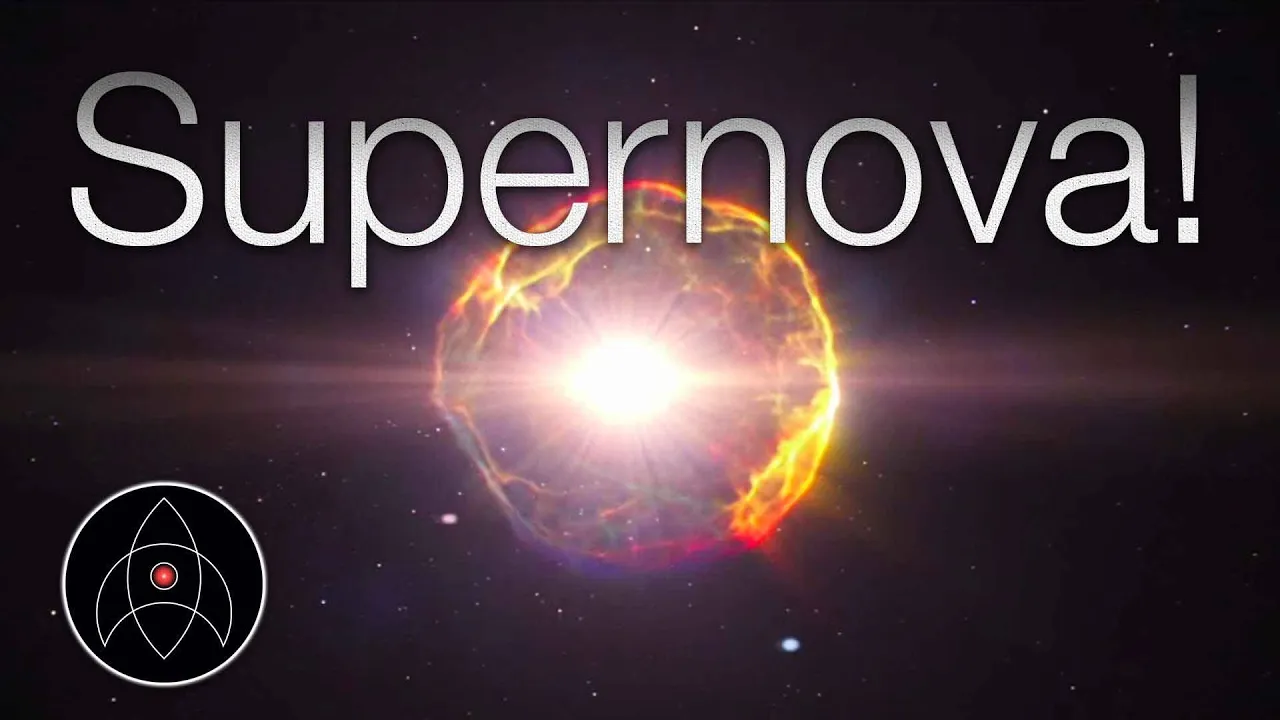
Perhaps the most famous type of space explosion is the supernova. When the central core of a massive star has fused itself into a giant ball of iron and nickel, it collapses into a neutron star and releases a prodigious amount of energy in neutrinos. These sweep up the outer layers of the collapsing core, sending them out a few percent the speed of light.
This is much faster than the speed of sound in the interstellar medium, so we have a shockwave.
But a few percent lightspeed is not the 99.999 etc % light speed of some of the cosmic rays we’ve seen. It was Enrico Fermi who figured out how supernova shockwaves can accelerate particles to vastly higher speeds than they themselves traveled. This is the same Fermi who was one of the founders of quantum mechanics, built the first nuclear reactor, and wondered where all the aliens are.
At around the same time that we were building our first particle accelerators on Earth using powerful magnetic fields, Fermi realized that magnetic fields might also do the trick in supernovae. We all know that the Sun has a magnetic field. When that field gets tangled up, like it is right now, we get magnetic storms. These frequently erupt, spewing out knots of magnetic field and energetic plasma into the solar system.
So if the Sun can do that over and over .. imagine what an exploding star can do.
Let’s think about magnetism for a minute. Moving electric charges make magnetic fields with field lines that loop around the direction of motion. And magnetic fields generate a force on moving charged particles that cause those particles to circle around the field lines. The net result is that magnetic fields and the currents they generate are self-reinforcing. In a plasma, magnetic fields sort of act like rebar in concrete, reinforcing the plasma, giving it inertia, and also shaping it.
So when a star explodes, its magnetic field doesn’t just vanish. Some gets locked in the resulting neutron star or black hole, but the rest is dragged outwards with the rest of the explosion. The expanding shockwave is a tsunami of both charged particles and of intense magnetic field.
In an explosion in the atmosphere, the shockfront high-density of air smashes into the lower-density air ahead of it, dragging it into the propagating front. But the interstellar medium is so diffuse that we don’t expect a lot of collisions with an oncoming supernova front.
That would mean there is no shockwave if it weren’t for magnetic fields—but not just those in the shockfront. Weak tendrils of magnetic field suffuse the entire galaxy, weaving through the interstellar medium. Our supernova shockfront first grabs this ISM magnetic field and drags it forward, and this in turn drags the ISM plasma. We call these collisionless shocks.
Let’s think about the two components of the shockfront. We have the matter. Material from the explosion is coming in fast. It slows down in the shockfront because this is where we’re colliding with the interstellar medium. Meanwhile material in the interstellar medium is being swept up and accelerated as it enters the front. So if you’re a proton traveling with the shockfront, in your reference frame you actually see material rushing in towards you from both sides.
Next we have the magnetic fields. Behind you there’s the magnetic field from the explosion, which piles up as it slows down approaching the front, and ahead you have the weaker interstellar field which is also piling up. These result in two walls of magnetic turbulence.
So our proton is chilling in the shockfront and bounces its way out, forwards or backwards, it doesn’t matter. There it finds itself in a magnetic tangle that’s effectively moving towards it. It gets deflected back into the front and is likely to pick up a bit of energy in the process due to the relative motion of the deflecting field. And then it goes out the other side of the front and gets turned around again, gaining a little more energy. This can happen many, many times, accelerating the proton to enormous speeds.
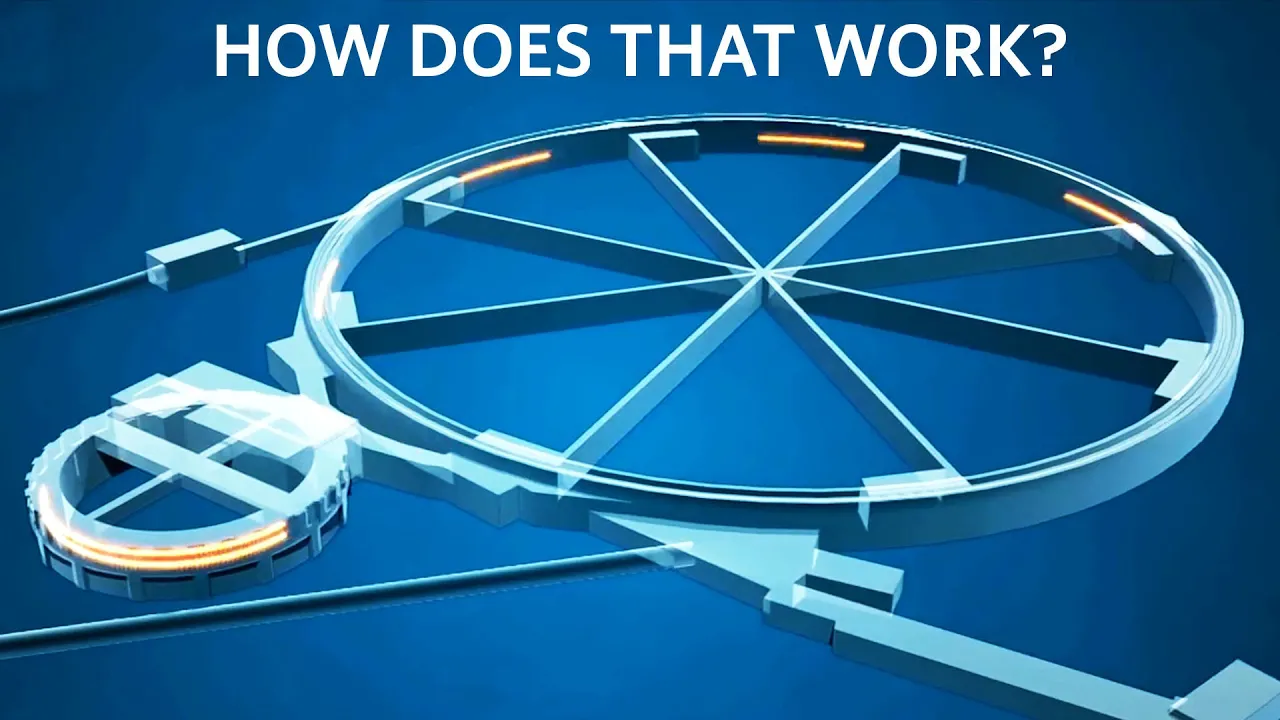
This is the Fermi Acceleration Mechanism, also known as diffusive acceleration because the particles diffuse or bounce randomly through the shock and tangled fields This is how we turn a supernova into a particle accelerator. In fact the resemblance to an artificial particle accelerator is stronger than just the fact that they both use magnetic fields. Why is the Large Hadron Collider so … what’s the word … Large? It’s because larger loops can keep hold of faster charged particles. The turn radius of a particle in a magnetic field is called the Larmor radius—or gyroradius or synchrotron radius—same thing. This radius increases with the speed of the particle and decreases with the strength of the magnetic field.
Supernova remnants have magnetic fields not that different to the Earth’s—really weak compared to a typical particle accelerator. But they can still accelerate particles to a large fraction of the speed of light. The combination of weak fields and high speeds requires an extremely large Larmor radius. And so for supernova remnants to be good particles accelerators— without strong fields, they just need to be ridiculously enormous. The turbulent regions can extend many times the width of our solar system, while the overall radii of these expanding shells reach several light years. Plenty of space for cosmic rays to bounce their way to extreme eneregies.
Supernovae can energize a proton up to 10^17 electron volts. A supernova-accelerated iron nucleus can reach about 10 times that energy. But the maximum energy of a supernova-accelerated particle is still around 100 times lower than the highest energy cosmic rays. So where do the rest come from?
It’s not so easy to tell where any given cosmic ray comes from because we usually don’t see them directly. They tend to collide with molecules in the upper atmosphere and send showers of particles towards the ground. But by collecting those particles we can get a rough sense of the origin of a cosmic ray.
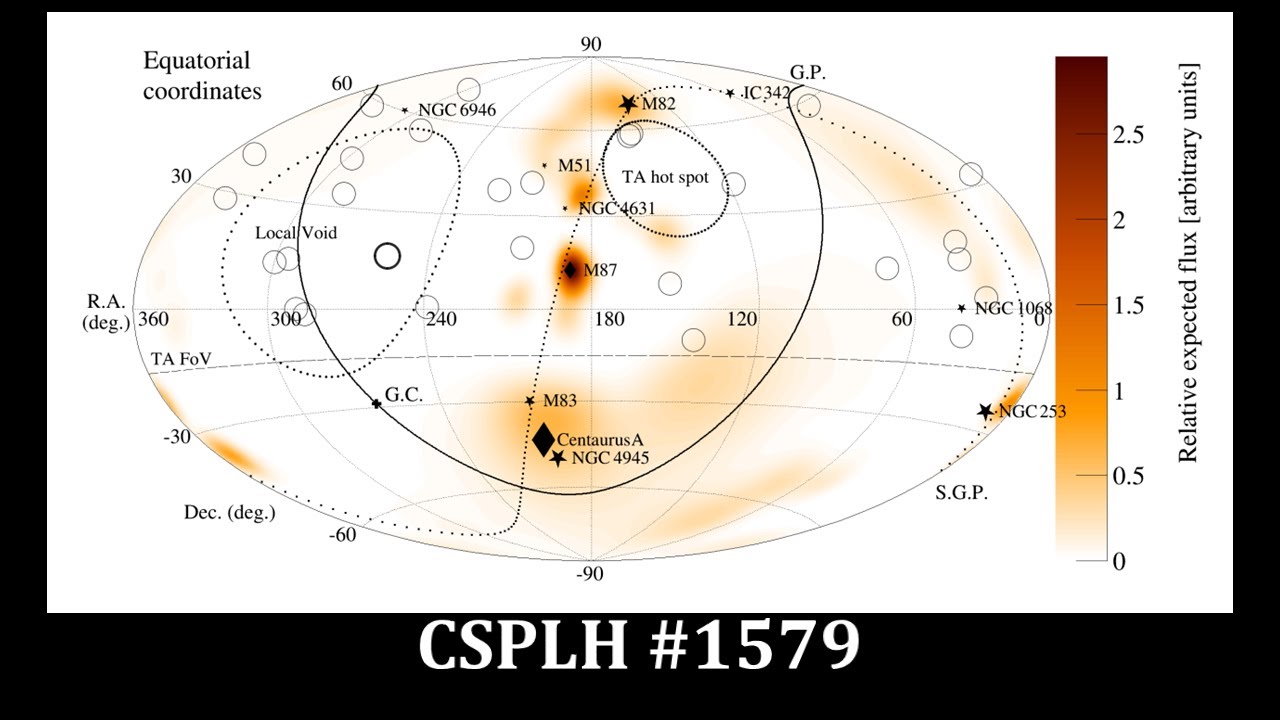
The Pierre Auger Observatory is a giant cosmic ray detector that spans 3000 square kilometers in western Argentina. It has found that the origins of ultra high energy cosmic rays are scattered across the sky. If they were from sources within the Milky Way then we’d expect a concentration in the plane of the Milky Way’s disk. We can’t see exactly where these particles are coming from, however their origin does appear to be correlated with the large-scale structure of the universe. They’re likely coming from other galaxies.
There are many potential origins for the highest energy cosmic rays—perhaps in the extreme magnetic fields around magnetars or around the supermassive black holes in active galactic nuclei. These cosmic particle accelerators look a bit more like traditional synchrotron accelerators like the LHC.
But there’s also a strong possibility that these cosmic rays also come from scaled-up versions of the supernova shockwave. Shocks are observed everywhere in the universe, and on all scales.
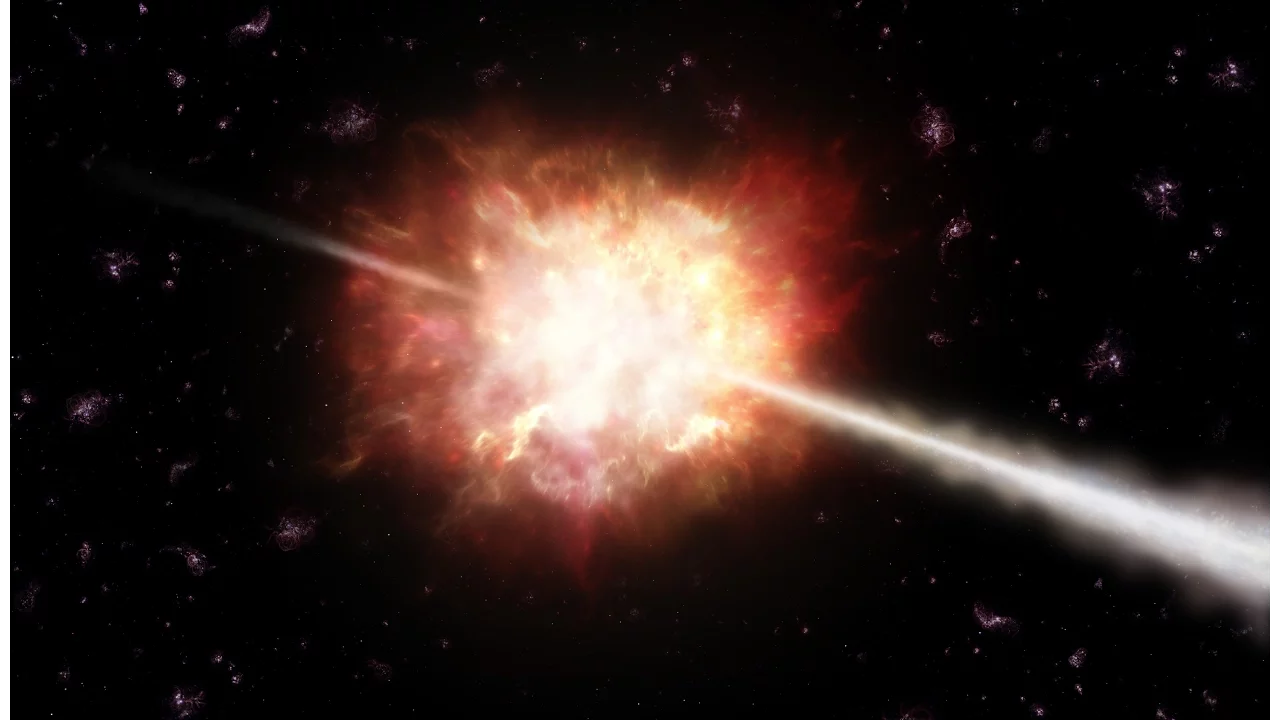
Enormous shockwaves result from collisions between galaxies, from the most extreme stellar explosions like hypernovae or gamma-ray bursts, and from the jets produced by active galactic nuclei.
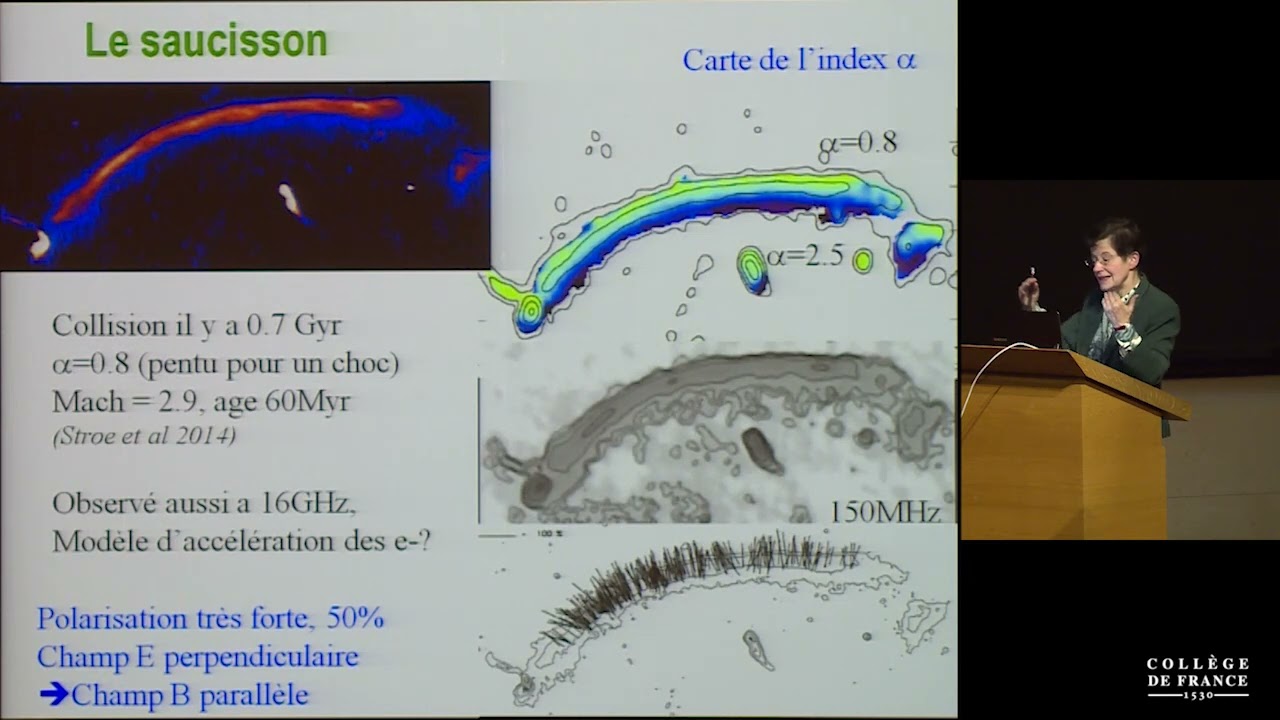
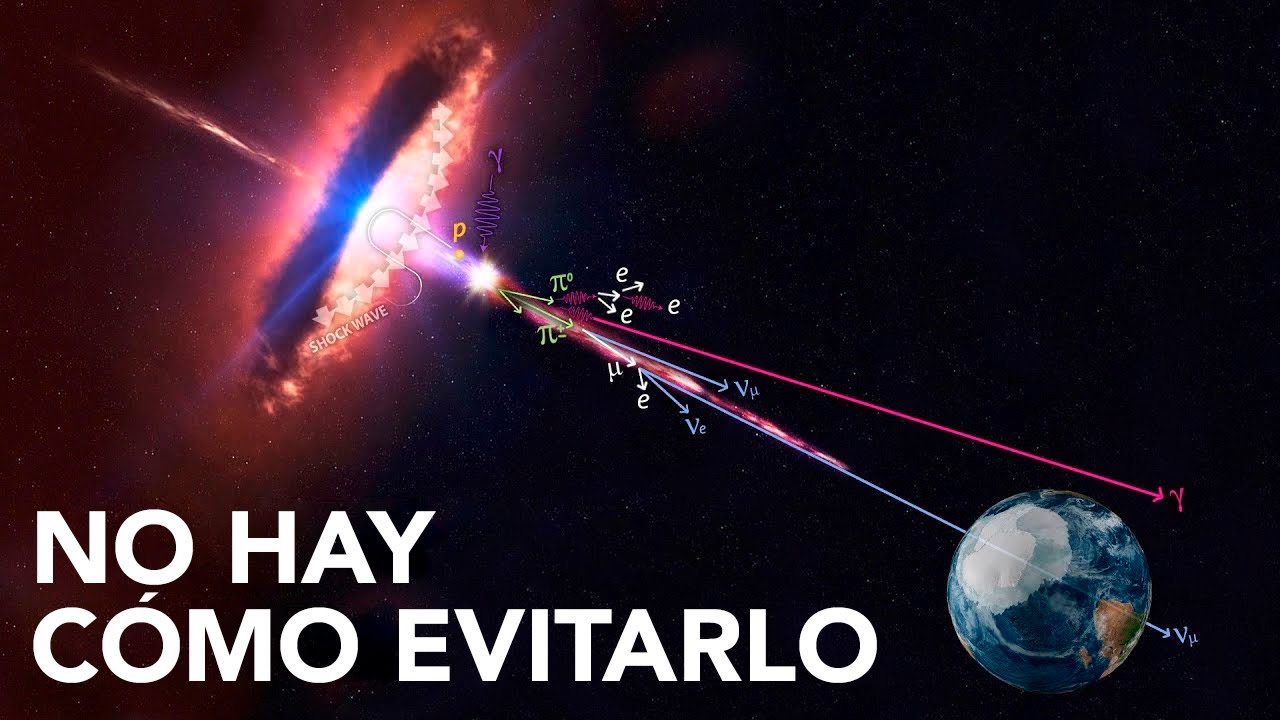
This last one is especially promising. When a feeding and magnetized supermassive black hole sends jets of material punching through its surrounding galaxies, shockwaves are inevitable, and the Fermi mechanism will give us cosmic rays. And when those jets punch into the intergalactic medium beyond the galaxy, they can bloom into giant lobes of diffuse plasma and magnetic field.
Although magnetic fields are weak in these lobes, they span hundreds of thousands of light years, and so are able to accelerate cosmic rays to the highest possible energies.
It took a balloon ride and a century of sciencing to be fairly sure that exploding stars are bombarding the earth with cosmic rays. It’s going to take a bit longer to fully understand the most energetic of these particles. Whether they’ll turn out to be from magnetars or supermassive black holes or galaxy-scale magnetized shockwaves, the search is now on for the largest particle accelerators in all of space time.
How do you do fellow simulations? Before we end the episode, I just wanted to let you know that we are adding a couple new permanent items to the merch store. Back by popular demand is the return of the Be Quiet The Devs Will Notice T-shirt, which now also available for the first time as a hoodie. And we also have our new How Do You Do fellow simulations, T-shirt and sweatshirt. For those of you who'd like to blend more seamlessly into the simulation.
Whatever your stance is on your virtual existence, we've got you covered at our very virtual marketplace over at pbsspacetime.com/shop.
Up Next

116:48
Special Relativity Lecture 6: Electrodynamics & Tensor Notation
@stanford
243.4K views•2012-05-31

12:53
21cm Hyperfine Transition in Neutral Hydrogen: Radio Astronomy Basics
@AaronRobertParsons
12.4K views•2011-10-13
6:59
Understanding Geodesics and Curvature in Spacetime: Clarifying Parallel Transport
@pbsspacetime
341.3K views•2015-07-08

27:14
Entropy and the Second Law of Thermodynamics Explained
@veritasium
27.5M views•2023-07-01
Related Study Plans & Knowledge Roadmaps
Structured learning paths in Physics
physics
Nuclear Physics (Decay, Fission & Reactors)
01Atomic Structure and the Binding Force
02Radioactive Decay and Half-Life
03Nuclear Fission Mechanics and Chain Reactions
+ 2 more learning modules
12h5 modules
Explore Roadmap
physics
Soft Matter (Polymers, Colloids & Rheology)
01Foundations of Soft Matter & Thermal Forces
02Polymer Physics and Macromolecules
03Colloids, Surfactants, and Self-Assembly
+ 2 more learning modules
38h5 modules
Explore Roadmap
physics
Analytical Mechanics: Lagrangian & Hamiltonian
01Mathematical Foundations: Calculus of Variations
02From Newtonian Mechanics to Constraint Dynamics
03The Principle of Least Action & Lagrangian Mechanics
+ 3 more learning modules
28h6 modules
Explore Roadmap
physics
General Relativity (Spacetime & Cosmology)
01Foundations of Relativity: Special Relativity
02The Geometry of Spacetime: Equivalence Principle & Curvature
03Einstein's Field Equations: The Mathematics of Gravity
+ 2 more learning modules
55h5 modules
Explore Roadmap