






















Intermolecular forces are attractive forces between molecules that determine physical properties like boiling point; they include dipole-dipole interactions (attraction between polar molecules with partial charges), hydrogen bonding (a stronger dipole-dipole interaction where hydrogen bonds to F, O, or N), and London dispersion forces (weakest forces arising from temporary electron fluctuations); molecular polarity depends on electronegativity differences and molecular geometry, with more polar molecules having stronger intermolecular attractions and higher boiling points.
Intermolecular Forces in Biology: Khan Academy Chemistry of Life
Added:Understanding electronegativity and how differences in it lead to polar and nonpolar covalent bonds.
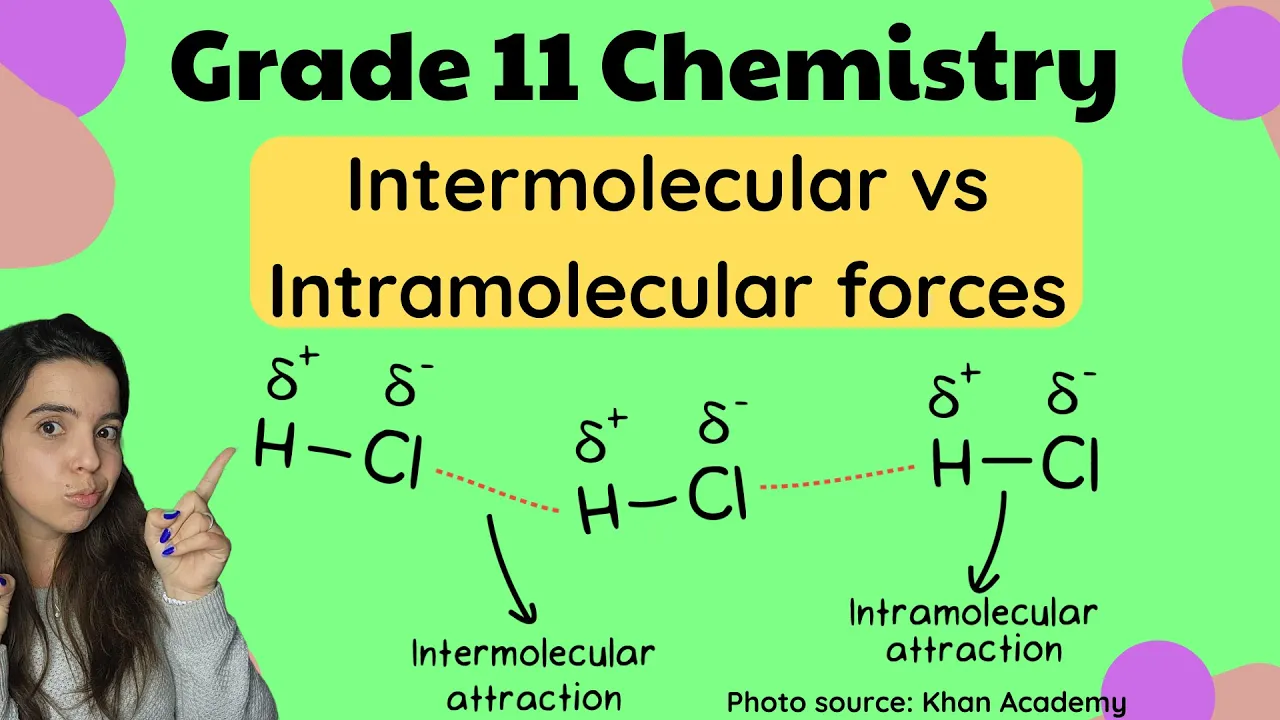
The distinction between intramolecular forces (chemical bonds holding an individual molecule together) and intermolecular forces (attractions between separate molecules).
Basic molecular geometry and how the 3D shape of a molecule determines whether it has a net dipole moment.
The fundamental principle of electrostatic attraction, specifically that opposite partial charges attract and like charges repel.
The role of hydrogen bonding in stabilizing the secondary (alpha-helices and beta-sheets) and tertiary structures of proteins.
How complementary base pairing in DNA is facilitated and stabilized by specific hydrogen bonds, and how these weak forces allow for DNA replication.
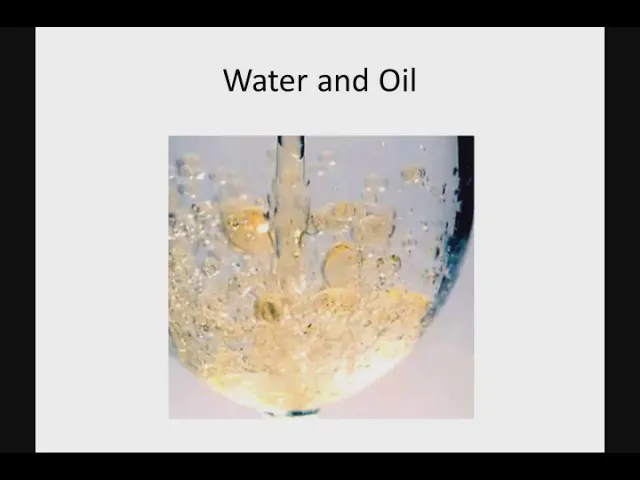
The unique physical properties of water (such as cohesion, adhesion, high specific heat, and surface tension) that are critical to sustaining life on Earth.
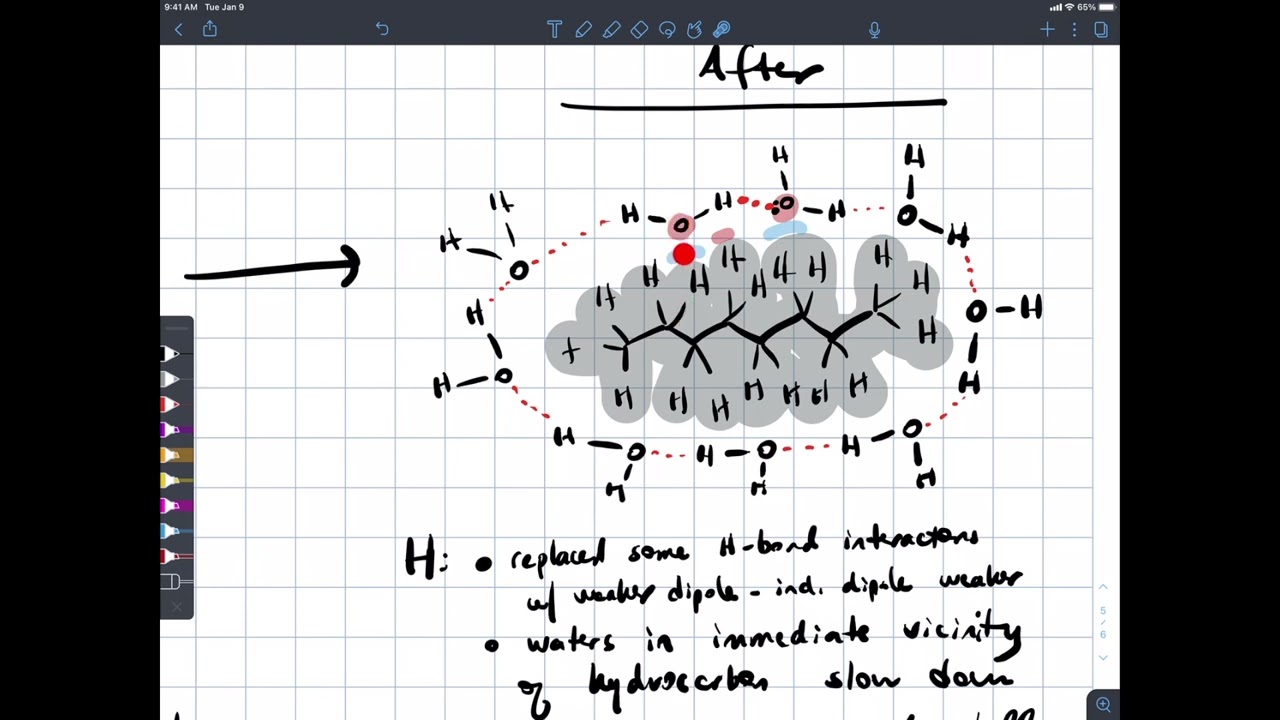
The hydrophobic effect and how intermolecular forces drive the self-assembly of lipid bilayers in cellular membranes.
718K views1.4Klikes8:35Original Release: 2013-10-30
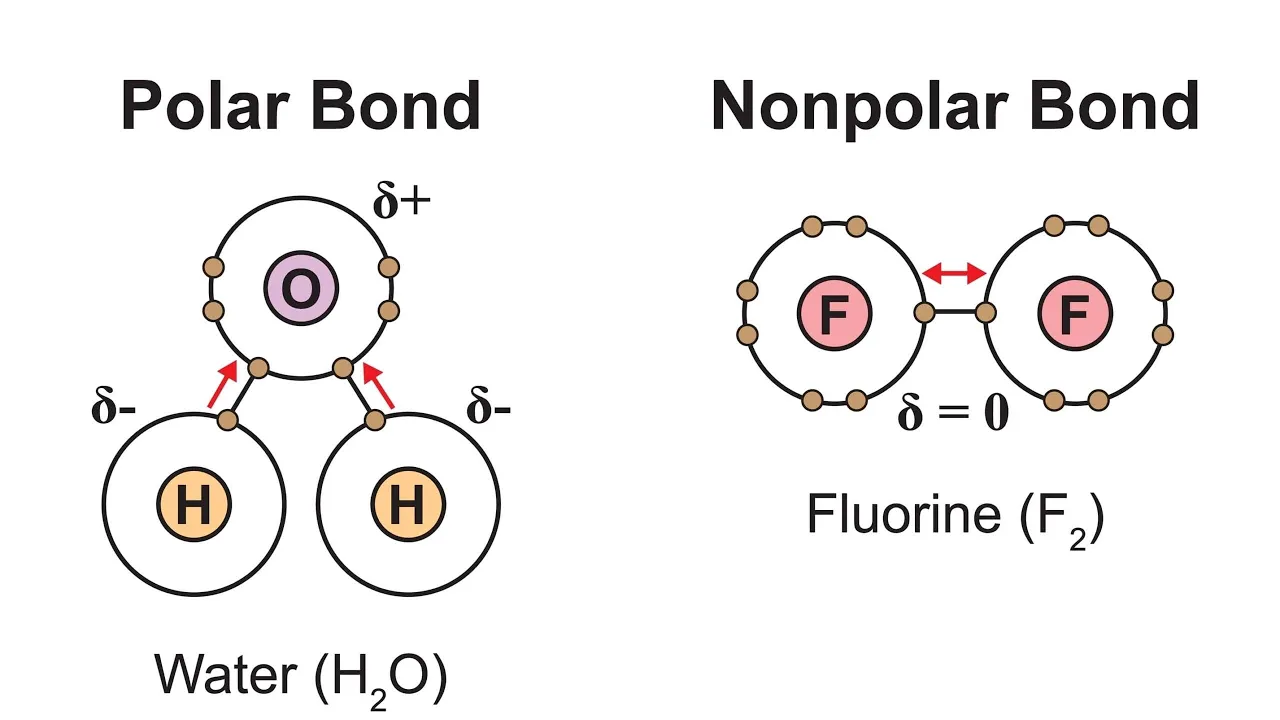
In the video on electronegativity, we learned how to determine whether a covalent bond is polar or nonpolar.
In this video, we're going to see how we figure out whether molecules are polar or nonpolar and also how to apply that polarity to what we call intermolecular forces.
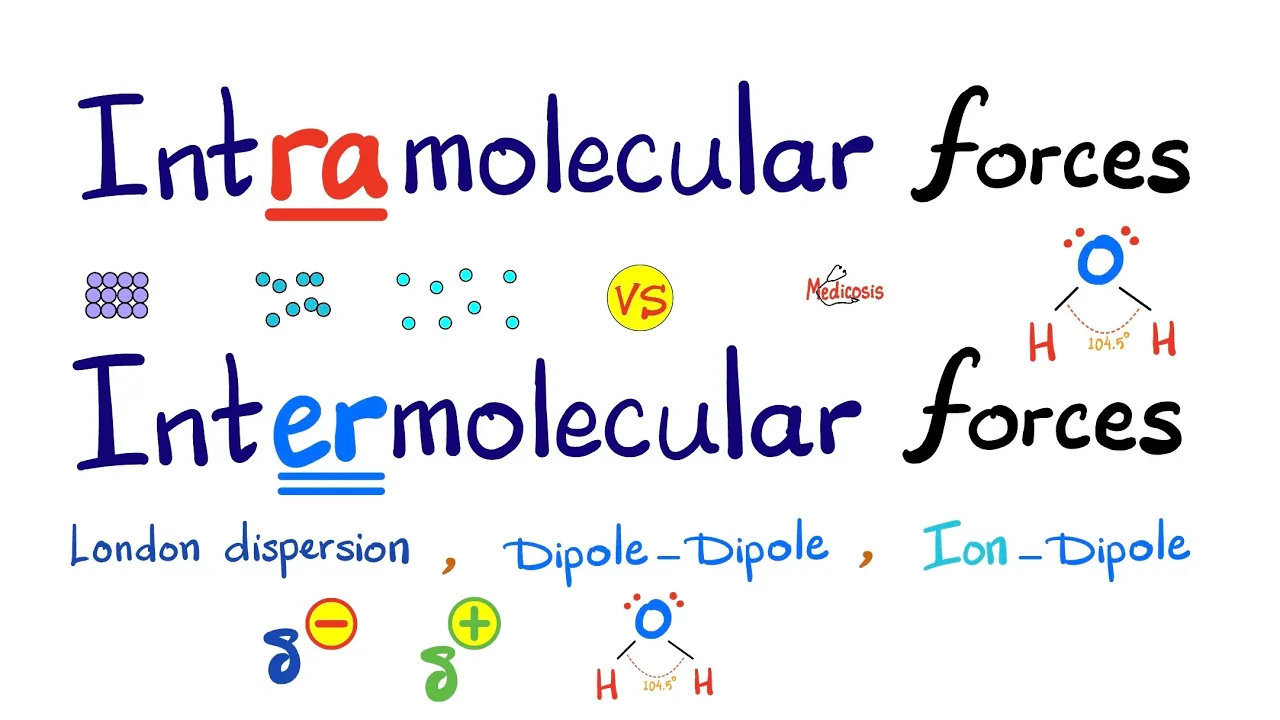
Intermolecular forces are the forces that are between molecules.
And so that's different from an intramolecular force, which is the force within a molecule.
So a force within a molecule would be something like the covalent bond.
And an intermolecular force would be the force that are between molecules.
And so let's look at the first intermolecular force.
It's called a dipole-dipole interaction.
And let's analyze why it has that name.
If I look at one of these molecules of acetone here and I focus in on the carbon that's double bonded to the oxygen, I know that oxygen is more electronegative than carbon.
And so we have four electrons in this double bond between the carbon and the oxygen.
So I'll try to highlight them right here.
And since oxygen is more electronegative, oxygen is going to pull those electrons closer to it, therefore giving oxygen a partial negative charge.
Those electrons in yellow are moving away from this carbon.
So the carbon's losing a little bit of electron density, and this carbon is becoming partially positive like that.
And so for this molecule, we're going to get a separation of charge, a positive and a negative charge.
So we have a polarized double bond situation here.
We also have a polarized molecule.
And so there's two different poles, a negative and a positive pole here.
And so we say that this is a polar molecule.
So acetone is a relatively polar molecule.
The same thing happens to this acetone molecule down here.
So we get a partial negative, and we get a partial positive.
So this is a polar molecule as well.
It has two poles.
So we call this a dipole.
So each molecule has a dipole moment.
And because each molecule is polar and has a separation of positive and negative charge, in organic chemistry we know that opposite charges attract, right?
So this negatively charged oxygen is going to be attracted to this positively charged carbon.
And so there's going to be an electrostatic attraction between those two molecules.
And that's what's going to hold these two molecules together.
And you would therefore need energy if you were to try to pull them apart.
And so the boiling point of acetone turns out to be approximately 56 degrees Celsius.
And since room temperature is between 20 and 25, at room temperature we have not reached the boiling point of acetone.
And therefore, acetone is still a liquid.
So at room temperature and pressure, acetone is a liquid.
And it has to do with the intermolecular force of dipole-dipole interactions holding those molecules together.
And the intermolecular force, in turn, depends on the electronegativity.
Let's look at another intermolecular force, and this one's called hydrogen bonding.
So here we have two water molecules.
And once again, if I think about these electrons here, which are between the oxygen and the hydrogen, I know oxygen's more electronegative than hydrogen.
So oxygen's going to pull those electrons closer to it, giving the oxygen a partial negative charge like that.
The hydrogen is losing a little bit of electron density, therefore becoming partially positive.
The same situation exists in the water molecule down here.
So we have a partial negative, and we have a partial positive.
And so like the last example, we can see there's going to be some sort of electrostatic attraction between those opposite charges, between the negatively partially charged oxygen, and the partially positive hydrogen like that.
And so this is a polar molecule.
Of course, water is a polar molecule.
And so you would think that this would be an example of dipole-dipole interaction.
And it is, except in this case it's an even stronger version of dipole-dipole interaction that we call hydrogen bonding.
So at one time it was thought that it was possible for hydrogen to form an extra bond.
And that's where the term originally comes from.
But of course, it's not an actual intramolecular force.
We're talking about an intermolecular force.
But it is the strongest intermolecular force.
The way to recognize when hydrogen bonding is present as opposed to just dipole-dipole is to see what the hydrogen is bonded to.
And so in this case, we have a very electronegative atom, hydrogen, bonded-- oxygen, I should say-- bonded to hydrogen.
And then that hydrogen is interacting with another electronegative atom like that.
So we have a partial negative, and we have a partial positive, and then we have another partial negative over here.
And this is the situation that you need to have when you have hydrogen bonding.
Here's your hydrogen showing intermolecular force here.
And what some students forget is that this hydrogen actually has to be bonded to another electronegative atom in order for there to be a big enough difference in electronegativity for there to be a little bit extra attraction.
And so the three electronegative elements that you should remember for hydrogen bonding are fluorine, oxygen, and nitrogen.
And so the mnemonics that students use is FON.
So if you remember FON as the electronegative atoms that can participate in hydrogen bonding, you should be able to remember this intermolecular force.
The boiling point of water is, of course, about 100 degrees Celsius, so higher than what we saw for acetone.
And this just is due to the fact that hydrogen bonding is a stronger version of dipole-dipole interaction, and therefore, it takes more energy or more heat to pull these water molecules apart in order to turn them into a gas.
And so, of course, water is a liquid at room temperature.
All right.
Let's look at another intermolecular force.
And this one is called London dispersion forces.
So these are the weakest intermolecular forces, and they have to do with the electrons that are always moving around in orbitals.
And even though the methane molecule here, if we look at it, we have a carbon surrounded by four hydrogens for methane.
And it's hard to tell in how I've drawn the structure here, but if you go back and you look at the video for the tetrahedral bond angle proof, you can see that in three dimensions, these hydrogens are coming off of the carbon, and they're equivalent in all directions.
And there's a very small difference in electronegativity between the carbon and the hydrogen.
And that small difference is canceled out in three dimensions.
So the methane molecule becomes nonpolar as a result of that.
So this one's nonpolar, and, of course, this one's nonpolar.
And so there's no dipole-dipole interaction.
There's no hydrogen bonding.
The only intermolecular force that's holding two methane molecules together would be London dispersion forces.
And so once again, you could think about the electrons that are in these bonds moving in those orbitals.
And let's say for the molecule on the left, if for a brief transient moment in time you get a little bit of negative charge on this side of the molecule, so it might turn out to be those electrons have a net negative charge on this side.
And then for this molecule, the electrons could be moving the opposite direction, giving this a partial positive.
And so there could be a very, very small bit of attraction between these two methane molecules.
It's very weak, which is why London dispersion forces are the weakest intermolecular forces.
But it is there.
And that's the only thing that's holding together these methane molecules.
And since it's weak, we would expect the boiling point for methane to be extremely low.
And, of course, it is.
So the boiling point for methane is somewhere around negative 164 degrees Celsius.
And so since room temperature is somewhere around 20 to 25, obviously methane has already boiled, if you will, and turned into a gas.
So methane is obviously a gas at room temperature and pressure.
Now, if you increase the number of carbons, you're going to increase the number of attractive forces that are possible.
And if you do that, you can actually increase the boiling point of other hydrocarbons dramatically.
And so even though London dispersion forces are the weakest, if you have larger molecules and you sum up all those extra forces, it can actually turn out to be rather significant when you're working with larger molecules.
And so this is just a quick summary of some of the intermolecular forces to show you the application of electronegativity and how important it is.
Up Next

86:26
Gas Chromatography: Fundamentals and Instrumentation Explained
@anneliscienceblog2562
29.6K views•2021-01-04
83:56
Biocatalysis and Catalysis in Islatravir Synthesis | Merck Webinar
@SCIwheresciencemeetsbusiness
675 views•2020-10-08

10:10
Properties of Ethers and Crown Ethers | Organic Chemistry
@readysetorgo
57.9K views•2012-09-19

17:31
Edible Water Bottles: A DIY Guide to Sodium Alginate Spherification
@ryan
10.5M views•2019-06-21
Related Study Plans & Knowledge Roadmaps
Structured learning paths in Chemistry
chemistry
Nuclear Chemistry: Decay, Meds & Fuel Cycle
01Introduction to Nuclear Structure and Radioactivity
02Decay Dynamics and Kinetics
03Radiation Interaction and Detection
+ 2 more learning modules
24h5 modules
Explore Roadmap
chemistry
Supramolecular Chemistry: Forces & Machines
01Foundations of Chemical Bonding and Intermolecular Forces
02Introduction to Host-Guest Chemistry
03Thermodynamics and Dynamics of Self-Assembly
+ 2 more learning modules
16h5 modules
Explore Roadmap
chemistry
Photochemistry: Excited States & Reactions
01Foundations of Light-Matter Interactions
02Molecular Orbitals and Electronic States
03Photophysical Processes and Jablonski Diagrams
+ 2 more learning modules
18h5 modules
Explore Roadmap
chemistry
Coordination Chemistry: Bonding & Properties
01Introduction to Transition Metals and Ligands
02Crystal Field Theory (CFT) and Geometry
03Magnetic Behavior and Spin States
+ 2 more learning modules
14h5 modules
Explore Roadmap