



























Ethers exhibit different physical properties based on their structure: ethanol has a high boiling point (78°C) due to hydrogen bonding between molecules, while dimethyl ether has a much lower boiling point (-25°C) because it cannot form hydrogen bonds; increasing the number of carbons in alkyl groups raises the boiling point through stronger London dispersion forces, making diethyl ether (35°C) a useful solvent for extraction; crown ethers are large ring-shaped molecules that selectively bind specific cations like potassium ions through electrostatic interactions between the ion and the oxygen atoms' lone pairs, enabling applications such as improving nucleophilicity in organic reactions.
Properties of Ethers and Crown Ethers | Organic Chemistry
Added:Understanding of basic organic chemistry functional groups, specifically the structural differences between alcohols, ethers, and alkanes.
Knowledge of intermolecular forces, including hydrogen bonding, dipole-dipole interactions, and London dispersion forces.
Concepts of molecular polarity, electronegativity, and how molecular geometry influences a compound's physical properties.
Basic understanding of electrostatic interactions, particularly ion-dipole interactions between cations and polar molecules.
Exploring Phase-Transfer Catalysis (PTC) and how crown ethers facilitate organic reactions by solubilizing inorganic salts in non-polar solvents.
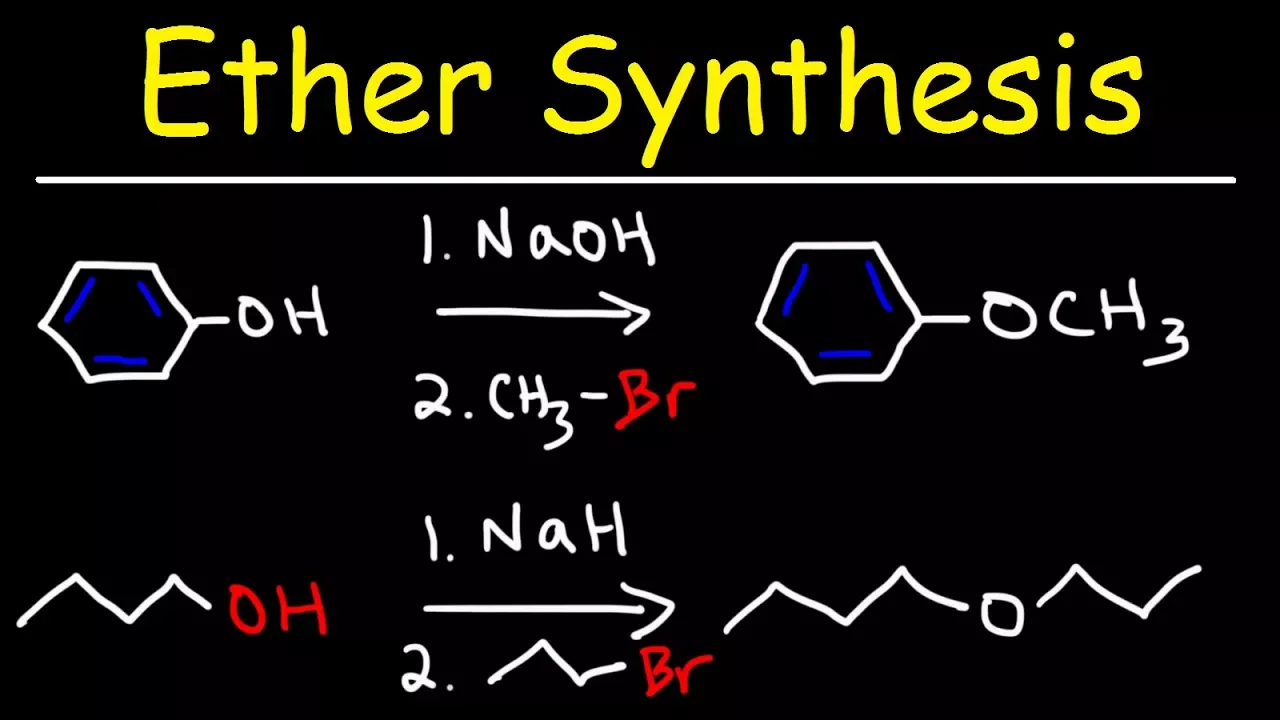
Studying the methods of ether synthesis (such as the Williamson Ether Synthesis) and their chemical reactivity, including acidic cleavage.
Delving into Supramolecular Chemistry and host-guest chemistry, including more complex macrocycles like cryptands and calixarenes.
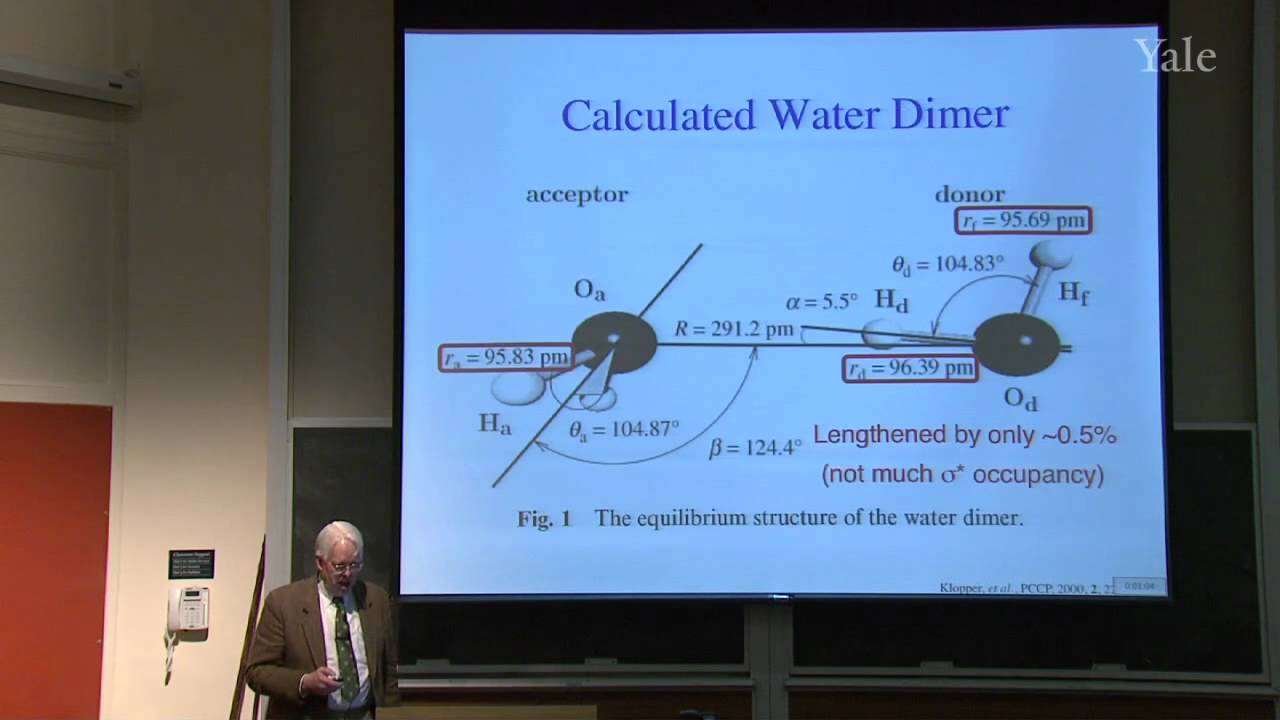
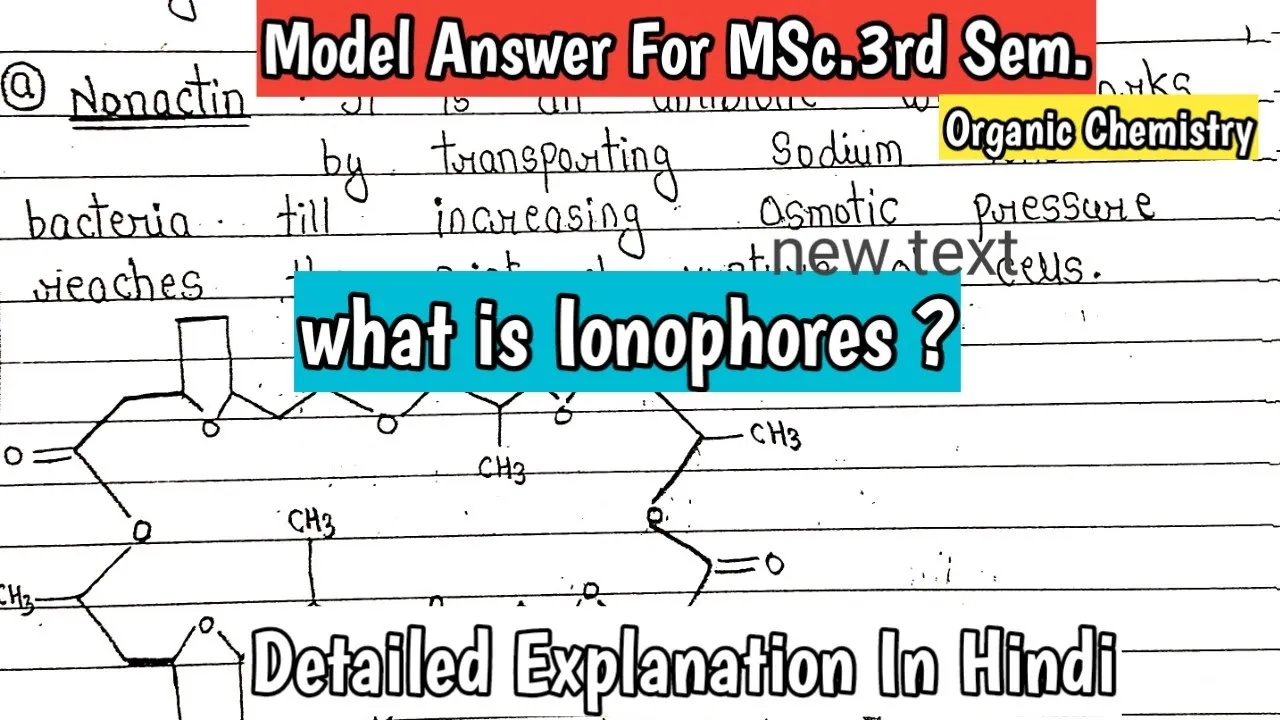
Investigating biological applications of ionophores, such as how natural antibiotics transport ions across cell membranes similarly to crown ethers.
57.9K views185likes10:10Original Release: 2012-09-19
If we look at the boiling points of ethanol and dimethyl ether, we can see there's a large difference between them.
Ethanol has a much higher boiling, 78 degrees Celsius.
Whereas dimethyl ether is negative 25 degrees.
And this explains the state of matter of these molecules.
Ethanol, since its boiling point is higher than room temperature, is, of course, a liquid at room temperature and pressure.
Whereas dimethyl ether, with a much lower boiling point, has already turned into a gas.
And so we can explain the states of matter by looking at the intermolecular forces that are present in these molecules.
So if I think about one molecule of ethanol, I know that the bonds between oxygen and hydrogen is polarized.
I know that oxygen is more electronegative.
So it will be partially negative.
And the hydrogen is partially positive as it loses some electron density.
If that molecule of ethanol interacts with another molecule of ethanol, the second molecule of ethanol is also polarized.
The oxygen is partially negative.
And the hydrogen is partially positive.
And we know that opposite charges attract.
So the partially positively-charged hydrogen is attracted to the partially negatively-charged oxygen like that.
And there's going to be attraction between those two molecules.
And we call this intermolecular force hydrogen bonding, the strongest type of intermolecular force.
So hydrogen bonding is present between molecules of ethanol.
And this accounts for its large boiling point.
Let's look at more details about hydrogen bonding here.
So hydrogen bonding exists when you have hydrogen bonded to an electronegative atom like that to this oxygen.
But students forget that you also need another electronegative atom over here to give you more of a difference in charge and to make that hydrogen more partially positive.
So it's really three atoms involved in hydrogen bonding there.
Let's look at dimethyl ether and see why it does not exhibit hydrogen bonding.
So if I were to draw one molecule of dimethyl ether here.
And think about the polarization between the oxygen and this carbon right here.
Oxygen is more electronegative.
So it will be partially negative.
This carbon will be partially positive like that.
If I think about the interaction of that molecule of dimethyl ether with another molecule of dimethyl ether like that, you might be tempted to say, well there could be some hydrogen bonding because I know that this carbon right here has some hydrogens attached to it.
And so some students will say, oh there must be hydrogen bonding between this oxygen down here and this hydrogen.
But that is not the case because this hydrogen right here, while it is interacting with an oxygen, this hydrogen is bonded to a carbon which is not very electronegative.
And so there's no large differences in electronegativity in the bond between carbon and hydrogen.
Even the carbon's a little bit more electronegative.
There's not enough to make this a true hydrogen bond.
And so really there's only a small amount of dipole-dipole interaction between two molecules of dimethyl ether.
So somewhere on this second molecule, there is a partial negative, partial positive.
And so there will be a little bit of dipole-dipole interaction.
But it's not very strong.
And certainly nowhere near as strong as the hydrogen bonding exhibited on the left.
Hydrogen bonding being just the super strong form of dipole-dipole interaction.
And so dimethyl ether does not have as high of a boiling point as ethanol.
Again, the answer is hydrogen bonding.
Let's see what happens to the boiling point of ethers as we increase the number of carbons in the alkyl groups.
So if we're going to look at that dimethyl ether again, and let's compare that to an ether that has more carbons than the alkyl group, so diethyl ether.
We've already seen the boiling point of dimethyl ether as approximately negative 25 degrees Celsius.
Whereas diethyl ether is about 35 degrees Celsius.
And so there's a large difference in boiling points diethyl ethers boiling point is just higher than room temperature.
So it is still a liquid at room temperature and pressure.
So let's see if we can look at why diethyl ether has a higher boiling point.
We know that ether molecules can't hydrogen bond with each other.
So that cannot be the intermolecular force responsible for this increase in boiling point.
So if we look at two molecules of diethyl ether interacting, one of the other intermolecular forces that we discussed was London dispersion forces.
So London dispersion forces, you watched earlier video for more details.
But when you have these large alkyl groups, provides more surface area for a form of attraction called London dispersion.
And so that increased attraction between alkyl groups means that it's harder to pull those molecules apart.
It requires more energy to pull those molecules apart, requires more heat in order to do so.
And so that's the reason for the increase in boiling point that we see for diethyl ether, up to 35 degrees Celsius.
And even though London dispersion forces are the weakest intermolecular forces, they're additive.
So the effect is added when you have lots and lots of molecules.
And that's the reason for the large difference between dimethyl ether and for diethyl ether.
And so the increase of the number of carbons in the alkyl groups increases the boiling point just above room temperature but not much above room temperature.
So this makes diethyl ether an excellent solvent for extraction.
The other thing the alkyl groups do, is they increase the nonpolar part of the molecule.
So it's a little bit more nonpolar due to these alkyl groups right here which means that diethyl ether is very good for dissolving a lot of nonpolar organic compounds.
And so if you can dissolve a lot of nonpolar organic compounds and the boiling point is just above room temperature, it's an excellent solvent for extraction because you can dissolved are nonpolar organic molecules.
And then you can just boil off the ether.
And you're left with your organic product.
So you'll use diethyl ether a lot for extractions.
Let's look at another type of ether which is a kind of an interesting one.
And we call these ethers, crown ethers.
So if we look at that gigantic either there, it's called a crown ether.
This was discovered by a guy named Charles Peterson who won the Nobel Prize for this.
And the system of nomenclature for crown ethers would be to first count up how many atoms comprise your a ring here, your crown.
So if we go 1, 2, 3, 4, 5, 6, 7, 8, 9, 10, 11, 12, 13, 14, 15, 16, 17, and 18.
So there are 18 parts of this crown.
So we would write an 18 right here like that, followed by the name crown, followed by the number of oxygens in here.
So we have 1 oxygen, 2, 3, 4, 5, and 6.
So the nomenclature would be, 18-crown-6 ether.
And that just tells you what sort of crown ether that you are dealing with.
So why is it called a crown ether?
Well, the interesting thing about crown ethers are that they can interact with different ions.
For example, the size of the potassium ion, so K+, happens to fit right in the center of this.
So the spacing is just right for a potassium ion to fit in there.
And since all of these oxygens have lone pairs of electrons on them, so negatively charged, there's an attraction between the positively-charged potassium ion and the negatively-charged electrons or the partially negative charge oxygen atoms.
So there's attraction.
Opposite charges attract.
And those negative charges are going to hold that potassium ion in here like that.
So it looks like a crown.
If you think about the potassium ion as being someone's head and then that's wearing this ether crown on someone's head like that.
And crown ethers have proved to be very useful, very useful things.
For example, if you had some potassium fluoride, so some K+ F-.
Well, normally potassium fluoride would not dissolve in a nonpolar organic solvents.
But if you use a crown ether, the oxygens can take care of the potassium.
And the outside of the crown either is nonpolar.
So this portion and this portion, the outside of the crown ether is nonpolar which will dissolve in an organic solvent, in a nonpolar organic solvent like benzene like that.
So like dissolves like.
So this portion would dissolve in benzene.
And then what that would do is, that would free up your fluoride anion.
That would increase the nucleophilic strength of your fluoride anion which could participate in an SN2 reaction.
So that's one of the uses of crown ethers is to go ahead and take the cation, leaving the anion to function as a better nucleophile because the potassium ion is solvated by the crown ether.
And of course, since different kinds of different sizes, you can get different sized crown ethers to take care of those ions.
So crown ethers I just think are very interesting molecules.
And if you could look at a three dimensional representation of a crown ether, it's much easier to see that the outside is very nonpolar.
So interesting, interesting molecules.
Up Next

26:32
Cyclodextrins Explained: Structure, Properties, and Applications
@e-content-science1967
2K views•2020-03-15
83:56
Biocatalysis and Catalysis in Islatravir Synthesis | Merck Webinar
@SCIwheresciencemeetsbusiness
675 views•2020-10-08

8:35
Intermolecular Forces in Biology: Khan Academy Chemistry of Life
@readysetorgo
718K views•2013-10-30

17:31
Edible Water Bottles: A DIY Guide to Sodium Alginate Spherification
@ryan
10.5M views•2019-06-21
Related Study Plans & Knowledge Roadmaps
Structured learning paths in Chemistry
chemistry
Nuclear Chemistry: Decay, Meds & Fuel Cycle
01Introduction to Nuclear Structure and Radioactivity
02Decay Dynamics and Kinetics
03Radiation Interaction and Detection
+ 2 more learning modules
24h5 modules
Explore Roadmap
chemistry
Supramolecular Chemistry: Forces & Machines
01Foundations of Chemical Bonding and Intermolecular Forces
02Introduction to Host-Guest Chemistry
03Thermodynamics and Dynamics of Self-Assembly
+ 2 more learning modules
16h5 modules
Explore Roadmap
chemistry
Photochemistry: Excited States & Reactions
01Foundations of Light-Matter Interactions
02Molecular Orbitals and Electronic States
03Photophysical Processes and Jablonski Diagrams
+ 2 more learning modules
18h5 modules
Explore Roadmap
chemistry
Coordination Chemistry: Bonding & Properties
01Introduction to Transition Metals and Ligands
02Crystal Field Theory (CFT) and Geometry
03Magnetic Behavior and Spin States
+ 2 more learning modules
14h5 modules
Explore Roadmap