




![SAINTS ROW Gameplay Walkthrough [4K 60FPS PC ULTRA] - No Commentary](https://i.ytimg.com/vi_webp/fVTGJn5YnsI/maxresdefault.webp)




















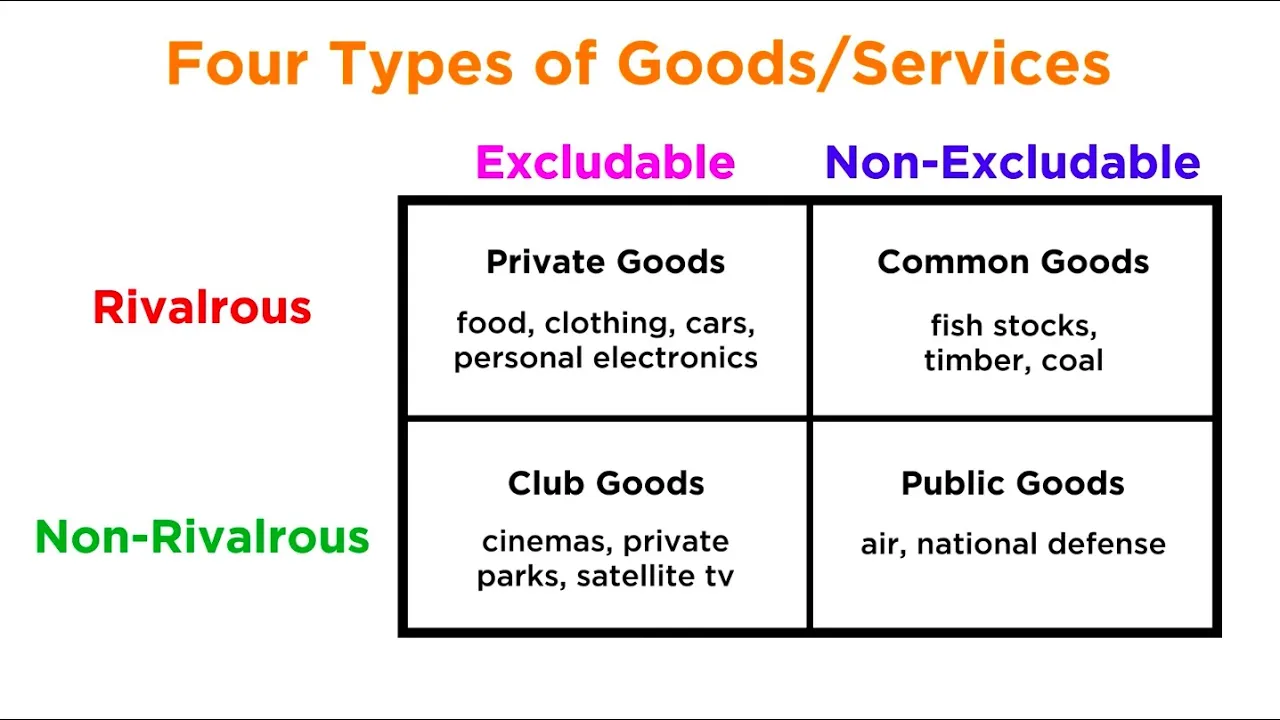
Goods can be classified into four categories based on two characteristics: rivalry (whether one person's use prevents another's) and excludability (whether access can be restricted). Private goods are both rival and excludable (e.g., bananas, clothing). Artificially scarce goods are excludable but not rival (e.g., satellite TV). Common resources are rival but not excludable (e.g., fish stocks, leading to the tragedy of the commons). Public goods are neither rival nor excludable (e.g., air, national defense), creating a free-rider problem that typically requires government intervention.
Rival vs Excludable Goods: Types of Goods in Economics
Added:Understanding the basic economic concepts of supply, demand, and how market prices allocate resources.
The definition of economic scarcity and how it forces choices among consumers and producers.
The foundational concept of property rights and how ownership determines access to resources.
An introduction to the concept of market efficiency and the idea of consumer utility.
The 'Free-Rider Problem' and how it leads to the underprovision of public goods by private markets.
The 'Tragedy of the Commons' and policy solutions to prevent the overexploitation of common resources.
Government intervention mechanisms, such as Pigouvian taxes, subsidies, and direct public provision of goods.
The Coase Theorem and how assigning property rights can resolve externalities without state intervention.
An analysis of natural monopolies and pricing strategies for club goods (toll goods).
51K views644likes10:13Original Release: 2019-04-18
- [Instructor] In this video, we're going to do a bit of a deep dive in classifying different types of goods.
And before we even get into the thick of things, I'm gonna make some definitions.
So the first definition is that of a rival good.
Now, a rival good, one way to think about it is, if one person uses it, it impairs the possibility of another person using it or it impairs the ability of another person using it.
So one person, one person or party using it, using it impairs or oftentimes prevents another party, another person from using it or getting the benefit, using it.
And we're going to talk a lot about some goods that are rival goods versus non-rival goods.
Now, another related idea is that of excludability.
And as we'll see, sometimes these things go together, but sometimes they aren't.
So excludable, excludable means that you could stop someone from using it, can stop someone, someone from using it, you can exclude them, using it.
So what I'm gonna do is I'm gonna set up a bit of a matrix where, on one axis, I'm gonna think about whether something is a rival good or not, and then, on another axis, I'm going to think about whether it's excludable or not.
So let me just do a big two-by-two matrix here.
So, that it looks big enough for me.
Then I said I would do two by two.
That looks like about halfway.
I always underestimate.
Okay, that looks about halfway, and now we'll do it here as well.
And so on this axis, I'm gonna think about whether something is a rival good or not.
So rival good, question mark.
This row is it is a rival good.
This row is it is not a rival good.
And then for the columns, I'm going to think about whether something is an excludable good, so excludable.
Excludable, question mark.
Yes and no.
So let's start in this first top-left cell.
So what are examples of things that are both excludable and rival goods?
Pause this video, and see if you can think of any.
Well, actually many of the things that we imagine buying or using fall into this top-left category, things like a, so, let's say bananas.
Bananas are for sure excludable.
I could prevent someone from taking my banana.
You have to pay in order to have access to a banana.
And it for sure is a rival good.
If I have a banana, especially if I eat that banana, well, that's definitely going to impair your ability to eat that banana.
Another example is clothing.
It's definitely a rival good.
If I'm wearing this shirt, it's going to be very difficult for you to wear that shirt as well.
And like bananas, you can force someone to pay money for that clothing.
They're not just going to get as much clothing as they want for free.
You could think of housing.
You can exclude someone from your house or from an arbitrary house.
They have to pay for it or pay the rent.
And it's a rival good.
If one person or one family is using a house, it definitely impairs the ability for another family to use the house.
And we could keep thinking of more and more ideas in this top left.
In general, goods in this top left are called private goods, private, private goods.
Now, let's imagine going to things that are excludable but maybe not as rivalrous.
And there's really a large spectrum of things.
And as we'll see in the future and you could imagine, some things are kind of blurring the line or depends at what context you're using it.
But one example of something that is excludable but is not necessarily a rival good, that one person using it doesn't prevent the other person from using it in theory, something like satellite television, satellite, satellite TV.
Why is that excludable?
Well, you can force someone to pay to access satellite television.
Only if you have access to some type of a device or some code, you might be able to watch the signal.
But the reason why it's not a rival good is you have the satellites in space, here's my little satellite, and it's beaming, it's beaming the signal down to Earth.
And in theory, if I'm receiving the signal here and I'm watching satellite television, it doesn't impair someone else ability to get to watch that satellite signal.
But we have artificially made it scarce by perhaps making people pay for that, even though everyone else, everyone could use it without impairing the ability for anyone else to use it.
And so that's why this category of goods is often called artificially scarce good, artificially scarce.
The scarcity is artificially happening because you're making it excludable, but it doesn't necessarily have to.
Another example could be something like a private park.
If I go buy a bunch of land and I landscape it nicely, I might say that you have to spend $1,000 to get entry to that park.
Well, that is very, that's very exclusive, and I'm clearly excluding people from that park.
But in theory, if I go and enjoy that park and if it's large enough, well, it doesn't necessarily impair the ability for someone else to enjoy the park as well.
Now, if all of a sudden thousands or millions of people tried to enjoy the park, then it might become a little bit more rivalrous.
Now let's go on the other side, things that are not so excludable.
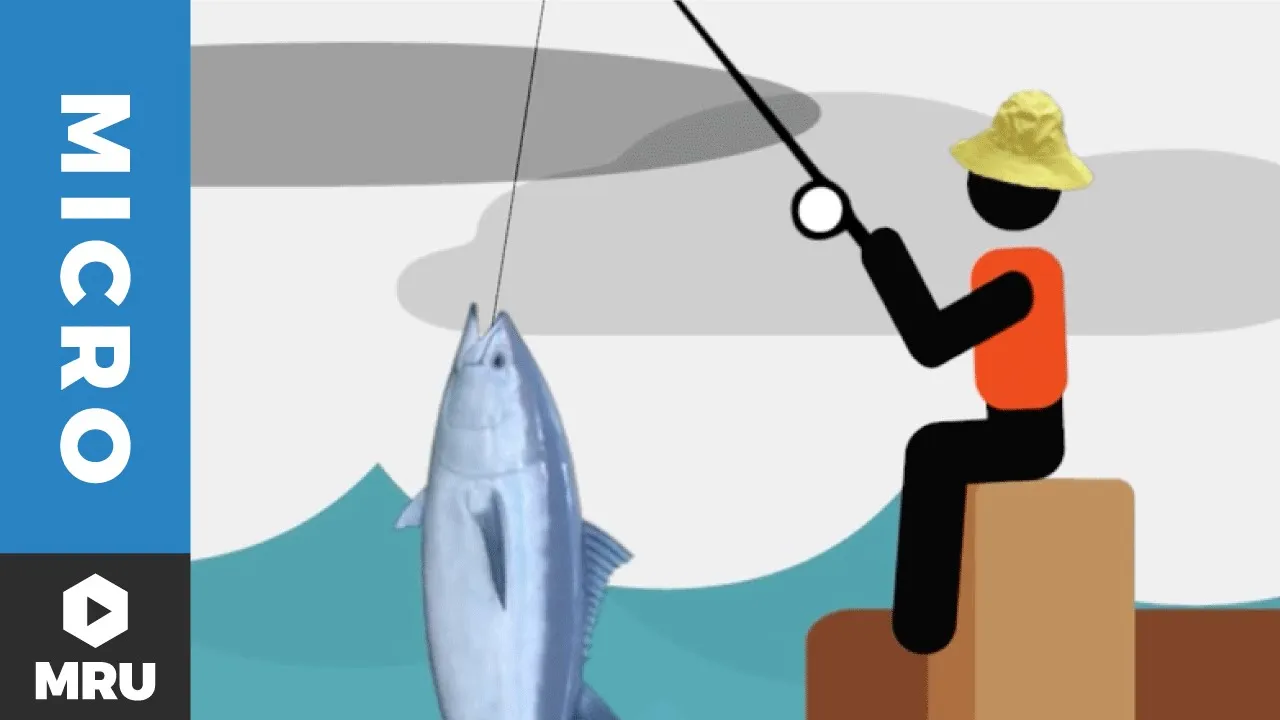
Well, if we think about things that are rival goods but not excludable, the classic example here is fish stocks, fish stocks.
When we're talking about fish stocks, we're talking about, let's imagine some body of water here, and there are fish in this body of water.
And let's say that everyone could, you can't exclude people from it, so anyone can go and stick their fishing rod into this, into this pond or into this lake and get fish.
But the problem is, is that if I get a fish, that's going to make it hard for someone else to get fish.
And you can imagine an extreme, if enough people are grabbing the fish, it is impairing the ability for other folks to get fish.
And so this type of resource or I should say this type of good is known as a common resource, common, common resource.
And it's prone to what is known as tragedy of the commons, and we have a whole video on tragedy of the commons.
But the tragedy of commons, which happens for common resources is when every individual person acts in their own best interest, they might say, hey, I'm just gonna get as much fish as I need to support my family, I could even make a business out of it, I can sell it.
At the end of the day, you might do something that's not in the common interest, and it's actually not even in your own personal interest long term.
Because if enough people fish in the short term and get that benefit, you might deplete all the fish, and they're not able to reproduce.
And then at some point, there are no fish left.
So in the medium to long run, you have hurt everyone, including yourself.
So that would be the tragedy of the commons, which is typical for a lot of things that are common resources.
Another thing that you could view as a common resource is timber or wood that's on land that anyone could access.
In a lot of cases, clean, clean water, fresh water I should say, not salt water, fresh water.
Now, on some level, if there's a lot of folks doing it, it's definitely going to be rivalrous.
But if there's only one or two people and your source of fresh water is huge, well, then it might feel a little less rivalrous.
So once again, we can debate, it might be under different circumstances.
Now, last but not least, let's think about what are examples of things that are neither rivalrous nor excludable?
And that whole category is referred to as public, public goods.
Pause this video, and see if you can think of any.
Well, one thing that is often considered a public good is air.
Now, you could debate, at some extreme level, if the air is really used up or something, you might start to feel like it's rivalrous.
But for most cases, when one person is breathing air, it's not impairing the ability for someone else to use the air.
And it's very hard to exclude someone from breathing.
People just need to take a breath.
So it sits out here in public goods.
You can imagine something like national defense, national defense.
If you are benefiting from national defense because of aircraft carriers and missile systems and planes and the military that the nation has, does that exclude me, your neighbor, from also benefiting from it?
No, and in fact, it would be very difficult to exclude.
You would have to kick me out of the country for me to not benefit from the national defense.
So in general, we would consider it to be non-excludable.
And then is it a rival good?
Well, if you are feeling safe because of national defense, that doesn't impair my ability to feel safe from national defense.
So it's also a non-rival good, at least in most general circumstances.
So I would consider that a public good as well.
Now, when we talk about public goods, there's the notion of the free rider problem, free rider, and that's because you can't exclude folks from using it.
It's usually not in the incentive of any entrepreneur to try to make these public goods happen.
And so this is typically the domain of government.
And in general, when thinking about this whole column of things that are non-excludable, this is a domain where the government tries to get involved.
So we don't have the tragedy of the commons with fish stocks or timber or fresh water, they might put some regulation in or some permitting process.
Up Next
8:43
Economic Systems & Types of Goods: Macroeconomics Explained
@ProfessorDaveExplains
79.5K views•2022-03-30
5:07
Impact of Yuan in Indo-Russian Trade Amid Sanctions
@WION
261.9K views•2022-07-01

10:27
Keynesian Cross & Multiplier: Fiscal Policy Effects
@khanacademy
218.5K views•2012-04-05

113:18
The Age of Easy Money: Fed & Inflation | Full Documentary
@frontline
21.2M views•2023-03-15
Related Study Plans & Knowledge Roadmaps
Structured learning paths in Economics
economics
Sovereign Debt: Defaults, IMF & Restructuring
01Introduction to Sovereign Debt & Government Bonds
02Debt Sustainability & Credit Ratings
03Anatomy and History of Debt Crises
+ 2 more learning modules
12h5 modules
Explore Roadmap
economics
Market Design: Matching Theory & Gale-Shapley
01Introduction to Market Design and Price-Free Markets
02Two-Sided Matching & The Gale-Shapley Algorithm
03School Choice Systems and Mechanism Design
+ 2 more learning modules
10h5 modules
Explore Roadmap
economics
Impossible Trinity: Forex, Capital & Policy
01Introduction to Monetary Policy and Central Banking
02Exchange Rates and International Capital Flows
03The Mundell-Fleming Model
+ 2 more learning modules
8h5 modules
Explore Roadmap
economics
Healthcare Economics: Market Failures & Systems
01Introduction to Healthcare Markets and Market Failure
02Asymmetric Information and Adverse Selection
03Moral Hazard and Insurance Design
+ 2 more learning modules
12h5 modules
Explore Roadmap