Mutexes in Go are synchronization primitives that ensure only one goroutine can access a shared resource at a time, preventing race conditions when multiple goroutines attempt to read or write to shared variables simultaneously. The sync.Mutex type provides lock and unlock operations to protect critical sections of code, with defer Mutex.Unlock() being a common pattern to ensure the lock is always released even if a panic occurs. This mechanism serializes access to shared variables, guaranteeing accurate counting and preventing inconsistent results in concurrent programs.
Go Mutexes Explained: Preventing Race Conditions in Concurrent Programming
Added:Deep Dive
Basic syntax and structure of the Go programming language, including functions and pointers.

Go Tutorial Basic | Golang
156.1K
A complete Go program follows a specific structure: package declaration at the top (e.g., package main), import statements for required packages, and a main function as the entry point. Go uses 'func' to define functions, and all code must reside within functions or packages. The language is statically typed, requiring explicit type declarations (int, float64, string, bool) or type inference with := syntax. Unlike C/C++/Java, Go does not require semicolons to terminate statements, though they are used to separate multiple expressions on a single line. Go enforces clean code practices by generating errors for unused imports and variables, promoting concise, maintainable programs.
Click to watch →

GO crash course | Code Eater - Blockchain | Hindi
4.9K
Functions in Go are declared using the 'func' keyword followed by the function name and parameters. The syntax is 'func functionName(parameters) returnType { body }'. Functions can accept multiple arguments and return multiple values. Return values are specified using the 'return' keyword. Pointers in Go are variables that store memory addresses of other variables. To create a pointer, use the '&' operator to get the address of a variable. Pointers enable efficient memory usage, dynamic memory allocation, and passing large structures by reference. They are fundamental for advanced programming concepts like dynamic arrays and linked lists.
Click to watch →

#golang #golanguage - GO Language For Tourists - Section 08 - Pointers
1.3K
Functions in Go are first-class citizens and can be treated as values. A function pointer is a variable that can hold the address of a function. Function pointers are declared using the function type syntax, for example: var pFunc func(int) (int, error). Function pointers can be assigned function values directly (pFunc = myFunction) without using the address-of operator, because the function name itself represents its address. Function pointers enable passing functions as arguments to other functions, implementing callbacks and higher-order functions.
Click to watch →

Go Faster, Part 1 (An Introduction to the Go Programming Language)
393
Go is designed to simplify every development step, making programming faster and more streamlined. The language is extremely fast, based on C but not as low-level, with a compiler that optimizes many things other languages cannot. Go is statically typed, with the compiler performing extensive type checking that catches approximately 80% of errors before runtime. All Go code must declare a package, with executable programs requiring the 'main' package. Libraries are imported using the 'import' statement, with functions from imported packages requiring capital letters. Variable declaration follows 'var X int = 5' syntax, with type after the variable name. Functions declare parameters and return types in a specific order, with lowercase names being unexported. Go supports type inference using the ':=' operator. Go handles errors through functions returning multiple values, with the error type being a built-in system type. When no error occurs, 'nil' is returned. Go requires all declared variables be used, with unused variables assigned to underscore ('_'). The 'panic' function handles non-recoverable errors by exiting the program immediately. Go pointers are safe and differ from C-style pointers. To pass a value as a pointer, use the '&' operator; to dereference, use '*'. Go is garbage collected, meaning local variables don't disappear when functions return, making it safe to return pointers to local variables. Go uses structs instead of classes, with structs being data-oriented while classes are function-oriented. Structs are defined as lists of fields with their types, with no commas or default values. Struct fields are typically capitalized (exported). Structs are passed by value by default, meaning the entire struct is copied when passed to functions. To pass by reference, use a pointer to the struct. Go arrays are declared with 'var name [size]Type' syntax, zero-initialized by default, and passed by value. The 'len()' function returns array length. Go maps are declared as 'map[KeyType]ValueType' and behave like dictionaries, starting as nil and requiring initialization. Maps act as pointers, so modifications affect the original map. Accessing non-existent keys returns the zero value. To check key existence, use 'value, ok := map[key]' pattern. All Go variables have zero values upon initialization, preventing uninitialized variable usage. Go has only one looping construct: the 'for' statement. The basic syntax is 'for initializer; condition; post { body }', where the initializer runs once before the loop, the condition is evaluated before each iteration, and the post runs after each iteration. Variations include dropping initializer and post for while-like loops, or just 'for {}' for infinite loops. If statements can also have initializers, with variables scoped only to the if block.
Click to watch →

【Go 言語入門】基本文法からポインタ・構造体など丁寧に解説!
2.4K
This tutorial covers Go language fundamentals including environment setup with Docker, package system and imports, three variable declaration methods (separate declaration, combined declaration, and short declaration with :=), for loop processing, if condition branching, function definition with parameters and return values, struct definition with properties and methods, and pointer concepts including address-of (&) and dereference (*) operators, with practical examples demonstrating how to modify struct properties using pointers versus value copies.
Click to watch →
Deep Dive
The concept of Goroutines and how to launch concurrent execution blocks using the 'go' keyword.

The Go Programming Language
405.3K
Go implements a revolutionary concurrency model based on goroutines and channels. Goroutines are lightweight concurrent processes managed by the language runtime, with automatically managed stacks that grow and shrink as needed. They are multiplexed onto threads automatically and transparently. Communication occurs through channels, which are first-class values supporting send and receive operations. Garbage collection is essential for effective concurrency because it eliminates the bookkeeping burden of determining memory ownership when passing data between concurrent entities. The 'go' keyword launches functions as goroutines, running them concurrently. The select statement enables waiting on multiple channel operations simultaneously, choosing which communication to perform based on readiness. This enables building concurrent servers where each request is handled in a separate goroutine, with results returned on dedicated channels. Clients send requests and receive results in arbitrary order, enabling scalable network services with potentially thousands of concurrent connections, solving the traditional thread-per-request model's resource intensity and complexity.
Click to watch →
Why I'm learning Go
77K
Go provides built-in concurrency primitives for concurrent programming. Goroutines (created with 'go' keyword) run concurrently without blocking main execution, multiplexed onto OS threads for efficiency. Channels enable communication between goroutines, functioning like queues where goroutines send and receive values. This built-in concurrency model eliminates the need for third-party libraries. The 'defer' keyword ensures cleanup code runs when functions exit, useful for resource management. 'sync.WaitGroup' coordinates completion of multiple goroutines. This approach provides structured concurrency with minimal syntax, making concurrent programming more accessible than JavaScript's asynchronous patterns.
Click to watch →

Learn GO Fast: Full Tutorial
934.5K
Goroutines are lightweight threads launched with go keyword, enabling concurrent execution. Concurrency differs from parallelism—multiple tasks can be in progress through context switching even on single-core systems. sync.WaitGroup tracks active goroutines for synchronization. Mutexes (sync.Mutex) prevent data races by ensuring exclusive access to shared data. Read-write mutexes (sync.RWMutex) allow concurrent reads while maintaining exclusive writes, improving performance for read-heavy workloads. Channels enable safe communication between goroutines using the <- operator for sending and receiving. Unbuffered channels require receivers to be ready before sending completes. Select statements wait on multiple channel operations simultaneously, enabling timeout logic and choosing between multiple possible events.
Click to watch →

Изучаем Go. Урок №19. Concurrency (1). Goroutines. Defer. Panic/Recover #golang
26.7K
Goroutines are lightweight threads in Go, typically 2KB in size compared to over 1MB for OS threads. They enable concurrent and parallel execution managed by Go's scheduler. Goroutines are created using the 'go' keyword followed by a function call. The main goroutine always exists and contains the main() function. Without synchronization, spawned goroutines may not complete before the main goroutine terminates the program. Goroutines can be in running or blocked states, transitioning between them during execution. The maximum concurrent goroutines equals the number of logical CPU cores, checkable via runtime.NumCPU(). The runtime.GOMAXPROCS(n) function controls parallel execution, with 1 forcing sequential execution. Manual scheduling is possible using runtime.GOSCHED() for educational purposes.
Click to watch →

Learning Golang: Introduction to Concurrency Patterns, goroutines and channels
58.8K
In Go, concurrency is achieved through goroutines (lightweight threads managed by the Go runtime) and channels (communication mechanisms for sending and receiving values between goroutines). Goroutines are launched using the 'go' keyword and run concurrently with the main function. Channels use the 'chan' keyword and the arrow operator (<-) for data flow, with blocking behavior by default when the other side is not ready. Buffered channels have a capacity that allows sending without blocking until full. Key channel keywords include 'close' (stops sending/receiving), 'select' (coordinates multiple channels like a switch), and 'range' (iterates through channel values until closed).
Click to watch →
Deep Dive
The theoretical concept of shared memory and how concurrent threads of execution access joint resources.

How we program multicores - Joe Armstrong
74.9K
Programming languages use two fundamentally different concurrency models. Shared memory concurrency violates physical laws regarding simultaneity and is extremely difficult to understand and implement correctly. Message passing concurrency violates fewer physical laws and is much easier to understand because it operates on single sites with sequential event processing. Most mainstream languages like C, Python, Java use shared memory concurrency, while Erlang, Elixir, and Pony use message passing. The choice of concurrency model fundamentally affects system reliability, scalability, and maintainability.
Click to watch →
![[KAIST CS492C, 2020 Fall] Lock-Based Concurrency, an Introduction to](https://i.ytimg.com/vi/JEGzAPX603U/sddefault.jpg)
[KAIST CS492C, 2020 Fall] Lock-Based Concurrency, an Introduction to
3K
This section establishes the foundational concepts of shared memory concurrency, where multiple threads share the same memory space simultaneously. Threads are agents executing programs with program counters, maintaining local storage (registers), and accessing shared memory through read/write operations. The section introduces lock-based concurrency as a synchronization strategy where only one thread can access a shared resource at any time, ensuring mutual exclusion. It demonstrates the race condition problem through an example where two threads increment a shared variable x. Without locks, interleaved execution can cause incorrect results (x=1 instead of x=2) because the read-modify-write operation is not atomic. Locks prevent this by serializing access, ensuring all accesses by one thread complete before another thread accesses the same resource.
Click to watch →

Paralel Programlama 02 - Paylaşımlı Bellek Kavramı
1.5K
Shared memory systems provide unified address spaces accessible by all processing units, enabling efficient data sharing. Modern multi-processor systems have multiple physical CPUs with multiple cores each. Processes are independent execution units with separate memory spaces, while threads share memory within processes. Concurrent execution involves interleaved instruction execution where instructions from different processes may run in different orders. Thread-safe routines must produce correct results regardless of concurrent calls. Race conditions occur when multiple processes access shared data simultaneously without synchronization. Critical sections are code segments accessing shared resources that must execute by only one process at a time. Lock-based synchronization uses shared lock variables to control critical section access, with processes checking locks before entering and releasing upon exit.
Click to watch →

PDC (18)| Shared Memory Programming| by Arfan Shahzad
4.6K
Shared memory programming enables multiple processors or threads to access a common memory space, allowing concurrent execution through thread creation, synchronization using mutex locks and condition variables, and proper resource management with join operations to ensure coordinated parallel processing.
Click to watch →

Threads no Node js 💥Tudo o que você precisa saber!!
15.3K
Worker Threads can share memory with the main thread using SharedArrayBuffer and Atomics, allowing data to be passed between threads without copying. SharedArrayBuffer is shared in memory rather than copied, so changes are immediately visible across all threads. This requires Node.js version 12.20.0 or higher and is based on the SharedArrayBuffer API from the web platform. Atomics provides atomic operations that guarantee only one thread can execute the operation at a time, preventing race conditions when multiple threads access the same memory location concurrently. This is essential for safe concurrent access to shared memory in Worker Threads.
Click to watch →
Deep Dive
An introductory understanding of what a race condition is and why non-deterministic behavior occurs in concurrent systems.
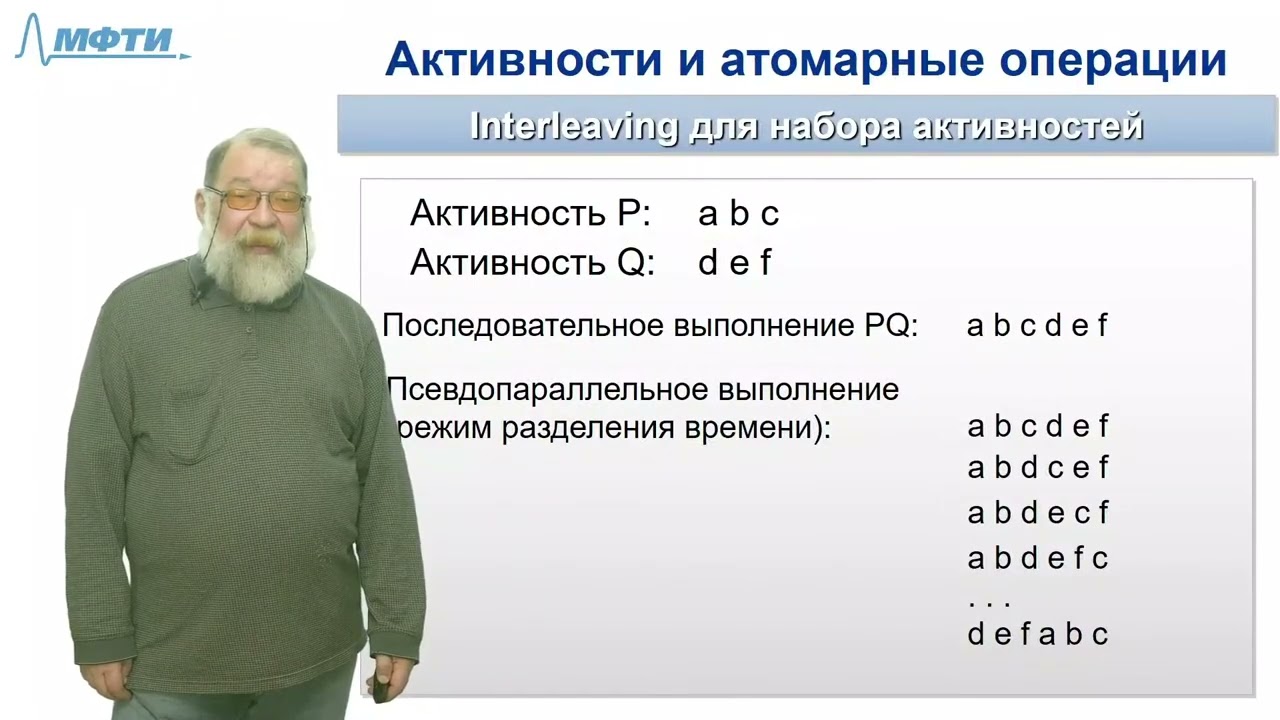
Основы операционных систем, Карпов В.Е. (Лекция №5, 2019)
7.2K
A set of activities is deterministic if identical initial data always produces identical results regardless of interleaving. Non-deterministic sets produce different results under different interleavings. Race conditions are the root cause of non-determinism, occurring when multiple activities compete for shared resources. In time-sharing systems, deterministic sets are desirable because CPU scheduling order becomes irrelevant.
Click to watch →

Java Core October: Multithreading. Лекция#15 (Часть 2)
4.7K
Concurrent programs exhibit non-deterministic behavior because multiple threads compete for CPU resources. Even if a thread is expected to run for 1000 seconds, interference from other threads can cause it to complete much sooner or later. When two threads simultaneously increment a shared counter, the result becomes unpredictable (e.g., 1.6 billion instead of 2 billion). This occurs because the read-modify-write sequence is not atomic and can be interrupted by the operating system, causing lost updates where one thread's increment overwrites another's.
Click to watch →

L4.45: parbegin-parend or cobegin-coend example-8 | concurrency in OS
567
Race conditions occur when multiple processes read and write to the same memory location without proper synchronization, leading to unpredictable results. The video demonstrates this through an example where one process reads a value while another updates it, causing the final result to depend on the specific interleaving of operations. The instructor shows that the same code can produce different final values (20 or 21) depending on execution order. A critical requirement in concurrent programming is that all statements must execute completely, and certain operations must occur in specific sequences to ensure correctness. Understanding these constraints is essential for designing reliable concurrent systems.
Click to watch →
Cours Système d'exploitation (24/10/2021)
1.1K
A system of tasks is a pair consisting of a set of elementary tasks and a precedence relation between tasks. A system of tasks is deterministic if all possible execution behaviors produce the same final result. If different behaviors produce different results, the system is non-deterministic. The actual execution behavior depends on the scheduling policy used. Race conditions occur when the final result depends on the order of execution of concurrent tasks. In the example, executing T2 then T3 produces a different result than T3 then T2. This non-determinism is unacceptable for reliable concurrent programs. The banking example demonstrates that concurrent transactions can cause race conditions, leading to incorrect account balances. Synchronization is essential to prevent race conditions and ensure correct concurrent execution.
Click to watch →

Clase 6 - Parte 2/2 - Concurrencia (1/3)
264
Concurrent systems require synchronization to protect shared resources. When multiple threads modify shared variables simultaneously, race conditions occur where final results depend on execution timing. A counter increment example demonstrates this: two threads each incrementing 10,000 times should yield 20,000, but concurrent execution produces inconsistent results like 29,193. These non-deterministic errors are difficult to debug because they occur inconsistently. High-level operations decompose into multiple low-level instructions (load, modify, store), creating interruption points that enable race conditions.
Click to watch →
Prerequisite Knowledge
- Concept 01Basic syntax and structure of the Go programming language, including functions and pointers.
- Concept 02The concept of Goroutines and how to launch concurrent execution blocks using the 'go' keyword.
- Concept 03The theoretical concept of shared memory and how concurrent threads of execution access joint resources.
- Concept 04An introductory understanding of what a race condition is and why non-deterministic behavior occurs in concurrent systems.
Subsequent Learning
- Step 01Utilizing 'sync.RWMutex' (Reader-Writer Mutex) to optimize performance for read-heavy concurrent operations.
- Step 02Using Go's built-in Race Detector tool ('go run -race') to identify data races in complex applications.
- Step 03Mastering Go Channels and the CSP (Communicating Sequential Processes) model as an alternative to shared-memory synchronization.
- Step 04Understanding and preventing advanced concurrency issues such as deadlocks, livelocks, and resource starvation.
- Step 05Exploring the 'sync/atomic' package for low-level, lock-free synchronization on primitive data types.
Mutex Basics
Lock & Unlock
Best Practices
Mutex Basics
0:00Playing Section
- 1
Mutex prevents race conditions by allowing one goroutine access.
- 2
Sync package provides Mutex type for locking critical sections.
- 3
Example spins up 100 goroutines to increment a shared counter.
Communicating Sequential Processes (CSP) and Channel-Based Concurrency
While sync.Mutex relies on locking shared memory to prevent race conditions, Go’s primary design philosophy is rooted in Communicating Sequential Processes (CSP), summarized by the proverb: 'Do not communicate by sharing memory; instead, share memory by communicating.' This perspective advocates for using channels to pass data between goroutines rather than locking access to shared variables. Channel-based concurrency reduces the risk of manual locking bugs like deadlocks, race conditions from forgotten locks, and complex state synchronization. By transferring data ownership through channels, developers can build concurrent systems that are easier to reason about, test, and maintain without relying on traditional low-level mutual exclusion.
Deep Dive
Utilizing 'sync.RWMutex' (Reader-Writer Mutex) to optimize performance for read-heavy concurrent operations.

Начни изучать конкурентность в Go с этого видео
23.6K
Mutex (mutual exclusion lock) ensures that only one goroutine can access shared data at a time. When multiple variables need to be updated atomically together, a mutex can lock all of them simultaneously, preventing race conditions. RWMutex (Read-Write Mutex) is an optimization for read-heavy workloads: it allows multiple readers to access data simultaneously while preventing concurrent writes. This improves performance when reads far outnumber writes, as readers don't block each other. The 'RLock' method locks for reading, and 'Lock' method locks for writing.
Click to watch →
Изучаем Go. Урок №20. Concurrency (2). WaitGroup. Data Race. Mutex/RWMutex #golang
24.3K
Mutex provides exclusive access to shared resources using Lock() and Unlock() methods. Only one goroutine can hold the mutex at a time, serializing access to protected resources. RWMutex extends this by allowing multiple concurrent readers through RLock() and RUnlock(), while writers use Lock() and Unlock() for exclusive access. This improves performance for read-heavy workloads because multiple readers can access the resource simultaneously. The video demonstrates that RWMutex completes read-heavy workloads approximately twice as fast as regular mutex.
Click to watch →
Learn GO Fast: Full Tutorial
934.5K
Read-write mutexes (sync.RWMutex) provide finer-grained control over concurrent access than regular mutexes. They allow multiple readers to access shared data simultaneously while ensuring exclusive access for writers. The RLock() and RUnlock() methods allow concurrent reads, while Lock() and Unlock() maintain exclusive access for writes. This improves concurrency performance when reads are frequent and writes are rare, as multiple readers can proceed in parallel without blocking each other.
Click to watch →

Всё про конкурентность в Go
42.7K
RWMutex (Read-Write Mutex) is a variant of mutex that allows multiple concurrent readers while ensuring exclusive access for writers. It provides separate locks for reading and writing operations, improving performance in scenarios where reads are more frequent than writes. This is particularly useful for data structures where read operations dominate, as multiple goroutines can read simultaneously without contention, while writes still require exclusive access.
Click to watch →

Go | Golang. Погружение в concurrency
717
RWMutex provides RLock() for concurrent reads and Lock() for exclusive writes. Read locks use a separate counter, allowing multiple readers simultaneously. Write locks wait for all read locks to release. This design benefits read-heavy workloads where reads vastly outnumber writes. However, RWMutex is not always faster—balanced read/write workloads may perform worse due to overhead. The choice depends on actual access patterns.
Click to watch →
Deep Dive
Using Go's built-in Race Detector tool ('go run -race') to identify data races in complex applications.
Начни изучать конкурентность в Go с этого видео
23.6K
Go provides a built-in race detector that can identify data races at compile time. By running the program with the '-race' flag (e.g., 'go run -race main.go'), the compiler analyzes the code and reports any detected race conditions. This tool is invaluable for finding concurrency bugs that might not be visible during normal testing.
Click to watch →

Golang: вебсокет чат на 100к пользователей (открытый урок, Юрий Насретдинов)
525
Go provides a race detector that detects data races when compiling with the -race flag. A data race occurs when two goroutines access the same memory location simultaneously, with at least one access being a write. The race detector instruments code to track memory accesses and detect conflicts, similar to sanitizers in C/C++. However, it's not enabled by default and requires explicit compilation. For maps, Go provides built-in checks that detect concurrent modification. For other types, the race detector catches issues. The speaker emphasizes that proper synchronization is essential for concurrent applications, and the race detector helps catch bugs during development.
Click to watch →

Profiling & Optimizing in Go / Brad Fitzpatrick
21.4K
Go includes a built-in race detector that helps identify data races in concurrent programs. To use it, you compile or run your program with the `-race` flag (e.g., `go test -race`). The race detector uses ASan (AddressSanitizer) and TSan (ThreadSanitizer) libraries from C++ to annotate all memory accesses and detect when two goroutines access the same memory concurrently without proper synchronization. While the race detector has no false positives, it may have false negatives, meaning some races might not be detected. When a data race is found, the tool reports which goroutine performed the read and which performed the write, allowing developers to fix the issue by adding proper locking mechanisms like mutexes.
Click to watch →

GopherCon 2015: Go Dynamic Tools - Dmitry Vyukov
8.7K
Data races occur when two goroutines access the same variable concurrently with at least one write, compromising program correctness, stability, and security. Compilers assume race-free programs and perform aggressive optimizations, making races particularly dangerous. Go provides a built-in race detector using compiler instrumentation and runtime tracking based on the happens-before relation, ensuring no false positives. Effective testing requires concurrent tests that exercise code paths, with continuous testing recommended due to possible false negatives. The detector has found over 70 bugs in the standard library and 350+ in Google's codebase.
Click to watch →

Lecture 2: RPC and Threads
242.5K
Go's built-in race detector identifies race conditions by allocating shadow memory for every location and tracking thread accesses. It detects reads of previously-written locations without intervening synchronization. The tool is invaluable because race conditions often work correctly during testing but fail in production. However, the race detector only analyzes executed code paths, so comprehensive testing is needed to ensure all code paths are exercised.
Click to watch →
Deep Dive
Mastering Go Channels and the CSP (Communicating Sequential Processes) model as an alternative to shared-memory synchronization.

GopherCon 2014 A Channel Compendium by John Graham-Cumming
12K
Go channels originate from Tony Hoare's 1978 paper on Communicating Sequential Processes (CSP), which introduced the fundamental concept that communication and synchronization are the same thing. In original CSP, processes had to synchronize on events without buffering, using chocolate vending machine examples where a person and machine agreed on coin events. Channels evolved from this theory, providing practical concurrency primitives. Go implements CSP principles with syntax inspired by Occam, making concurrent programming accessible while preserving the theoretical foundations that make reasoning about concurrent systems easier.
Click to watch →

Eric Shull: Communicating Sequential Processes (September 22, 2015)
12.8K
Communicating Sequential Processes (CSP), developed by Tony Hoare in 1978, is a concurrency model that solves the 'telepathy problem' of traditional concurrent programming by replacing shared memory with explicit message passing through channels. Unlike traditional approaches that use locks and mutexes leading to race conditions and deadlocks, CSP uses two primitives: processes (independent computational units) and channels (communication pathways) to enable predictable, composable concurrent programming. This model is implemented in Go through goroutines and channels, allowing developers to convert synchronous operations to asynchronous ones easily and reason about concurrent systems more clearly.
Click to watch →
Введение в язык программирования Go
95.3K
Go uses goroutines for concurrent execution, which are lightweight threads managed by Go's runtime. Goroutines are created using the go keyword and are much more lightweight than OS threads (2 KB initial stack vs 1-2 MB for OS threads). The runtime scheduler manages goroutine execution across OS threads, using knowledge of goroutine behavior to optimize scheduling. Channels are Go's built-in mechanism for concurrent communication and synchronization, created using make with a type parameter. There are two types: buffered channels (with capacity) and unbuffered channels (synchronous communication). Channels support send and receive operations that block when appropriate. Select is Go's multiplexing construct for handling multiple channels, evaluating channel operations and executing the first ready case. Go's concurrency model follows the 'send data, not memory' principle, preferring channels over shared memory for concurrent communication.
Click to watch →

Go Class: 23 CSP, Goroutines, and Channels
33.1K
Go implements the CSP (Communicating Sequential Processes) concurrency model through goroutines (lightweight threads) and channels (unidirectional communication pipes), enabling safe concurrent programming by transferring data ownership and establishing happens-before relationships rather than sharing memory, which simplifies writing concurrent programs compared to traditional thread-based approaches.
Click to watch →

Why Go Channels Beat Locks for Concurrency?
2.7K
Go channels are handoff mechanisms, not queues. An unbuffered channel has no storage - values are copied directly between goroutine stacks. Sends block until receivers are ready, and vice versa. Buffered channels add temporary storage but don't improve performance. Closing a channel broadcasts to all waiting receivers, enabling coordinated shutdown. The select statement allows waiting on multiple channels simultaneously. Context cancellation works by closing the Done channel. Common pitfalls include go routine leaks (stuck goroutines without errors), nil channels (block forever), and overusing channels when mutexes would be simpler. The key principle is 'channels orchestrate, mutexes serialize' - use channels for passing data between goroutines, mutexes for protecting shared memory.
Click to watch →
Deep Dive
Understanding and preventing advanced concurrency issues such as deadlocks, livelocks, and resource starvation.

Java Multithreading Crash Course – Quick Revision for Interviews | Important Interview Topics!
48.7K
Advanced concurrency concepts include deadlock (circular dependencies where threads wait indefinitely for each other), livelock (threads actively changing state but making no progress), and starvation (low-priority threads denied resources by higher-priority ones). Prevention strategies include fixed lock acquisition order, tryLock() with timeouts, deadlock detection tools, random delays, fair scheduling policies, and reentrant locks with fairness settings. These conditions commonly appear in distributed systems and web servers.
Click to watch →

Understanding Deadlocks, Live-locks, and Starvation in Golang
1.9K
Deadlocks occur when two or more processes block each other while waiting for resources held by each other, requiring four Coffman conditions (mutual exclusion, hold and wait, no preemption, circular wait) to be met; livelocks involve processes continuously changing state without making progress, similar to deadlock but with ongoing state transitions; starvation happens when a lower-priority process is repeatedly denied access to a resource by higher-priority processes; all three problems can be prevented through careful lock ordering, fair scheduling algorithms, and aging techniques that ensure equitable resource distribution.
Click to watch →
Stanford CS149 I 2023 I Lecture 13 - Fine-Grained Synchronization and Lock-Free Programming
4.6K
Three fundamental concurrency problems affect multi-threaded programs: (1) Deadlock occurs when processes hold resources while waiting for others in a circular chain, preventing all progress; (2) Live lock happens when processes continuously perform work but make no progress, like people repeatedly stepping aside at a door; (3) Starvation occurs when a process is perpetually denied resources despite the system being active, such as cars on a side road never getting through a busy intersection. Understanding these conditions is essential for designing correct concurrent systems.
Click to watch →

#21 Многопоточность - Deadlock, livelock, starvation. Ответ на вопрос собеседования C# / .Net
6.2K
In multithreading programming, three critical concurrency issues can cause application failures: Deadlock occurs when threads wait indefinitely for each other to release resources, creating a circular wait where no thread can proceed; Livelock is similar but threads continuously perform meaningless operations while waiting, appearing active but making no progress; Starvation happens when a thread cannot access required resources because other threads monopolize them, preventing task completion. These issues arise primarily from inconsistent lock ordering, where different threads acquire shared resources in different sequences, leading to circular dependencies that prevent program execution.
Click to watch →

Concurrency & Synchronization in Golang - Complete Guide
309
Beyond basic race conditions, concurrency introduces subtle hazards: deadlocks occur when two goroutines mutually block each other by holding different mutexes in opposite orders, solvable by enforcing consistent lock ordering. Starvation happens when a goroutine is perpetually denied access because other goroutines hold mutexes indefinitely, requiring careful lock management. These problems demonstrate why concurrency requires disciplined design—performance gains come at the cost of increased complexity and potential for subtle bugs that only manifest under certain scheduling conditions.
Click to watch →
Deep Dive
Exploring the 'sync/atomic' package for low-level, lock-free synchronization on primitive data types.

An Introduction to Multithreading in C++20 - Anthony Williams - ACCU 2022
5.4K
Atomics provide low-level hardware-level synchronization for trivially copyable types. They support load/store operations and compound operations like +=, -=, bitwise operations. Atomic<T>::is_always_lock_free indicates whether operations use hardware instructions or fall back to mutexes. Atomics should be used only after profiling indicates synchronization is the bottleneck and the data being synchronized is bitwise comparable. Most built-in types and pointers are lock-free on common platforms.
Click to watch →

Go Concurrency Patterns: A Practical Guide by Rob Pike (Google I/O 2012) | Master Goroutines, Channels, and Select for High-Performance Server Design
868.7K
While Go's concurrency tools are powerful, they are not always appropriate. Simple synchronization needs (like reference counters) may be better handled by lower-level primitives in the sync/atomic package. The principle is to use the simplest appropriate tool for each problem, balancing expressiveness against complexity.
Click to watch →

Learn Golang Concurrency For Beginners By Example
30.1K
The sync/atomic package provides atomic operations for simple types like integers. These operations guarantee that updates to shared variables happen atomically without requiring locks. For example, atomic.AddInt32() safely increments a shared integer counter across multiple goroutines without introducing race conditions.
Click to watch →

Crust of Rust: Atomics and Memory Ordering
101.3K
Atomics are essential for concurrent programming because primitive types lack guarantees about memory visibility between threads. Atomic types (like AtomicUsize) allow shared-reference access instead of requiring exclusive access. Core operations include load, store, and compare_exchange, with compare_exchange_weak used in loops for architectures like ARM. Memory orderings control guarantees: Relaxed provides no ordering constraints, Acquire prevents reordering before loads, Release prevents reordering after stores, AcqRel combines both, and SeqCst provides strongest guarantees. Spinlocks demonstrate lock-free synchronization using compare_exchange_weak in loops, avoiding the race condition of naive implementations where two threads could both succeed in acquiring the lock. Internal to Rust, atomic types use UnsafeCell for raw pointer access. To share atomics between threads, use Arc instead of Box because Arc provides Send/Sync implementations for safe multi-threaded sharing.
Click to watch →

Примитивы синхронизации в Go // Демо-занятие курса «Golang Developer. Basic»
110
Sync.Map provides thread-safe concurrent map access using an internal RWMutex, optimized for read-heavy workloads with two internal maps (dirty for writes, clean for reads). Methods include Store(), Load(), and LoadOrStore() for atomic value operations. Atomic operations (Add, Sub, Swap) use hardware-level instructions for lock-free synchronization on specific types. Sync.Once ensures a block of code executes exactly once, useful for lazy initialization. These primitives enable efficient concurrent programming without explicit locking for simple operations, while Sync.Map provides scalable concurrent access to map data structures.
Click to watch →
Mutex Basics
Lock & Unlock
Best Practices
Mutex Basics
0:00- 1
Mutex prevents race conditions by allowing one goroutine access.
- 2
Sync package provides Mutex type for locking critical sections.
- 3
Example spins up 100 goroutines to increment a shared counter.
Communicating Sequential Processes (CSP) and Channel-Based Concurrency
While sync.Mutex relies on locking shared memory to prevent race conditions, Go’s primary design philosophy is rooted in Communicating Sequential Processes (CSP), summarized by the proverb: 'Do not communicate by sharing memory; instead, share memory by communicating.' This perspective advocates for using channels to pass data between goroutines rather than locking access to shared variables. Channel-based concurrency reduces the risk of manual locking bugs like deadlocks, race conditions from forgotten locks, and complex state synchronization. By transferring data ownership through channels, developers can build concurrent systems that are easier to reason about, test, and maintain without relying on traditional low-level mutual exclusion.
Basic syntax and structure of the Go programming language, including functions and pointers.
The concept of Goroutines and how to launch concurrent execution blocks using the 'go' keyword.
The theoretical concept of shared memory and how concurrent threads of execution access joint resources.
An introductory understanding of what a race condition is and why non-deterministic behavior occurs in concurrent systems.
Utilizing 'sync.RWMutex' (Reader-Writer Mutex) to optimize performance for read-heavy concurrent operations.
Using Go's built-in Race Detector tool ('go run -race') to identify data races in complex applications.
Mastering Go Channels and the CSP (Communicating Sequential Processes) model as an alternative to shared-memory synchronization.
Understanding and preventing advanced concurrency issues such as deadlocks, livelocks, and resource starvation.
Exploring the 'sync/atomic' package for low-level, lock-free synchronization on primitive data types.
335 views17likes4:24@TheCodingGopherOriginal Release: 2024-10-06
mutexes and go are used to provide synchronization between multiple go routines ensuring that only one go routine can access a shared resource at a time and this prevents race conditions which can occur when two or more go routines attempt to read or write to a shared variable simultaneously in go we have the sync package which provides a mutex type that you can use to lock and unlock critical sections of code and in this example we're going to demonstrate how to you how use a mutex in go if we look at the main function we declare the number of go routines as a 100 and we increment the weight group counter to 100 by using weight group.
add and passing in the number of go routines and then going from 0 to 100 we spin up go routines uh that are running concurrently with respect to one another and the main function by using the go keyword and then passing in the name of the function that we want to invoke called increment we defer weight group.one to ensure that once this increment go routine finishes we are decrementing the weight group counter by one and so once all 100 go routines complete the weight group uh counter will return to zero and weight group.we will unblock so this is the critical section of code notice that up here in the variable section we declare a mutex using sync. we group and this mutex is going to be used to lock and unlock critical sections of the code to ensure that only one go chain modifies the counter at a time and the counter is a simple integer variable so after we defer weight group.one we call this piece of code mutexlock and this acquires the lock before accessing the shared variable which is the counter integer in this case so now we can modify the shared variable counter by incrementing it by one and after that we are able to call mutex do unlock so once the modification is done we call mutex do unlock and this ures that other go routines cannot modify counter until the current go routine has completed so this is the critical section of code and a mut tex. lock acquires the lock to prevent other go routines from accessing the variable and then mutex do unlock allows this lock to be acquired by other go routines so as I mentioned before we have this concurrency control mechanism called a weight group sync. we group and this ensures that we can wait for all the go routines to finish what this does is it ensures that the main function does not exit before all the increments are complete it's actually blocked on this call to weight group.
weight one important thing to note is that without this sync. mutex multiple go routines could simultaneously increment the counter leading to inconsistent results so by locking this critical section only one go routine can modify the counter at a time and this ensures accurate counting so some of the key points to note in this example is that the lock requires the mutex and prevents other go routines from entering the critical section the unlock releases the mutex and allows other go routines to acquire the lock and to proceed it's actually very common to defer the unlock uh right after the lock call and this ensures that the mutex is always unlocked even if a panic occurs within the critical section so in this case we could do something like this defer M tex.
unlock and so if a panic occurs this code would be resilient to that and so to summarize this mechanism is guaranteeing that shared variables are being safely modified in concurrent programs by serializing the access to them
Up Next
16:01
Advanced CPU and GPU Optimizations in PS3 Emulation with AVX-512
@MrWhatcookie
96.9K views•2025-07-23

87:26
Introduction to Secure Multiparty Computation with Yehuda Lindell
@fhe_org
7.7K views•2021-02-04
4:55
HTTP Requests Explained: GET, POST, PUT, DELETE
@codecademy
103.1K views•2021-10-07

19:25
Enigma Machine Mechanics: WWII Encryption Explained
@JaredOwen
13.2M views•2021-12-11
Related Study Plans & Knowledge Roadmaps
Structured learning paths in Computer Science
computer-science
Container Runtimes: Namespaces, Cgroups & Go
01Linux Systems & Go Programming Foundations
02The Core of Isolation: Chroot and Filesystems
03Linux Namespaces: Process Isolation
+ 3 more learning modules
32h6 modules
Explore Roadmap
computer-science
Building a CHIP-8 Emulator: Rust & CPU Basics
01Computer Architecture Foundations (Bits & Bytes)
02Rust Programming for Systems Development
03CHIP-8 Virtual Hardware Specifications
+ 2 more learning modules
32h5 modules
Explore Roadmap
computer-science
Building BitTorrent: Go, P2P & Concurrency
01Go Fundamentals & Concurrency
02Networking Foundations & P2P Architecture
03Bencode Parsing & Torrent Metadata
+ 3 more learning modules
26h6 modules
Explore Roadmap
computer-science
Actor Models (C++ Concurrency & Lock-Free)
01C++ Multi-Threading Foundations
02Thread Pools and Task Scheduling
03Atomics and Lock-Free Queue Design
+ 3 more learning modules
45h6 modules
Explore Roadmap