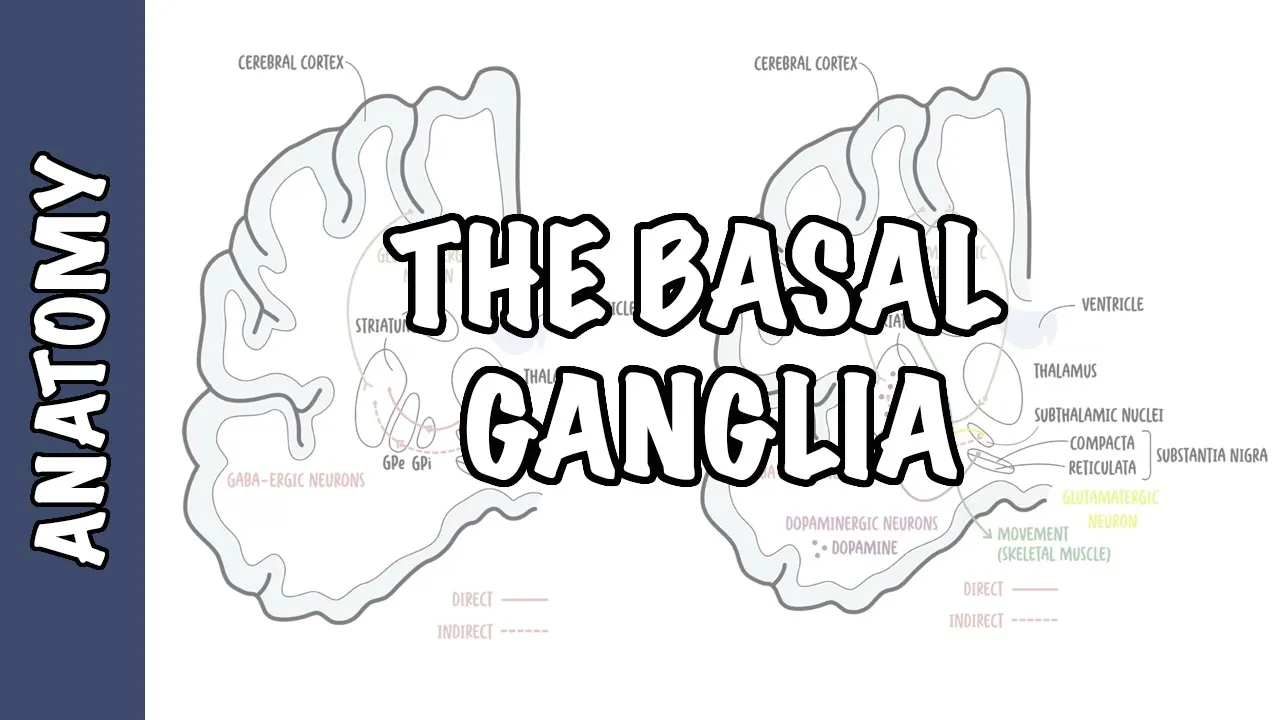




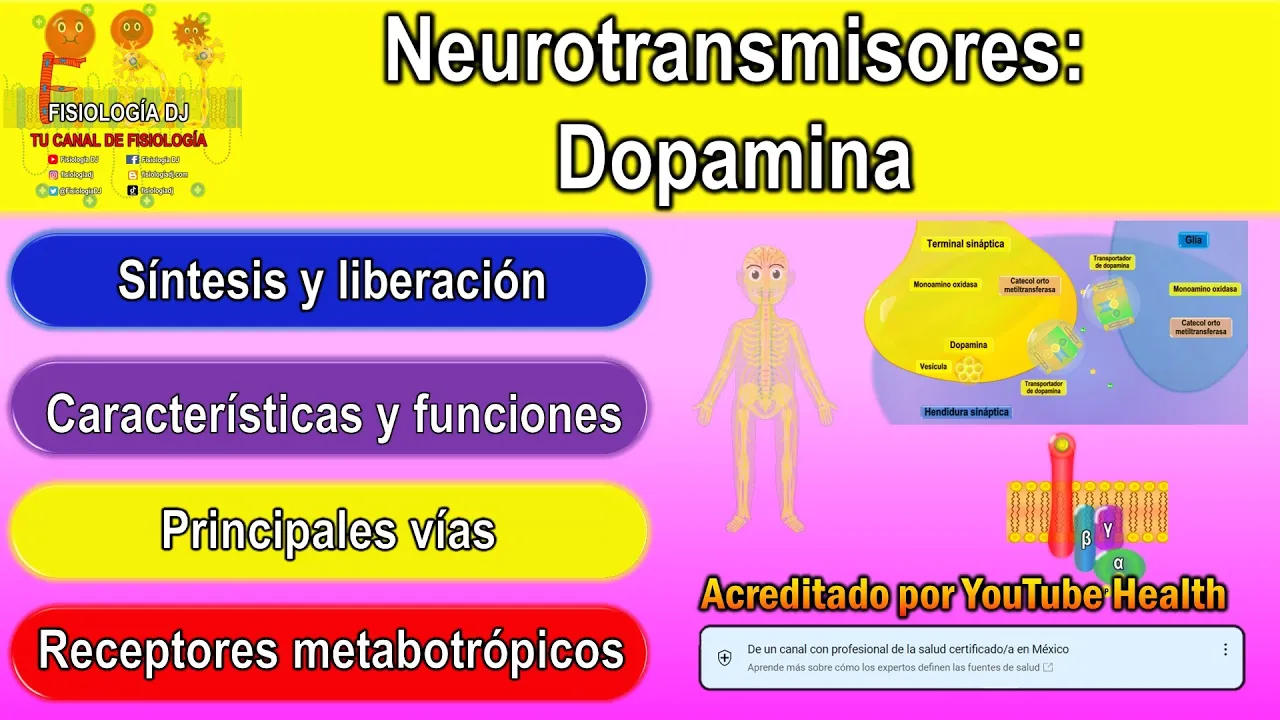
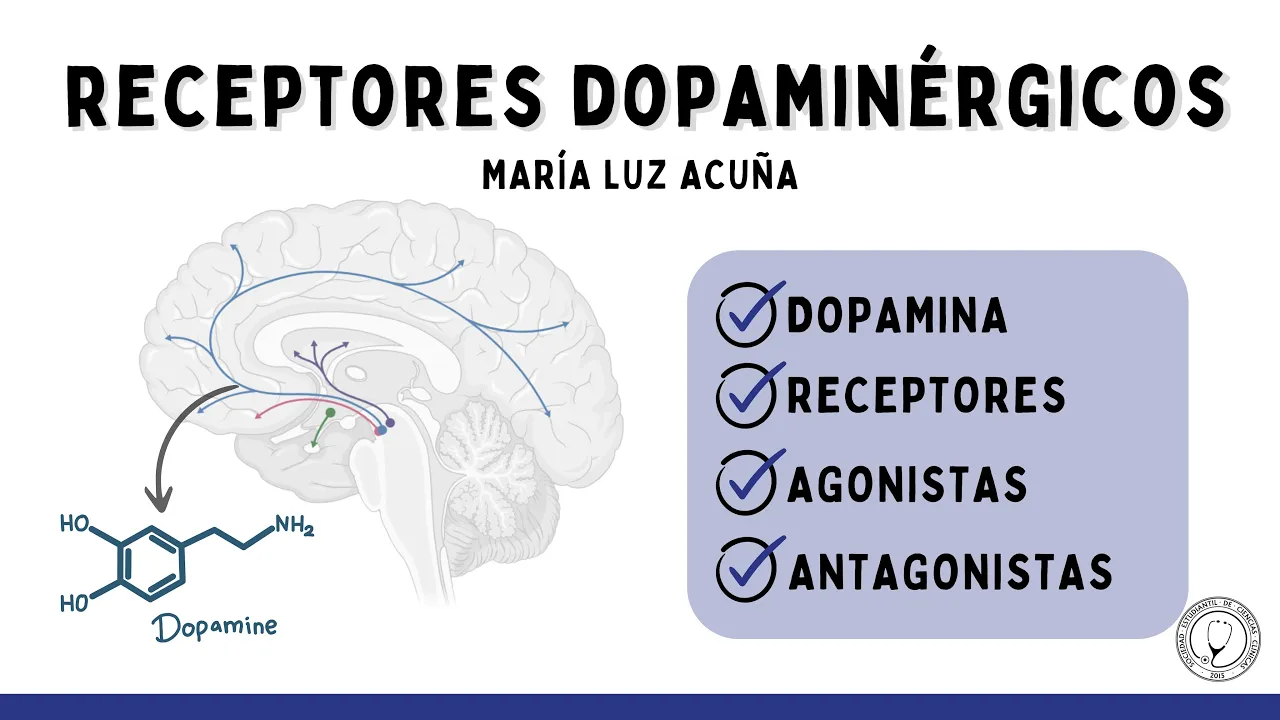







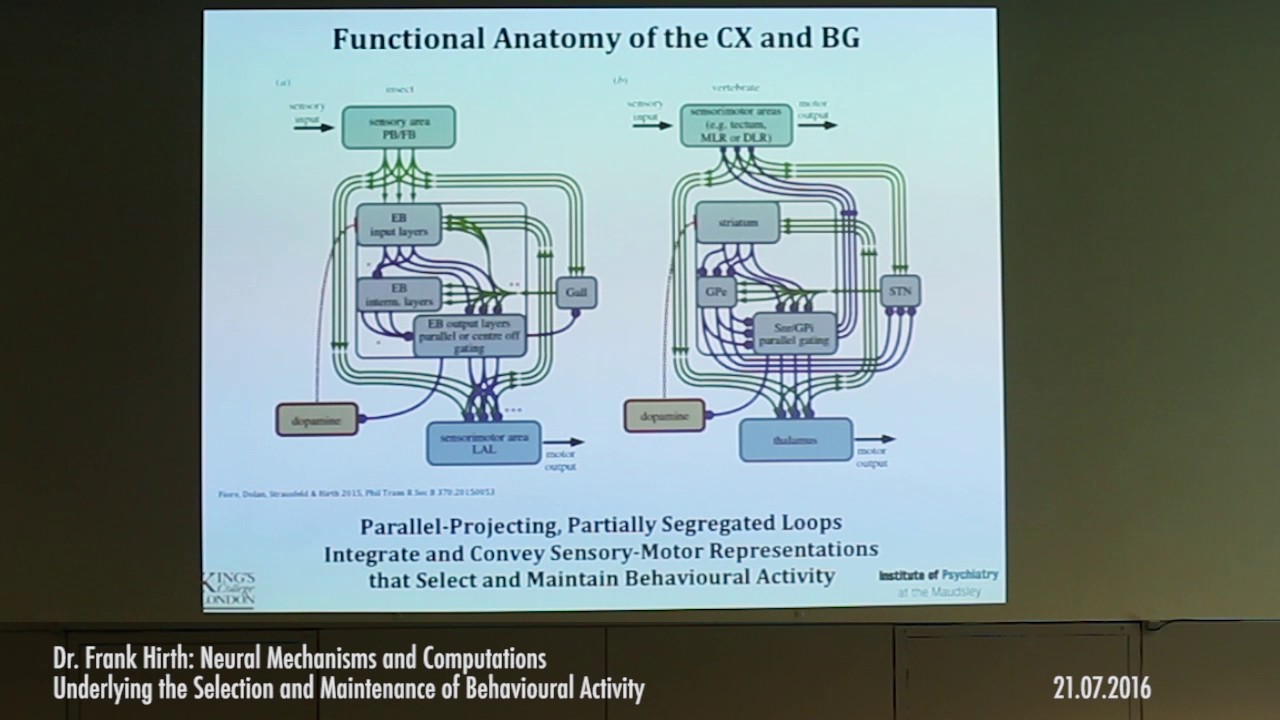










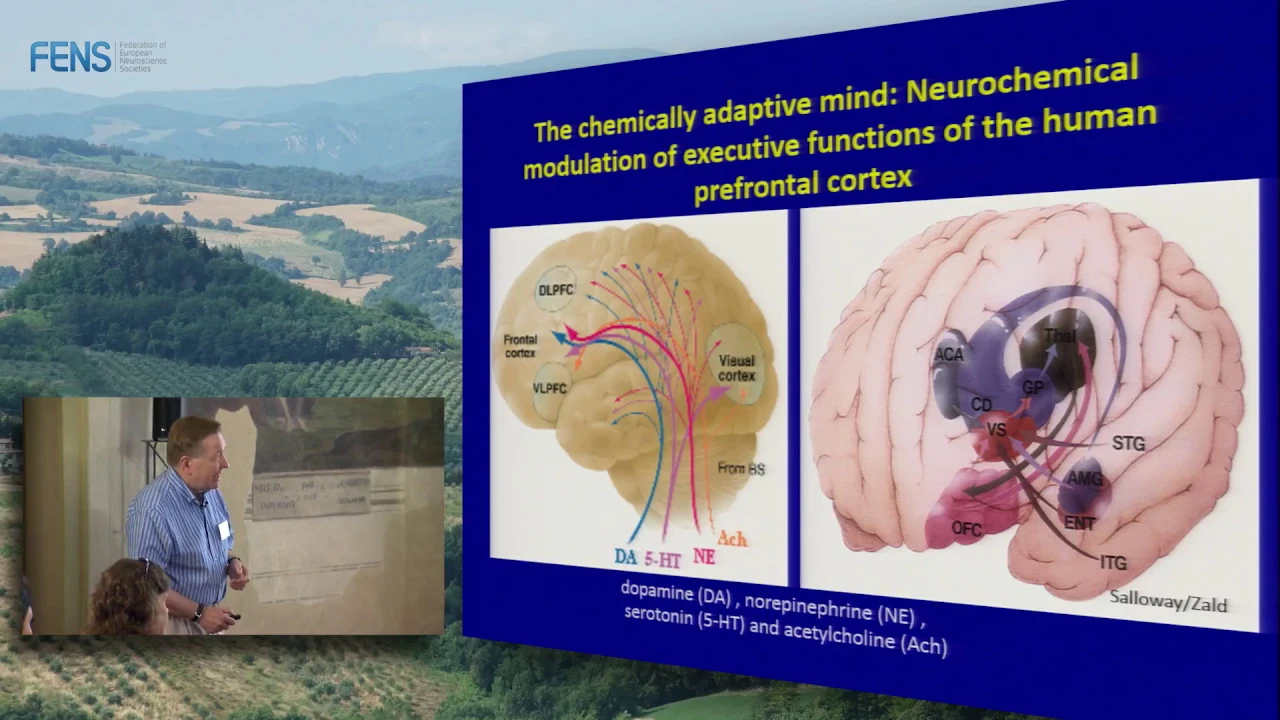
Dopaminergic neurons release multiple neurotransmitters (dopamine, GABA, and glutamate) that act on different timescales to modulate striatal circuit function; direct pathway neurons (D1 receptor-expressing) detect dopamine increases via cAMP/PKA signaling, while indirect pathway neurons (D2 receptor-expressing) detect dopamine decreases, creating an asymmetric system where dopamine acutely regulates action initiation and chronically influences learning through reward prediction error signals that differentially activate PKA in each neuron population.
Dopaminergic Control of Cellular State and Action Selection: Bernardo Sabatini (Harvard Medical School)
Added:Basal Ganglia Anatomy and Circuitry: Understanding the organization of the basal ganglia, particularly the striatum, and the distinction between the direct (go) and indirect (no-go) pathways.
Dopamine Receptor Signaling: Familiarity with how dopamine acts as a neuromodulator through G-protein coupled receptors, specifically comparing D1-like and D2-like receptor pathways.
Synaptic Plasticity and Neuromodulation: Basic concepts of synaptic transmission, neurotransmitter release, and how neuromodulators alter the excitability of post-synaptic neurons.
The Concept of Action Selection: Theoretical models of how the central nervous system selects specific motor outputs while suppressing competing behaviors.
Pathophysiology of Dopaminergic Disorders: Exploring how dysregulation of striatal dopamine leads to movement disorders (e.g., Parkinson's disease) and psychiatric conditions (e.g., addiction, schizophrenia).
Computational Reinforcement Learning: Studying how dopaminergic signals represent reward prediction errors and how these align with mathematical 'actor-critic' models of learning.
Advanced Neurotechnology Applications: Investigating experimental techniques like optogenetics, fiber photometry, and in vivo calcium imaging used to observe and manipulate striatal activity in real-time.
Neuromodulatory Interactions: Analyzing the functional interplay between dopamine and other neurotransmitters, such as acetylcholine and GABA, within the striatal microcircuit.
2.1K views28likes1:02:12Original Release: 2021-07-01
so hello everyone uh so it's my with my great pleasure that uh i'm here to uh today to act as a moderator on the first day keynote lecture uh before just let me uh to remind you to ask questions in the qa window and please type your question there anytime as there is no need to wait until the end but just a reminder that you can also use the slack channel to continue discussion after the talk and please uh remain respectful in our interaction during the conference so i'm very pleased to introduce you now our keynote speaker leonardo sabattini so bernardo is a professor of neurobiology at harvard medical school university in special science in biomedical engineering from harvard college and a phd nmd for harvard medical school where we moved back as a pi in 2001 after postdoctoral training in the college goblin lab so bernardo is a recipient of many prestigious awards including how a huge investigation award and he was recently elected to the national academy of science so let me say that through his career bernardo published many seminar papers that have been really shaping the field of masaganga physiology spanning from study of the biophysical processes that control the function of individual sinuses to mechanism of san antonio modulation and the relationship between senator plasticity and behavior both in health and in disease state and to perform this comprehensive analysis of basal ganglia function his group has developed a novel optical electrophysiological and biblical approach so say this uh bernardo please defrost is yours thanks so much raphaela it's um wonderful to see you again it's been a long time and um thanks everybody i was really looking forward to this conference to see many friends yeah thanks everyone for attending and i'm going to tell you about work about dopamine signaling from my lab that's been building over about a decade for now i hope everybody can see the slides now and hopefully they're advancing for everybody from somebody yeah they're nice and wonderful okay so uh most of the work i'm going to talk to you about is about published and i'm going to point out where those papers are but i thought it would be nice to provide an overview of of a decade of work as opposed to a small snippet of something that's going on now and so um i'm not going to introduce the basal ganglia today but i'm just going to introduce a few terms i think we've seen the basal ganglia in many presentations but today we're going to be talking about the basal ganglia in mice and i'm going to take a mouse-centric view of the presentation and i'm going to refer to direct pathway neurons as dspns direct striatal projection neurons and of course indirect pathway neurons as ispns as is as is customary for many people and so today we're going to talk about the effects of dopamine on the striatum and i'm going to tell you about some biophysical studies that were done in the dorsal striatum and then some in vivo studies that were done in the ventral striatum in the core of the nucleus accumbens and i'll try to make those distinctions clear as we go along so like many people at this conference were interested in understanding you know what does dopamine do and how does it exert its behavioral effects and in particular it's important to think about really two kinds of behavioral effects that are quite different one is the acute effects that dopamine has on a circuit and on behavior and i think this is really best exemplified by the effects of dopamine on action initiation on timing and on vigor and of course a very striking example is parkinson's disease in which you can have somebody who's very severely debilitated but on giving them levadoba they can right away sort of get up and walk so arguing really about an acute regulation of dopamine on the circuit that's essential for normal motor function however of course there's also the other side of dopamine which is the kind of chronic effects that are maybe best seen in reinforcement learning models or in drug addiction in which dopamine alters the circuit in such a way that the future behavior of the animal has changed for very long periods of time and it's a bit of mystery here as to how dopamine does uh both of these things and rather i should really say dopaminergic neurons as opposed to dopamine because of course dopaminergic neurons are quite complex and release more than so this is a uh a parasagital section of a mouse brain showing the sources of dopamine here in the midbrain and the ventral mental area and substantia niro compacted and the dense innervation of those fibers then release within striatum and we are in electrophysiology lab primarily and therefore we started by an electrophysiological perspective and so nearly 10 years ago two people in the lab nick trish and jun ding started to ask a very simple question which is what does dopamine do to striatal projection neuron firing and they took an optogenetic approach and i think you heard from from nick yesterday who may have touched on on some of these subjects so they did a very simple experiment which is to obtain whole cell recordings from striatal projection neurons in the slice these neurons of course were labeled so that we could tell whether they were direct during direct pathway neurons and then simply looked at the firing properties of these cells under a variety of different conditions and so here's an example of a recording from a direct pathways binding projection neuron in which they inject current in order to get a barrage of action potentials and then they're going to use channelrhodopsin they use used charadopsin to fire dopaminergic neurons and release dopamine phasically as this neuron was firing and so what you can see is that at the time of the flash of activation of dopaminergic fibers in this acute brain slice there was a pause in the firing of the cell which is then followed by a clear increase in the firing rate of the neuron and when they waited just a little bit more then of course the effect of this pause disappeared there's a clear increase in the firing rate of the neuron and then waiting even longer than their own return to baseline and so one could see that there was a transient activation of firing of these cells that in their hands only lasted about 20 seconds or so or so but mark bevin has gone gone on to do some really beautiful work with perforated patch recordings showing that the effects of dopamine on direct pathway neurons can actually last uh minutes uh and and are seen as an increase in the activity of these cells the excitability of themselves over time of course so of course what intrigued us was this pause here and uh nick and joan went on to show that in fact this pause is caused by gaba release from dopaminergic cells and as many of you know it had been appreciated that about 10 of dopaminergic neurons are actually glutamatergic because they express the machinery necessary to package and release glutamate but it hadn't been known at the time that they could also release canada and so i'm not going to go into the uh all of the studies that they did i'm just going to show this summary cartoon uh from from a paper that nick and i put together in which we outline the really bizarre way in which dopaminergic neurons are gabaergic and so it turns out that dopaminergic neurons do not have any of the classical machinery necessary to synthesize gaba or to package gaba into vesicles and so the way they become gabaergic is by the function primarily of a plasma membrane gaba transporter which is able to capture gaba from the extracellular space bring it into cytoplasm or the axoplasm and then it appears to be loaded into vesicles the same vesicles that have dopamine by the vesicular monoming transporter and we did a whole variety of experiments to show that that this model is correct and so this is really interesting because these neurons don't look gabaergic based on their transcriptional analysis or their proteomic analysis but in fact they are gabaergic by using these proteins in very different ways than is normally uh normally occurs and so this effect is independent of the gaba synthetic enzymes gavel gad1 and gad2 and it's also independent of the normal vesicular gaba transporter slsc321a 32a1 sorry but it is dependent on as i said the particular monoming transporter and gap 1. and there have been some follow-up studies uh one from gending's lab showing that a modifier of this process is an uh is an aldehyde dehydrogenase which is able to make gaba through an alternative pathway and in the absence of gap one uh this seems to be a way in which the cell can can maintain uh its gabaergic nature and work from uh the lab of ben philpot has shown that in an angelman's uh uh model mouse the uv3a knockout this gather release is is altered and both studies showed that there were behavioral consequences of this although i think it's still fair to say that we don't really understand the context in which gabriel released from dopaminergic neurons is relevant to what it does in the circuit now of course there are other targets of dopamine fibers within the striatum and there are many different classes of striatal neurons chris straub when he was a postdoc in a lab collaborating with nick trish did a study of the effects of activity of dopaminergic neurons on cholinergic interneurons which of course are found within the striatum and comprise a small percentage of all the cells that are there these cells are readily recognized in brain slices in this case because they're expressing gfp but in most cases just because they're large cells that fire tonically at a few hertz and have very low input resistance and so chris did exactly the same experiment as i showed you before but now recording from cholinergic interneurons and what you saw is that these cells as expected were firing along at a low rate a couple of hertz and at the time of activating dopaminergic axons these cells again showed a pause and firing and now an increase in firing rate as we saw before but you'll notice here the kinetics are actually quite different whereas before this increase in firing rate in striatal projection neurons lasted for tens of seconds here it only lasts for about one second or so okay whereas the pause lasts a little bit longer and so in whole cell uh uh voltage clamp recordings he was able to look at the currents that underlie this complex phenotype he was able to see if there were actually three different currents that appeared one was a very fast outward current here and then there's a second outward current then in this case is truncated by a very large inward current it turns out that these three currents represent gaba acting on gaba-a receptors here does this gabba release from dopaminergic neurons although potentially through a different mechanism than what i showed you before for the straddle projection neurons the second current is actually dopamine acting on type 2 dopamine receptors and opening presumably gerk channels they're mediating this outward current which is the one that actually mediates the pause that's here as you can tell the scavenger current is so brief in its time course that it can't really account for this longer pause that occurs we were unable to identify what this inward current was we did a lot of pharmacology and we couldn't really figure out what it was or what neurotransmitter mediates it steve rayford's lab and chris ford went on to independently both show that in fact this is due to glutamate release and activation of metabotropic glutamate receptor that signals through trip channels it's a really odd pharmacology and it's uh you know i'm coming embarrassed that we couldn't figure it out but seeing the the oddness of the current that they discovered i understand why we missed it so because of all this what we learn is that in this acute domain the activity of dopaminergic neurons is mediated uh it influences striatum by at least three different neurotransmitters so dopamine and gaba are both released we think in the same vesicle this is vmap2 dependent and we think this is the feature of all dopaminergic neurons at least within the dorsal stratum and arising from the substantia niro compact something else glutamate chris ford and steve reports showed activates cholinergic interneurons and that effect can last uh you know a few seconds and so we have basically glutamate and gaba that are influencing the neurons on this one to 100 milliseconds sort of time of course then we have dopamine and glutamate that through metabotropic receptors can influence the circuitry on longer time courses and then we have effects that last many seconds uh on spn activity as i mentioned as mark bevin has shown we showed a little bit and then as i'll show you in a minute on biochemistry so that's a complex picture of the acute regulation of striatal neurons by dopaminergic activity firing it's you know now a challenge to go back in vivo and understand which of those effects are seen as dopaminergic neurons go up and down as an animal experiences environment and which of those effects are really crucial to proper functioning in the striatal circuit and to things like like learning and those are studies of course they're ongoing and furthermore we'd like to understand contribution of these different neurotransmitters to disease phenotypes like parkinson's and please keep in mind that because gaba and dopamine are both dependent on the secular monoamine transporter for entry and vesicles pretty much all of the manipulations that have been done to study a parkinsonian animal which traditionally are things like six hydroxy dopamine to kill axons or pharmacological ways of destroying the function of the restricted monoming transporter those will have affected both gaba and dope immunities of course levodopa as a restorative therapy in some cases will presumably only restore dopamine release now for the rest of the talk i'm going to transition i'm thinking about the more chronic effects of dopamine release which is how does dopamine influence future behavior and of course as all of you know dopamine neurons are thought to encode reward prediction errors and it's thought that this dynamic context dependent modulation of dopamine neurons increasing their activity at the time of a reward or at the time of a cue that predicts a reward and decreasing their activity at the time in which an expected reward is missed it's thought that these are the signals that are used to induce learning and to modify future video so how can we look at these well we started by asking about what are the effects of dopamine on pk that was sort of our goal so remember the direct and indirect pathway neurons differ by the expression of dopamine receptors so direct pathway neurons express type 1 dopamine receptors which couple through g alpha s g proteins to activate adenylyte cyclase which which produces cyclic amp which turns on pk on the other hand the indirect path of neurons express type 2 dopamine receptors that signal through g alpha i to inhibit adenylyl cyclase and thereby withdraw cyclic amp and presumably suppress pk and this is the model that's dominated a lot of reinforcement learning and drug addiction for a long time and these signals to pk are thought to be necessary and sufficient for learning that's something that we can get back into later so we wanted to ask how is dopamine influencing pka and then do that in a reward guided learning context to understand how these signals modulate learning and reinforcement so supjun lee who was an md phd student doing his dissertation in the lab is now wrapping up medical school designed a task in which an animal had to explore an arena and shape its behavior in order to gain a food reward and so these are food pellets that were delivered here by a receptacle on the left hand side in this image and the animal was food restricted so it was highly motivated to do this task in order to uh you know to get food uh and and uh and not feel hungry right and so the task consisted basically of a virtual division of the arena into different components these are not marked in any way but the video camera and the processing software basically subdivided the arena into these compartments so there was a zone over here that we're labeling zone one this is a trigger zone and the animal had to learn to hang out in this zone for a certain amount of time and if it spent enough time in that zone then an led would turn on and it had to then run across the arena do that within a certain time limit and then again spend some time in zone two if it did that then food would be delivered through this receptacle so it basically had to hang out in years on one run hang out here and then it could get free so here's an example of a success trial i hope this video is playing for you you can see the mouse over here on the right in the trigger zone the led turns on it runs across quickly it waits here it goes right to the receptacle but it has to wait a little bit of time actually for the pellet to be released and then it consumes the pellet and goes on so here's the task structure first we have the animal has to enter the trigger zone it has to wait there a certain amount of time led has to get to the receptacle zone in a certain amount of time dispense the pellet and then go to the inter trial interval and the key thing that sukjun did is to limit the number of trials that the animal could engage to 20 per day so in that way we had exactly 20 trials every day and simplified a lot of the analysis and we had a very long inter-stimulus inter-trial interval which was at least two minutes okay so this gave us a lot of time to look at to let signals get back to the baseline to look at intratrial effects and to really cleanly separate different components of dopamine and eventually pka signaling in different parts of the task so mice do learn the task but here we can see a success rate progression for a bunch of different mice overlaid as a function of training day all animals were trained for 11 days and as i mentioned only 20 trials per day so you can see the training the learning rate is variable across animals and here's the summary across this cohort that you see there now because the learning is variable across animals for each animal we subdivided its progress into what we called early mid and late which was based on how many successes it would get out of those 20 trials so when it was down here into the success rate we called it an early mouse even if it was all the way out in day seven if it was here it was a mid and here was a late or expert maps okay so we tried to look at four actually we did look at four signals that we thought would be of interest so first we looked at the activity of of dta dopaminergic neurons so now i'm switching to nucleus accumbens and ventral striatum of vta dopaminergic neurons as measured at the cell body with fiber photometry we also measured the activity of those axons again with fibrophotometry and calcium indicators in the accumbens itself so those are two fibers there then we measure the concentration or a signal proportional to the concentration of dopamine in the nucleus accumbens using d-light which had been developed by lin tian's lab around that time and then lastly we looked at pka signaling within direct or indirect pathway neurons using a tool that uh that was developed in my lab that i'll tell you about more in a minute so we looked at these four signals of interest and importantly we looked at them every day so through the entire learning process from the first exposure of the animal to the arena all the way until it became an expert and then after it became an expert we introduced two other kinds of trials that were reward emission and led emission that i'll tell you about in a minute too okay so the animals then had two fibers and planted in them so for example here you can see one fiber that's targeting the cell bodies of the vta they're expressing jr camp 1b this is a red calcium sensitive fluorophore a red gecki developed the canalia and then uh we had a second fiber implanted in the nucleus accumbens by which we could record the red signals of these axons that were arriving in the accumbens as well as the light that was expressed there so we could look at the activity of the axons the cell bodies and the dopamine concentration of this experiment okay so what do these signals look like well here's an example from early in training and these signals are now aligned in this dashed line to the time of food dispensal dispense dispensing dispensing okay so this is when food drops into the receptacle and the animal can then consume it and so what you see is that early in training there's a large increase in the somatic gr-cam one signal there's also a large increase in maximal signal at the same time and there's a large increase in the dopamine signal measured by d-light at the same time so all of these three are going together and in fact in our hands unlike reports from josh burke and others we do not see any disjunction between the somatic the axonal signal or the light we see these really all tracking together and we think that one fully explains the other and we don't really understand at this point the differences with uh josh's lab and other reports okay so this is early in training now if we wait to the mid and late phases we can see that two things happen one is that this food evoked response begins to drop and of course this is expected because the animal has now learned the task and expects the food to be there so this is kind of classic rp which is the reward mode the reward generated signal gets smaller as that reward becomes expected but of course you'll also notice that now there's a signal that begins to appear before the food drops here and so we can look and i'm sorry these are only the success trials that are plotted here so now we can look at that signal that appears before by aligning instead of to the food delivery but to that cube to that led turning on and so here you can see now using all trials because the outcome doesn't matter but if we just look at uh q alignment you can see that early on there's a little bit of a q evoked signal that's seen again in all three of these signals and then as we wait for the mid or the late stage animals then that signal gets bigger and bigger and bigger so the q evoke signal in all of them gets larger okay and so now you'll notice some of you that the food evoke signal seems uh you know smaller and that's because it's no longer aligned so it doesn't summate in the same way and also because there are failure trials included here as well in which there was no reward so basically we're seeing classic rb here here the reward signal goes down as it becomes more predictable whereas the q signal which is now predictive of reward but whose timing is unexpected by the animal that now generates larger and larger transients now these effects are clear really on each mouse and each trial uh did really a wonderful job of optimizing photometry signals so as i mentioned we could image continuously across the whole learning process but also with good signal to noise so that we could really analyze individual trials in individual animals so here you can see on the lower left all trials um for beginner animals in which we've marked the time of trigger zone entry by the t the time that the led turns on three seconds later by the l the time that the animal now with a variable delay enters the trigger the receptacle zone as z and then the dispensal happens with a fixed time after that again three seconds and then the iti and so here you can see that beginner animals show no dopamine transients to entering the trigger zone or the led turning on instead they only show the dopamine transient when the dispensal drops the drops the uh the pellet um and then r here indicates when they actually eat it these trials are sorted simply by time of them entering the uh the receptacle zone and so you can see this is really tightly time locked dopamine signal to the actual delivery of the food in the intermediate animals now you can see the emergence of this led evoked signal it's really there in all trials and you can see that the behavior is becoming tighter the timing is becoming tighter uh and the time between dispensable drop and actually eating is becoming shorter and in the expert animals now of course the cure evokes signal is really dominant and you can notice you know just by eye how much this reward independent signal is dropping okay so this is the evolution of the dopamine signal with training the food signal getting smaller as they move from early to mid to late and the q signal you know getting larger and as i mentioned we see this in the somatic vr cam signal we see it in the axonal jr cam signal and we see it in the accumbens d-like signal and they really all share exactly the same properties and look very much like you know classic rb okay so now i want to transition to pka and so you know these rpe type signals are thought as i mentioned to be the ones that regulate learning and they do so presumably via their effects on uh dopamine receptors oh i'm sorry i forgot i forgot to forget to talk about this okay so sorry i at this part i've been showing you success trials uh which is and i've shown you how the signal moves from the reward or to the cube but i want to talk first a little bit about this emission trials really reinforce the fact that this looks like rpe okay so here are emission trials okay um and these are uh um uh you can see here the animal uh these are these are expert animals and you can see that at the time of the led being active this is a really nice dopamine transient but even though the animal does everything correctly we've decided to not give it a reward and we do this as i mentioned you know late once the animals already become an expert and so you can see that uh you know even though the animal makes it into the receptacle zone there's no reward signal that's because we didn't give it a reward okay now we also do a different kind of a mission trial which is very important which is an led emission trial so we actually drop the cube now when we drop the queue very late in learning the animals sometimes by chance can do the whole routine correctly even though the led is not there okay so they get a reward it's an unexpected reward because without the queue they don't really know that they've done it correctly but they just happen to run around the cage you know in the correct pattern the frequency of getting this these is small you know we know that the animal needs the ldd to do the task correctly at high efficiency but it does happen you know with some some probability so what you can see in these is of course there is no led evoked signal because we didn't turn on the led at the time that we should have turned on but there's a reward signal as the animal got the reward so what do these look like when we quantify them well it's really sort of beautiful rpe so here in green so these are aligned now to the food dispensal okay which tightly aligns this food signal and so you can see here in green the normal q evoke signal and then the food dispensal signal that comes and so these are expert animals so they have you know some food or folk response and some q revoked response now in blue overlaid are these reward emission trials in which we just fail to deliver the reward and what you can see is that at the time that the animal expects it now built in crashes and it dropped below baseline again consistent exactly with plastic schultzian you know rte what's really interesting though is these led emission trials where you can see well there's no led signals of course there's no transient at the time that it should have been an led but now the food signal is really large and that's of course because this was an unexpected signal so again really looking a lot like like rp and then here on the right you can simply see a blow-up of these signals at the time of food dispensary really highlighting the opposite signs and the graded effect that we sleep okay so this really looks like classic rp dopamine transient and the dopamine neuron activity decrease to reward and increase to the cube of learning and then reward emission and also fail your child which i'm not showing you here also cause dopamine to fall below baseline and you can look at switching's published paper for more details okay so now the question how does this translate to modulation of pk and how does it differentially translate the modulation of pk in direct pathway neurons and indirect pathway neurons and so one very simple model would be that whenever dopamine goes up pka increases here and pka drops there and then conversely whenever pk whenever dopamine goes down you might expect pka to drop here and to go up there but if you really think about that there's a lot of things that are built into that there are assumptions about saturation or lack of saturation of dopamine receptors there's assumptions about kinetics of the actions of phosphatases and kinases they're all built into those models and there are assumptions about affinities of receptors that are built into those models that really have not been tested you know dynamically in an animal doing a behavior now why did we focus on pk well of course one is that it's downstream of dopamine receptors but the other is because this is a kinase that's central to many forms of plasticity that are seen in neurons including changes in cellular excitability you know jim's lab has done a lot of this uh on synapses jim's lab and rick rubineer and many others uh have looked at this rick of course in the hippocampus not in australia there's regulations nmda recycled calcium influx of zanzukin and other people contribute to this as well promote synapse formation janya kozarovitsky who uh worked in in my lab uh built on uh work that had been done by uh hong kong years ago in kenya showed that in the striatum dopamine regulation of pka can influence the activity of the ability to generate new synapses and jenny is going to be speaking tomorrow i don't know if she's going to touch you know on that of course it regulates transcription there's many people within like greenberg and paul greene paul greengard greenberg eric kandel who contributed to this and lots and lots of other effects of pk okay so pk activity is supposed to mediate reward reinforcement and generally it's sort of a pro-activity pro-plasticity kinase uh and so we want to understand when is it activated is it dynamically regulated by behavior what turns it on and is it different in directing the direct path so yao chen when she had been a postdoc in the lab developed a uh fluorescence lifetime pka center uh building on the work of xinjiang when she had been at hopkins uh and this is a molecule it was originally this is called a car which is a molecule in which there's a fluoresce a foster resonance energy transfer interaction between two fluorophores that's dependent on phosphorylation of a pseudosubstrate of of pka that's present in this linker domain when this is phosphorylated these two things come together having a fret interaction uh and of course this is this is uh modulated back and forth by the activity of pk phosphorylating the site but also by the activity of phosphatases dephosphorylating the site and so when i say pka today i really mean sort of net pka activity which is the balance of phosphorylated versus unphosphorylated substrate and i'm sorry i'll be a little bit sloppy and call that pka activity although oftentimes i can't really resolve whether there's an increase in pka or a decrease in the phosphatase okay so yao took the original a car and turned it into a fluorescence lifetime reporter and she used it really beautifully under two photon excitation to study a variety of different processes now the important thing to keep in mind is that when these two fluorophores interact they will they will reflect a high pk activity but when they interact their lifetime is shorter goes down so in all the graphs that you'll see in a moment you'll see things going down affecting pka going up and so the lifetime in this state here is about two nanoseconds the lifetime here is about 1.6 nanoseconds you know 0.4 nanoseconds doesn't sound like much but it's actually something that's very easy to resolve and the way you make these measurements is basically in a pulsed manner you can excite a fluorophore and then essentially start counting and then wait until there's emission of a photon and by measuring this time between pulse excitation and emission you can build a histogram of the lifetime of these fluorophores and and then derive information about pk state and of course rioja yasuda who uh usually pioneer in developing these approaches under two-photon microscopy uh you know really sort of paved the way for a lot of these things okay so here's a histogram of the lifetime of phlegm a car as we call it in a baseline state or after activation of pka by generated cyclic game evil forced one you can see the curve go from blue you know to red and then we can reverse that by blocking pka by going back with that with h89 this is now an image in which this color map shows the lifetime and what you can see is that uh is that after we activate forced coin all these cells will become red indicating this drop in lifetime and it reverses with h89 and as i mentioned even though these signals are very very small they're actually quite easy to quantify and the changes that are seen here are really robust this is a very clear decrease in lifetime reflecting more pka activity and reversible hiv okay so in slices we can use this to look at activation of uh dopamine receptors for example here's just an unquantified image showing you an effect on lifetime of flim-a-car when we activate d1 receptors and direct pathway neurons and as expected you can see that the cell begins to turn red first the cytoplasm and eventually the nucleus and the d1 receptor response is not as big as the maximal response that one would expect with force okay so yao gives a lot of beautiful studies with that uh which i'm not really going to tell you about today but instead i wanted you to understand the tool so you can see how we went on to use it in vivo and some uh who i've mentioned to you before um decided to try to use phlegm a car in vivo through an optical fiber and so he wanted to look at the bulk activity of pka in genetically defined striatal neurons of course direct pathway versus indirect pathway neurons is the most uh obvious and that's where where we started uh and ask are these dynamically modulated animals it was greatly helped by bart lotter who was a master's student at the time and now has joined the lab to do a phd and as i mentioned this work is published in a couple of papers have come out over the last couple of years and so i really encourage you to look at those uh to to get some of the details that i'll have to skip today okay so the system basically works by putting an optical fiber into the nucleus accumbens sending in pulsed one photon excitation through a pulsing blue laser that pulses at 50 megahertz and then measuring as i said the fluorescence output you know one photon at a time measuring the time between each excitation pulse and each output photon and this is done with something called time-correlated single photon counting and as before we're going to use the same task and motivate the animal by food restricting it and then giving it good rewards and as i mentioned you know we're going to compare direct and indirect pathway neurons focusing on this positive coupling of the d1 receptors and direct pathway neurons and the negative coupling of the d2 receptors in the indirect athlete very much and we express phlegm a car in either cell type using adeno-associated viruses preconditional viruses and transgenic mice that is really standard in the field okay so is pka modulated so the first thing we did is just give a hungry animal a food color forget about the task for a minute just give it a food pellet and see what happens and so you can see really nicely here that if we express acrim in direct pathway neurons and i'm going to call these direct pathway neurons even when they're in the nucleus accumbens uh and we're really defining them by d1 receptor expression so forgive me for calling them direct pathway i know that terminology doesn't apply as well in the accumbens but it's just convenient and so what you can see here is a line to the dash line when we give the animal food that there's a decrease in the lifetime of a car flame when it's expressed in the direct pathway neurons and of course this corresponds to more pka and so this is what we expect i'm sorry i think i froze there for a moment this is really what we expect a food reward increases dopamine binds to d1 receptors and increases pka in these cells and in fact we can show that that's what's going on here if we give the animals a d1 receptor antagonist we can block this response and if we express a genetically encoded protein pki which is an inhibitor of pka that i'll tell you more about later if we express that in the direct pathway we can see again that the a carb slim response goes away we did a bunch of other controls like mutating the phosphorylation site and so forth on the reporter and i encourage you to see that uh in the paper now one thing that really surprised us in doing these experiments is that you know by monitoring pk directly in cells we were able to look at the engagement of these targets in vivo and you know we found that a lot of pharmacology that people use in the periphery to manipulate dopamine receptors centrally really just doesn't work and we could look at that directly by pk so you look in the papers we spent a lot of time working out pharmacology that actually can monitor eka and people okay so uh the first thing we wanted to see is you know can we really modulate pk in the direct and indirect pathway just by changing yogurt okay so again forget about the task structure for a moment here we're going to use dual fibers again but we're going to express in dopamine neurons either a crimson so an activator the optogenetic activator or gtacr2 an altogenetic inhibitor so that's going to be expressed in the cell body the fiber present there in the vta will allow us to turn on or off dopamine neurons and then we can monitor what happens in the accumbens first in terms of delight and learning in terms of detail okay so here's the experiment first i'm showing you activation of dopaminergic neurons using crimson what you can see here is the dopamine transient that's invoked in the accumbens by a half second or a one second stimulation of those cells this was designed to mimic the size of the spontaneous food reward dopamine transient and then here you can see the pta transient that's evolved from the direct pathway neurons by the half second or the one second stimulation you can see one evokes a small pka activation and the other one are large this is now the same experiment done with recordings in type 2 dopamine receptor expression cells indirect half minerals and you can see that the same manipulation which is increasing dopamine has no effect whatsoever on pka response in these cells so our incredible conclusions from this experiment is that increasing dopamine modulates pk and direct pathway neurons but not indirect pathway neurons and of course this suggests that type 2 dopamine recyclers are actually fully occupied at basal dopamine levels so that increasing dopamine more has no effect and we went on to do a lot of different kinds of pharmacological experiments to really nail down this point we think this is absolutely true that at least in a mouse in the core of the accomplish in this kind of task basal dopamine is fully saturating the type 2 dopamine receptors okay now what about the converse experiment if we now use gta cr2 to inactivate opioid neurons here we did even longer inactivations really probe what's going on and that's because the reward emission typically drops dopamine levels for an extended period of time so one second two second or five seconds of inhibition you can see dopamine progressively decreases different levels as measured in the accumbens with delight these uh effects have no these manipulations have no effects on pk signaling indirect pathway neurons but fortunately because of light contamination we couldn't actually measure while uh the uh the the signal was on we had the blanket but uh but you can see that you know there is no effect uh at last there in converse in the indirect pathway neurons when we drop dopamine there's a robust and fast activation of pka in those cells so in fact withdrawing dopamine increases pka activity in indirect pathway neurons really robust so do you use some dopamine modulates pk in the indirect pathway cells but not the direct pathway cells and this suggests that the type 1 dopamine receptors are effectively not occupied at all by basal dopamine such that dropping dopamine more has no effect on pka and direct pathway cells and again we did a bunch of pharmacological experiments to really try to nail that down okay so this suggests then that d1 receptors and direct pathway neurons detect only increases in dopamine whereas d2 receptors and indirect pathway neurons detect only drops in dopamine from basal levels of course this is from the perspective of signaling 2 pka and there could be other effects by beta gavin some units so forth that we would have missed but what this implies really is there is no concurrent push-pull regulation of pk and direct and indirect pathway neurons because they detect fundamentally different features of dopamine transients that are going to be engaged at different times in the behavior okay so let's just look at that in a little bit more detail so let's return now then to this task this suction uh designed okay and now we're going to look in task at how uh task vote modulation or dopamine transforms into pk activity and we're going to exploit that in this task there's no laterality of the task and in fact such and when it went on showed that signals on the right and left hemisphere of the brain are really identical in this test so because of that we are able to do lifetime photography to monitor pk in one side of the brain and on the other side of the brain use intensity photometry to monitor another signal such as the light even if both of them were encoded by green fluoropores as was often the case because the a car signal is a green floor okay so here in expert animals you can see the classic rp is like signaling this is the boat when the animal does the test correctly there's the chew signal and there's the reward signal and here's the emission cue signal and then the crash of dopamine below baseline when the reward is emitted so what happens in the point of view of pka well here you can see in a direct pathway d1 receptor expressing neuron in red the q evokes a pka signal and then in when there's no reward that signal begins to go down the baseline uh if there is a reward and there's an additional component of pk that's seen in that cell that's due to this second peak of dopamine that follows when the food is delivered okay so q and reward evoked dopamine signaling indirect pathway neurons what about an indirect pathway well here is a transient that we see when the animal gets the q and the food so this looks like an inhibition of pka and in fact it is an inhibition of pk and i'll tell you more about that in a moment here is the emission trial you can see that the signal starts to go in this direction but when the animal fails to get that expected food reward now dopamine crashes as seen here and that leads to an activation of pka in that cell which has a very similar kinetics and a similar magnitude to the modulation of pk that's seen in direct catholic but now remember this is due to the withdrawal of dopamine whereas this is due to the exposure now this little blip that's here this is not d2 receptor dependent we don't know what that is remember i showed you already that if we increase dopamine beyond basal effects there's no regulation of pka in the indirect pathway neurons and using pharmacology we're able to prove that this signal is not d2 receptor dependent so there is some other pathway that's converging on the indirect pathway neurons which is increasing pka activity when dopamine goes up with the with the q and the food but it's not d2 or separate dependent and we don't know what it is this signal of course which is the crash is d2 receptor dependent and reflex with gall of dopamine now if you think about this a little bit more it's actually quite interesting right because there's basal dopamine which is yeah inhibiting adenylyl cyclase bgi via gi coupling it's doing that basically but now when dopamine drops pka turns on so that means that something else has to be providing a drive to increase isbn pka when dopamine drops and we don't know what that is it could be phasic activation of another gps star that happens at exactly the same time for a variety of reasons we don't think that's true instead it could also be due to a constitutive production of cyclic amp or activation of pka or a constitutively active gpcr it's there providing always a push towards activating pk which is normally suppressed by d2 receptors and then when dopamine drops that other signal is d repressed and turns on pk and again there are things that we need to work out here but just shows how complex the signaling you know really is sorry thank you okay so the key thing though is that these signals occur in different trials right these are success trials we get activation to be gay less than the error trials but the activation of the indirect pathway decay only happens in these areas so do these contribute to learning well the hypothesis is that direct pathway pk may be necessary for early phases of learning when rewarded both dopamine transients are largest and the could you vote few evoke transients are emerging of course you know an animal experience in a reward has a dopamine transient even before it learns a task structure on the other hand those laws or um reward omission whether due to failure or due to experimental manipulation those laws of both dips and dopamine are only present once the animal has learned the task structure and is predicting the reward and so therefore this indirect path to pk should only matter after this reward prediction errors are learned and failure trials cause a dip so late in learning so i'm going to skip our manipulations using pki you can look at those in the paper it largely bears out consistent with hypotheses that i just posed although the effects on the indirect pathway are very subtle and i'll point you to a paper that's present in my archives now this is not by subjungli but rather by jay only another grad student in the lab that really focuses on the function of the indirect pathway and when the indirect pathway becomes relevant to tax behavior there's a lot of really interesting things there and if you read that study and this study together you'll understand what the links are so let me wrap up then i hope i've convinced you the dopameric neurons are complex that they release at least three neurotransmitters that act on different time scales to trigger a wave of effects that go through all different kinds of cells in the striatum and have very different temporal domains the function of gaba and glutamate release from these thoughts i would say is still you know unclear uh in vivo in task learning specializations of the type 1 and type 2 dominant receptors make the biochemical effects of dopamine on these two cell classes occur in different trials and in different contexts okay so you should really think about them as things that happen at different times and these do contribute to different aspects of reward-guided behaviors this is uh the lab at the time when uh was there this is so shown here he really was incredible the amount of work that he was able to get done uh bart you know helped him as well and is continuing on in these studies he wasn't present in this picture um and this is jay only whose work i really encourage you to look at on on bioarchives and last year in the international science touches on this so thank you very much so thanks a lot bernardo for the fantastic talk uh we have here a number of questions so dennis i don't know you want to uh yeah sure i'll take it away um let's probably just start with the simplest one um howard fields wants to know whether the d light signal in the accumbens was in the core the shell or the lateral shell before cool um so then another question about the um i guess dopamine measurements during the behavior task so were you able to identify uh this is from ben benic um identifier can you speculate on any differences between the animals that entered the mid or late stages after a few versus many sessions i guess because you showed a lot of variability in the behavioral data is there any did you get any correlate maybe of their fast or slow learning yeah that's a great question and we haven't done that data analysis we do have that data and and you're absolutely right you know potentially we could see that an animal experiences a large dopamine transient early in learning for example and that one might be better at progressing through the task structure than the other ones we you know we have to do that analysis and uh sub gen is actually coming back to the lab this summer for a few months and maybe that's some of the one of the things that we'll dig into i'm sorry i don't have the response cool thanks um and this one is from um veronica alvarez she's wondering um i guess because you mostly showed the delight signals during that um during the reward of mission on the test what happens to the axon g cam signals and the soma signals and then she does a second question which is a little more speculative and if you think the dopamine is facilitating the reinforcement learning what do you what do you think the role of dopamine is in the expert animals since there's a remaining you know food signal it was a great question so many of you may not know veronica was the first post talk in my lab so pleasure to not see you hear from you and thanks for organizing this wonderful session uh so um so the axonal signal really follows the uh the dlight signal we really don't see any difference so basically you know there's there's activated activity of these cells and so if they all sort of you know pause at the same time we see the g camp or the jr camp signal drop and it's the same so we see no difference really at all between somatic axonal and d light signals uh in these cells so no evidence for local regulation so what does dopamine do in the direct pathway once the animal's learning the test i really have no idea and uh you know if we if we blocked you know pki in those cells and the data that i skipped we saw that the early learning was affected but then the animals of course did learn which is not surprising i mean this is an animal that's working for its food right so you would think that they're going to be other and we did actually you know very very specific manipulations of blocking really right in the cell in the region that we're looking at i encourage you to look at that in the paper and these dopamine transients continue once the animal is good we don't see an effect of pki there but yet the dopamine transits are there so i really don't know veronica and it'd be interesting to see whether it be some long-term extinction phenotype if we got rid of that uh but unclear i have a curiosity if i can just so what do you know about the subcellular compartment specificity of the pka so what about differences in in the special and temporal dynamic in the shaft versus the spine yeah great question we don't know because of course this was not done with imaging we're trying to address that a little bit by looking at synaptically targeted pka one can of course look at nuclear pka and separate those signals we haven't done it yet uh ryoje yasuda has looked a little bit spine versus cytoplasmic pk in a different context in different cells and really didn't see a difference now there's a little bit of something that just keeps bothering which is that we don't think that our signals are limited by the kinetics of the reporter you'll notice the signals last about 20 seconds we don't think that's reporter limited but it's actually really hard to prove i think we need to kind of nail that down first before we do these other kinds of analysis yeah so there's actually a lot a lot more questions about the pka sensing um so one is uh so colon energy generally said to have both this person's anonymous sorry um cholinergic and are instead of both b1 like slash d5 receptors and d2 receptors so have you tried in these cells what sort of pka response might you see if you did we haven't done it it's on the list of things to do we haven't done it you know electrophysiologically we see the response dominated by the d2 receptor effect and of course you know that's burke beta gammas and so forth so it's a great question i don't have the answer yet cool sorry i just because i've been seeing one which is very interesting it was scrolling down so in relation to cool releases you mentioned about i mean queen fan is asking whether gaba or glutamate could release with dopamine can i have any modulation effect on the pka signaling yeah it's a great question um and i'm really very interested in the idea that the gaba b receptor affects potentially might be modulating eka in these cells of course that would be gi coupled in both both places um but i don't i don't know the answer to that i think it's a fascinating question and one we want to get to sorry for so many unknowns it's just this is where we are but there was a very interesting one of course you would want to hear about even speculation here so yeah so i think that gabba b response might be there uh you know nick did some experiments if i'm remembering correctly trying to look for a gabba ib uh uh current in in spns and didn't see it you know following uh following the open release but you know whether they're still signaling into pk we don't know thanks um let's see the next one oh yeah do you think that this d2 independent decrease in pk activity could possibly be driven by d1 receptor expression jonathan brits asking um so increasing dopamine during reward so at the time of reward there's a dip in ka activity in the indirect pathway neurons i don't see how that could be d1 receptor dependent um yeah gs coupled even if even topically expressed or in those few highest ends that might express e1 receptors i don't see how that would get the right sign i mean maybe i'm thinking about it wrong um yeah i don't see it i mean it could be dynamic regulation of opioid receptors that's going to be the easy one to try um of course there are muscarinic effects more in the direct path to when you're at pathway there's so many things to consider but i don't think the wrapping question is there and we do see regulation by ramping uh designed some really nice experiments only up going ramps and those were effective at modulating d1 pka [Music] nice um so jeremy day says beautiful talk bernard pierre vincent's group showed a few years ago using straddle slices that dopamine rapidly induces pka nuclear translocation and your tool validation seems to show this as well give evidence this happens with the physiological changes in dopamine in vivo yeah hi jeremy thanks all right so there's a great question um and we do have nuclear targeted and nuclear excluded flim-a car so we have the tools to do that but we haven't haven't done it uh in the slice as you noted we do see that nuclear translocation rather than translocation i should say you say we do see nuclear activation or phosphorylation of bk substrates um and we do think that's real and important for transcriptional regulation we don't know if it happens within dodges the evoked but we have the tools and by the way if other people want to get into this you know it's not that hard to do flim now there's been some beautiful papers that have come out showing other ways of doing uh flynn using frequency modulation that look quite robust and you know the tools are all on aging and we're happy to help people you know get going there's many more questions the answer than we can possibly address cool so yeah so i'm gonna try to combine this with all the question i had from a few people where so you claim i guess in the beginning that because you don't see an increase in um or a decrease with a pka sensor to dopamine release that the d2 receptors are fully occupied but then um because you see this dip you you speculate that maybe that's actually a constitute active uh receptor so do you think that these um dopamine dependent changes you might see in indirect pathway neurons might be due to other aspects of the receptor like internalization or um you know post-translational modifications yeah um so we are you know doing as brief and phasic dopamine signals as possible and of course our endogenous the evoked ones they seem consistent from one repetition to the next repetition so we don't think that there's a long-term modulation of the dopamine receptors such as loss of significant receptors to internalization at least you know under these conditions but we haven't looked at that directly but you know the stability of the signals would argue i think against that but there does seem to be some you know drive that's there and i also encourage you to look at the papers because we did a lot of pharmacology this is not all the evidence you know if we give a pharmacological agonist of d2 receptors we also see no modulation of decay in these cells so even you know the strongest uh you know agonist delivery uh doesn't doesn't do that even though that we can look at interactions between agonists and antagonists to prove that our pharmacology is working correctly so we really don't think that there's a capability to increase the receptor occupancy uh individual cool thanks and uh yeah it's another question from daniel travesty about the role of adenosine in a reward emission trials when um pk's is increased so adenosine receptors of course are fascinating in these cells uh you know uh yulong lee has making a den has made an adenosine sensor so one can look at their modulation um we did show pharmacologically that adenosine receptor is coupled to uh pka in indirect pathway neurons in exactly the way that the predictors are stated their class we don't know about their contribution to dynamic singling in people yeah thanks um we have to stop here because otherwise we go time so i really encourage you to continue the discussion in the slack channel because i can really see a very very interesting question so we're not going everyone if you can go on there and i would like to close the section here and really thanking bernardo for the great talk and all of you for the attendance and for the nice question and of course the bit of discussion that we could uh have it here today so i think now we are in the in the time we have the break and we see all of you at the poster session later today thanks so much thanks everyone for the great question
Up Next
11:35
Heart-Brain Connections: Science of Interoception and Empathy
@TEDx
24.2K views•2018-01-23
21:55
Deciphering Neural Circuits Controlling Anorexia in Mice | Richard Palmiter
@AllenInstitute
2.3K views•2011-10-10

4:10
Vagus Nerve (CN X): Anatomy, Nuclei & Functions Explained
@Alilamedicalmedia
305.2K views•2022-10-31
13:03
How Exercise Benefits Your Brain: Science Explained
@TED
11.4M views•2018-03-21
Related Study Plans & Knowledge Roadmaps
Structured learning paths in Neuroscience
neuroscience
Appetite Regulation: Brain Circuits & Hormones
01Foundations of Endocrinology and Brain Anatomy
02Introduction to Energy Homeostasis
03Peripheral Signals: Leptin, Ghrelin, and Insulin
+ 2 more learning modules
14h5 modules
Explore Roadmap
neuroscience
Neuroeconomics: Value, Risk & Brain Mechanisms
01Foundations of Neuroscience and Brain Anatomy
02Introduction to Neuroeconomics and Subjective Value
03Dopaminergic Prediction Errors & Reinforcement Learning
+ 3 more learning modules
18h6 modules
Explore Roadmap
neuroscience
Spatial Navigation: Cells, Grids & Brain Maps
01Foundations of Brain Anatomy and Memory
02Place Cells and Head-Direction Cells
03Grid Cells: The Brain's Coordinate System
+ 2 more learning modules
12h5 modules
Explore Roadmap
neuroscience
BCIs: Neural Decoding & Prosthetic Control
01Neuroscience Foundations: How the Brain Signals Intent
02Signal Acquisition: Recording the Brain's Activity
03Neural Decoding: Translating Brain Waves into Data
+ 2 more learning modules
25h5 modules
Explore Roadmap